
Calibration of LIGO data in the time domain
Calibration of LIGO data in the time domain X. Siemens, B. Allen, M. Hewitson, M. Landry
-So far LIGO data has been calibrated in the frequency domain. -For the S 1 analysis 60 s Fourier transforms were used. The change in the response of the instrument was computed every minute. -For the S 2 analysis the pulsar working group decided to use 1800 s long Fourier transforms to take advantage of the speed of FFT. -GEO has been producing h(t) and we can adapt their method to calibrate our data.
![[R. Adhikari et al. LIGO-T 030097 -00 -D] We reconstruct the strain from the](http://slidetodoc.com/presentation_image_h2/8d1b1eca1244a9a1e83e45781397ac9f/image-3.jpg "[R. Adhikari et al. LIGO-T 030097 -00 -D] We reconstruct the strain from the")
[R. Adhikari et al. LIGO-T 030097 -00 -D] We reconstruct the strain from the residual and control motions: [Mohanty and Rakhmanov, August 2003 LSC Meeting] High frequency Low frequency
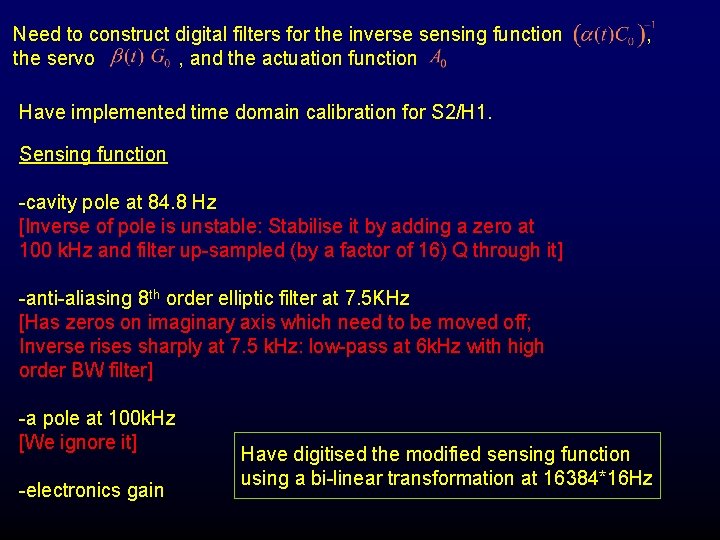
Need to construct digital filters for the inverse sensing function the servo , and the actuation function , Have implemented time domain calibration for S 2/H 1. Sensing function -cavity pole at 84. 8 Hz [Inverse of pole is unstable: Stabilise it by adding a zero at 100 k. Hz and filter up-sampled (by a factor of 16) Q through it] -anti-aliasing 8 th order elliptic filter at 7. 5 KHz [Has zeros on imaginary axis which need to be moved off; Inverse rises sharply at 7. 5 k. Hz: low-pass at 6 k. Hz with high order BW filter] -a pole at 100 k. Hz [We ignore it] -electronics gain Have digitised the modified sensing function using a bi-linear transformation at 16384*16 Hz
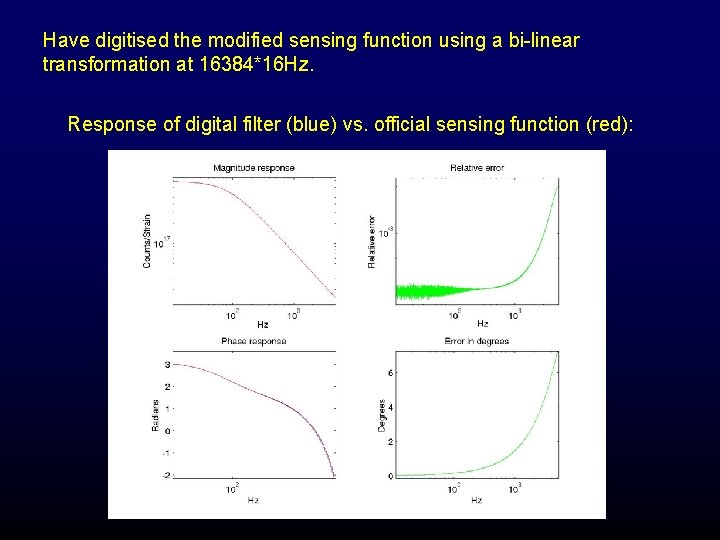
Have digitised the modified sensing function using a bi-linear transformation at 16384*16 Hz. Response of digital filter (blue) vs. official sensing function (red):
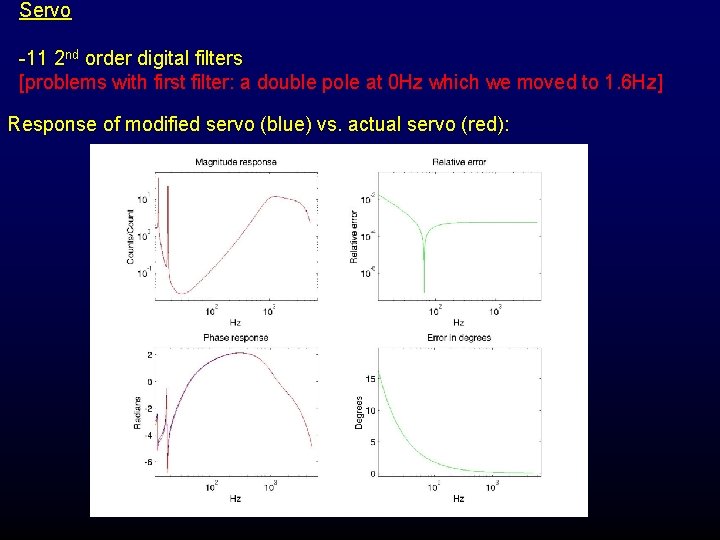
Servo -11 2 nd order digital filters [problems with first filter: a double pole at 0 Hz which we moved to 1. 6 Hz] Response of modified servo (blue) vs. actual servo (red):
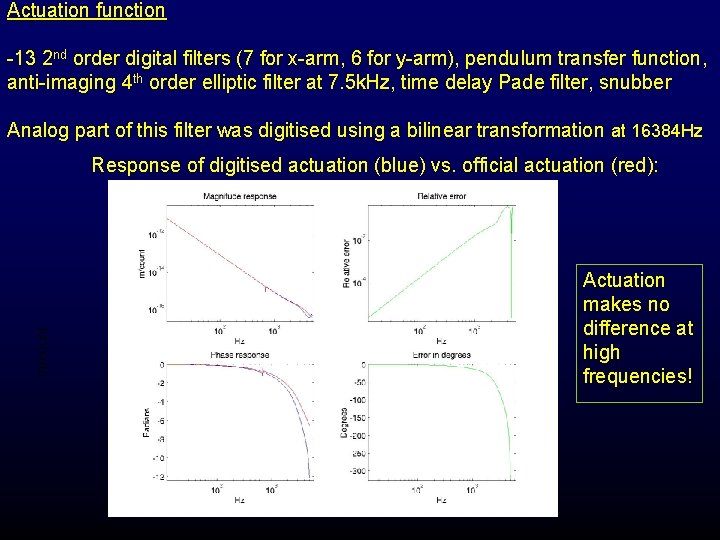
Actuation function -13 2 nd order digital filters (7 for x-arm, 6 for y-arm), pendulum transfer function, anti-imaging 4 th order elliptic filter at 7. 5 k. Hz, time delay Pade filter, snubber Analog part of this filter was digitised using a bilinear transformation at 16384 Hz Response of digitised actuation (blue) vs. official actuation (red): m/count Actuation makes no difference at high frequencies! Hz

Signal Processing Pipeline:
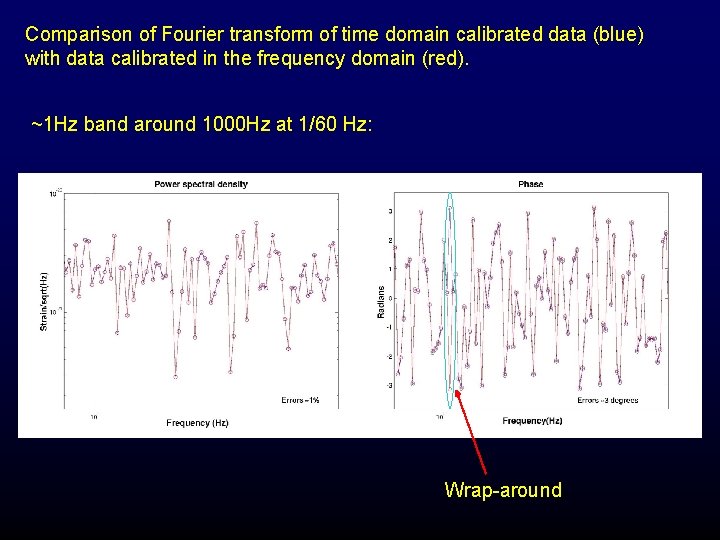
Comparison of Fourier transform of time domain calibrated data (blue) with data calibrated in the frequency domain (red). ~1 Hz band around 1000 Hz at 1/60 Hz: Wrap-around
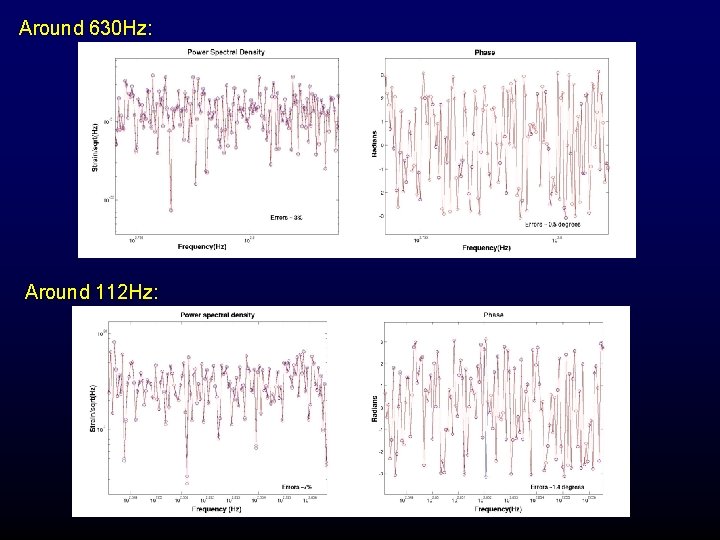
Around 630 Hz: Around 112 Hz:
Conclusions -All elements of pipeline are in place -Code has been parallelized (under condor) and full S 2/H 1 dataset is calibrated on Medusa (UWM) in a few hours. The output is 16 s frames. -Still need filters for H 2 and L 1. -Will keep working on filter and pipeline optimization.
- Slides: 11