
Calibration for the ZeroDegree Calorimeter ZDC 2 pairs

Calibration for the Zero-Degree Calorimeter (ZDC) • 2 pairs of hadronic calorimeters (ZN, ZP) @ 116 m from IP ZP • 1 (small) e. m. calorimeter (ZEM) in front of the compensator dipole of the dimuon arm ZN ZEM ALICE • Dipole to compensate the field of the dimuon arm dipole • Quadrupole triplet to focalize ion beams 116 m • Dipole to separate beams
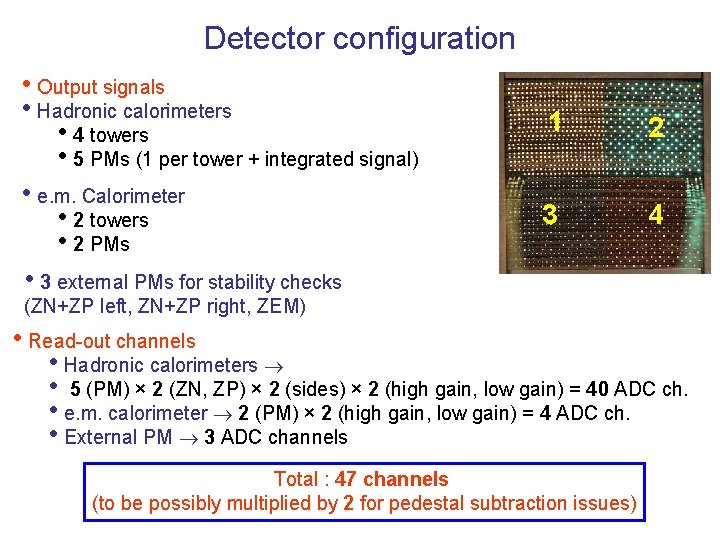
Detector configuration • Output signals • Hadronic calorimeters • 4 towers • 5 PMs (1 per tower + integrated signal) • e. m. Calorimeter • 2 towers • 2 PMs • 3 external PMs for stability checks 1 2 3 4 (ZN+ZP left, ZN+ZP right, ZEM) • Read-out channels • Hadronic calorimeters • 5 (PM) × 2 (ZN, ZP) × 2 (sides) × 2 (high gain, low gain) = 40 ADC ch. • e. m. calorimeter 2 (PM) × 2 (high gain, low gain) = 4 ADC ch. • External PM 3 ADC channels Total : 47 channels (to be possibly multiplied by 2 for pedestal subtraction issues)
Objects needed for calibration • Should contain the info needed for: • Pedestal subtraction • Energy calibration • Hint: • Hardware is very similar to the one installed for the NA 50/NA 60 experiments • NA 60 uses a quasi-Ali. Root framework (NA 60 Root) • Start from the existing Na. ZDCCalib class • Make it compliant with the rules that will be defined for ALICE offline calibration classes Size of the calibration (alignment) object should be small (of the order of some KBytes) ZDCs of

Source of calibration objects • For pedestal subtraction: • We surely need short runs with generator trigger • Rate: 1 per LHC fill could be enough • It might be useful to have generator trigger events inside normal data taking runs (at very low rate) • For alignment issues: • The ZDC can move in the vertical axis • Short position scanning at each LHC fill, to compensate for small deviations of the closed orbit • Record on the calibration/alignment class the position of the detector
Update and access frequency • One calibration object (normally written only once) per physics run • At least one per LHC fill • The calibration object should be read-out at the beginning of the reconstruction of each run • The acquired information is used to calculate the pedestals and to apply the energy calibration parameters event by event
External DB dependencies • Probably we can make use of the info: • on the general run conditions • on the values of the various currents in the beam line (from IP down to the ZDC) Abnormal values of these quantities may lead to a rejection of the whole run for what concerns the ZDC • Depending on the duration of the run, it might be useful to access these quantities, during the reconstruction, several times per run
- Slides: 7