
Calibration Corner Best Practices in Ensuring Consistent Call
Calibration Corner Best Practices in Ensuring Consistent Call Quality Measures
Who has a Quality Assurance Program implemented at their agency?
Who has a Calibration Process implemented at their agency?
The Benefits of CALIBRATION l What is Calibration? l l l The act of marking or gauging against a standard scale of measurement Correlate the readings (of measurement) with those of a standard in order to check accuracy To adjust; taking in external factors into account or to allow comparison to other data
Why Calibrate? l l l Develops Consistency for QA in Listening & Scoring Calls Multi Department Involvement Provides Perspective Creates Transparency Sets Goals & Expectations Promotes Growth for Caller Experience

FAMILY FEUD What are Benefits to a Calibration Session? 1. ) 2. ) Sets Goals & Expectations Multi-Department Involvement 3. ) Creates Transparency 4. ) Provides Perspective TIME TO PASS SCORE Try Again
The Roadmap
Front Line Staff & Caller l How does it help the overall call? l l How does it assist the I&R Specialist in completing a call? l l l Creates a roadmap for both I&R Specialist and Caller Provides key elements to better understand the callers needs and provide appropriate referrals Opens up room for growth by providing a level of standard and a tool to measure against How does it improve the caller experience? l Clarifies the callers needs and provides consistent information on how to access services.
Steps to Setting Up the Calibration Process… 1. Participation l Resource, I&R Specialist, Program Managers, etc… 2. Parameters & Frequency l l Number of Calls How often Do You Want to Calibrate Trends and Areas for Training Select Variety of Calls (good call, call that needs improvement) 3. Facilitators Rotation l Discussion l Calibration Report 4. Calibration Calls Excluded from Overall QA Score l
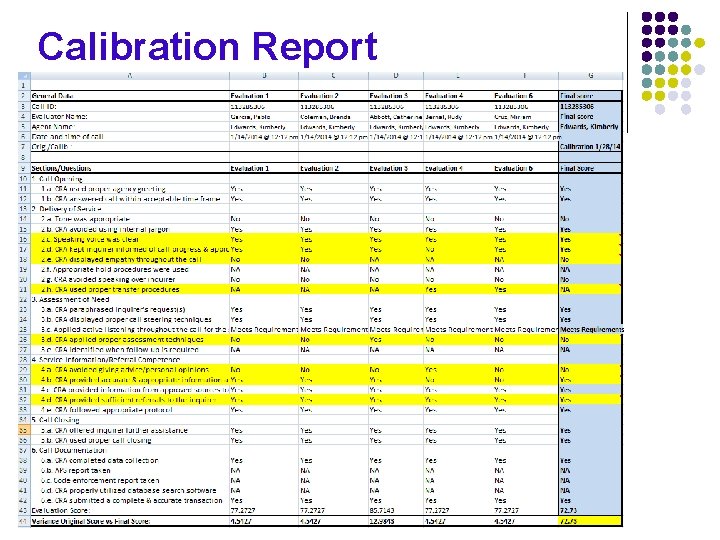
Calibration Report
Mini Calibration Session l l Let’s Listen to the Elements of a Call Together Please score as we go along…

Call #1
Call #2 (Part 1)
Call #2 (Part 2)
Call #2 (Part 3)
Let’s Calibrate!!
How Did You Score vs QA Score? l Go over each element l l l Show of hands on who scored how Discuss elements where there is variance Allow explanation of why scored that way
& Wrap Up l Things to Consider l l Establishing Protocol Standard of Deviation Establishing accountability Growth through Coaching
• Testimonials What do they have to say?
Myieko Clayton, I&R Specialist “After calibration I felt a sense of empowerment… I received great feedback. Making a mistake isn't always a bad thing, just an advantage to use it as a learning tool. It helped me work on areas that I didn’t know I needed work on. It was an eye opener. ”
Denise Friedman, I&R Specialist “I was struggling with certain elements of QA, attending calibration allowed me to ask questions directly to those who were scoring my calls. I was able to understand my scores and the elements I struggled with. Calibration has helped me increase my scores and stay consistent. ””
Carol Larson, I&R Specialist “It helped me in my own job performance. I was able to see how exactly how calls are evaluated… hearing co-workers calls gave me ideas on my own language and call handling. There is no downside to including CRAs in the process. ”
Albertine Gutierrez, I&R Specialist “I didn’t know what to expect. The process was more detailed and involved that I thought it would be. I really got insight as to what QA is actively working on in terms of the scoring process. I got exposure as to how each person can hear a call differently”
Debbie Ortiz, I&R Specialist “I was a little overwhelmed at first because I was reminded of all the aspects of QA…it made me reevaluate the way I handle calls. I knew I was making mistakes, my QA score reflected it… I didn’t know what those mistakes were. The calibration helped me define them”

Pablo & Denise 211 Los Angeles County
- Slides: 26