
Calibration and Monitoring of the CMS Strip Tracker
Calibration and Monitoring of the CMS Strip Tracker Detector • Introduction • Tracker Layout • Low Level Reconstruction • Data Quality Monitoring & Calibration Workflows • Calibration procedures • with results from the Slice Test • Conclusions D. Giordano INFN &Università degli studi di Bari on behalf of the CMS Tracker Collaboration 17 th International Workshop on Vertex detectors August 1 st 2008 , Utö, Stockholm, SWEDEN
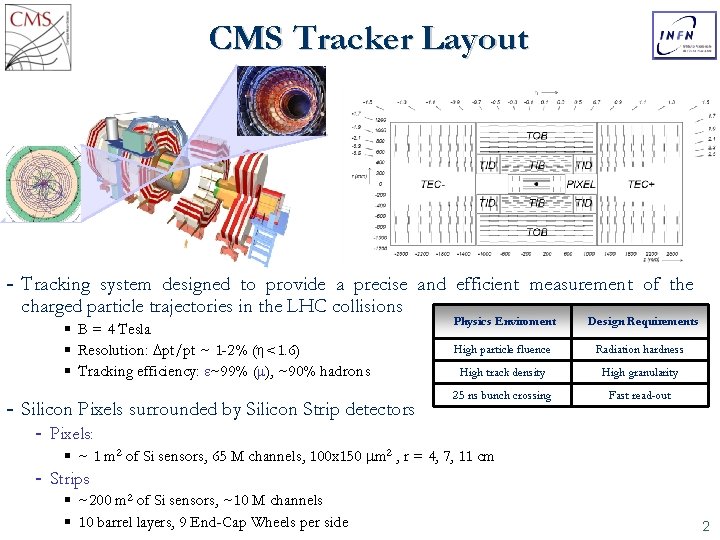
CMS Tracker Layout Tracking system designed to provide a precise and efficient measurement of the charged particle trajectories in the LHC collisions § B = 4 Tesla § Resolution: Dpt/pt ~ 1 -2% ( <1. 6) § Tracking efficiency: e~99% (m), ~90% hadrons Silicon Pixels surrounded by Silicon Strip detectors Physics Enviroment Design Requirements High particle fluence Radiation hardness High track density High granularity 25 ns bunch crossing Fast read-out Pixels: § ~ 1 m 2 of Si sensors, 65 M channels, 100 x 150 mm 2 , r = 4, 7, 11 cm Strips § ~200 m 2 of Si sensors, ~10 M channels § 10 barrel layers, 9 End-Cap Wheels per side 2
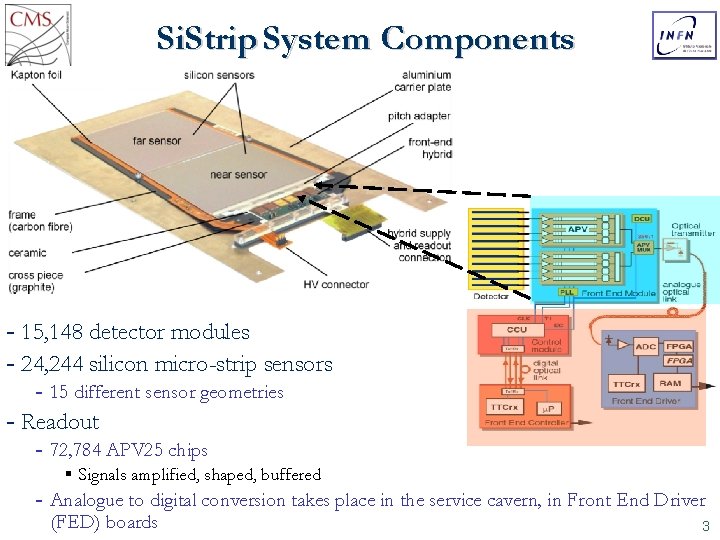
Si. Strip System Components 15, 148 detector modules 24, 244 silicon micro-strip sensors 15 different sensor geometries Readout 72, 784 APV 25 chips § Signals amplified, shaped, buffered Analogue to digital conversion takes place in the service cavern, in Front End Driver (FED) boards 3
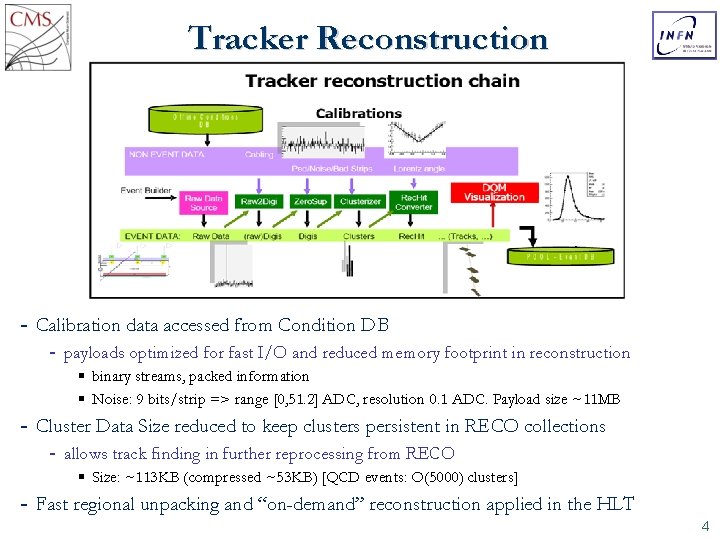
Tracker Reconstruction Calibration data accessed from Condition DB payloads optimized for fast I/O and reduced memory footprint in reconstruction § binary streams, packed information § Noise: 9 bits/strip => range [0, 51. 2] ADC, resolution 0. 1 ADC. Payload size ~11 MB Cluster Data Size reduced to keep clusters persistent in RECO collections allows track finding in further reprocessing from RECO § Size: ~113 KB (compressed ~53 KB) [QCD events: O(5000) clusters] Fast regional unpacking and “on-demand” reconstruction applied in the HLT 4
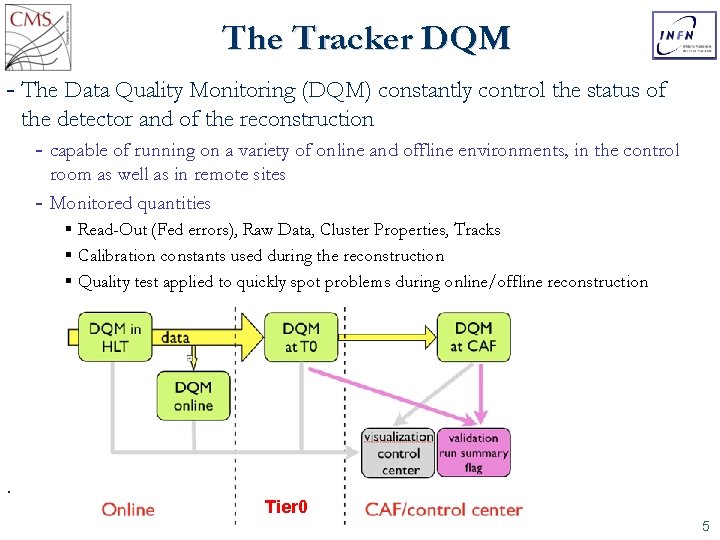
The Tracker DQM The Data Quality Monitoring (DQM) constantly control the status of the detector and of the reconstruction capable of running on a variety of online and offline environments, in the control room as well as in remote sites Monitored quantities § Read-Out (Fed errors), Raw Data, Cluster Properties, Tracks § Calibration constants used during the reconstruction § Quality test applied to quickly spot problems during online/offline reconstruction . Tier 0 5
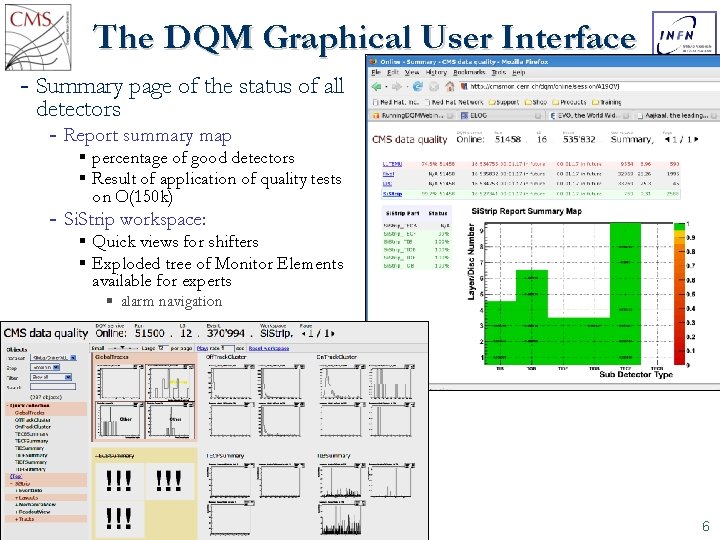
The DQM Graphical User Interface Summary page of the status of all detectors Report summary map § percentage of good detectors § Result of application of quality tests on O(150 k) Si. Strip workspace: § Quick views for shifters § Exploded tree of Monitor Elements available for experts § alarm navigation . 6
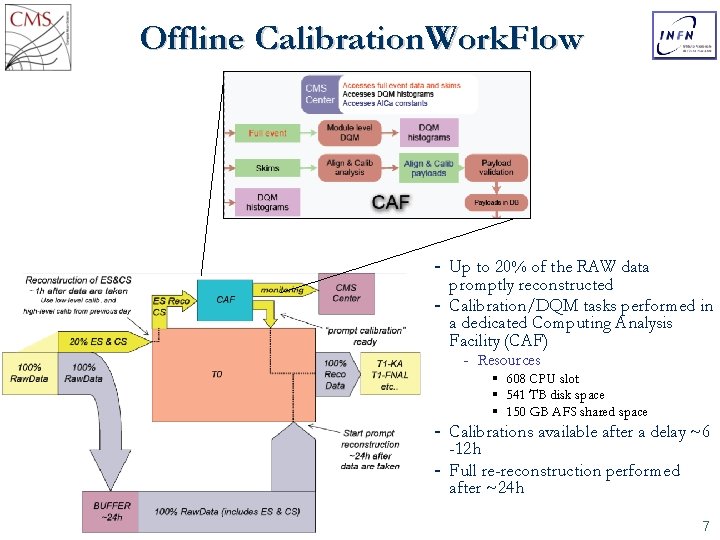
Offline Calibration. Work. Flow Up to 20% of the RAW data promptly reconstructed Calibration/DQM tasks performed in a dedicated Computing Analysis Facility (CAF) Resources § 608 CPU slot § 541 TB disk space § 150 GB AFS shared space Calibrations available after a delay ~6 -12 h Full re-reconstruction performed after ~24 h 7
Si. Strip Tracker Calibration Procedures & Results based on the most recent tests 8
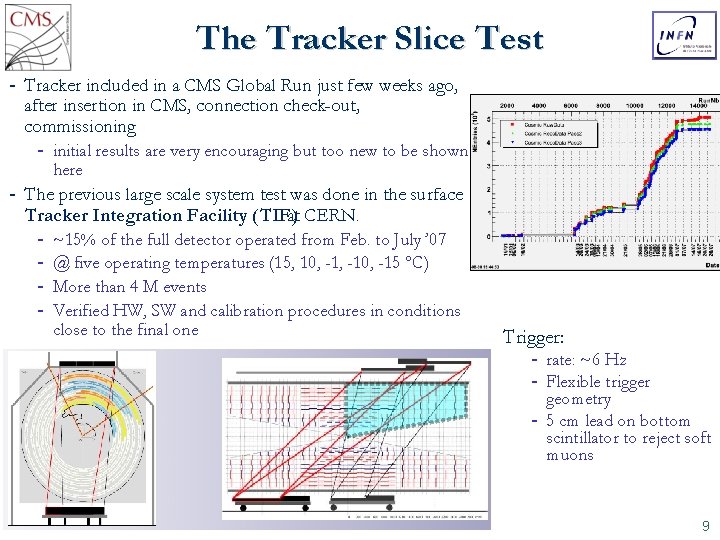
The Tracker Slice Test Tracker included in a CMS Global Run just few weeks ago, after insertion in CMS, connection check-out, commissioning initial results are very encouraging but too new to be shown here The previous large scale system test was done in the surface Tracker Integration Facility (TIF) at CERN. ~15% of the full detector operated from Feb. to July ’ 07 @ five operating temperatures (15, 10, -10, -15 °C) More than 4 M events Verified HW, SW and calibration procedures in conditions close to the final one Trigger: rate: ~6 Hz Flexible trigger geometry 5 cm lead on bottom scintillator to reject soft muons . 9
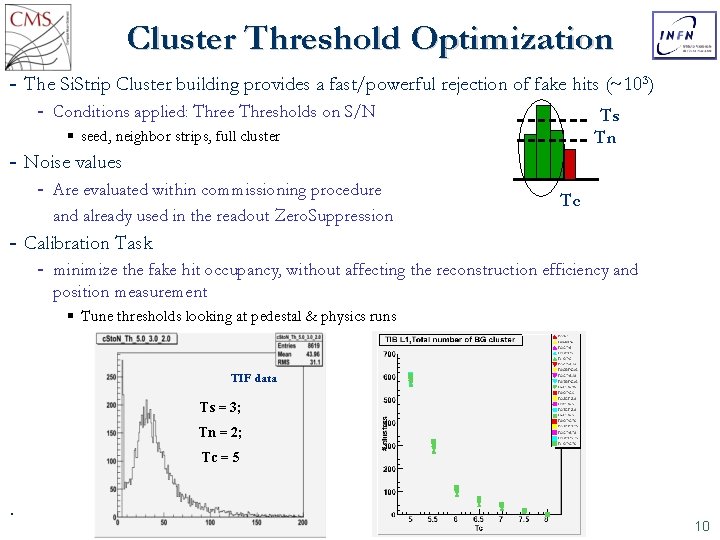
Cluster Threshold Optimization The Si. Strip Cluster building provides a fast/powerful rejection of fake hits (~103) Conditions applied: Three Thresholds on S/N Ts Tn § seed, neighbor strips, full cluster Noise values Are evaluated within commissioning procedure and already used in the readout Zero. Suppression Tc Calibration Task minimize the fake hit occupancy, without affecting the reconstruction efficiency and position measurement § Tune thresholds looking at pedestal & physics runs TIF data Ts = 3; Tn = 2; Tc = 5 . 10
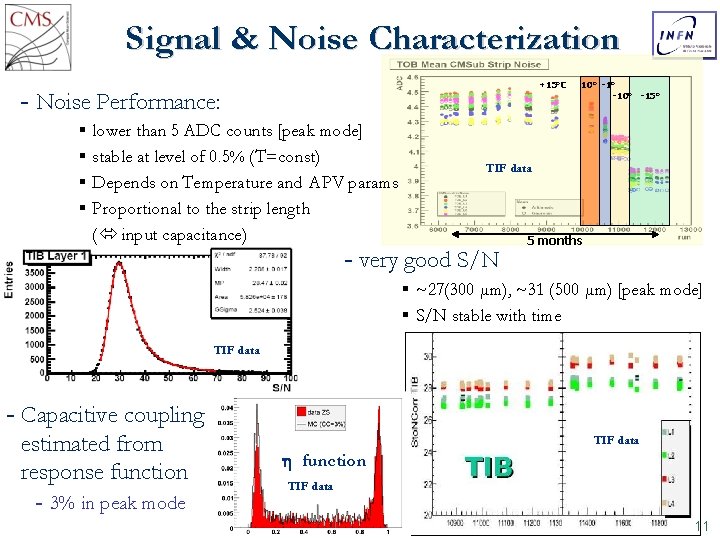
Signal & Noise Characterization +15°C Noise Performance: § § lower than 5 ADC counts [peak mode] stable at level of 0. 5% (T=const) Depends on Temperature and APV params Proportional to the strip length ( input capacitance) 10° -10° -15° TIF data very good S/N 5 months § ~27(300 µm), ~31 (500 µm) [peak mode] § S/N stable with time TIF data Capacitive coupling estimated from response function 3% in peak mode TIF data h function TIF data 11
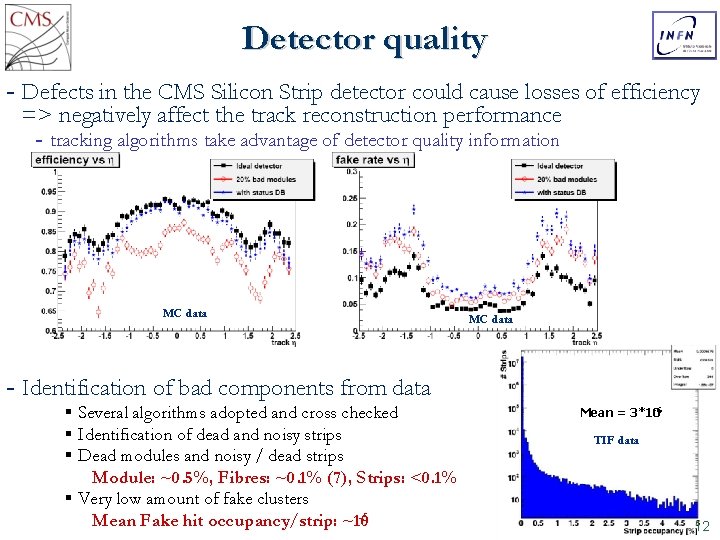
Detector quality Defects in the CMS Silicon Strip detector could cause losses of efficiency => negatively affect the track reconstruction performance tracking algorithms take advantage of detector quality information MC data Identification of bad components from data § Several algorithms adopted and cross checked § Identification of dead and noisy strips § Dead modules and noisy / dead strips Module: ~0. 5%, Fibres: ~0. 1% (7), Strips: <0. 1% § Very low amount of fake clusters -5 Mean Fake hit occupancy/strip: ~10 -6 Mean = 3*10 TIF data 12
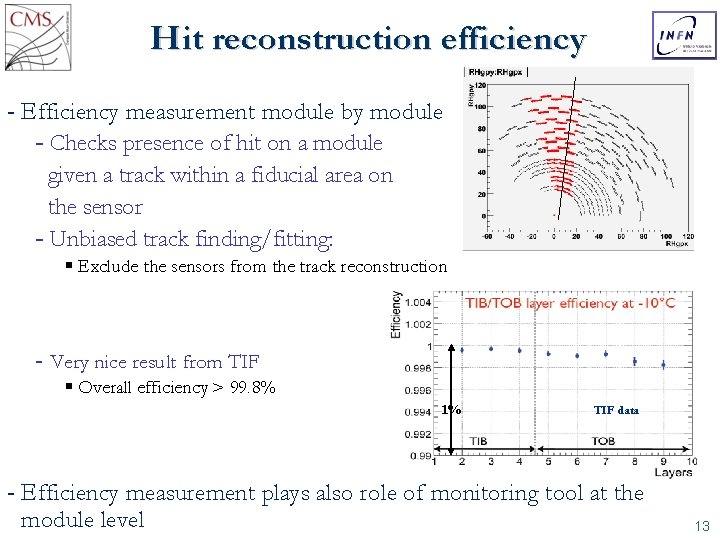
Hit reconstruction efficiency Efficiency measurement module by module Checks presence of hit on a module given a track within a fiducial area on the sensor Unbiased track finding/fitting: § Exclude the sensors from the track reconstruction Very nice result from TIF § Overall efficiency > 99. 8% 1% TIF data Efficiency measurement plays also role of monitoring tool at the module level 13
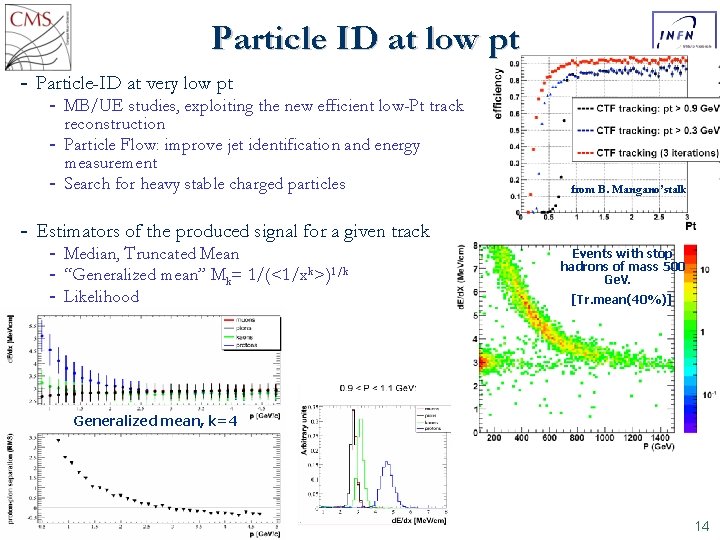
Particle ID at low pt Particle-ID at very low pt MB/UE studies, exploiting the new efficient low-Pt track reconstruction Particle Flow: improve jet identification and energy measurement Search for heavy stable charged particles from B. Mangano’stalk Estimators of the produced signal for a given track Median, Truncated Mean “Generalized mean” Mk= 1/(<1/xk>)1/k Likelihood Events with stop hadrons of mass 500 Ge. V. [Tr. mean(40%)] Generalized mean, k=4 . 14
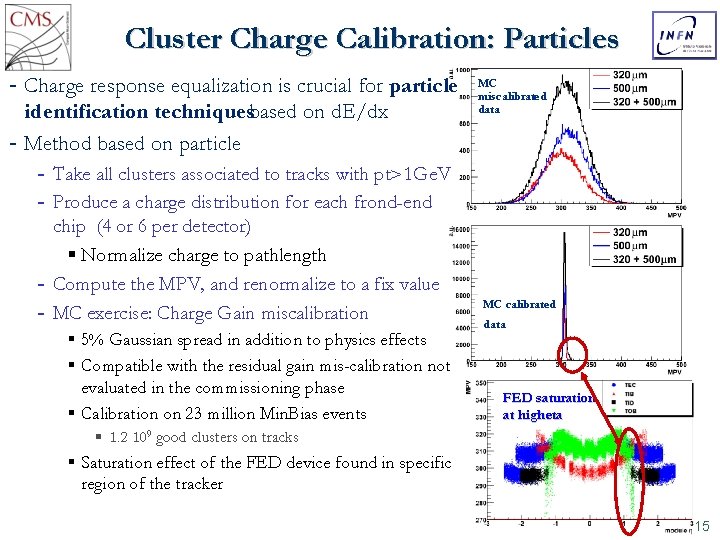
Cluster Charge Calibration: Particles Charge response equalization is crucial for particle identification techniquesbased on d. E/dx Method based on particle Take all clusters associated to tracks with pt>1 Ge. V Produce a charge distribution for each frond-end chip (4 or 6 per detector) § Normalize charge to pathlength Compute the MPV, and renormalize to a fix value MC exercise: Charge Gain miscalibration § 5% Gaussian spread in addition to physics effects § Compatible with the residual gain mis-calibration not evaluated in the commissioning phase § Calibration on 23 million Min. Bias events MC miscalibrated data MC calibrated data FED saturation at high eta § 1. 2 109 good clusters on tracks § Saturation effect of the FED device found in specific region of the tracker 15
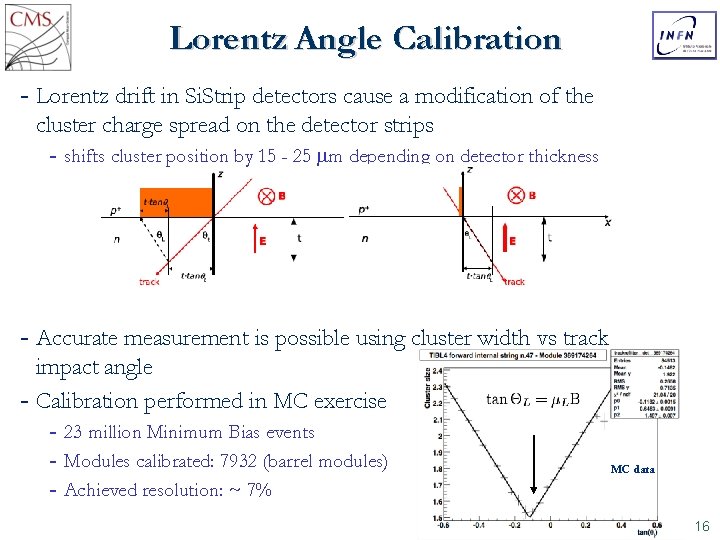
Lorentz Angle Calibration Lorentz drift in Si. Strip detectors cause a modification of the cluster charge spread on the detector strips shifts cluster position by 15 - 25 mm depending on detector thickness Accurate measurement is possible using cluster width vs track impact angle Calibration performed in MC exercise 23 million Minimum Bias events Modules calibrated: 7932 (barrel modules) Achieved resolution: ~ 7% MC data 16
Conclusions Due to the very high Strip Tracker granularity (~10 M channels, ~15 k module) the Calibration and DQM tasks are challenging aspects of the CMS Tracker operation Cope with the timing and memory constraint Crucial for Online operation Several calibrations performed at low level reconstruction to take into account of the physics/electronics effects These calibrations represent also the first, prompt analyses to control the detector performances Intensive testing/development cycles of the Calibration and DQM systems performed during the last year Effort to include all the calibration tasks in the DQM framework, and gain in versatility and modularity 17
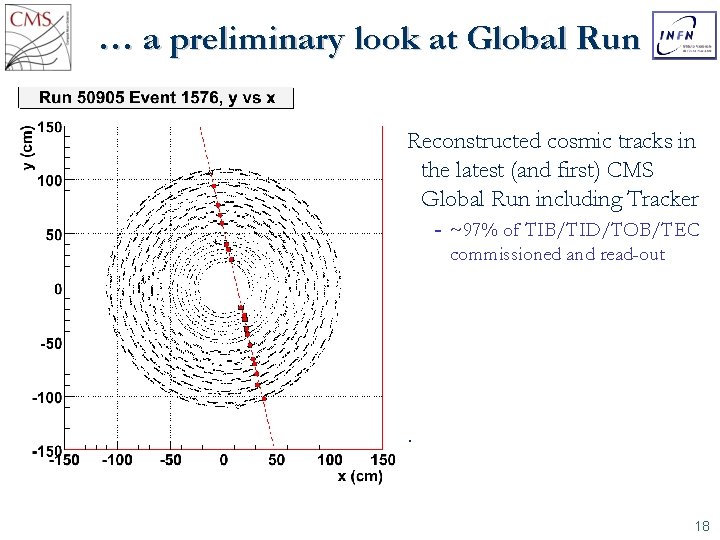
… a preliminary look at Global Run Reconstructed cosmic tracks in the latest (and first) CMS Global Run including Tracker ~97% of TIB/TID/TOB/TEC commissioned and read-out . 18
Backup 19
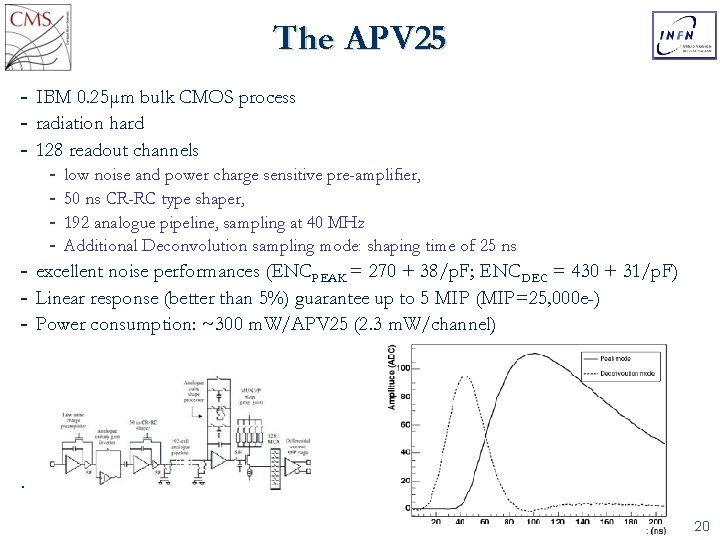
The APV 25 IBM 0. 25μm bulk CMOS process radiation hard 128 readout channels low noise and power charge sensitive pre-amplifier, 50 ns CR-RC type shaper, 192 analogue pipeline, sampling at 40 MHz Additional Deconvolution sampling mode: shaping time of 25 ns excellent noise performances (ENCPEAK = 270 + 38/p. F; ENCDEC = 430 + 31/p. F) Linear response (better than 5%) guarantee up to 5 MIP (MIP=25, 000 e-) Power consumption: ~300 m. W/APV 25 (2. 3 m. W/channel) . 20
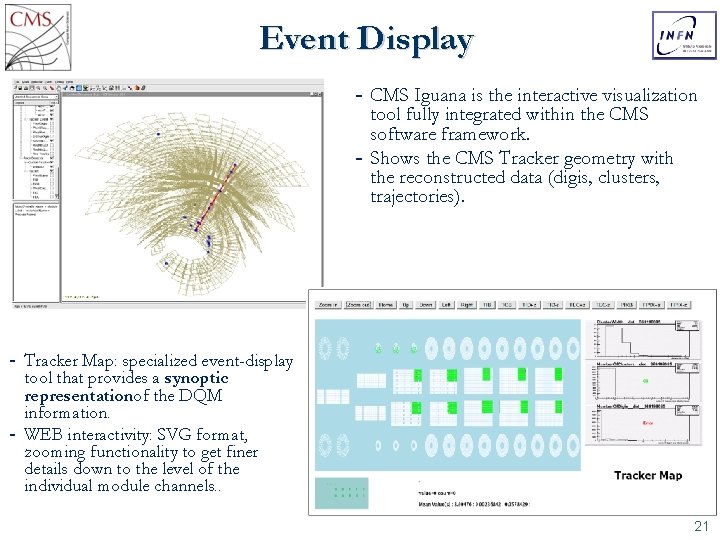
Event Display CMS Iguana is the interactive visualization tool fully integrated within the CMS software framework. Shows the CMS Tracker geometry with the reconstructed data (digis, clusters, trajectories). Tracker Map: specialized event-display tool that provides a synoptic representationof the DQM information. WEB interactivity: SVG format, zooming functionality to get finer details down to the level of the individual module channels. . 21
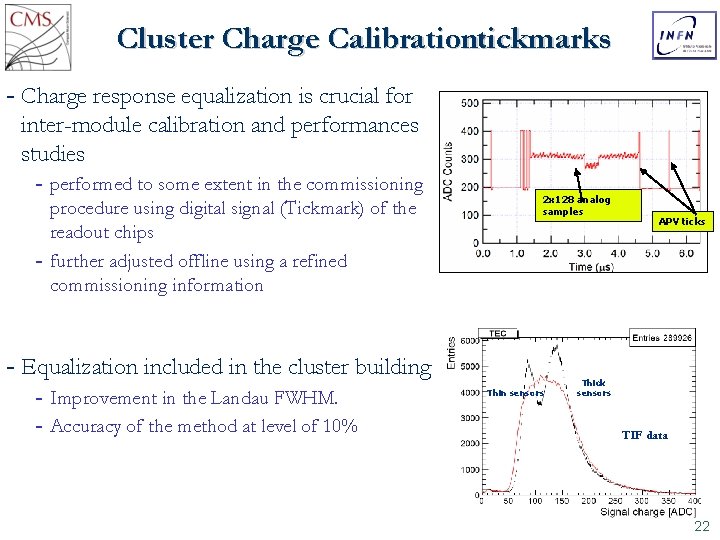
Cluster Charge Calibration: tickmarks Charge response equalization is crucial for inter-module calibration and performances studies performed to some extent in the commissioning procedure using digital signal (Tickmark) of the readout chips further adjusted offline using a refined commissioning information 2 x 128 analog samples Equalization included in the cluster building Improvement in the Landau FWHM. Accuracy of the method at level of 10% Thin sensors APV ticks Thick sensors TIF data 22
- Slides: 22