
Calibration and alignment database development Dmitry Romanov Overall
Calibration and alignment database development Dmitry Romanov

Overall design Interfaces WEB PHP Console Tools JANA and C++ Users Python USERS Calib. DB API C++ Python API My. SQL Provider File DB Provider My SQL Server Local DB File

My. SQL C API Usage MYSQL *conn; Connection handler MYSQL_RES *res; Resource handler MYSQL_ROW row; Row structure

My. SQL C API Advantages of using My. SQL C API � Pure API, not bloated by any wrappers. Disadvantages � May change from version to version of My. SQL � “Heavy” wrapping is needed to build desired architecture. � It is only for My. Sql. � Tricky functions � Not a thread safe

Root DB Framework TSQLServer TMy. SQLServer TPg. SQLServer TOracle. Server TSap. DBServer TODBCServer TSQLServer may accept connection string: <dbms>: //<host>[: <port>][/<database>] Depending on the <dbms> a static function Connect() will use an appropriate plugin which will provide the real interface. TSQLServer *db = TSQLServer: : Connect("mysql: //localhost/test", “login", “pwd"); Actual (dynamic) type will be TMy. Sql. Server * Base classes TSQLColumn. Info - Information about column from SQL table TSQLResult - SQL query result TSQLRow - One row of an SQL query result TSQLServer - Connection to SQL server TSQLStatement - SQL statement TMy. SQLResult TSQLStatement – provides bufferised IO and some DB unification. TPgre. Result T…Result

Root DB framework examples TSQLServer *db = TSQLServer: : Connect("mysql: //localhost/test", "nobody", ""); res = db->Get. Tables("test"); //List all tables in database "test" res = db->Query("select count(*) from test”); //Query Int rows = res->Get. Row. Count(); //Get rows number Int flds = res->Get. Field. Count(); //Get rows count while ((row = res->Next())) { row->Get. Field(0)); } //Get Data row by row delete res; //Release resources delete db; //Close connection
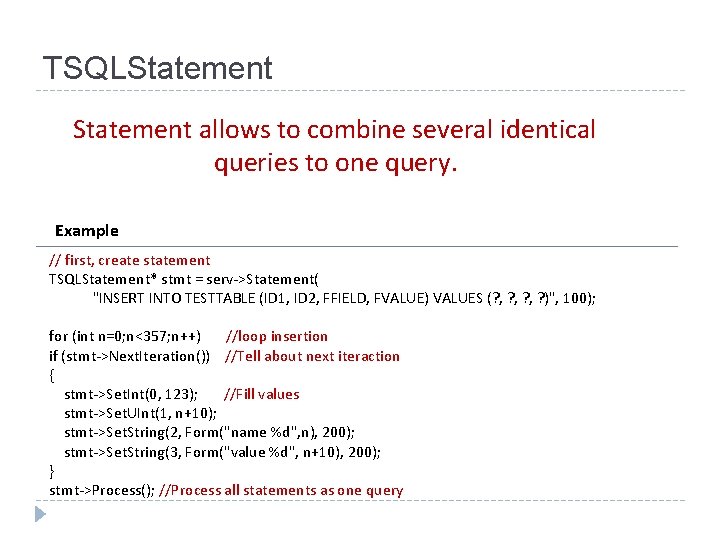
TSQLStatement allows to combine several identical queries to one query. Example // first, create statement TSQLStatement* stmt = serv->Statement( "INSERT INTO TESTTABLE (ID 1, ID 2, FFIELD, FVALUE) VALUES (? , ? , ? )", 100); for (int n=0; n<357; n++) //loop insertion if (stmt->Next. Iteration()) //Tell about next iteraction { stmt->Set. Int(0, 123); //Fill values stmt->Set. UInt(1, n+10); stmt->Set. String(2, Form("name %d", n), 200); stmt->Set. String(3, Form("value %d", n+10), 200); } stmt->Process(); //Process all statements as one query
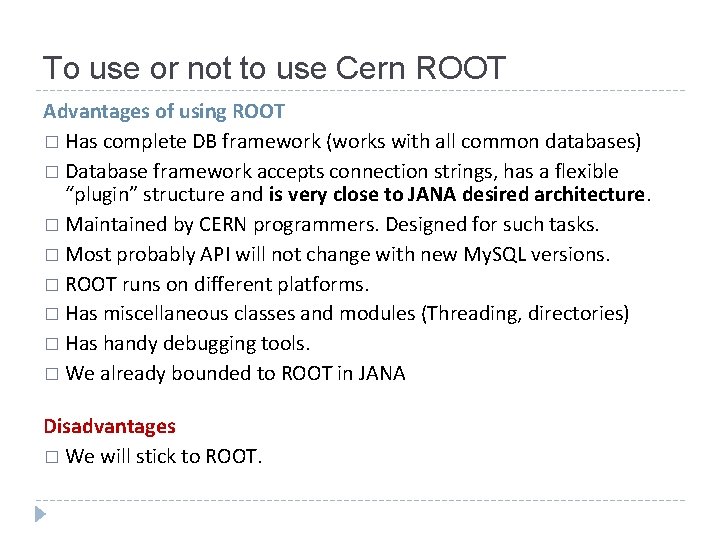
To use or not to use Cern ROOT Advantages of using ROOT � Has complete DB framework (works with all common databases) � Database framework accepts connection strings, has a flexible “plugin” structure and is very close to JANA desired architecture. � Maintained by CERN programmers. Designed for such tasks. � Most probably API will not change with new My. SQL versions. � ROOT runs on different platforms. � Has miscellaneous classes and modules (Threading, directories) � Has handy debugging tools. � We already bounded to ROOT in JANA Disadvantages � We will stick to ROOT.
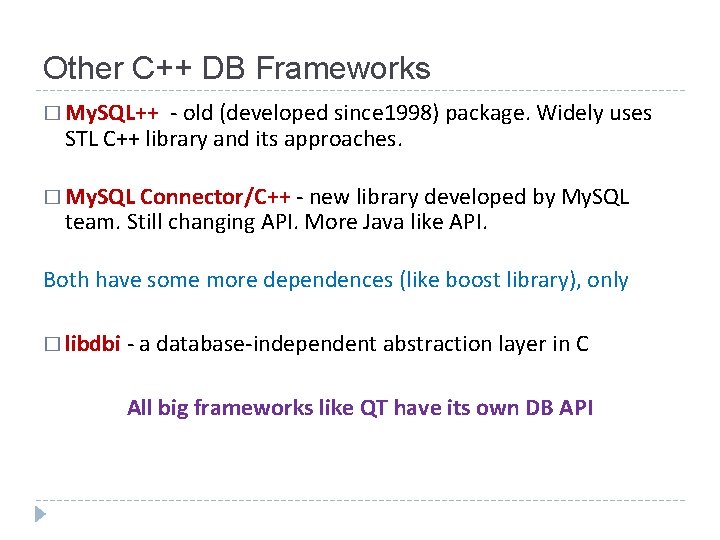
Other C++ DB Frameworks � My. SQL++ - old (developed since 1998) package. Widely uses STL C++ library and its approaches. � My. SQL Connector/C++ - new library developed by My. SQL team. Still changing API. More Java like API. Both have some more dependences (like boost library), only � libdbi - a database-independent abstraction layer in C All big frameworks like QT have its own DB API
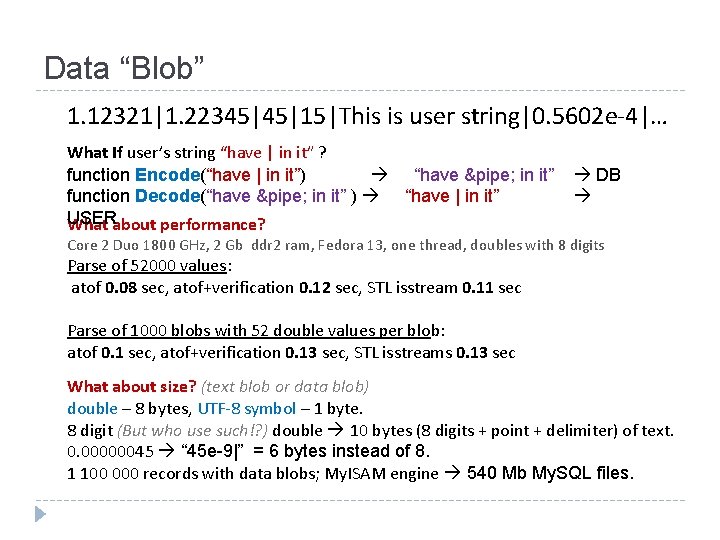
Data “Blob” 1. 12321|1. 22345|45|15|This is user string|0. 5602 e-4|… What If user’s string “have | in it” ? function Encode(“have | in it”) “have &pipe; in it” function Decode(“have &pipe; in it” ) “have | in it” USER What about performance? DB Core 2 Duo 1800 GHz, 2 Gb ddr 2 ram, Fedora 13, one thread, doubles with 8 digits Parse of 52000 values: atof 0. 08 sec, atof+verification 0. 12 sec, STL isstream 0. 11 sec Parse of 1000 blobs with 52 double values per blob: atof 0. 1 sec, atof+verification 0. 13 sec, STL isstreams 0. 13 sec What about size? (text blob or data blob) double – 8 bytes, UTF-8 symbol – 1 byte. 8 digit (But who use such!? ) double 10 bytes (8 digits + point + delimiter) of text. 0. 00000045 “ 45 e-9|” = 6 bytes instead of 8. 1 100 000 records with data blobs; My. ISAM engine 540 Mb My. SQL files.
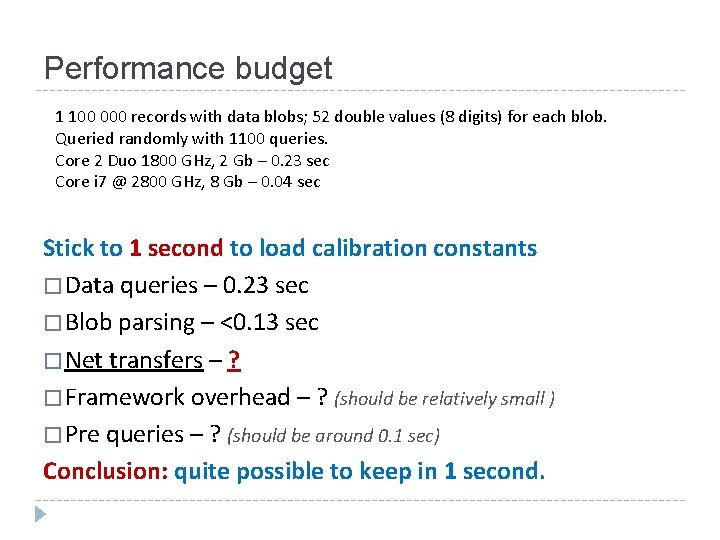
Performance budget 1 100 000 records with data blobs; 52 double values (8 digits) for each blob. Queried randomly with 1100 queries. Core 2 Duo 1800 GHz, 2 Gb – 0. 23 sec Core i 7 @ 2800 GHz, 8 Gb – 0. 04 sec Stick to 1 second to load calibration constants � Data queries – 0. 23 sec � Blob parsing – <0. 13 sec � Net transfers – ? � Framework overhead – ? (should be relatively small ) � Pre queries – ? (should be around 0. 1 sec) Conclusion: quite possible to keep in 1 second.
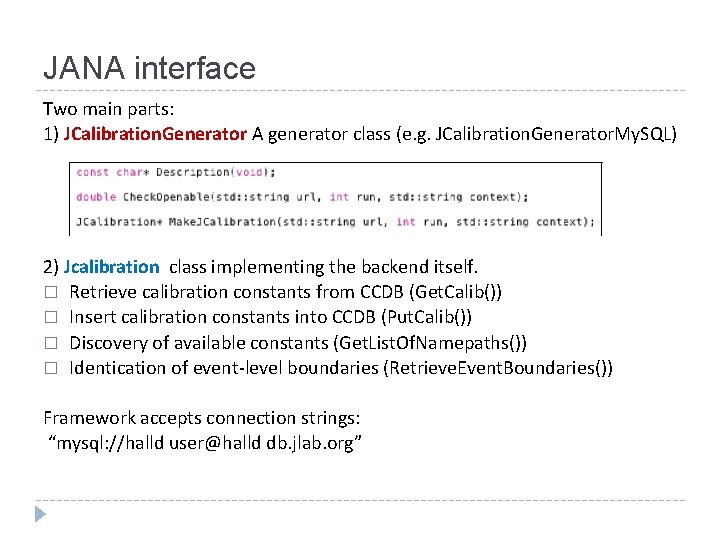
JANA interface Two main parts: 1) JCalibration. Generator A generator class (e. g. JCalibration. Generator. My. SQL) 2) Jcalibration class implementing the backend itself. � Retrieve calibration constants from CCDB (Get. Calib()) � Insert calibration constants into CCDB (Put. Calib()) � Discovery of available constants (Get. List. Of. Namepaths()) � Identication of event-level boundaries (Retrieve. Event. Boundaries()) Framework accepts connection strings: “mysql: //halld user@halld db. jlab. org”
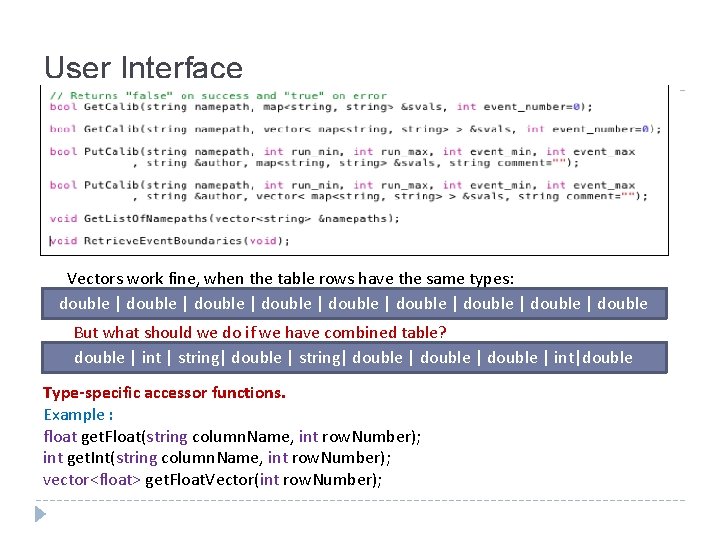
User Interface Vectors work fine, when the table rows have the same types: double | double | double But what should we do if we have combined table? double | int | string| double | int|double Type-specific accessor functions. Example : float get. Float(string column. Name, int row. Number); int get. Int(string column. Name, int row. Number); vector<float> get. Float. Vector(int row. Number);
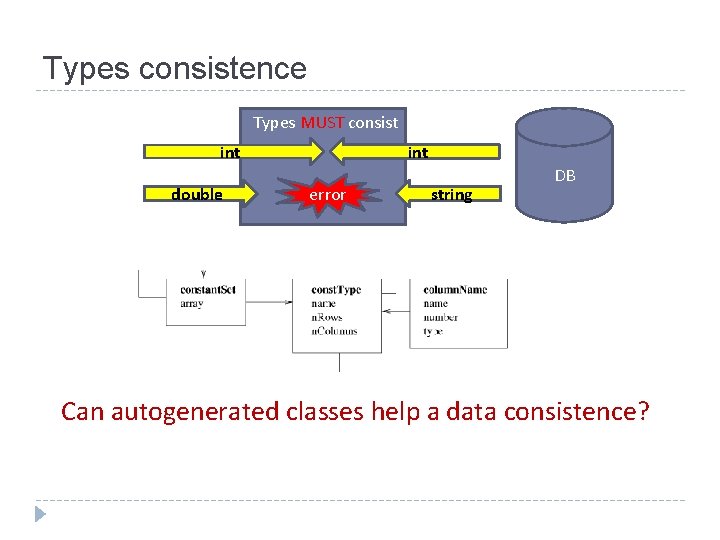
Types consistence Types MUST consist int double int error string DB Can autogenerated classes help a data consistence?
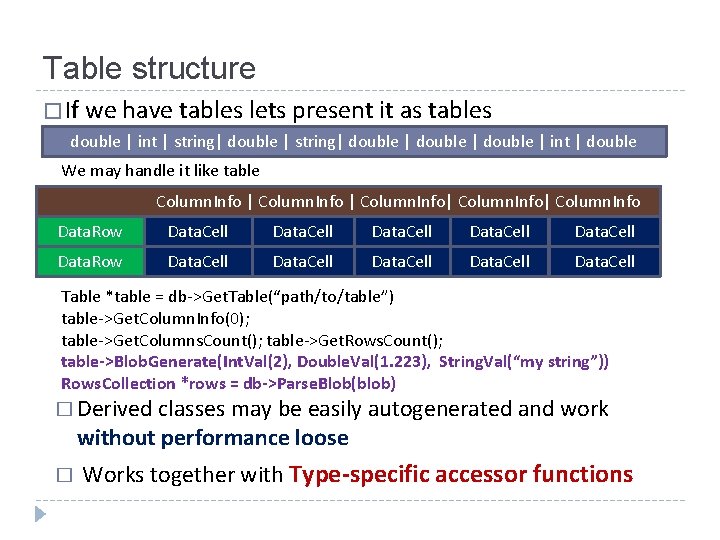
Table structure � If we have tables lets present it as tables double | int | string| double | int | double We may handle it like table Column. Info | Column. Info| Column. Info Data. Row Data. Cell Data. Cell Table *table = db->Get. Table(“path/to/table”) table->Get. Column. Info(0); table->Get. Columns. Count(); table->Get. Rows. Count(); table->Blob. Generate(Int. Val(2), Double. Val(1. 223), String. Val(“my string”)) Rows. Collection *rows = db->Parse. Blob(blob) � Derived classes may be easily autogenerated and work without performance loose � Works together with Type-specific accessor functions

DB Structure
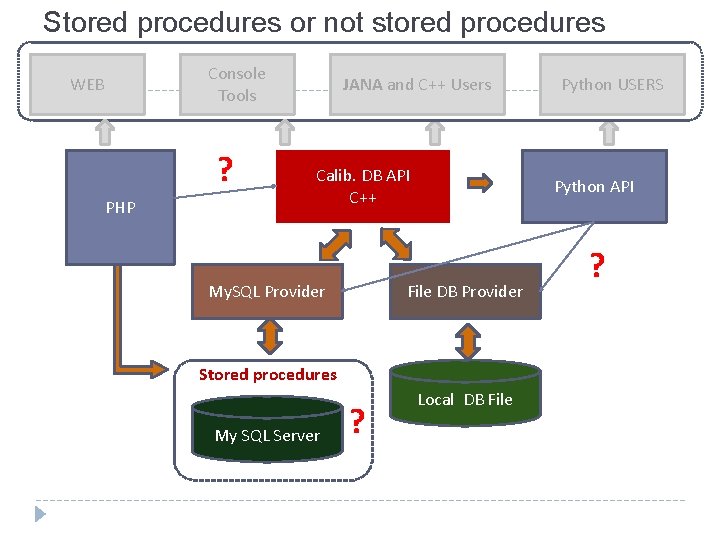
Stored procedures or not stored procedures Console Tools WEB ? PHP JANA and C++ Users Calib. DB API C++ My. SQL Provider Python API File DB Provider Stored procedures My SQL Server ? Python USERS Local DB File ?
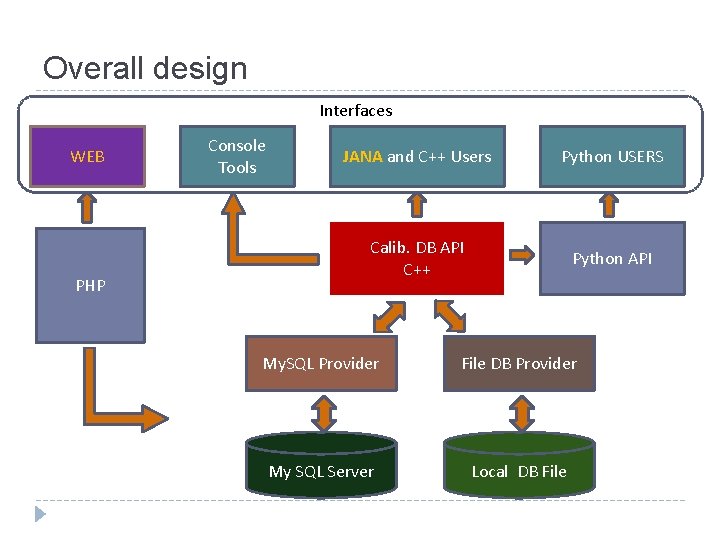
Overall design Interfaces WEB PHP Console Tools JANA and C++ Users Python USERS Calib. DB API C++ Python API My. SQL Provider File DB Provider My SQL Server Local DB File
Interaction with other languages � JANA uses CCDB C++ API � Possible C++ user may use CCDB C++ API without JANA? � Web interface uses PHP wich interacts to My. SQL (or Posgres or whatever) through queries or stored procedures. � Console interface uses CCDB C++ API. Maybe is written on Python. � Python is using CCDB C++ API. � Other possible languages may use CCDB C++ API or My. SQL Queries (or stored procedures)
- Slides: 19