
Calentamiento Mi madre a comprarme esa camisa pero
- Slides: 65
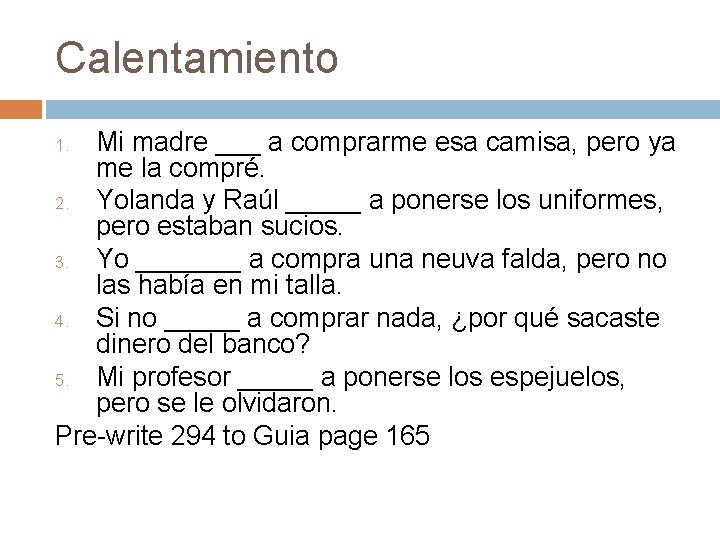
Calentamiento Mi madre ___ a comprarme esa camisa, pero ya me la compré. 2. Yolanda y Raúl _____ a ponerse los uniformes, pero estaban sucios. 3. Yo _______ a compra una neuva falda, pero no las había en mi talla. 4. Si no _____ a comprar nada, ¿por qué sacaste dinero del banco? 5. Mi profesor _____ a ponerse los espejuelos, pero se le olvidaron. Pre-write 294 to Guia page 165 1.
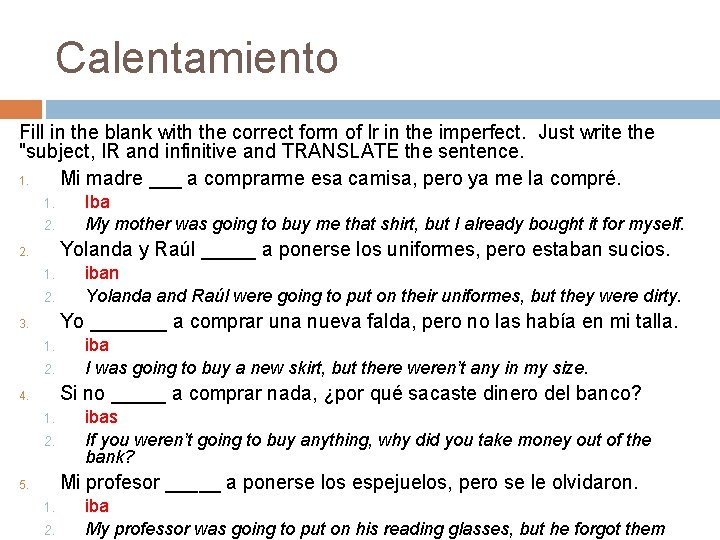
Calentamiento Fill in the blank with the correct form of Ir in the imperfect. Just write the "subject, IR and infinitive and TRANSLATE the sentence. 1. Mi madre ___ a comprarme esa camisa, pero ya me la compré. 1. 2. Iba My mother was going to buy me that shirt, but I already bought it for myself. Yolanda y Raúl _____ a ponerse los uniformes, pero estaban sucios. 2. 1. 2. iban Yolanda and Raúl were going to put on their uniformes, but they were dirty. Yo _______ a comprar una nueva falda, pero no las había en mi talla. 3. 1. 2. iba I was going to buy a new skirt, but there weren’t any in my size. Si no _____ a comprar nada, ¿por qué sacaste dinero del banco? 4. 1. 2. ibas If you weren’t going to buy anything, why did you take money out of the bank? Mi profesor _____ a ponerse los espejuelos, pero se le olvidaron. 5. 1. 2. iba My professor was going to put on his reading glasses, but he forgot them
Theme: Comparisons of Inequality Objective & Big Picture: To be able to compare two things where one is more/less than Language Objective: TSWBAT compare themselves with someone taller than them & someone shorter than them Prepare: Pre-write 294 to Guia page 165
Comparisons of Inequality (Las comparaciones de desigualdad) (More than. . . , less than. . . )
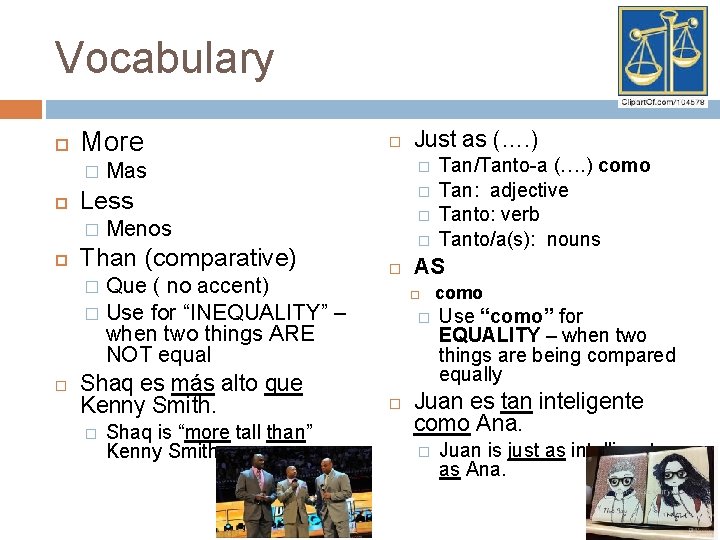
Vocabulary More � Mas � � Menos Than (comparative) Que ( no accent) � Use for “INEQUALITY” – when two things ARE NOT equal Shaq es más alto que Kenny Smith. � � � Shaq is “more tall than” Kenny Smith. Just as (…. ) � Less � AS � Tan/Tanto-a (…. ) como Tan: adjective Tanto: verb Tanto/a(s): nouns como Use “como” for EQUALITY – when two things are being compared equally Juan es tan inteligente como Ana. � Juan is just as intelligent as Ana.
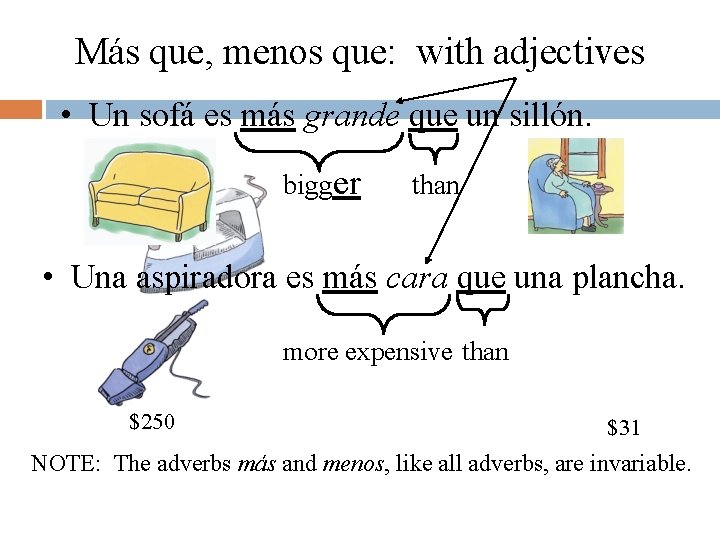
Más que, menos que: with adjectives • Un sofá es más grande que un sillón. bigger than • Una aspiradora es más cara que una plancha. more expensive than $250 $31 NOTE: The adverbs más and menos, like all adverbs, are invariable.
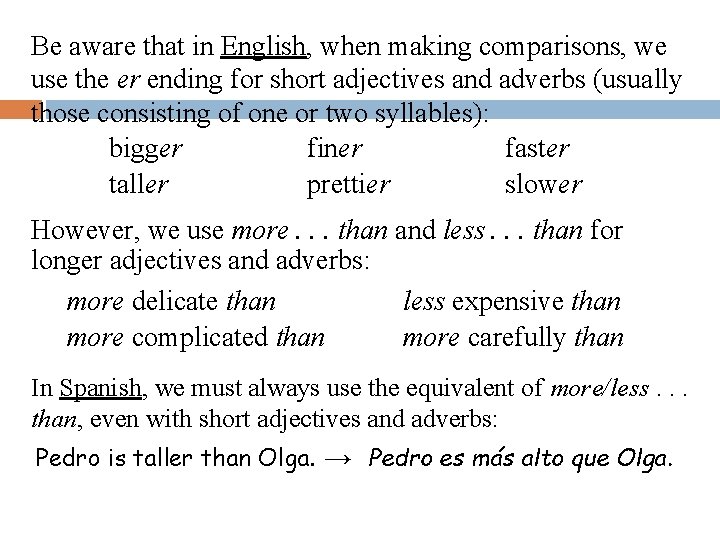
Be aware that in English, when making comparisons, we use the er ending for short adjectives and adverbs (usually those consisting of one or two syllables): bigger finer faster taller prettier slower However, we use more. . . than and less. . . than for longer adjectives and adverbs: more delicate than less expensive than more complicated than more carefully than In Spanish, we must always use the equivalent of more/less. . . than, even with short adjectives and adverbs: Pedro is taller than Olga. → Pedro es más alto que Olga.
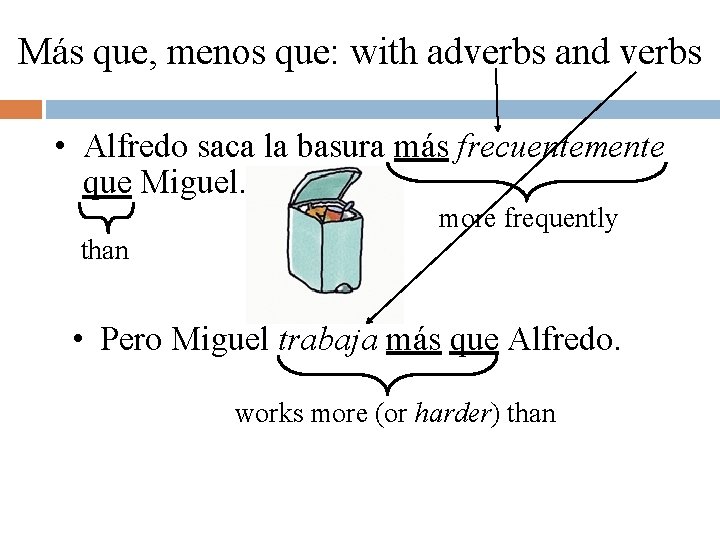
Más que, menos que: with adverbs and verbs • Alfredo saca la basura más frecuentemente que Miguel. more frequently than • Pero Miguel trabaja más que Alfredo. works more (or harder) than
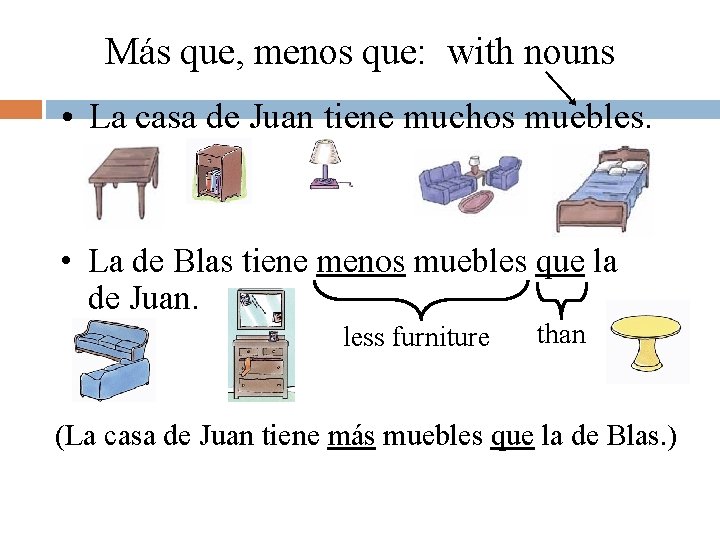
Más que, menos que: with nouns • La casa de Juan tiene muchos muebles. • La de Blas tiene menos muebles que la de Juan. less furniture than (La casa de Juan tiene más muebles que la de Blas. )
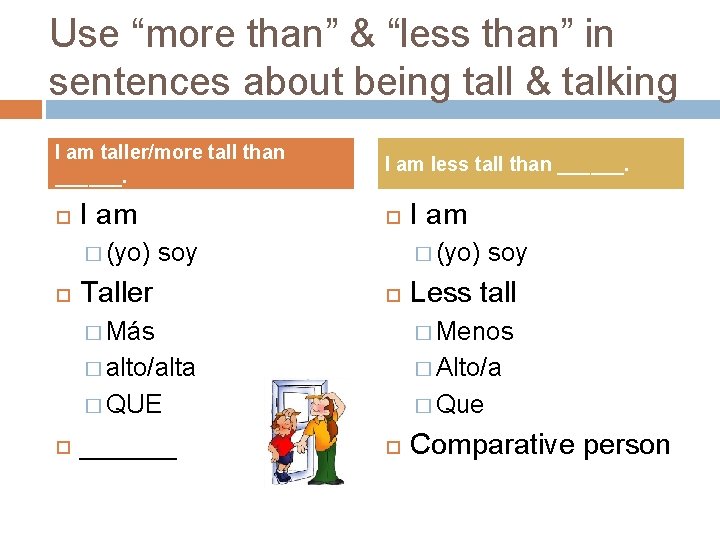
Use “more than” & “less than” in sentences about being tall & talking I am taller/more tall than ______. I am less tall than ______. � (yo) soy Taller I am � (yo) soy Less tall � Más � Menos � alto/alta � Alto/a � QUE � Que ______ Comparative person
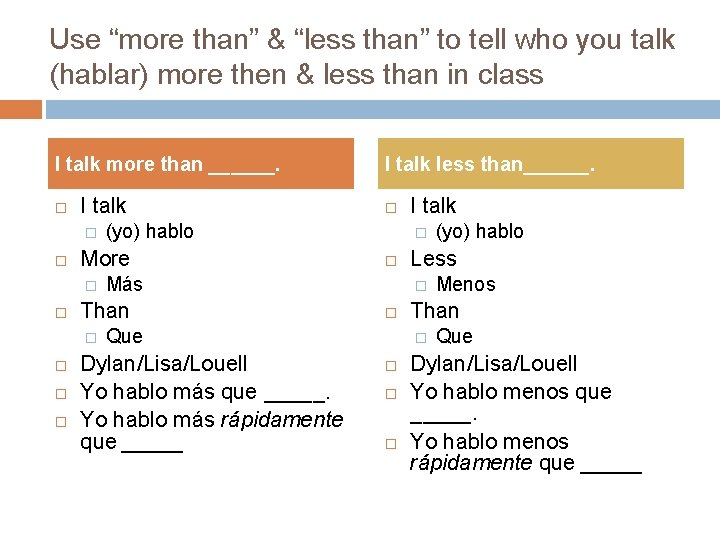
Use “more than” & “less than” to tell who you talk (hablar) more then & less than in class I talk more than ______. I talk � Menos Than � (yo) hablo Less � Que Dylan/Lisa/Louell Yo hablo más que _____. Yo hablo más rápidamente que _____ I talk � Más Than � (yo) hablo More � I talk less than______. Que Dylan/Lisa/Louell Yo hablo menos que _____. Yo hablo menos rápidamente que _____
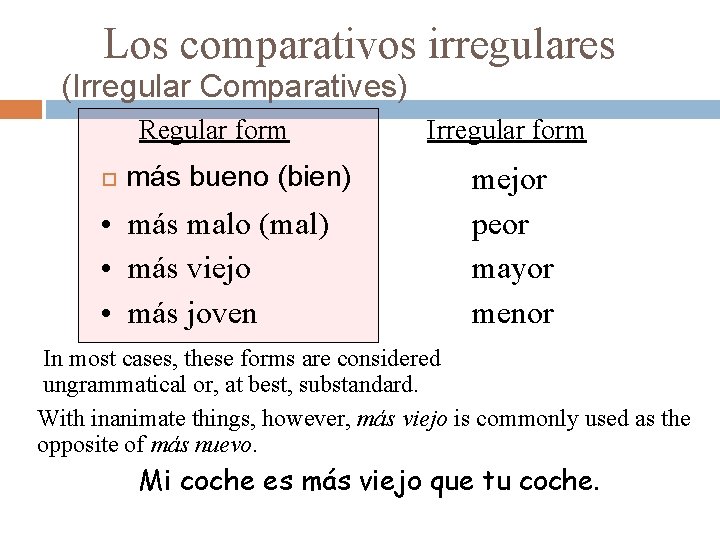
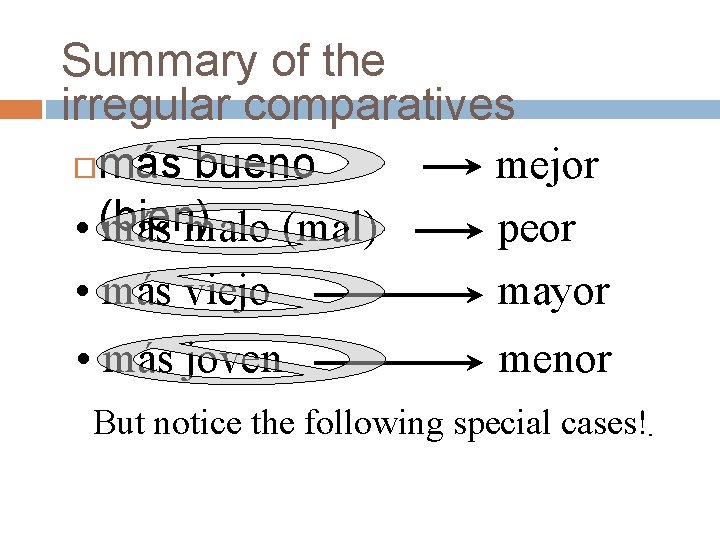
Los comparativos irregulares (Irregular Comparatives) Regular form más bueno (bien) • más malo (mal) • más viejo • más joven Irregular form mejor peor mayor menor In most cases, these forms are considered ungrammatical or, at best, substandard. With inanimate things, however, más viejo is commonly used as the opposite of más nuevo. Mi coche es más viejo que tu coche.
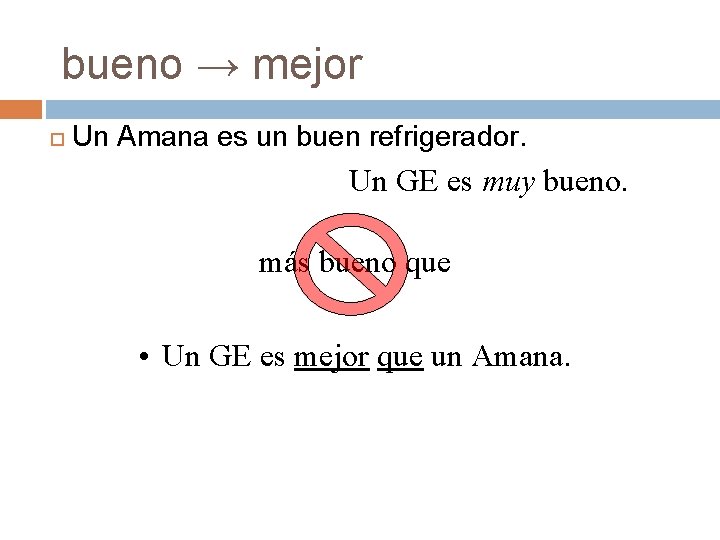
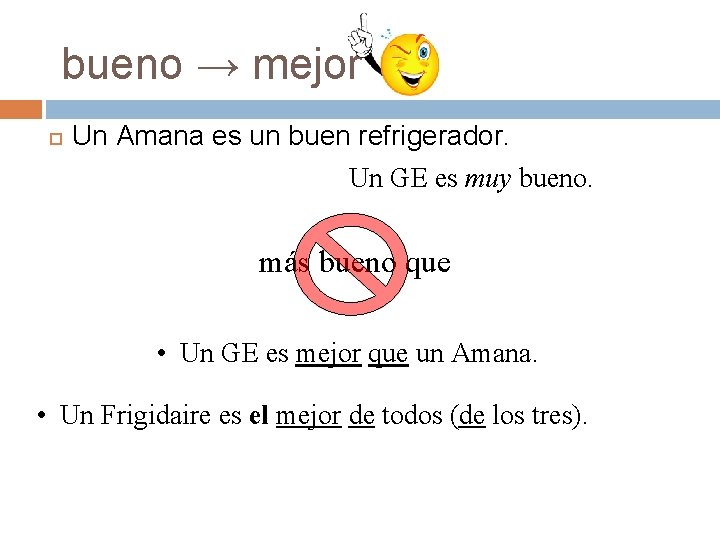
bueno → mejor Un Amana es un buen refrigerador. Un GE es muy bueno. más bueno que • Un GE es mejor que un Amana.
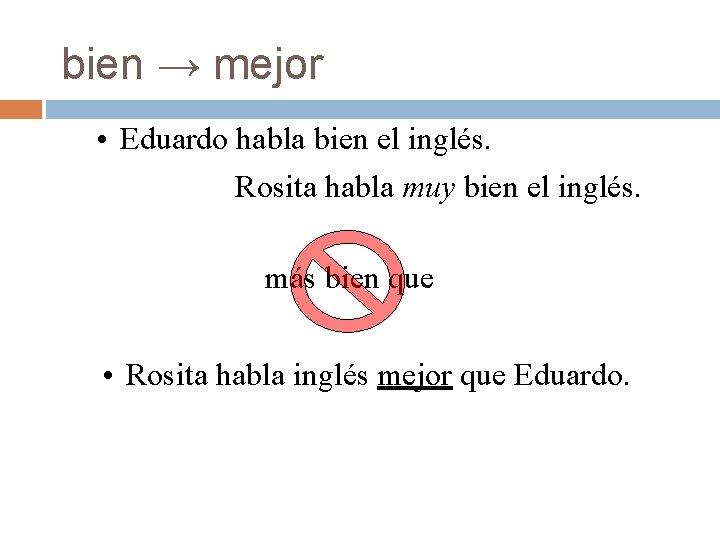
bien → mejor • Eduardo habla bien el inglés. Rosita habla muy bien el inglés. más bien que • Rosita habla inglés mejor que Eduardo.
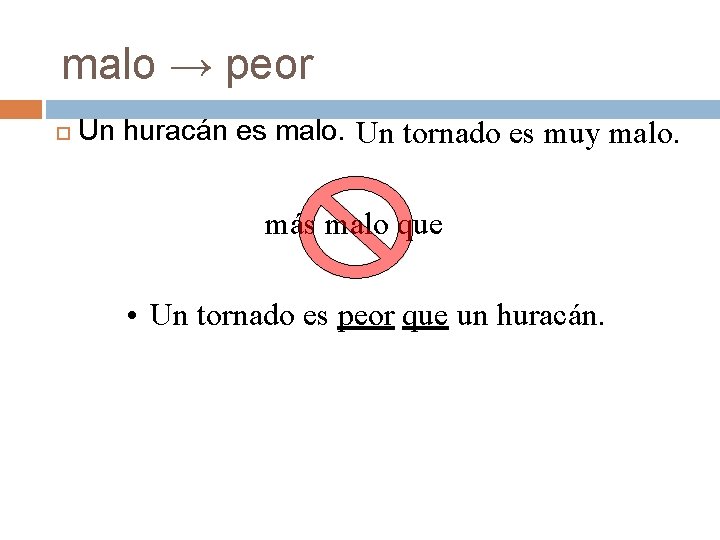
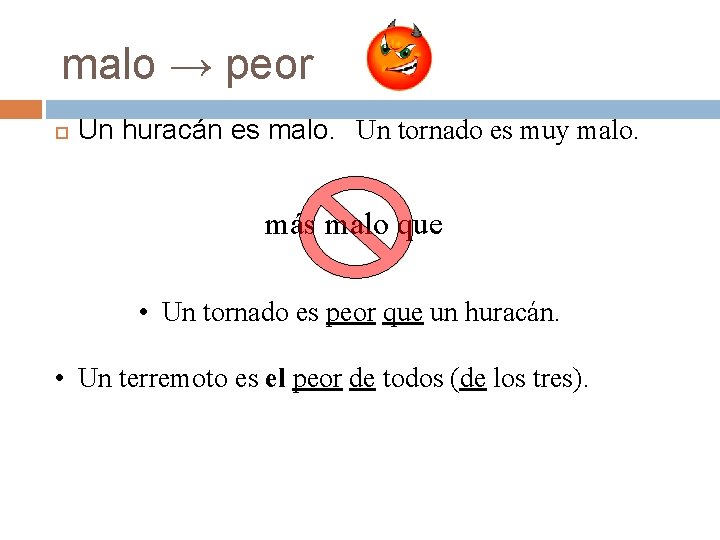
malo → peor Un huracán es malo. Un tornado es muy malo. más malo que • Un tornado es peor que un huracán.
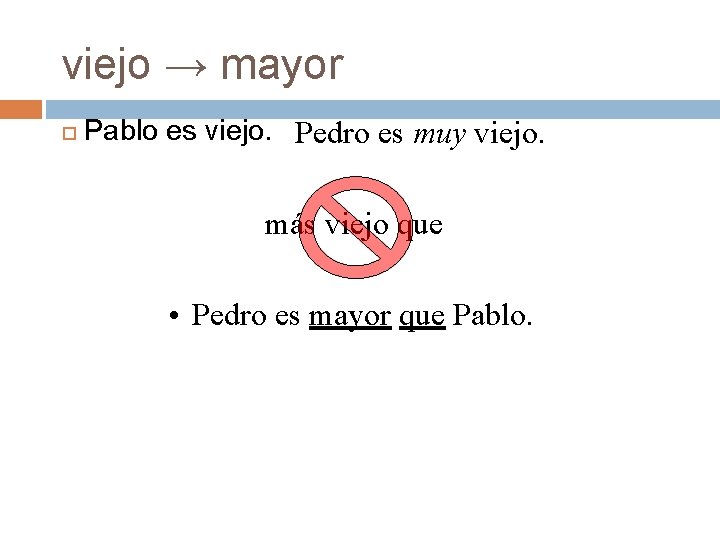
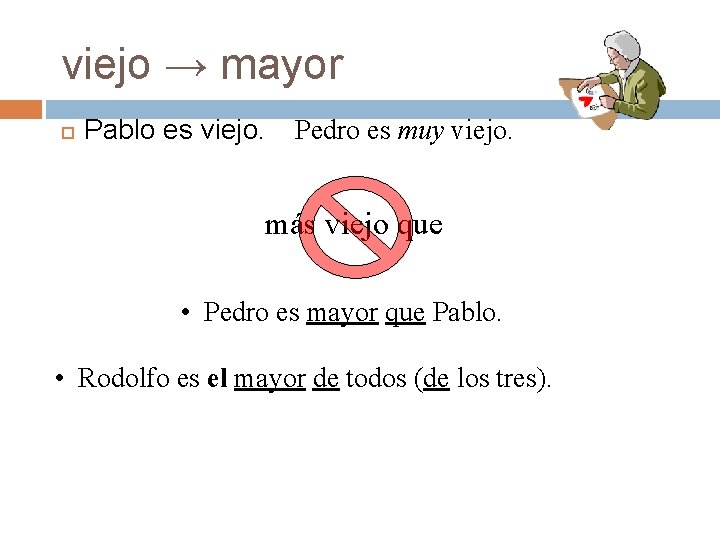
viejo → mayor Pablo es viejo. Pedro es muy viejo. más viejo que • Pedro es mayor que Pablo.
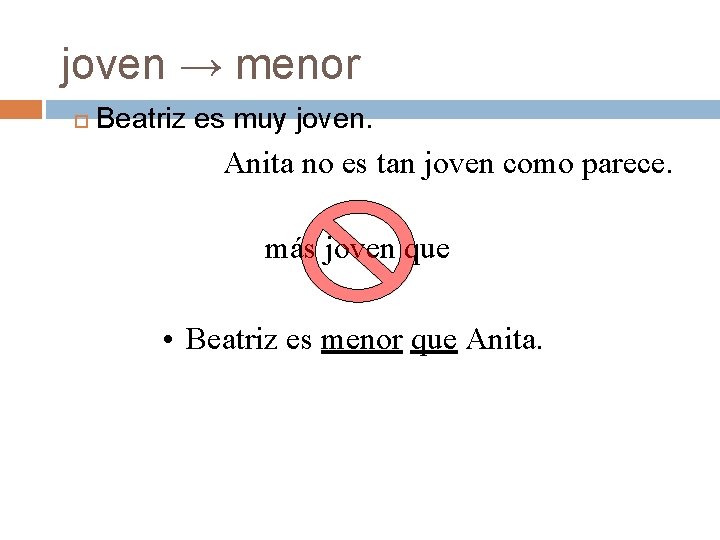
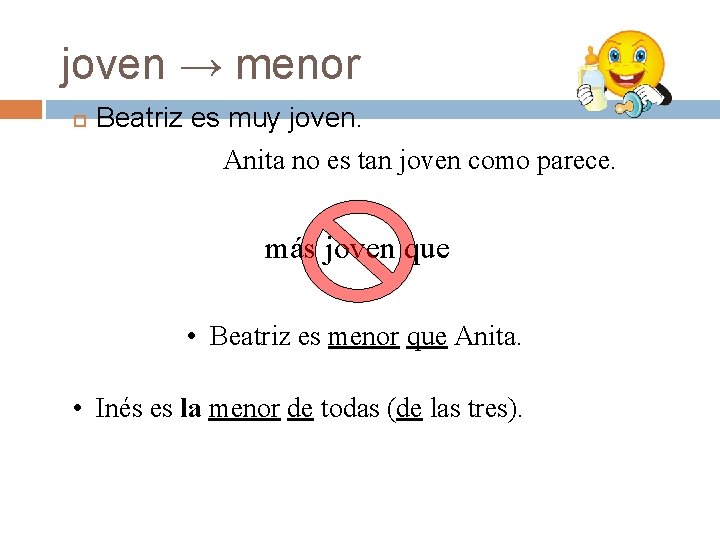
joven → menor Beatriz es muy joven. Anita no es tan joven como parece. más joven que • Beatriz es menor que Anita.
Summary of the irregular comparatives mejor más bueno • (bien) más malo (mal) peor • más viejo mayor • más joven menor But notice the following special cases! .
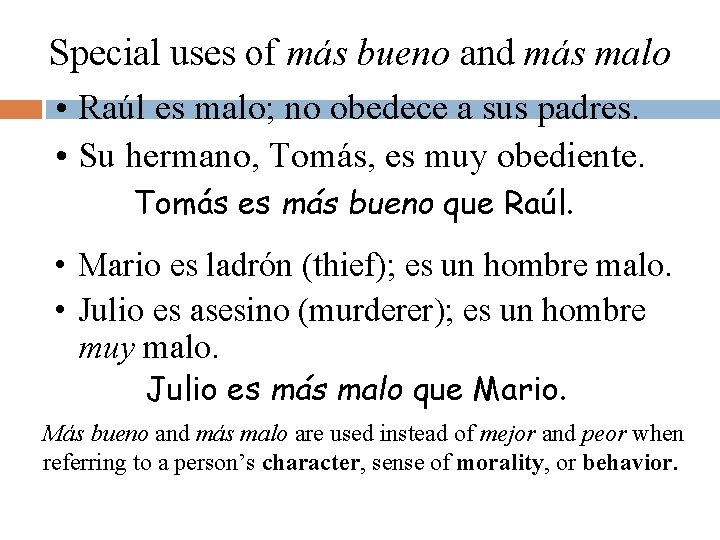
Special uses of más bueno and más malo • Raúl es malo; no obedece a sus padres. • Su hermano, Tomás, es muy obediente. Tomás es más bueno que Raúl. • Mario es ladrón (thief); es un hombre malo. • Julio es asesino (murderer); es un hombre muy malo. Julio es más malo que Mario. Más bueno and más malo are used instead of mejor and peor when referring to a person’s character, sense of morality, or behavior.
¡A practicar! Be ready to say who you are “just as tall as” in the class, tomorrow at the door.
Theme: Comparisons of Equality & Inequality Objective & Big Picture: To be able to compare two things where one is more/less than another. Language Objective: TSWBAT tell who is the most friendly in the class and who is the least tall
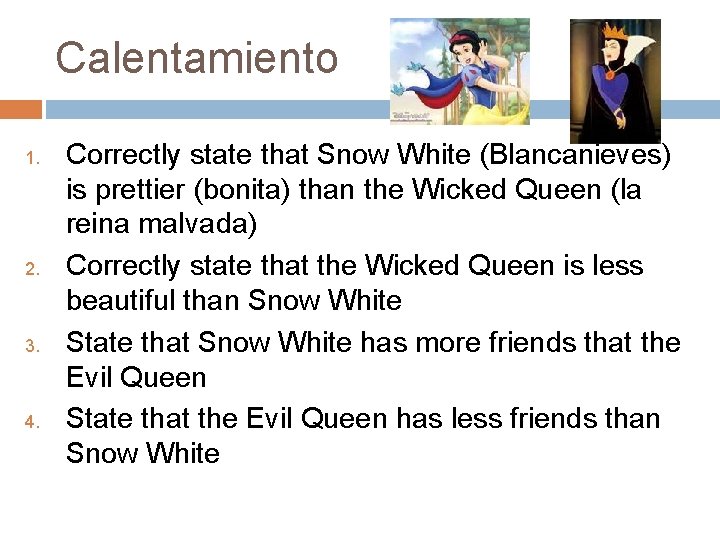
Calentamiento 1. 2. 3. 4. Correctly state that Snow White (Blancanieves) is prettier (bonita) than the Wicked Queen (la reina malvada) Correctly state that the Wicked Queen is less beautiful than Snow White State that Snow White has more friends that the Evil Queen State that the Evil Queen has less friends than Snow White
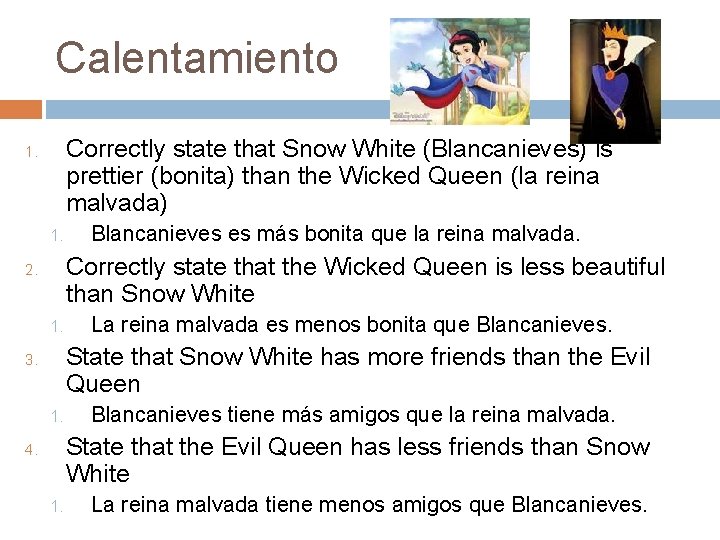
Calentamiento Correctly state that Snow White (Blancanieves) is prettier (bonita) than the Wicked Queen (la reina malvada) 1. Blancanieves es más bonita que la reina malvada. Correctly state that the Wicked Queen is less beautiful than Snow White 2. 1. La reina malvada es menos bonita que Blancanieves. State that Snow White has more friends than the Evil Queen 3. 1. Blancanieves tiene más amigos que la reina malvada. State that the Evil Queen has less friends than Snow White 4. 1. La reina malvada tiene menos amigos que Blancanieves.
Theme: Comparisons of Equality & Inequality Objective & Big Picture: To be able to compare two things where one is more/less than another. Language Objective: TSWBAT tell who is the most friendly in the class and who is the least tall
Theme: Comparisons of Equality & Inequality Prepare: Pre-write 163 -166 Procedures: � Present: Rules of Comparison of equality & inequality � Participate - Take notes & responds to presentation prompts for practice � Practice - Read the conversation in exercise 5 -13, copy all comparisons & translate them to English; create comparisons according to prompts � Personalize - create two sentences: tell who is the most friendly in the class and who is the least tall � Evaluation: 5 -13, 5 -15, MSL 5: 20 -26
COMPARISONS OF EQUALITY (Las comparaciones de igualdad) Objective: TSWBAT compare their height or personality to someone in the class of similar height or personality & having as many pencils as someone else in class
To compare similar things with adjectives & adverbs in Spanish… Use the following construction: � Tan + adjective/adverb + como � Just as + adjective/adverb + as La Señorita Meinecke es tan bonita como Miss Universo. (Je! Je!) Ms. Meinecke is just as pretty as Miss Universe. (Hee!) � Think of TAN as “just as” � COMO with no accent means “like/as”
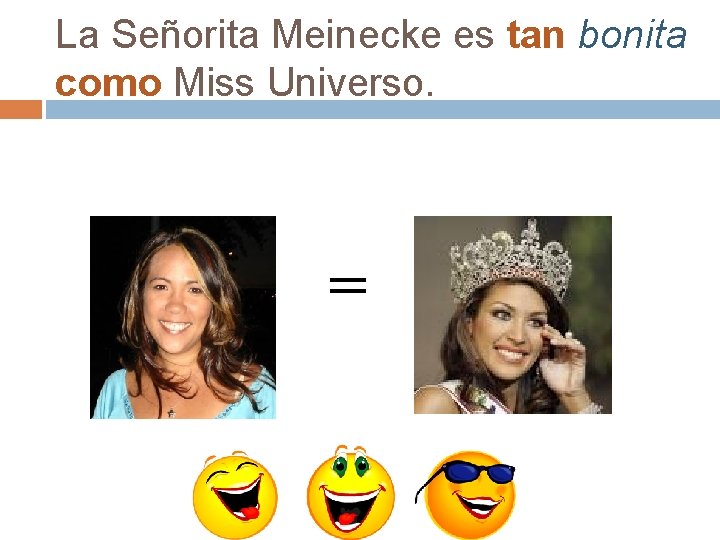
La Señorita Meinecke es tan bonita como Miss Universo. =
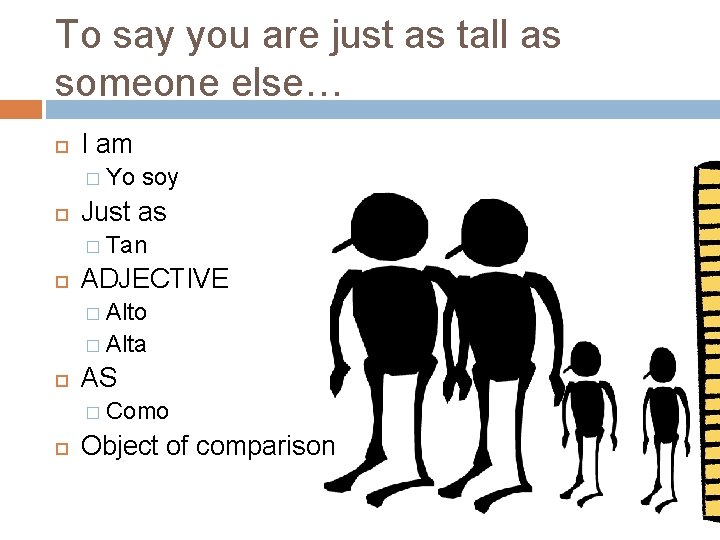
To say you are just as tall as someone else… I am � Yo soy Just as � Tan ADJECTIVE � Alto � Alta AS � Como Object of comparison
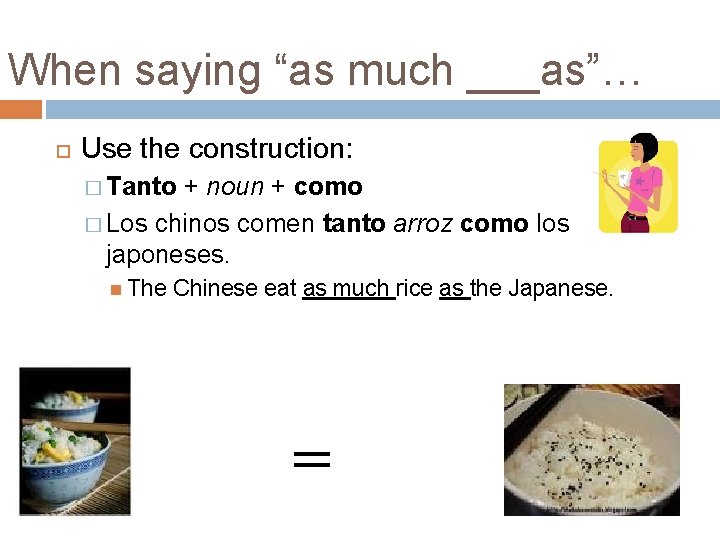
When saying “as much ___as”… Use the construction: � Tanto + noun + como � Los chinos comen tanto arroz como los japoneses. The Chinese eat as much rice as the Japanese. =
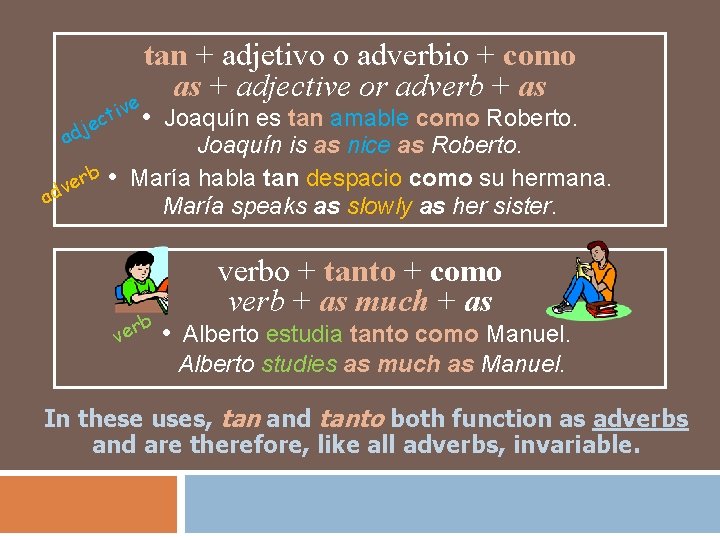
v ti c e j ad tan + adjetivo o adverbio + como as + adjective or adverb + as e • Joaquín es tan amable como Roberto. Joaquín is as nice as Roberto. rb • María habla tan despacio como su hermana. e v ad María speaks as slowly as her sister. b verbo + tanto + como verb + as much + as • Alberto estudia tanto como Manuel. Alberto studies as much as Manuel. In these uses, tan and tanto both function as adverbs and are therefore, like all adverbs, invariable.
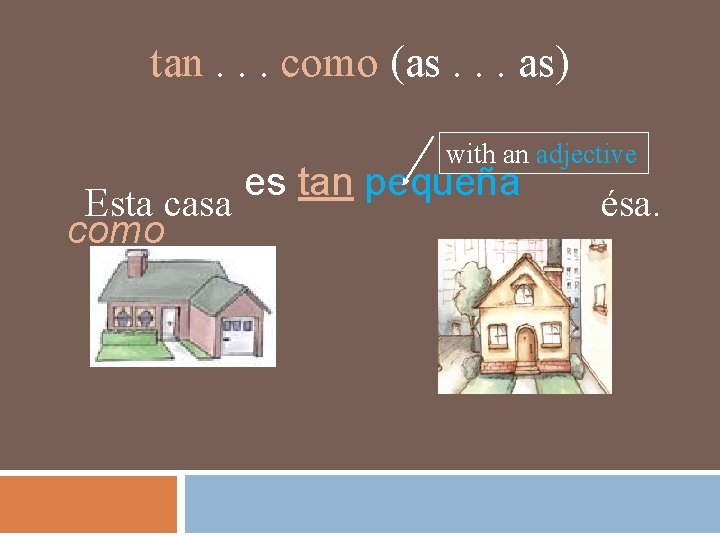
tan. . . como (as. . . as) with an adjective es tan pequeña Esta casa como ésa.
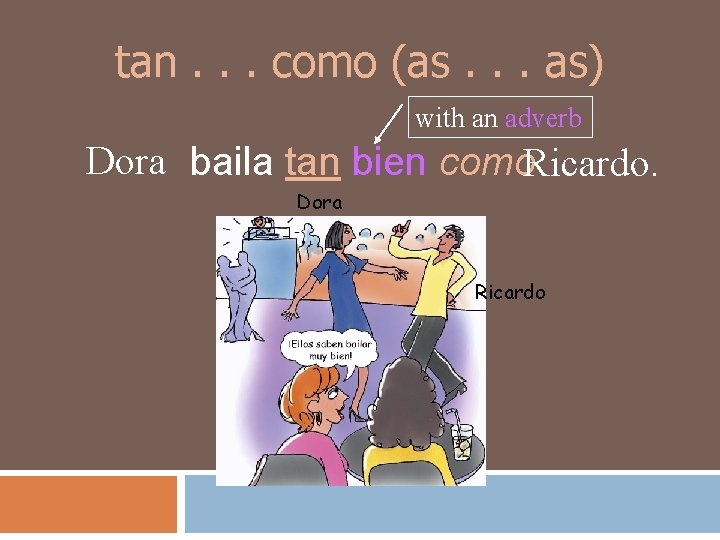
tan. . . como (as. . . as) with an adverb Dora baila tan bien como Ricardo. Dora Ricardo
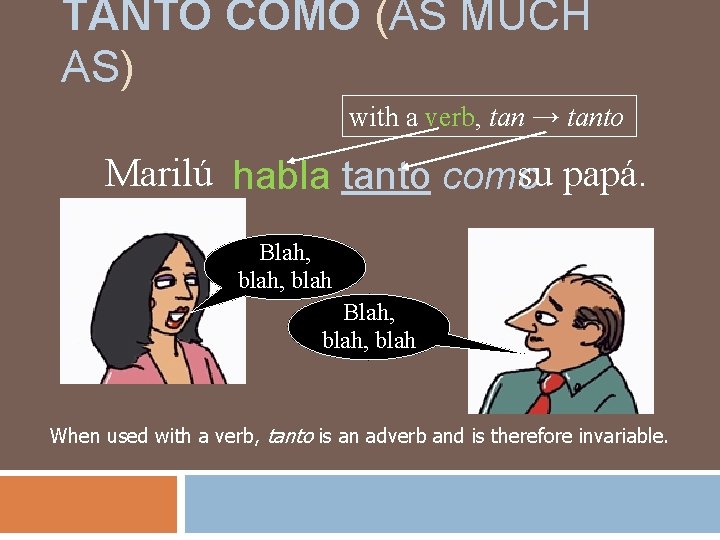
TANTO COMO (AS MUCH AS) with a verb, tan → tanto Marilú su papá. habla tanto como Blah, blah, blah When used with a verb, tanto is an adverb and is therefore invariable.
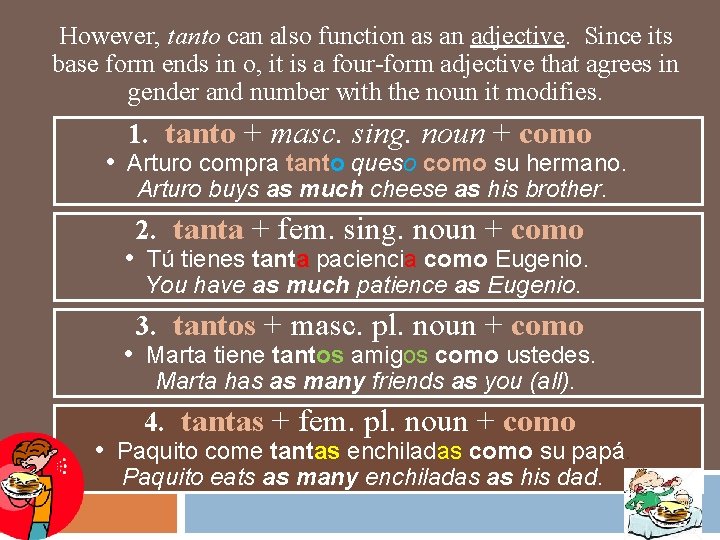
However, tanto can also function as an adjective. Since its base form ends in o, it is a four-form adjective that agrees in gender and number with the noun it modifies. 1. tanto + masc. sing. noun + como • Arturo compra tanto queso como su hermano. Arturo buys as much cheese as his brother. 2. tanta + fem. sing. noun + como • Tú tienes tanta paciencia como Eugenio. You have as much patience as Eugenio. 3. tantos + masc. pl. noun + como • Marta tiene tantos amigos como ustedes. Marta has as many friends as you (all). 4. tantas + fem. pl. noun + como • Paquito come tantas enchiladas como su papá. Paquito eats as many enchiladas as his dad.
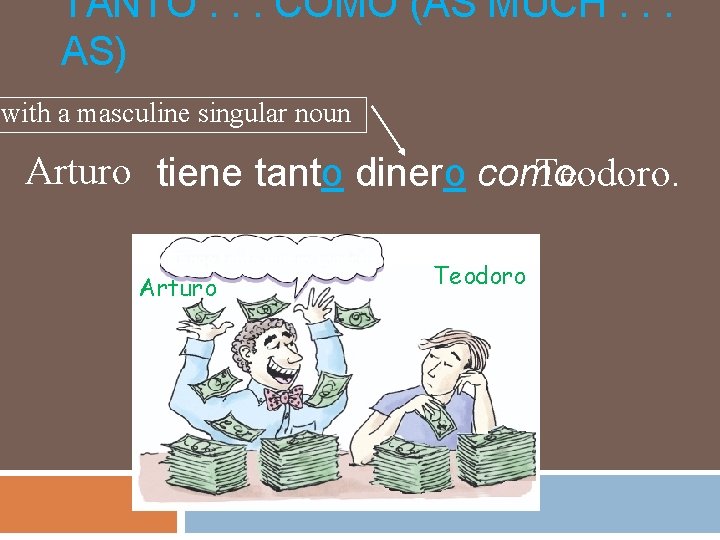
TANTO. . . COMO (AS MUCH. . . AS) with a masculine singular noun Arturo tiene tanto dinero como Teodoro. ¡Tengo tanto dinero como tú! Arturo Teodoro
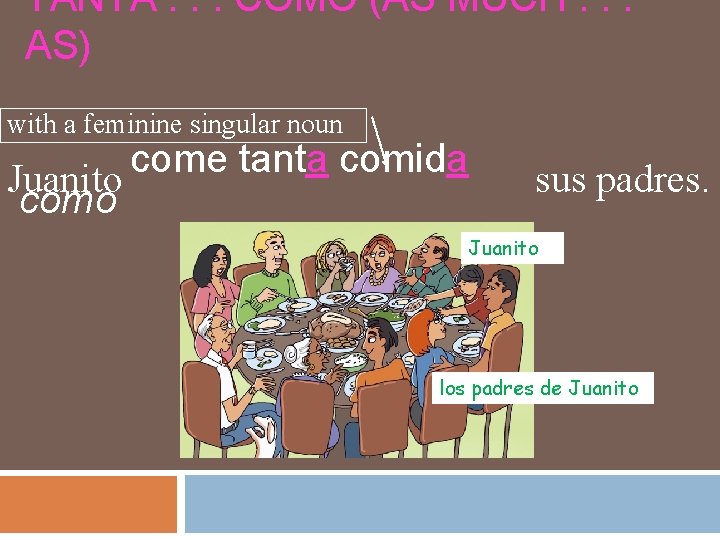
TANTA. . . COMO (AS MUCH. . . AS) with a feminine singular noun come tanta comida Juanito como sus padres. Juanito los padres de Juanito
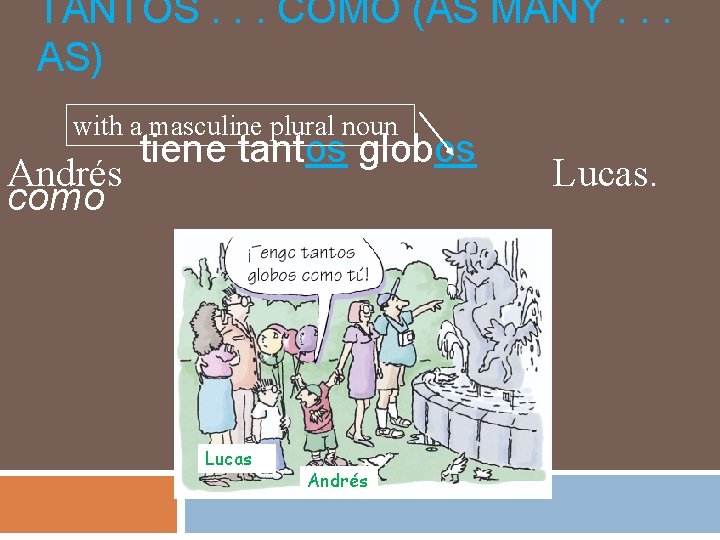
TANTOS. . . COMO (AS MANY. . . AS) with a masculine plural noun tiene tantos globos Andrés como Lucas Andrés Lucas.
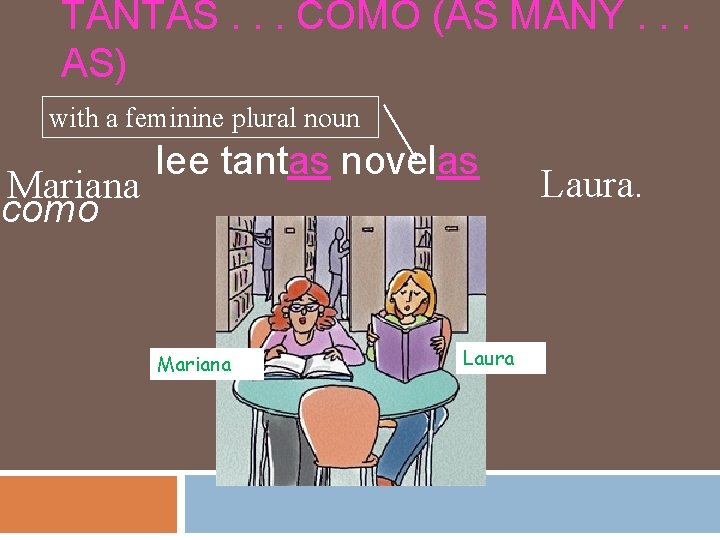
TANTAS. . . COMO (AS MANY. . . AS) with a feminine plural noun lee tantas novelas Mariana como Mariana Laura.
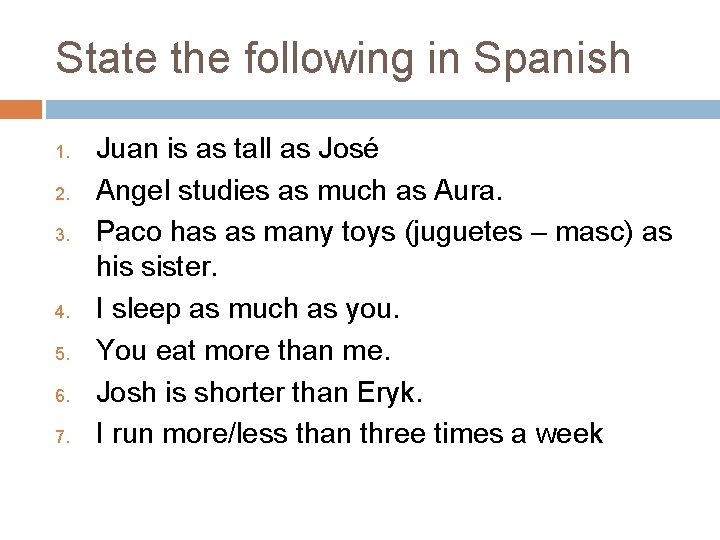
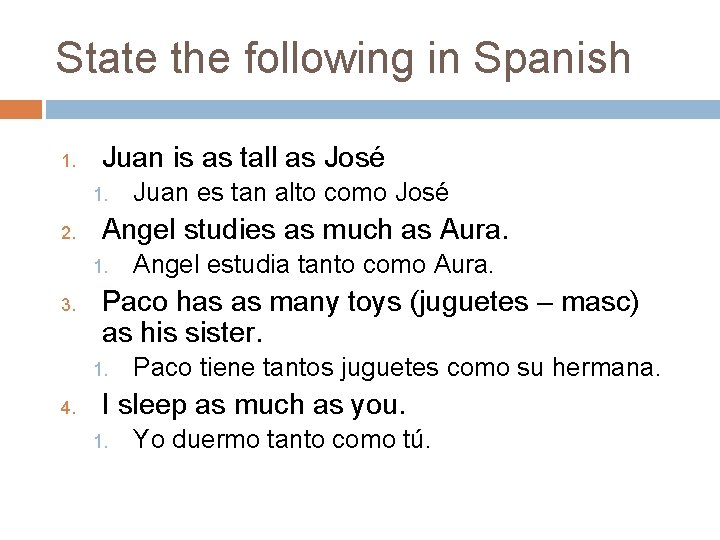
State the following in Spanish 1. 2. 3. 4. 5. 6. 7. Juan is as tall as José Angel studies as much as Aura. Paco has as many toys (juguetes – masc) as his sister. I sleep as much as you. You eat more than me. Josh is shorter than Eryk. I run more/less than three times a week
State the following in Spanish 1. Juan is as tall as José 1. 2. Angel studies as much as Aura. 1. 3. Angel estudia tanto como Aura. Paco has as many toys (juguetes – masc) as his sister. 1. 4. Juan es tan alto como José Paco tiene tantos juguetes como su hermana. I sleep as much as you. 1. Yo duermo tanto como tú.
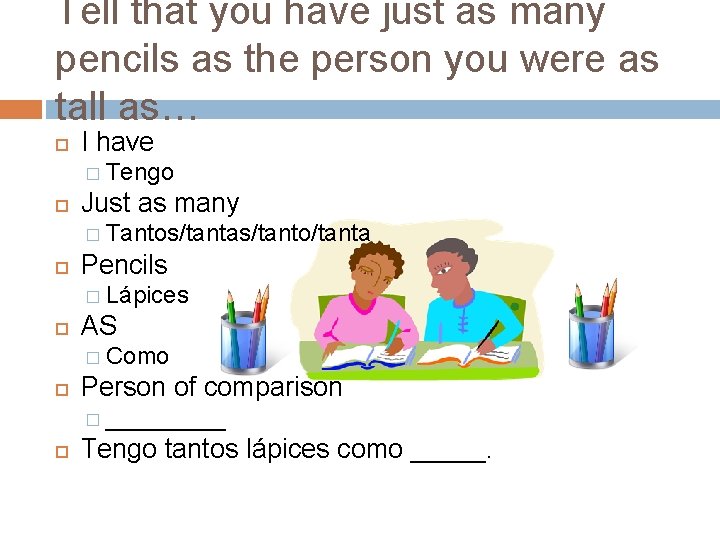
Tell that you have just as many pencils as the person you were as tall as… I have � Tengo Just as many � Tantos/tantas/tanto/tanta Pencils � Lápices AS � Como Person of comparison � _____ Tengo tantos lápices como _____.
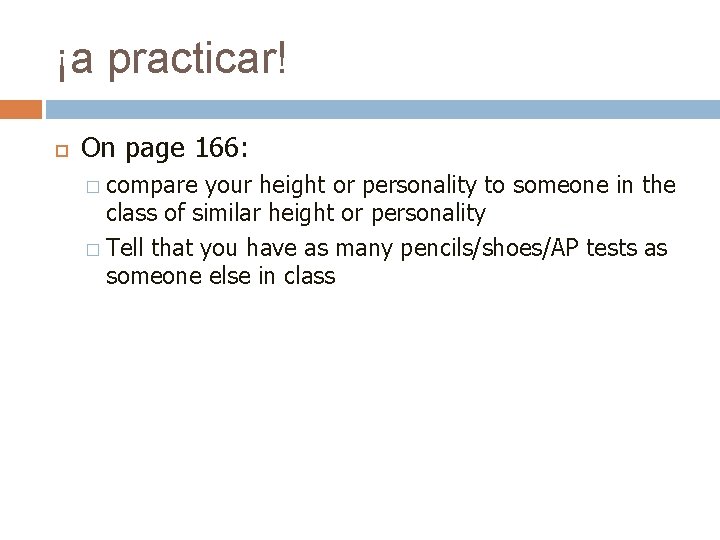
¡a practicar! On page 166: � compare your height or personality to someone in the class of similar height or personality � Tell that you have as many pencils/shoes/AP tests as someone else in class
FIN
Calentamiento Create four equality comparison sentences in Spanish: � I am just as nice as. . (someone in class) � I have as many apples (manzanas) as ____ � Anthony eats as many tacos as Matt. � Anthony eats as much as Matt
Calentamiento Create three equality comparison sentences in Spanish: � I am just as nice as. . (someone in class) � I have as many apples (manzanas) as ____ � Anthony eats as many tacos as Matt. � Anthony eats as much as Matt.
The Superlative (El superlativo) (The most. . . , the least. . . ) Good, better, BEST!!! Objetivo: TSWBAT tell who is the most friendly in the class and who is the least tall
Superlatives express the highest and lowest degree of something � The best vs. the least � The biggest vs. the smallest � The most loved vs. the least hated
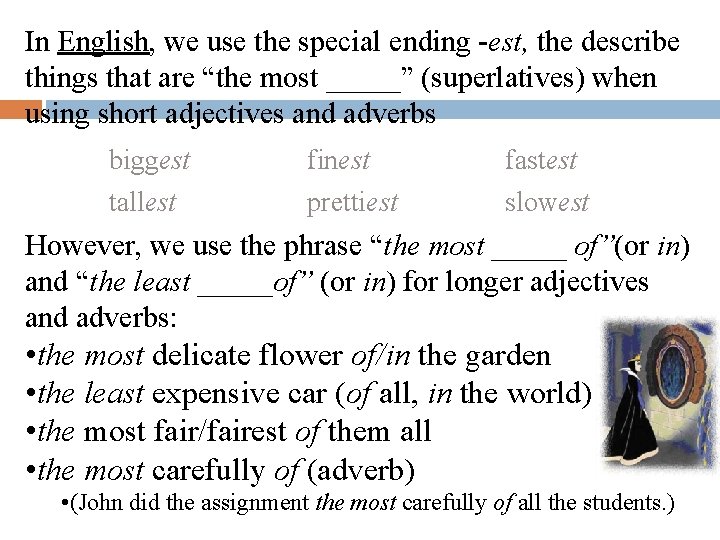
In English, we use the special ending -est, the describe things that are “the most _____” (superlatives) when using short adjectives and adverbs biggest tallest finest prettiest fastest slowest However, we use the phrase “the most _____ of”(or in) and “the least _____of” (or in) for longer adjectives and adverbs: • the most delicate flower of/in the garden • the least expensive car (of all, in the world) • the most fair/fairest of them all • the most carefully of (adverb) • (John did the assignment the most carefully of all the students. )
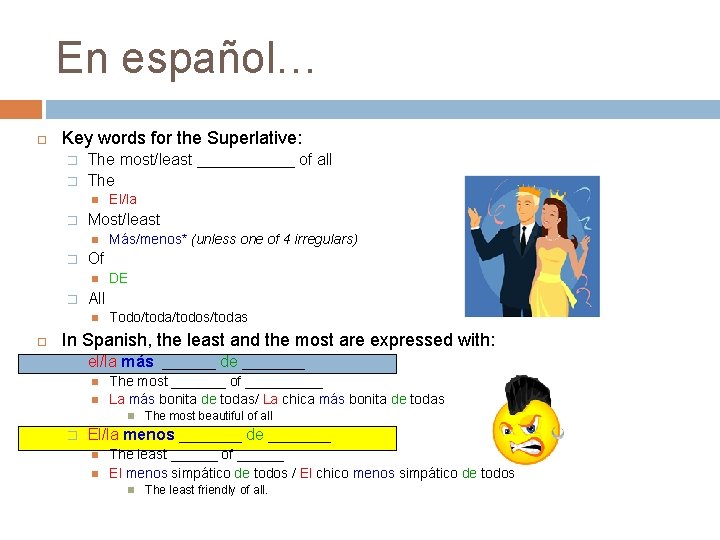
En español… Key words for the Superlative: � � The most/least ______ of all The � Most/least � DE All Más/menos* (unless one of 4 irregulars) Of � El/la Todo/toda/todos/todas In Spanish, the least and the most are expressed with: � el/la más ______ de _______ The most _______ of _____ La más bonita de todas/ La chica más bonita de todas � The most beautiful of all El/la menos _______ de _______ The least ______ of ______ El menos simpático de todos / El chico menos simpático de todos The least friendly of all.
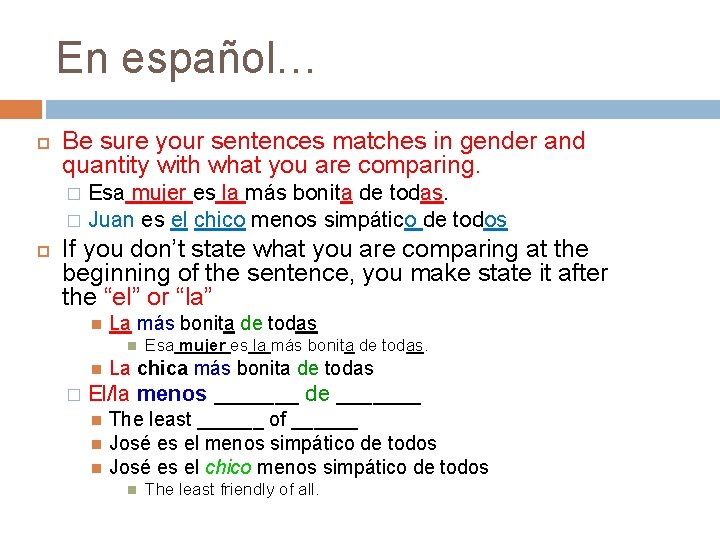
En español… Be sure your sentences matches in gender and quantity with what you are comparing. Esa mujer es la más bonita de todas. � Juan es el chico menos simpático de todos � If you don’t state what you are comparing at the beginning of the sentence, you make state it after the “el” or “la” La más bonita de todas � Esa mujer es la más bonita de todas. La chica más bonita de todas El/la menos _______ de _______ The least ______ of ______ José es el menos simpático de todos José es el chico menos simpático de todos The least friendly of all.
http: //www. youtube. com/watch? v=H 2 zl. M 5 Miw Rs
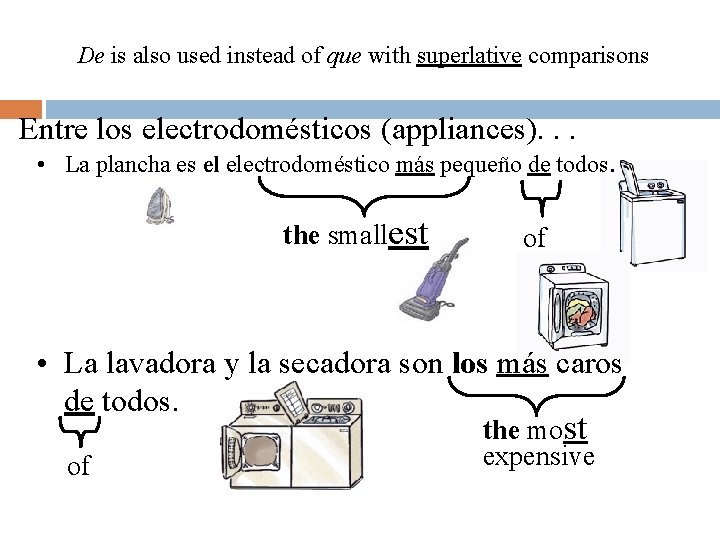
De is also used instead of que with superlative comparisons Entre los electrodomésticos (appliances). . . • La plancha es el electrodoméstico más pequeño de todos. the smallest of • La lavadora y la secadora son los más caros de todos. of the most expensive
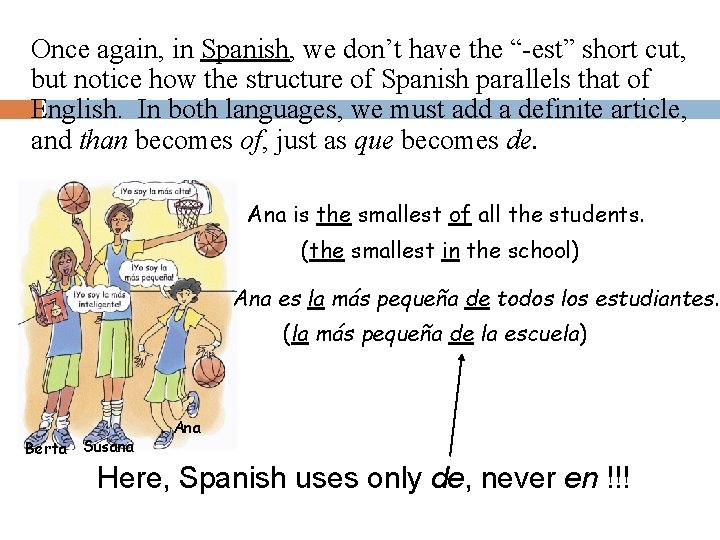
Once again, in Spanish, we don’t have the “-est” short cut, but notice how the structure of Spanish parallels that of English. In both languages, we must add a definite article, and than becomes of, just as que becomes de. Ana is the smallest of all the students. (the smallest in the school) Ana es la más pequeña de todos los estudiantes. (la más pequeña de la escuela) Berta Susana Ana Here, Spanish uses only de, never en !!!
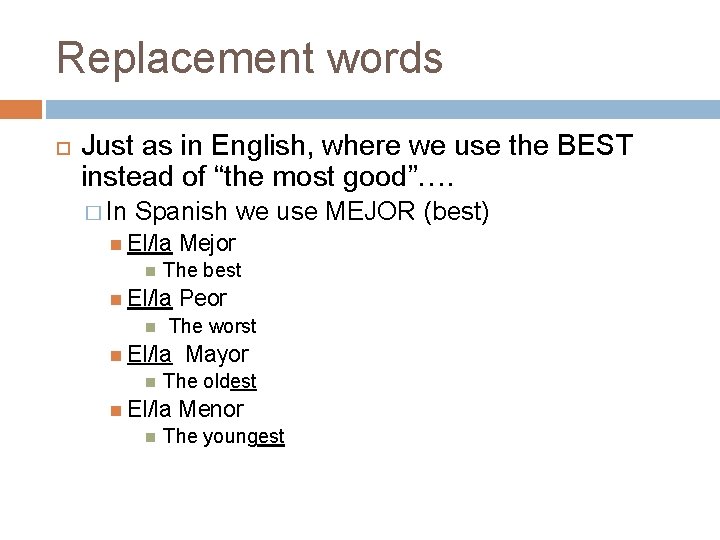
Replacement words Just as in English, where we use the BEST instead of “the most good”…. � In Spanish we use MEJOR (best) El/la Mejor The best El/la Peor The worst El/la Mayor The oldest El/la Menor The youngest
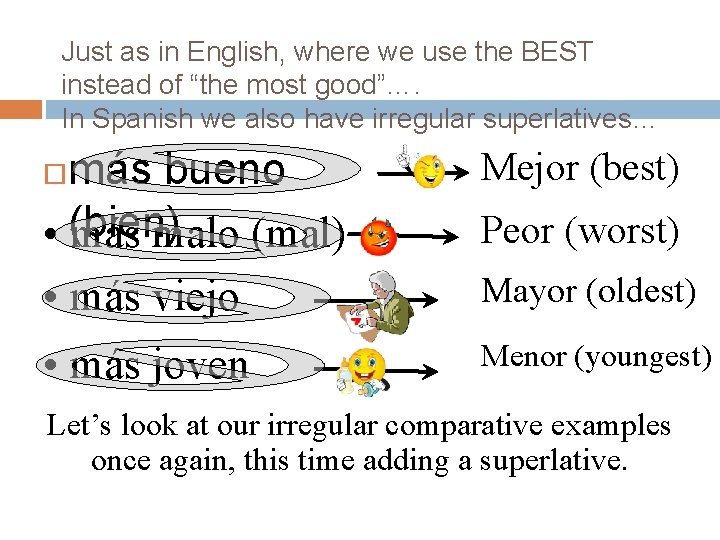
Just as in English, where we use the BEST instead of “the most good”…. In Spanish we also have irregular superlatives… más bueno • (bien) más malo (mal) • más viejo Mejor (best) • más joven Menor (youngest) Peor (worst) Mayor (oldest) Let’s look at our irregular comparative examples once again, this time adding a superlative.
bueno → mejor Un Amana es un buen refrigerador. Un GE es muy bueno. más bueno que • Un GE es mejor que un Amana. • Un Frigidaire es el mejor de todos (de los tres).
malo → peor Un huracán es malo. Un tornado es muy malo. más malo que • Un tornado es peor que un huracán. • Un terremoto es el peor de todos (de los tres).
viejo → mayor Pablo es viejo. Pedro es muy viejo. más viejo que • Pedro es mayor que Pablo. • Rodolfo es el mayor de todos (de los tres).
joven → menor Beatriz es muy joven. Anita no es tan joven como parece. más joven que • Beatriz es menor que Anita. • Inés es la menor de todas (de las tres).
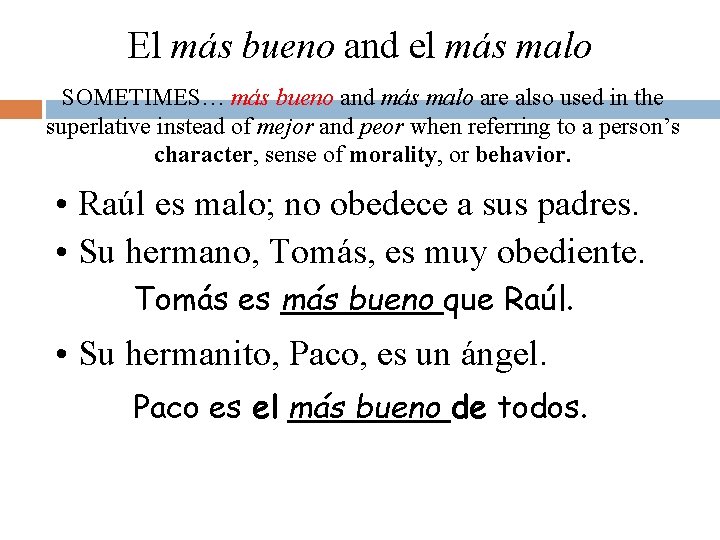
El más bueno and el más malo SOMETIMES… más bueno and más malo are also used in the superlative instead of mejor and peor when referring to a person’s character, sense of morality, or behavior. • Raúl es malo; no obedece a sus padres. • Su hermano, Tomás, es muy obediente. Tomás es más bueno que Raúl. • Su hermanito, Paco, es un ángel. Paco es el más bueno de todos.
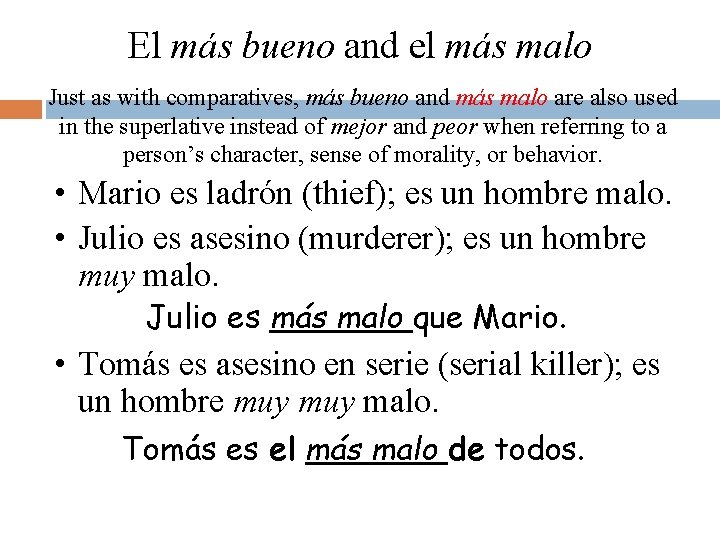
El más bueno and el más malo Just as with comparatives, más bueno and más malo are also used in the superlative instead of mejor and peor when referring to a person’s character, sense of morality, or behavior. • Mario es ladrón (thief); es un hombre malo. • Julio es asesino (murderer); es un hombre muy malo. Julio es más malo que Mario. • Tomás es asesino en serie (serial killer); es un hombre muy malo. Tomás es el más malo de todos.
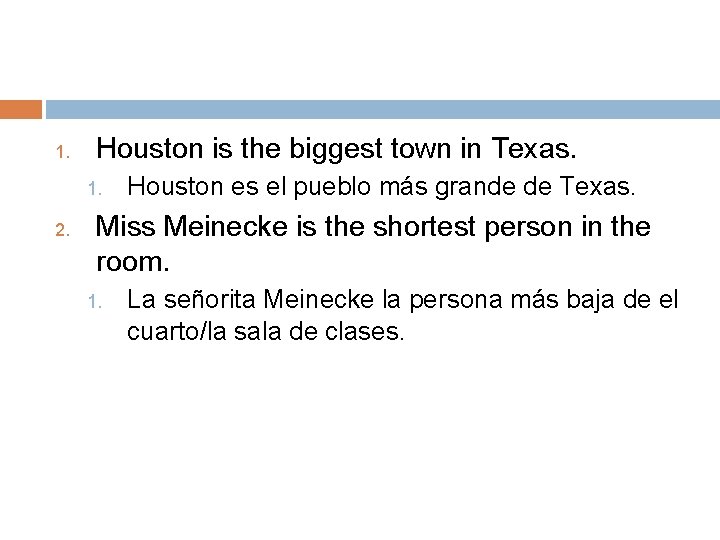
1. Houston is the biggest town in Texas. 1. 2. Houston es el pueblo más grande de Texas. Miss Meinecke is the shortest person in the room. 1. La señorita Meinecke la persona más baja de el cuarto/la sala de clases.
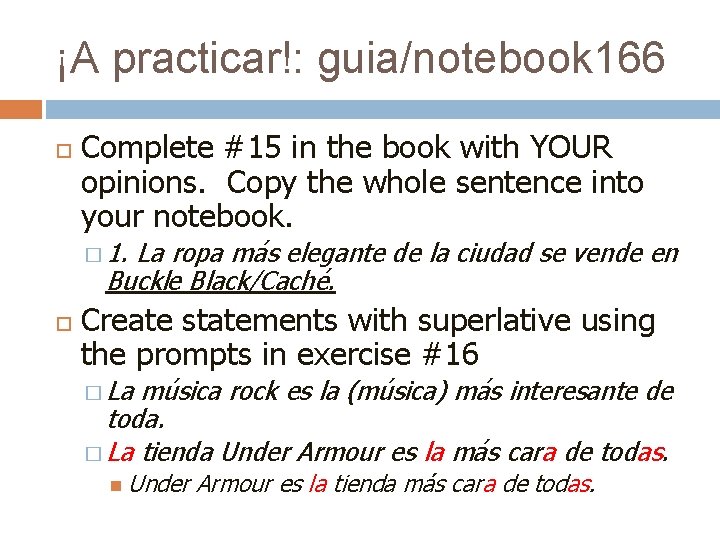
¡A practicar!: guia/notebook 166 Complete #15 in the book with YOUR opinions. Copy the whole sentence into your notebook. � 1. La ropa más elegante de la ciudad se vende en Buckle Black/Caché. Create statements with superlative using the prompts in exercise #16 � La música rock es la (música) más interesante de toda. � La tienda Under Armour es la más cara de todas. Under Armour es la tienda más cara de todas.
FIN