
CALCULUS III CHAPTER 4 Vector integrals and integral
- Slides: 40
CALCULUS III CHAPTER 4: Vector integrals and integral theorems Vector integrals • Line integrals • Surface integrals • Volume integrals Integral theorems • The divergence theorem • Green’s theorem in the plane • Stoke’s theorem • Conservative fields and scalar potentials • Vector potentials
VECTOR INTEGRALS
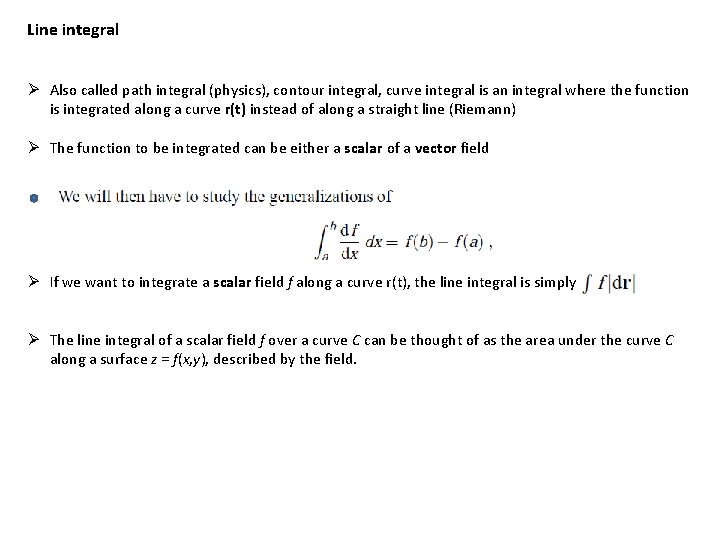
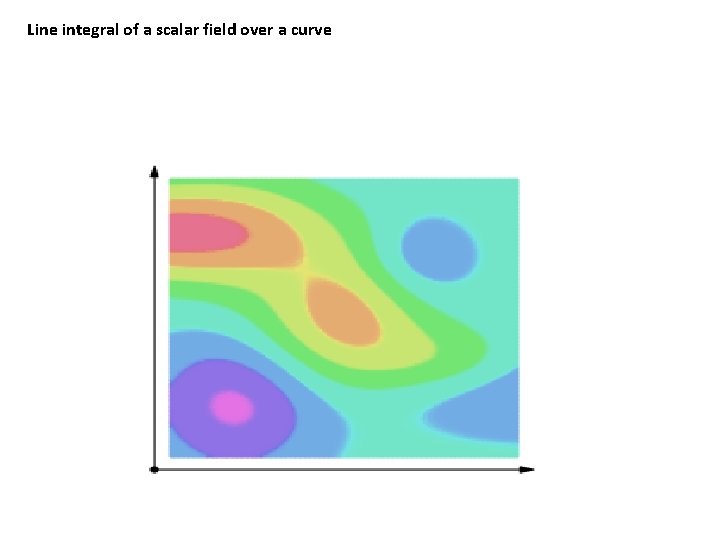
Line integral Ø Also called path integral (physics), contour integral, curve integral is an integral where the function is integrated along a curve r(t) instead of along a straight line (Riemann) Ø The function to be integrated can be either a scalar of a vector field Ø If we want to integrate a scalar field f along a curve r(t), the line integral is simply Ø The line integral of a scalar field f over a curve C can be thought of as the area under the curve C along a surface z = f(x, y), described by the field.
Line integral of a scalar field over a curve
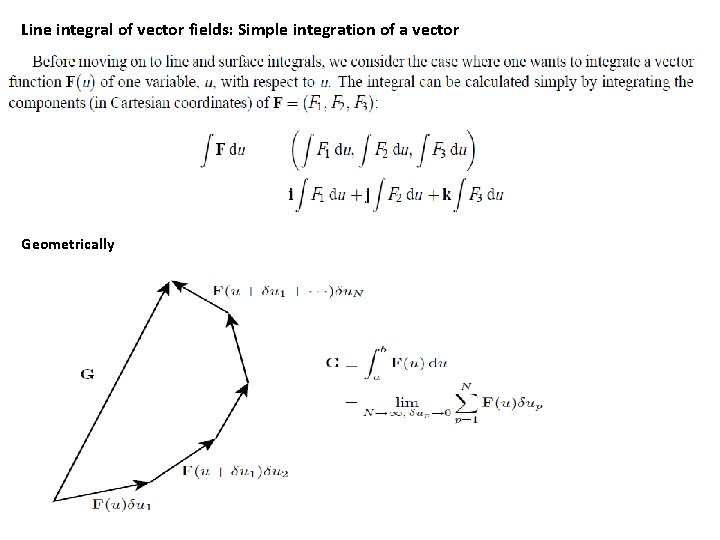
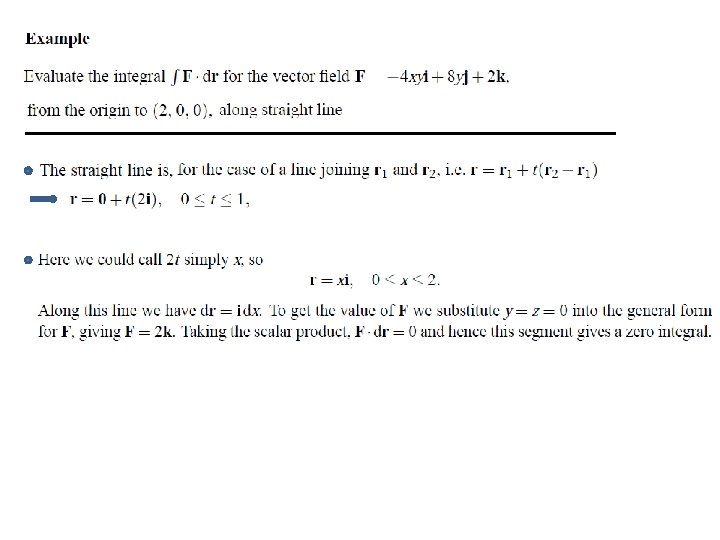
Line integral of vector fields: Simple integration of a vector Geometrically
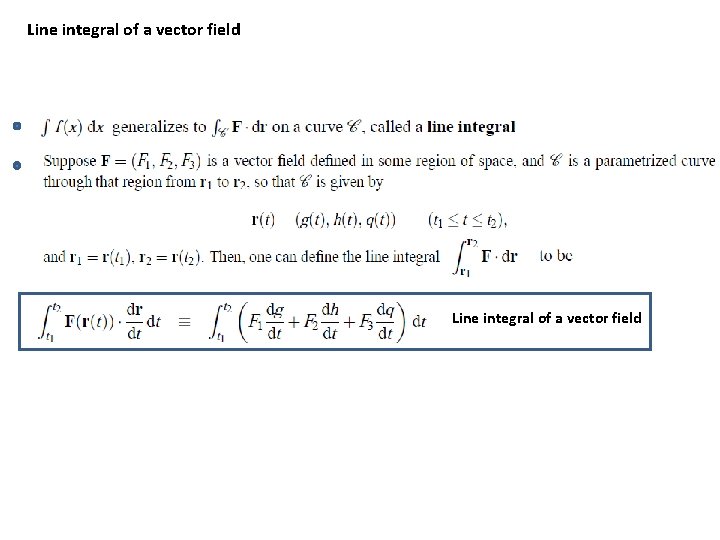
Line integral of a vector field
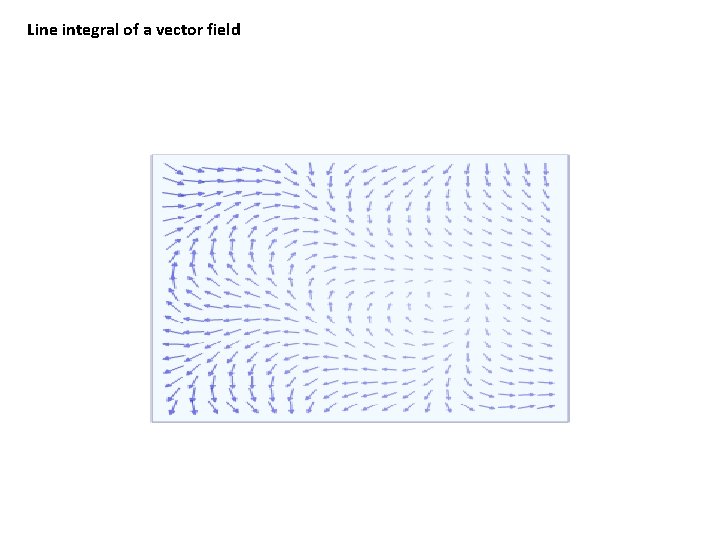
Line integral of a vector field
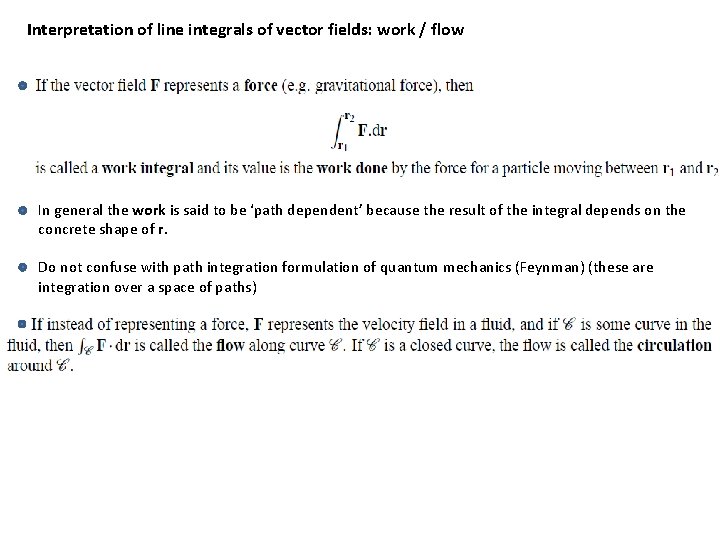
Interpretation of line integrals of vector fields: work / flow In general the work is said to be ‘path dependent’ because the result of the integral depends on the concrete shape of r. Do not confuse with path integration formulation of quantum mechanics (Feynman) (these are integration over a space of paths)
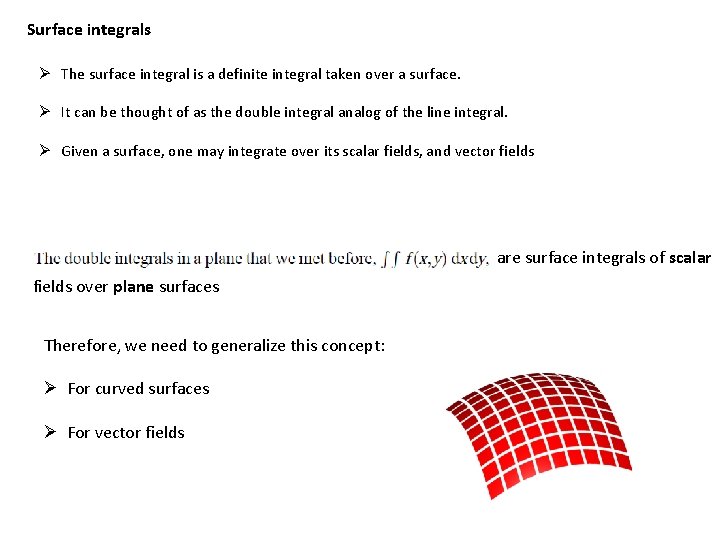
Surface integrals Ø The surface integral is a definite integral taken over a surface. Ø It can be thought of as the double integral analog of the line integral. Ø Given a surface, one may integrate over its scalar fields, and vector fields are surface integrals of scalar fields over plane surfaces Therefore, we need to generalize this concept: Ø For curved surfaces Ø For vector fields
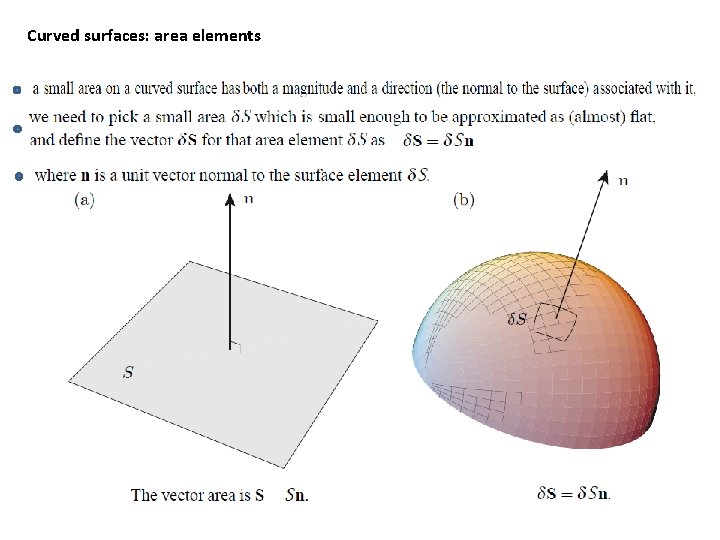
Curved surfaces: area elements
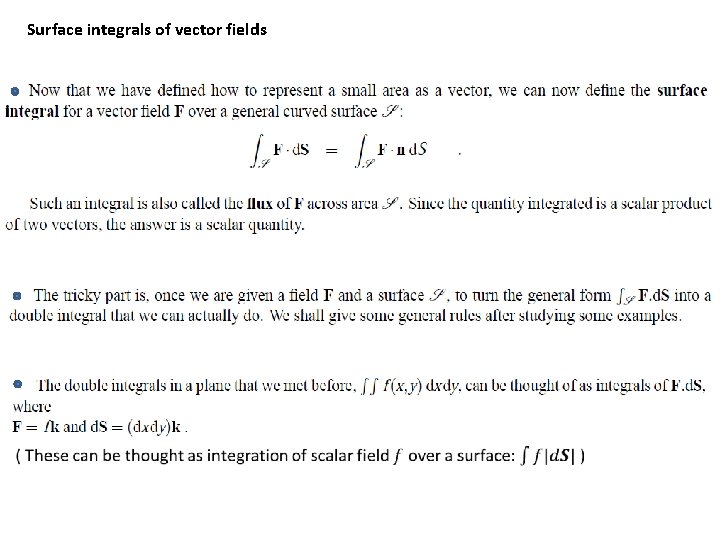
Surface integrals of vector fields
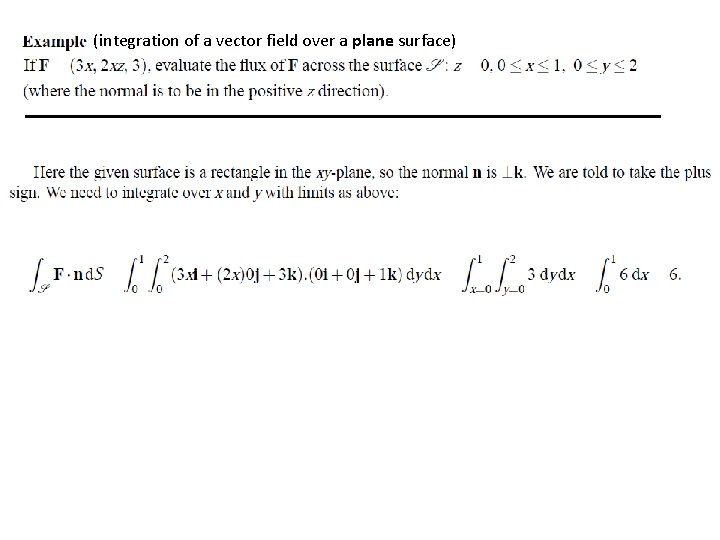
(integration of a vector field over a plane surface)
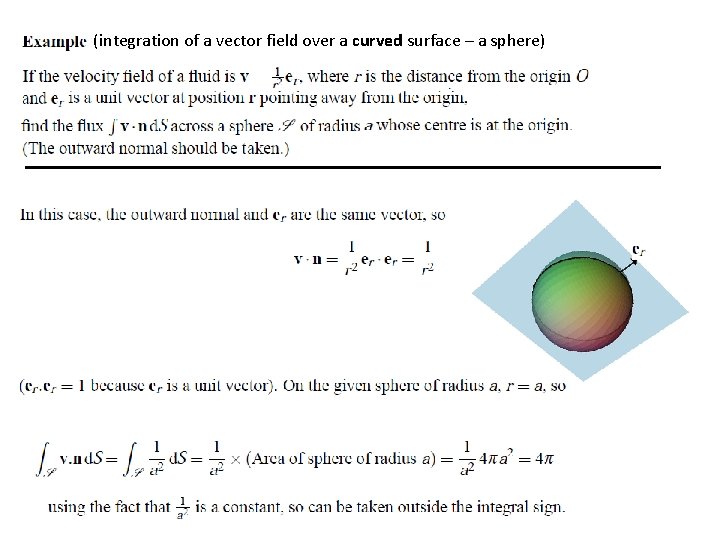
(integration of a vector field over a curved surface – a sphere)
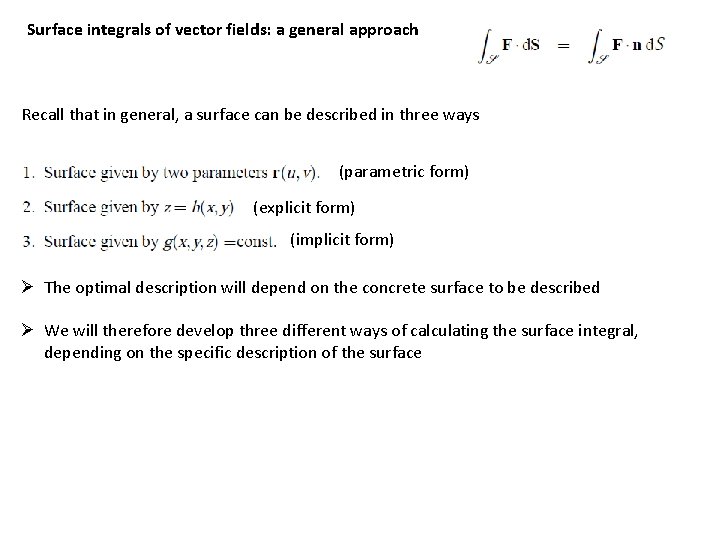
Surface integrals of vector fields: a general approach Recall that in general, a surface can be described in three ways (parametric form) (explicit form) (implicit form) Ø The optimal description will depend on the concrete surface to be described Ø We will therefore develop three different ways of calculating the surface integral, depending on the specific description of the surface
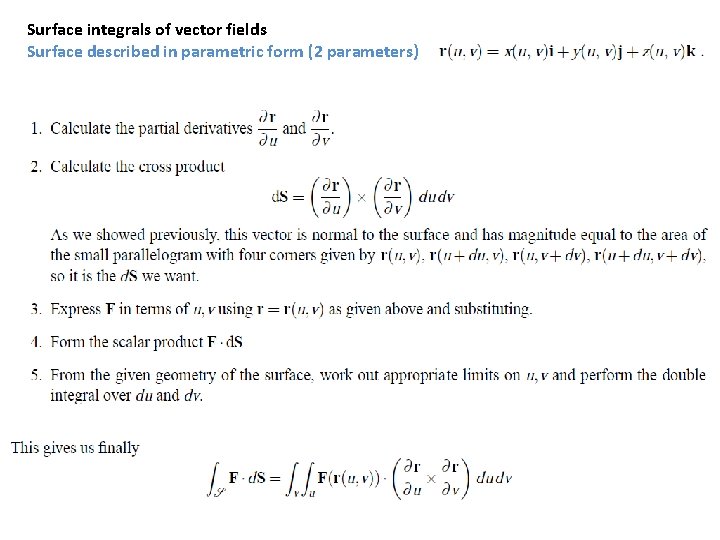
Surface integrals of vector fields Surface described in parametric form (2 parameters)
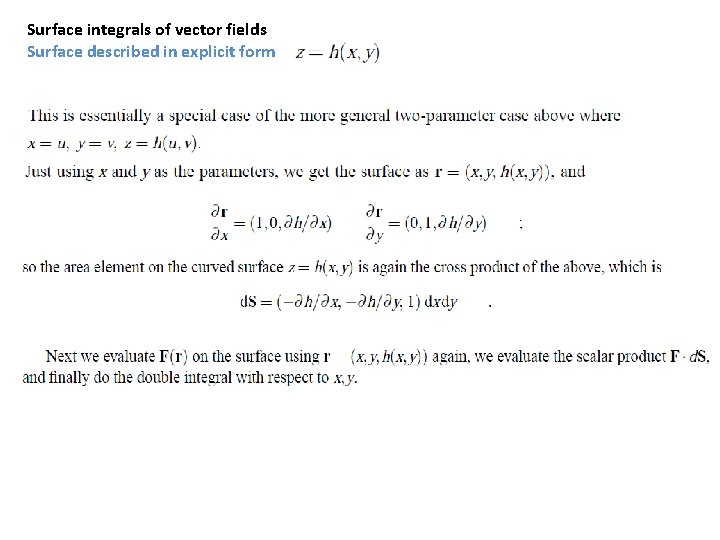
Surface integrals of vector fields Surface described in explicit form
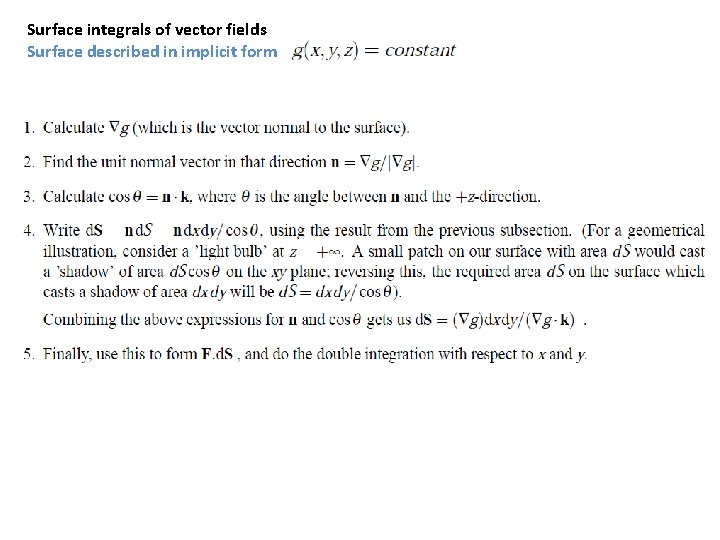
Surface integrals of vector fields Surface described in implicit form
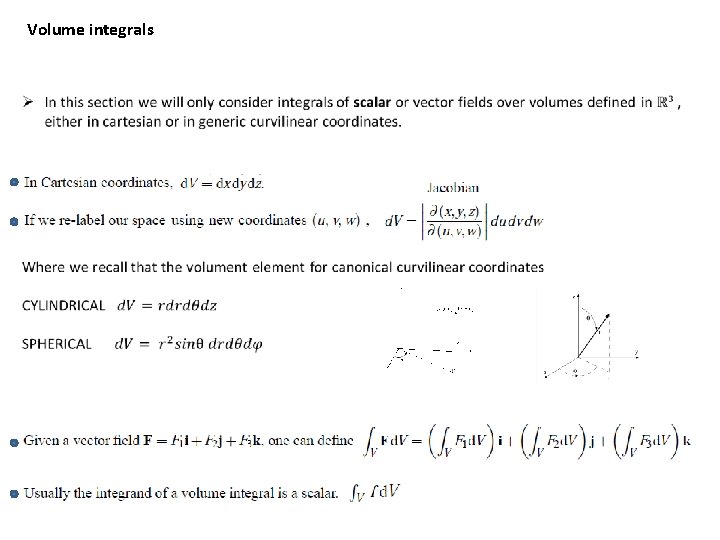
Volume integrals
INTEGRAL THEOREMS
Ø In the preceding sections we have studied how to calculate the integrals of vector fields over curves (line integrals), surfaces, and volumes. Ø It turns out that there exist relations between these kind of integrals in some circumstances. Ø These relations are generically gathered under the label integral theorems. Ø These theorems link the concepts of line and surface integrals through the differential operator
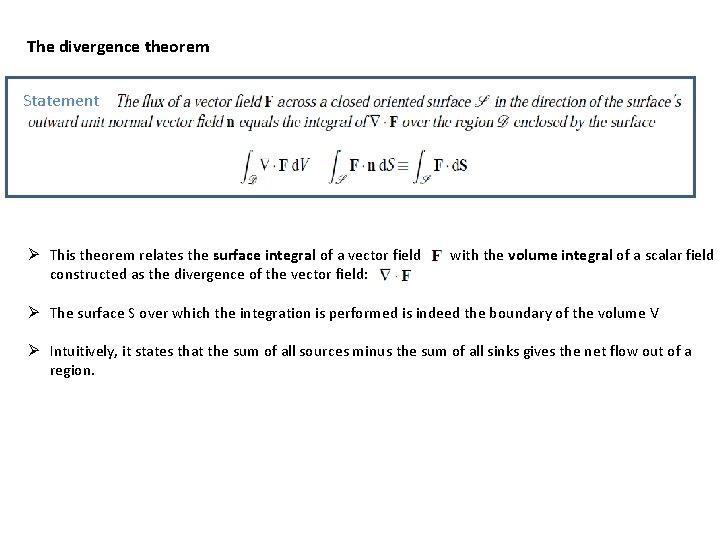
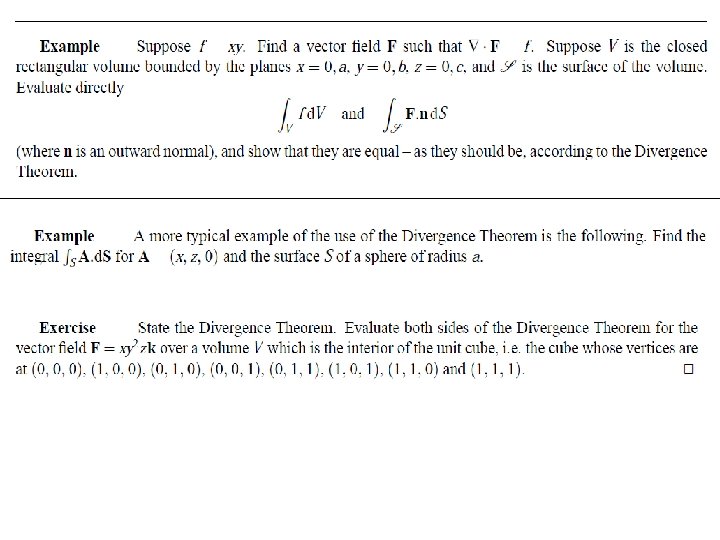
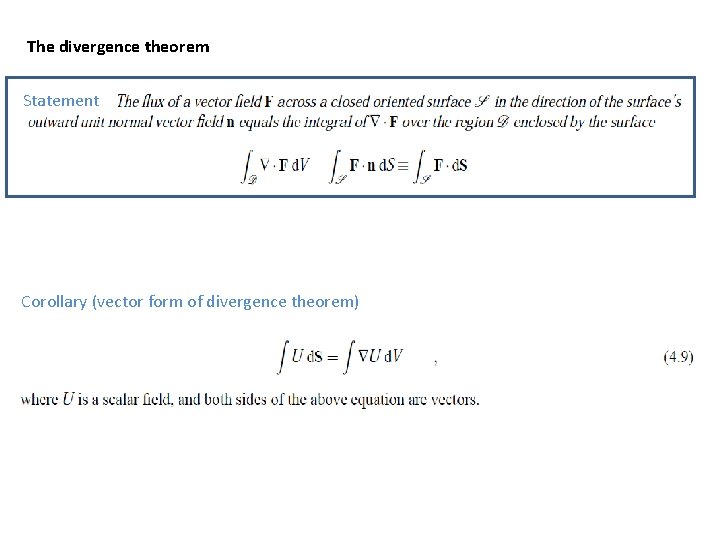
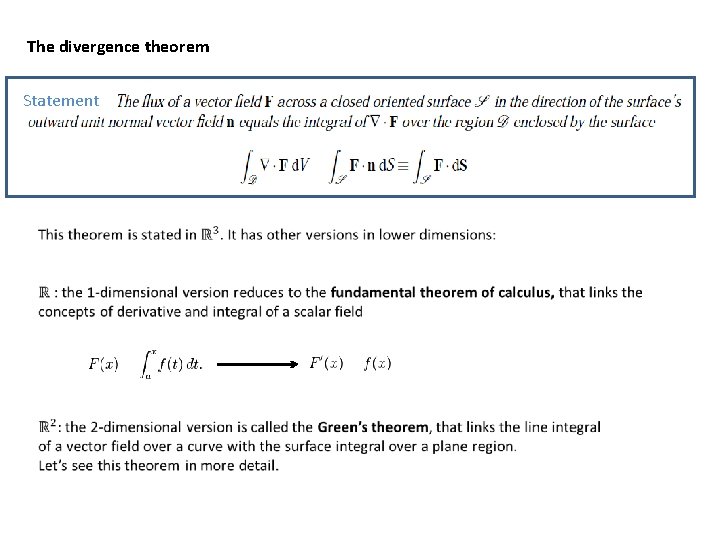
The divergence theorem Statement Ø This theorem relates the surface integral of a vector field constructed as the divergence of the vector field: with the volume integral of a scalar field Ø The surface S over which the integration is performed is indeed the boundary of the volume V Ø Intuitively, it states that the sum of all sources minus the sum of all sinks gives the net flow out of a region.
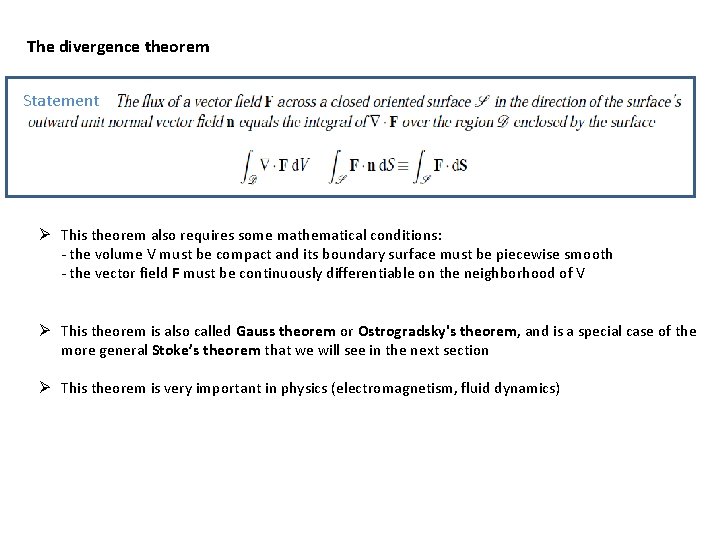
The divergence theorem Statement Ø This theorem also requires some mathematical conditions: - the volume V must be compact and its boundary surface must be piecewise smooth - the vector field F must be continuously differentiable on the neighborhood of V Ø This theorem is also called Gauss theorem or Ostrogradsky's theorem, and is a special case of the more general Stoke’s theorem that we will see in the next section Ø This theorem is very important in physics (electromagnetism, fluid dynamics)
The divergence theorem Statement Corollary (vector form of divergence theorem)
The divergence theorem Statement
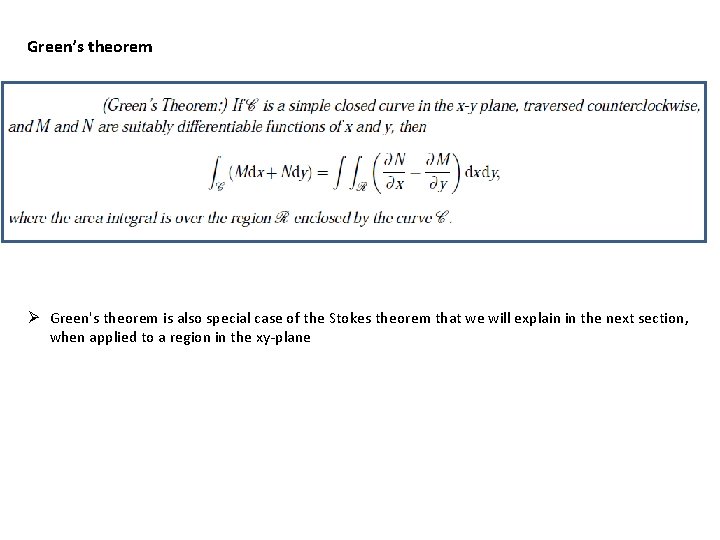
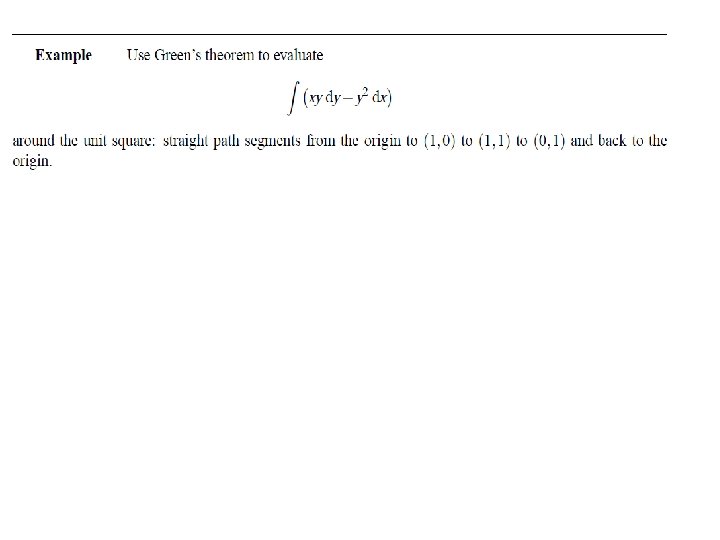
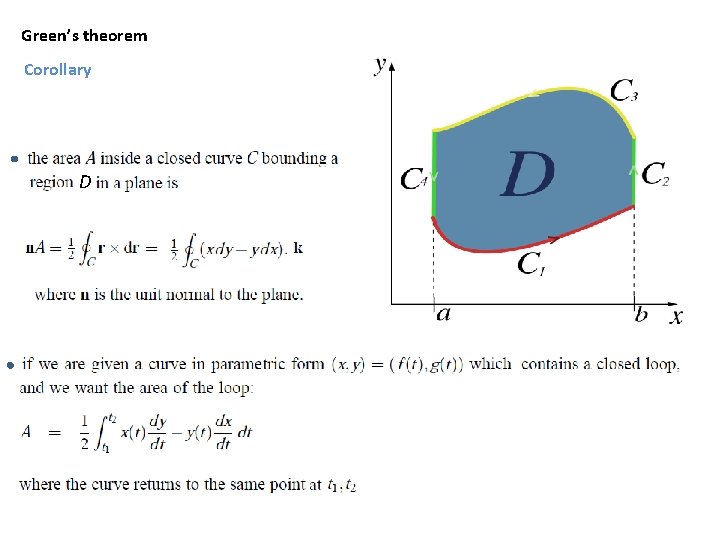
Green’s theorem Ø Green's theorem is also special case of the Stokes theorem that we will explain in the next section, when applied to a region in the xy-plane
Green’s theorem Corollary D
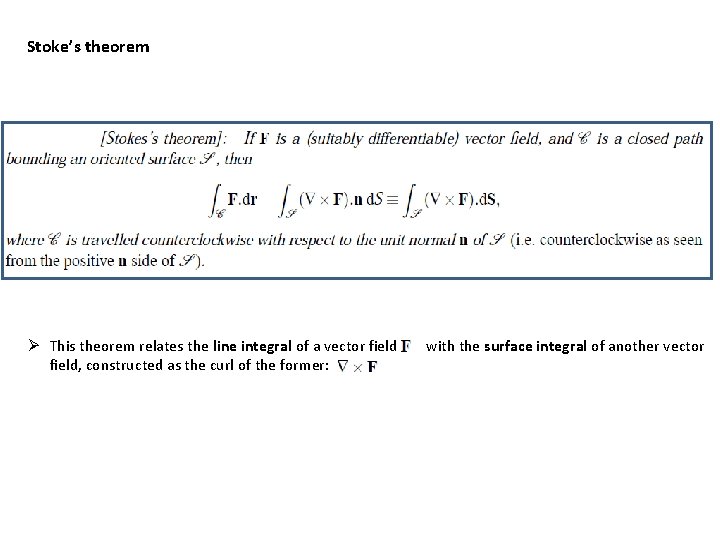
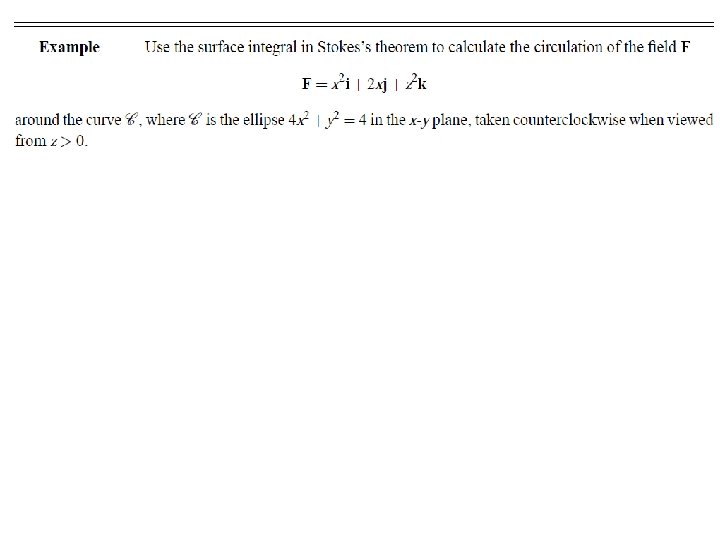
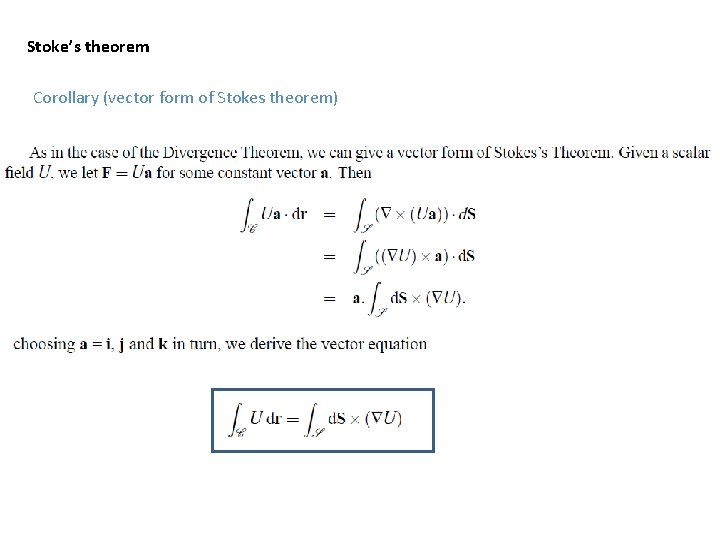
Stoke’s theorem Ø This theorem relates the line integral of a vector field, constructed as the curl of the former: with the surface integral of another vector
Stoke’s theorem Corollary (vector form of Stokes theorem)
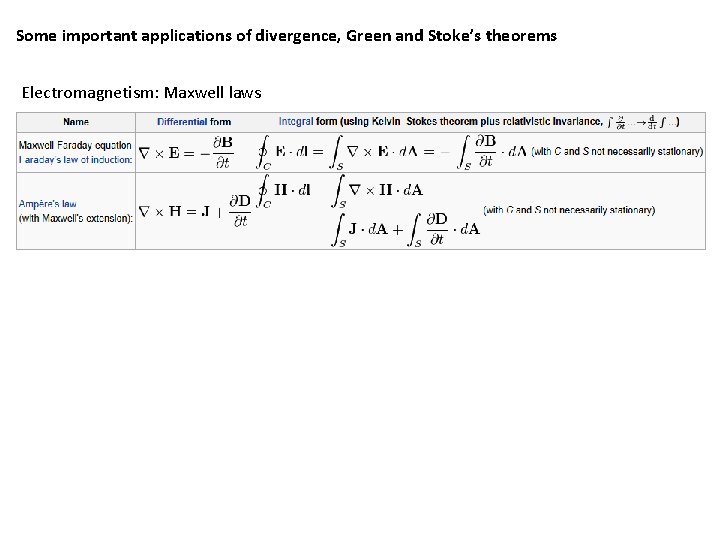
Some important applications of divergence, Green and Stoke’s theorems Electromagnetism: Maxwell laws
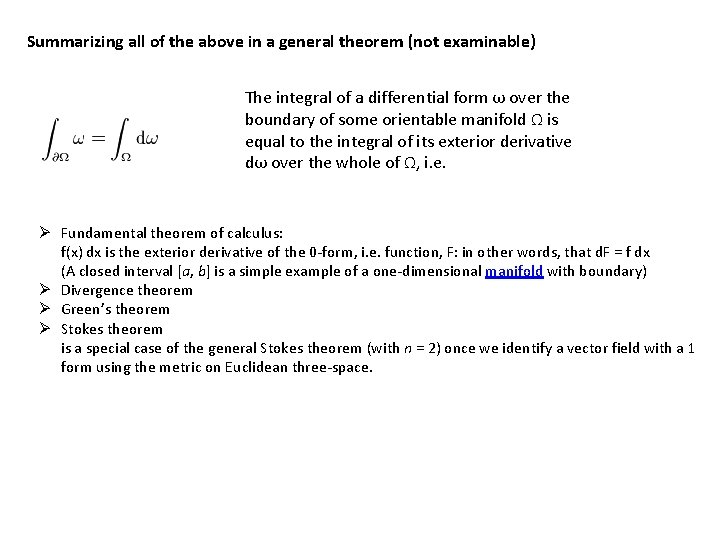
Summarizing all of the above in a general theorem (not examinable) The integral of a differential form ω over the boundary of some orientable manifold Ω is equal to the integral of its exterior derivative dω over the whole of Ω, i. e. Ø Fundamental theorem of calculus: f(x) dx is the exterior derivative of the 0 -form, i. e. function, F: in other words, that d. F = f dx (A closed interval [a, b] is a simple example of a one-dimensional manifold with boundary) Ø Divergence theorem Ø Green’s theorem Ø Stokes theorem is a special case of the general Stokes theorem (with n = 2) once we identify a vector field with a 1 form using the metric on Euclidean three-space.
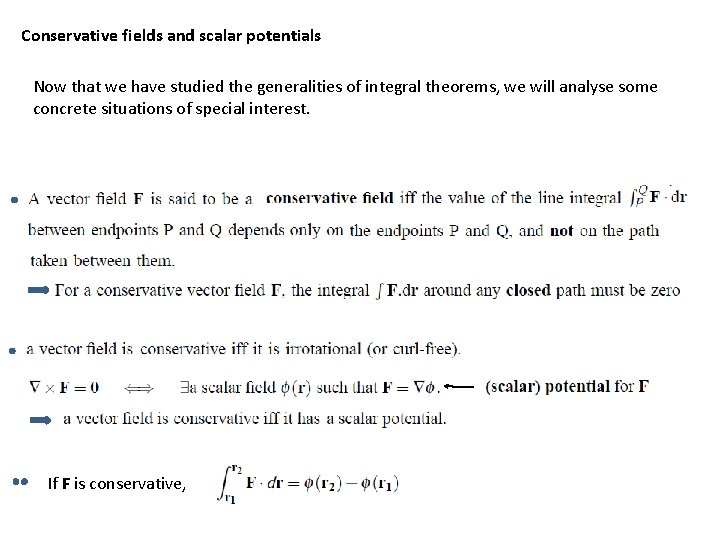
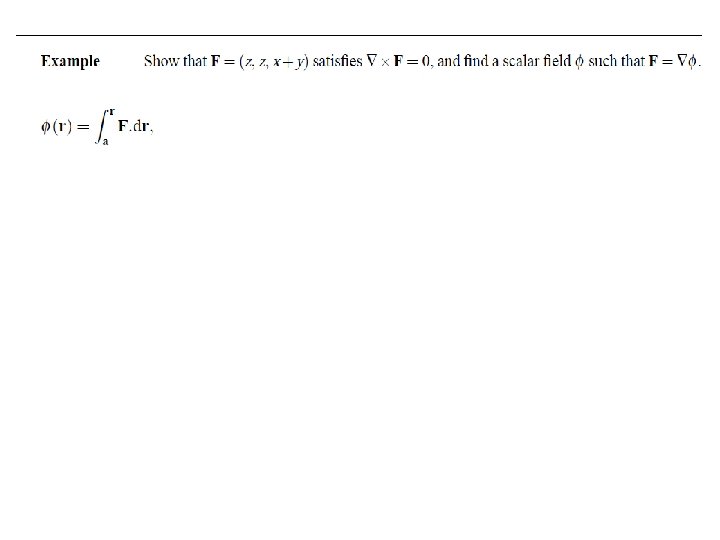
Conservative fields and scalar potentials Now that we have studied the generalities of integral theorems, we will analyse some concrete situations of special interest. If F is conservative,
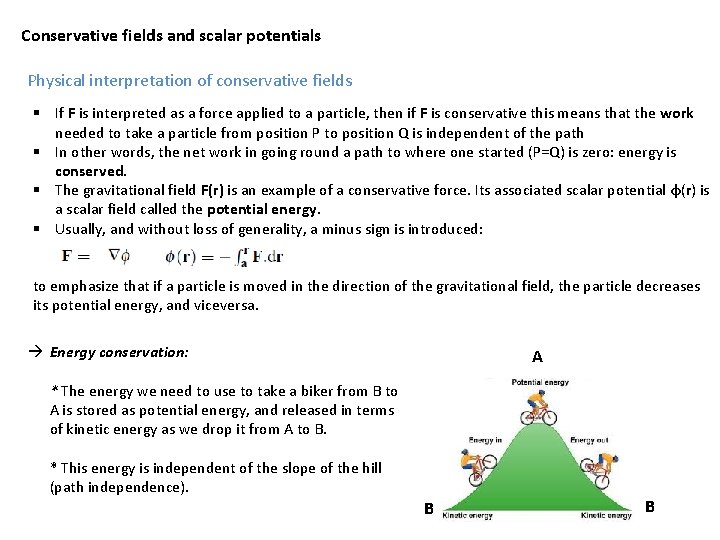
Conservative fields and scalar potentials Physical interpretation of conservative fields § If F is interpreted as a force applied to a particle, then if F is conservative this means that the work needed to take a particle from position P to position Q is independent of the path § In other words, the net work in going round a path to where one started (P=Q) is zero: energy is conserved. § The gravitational field F(r) is an example of a conservative force. Its associated scalar potential φ(r) is a scalar field called the potential energy. § Usually, and without loss of generality, a minus sign is introduced: to emphasize that if a particle is moved in the direction of the gravitational field, the particle decreases its potential energy, and viceversa. à Energy conservation: A * The energy we need to use to take a biker from B to A is stored as potential energy, and released in terms of kinetic energy as we drop it from A to B. * This energy is independent of the slope of the hill (path independence). B B
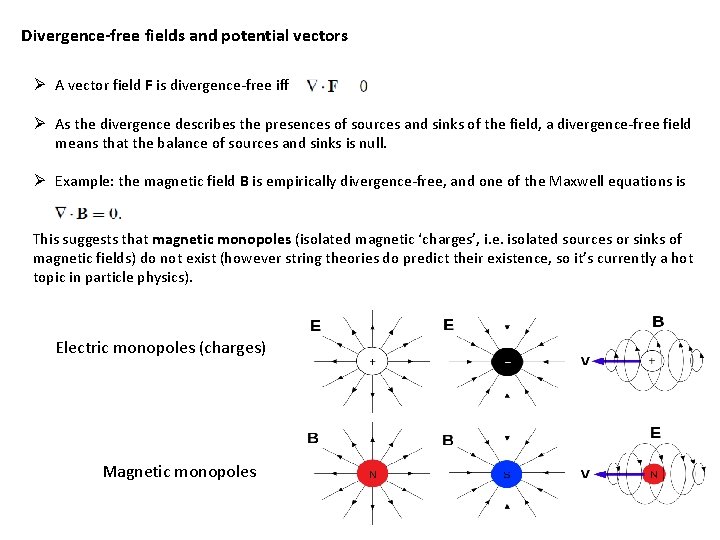
Divergence-free fields and potential vectors Ø A vector field F is divergence-free iff Ø As the divergence describes the presences of sources and sinks of the field, a divergence-free field means that the balance of sources and sinks is null. Ø Example: the magnetic field B is empirically divergence-free, and one of the Maxwell equations is This suggests that magnetic monopoles (isolated magnetic ‘charges’, i. e. isolated sources or sinks of magnetic fields) do not exist (however string theories do predict their existence, so it’s currently a hot topic in particle physics). Electric monopoles (charges) Magnetic monopoles
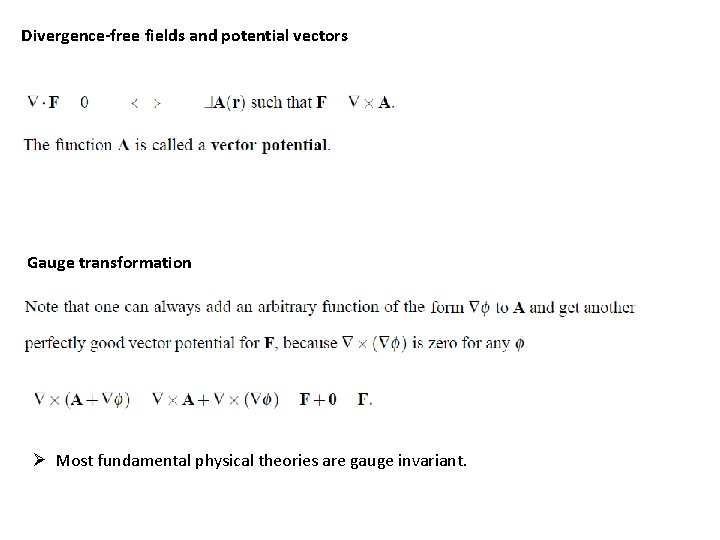
Divergence-free fields and potential vectors Gauge transformation Ø Most fundamental physical theories are gauge invariant.