
CALCULUS I Chapter 1 Functions Graphs and Limits




- Slides: 50
CALCULUS I Chapter 1 Functions, Graphs, and Limits Mr. Saâd BELKOUCH
� Functions � Graph of a Function � Linear Functions � Limits � One-Sided Limits and Continuity 2
Section 1: Functions �A function is a rule that assigns to each object in a set A exactly one object in a set B. The set A is called the domain of the function, and the set of assigned objects in B is called the range. � A function is denoted by a letter such as f, g, h…etc � The value that the function f assigns to the number x in the domain is then denoted by f(x) � f(x) = 2 x 3 + 7 3
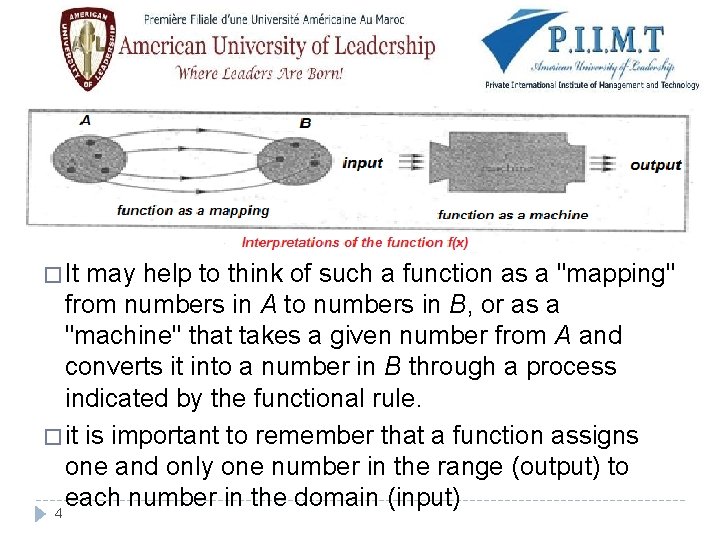
� It may help to think of such a function as a "mapping" from numbers in A to numbers in B, or as a "machine" that takes a given number from A and converts it into a number in B through a process indicated by the functional rule. � it is important to remember that a function assigns one and only one number in the range (output) to each number in the domain (input) 4
Example: � Find f(3) if f(x) = x 2 + 4 � Solution: f(3) = 32 + 4 = 13 � A function assigns one and only one number in the range to each number in the domain. � A functional relationship may be represented by an equation y = f(x) � y is called the dependent variable and x the indepedent variable since the value of y depends on that of x 5
Domain of a function � If a formula is used to define a function f, then we assume the domain of f to be the set of all numbers for which f(x) is defined. We refer to this as the natural domain of f � Example: f (x) = 1 / ( x - 1) � x can take any real number except 1 since x = 1 would make the denominator equal to zero and the division by zero is not allowed in mathematics. Hence the domain in interval notation is given by: (-infinity , 1) U (1 , +infinity) 6
Example: � Find the domain and range of each of these functions. f(x) = � Solution Since division by any number other than 0 is possible, the domain of f is the set of all numbers x such that x - 3 ≠ 0; that is, x ≠ 3. The range of f is the set of all numbers y except 0, since for any y≠ 0, there is an x such that y = 1/x-3 in particular, x= 3+ 7
Example: � Find the domain and range of this function. g(x) = � Solution Since negative numbers do not have real square roots, g(t) can be evaluated only when t- 2 ≥ 0, so the domain of g is the set of all numbers t such that t≥ 2. The range of g is the set of all nonnegative numbers, if y≥ 0, there is a t such that y = ; namely, t = +2. 8
Composition of functions � Given functions f(u) and g(x), the composition f(g(x)) is the function of x formed by substituting u = g(x) for u in the formula for f(u). � In other words, it is a combination of two functions, where you apply the first function, get an answer, and then fill that answer into the second function. � Note that the composite function f(g(x)) "makes sense" only if the domain of f contains the range of g 9
� Here are two simple functions, which we'll label f and g: f(x) = 4 x 2 - 1 g(x) = 3 x + 2 The composite function value we want is f( g(2) ) First work out g(2) = 3(2) + 2 = 8 Then work out f(8) = 4(8)2 - 1 = 4(64) - 1 = 255 So f( g(2) ) = 255 Notice that you do the inside function first. Then you fill that answer into the outside function. 10
The Difference Quotient �A difference quotient is an expression of the general form where f is a given function of x and h is a number � The difference quotient is used in the definition of the derivative 11
Section 2: The graph of a function � The graph of a function is a diagram that exhibits a relationship between two sets of numbers as a set of points (or plot) having coordinates determined by the function. � Graphs have visual impact. They also reveal information that may not be evident from verbal or algebraic descriptions. 12
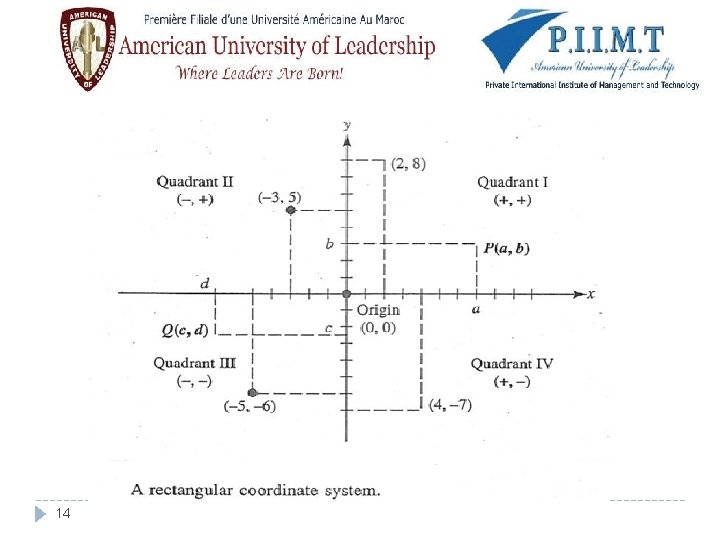
Rectangular coordinate system �A rectangular coordinate system (or Cartesian coordinate system) is defined by an ordered pair of perpendicular lines (coordinate axes), generally a single unit of length for both axes, and an orientation for each axis. � The coordinate axes separate the plane into four parts called quadrants � Any point P in the plane can be associated with a unique ordered pair of numbers (a, b) called the coordinates of P. � a is the x coordinate (or abscissa) and b is called the y 13 coordinate (or ordinate).
14
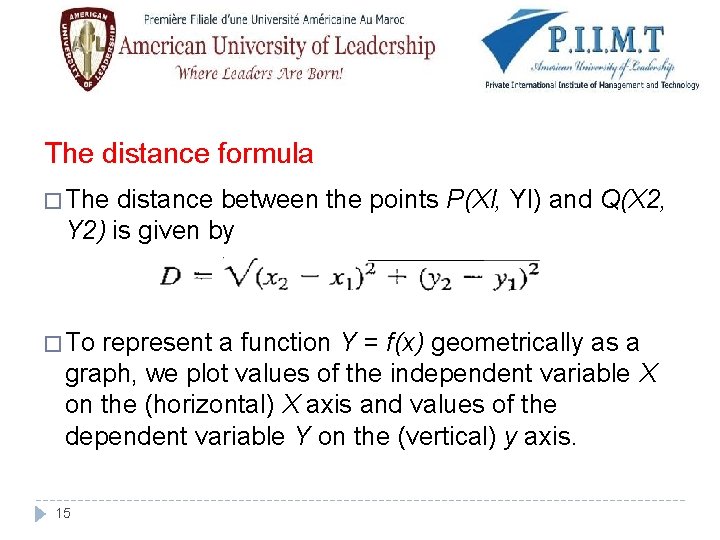
The distance formula � The distance between the points P(Xl, Yl) and Q(X 2, Y 2) is given by � To represent a function Y = f(x) geometrically as a graph, we plot values of the independent variable X on the (horizontal) X axis and values of the dependent variable Y on the (vertical) y axis. 15
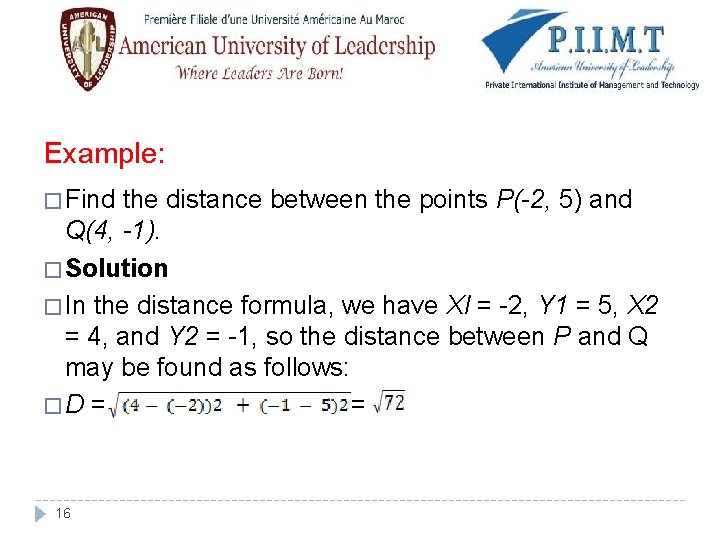
Example: � Find the distance between the points P(-2, 5) and Q(4, -1). � Solution � In the distance formula, we have Xl = -2, Y 1 = 5, X 2 = 4, and Y 2 = -1, so the distance between P and Q may be found as follows: �D = = 16
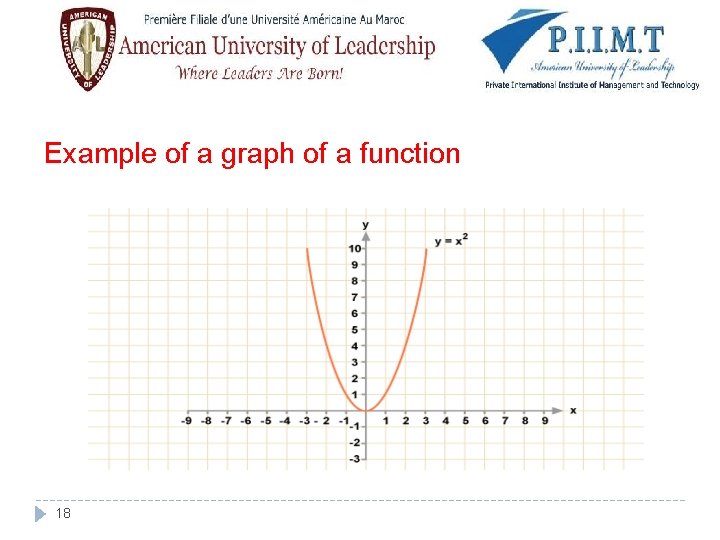
The graph of a function � The graph of a function f consists of all points (x, y) where x is in the domain of f and y = f(x); that is, all points of the form (x, f(x)). 17
Example of a graph of a function 18
Y and x intercepts � The points (if any) where a graph crosses the x axis are called x intercepts, and similarly, a y intercept is a point where the graph crosses the y axis. � To find any x intercept, set y = 0 and solve for x. To find any Y intercept, set x = 0 and solve for y. 19
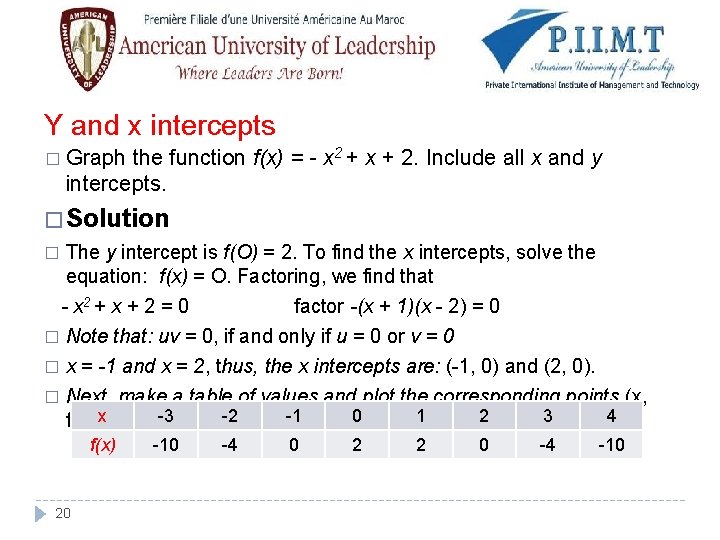
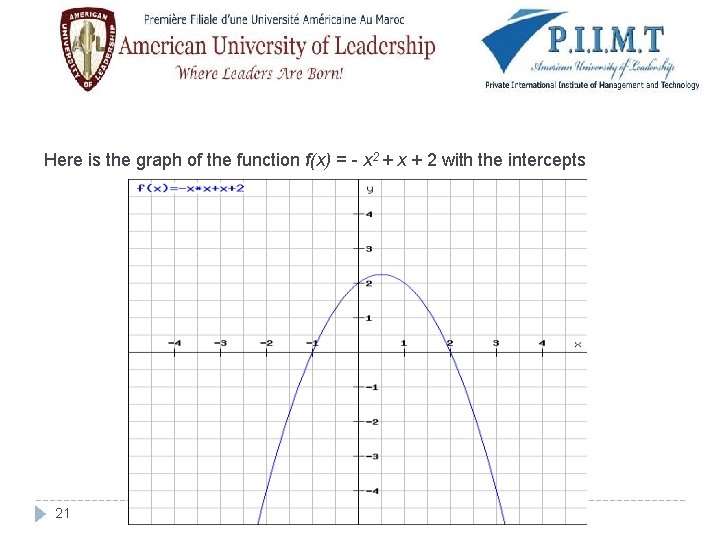
Y and x intercepts � Graph the function f(x) = - x 2 + x + 2. Include all x and y intercepts. � Solution The y intercept is f(O) = 2. To find the x intercepts, solve the equation: f(x) = O. Factoring, we find that - x 2 + x + 2 = 0 factor -(x + 1)(x - 2) = 0 � Note that: uv = 0, if and only if u = 0 or v = 0 � x = -1 and x = 2, thus, the x intercepts are: (-1, 0) and (2, 0). � � Next, make a table of values and plot the corresponding points (x, -3 -2 -1 0 1 2 3 4 f(x)). x f(x) 20 -10 -4 0 2 2 0 -4 -10
Here is the graph of the function f(x) = - x 2 + x + 2 with the intercepts 21
Graphing Parabolas � In general, the graph of y = Ax 2 + Bx + C is a parabola as long as A #0. All parabolas have a "U shape, " and the parabola y = Ax 2 + Bx + C opens up if A > 0 and down if A < O. The "peak". � To graph a reasonable parabola, we should know: � The location of the vertex ( where x = -B/2 A ) � Whether the parabola opens up (A > 0) or down (A < 0) � Any intercepts Example: y = -x 2 + x + 2 22
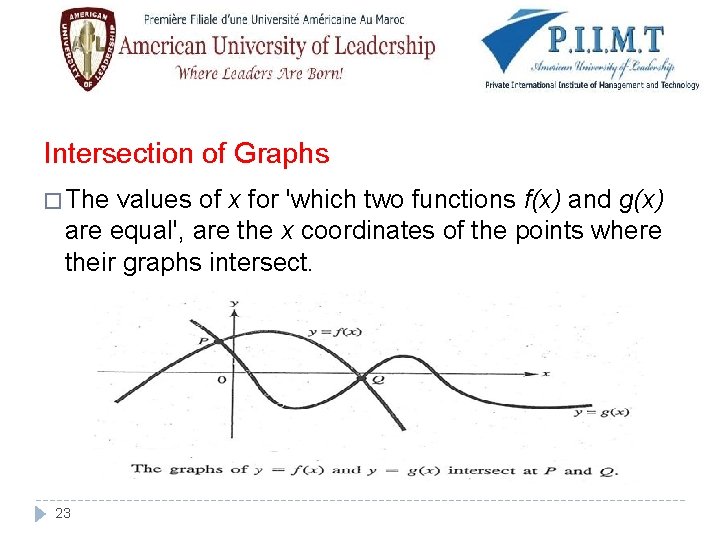
Intersection of Graphs � The values of x for 'which two functions f(x) and g(x) are equal', are the x coordinates of the points where their graphs intersect. 23
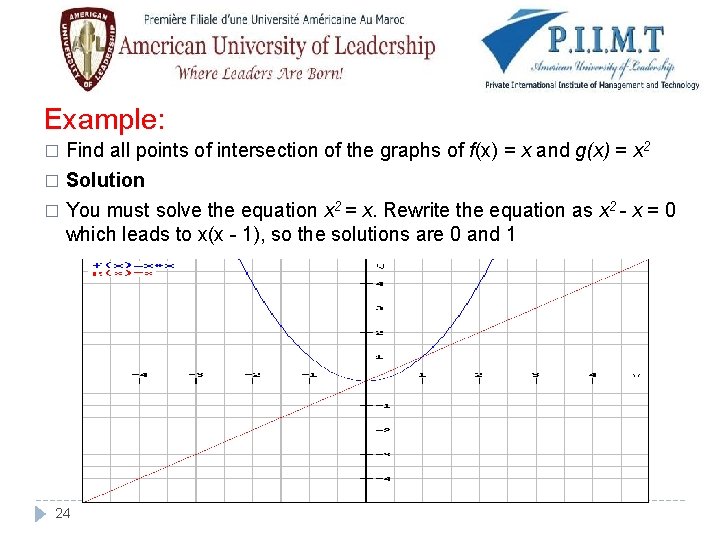
Example: Find all points of intersection of the graphs of f(x) = x and g(x) = x 2 � Solution � � You must solve the equation x 2 = x. Rewrite the equation as x 2 - x = 0 which leads to x(x - 1), so the solutions are 0 and 1 24
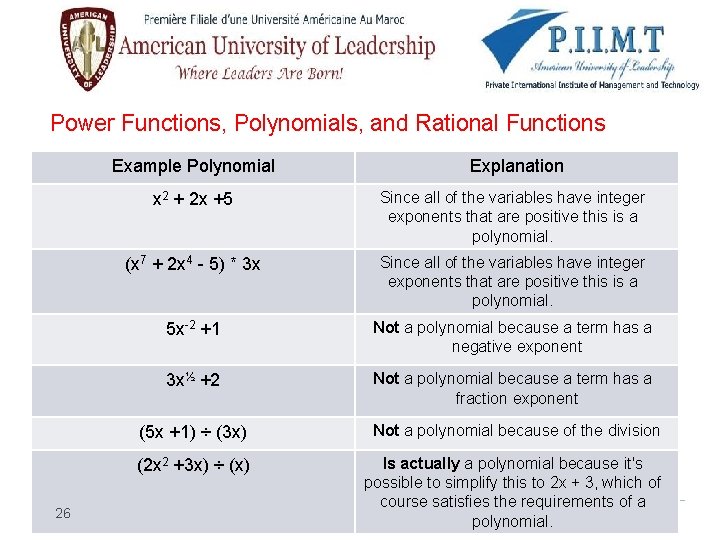
Power Functions, Polynomials, and Rational Functions �A polynomial is a function of the form p(x) = an. xn" + an-1 xx-1 +…………+ alx + ao where n is a nonnegative integer and ao, a 1, ………. . , an are constants. The integer n (when not equal to zero) is called the degree of the polynomial A quotient of two polynomials p(x) and q(x) is called a rational function. 25
Power Functions, Polynomials, and Rational Functions 26 Example Polynomial Explanation x 2 + 2 x +5 Since all of the variables have integer exponents that are positive this is a polynomial. (x 7 + 2 x 4 - 5) * 3 x Since all of the variables have integer exponents that are positive this is a polynomial. 5 x-2 +1 Not a polynomial because a term has a negative exponent 3 x½ +2 Not a polynomial because a term has a fraction exponent (5 x +1) ÷ (3 x) Not a polynomial because of the division (2 x 2 +3 x) ÷ (x) Is actually a polynomial because it's possible to simplify this to 2 x + 3, which of course satisfies the requirements of a polynomial.
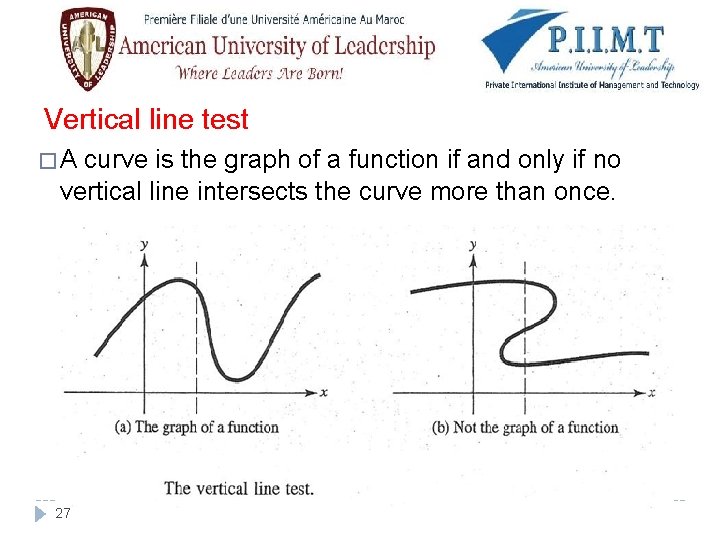
Vertical line test �A curve is the graph of a function if and only if no vertical line intersects the curve more than once. 27
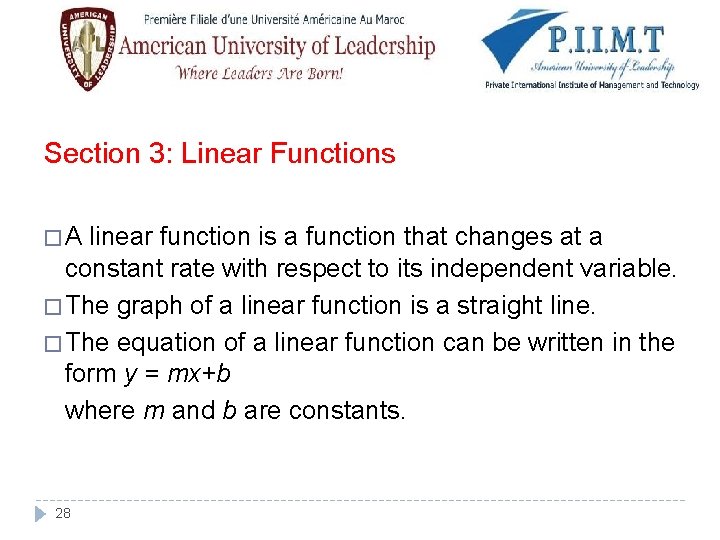
Section 3: Linear Functions �A linear function is a function that changes at a constant rate with respect to its independent variable. � The graph of a linear function is a straight line. � The equation of a linear function can be written in the form y = mx+b where m and b are constants. 28
The Slope of a Line � The slope of the nonvertical line passing through the points (Xl, YI) and (X 2, Y 2) is given by the formula Slope = (Y 2 – Y 1) / (X 2 – X 1) Since the graph of a linear function (Y = mx + b) is represented by a line it has only one Y intercept which is b � We say that y=mx+b is the equation of the line whose slope is m and whose Y intercept is (0, b). 29
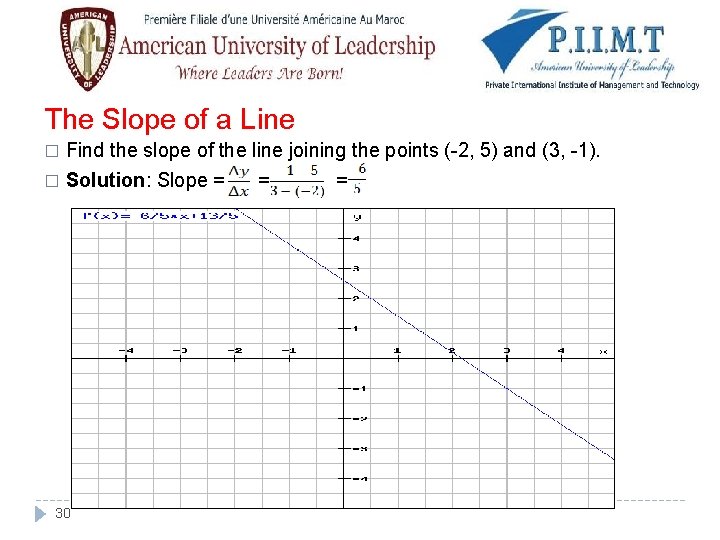
The Slope of a Line Find the slope of the line joining the points (-2, 5) and (3, -1). � Solution: Slope = = = � 30
The Point-Slope Form � The equation y - yo = m(x - xo) is an equation of the line that passes through the point (xo, yo) and that has slope equal to m. 31
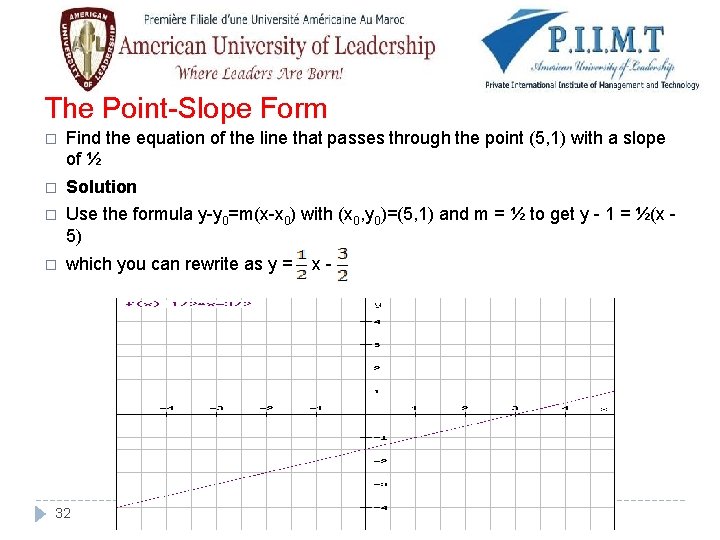
The Point-Slope Form � Find the equation of the line that passes through the point (5, 1) with a slope of ½ � Solution � Use the formula y-y 0=m(x-x 0) with (x 0, y 0)=(5, 1) and m = ½ to get y - 1 = ½(x 5) � which you can rewrite as y = 32 x-
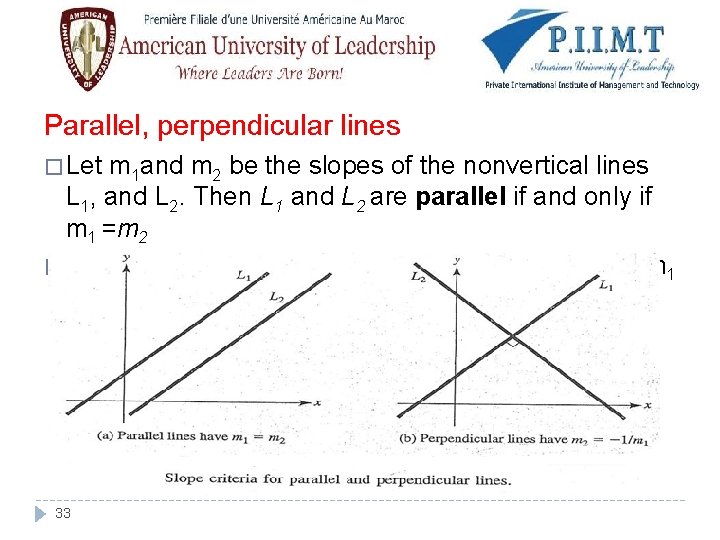
Parallel, perpendicular lines � Let m 1 and m 2 be the slopes of the nonvertical lines L 1, and L 2. Then L 1 and L 2 are parallel if and only if m 1 =m 2 � L 1 and L 2 are perpendicular if and only if m 2 = -1/ m 1 33
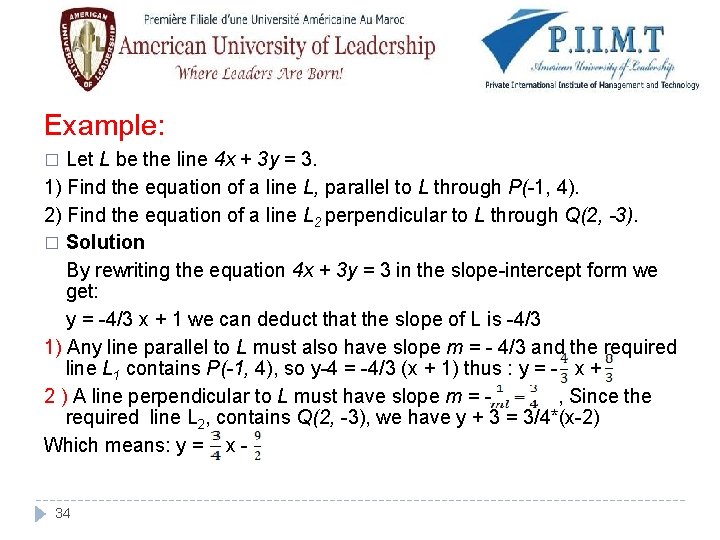
Example: Let L be the line 4 x + 3 y = 3. 1) Find the equation of a line L, parallel to L through P(-1, 4). 2) Find the equation of a line L 2 perpendicular to L through Q(2, -3). � Solution By rewriting the equation 4 x + 3 y = 3 in the slope-intercept form we get: y = -4/3 x + 1 we can deduct that the slope of L is -4/3 1) Any line parallel to L must also have slope m = - 4/3 and the required line L 1 contains P(-1, 4), so y-4 = -4/3 (x + 1) thus : y = - x + 2 ) A line perpendicular to L must have slope m = , Since the required line L 2, contains Q(2, -3), we have y + 3 = 3/4*(x-2) Which means: y = x � 34
Section 4: Limits � Let f(x) = 2 x + 2 and compute f(x) as x takes values closer to 1. We first consider values of x approaching 1 from the left (x < 1), then we consider x approaching 1 from the right (x > 1). � In both cases as x approaches 1, f(x) approaches 4. Intuitively, we say that limx→ 1 f(x) = 4. 35
The limit of a Function � If f(x) gets closer and closer to a number L as x gets closer and closer to c from both sides, then L is the limit of f(x) as x approaches c. The behavior is expressed by writing Lim f(x) = L X C Note: the limit of a constant is the constant itself, and the limit of f(x) = x as x approaches c is c. 36
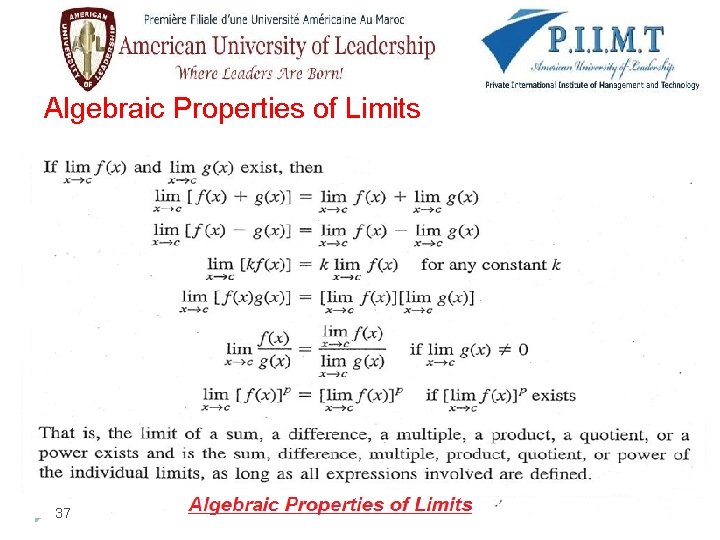
Algebraic Properties of Limits 37
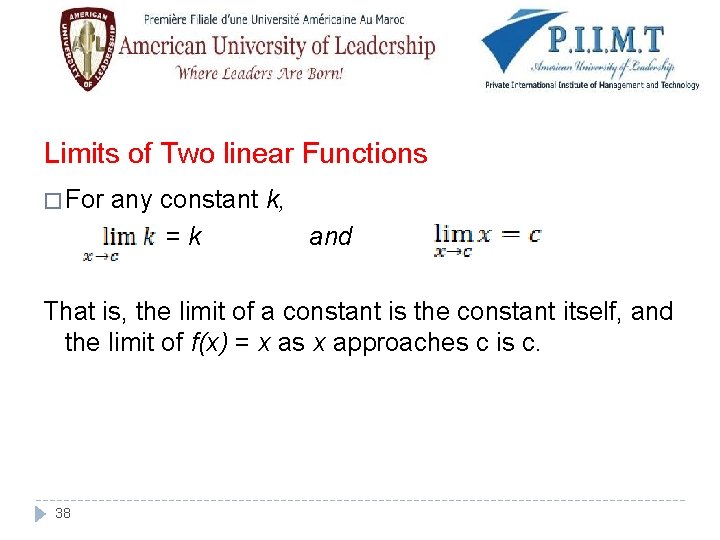
Limits of Two linear Functions � For any constant k, =k and That is, the limit of a constant is the constant itself, and the limit of f(x) = x as x approaches c is c. 38
39
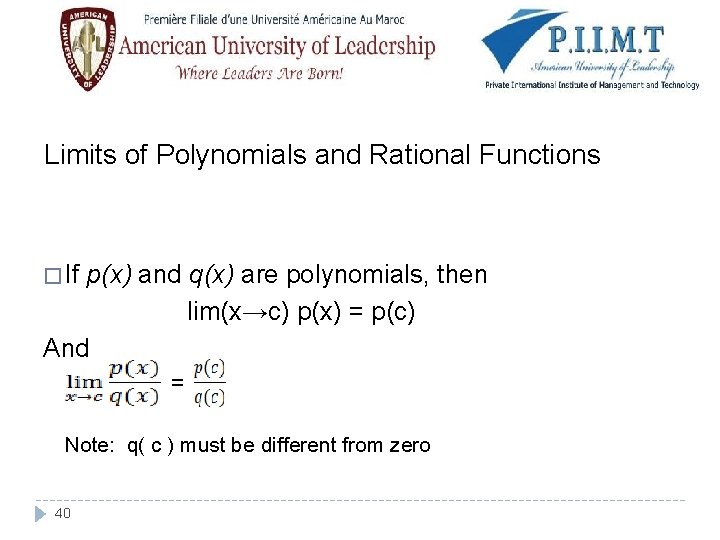
Limits of Polynomials and Rational Functions � If p(x) and q(x) are polynomials, then lim(x→c) p(x) = p(c) And = Note: q( c ) must be different from zero 40
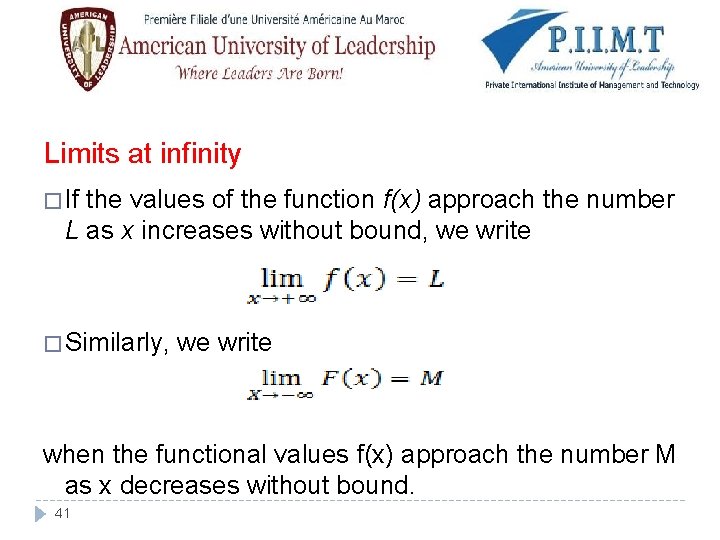
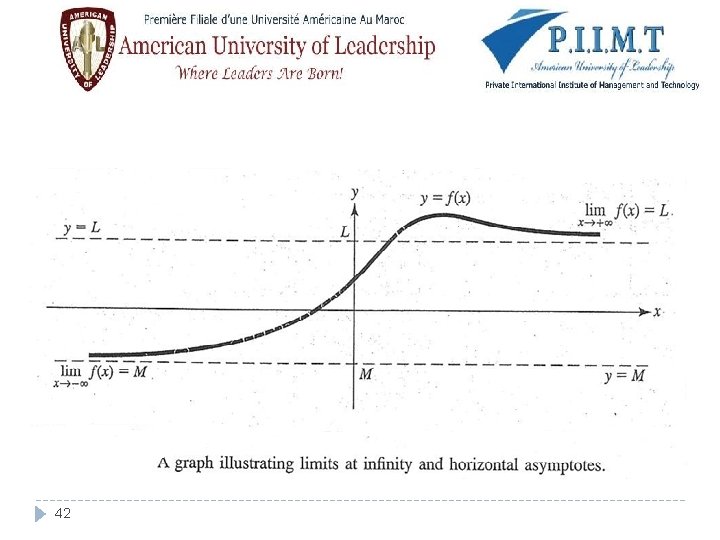
Limits at infinity � If the values of the function f(x) approach the number L as x increases without bound, we write � Similarly, we write when the functional values f(x) approach the number M as x decreases without bound. 41
42
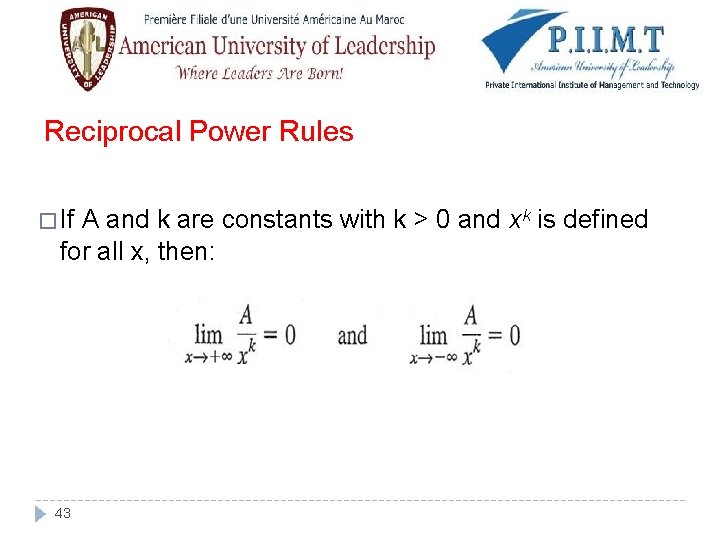
Reciprocal Power Rules � If A and k are constants with k > 0 and xk is defined for all x, then: 43
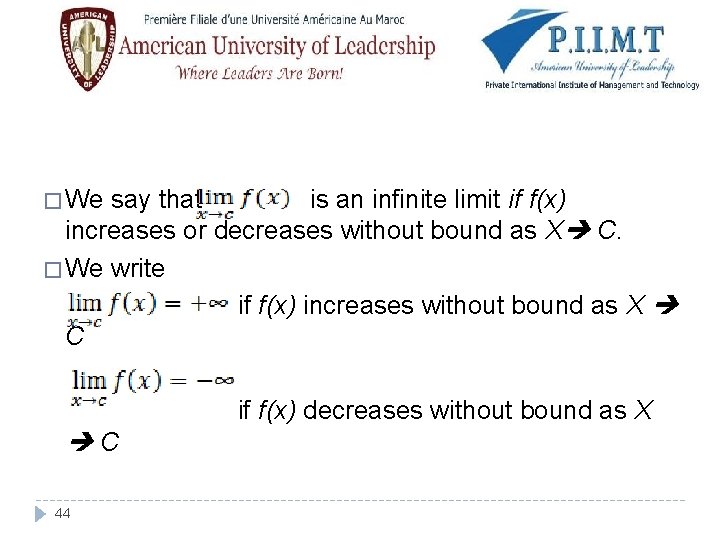
� We say that is an infinite limit if f(x) increases or decreases without bound as X C. � We write if f(x) increases without bound as X C if f(x) decreases without bound as X C 44
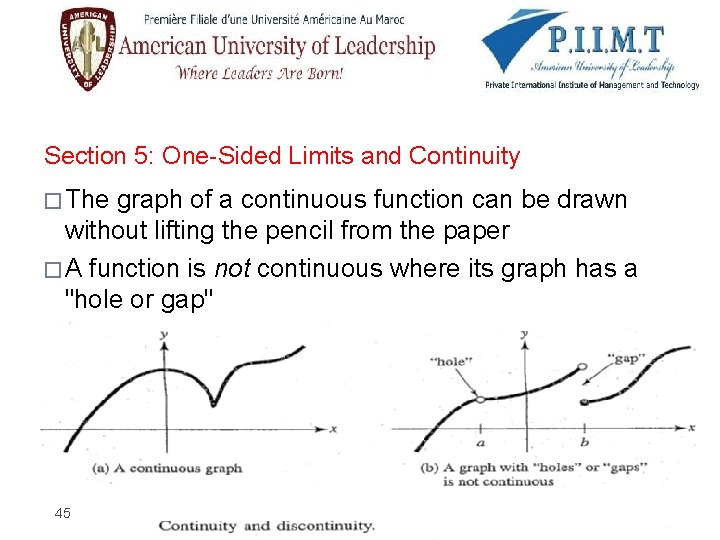
Section 5: One-Sided Limits and Continuity � The graph of a continuous function can be drawn without lifting the pencil from the paper � A function is not continuous where its graph has a "hole or gap" 45
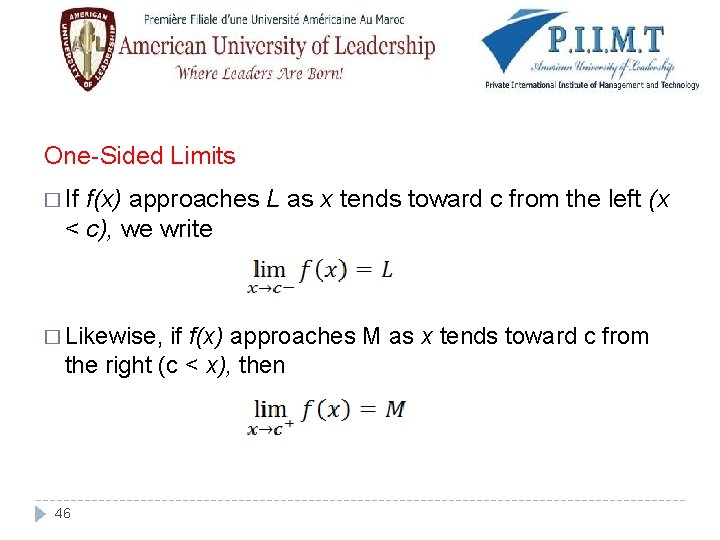
One-Sided Limits � If f(x) approaches L as x tends toward c from the left (x < c), we write � Likewise, if f(x) approaches M as x tends toward c from the right (c < x), then 46
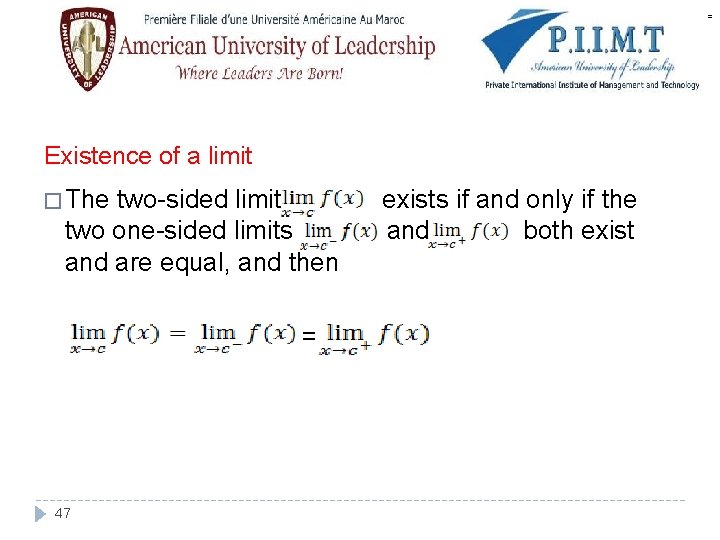
= Existence of a limit � The two-sided limit two one-sided limits and are equal, and then = 47 exists if and only if the and both exist
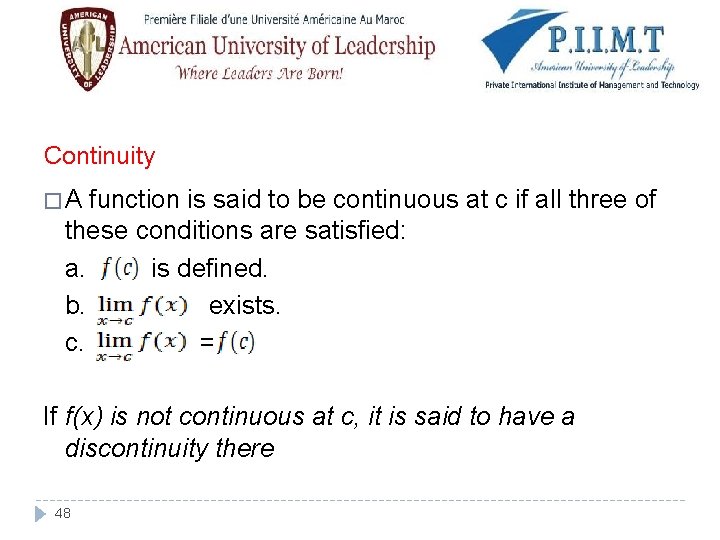
Continuity �A function is said to be continuous at c if all three of these conditions are satisfied: a. is defined. b. exists. c. = If f(x) is not continuous at c, it is said to have a discontinuity there 48
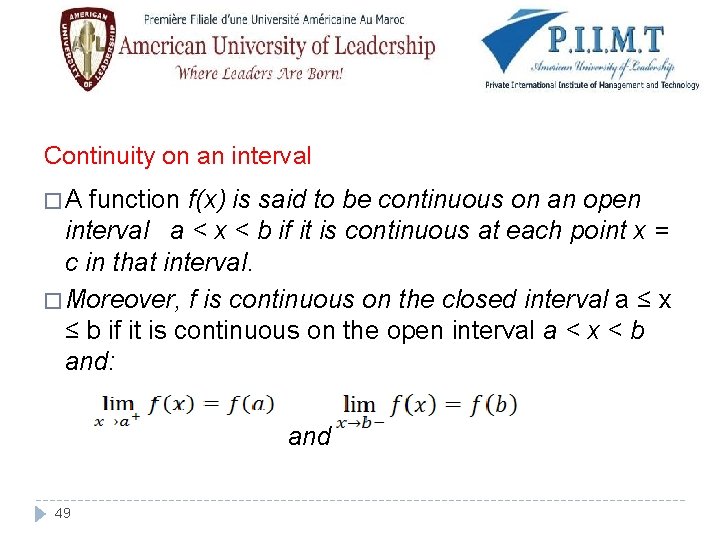
Continuity on an interval �A function f(x) is said to be continuous on an open interval a < x < b if it is continuous at each point x = c in that interval. � Moreover, f is continuous on the closed interval a ≤ x ≤ b if it is continuous on the open interval a < x < b and: and 49
END OF CHAPTER I 50