
Calculation of radiation produced by dark current in
Calculation of radiation produced by dark current in the Cornell ERL Lisa Nash, University of North Carolina at Chapel Hill Advisor: Val Kostroun
Motivation • Radiation fields from dark current in unknown • Measurements will be taken later this month – Goal of project was to simulate possible results
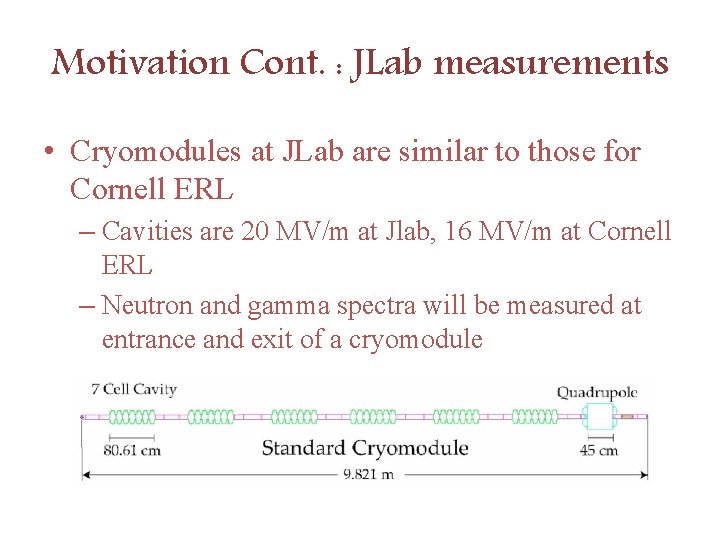
Motivation Cont. : JLab measurements • Cryomodules at JLab are similar to those for Cornell ERL – Cavities are 20 MV/m at Jlab, 16 MV/m at Cornell ERL – Neutron and gamma spectra will be measured at entrance and exit of a cryomodule
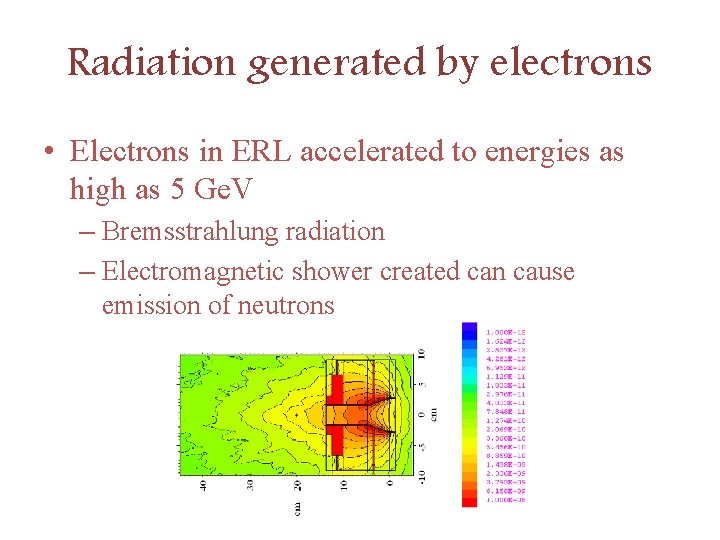
Radiation generated by electrons • Electrons in ERL accelerated to energies as high as 5 Ge. V – Bremsstrahlung radiation – Electromagnetic shower created can cause emission of neutrons

Monte-Carlo • Probability distributions randomly sampled to determine the outcome of each step – Reliability of models is important e+ e- g

Monte-Carlo Method and MCNP • 1930 s : Fermi used method to solve problems in neutron physics, but never published results. • WWII: Statistical sampling to solve problems discussed at LANL by several scientists. Method named for Monte-Carlo casino. • 1963: First general-purpose particle transport code developed at LANL • 1977: MCNP developed as Monte-Carlo Neutron Photon (now Monte-Carlo N-Particle, MCNPX=Monte-Carlo N-Particle e. Xtension)

Old Monte-Carlo code card
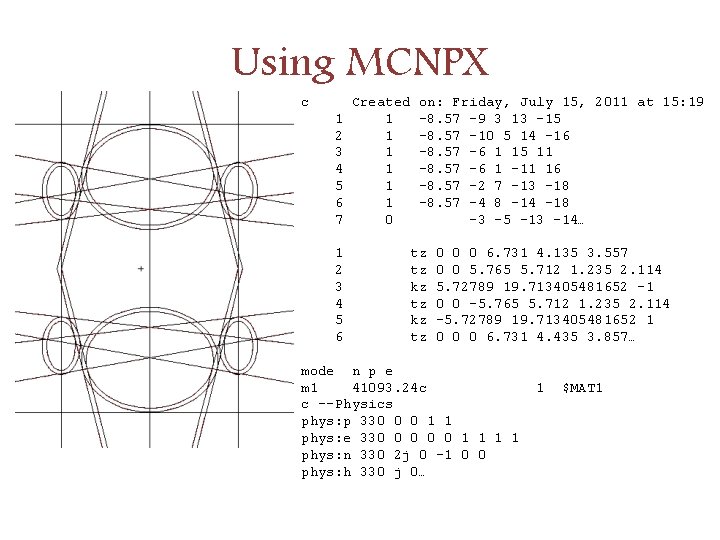
Using MCNPX c 1 2 3 4 5 6 7 1 2 3 4 5 6 Created 1 1 1 0 on: Friday, July 15, 2011 at 15: 19 -8. 57 -9 3 13 -15 -8. 57 -10 5 14 -16 -8. 57 -6 1 15 11 -8. 57 -6 1 -11 16 -8. 57 -2 7 -13 -18 -8. 57 -4 8 -14 -18 -3 -5 -13 -14… tz tz kz tz 0 0 0 6. 731 4. 135 3. 557 0 0 5. 765 5. 712 1. 235 2. 114 5. 72789 19. 713405481652 -1 0 0 -5. 765 5. 712 1. 235 2. 114 -5. 72789 19. 713405481652 1 0 0 0 6. 731 4. 435 3. 857… mode n p e m 1 41093. 24 c c --Physics phys: p 330 0 0 1 1 phys: e 330 0 0 1 1 phys: n 330 2 j 0 -1 0 0 phys: h 330 j 0… 1 $MAT 1
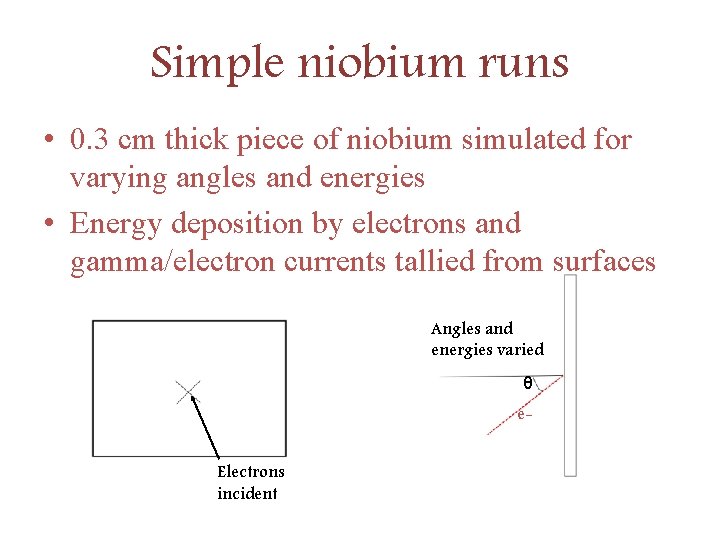
Simple niobium runs • 0. 3 cm thick piece of niobium simulated for varying angles and energies • Energy deposition by electrons and gamma/electron currents tallied from surfaces Angles and energies varied θ e. Electrons incident
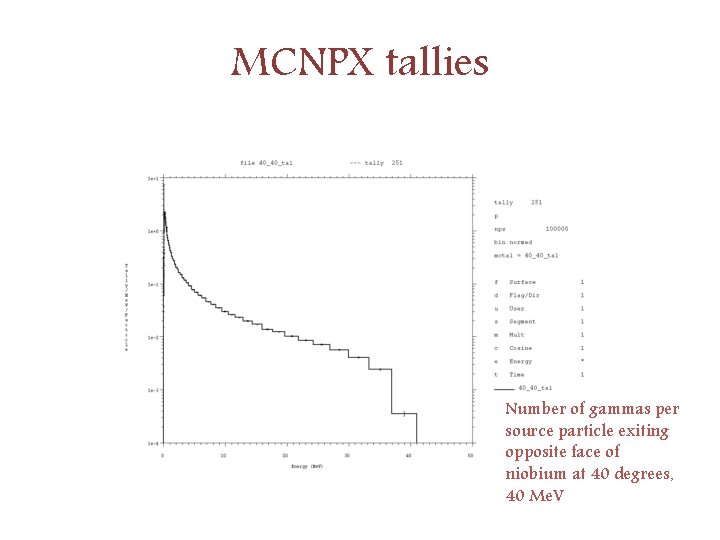
MCNPX tallies Number of gammas per source particle exiting opposite face of niobium at 40 degrees, 40 Me. V

Spatial distribution of radiation Gamma fluence at 0 degrees Gamma fluence at 80 degrees
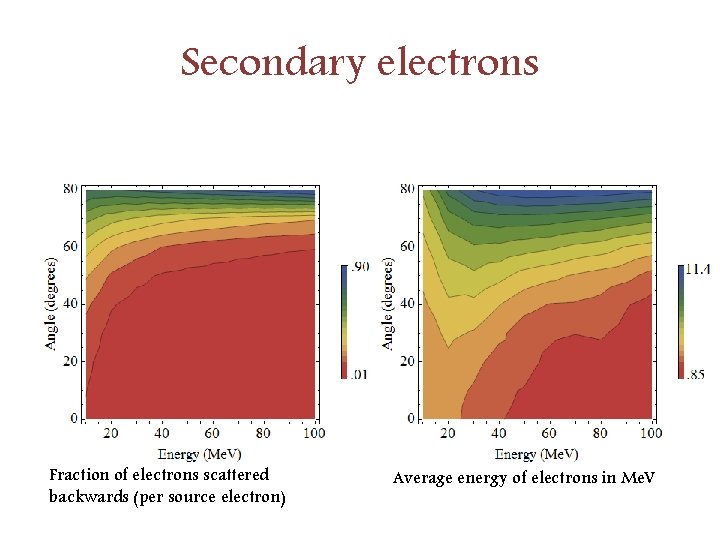
Secondary electrons Fraction of electrons scattered backwards (per source electron) Average energy of electrons in Me. V
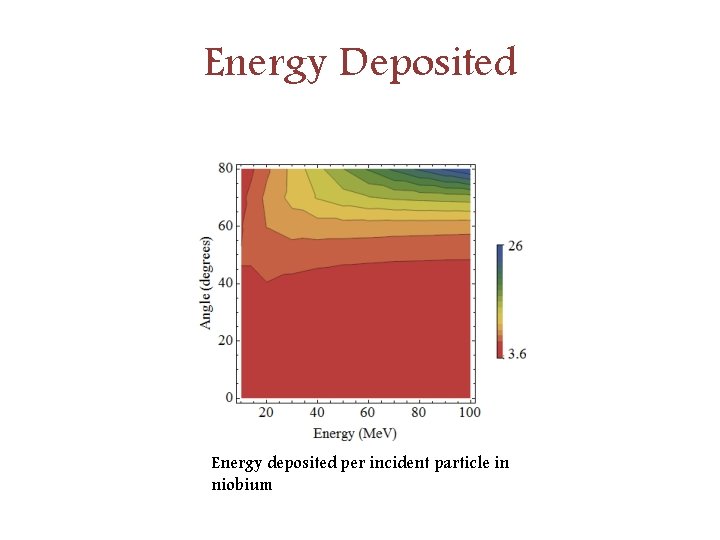
Energy Deposited Energy deposited per incident particle in niobium
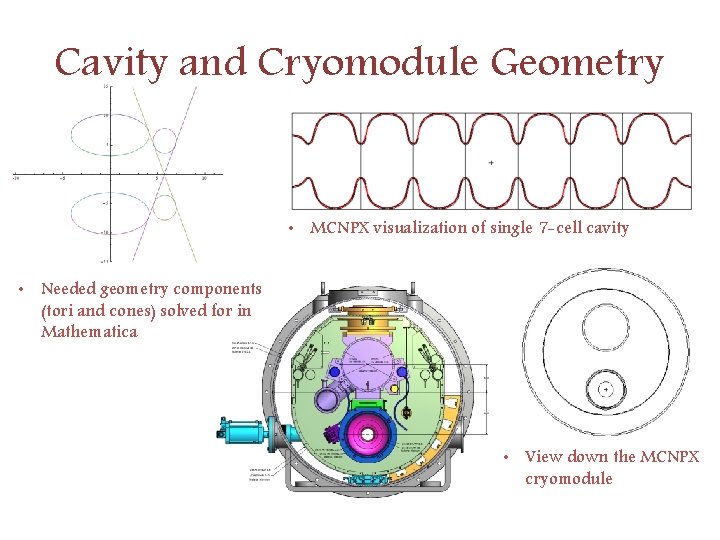
Cavity and Cryomodule Geometry • MCNPX visualization of single 7 -cell cavity • Needed geometry components (tori and cones) solved for in Mathematica • View down the MCNPX cryomodule
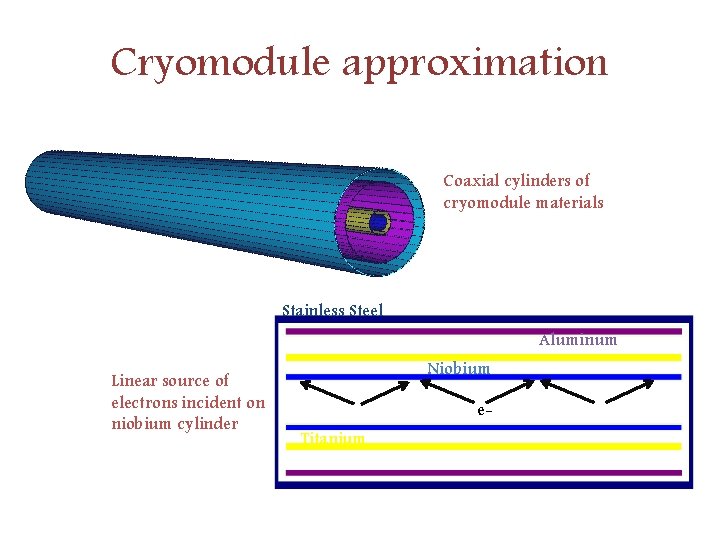
Cryomodule approximation Coaxial cylinders of cryomodule materials Stainless Steel Aluminum Linear source of electrons incident on niobium cylinder Niobium e. Titanium
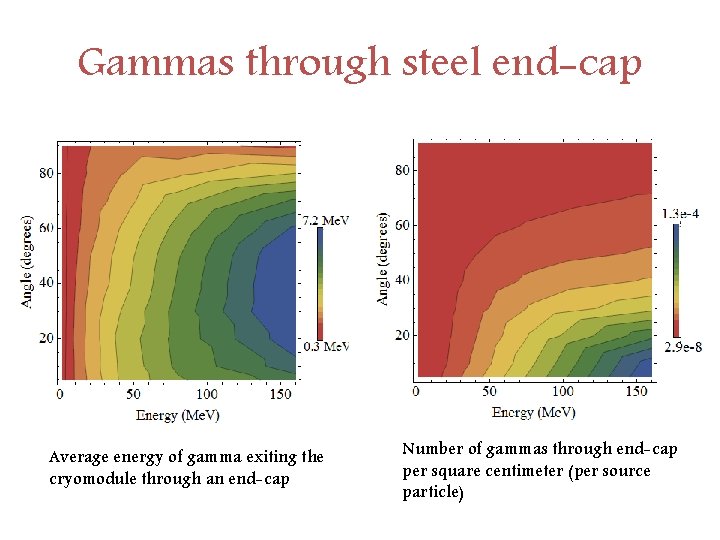
Gammas through steel end-cap Average energy of gamma exiting the cryomodule through an end-cap Number of gammas through end-cap per square centimeter (per source particle)
Summary • Varying degrees of detail have been added to problem geometry and are ready for simulation with Christie’s data • Val is preparing for measurement at the end of August
Acknowledgements • I would like to thank Val for teaching me about nuclear physics and simulations in MCNPX and everyone involved in setting up the REU program • This work was supported by the NFS

Questions?
- Slides: 19