
Calculation of Power Systems Inertia and Frequency Response

- Slides: 17
Calculation of Power Systems Inertia and Frequency Response Dino Porretta Steven Porretta Principal Engineer Ergo. Sum Inc. School of Computer Science University of Carleton dinoporretta@Ergosumweb. com stevenporretta@scs. carleton. ca http: //ergosumweb. com/
Introduction • Fundamental changes are taking place in the way that electricity is produced and consumed. • These changes are raising concerns about the deterioration of Inertial and Frequency Responses and the need to monitor them. • This paper presents a practical method to calculate the value of these Responses. • This paper focusses on generation losses. The concepts presented apply equally well to load losses. End
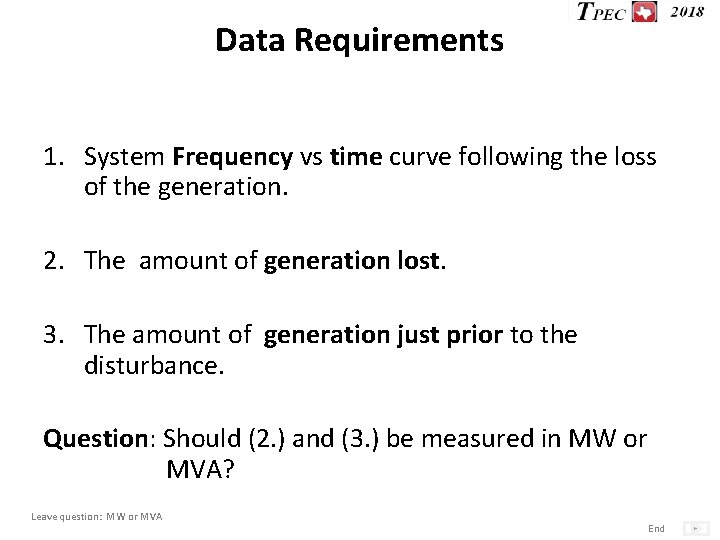
Data Requirements 1. System Frequency vs time curve following the loss of the generation. 2. The amount of generation lost. 3. The amount of generation just prior to the disturbance. Question: Should (2. ) and (3. ) be measured in MW or MVA? Leave question: MW or MVA End
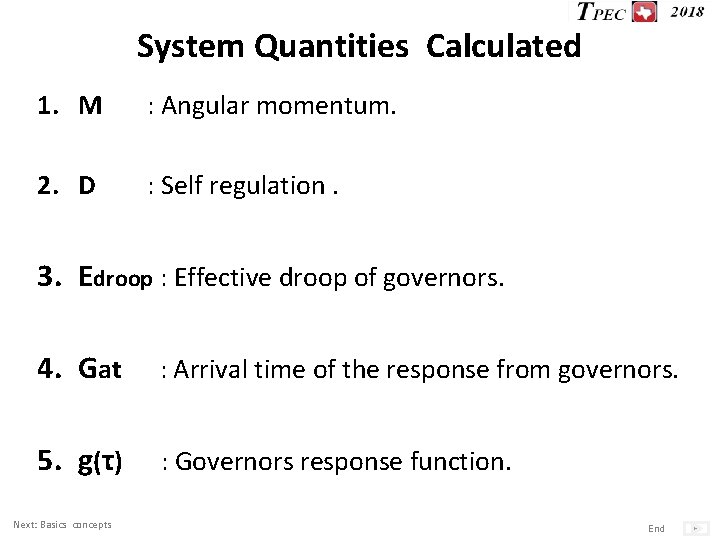
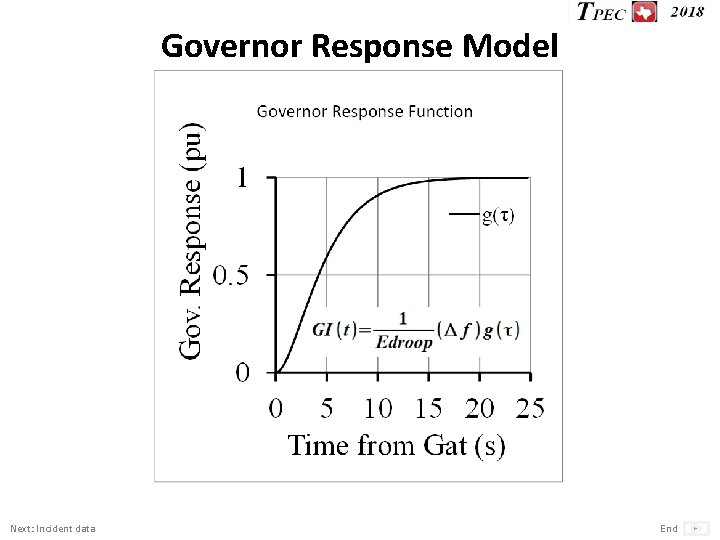
System Quantities Calculated 1. M : Angular momentum. 2. D : Self regulation. 3. Edroop : Effective droop of governors. 4. Gat : Arrival time of the response from governors. 5. g(τ) : Governors response function. Next: Basics concepts End
What Is Frequency Response ? 1. Frequency Response (FR) is the megawatt change in the Generation-Load imbalance affected by the system itself due to frequency changes alone. 2. FR derives from: a. Frequency characteristics of equipment. b. Generator governors. These two responses are fundamentally different. End
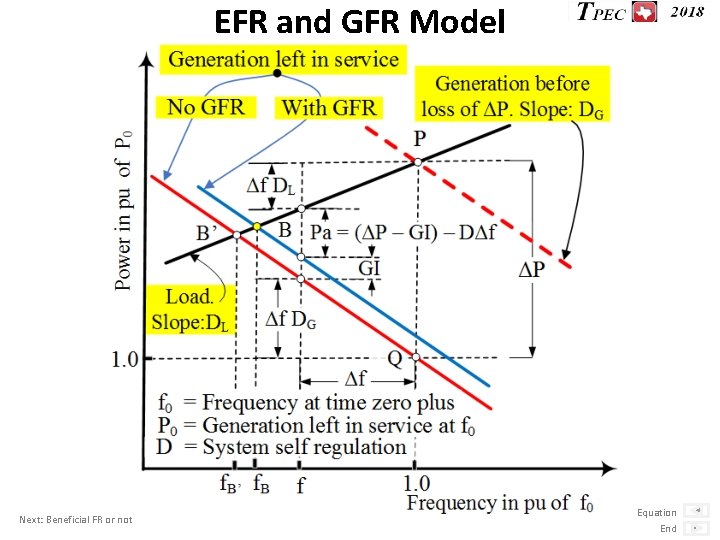
Equipment and Governor Frequency Responses 1. Equipment Frequency Response (EFR) is deployed with no delay as the frequency starts to change. Its magnitude is a result of equipment physics and design practices and it does not require changing input power to prime movers. 2. Governor Frequency Response (GFR) is deployed with a delay of about 2 to 5 seconds with full deployment 2 to 5 seconds later. Its magnitude is a result of governor Droop settings and generator loading practices and it does require changing input power to prime movers. Next: Frequency response diagram End
EFR and GFR Model Next: Beneficial FR or not Equation End
Beneficial and Non-Beneficial EFR 1. Not all equipment provide beneficial EFR. 2. To be beneficial EFR has to oppose frequency change. Question: Can a system without beneficial frequency response be operated? Next: Inertial response Beneficial FR perhaps just as important as Inertia. End
What Is Inertial Response ? This response is consistent with the following equation: (2) For a generation loss: The left hand side of this equation represents the Inertial Response. At all times, the Inertial Response is equal to the accelerating power (Pa). Equation Next: Inertial response vs Frequency response End
Inertial Response Vs Frequency Response 1. Frequency Response reduces the accelerating power. Therefore: a. It decreases the rate of frequency decay b. It arrests the frequency decay 2. Inertial Response does not change the accelerating power, it only matches it. Therefore: a. Has no impact on the value at which frequency decay is arrested b. Higher M values decrease the rate of frequency decay Next: Frequency Dev. Eq. End
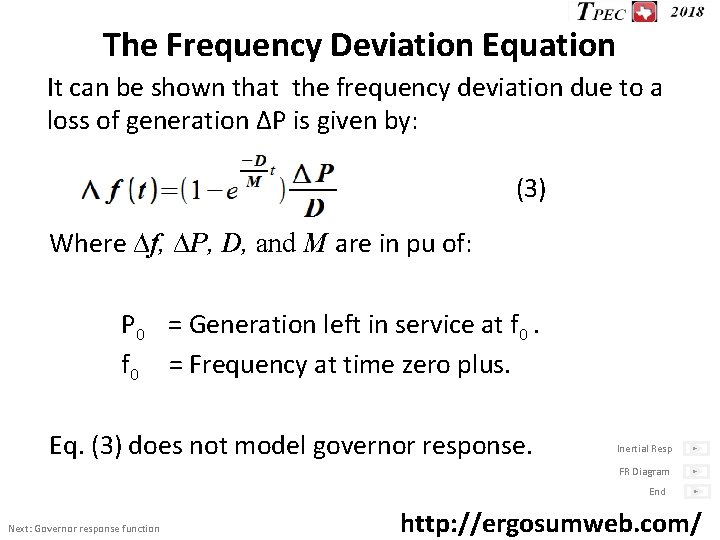
The Frequency Deviation Equation It can be shown that the frequency deviation due to a loss of generation ∆P is given by: (3) Where ∆f, ∆P, D, and M are in pu of: P 0 = Generation left in service at f 0 = Frequency at time zero plus. Eq. (3) does not model governor response. Inertial Resp FR Diagram End Next: Governor response function http: //ergosumweb. com/
Governor Response Model Next: Incident data End
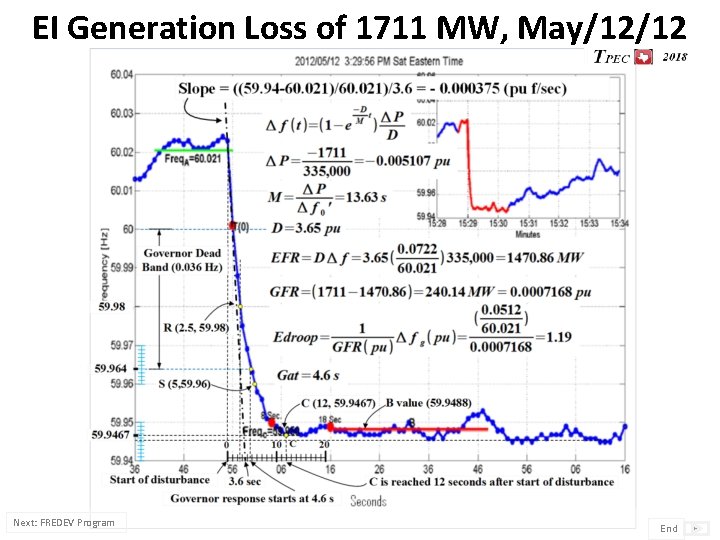
EI Generation Loss of 1711 MW, May/12/12 Next: FREDEV Program End
FREDEV Program
Result Analysis 1. Governor frequency response lower than expected: Edroop 119%, response 240 MW. 2. Equipment frequency response higher than expected: D 3. 65 pu, response of 1471 MW. 3. Governors frequency response arrives later than expected: 3. 9 s to 23. 9 s after disturbance. 4. System M of 13. 65 s higher than that of highest inertia generator: due to the kinetic energy stored in motors. 5. There is evidence of governor response withdrawal: 20%, starting at 30 seconds. End
Conclusions 1. This paper has presented a method to calculate Inertia and Frequency Responses using data gathered for significant frequency events. 2. The calculations were done using the FREDEV program. This program is ideally suited for monitoring the following quantities: a. Inertia and Frequency Responses. b. Inertia from motor loads. c. Adherence to governor settings guidelines. d. Governor response withdrawal practices. e. Optimize under-frequency protection settings. End
The End