
Calculation of Permeability Parameter of Perforated Wall K
Calculation of Permeability Parameter of Perforated Wall K. -D. Suh, Y. W. Kim, C. -H. Ji Seoul National University ICCE 2010, Shanghai 1
Contents Definition of permeability parameter n Laboratory experiments n Empirical formula n Validation n Conclusion n ICCE 2010, Shanghai 2
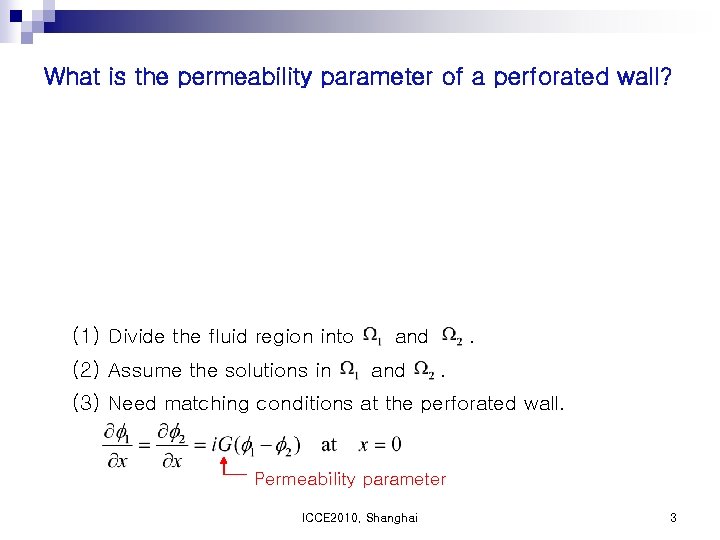
What is the permeability parameter of a perforated wall? (1) Divide the fluid region into (2) Assume the solutions in and . . (3) Need matching conditions at the perforated wall. Permeability parameter ICCE 2010, Shanghai 3
Permeability parameter, G n G indicates (1) resistance of the wall and (2) phase difference between front and back of the wall due to inertial effects. n Formulas of Mei et al. (1974) and Sollitt and Cross (1972) are widely used. n In this study, we deal with Sollitt and Cross (1972) formula. ICCE 2010, Shanghai 4
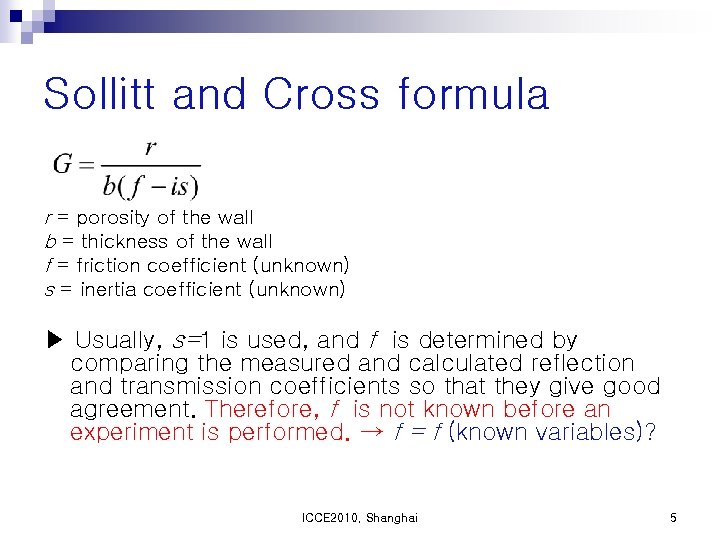
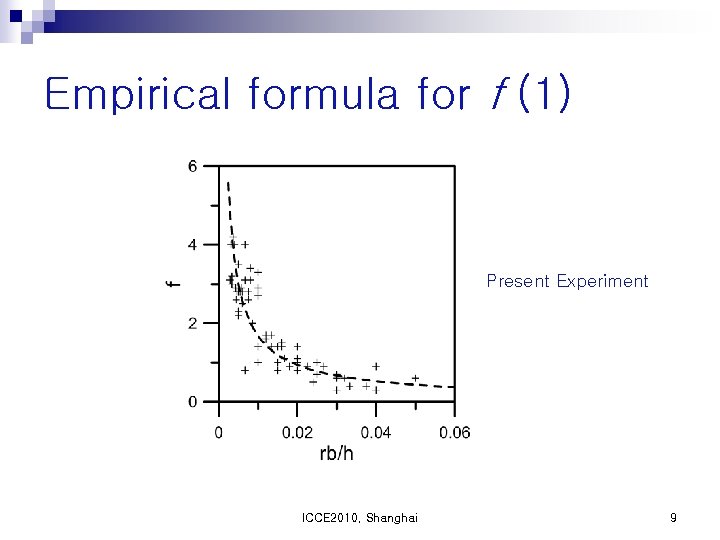
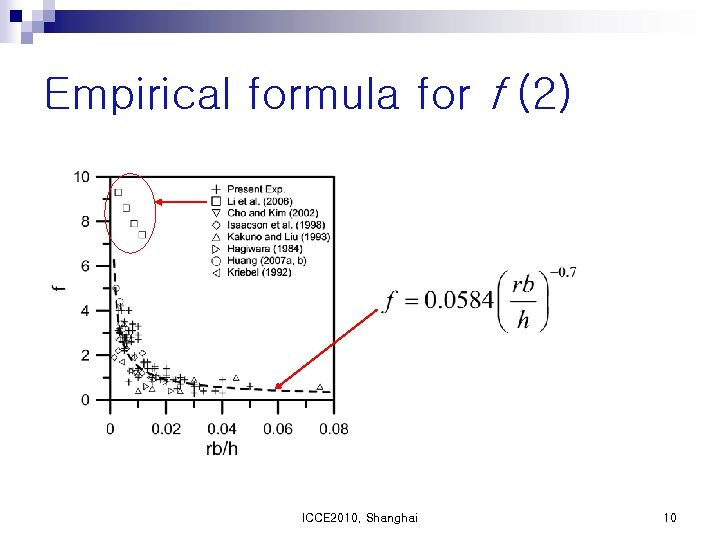
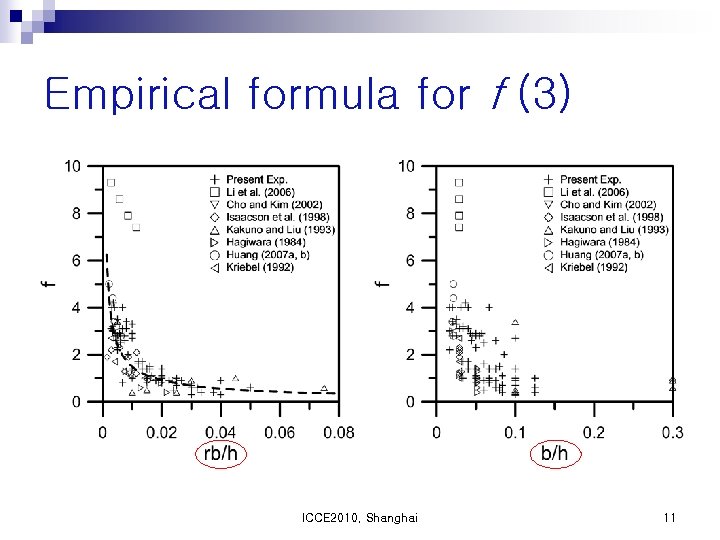
Sollitt and Cross formula r = porosity of the wall b = thickness of the wall f = friction coefficient (unknown) s = inertia coefficient (unknown) ▶ Usually, s=1 is used, and f is determined by comparing the measured and calculated reflection and transmission coefficients so that they give good agreement. Therefore, f is not known before an experiment is performed. → f = f (known variables)? ICCE 2010, Shanghai 5
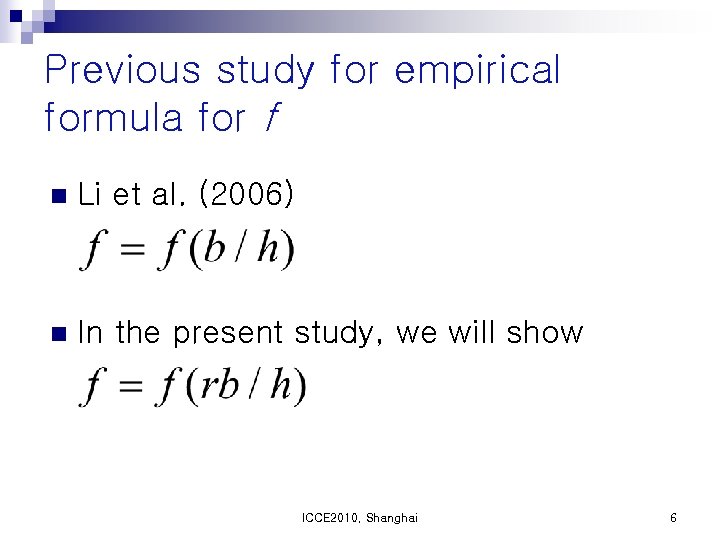
Previous study for empirical formula for f n Li et al. (2006) n In the present study, we will show ICCE 2010, Shanghai 6
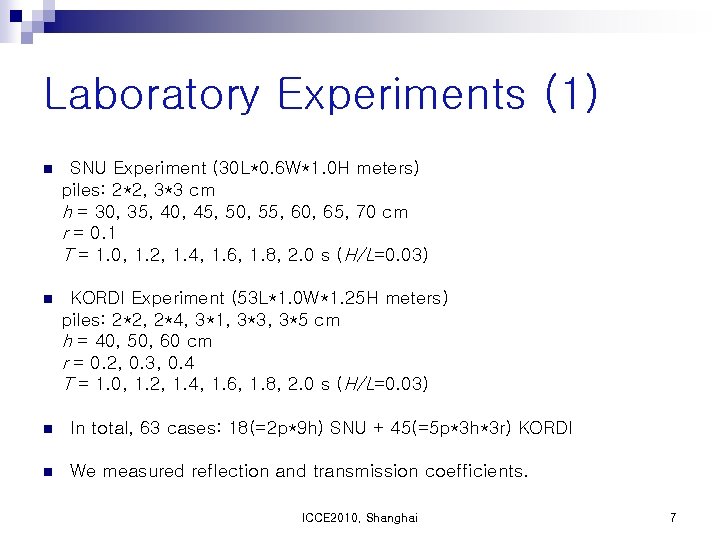
Laboratory Experiments (1) n SNU Experiment (30 L*0. 6 W*1. 0 H meters) piles: 2*2, 3*3 cm h = 30, 35, 40, 45, 50, 55, 60, 65, 70 cm r = 0. 1 T = 1. 0, 1. 2, 1. 4, 1. 6, 1. 8, 2. 0 s (H/L=0. 03) n KORDI Experiment (53 L*1. 0 W*1. 25 H meters) piles: 2*2, 2*4, 3*1, 3*3, 3*5 cm h = 40, 50, 60 cm r = 0. 2, 0. 3, 0. 4 T = 1. 0, 1. 2, 1. 4, 1. 6, 1. 8, 2. 0 s (H/L=0. 03) n In total, 63 cases: 18(=2 p*9 h) SNU + 45(=5 p*3 h*3 r) KORDI n We measured reflection and transmission coefficients. ICCE 2010, Shanghai 7
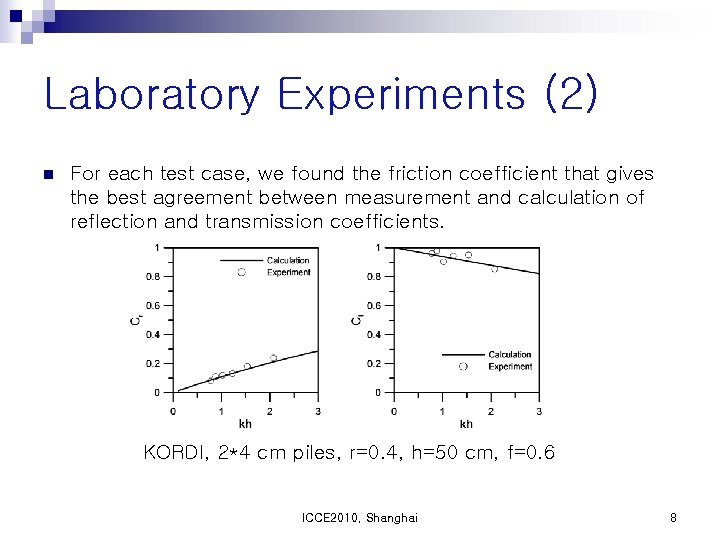
Laboratory Experiments (2) n For each test case, we found the friction coefficient that gives the best agreement between measurement and calculation of reflection and transmission coefficients. KORDI, 2*4 cm piles, r=0. 4, h=50 cm, f=0. 6 ICCE 2010, Shanghai 8
Empirical formula for f (1) Present Experiment ICCE 2010, Shanghai 9
Empirical formula for f (2) ICCE 2010, Shanghai 10
Empirical formula for f (3) ICCE 2010, Shanghai 11
Validation (1) ICCE 2010, Shanghai 12
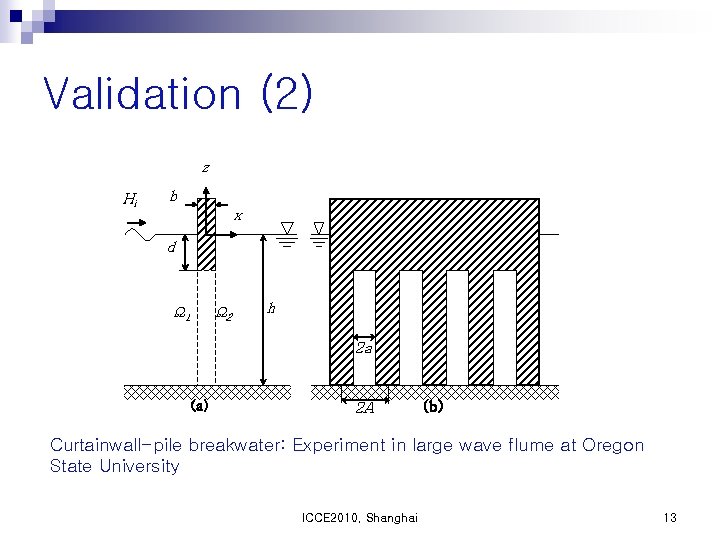
Validation (2) z Hi b x d Ω 1 Ω 2 h 2 a (a) 2 A (b) Curtainwall-pile breakwater: Experiment in large wave flume at Oregon State University ICCE 2010, Shanghai 13
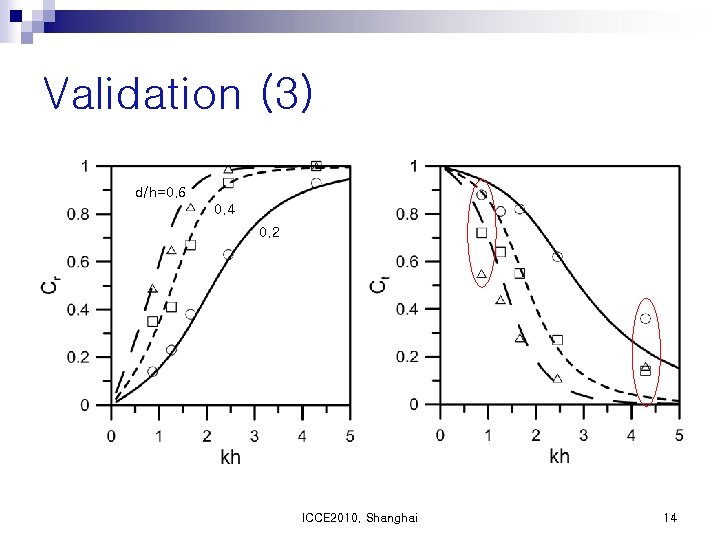
Validation (3) d/h=0. 6 0. 4 0. 2 ICCE 2010, Shanghai 14
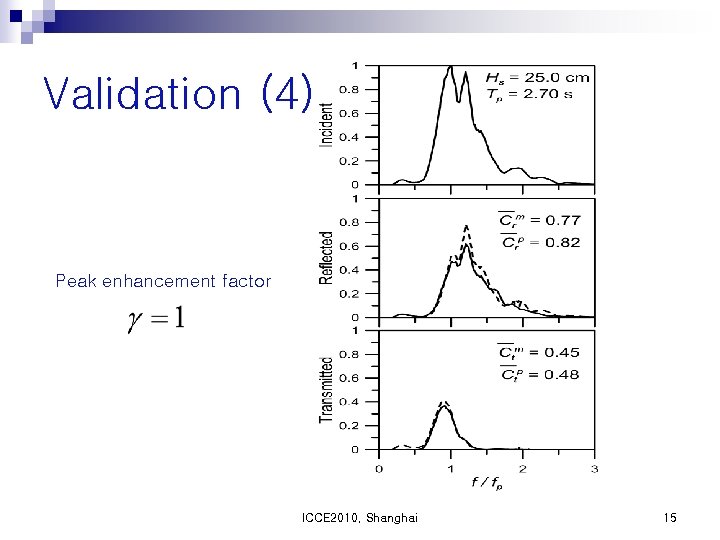
Validation (4) Peak enhancement factor ICCE 2010, Shanghai 15
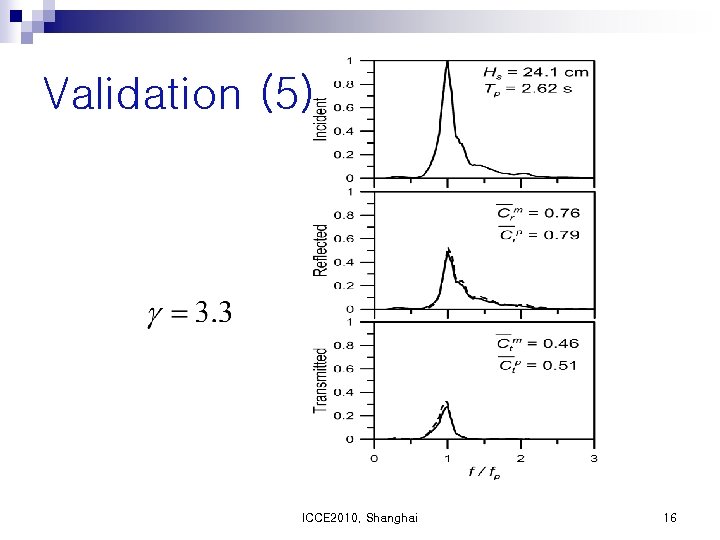
Validation (5) ICCE 2010, Shanghai 16
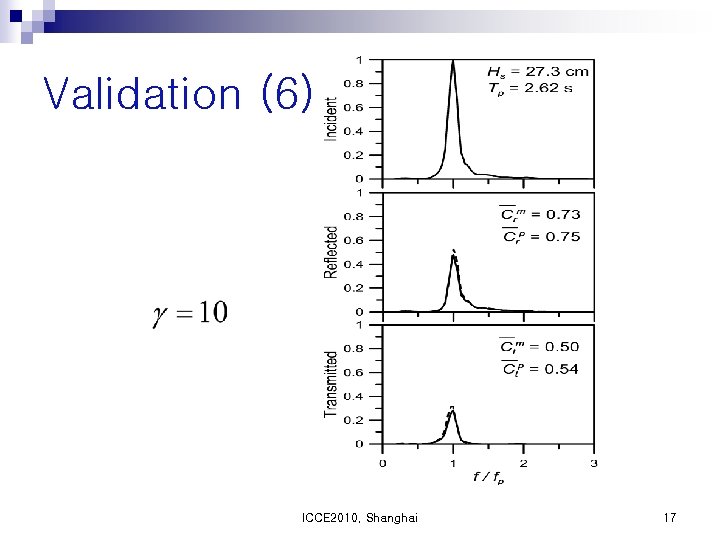
Validation (6) ICCE 2010, Shanghai 17
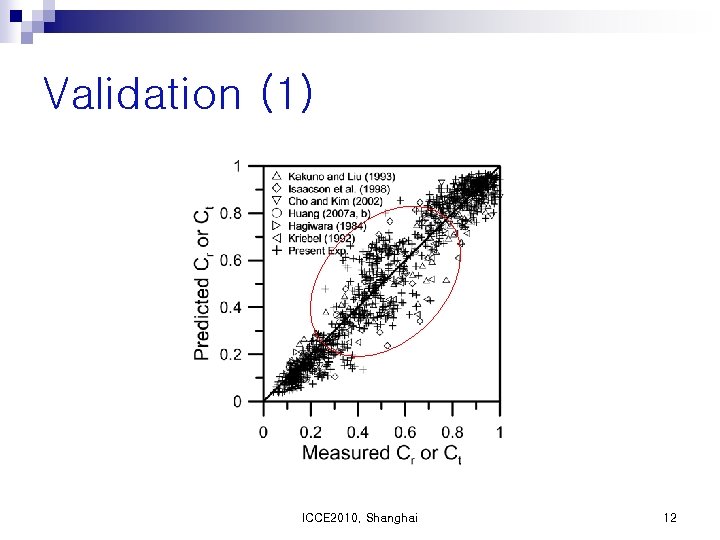
Conclusions n We proposed an empirical formula for the friction coefficient in the permeability parameter of Sollitt and Cross formulation, so that it can be used directly without invoking the best-fit procedure between measurement and prediction. n The proposed formula can be used for both regular and irregular waves. n The empirical formula could be used for various types of perforated wall, since it only needs the porosity and thickness of the wall and the water depth. ICCE 2010, Shanghai 18
- Slides: 18