
Calculating the resistance of a bulb A filament
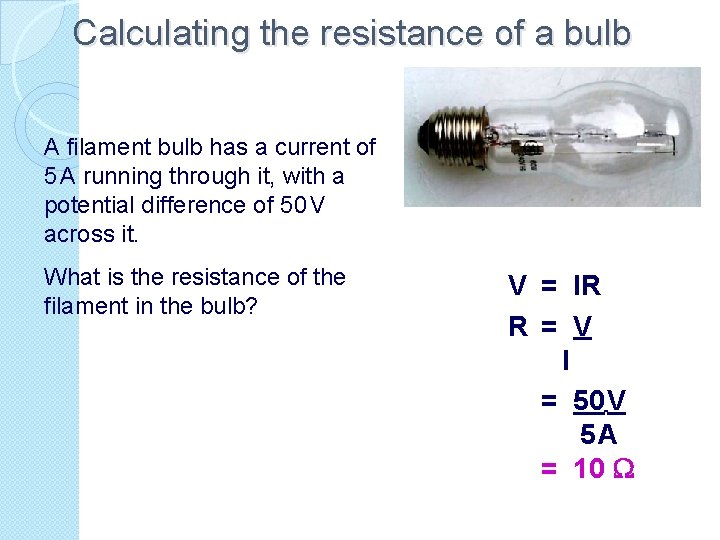
Calculating the resistance of a bulb A filament bulb has a current of 5 A running through it, with a potential difference of 50 V across it. What is the resistance of the filament in the bulb? V = IR R = V I = 50 V 5 A = 10
P 6 – Electricity for Gadgets Lesson 3 – Resistors in series Learning aim: Demonstrate an understanding of how resistors work in series circuits
Success Criteria Learning Objectives � Understand how potential dividers work. � Understand how to add resistors in series. � Calculate the output from a potential divider. � Recall the properties of potential dividers. (Grade E-D) � Use Rt = R 1 + R 2 to find the total voltage of resistors in series. (Grade E-D) � Explain how combinations of fixed and variable resistors can be used in potential divider circuits. (Grade C) � Calculate Vout for simple ratios of resistors. (HT) (Grade C-A) � Explain how a Vout with adjustable threshold can be achieved. (Grade C -A)
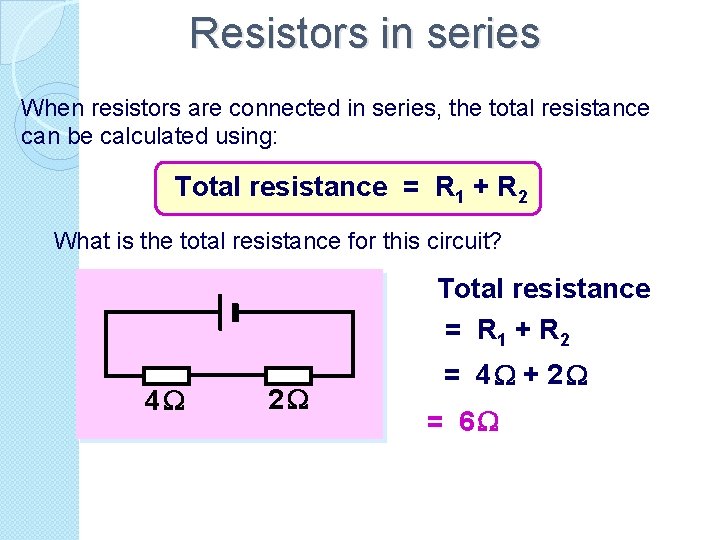
Resistors in series When resistors are connected in series, the total resistance can be calculated using: Total resistance = R 1 + R 2 What is the total resistance for this circuit? Total resistance = R 1 + R 2 4 2 = 4 + 2 = 6
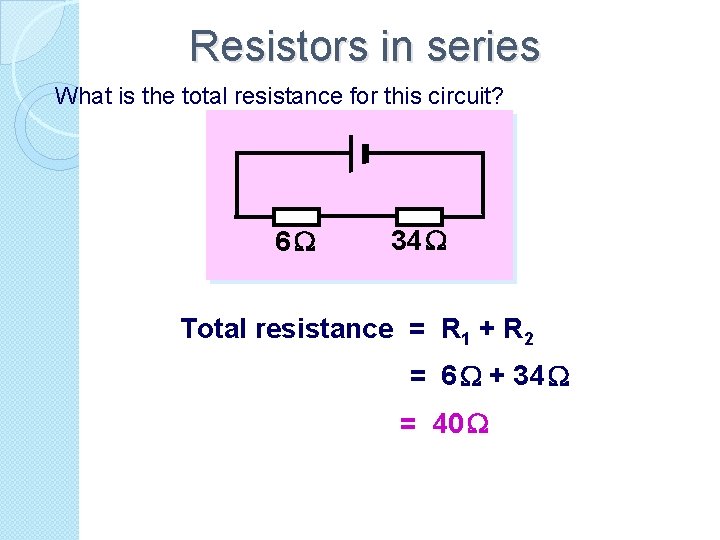
Resistors in series What is the total resistance for this circuit? 6 34 Total resistance = R 1 + R 2 = 6 + 34 = 40

LD Copy the diagram and answer the questions Ammeter reads 2 A A V Voltmeter reads 10 V 1) What is the resistance across this bulb? 2) Assuming all the bulbs are the same what is the total resistance in this 26/09/2020 circuit?
Experiment - P 6 b 01 (part a) Using a variable resistor as a potential divider. At the end of this experiment you should be able to produce a definition for a potential divider
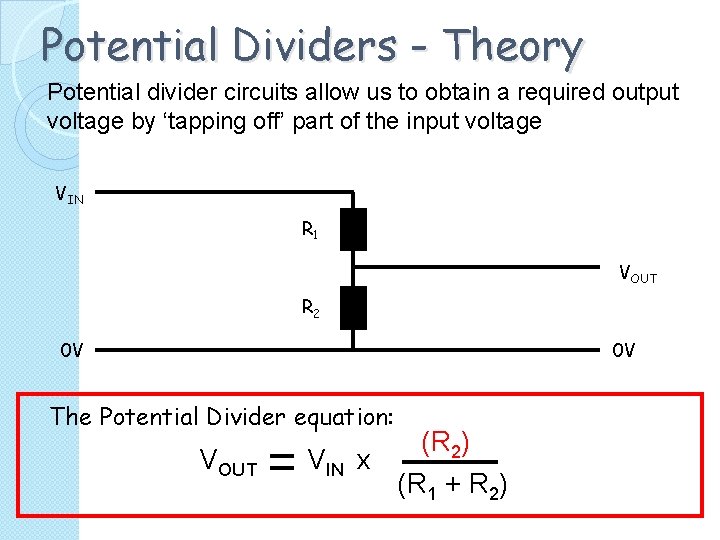
Potential Dividers - Theory Potential divider circuits allow us to obtain a required output voltage by ‘tapping off’ part of the input voltage VIN R 1 VOUT R 2 0 V 0 V The Potential Divider equation: VOUT VIN (R 2) x (R 1 + R 2)
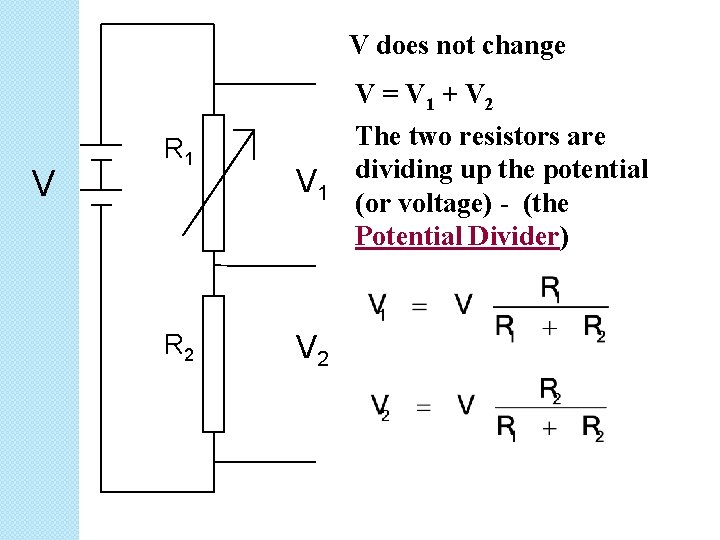
V does not change V R 1 R 2 V 1 V 2 V = V 1 + V 2 The two resistors are dividing up the potential (or voltage) - (the Potential Divider)
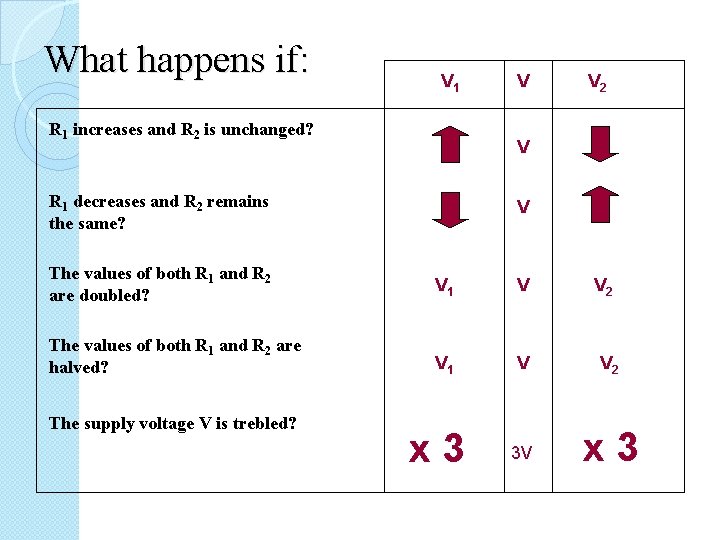
What happens if: V 1 R 1 increases and R 2 is unchanged? V V 2 V R 1 decreases and R 2 remains the same? V The values of both R 1 and R 2 are doubled? V 1 V The values of both R 1 and R 2 are halved? V 1 V V 2 3 V x 3 The supply voltage V is trebled? x 3 V 2
Uses of the potential divider • To supply a variable voltage • To make an input sensor from other components - many detectors will switch on as a voltage goes above or below a certain threshold (such as in a thermostat).
HT Practical P 6 b 01(part b) I can design and construct a potential divider circuit to achieve a given output pd. Equipment available: variety of resistors , leads, batteries, voltmeters.
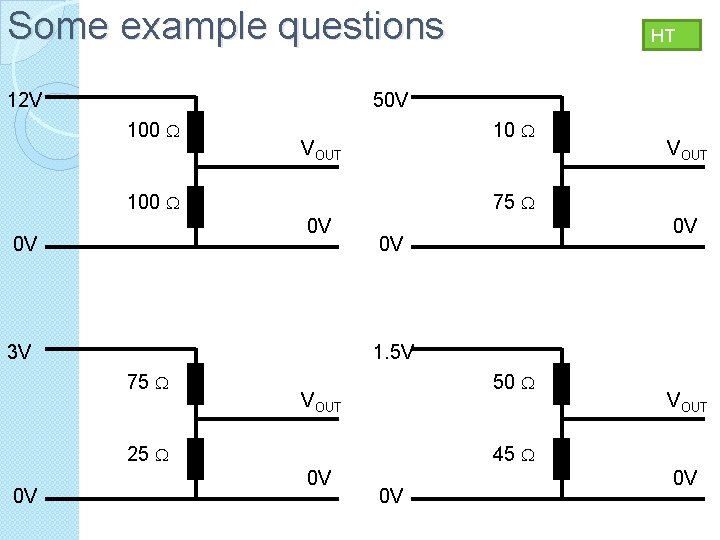
Some example questions 12 V 50 V 100 10 VOUT 100 VOUT 75 0 V 0 V 3 V 0 V 0 V 1. 5 V 75 50 VOUT 25 0 V HT VOUT 45 0 V 0 V 0 V
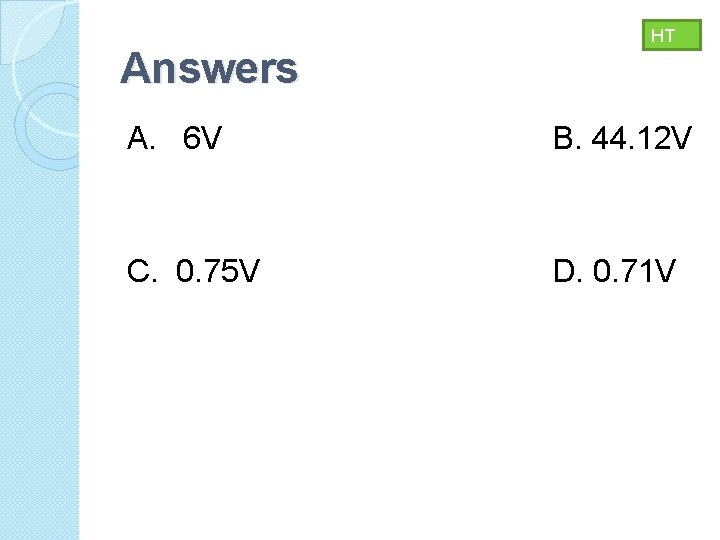
Answers HT A. 6 V B. 44. 12 V C. 0. 75 V D. 0. 71 V
To do Complete the worksheet P 6 b 01 Q 2. Resistors in series Then try – Q 3 a-c as well
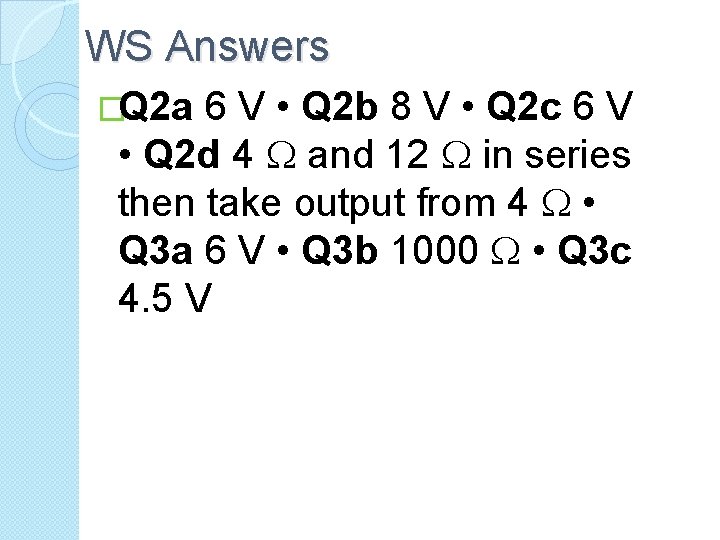
WS Answers �Q 2 a 6 V • Q 2 b 8 V • Q 2 c 6 V • Q 2 d 4 and 12 in series then take output from 4 • Q 3 a 6 V • Q 3 b 1000 • Q 3 c 4. 5 V
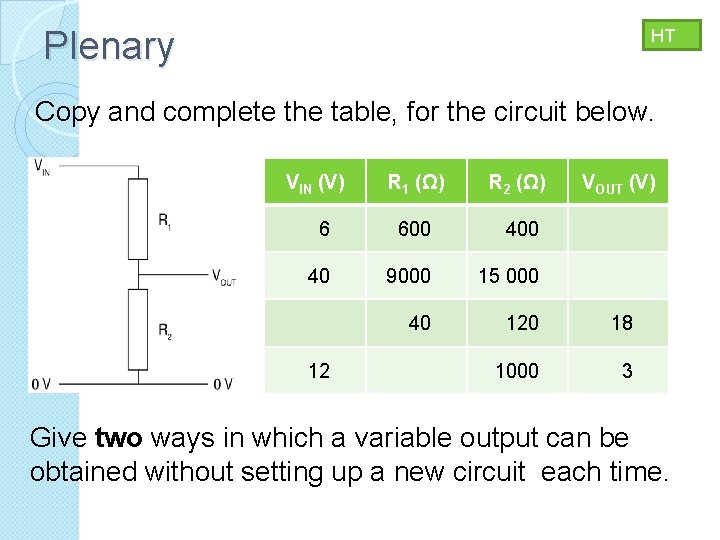
Plenary HT Copy and complete the table, for the circuit below. VIN (V) R 1 (Ω) R 2 (Ω) 6 600 40 9000 15 000 40 120 18 1000 3 12 VOUT (V) Give two ways in which a variable output can be obtained without setting up a new circuit each time.
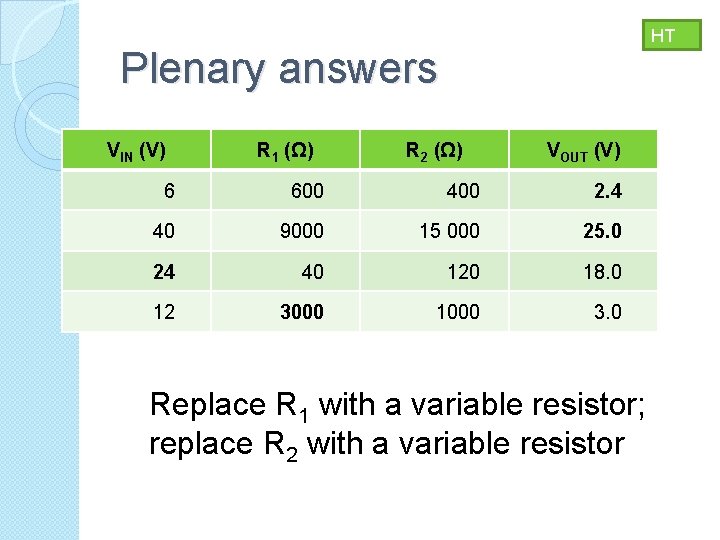
HT Plenary answers VIN (V) R 1 (Ω) R 2 (Ω) VOUT (V) 6 600 400 2. 4 40 9000 15 000 25. 0 24 40 120 18. 0 12 3000 1000 3. 0 Replace R 1 with a variable resistor; replace R 2 with a variable resistor
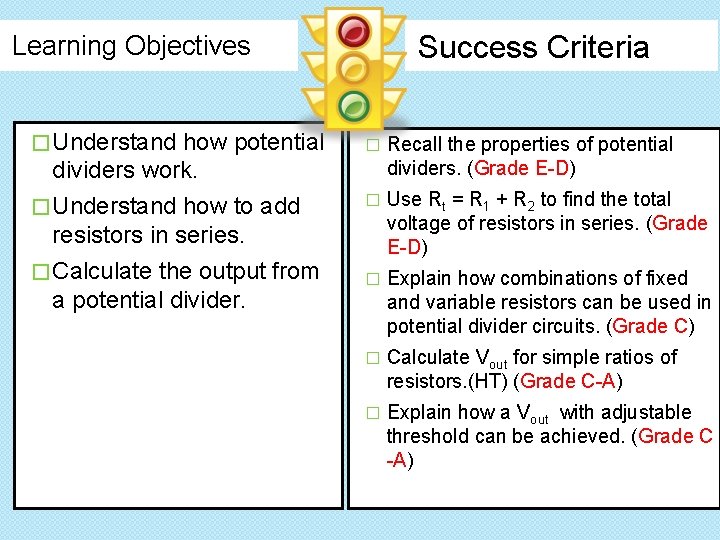
Success Criteria Learning Objectives � Understand how potential dividers work. � Understand how to add resistors in series. � Calculate the output from a potential divider. � Recall the properties of potential dividers. (Grade E-D) � Use Rt = R 1 + R 2 to find the total voltage of resistors in series. (Grade E-D) � Explain how combinations of fixed and variable resistors can be used in potential divider circuits. (Grade C) � Calculate Vout for simple ratios of resistors. (HT) (Grade C-A) � Explain how a Vout with adjustable threshold can be achieved. (Grade C -A)

PC research task �http: //www. bbc. co. uk/schools/gcsebite size/science/triple_ocr_gateway/electri city_for_gadgets/sharing/revision/1/
- Slides: 20