
Calculating Rotations for Distance and Turns Edited By
Calculating Rotations for Distance and Turns Edited By: Daniel Kohn University of Memphis Thanks to : Mac Jones (https: //stemrobotics. pdx. edu/sites/default/files/Calculating%20 Rotations%20 for%20 Turns. pptx ) Marco Diex / Howard Mc. Millian (https: //www. educationfund. org/file_download/inline/cb 3 dcd 76 -53 ea-4680 -8 ed 1 -bacc 4 c 3 ac 1 d 2 )

Overview • Ways to calculate Rotations for Distance • Two Types of Turns • Calculating Rotations for Pivot Turns • Equation for Calculating Pivot Turns • Calculating Rotations for Point Turns • Equation for Calculating Point Turns • Relationships Between the Two Types of Turns • Parting Thoughts

Distance
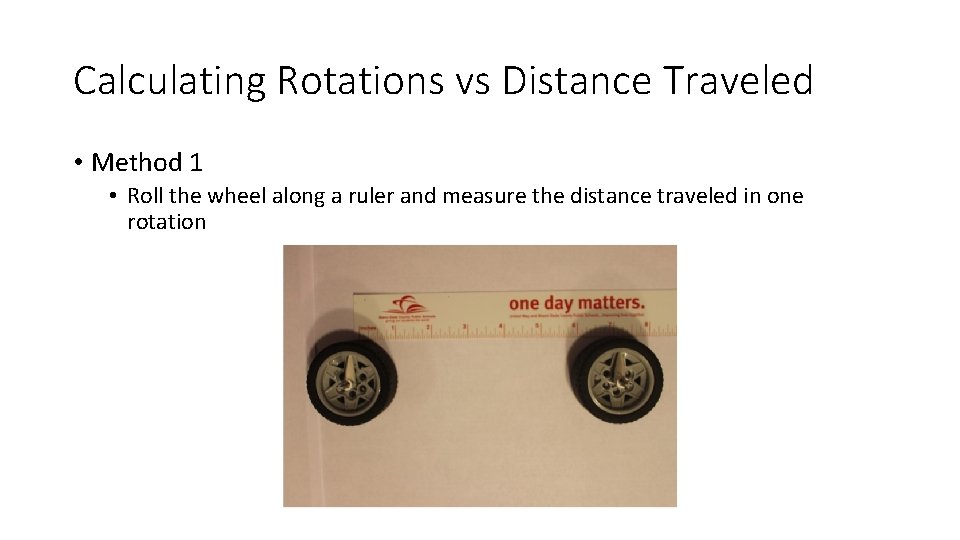
Calculating Rotations vs Distance Traveled • Method 1 • Roll the wheel along a ruler and measure the distance traveled in one rotation
Calculating Rotations vs Distance Traveled • Method 1 b • Use the same method as previously but using a robot programmed to go so many rotations, degrees or seconds and measure the distance traveled. • This can be used to calculate for any distance using ratios. • For more accuracy, use a larger number of rotations, degrees or seconds traveled.
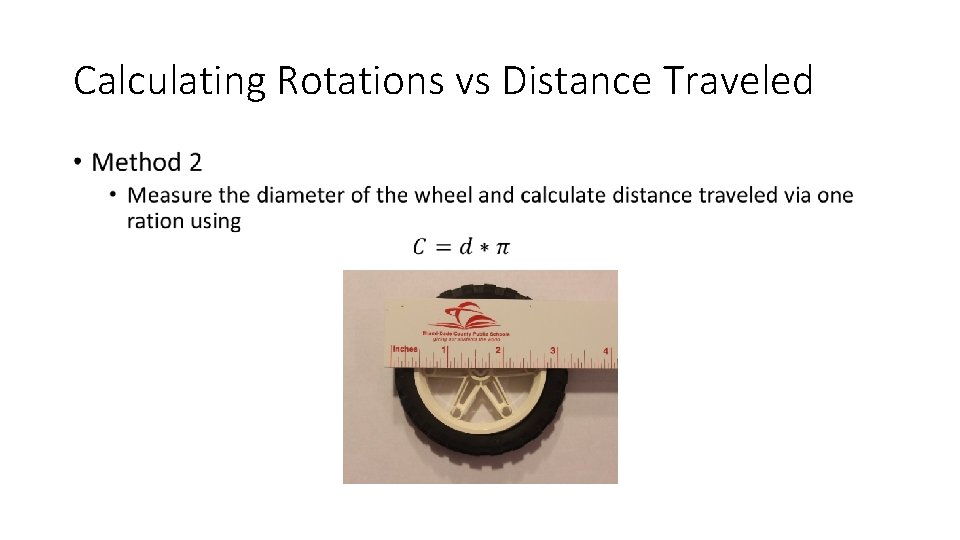
Calculating Rotations vs Distance Traveled •
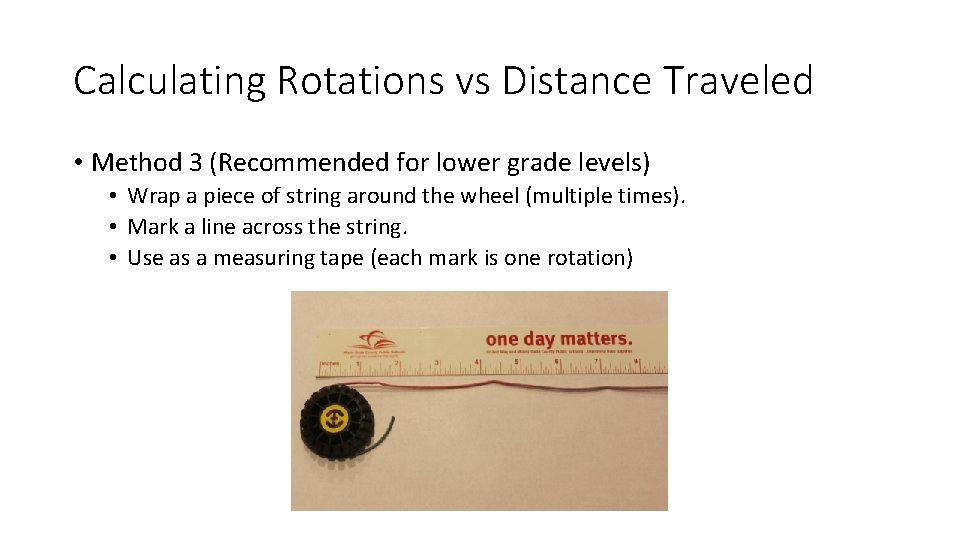
Calculating Rotations vs Distance Traveled • Method 3 (Recommended for lower grade levels) • Wrap a piece of string around the wheel (multiple times). • Mark a line across the string. • Use as a measuring tape (each mark is one rotation)

Turns
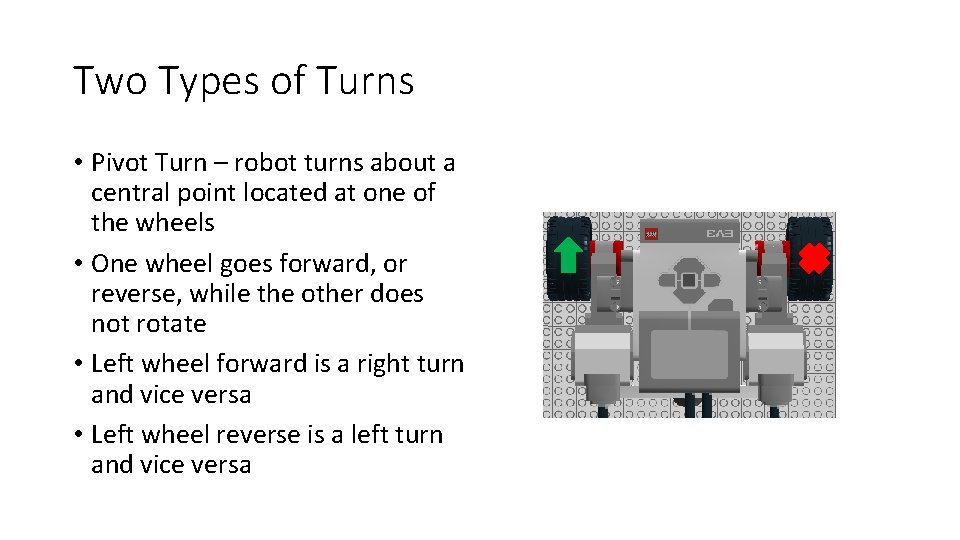
Two Types of Turns • Pivot Turn – robot turns about a central point located at one of the wheels • One wheel goes forward, or reverse, while the other does not rotate • Left wheel forward is a right turn and vice versa • Left wheel reverse is a left turn and vice versa
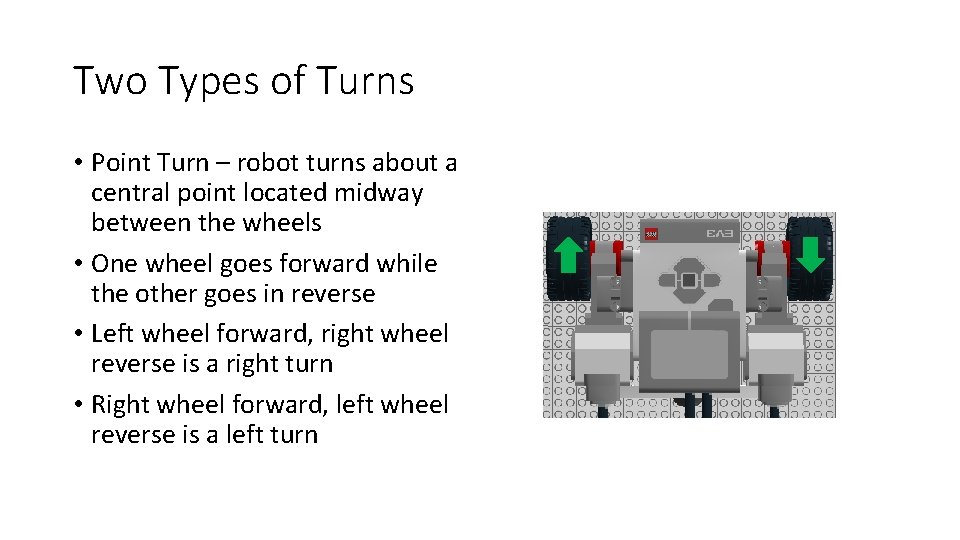
Two Types of Turns • Point Turn – robot turns about a central point located midway between the wheels • One wheel goes forward while the other goes in reverse • Left wheel forward, right wheel reverse is a right turn • Right wheel forward, left wheel reverse is a left turn
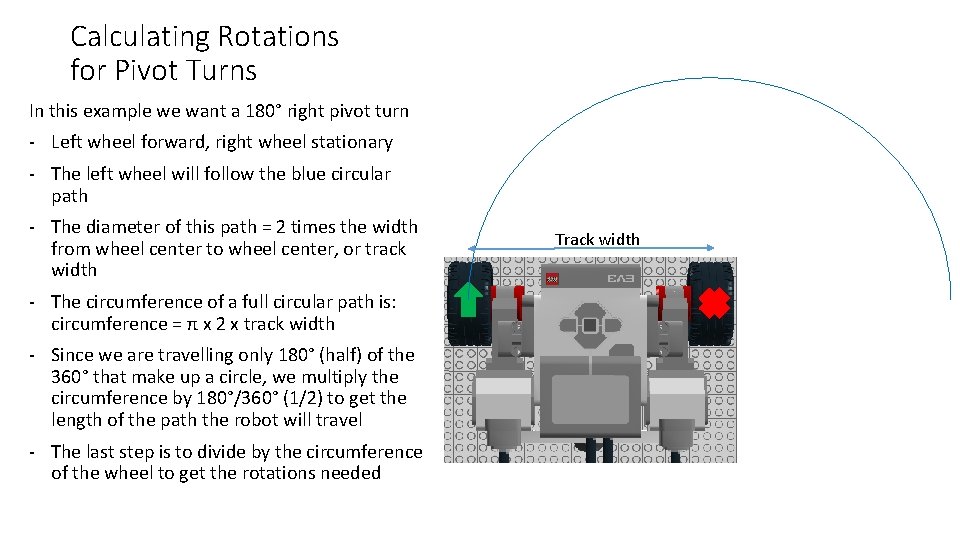
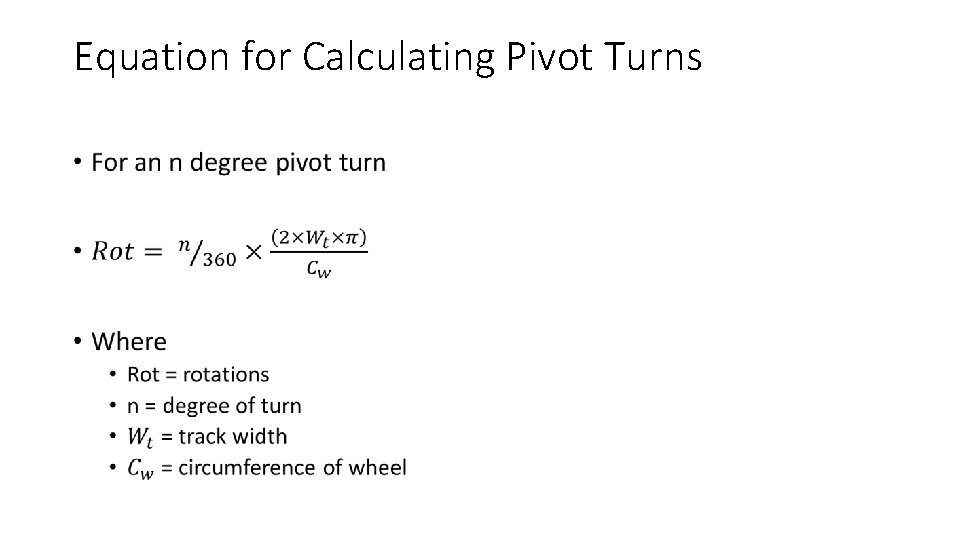
Calculating Rotations for Pivot Turns In this example we want a 180° right pivot turn - Left wheel forward, right wheel stationary - The left wheel will follow the blue circular path - The diameter of this path = 2 times the width from wheel center to wheel center, or track width - The circumference of a full circular path is: circumference = π x 2 x track width - Since we are travelling only 180° (half) of the 360° that make up a circle, we multiply the circumference by 180°/360° (1/2) to get the length of the path the robot will travel - The last step is to divide by the circumference of the wheel to get the rotations needed Track width
Equation for Calculating Pivot Turns •
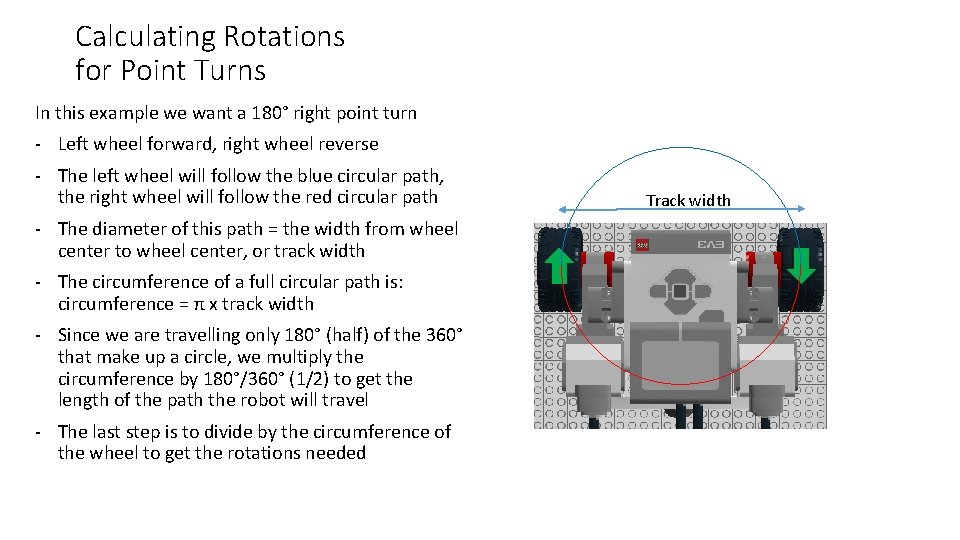
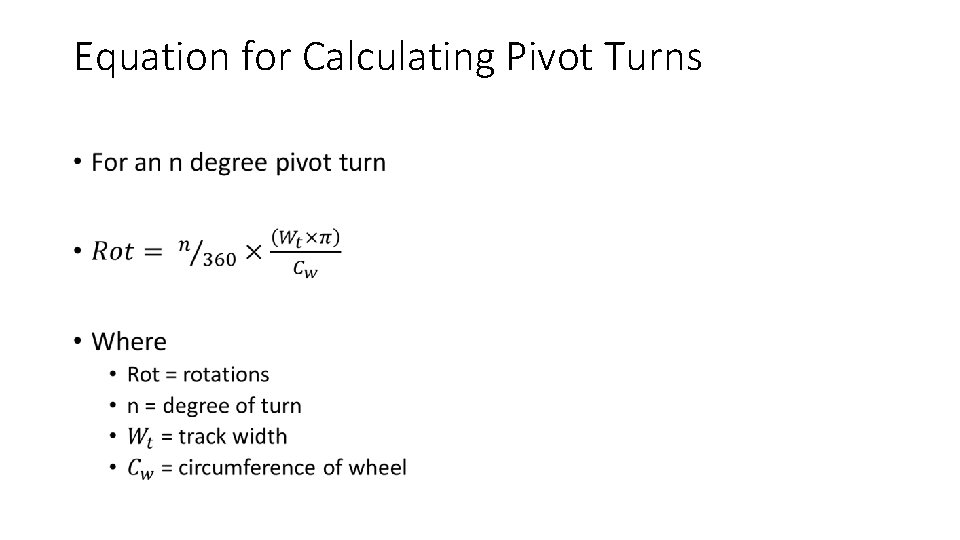
Calculating Rotations for Point Turns In this example we want a 180° right point turn - Left wheel forward, right wheel reverse - The left wheel will follow the blue circular path, the right wheel will follow the red circular path - The diameter of this path = the width from wheel center to wheel center, or track width - The circumference of a full circular path is: circumference = π x track width - Since we are travelling only 180° (half) of the 360° that make up a circle, we multiply the circumference by 180°/360° (1/2) to get the length of the path the robot will travel - The last step is to divide by the circumference of the wheel to get the rotations needed Track width
Equation for Calculating Pivot Turns •
Alternate Method for Pivot Turns (recommended for Lower Grade Levels) • Program the robot to spin in place (using rotations, degrees or time). Use a number so that it does multiple spins for best results) • Put robot on a tile floor (placing the robot center on a cross joint +) • Count the number of spins (including the fractional turn at the end) • Use ratios to get Deg / Motor Rotations, Deg / Motor Degrees or Deg / Time.
Relationships Between the Two Types of Turns Pivot Turns Point Turns • Need twice as many rotations as • Need half as many rotations as a a point turn pivot turn • Need more space • Need less space • Harder for robot navigation • Easier for robot navigation (robot does not remain in the (robot remains in same place on field – Pivot point field – turn only, center of turn is is static wheel not center of wheel axle) robot)
Parting Thoughts • The process used for finding the path is the same process used to find the arc length of a circle in geometry, we just divide the arc length by the wheel circumference to find wheel rotations. • The pivot turn does twice as many rotations as a point turn because only one wheel is doing the turning. In a point turn both wheels are turning so they each turn only half as many rotations as a pivot turn to turn the robot the same number of degrees.
- Slides: 17