
Calculating rates of reactions Rate of chemical reaction
- Slides: 4
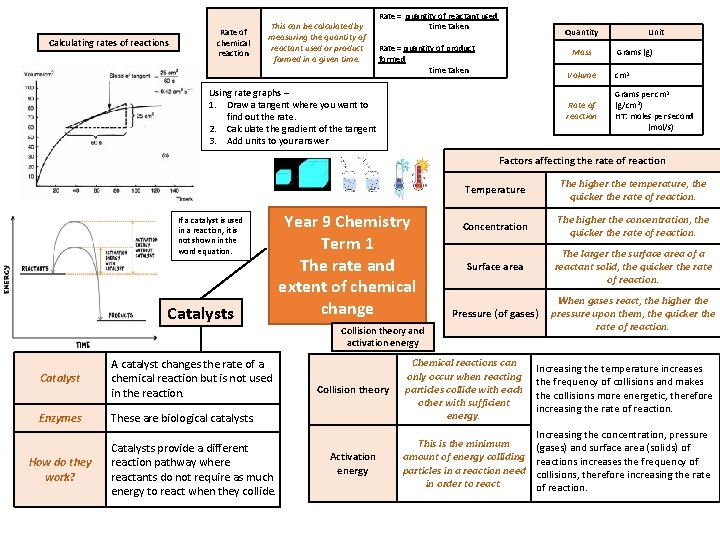
Calculating rates of reactions Rate of chemical reaction This can be calculated by measuring the quantity of reactant used or product formed in a given time. Rate = quantity of reactant used time taken Quantity Rate = quantity of product formed time taken Mass Using rate graphs – 1. Draw a tangent where you want to find out the rate. 2. Calculate the gradient of the tangent 3. Add units to your answer Unit Grams (g) Volume cm 3 Rate of reaction Grams per cm 3 (g/cm 3) HT: moles per second (mol/s) Factors affecting the rate of reaction If a catalyst is used in a reaction, it is not shown in the word equation. Catalysts Year 9 Chemistry Term 1 The rate and extent of chemical change Temperature The higher the temperature, the quicker the rate of reaction. Concentration The higher the concentration, the quicker the rate of reaction. Surface area The larger the surface area of a reactant solid, the quicker the rate of reaction. Pressure (of gases) When gases react, the higher the pressure upon them, the quicker the rate of reaction. Collision theory and activation energy Catalyst A catalyst changes the rate of a chemical reaction but is not used in the reaction. Enzymes These are biological catalysts. How do they work? Catalysts provide a different reaction pathway where reactants do not require as much energy to react when they collide. Collision theory Chemical reactions can only occur when reacting particles collide with each other with sufficient energy. Increasing the temperature increases the frequency of collisions and makes the collisions more energetic, therefore increasing the rate of reaction. Activation energy This is the minimum amount of energy colliding particles in a reaction need in order to react. Increasing the concentration, pressure (gases) and surface area (solids) of reactions increases the frequency of collisions, therefore increasing the rate of reaction.
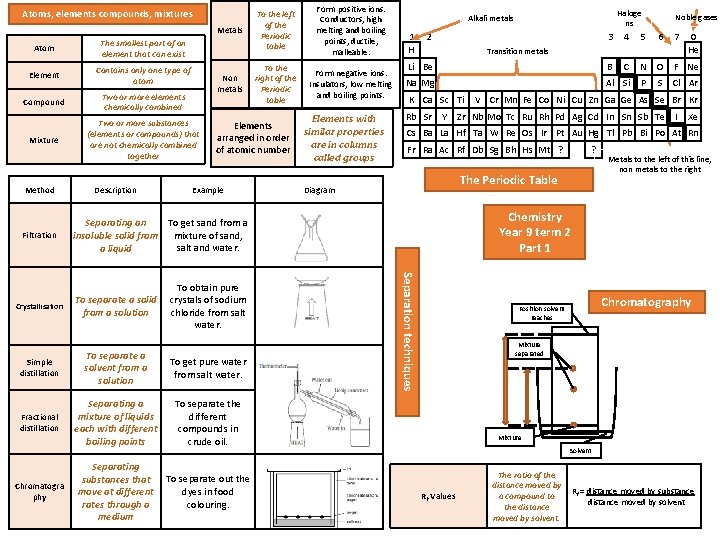
Atoms, elements compounds, mixtures Metals Atom The smallest part of an element that can exist Element Contains only one type of atom Compound Two or more elements chemically combined Mixture Two or more substances (elements or compounds) that are not chemically combined together Method Filtration Description Non metals Form positive ions. Conductors, high melting and boiling points, ductile, malleable. To the right of the Periodic table Form negative ions. Insulators, low melting and boiling points. Elements arranged in order of atomic number Example Elements with similar properties are in columns called groups 1 H 2 Crystallisation Simple distillation To separate a solvent from a solution To get pure water from salt water. Fractional distillation Separating a mixture of liquids each with different boiling points To separate the different compounds in crude oil. Separating substances that move at different rates through a medium To separate out the dyes in food colouring. Noble gases 3 4 5 6 7 Li Be B C N O F Ne Na Mg Al Si P S Cl Ar Transition metals K Ca Sc Ti Rb Sr Y 0 He V Cr Mn Fe Co Ni Cu Zn Ga Ge As Se Br Kr Zr Nb Mo Tc Ru Rh Pd Ag Cd In Sn Sb Te I Xe Cs Ba La Hf Ta W Re Os Ir Pt Au Hg Tl Pb Bi Po At Rn Fr Ra Ac Rf Db Sg Bh Hs Mt ? ? The Periodic Table Diagram Metals to the left of this line, non metals to the right Chemistry Year 9 term 2 Part 1 Separation techniques To obtain pure crystals of sodium chloride from salt water. Haloge ns Alkali metals To get sand from a Separating an insoluble solid from mixture of sand, salt and water. a liquid To separate a solid from a solution Chromatogra phy To the left of the Periodic table Chromatography Position solvent reaches Mixture separated Mixture Solvent Rf Values The ratio of the distance moved by a compound to the distance moved by solvent. Rf = distance moved by substance distance moved by solvent
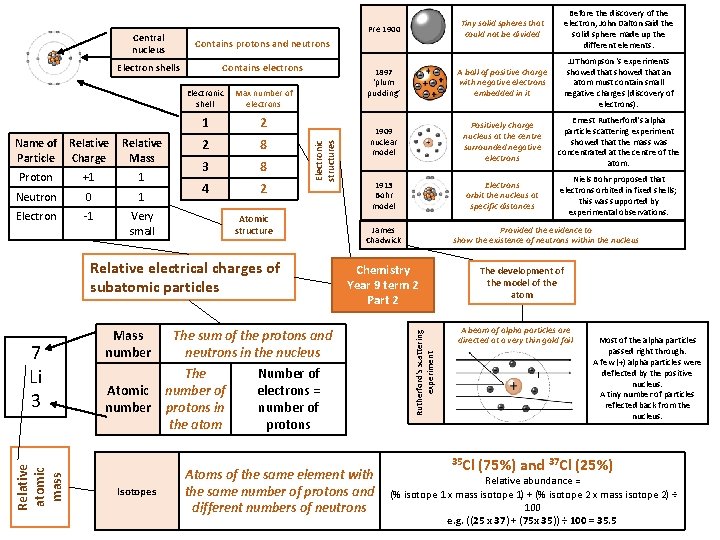
Electron shells Contains electrons Relative Mass Proton +1 1 Neutron 0 1 Electron -1 Very small Electronic shell Max number of electrons 1 2 2 8 3 8 4 2 Atomic structure Relative electrical charges of subatomic particles Relative atomic mass 7 Li 3 Mass number Atomic number Isotopes Pre 1900 Before the discovery of the electron, John Dalton said the solid sphere made up the different elements. 1897 ‘plum pudding’ A ball of positive charge with negative electrons embedded in it JJ Thompson ‘s experiments showed that an atom must contain small negative charges (discovery of electrons). 1909 nuclear model Positively charge nucleus at the centre surrounded negative electrons Ernest Rutherford's alpha particle scattering experiment showed that the mass was concentrated at the centre of the atom. 1913 Bohr model Electrons orbit the nucleus at specific distances Niels Bohr proposed that electrons orbited in fixed shells; this was supported by experimental observations. James Chadwick Chemistry Year 9 term 2 Part 2 The sum of the protons and neutrons in the nucleus The number of protons in the atom Provided the evidence to show the existence of neutrons within the nucleus Number of electrons = number of protons Atoms of the same element with the same number of protons and different numbers of neutrons Rutherford's scattering experiment Contains protons and neutrons Electronic structures Name of Relative Particle Charge Central nucleus Tiny solid spheres that could not be divided The development of the model of the atom A beam of alpha particles are directed at a very thin gold foil 35 Cl Most of the alpha particles passed right through. A few (+) alpha particles were deflected by the positive nucleus. A tiny number of particles reflected back from the nucleus. (75%) and 37 Cl (25%) Relative abundance = (% isotope 1 x mass isotope 1) + (% isotope 2 x mass isotope 2) ÷ 100 e. g. ((25 x 37) + (75 x 35)) ÷ 100 = 35. 5
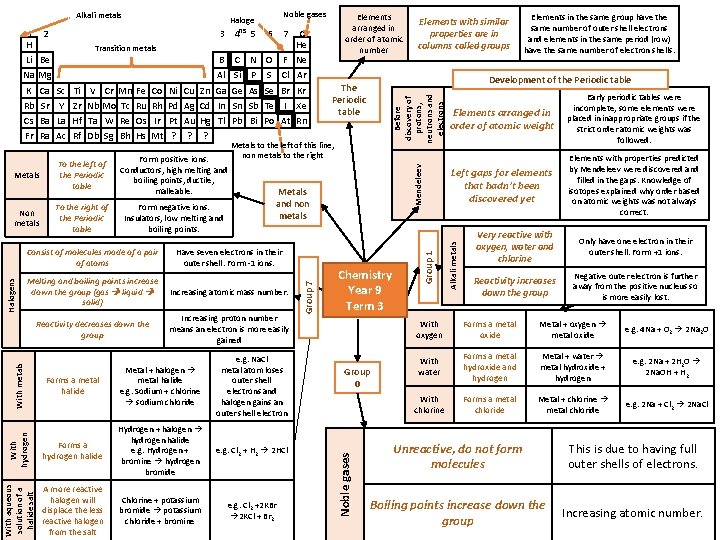
6 7 Transition metals C Na Mg Al Si N O P F Ne S Cl Ar K Ca Sc Ti V Cr Mn Fe Co Ni Cu Zn Ga Ge As Se Br Kr Rb Sr Y Zr Nb Mo Tc Ru Rh Pd Ag Cd In Sn Sb Te I Xe Cs Ba La Hf Ta W Re Os Ir Pt Au Hg Tl Pb Bi Po At Rn Fr Ra Ac Rf Db Sg Bh Hs Mt ? Non metals To the left of the Periodic table Form positive ions. Conductors, high melting and boiling points, ductile, malleable. To the right of the Periodic table Form negative ions. Insulators, low melting and boiling points. Consist of molecules made of a pair of atoms Metals to the left of this line, non metals to the right Have seven electrons in their outer shell. Form -1 ions. Increasing atomic mass number. Reactivity decreases down the group Increasing proton number means an electron is more easily gained Forms a hydrogen halide Hydrogen + halogen hydrogen halide e. g. Hydrogen + bromine hydrogen bromide e. g. Cl 2 + H 2 2 HCl A more reactive halogen will displace the less reactive halogen from the salt Chlorine + potassium bromide potassium chloride + bromine e. g. Cl 2 +2 KBr 2 KCl + Br 2 With metals Metal + halogen metal halide e. g. Sodium + chlorine sodium chloride e. g. Na. Cl metal atom loses outer shell electrons and halogen gains an outer shell electron With hydrogen Melting and boiling points increase down the group (gas liquid solid) Forms a metal halide Elements arranged in order of atomic weight Early periodic tables were incomplete, some elements were placed in inappropriate groups if the strict order atomic weights was followed. Left gaps for elements that hadn’t been discovered yet Elements with properties predicted by Mendeleev were discovered and filled in the gaps. Knowledge of isotopes explained why order based on atomic weights was not always correct. Metals and non metals With aqueous solution of a halide salt Halogens ? Group 7 Metals ? Elements in the same group have the same number of outer shell electrons and elements in the same period (row) have the same number of electron shells. Development of the Periodic table The Periodic table Chemistry Year 9 Term 3 Group 0 Alkali metals B 0 He Elements with similar properties are in columns called groups Mendeleev Li Be Elements arranged in order of atomic number Group 1 2 1 H Noble gases Before discovery of protons, neutrons and electrons Haloge 3 4 ns 5 Noble gases Alkali metals Very reactive with oxygen, water and chlorine Only have one electron in their outer shell. Form +1 ions. Reactivity increases down the group Negative outer electron is further away from the positive nucleus so is more easily lost. With oxygen Forms a metal oxide Metal + oxygen metal oxide e. g. 4 Na + O 2 2 Na 2 O With water Forms a metal hydroxide and hydrogen Metal + water metal hydroxide + hydrogen e. g. 2 Na + 2 H 2 O 2 Na. OH + H 2 With chlorine Forms a metal chloride Metal + chlorine metal chloride e. g. 2 Na + Cl 2 2 Na. Cl Unreactive, do not form molecules This is due to having full outer shells of electrons. Boiling points increase down the group Increasing atomic number.