
Calculating Polynomials We will use a generic polynomial
![Standard Evaluation Algorithm result = a[0] + a[1]*x x. Power = x for i](https://slidetodoc.com/presentation_image/2ea55069270b32b9045e12b3a641d030/image-2.jpg "Standard Evaluation Algorithm result = a[0] + a[1]*x x. Power = x for i")
![Horner’s Method Algorithm result = a[n] for i = n - 1 down to](https://slidetodoc.com/presentation_image/2ea55069270b32b9045e12b3a641d030/image-5.jpg "Horner’s Method Algorithm result = a[n] for i = n - 1 down to")
- Slides: 27
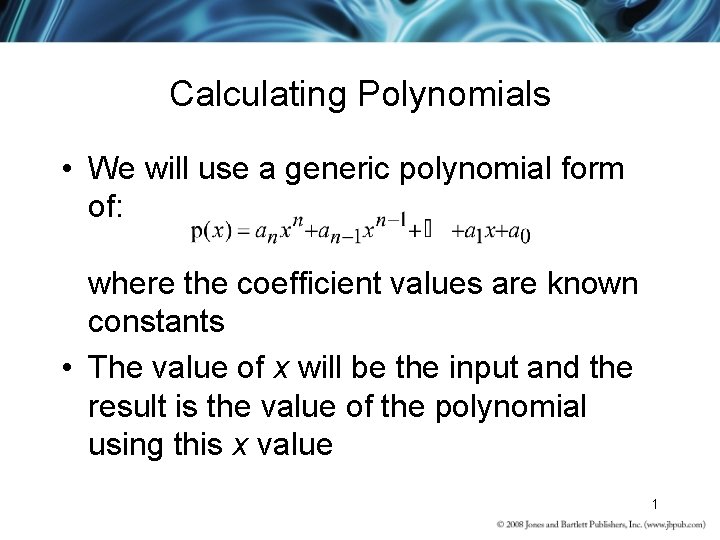
Calculating Polynomials • We will use a generic polynomial form of: where the coefficient values are known constants • The value of x will be the input and the result is the value of the polynomial using this x value 1
Standard Evaluation Algorithm result = a[0] + a[1]*x x. Power = x for i = 2 to n do x. Power = x. Power * x result = result + a[i]*x. Power end for return result 2
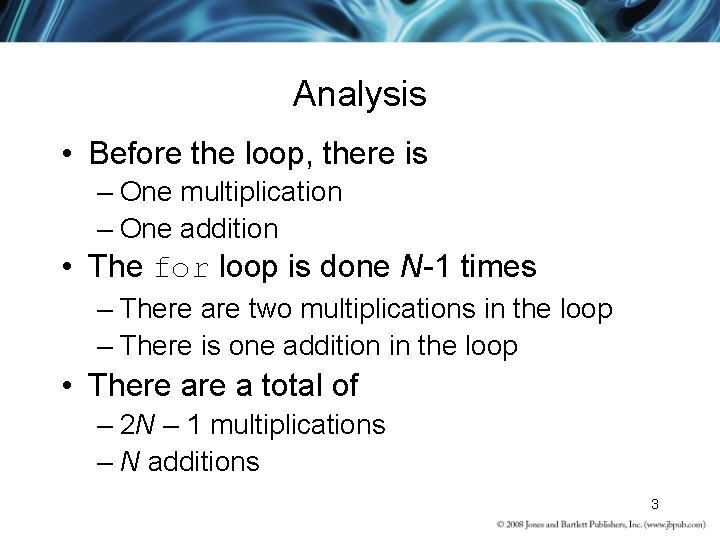
Analysis • Before the loop, there is – One multiplication – One addition • The for loop is done N-1 times – There are two multiplications in the loop – There is one addition in the loop • There a total of – 2 N – 1 multiplications – N additions 3
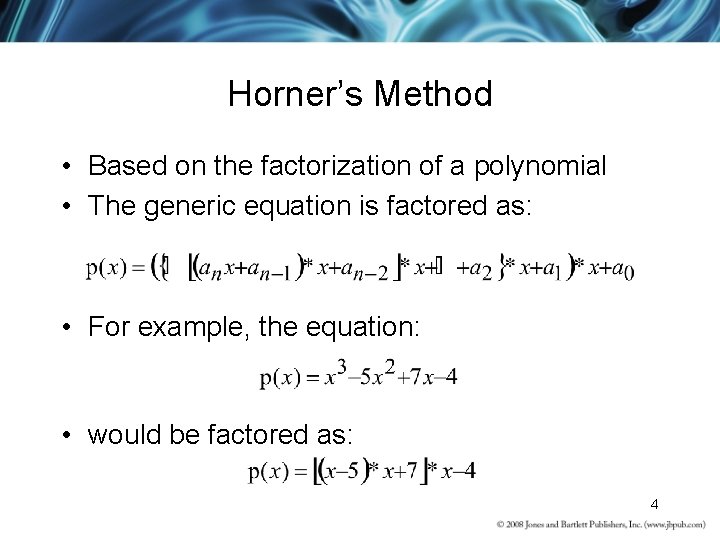
Horner’s Method • Based on the factorization of a polynomial • The generic equation is factored as: • For example, the equation: • would be factored as: 4
Horner’s Method Algorithm result = a[n] for i = n - 1 down to 0 do result = result * x result = result + a[i] end for return result 5
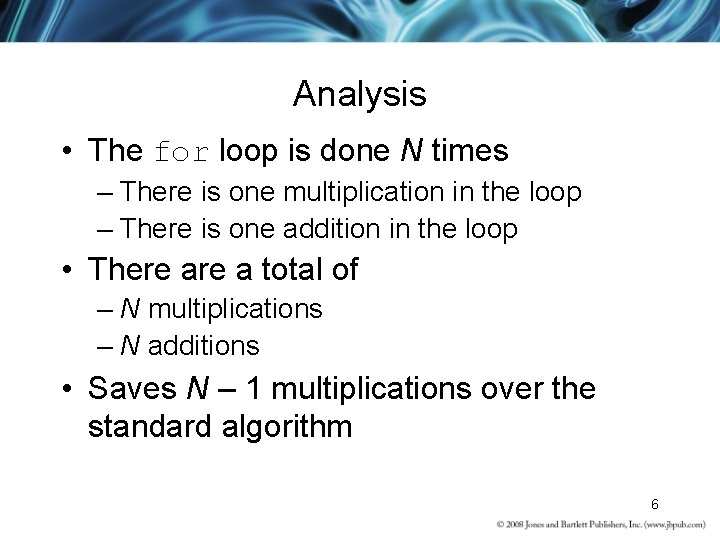
Analysis • The for loop is done N times – There is one multiplication in the loop – There is one addition in the loop • There a total of – N multiplications – N additions • Saves N – 1 multiplications over the standard algorithm 6
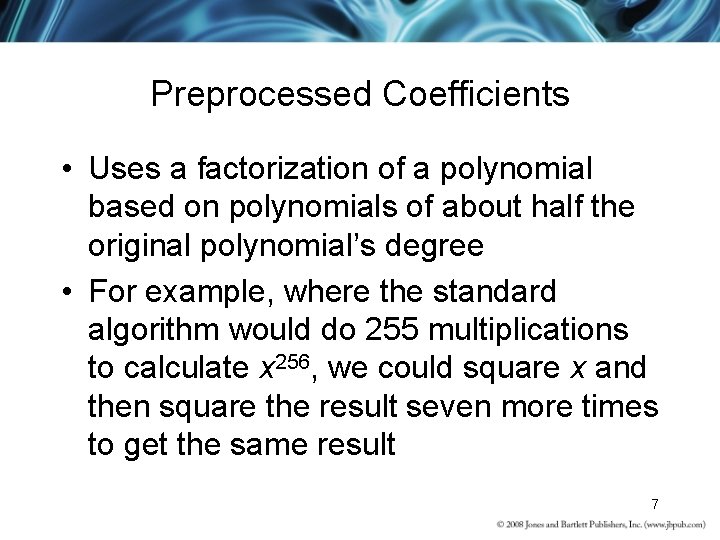
Preprocessed Coefficients • Uses a factorization of a polynomial based on polynomials of about half the original polynomial’s degree • For example, where the standard algorithm would do 255 multiplications to calculate x 256, we could square x and then square the result seven more times to get the same result 7
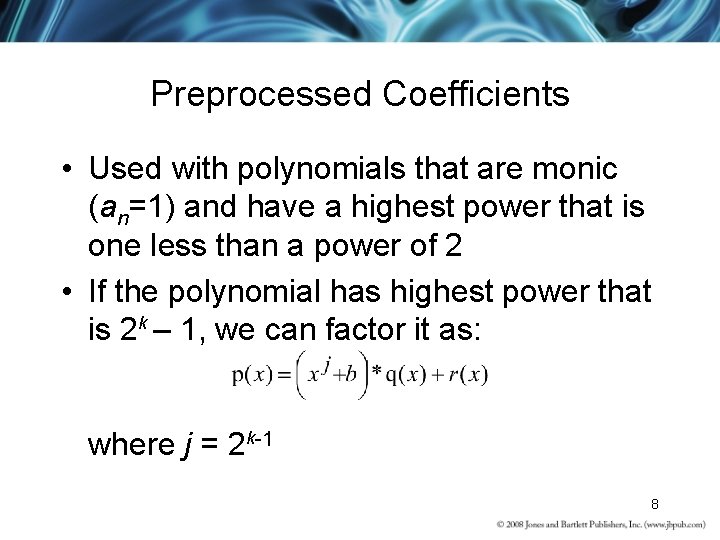
Preprocessed Coefficients • Used with polynomials that are monic (an=1) and have a highest power that is one less than a power of 2 • If the polynomial has highest power that is 2 k – 1, we can factor it as: where j = 2 k-1 8
Preprocessed Coefficients • If we choose b so that it is aj-1 – 1, q(x) and r(x) will both be monic, and so the process can be recursively applied to them as well 9
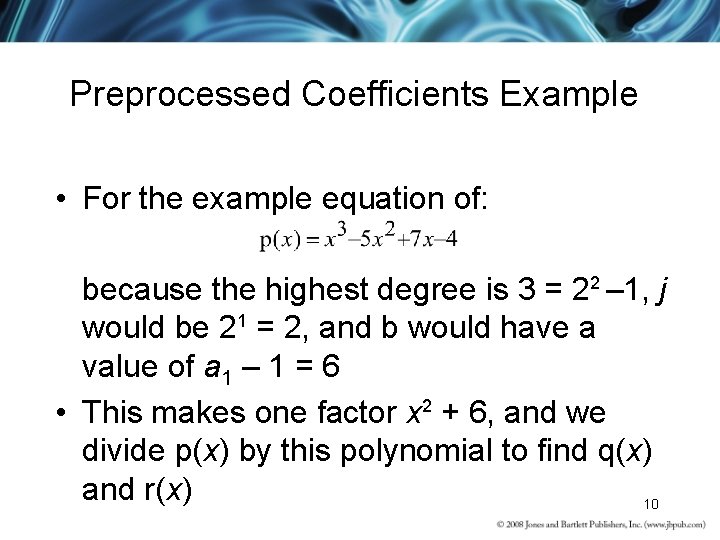
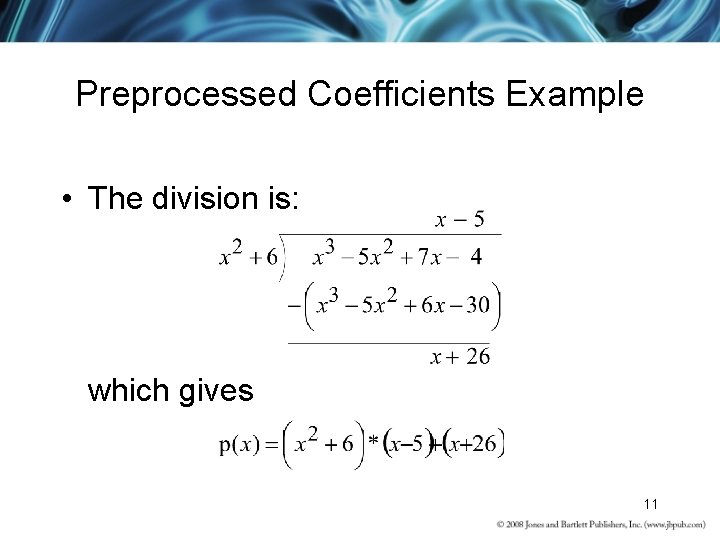
Preprocessed Coefficients Example • For the example equation of: because the highest degree is 3 = 22 – 1, j would be 21 = 2, and b would have a value of a 1 – 1 = 6 • This makes one factor x 2 + 6, and we divide p(x) by this polynomial to find q(x) and r(x) 10
Preprocessed Coefficients Example • The division is: which gives 11
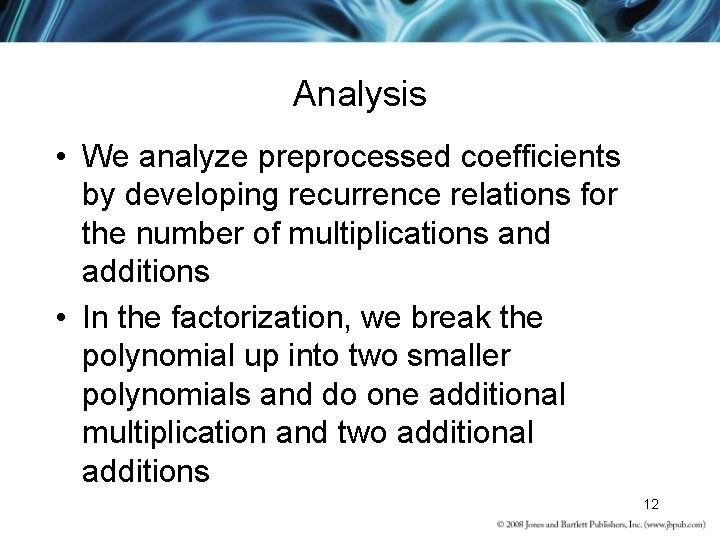
Analysis • We analyze preprocessed coefficients by developing recurrence relations for the number of multiplications and additions • In the factorization, we break the polynomial up into two smaller polynomials and do one additional multiplication and two additional additions 12
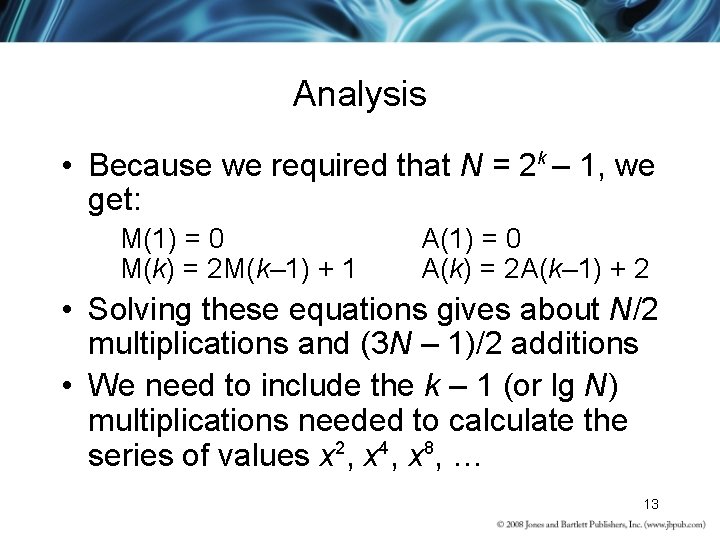
Analysis • Because we required that N = 2 k – 1, we get: M(1) = 0 M(k) = 2 M(k– 1) + 1 A(1) = 0 A(k) = 2 A(k– 1) + 2 • Solving these equations gives about N/2 multiplications and (3 N – 1)/2 additions • We need to include the k – 1 (or lg N) multiplications needed to calculate the series of values x 2, x 4, x 8, … 13
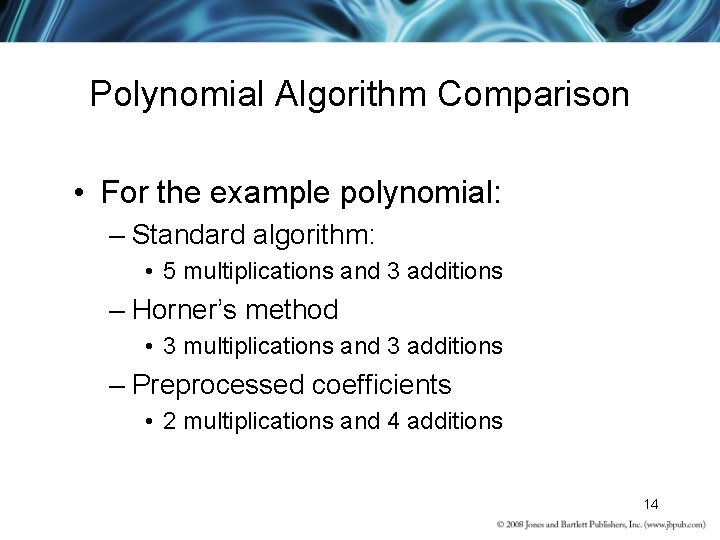
Polynomial Algorithm Comparison • For the example polynomial: – Standard algorithm: • 5 multiplications and 3 additions – Horner’s method • 3 multiplications and 3 additions – Preprocessed coefficients • 2 multiplications and 4 additions 14
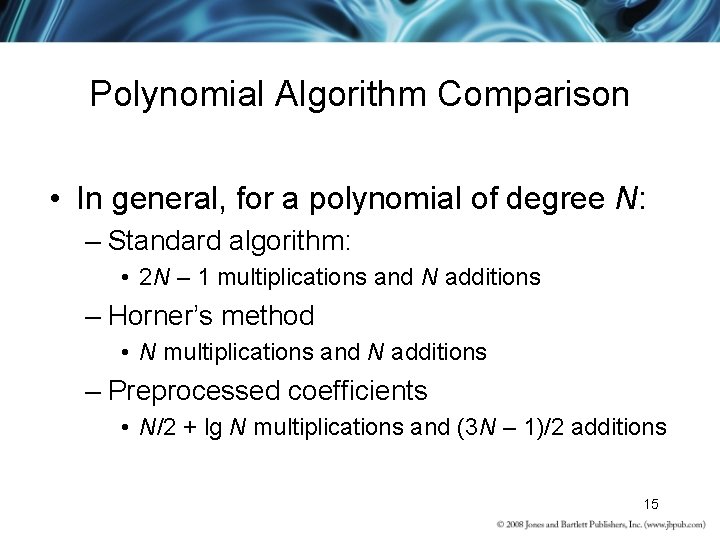
Polynomial Algorithm Comparison • In general, for a polynomial of degree N: – Standard algorithm: • 2 N – 1 multiplications and N additions – Horner’s method • N multiplications and N additions – Preprocessed coefficients • N/2 + lg N multiplications and (3 N – 1)/2 additions 15
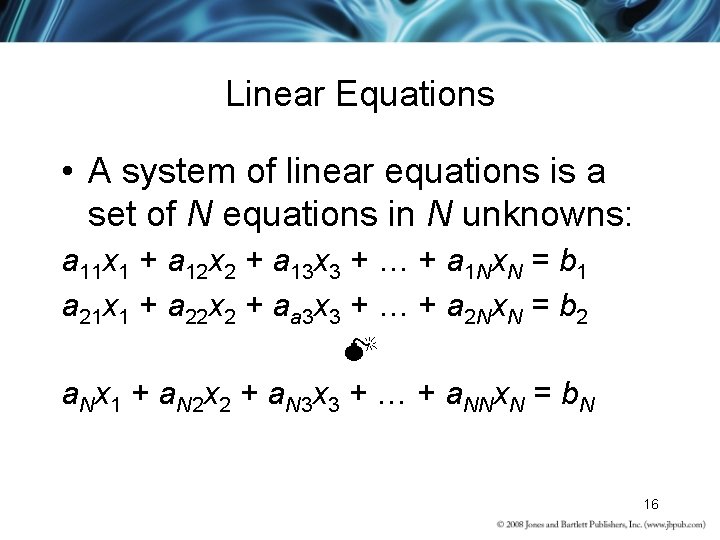
Linear Equations • A system of linear equations is a set of N equations in N unknowns: a 11 x 1 + a 12 x 2 + a 13 x 3 + … + a 1 Nx. N = b 1 a 21 x 1 + a 22 x 2 + aa 3 x 3 + … + a 2 Nx. N = b 2 a. Nx 1 + a. N 2 x 2 + a. N 3 x 3 + … + a. NNx. N = b. N 16
Linear Equations • When these equations are used, the coefficients (a values) are constants and the results (b values) are typically input values • We want to determine the x values that satisfy these equations and produce the indicated results 17
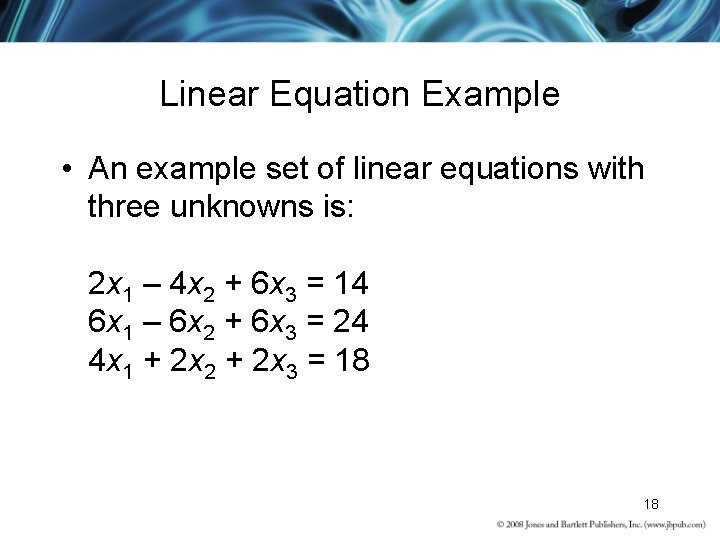
Linear Equation Example • An example set of linear equations with three unknowns is: 2 x 1 – 4 x 2 + 6 x 3 = 14 6 x 1 – 6 x 2 + 6 x 3 = 24 4 x 1 + 2 x 2 + 2 x 3 = 18 18
Solving Linear Equations • One method to determine a solution would be to substitute one equation into another • For example, we solve the first equation for x 1 and then substitute this into the rest of the equations • This substitution reduces the number of unknowns and equations 19
Solving Linear Equations • If we repeat this, we get to one unknown and one equation and can then back up to get the values of the rest • If there are many equations, this process can be time consuming, prone to error, and is not easily computerized 20
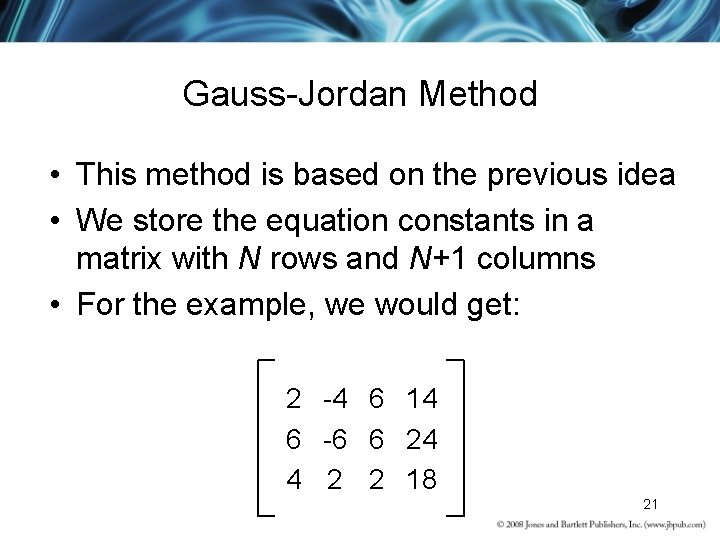
Gauss-Jordan Method • This method is based on the previous idea • We store the equation constants in a matrix with N rows and N+1 columns • For the example, we would get: 2 -4 6 14 6 -6 6 24 4 2 2 18 21
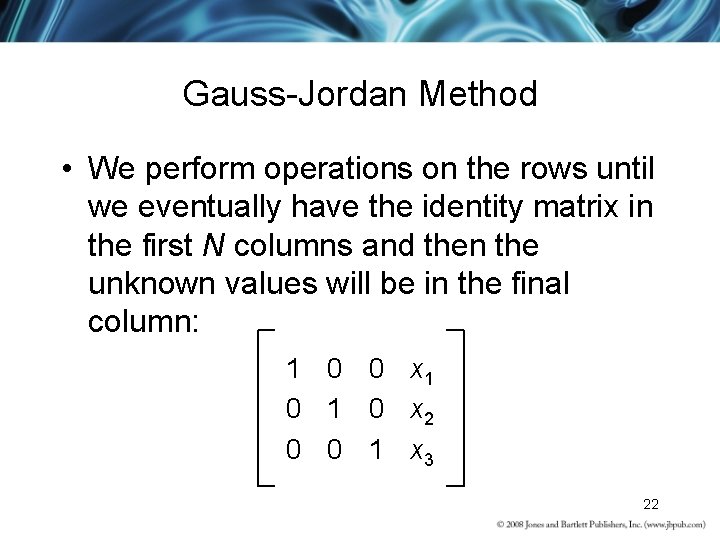
Gauss-Jordan Method • We perform operations on the rows until we eventually have the identity matrix in the first N columns and then the unknown values will be in the final column: 1 0 0 x 1 0 x 2 0 0 1 x 3 22
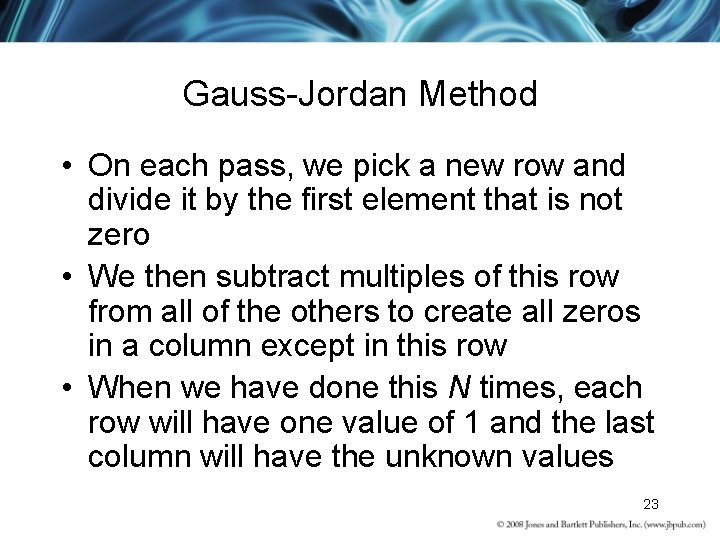
Gauss-Jordan Method • On each pass, we pick a new row and divide it by the first element that is not zero • We then subtract multiples of this row from all of the others to create all zeros in a column except in this row • When we have done this N times, each row will have one value of 1 and the last column will have the unknown values 23
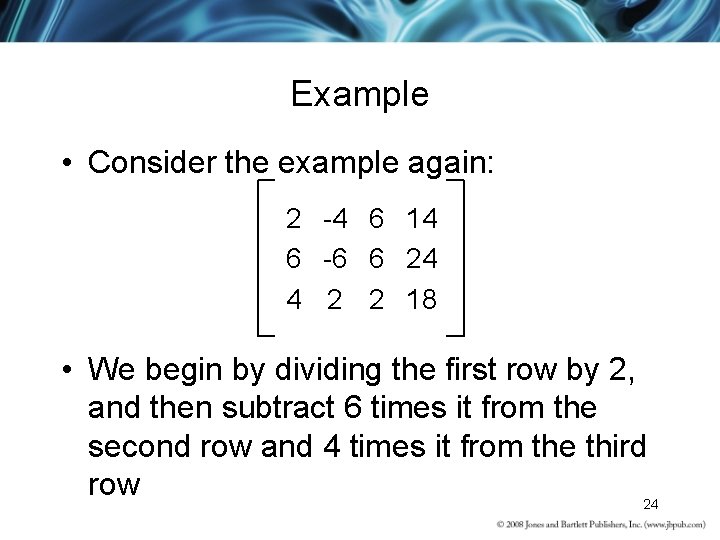
Example • Consider the example again: 2 -4 6 14 6 -6 6 24 4 2 2 18 • We begin by dividing the first row by 2, and then subtract 6 times it from the second row and 4 times it from the third row 24
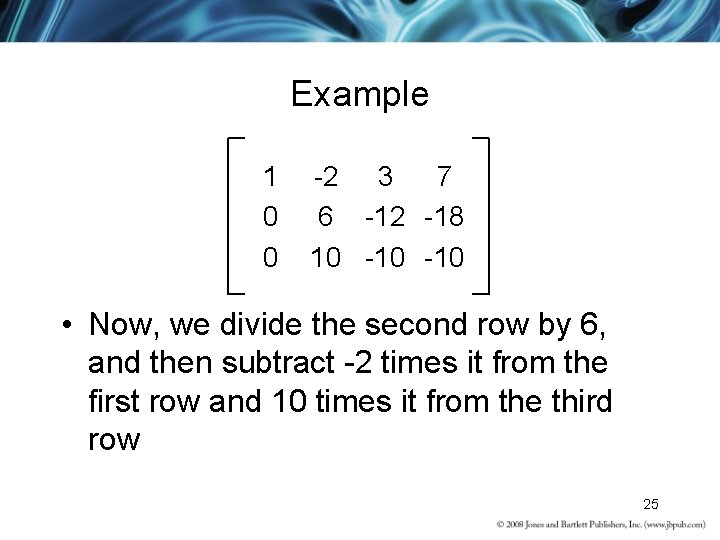
Example 1 0 0 -2 3 7 6 -12 -18 10 -10 • Now, we divide the second row by 6, and then subtract -2 times it from the first row and 10 times it from the third row 25
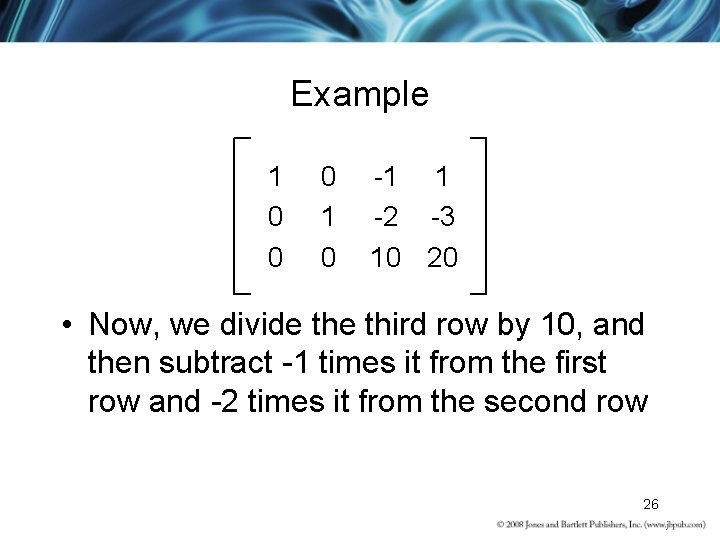
Example 1 0 0 0 1 0 -1 1 -2 -3 10 20 • Now, we divide third row by 10, and then subtract -1 times it from the first row and -2 times it from the second row 26
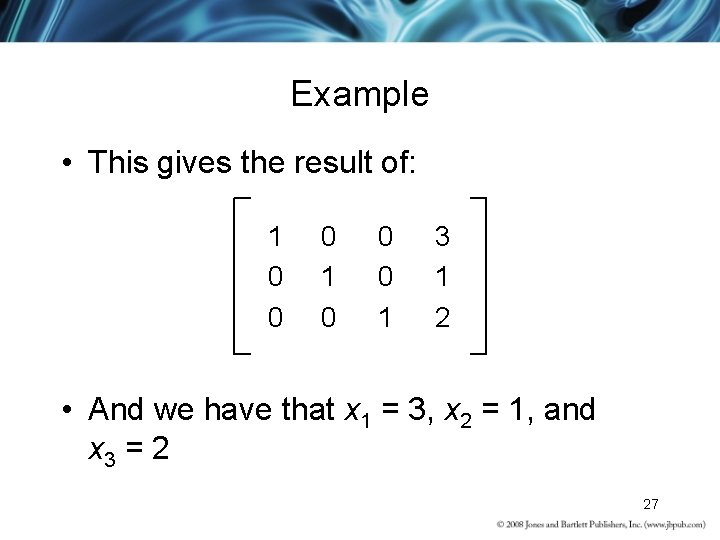
Example • This gives the result of: 1 0 0 0 1 3 1 2 • And we have that x 1 = 3, x 2 = 1, and x 3 = 2 27