
Calculating Empirical and Molecular Formulas Calculating empirical formula
- Slides: 5
Calculating Empirical and Molecular Formulas
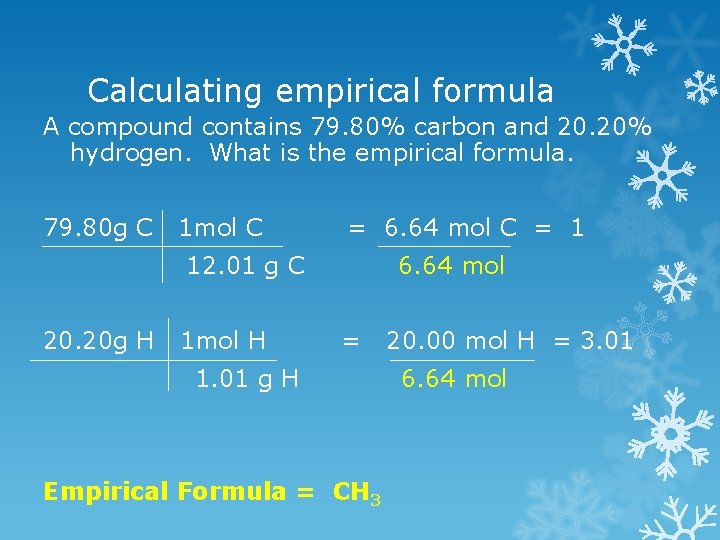
Calculating empirical formula A compound contains 79. 80% carbon and 20. 20% hydrogen. What is the empirical formula. 79. 80 g C 1 mol C = 6. 64 mol C = 1 12. 01 g C 20. 20 g H 1 mol H 6. 64 mol = 1. 01 g H Empirical Formula = CH 3 20. 00 mol H = 3. 01 6. 64 mol
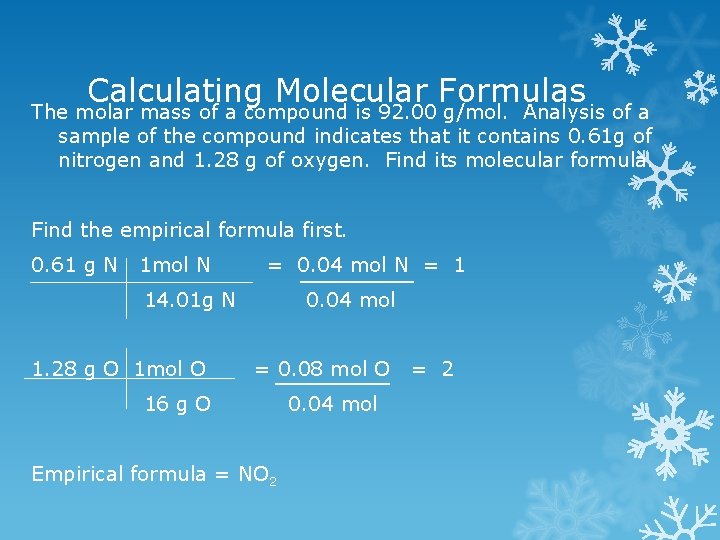
Calculating Molecular Formulas The molar mass of a compound is 92. 00 g/mol. Analysis of a sample of the compound indicates that it contains 0. 61 g of nitrogen and 1. 28 g of oxygen. Find its molecular formula. Find the empirical formula first. 0. 61 g N 1 mol N = 0. 04 mol N = 1 14. 01 g N 1. 28 g O 1 mol O 0. 04 mol = 0. 08 mol O 16 g O Empirical formula = NO 2 0. 04 mol = 2
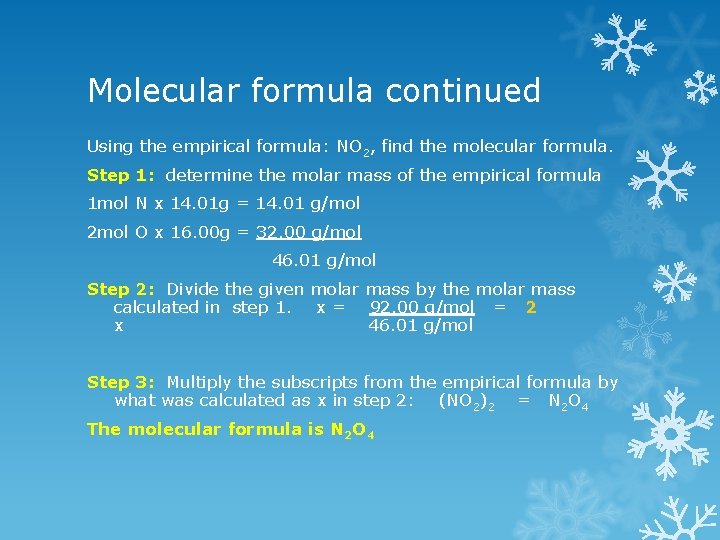
Molecular formula continued Using the empirical formula: NO 2, find the molecular formula. Step 1: determine the molar mass of the empirical formula 1 mol N x 14. 01 g = 14. 01 g/mol 2 mol O x 16. 00 g = 32. 00 g/mol 46. 01 g/mol Step 2: Divide the given molar mass by the molar mass calculated in step 1. x = 92. 00 g/mol = 2 x 46. 01 g/mol Step 3: Multiply the subscripts from the empirical formula by what was calculated as x in step 2: (NO 2)2 = N 2 O 4 The molecular formula is N 2 O 4
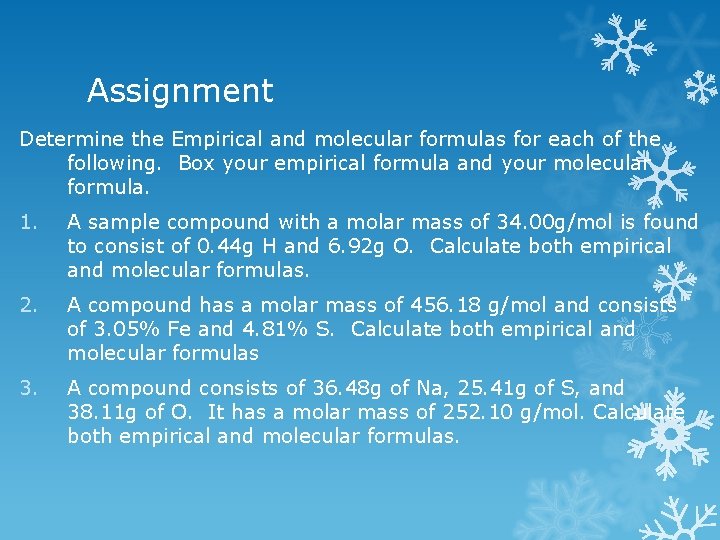
Assignment Determine the Empirical and molecular formulas for each of the following. Box your empirical formula and your molecular formula. 1. A sample compound with a molar mass of 34. 00 g/mol is found to consist of 0. 44 g H and 6. 92 g O. Calculate both empirical and molecular formulas. 2. A compound has a molar mass of 456. 18 g/mol and consists of 3. 05% Fe and 4. 81% S. Calculate both empirical and molecular formulas 3. A compound consists of 36. 48 g of Na, 25. 41 g of S, and 38. 11 g of O. It has a molar mass of 252. 10 g/mol. Calculate both empirical and molecular formulas.