
Calculate Volume and Performance Variances Intermediate Cost Analysis





- Slides: 35
Calculate Volume and Performance Variances Intermediate Cost Analysis and Management © 1
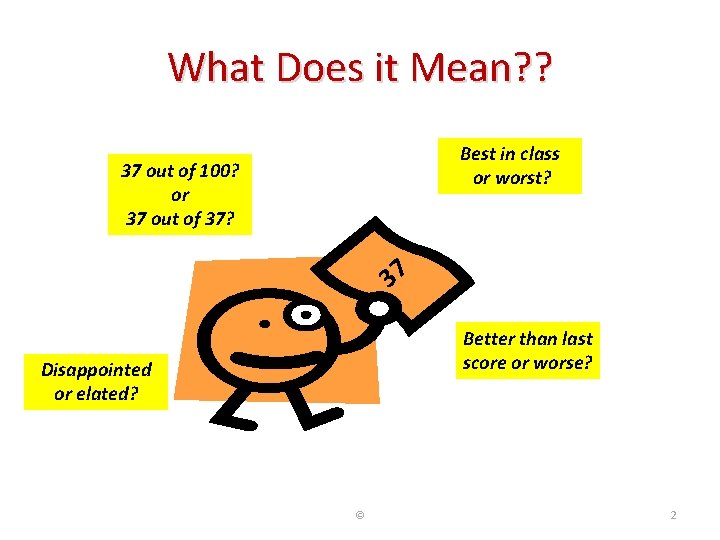
What Does it Mean? ? Best in class or worst? 37 out of 100? or 37 out of 37? 37 Better than last score or worse? Disappointed or elated? © 2
Terminal Learning Objective • Task: Calculate Volume and Performance Variances • Condition: You are training to become an ACE with access to ICAM course handouts, readings, and spreadsheet tools and awareness of Operational Environment (OE)/Contemporary Operational Environment (COE) variables and actors. • Standard: with at least 80% accuracy • Describe the concept of variances • Calculate the flex forecast and volume variance • Identify and enter relevant scenario data into macro enabled templates to calculate Volume and Performance Variance. • Identify causes of variances © 3
Purpose for Variance Analysis • Giving context to numbers creates their value • Starting by creating an expectation • Variance is difference between reality and expectation • Volume Variance isolates ‘effect’ due to volume change • All other variance to expectation is due to some sort of performance change © 4
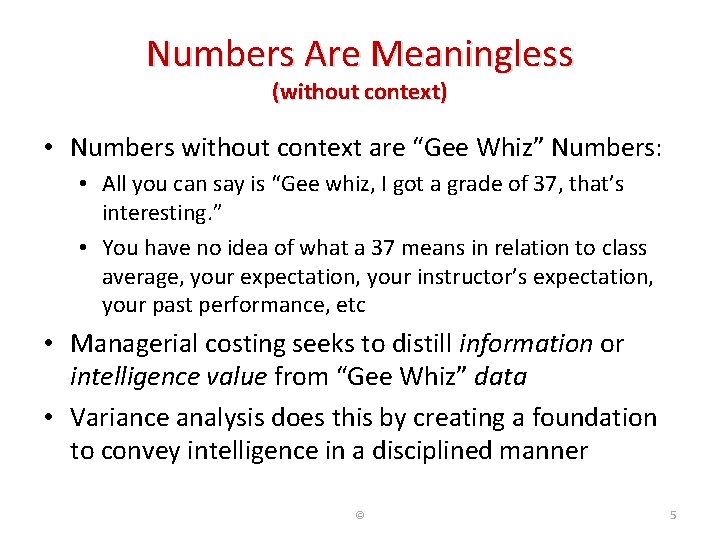
Numbers Are Meaningless (without context) • Numbers without context are “Gee Whiz” Numbers: • All you can say is “Gee whiz, I got a grade of 37, that’s interesting. ” • You have no idea of what a 37 means in relation to class average, your expectation, your instructor’s expectation, your past performance, etc • Managerial costing seeks to distill information or intelligence value from “Gee Whiz” data • Variance analysis does this by creating a foundation to convey intelligence in a disciplined manner © 5
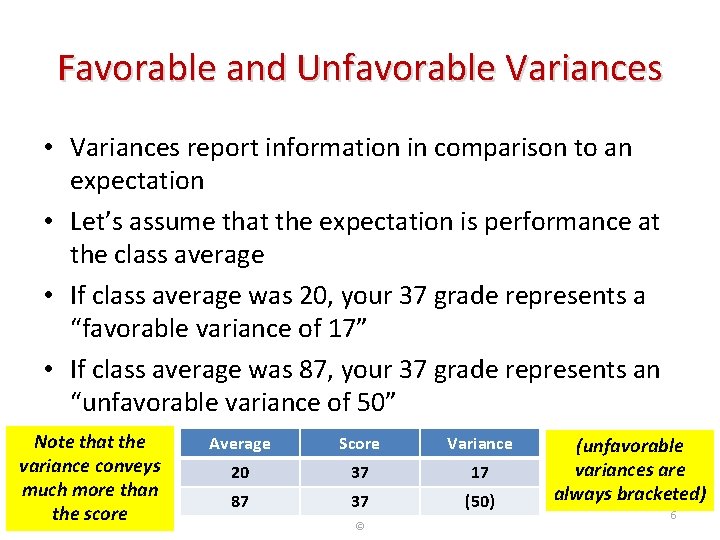
Favorable and Unfavorable Variances • Variances report information in comparison to an expectation • Let’s assume that the expectation is performance at the class average • If class average was 20, your 37 grade represents a “favorable variance of 17” • If class average was 87, your 37 grade represents an “unfavorable variance of 50” Note that the variance conveys much more than the score Average Score Variance 20 37 17 87 37 (50) © (unfavorable variances are always bracketed) 6
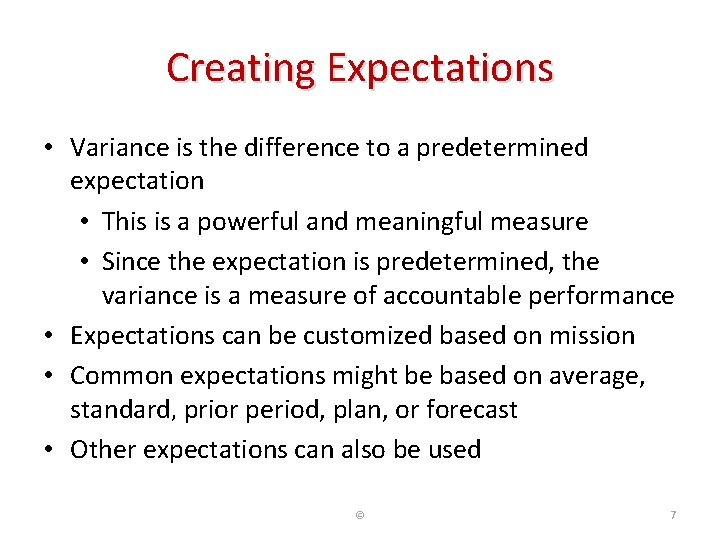
Creating Expectations • Variance is the difference to a predetermined expectation • This is a powerful and meaningful measure • Since the expectation is predetermined, the variance is a measure of accountable performance • Expectations can be customized based on mission • Common expectations might be based on average, standard, prior period, plan, or forecast • Other expectations can also be used © 7
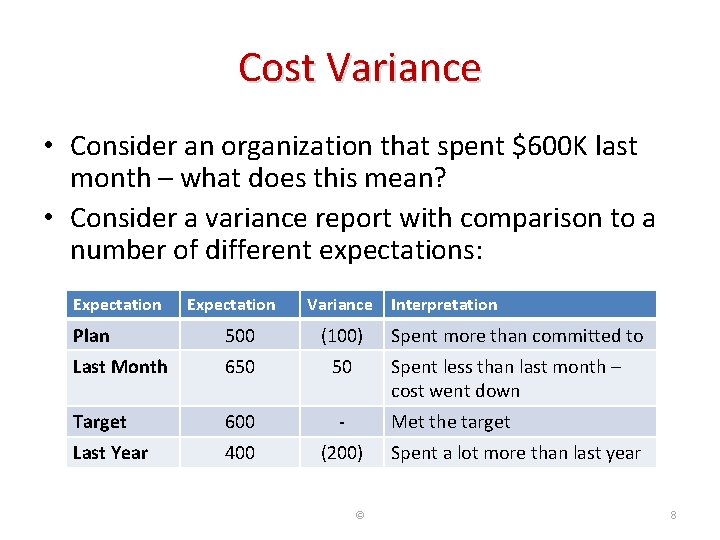
Cost Variance • Consider an organization that spent $600 K last month – what does this mean? • Consider a variance report with comparison to a number of different expectations: Expectation Variance Plan 500 (100) Last Month 650 50 Target 600 - Last Year 400 (200) Interpretation Spent more than committed to Spent less than last month – cost went down Met the target © Spent a lot more than last year 8
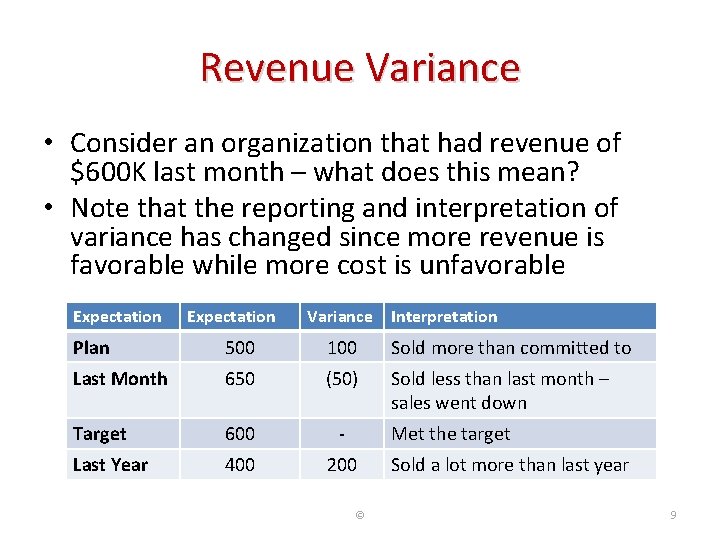
Revenue Variance • Consider an organization that had revenue of $600 K last month – what does this mean? • Note that the reporting and interpretation of variance has changed since more revenue is favorable while more cost is unfavorable Expectation Variance Interpretation Plan 500 100 Sold more than committed to Last Month 650 (50) Sold less than last month – sales went down Target 600 - Last Year 400 200 Met the target © Sold a lot more than last year 9
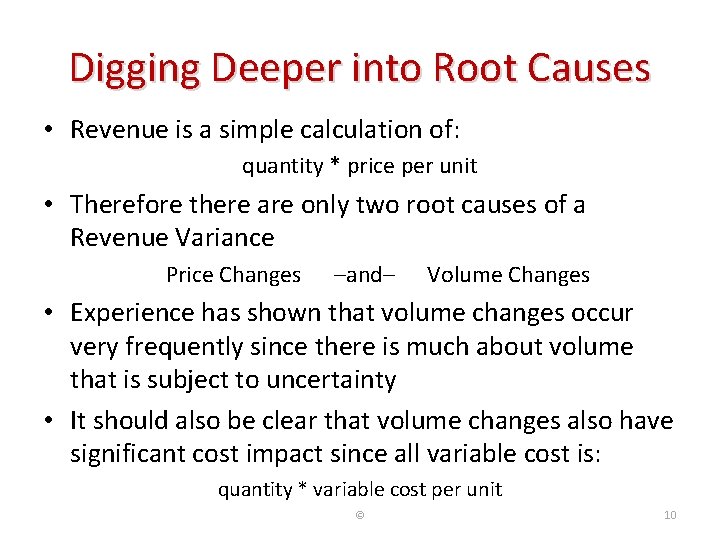
Digging Deeper into Root Causes • Revenue is a simple calculation of: quantity * price per unit • Therefore there are only two root causes of a Revenue Variance Price Changes –and– Volume Changes • Experience has shown that volume changes occur very frequently since there is much about volume that is subject to uncertainty • It should also be clear that volume changes also have significant cost impact since all variable cost is: quantity * variable cost per unit © 10
Learning Check • What is a variance? • If revenue is greater than expectation how is the variance described? • If cost is greater than expectation how is the variance described? © 11
The Flexible Forecast • Adjusts the forecast for changes in sales volume • Uses the same unit price and unit cost assumptions used in the forecast • Think of these as “what ifs” • “What” would the forecast have been “if” volume were different than planned © 12
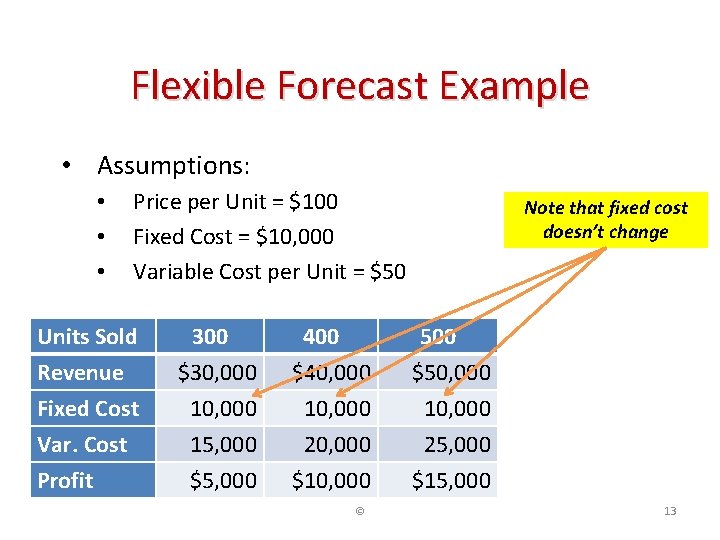
Flexible Forecast Example • Assumptions: • • • Price per Unit = $100 Fixed Cost = $10, 000 Variable Cost per Unit = $50 Units Sold Revenue Fixed Cost Var. Cost Profit Note that fixed cost doesn’t change 300 $30, 000 15, 000 400 $40, 000 10, 000 20, 000 500 $50, 000 10, 000 25, 000 $10, 000 $15, 000 © 13
Flexible Forecast Example • Assumptions: Contribution margin change “falls through” to profit Price per Unit = $100 Fixed Cost = $10, 000 Variable Cost per Unit = $50 Unit CM = $100 - $50 = $50 Units Sold 300 400 500 Revenue $30, 000 $40, 000 $50, 000 Fixed Cost 10, 000 Var. Cost 15, 000 20, 000 25, 000 • • • Profit $5, 000 $10, 000 © When units sold increases by 100, profit increases by 100 * $50 unit CM = $15, 000 $5, 000 14
So What? ? ? • The use of flexible forecasting is very useful in helping us dig deeper into the root causes of change from expectation • Consider a organization where cost went up 20% but output went up 30% • Even though cost increased which is generally unfavorable • It increased less that we might have expected • Indicating we need an approach to evaluate the compound effects of the volume change • This approach is call Volume Variance Analysis © 15
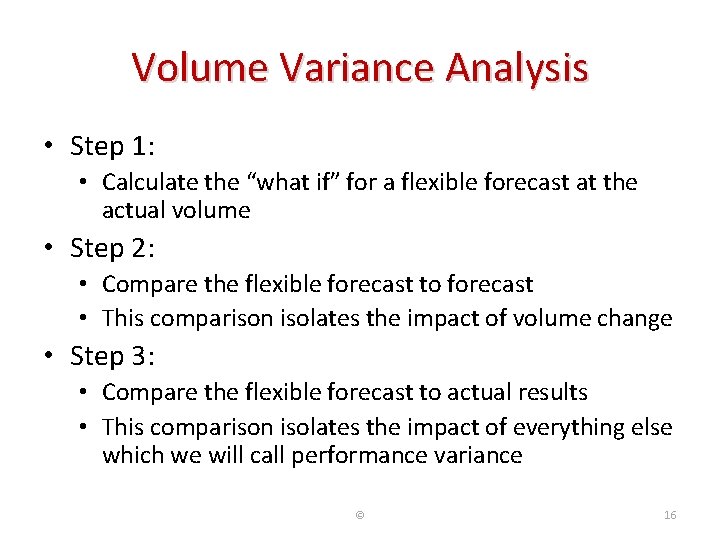
Volume Variance Analysis • Step 1: • Calculate the “what if” for a flexible forecast at the actual volume • Step 2: • Compare the flexible forecast to forecast • This comparison isolates the impact of volume change • Step 3: • Compare the flexible forecast to actual results • This comparison isolates the impact of everything else which we will call performance variance © 16
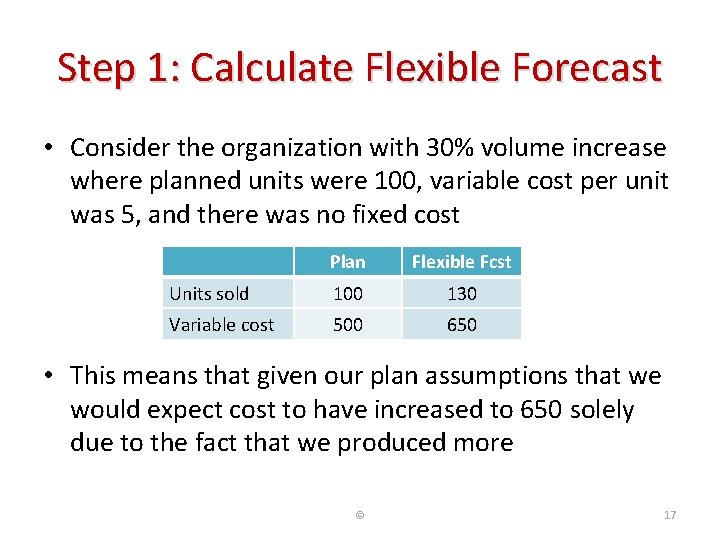
Step 1: Calculate Flexible Forecast • Consider the organization with 30% volume increase where planned units were 100, variable cost per unit was 5, and there was no fixed cost Plan Flexible Fcst Units sold 100 130 Variable cost 500 650 • This means that given our plan assumptions that we would expect cost to have increased to 650 solely due to the fact that we produced more © 17
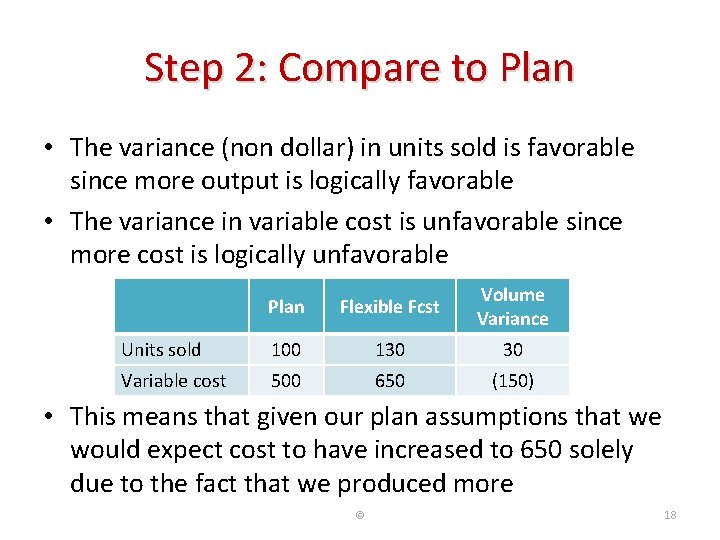
Step 2: Compare to Plan • The variance (non dollar) in units sold is favorable since more output is logically favorable • The variance in variable cost is unfavorable since more cost is logically unfavorable Plan Flexible Fcst Volume Variance Units sold 100 130 30 Variable cost 500 650 (150) • This means that given our plan assumptions that we would expect cost to have increased to 650 solely due to the fact that we produced more © 18
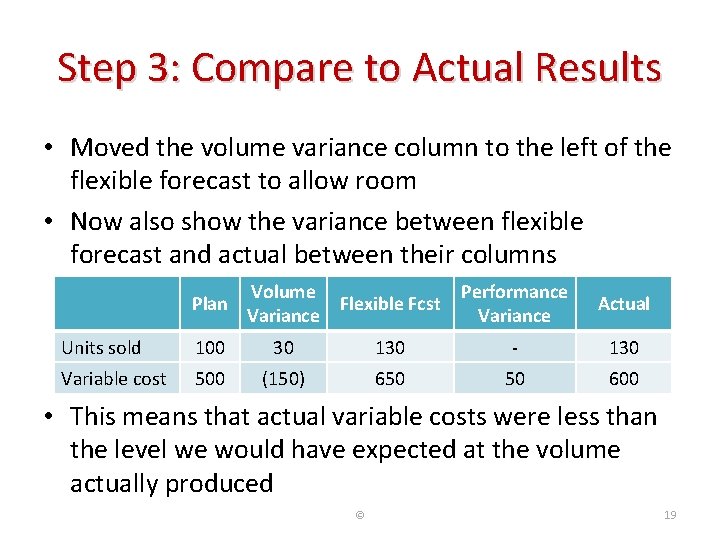
Step 3: Compare to Actual Results • Moved the volume variance column to the left of the flexible forecast to allow room • Now also show the variance between flexible forecast and actual between their columns Plan Volume Variance Flexible Fcst Performance Variance Actual Units sold 100 30 130 - 130 Variable cost 500 (150) 650 50 600 • This means that actual variable costs were less than the level we would have expected at the volume actually produced © 19
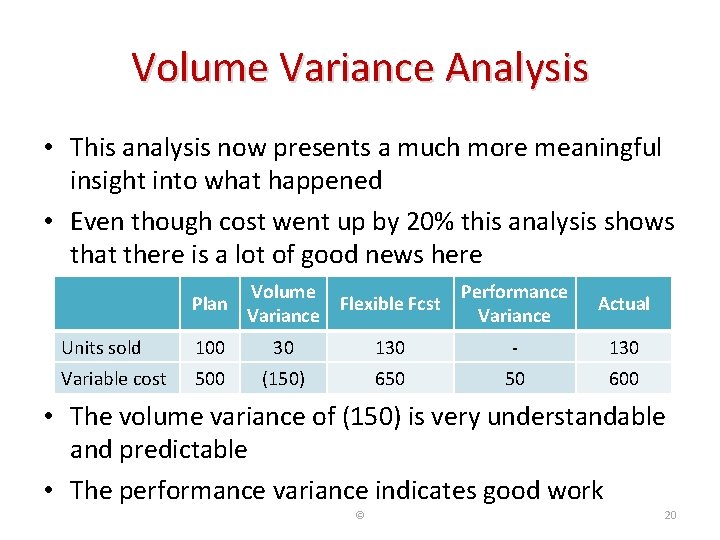
Volume Variance Analysis • This analysis now presents a much more meaningful insight into what happened • Even though cost went up by 20% this analysis shows that there is a lot of good news here Plan Volume Variance Flexible Fcst Performance Variance Actual Units sold 100 30 130 - 130 Variable cost 500 (150) 650 50 600 • The volume variance of (150) is very understandable and predictable • The performance variance indicates good work © 20
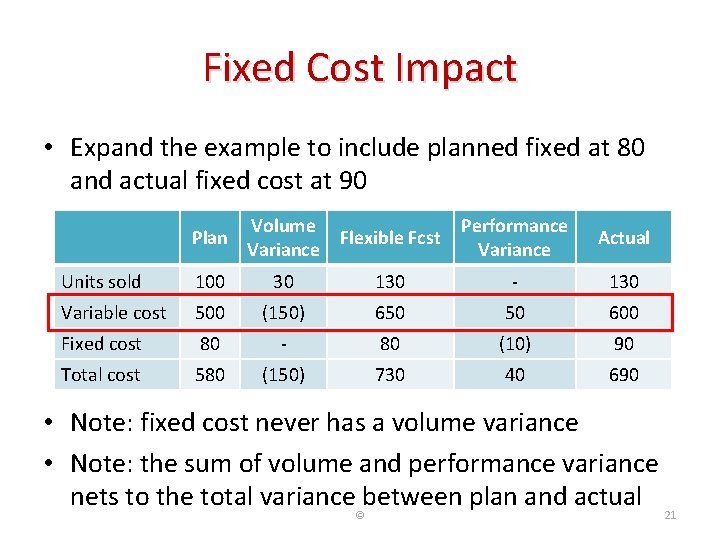
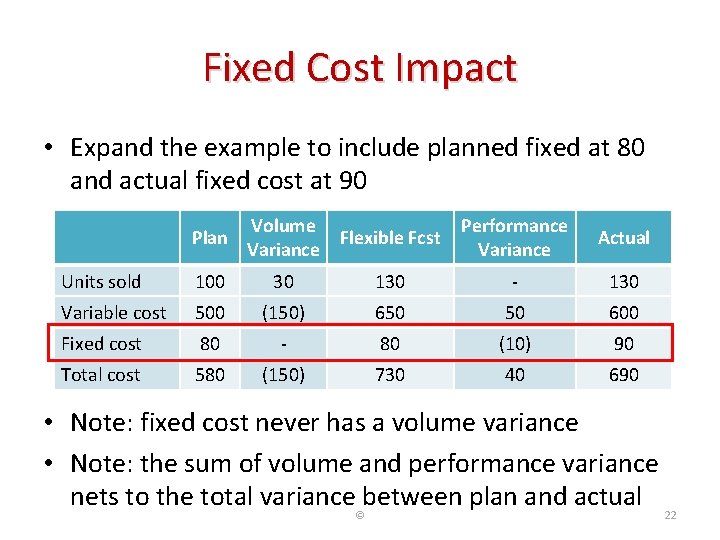
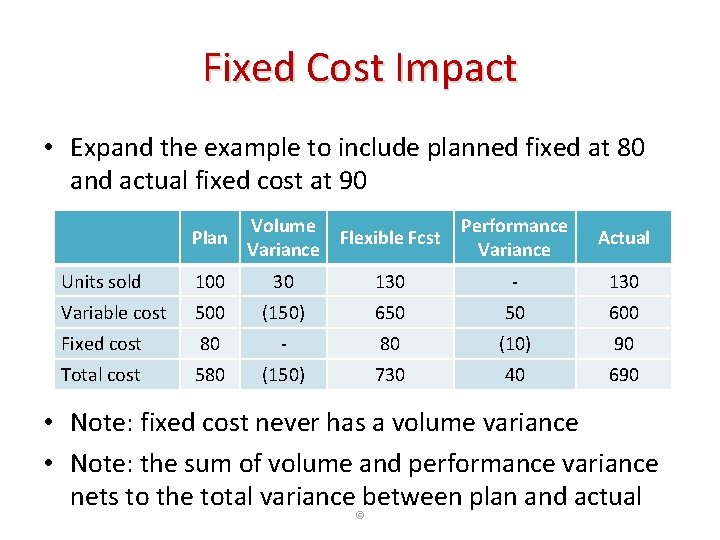
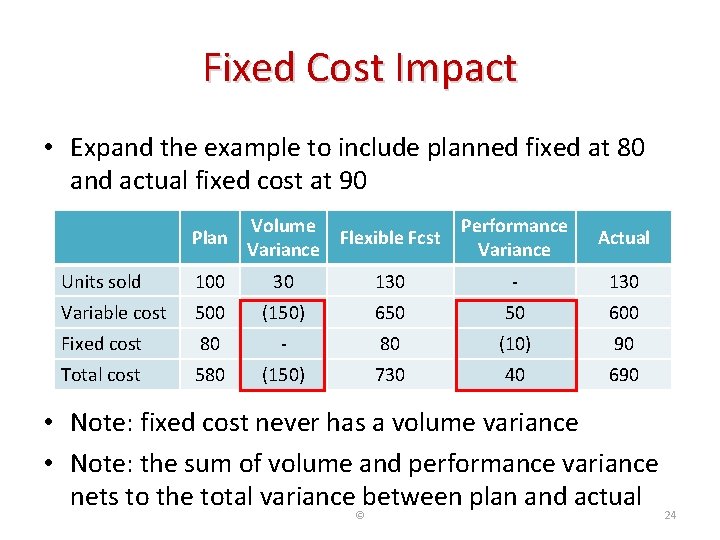
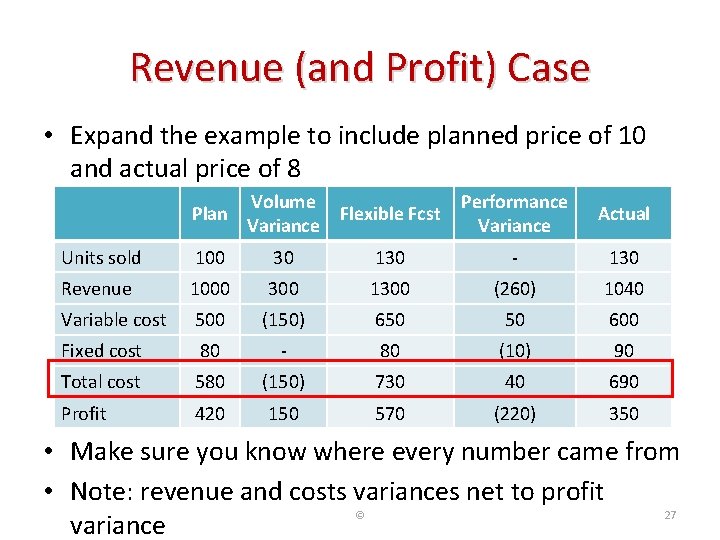
Fixed Cost Impact • Expand the example to include planned fixed at 80 and actual fixed cost at 90 Plan Volume Variance Flexible Fcst Performance Variance Actual Units sold 100 30 130 - 130 Variable cost 500 (150) 650 50 600 Fixed cost 80 - 80 (10) 90 Total cost 580 (150) 730 40 690 • Note: fixed cost never has a volume variance • Note: the sum of volume and performance variance nets to the total variance between plan and actual © 21
Fixed Cost Impact • Expand the example to include planned fixed at 80 and actual fixed cost at 90 Plan Volume Variance Flexible Fcst Performance Variance Actual Units sold 100 30 130 - 130 Variable cost 500 (150) 650 50 600 Fixed cost 80 - 80 (10) 90 Total cost 580 (150) 730 40 690 • Note: fixed cost never has a volume variance • Note: the sum of volume and performance variance nets to the total variance between plan and actual © 22
Fixed Cost Impact • Expand the example to include planned fixed at 80 and actual fixed cost at 90 Plan Volume Variance Flexible Fcst Performance Variance Actual Units sold 100 30 130 - 130 Variable cost 500 (150) 650 50 600 Fixed cost 80 - 80 (10) 90 Total cost 580 (150) 730 40 690 • Note: fixed cost never has a volume variance • Note: the sum of volume and performance variance nets to the total variance between plan and actual ©
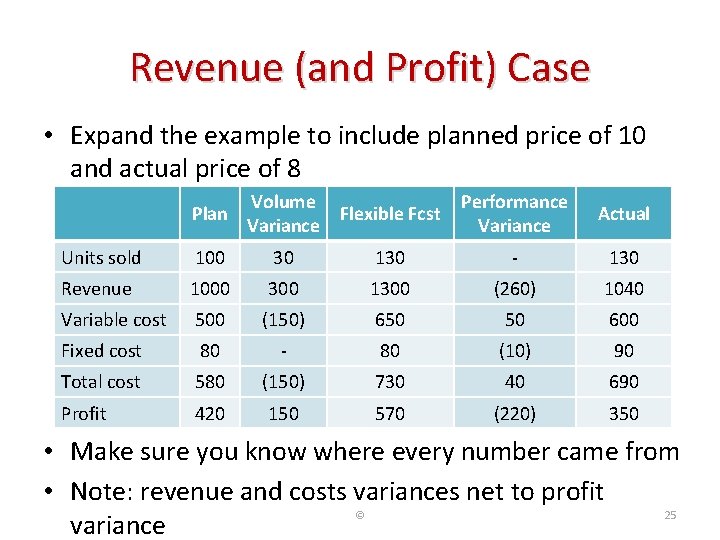
Fixed Cost Impact • Expand the example to include planned fixed at 80 and actual fixed cost at 90 Plan Volume Variance Flexible Fcst Performance Variance Actual Units sold 100 30 130 - 130 Variable cost 500 (150) 650 50 600 Fixed cost 80 - 80 (10) 90 Total cost 580 (150) 730 40 690 • Note: fixed cost never has a volume variance • Note: the sum of volume and performance variance nets to the total variance between plan and actual © 24
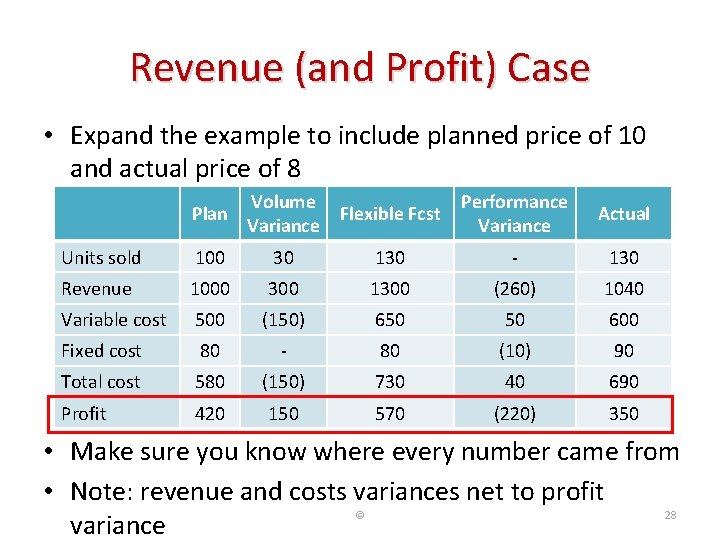
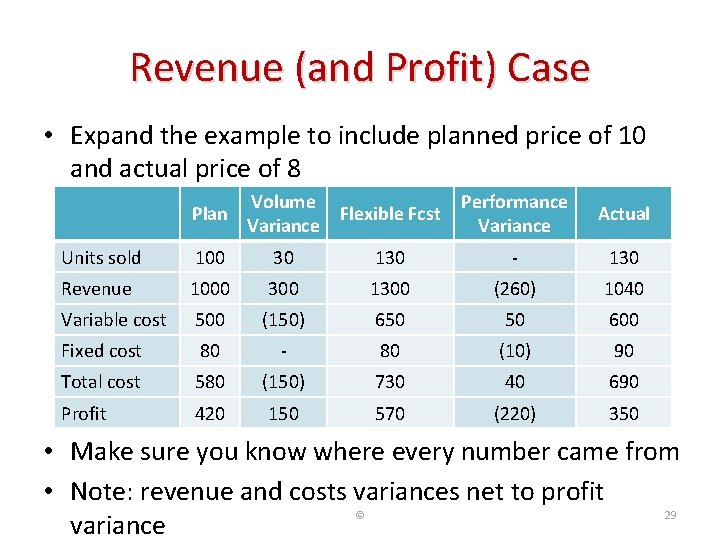
Revenue (and Profit) Case • Expand the example to include planned price of 10 and actual price of 8 Plan Volume Variance Flexible Fcst Performance Variance Actual Units sold 100 30 130 - 130 Revenue 1000 300 1300 (260) 1040 Variable cost 500 (150) 650 50 600 Fixed cost 80 - 80 (10) 90 Total cost 580 (150) 730 40 690 Profit 420 150 570 (220) 350 • Make sure you know where every number came from • Note: revenue and costs variances net to profit © 25 variance
Revenue (and Profit) Case • Expand the example to include planned price of 10 and actual price of 8 Plan Volume Variance Flexible Fcst Performance Variance Actual Units sold 100 30 130 - 130 Revenue 1000 300 1300 (260) 1040 Variable cost 500 (150) 650 50 600 Fixed cost 80 - 80 (10) 90 Total cost 580 (150) 730 40 690 Profit 420 150 570 (220) 350 • Make sure you know where every number came from • Note: revenue and costs variances net to profit © 26 variance
Revenue (and Profit) Case • Expand the example to include planned price of 10 and actual price of 8 Plan Volume Variance Flexible Fcst Performance Variance Actual Units sold 100 30 130 - 130 Revenue 1000 300 1300 (260) 1040 Variable cost 500 (150) 650 50 600 Fixed cost 80 - 80 (10) 90 Total cost 580 (150) 730 40 690 Profit 420 150 570 (220) 350 • Make sure you know where every number came from • Note: revenue and costs variances net to profit © 27 variance
Revenue (and Profit) Case • Expand the example to include planned price of 10 and actual price of 8 Plan Volume Variance Flexible Fcst Performance Variance Actual Units sold 100 30 130 - 130 Revenue 1000 300 1300 (260) 1040 Variable cost 500 (150) 650 50 600 Fixed cost 80 - 80 (10) 90 Total cost 580 (150) 730 40 690 Profit 420 150 570 (220) 350 • Make sure you know where every number came from • Note: revenue and costs variances net to profit © 28 variance
Revenue (and Profit) Case • Expand the example to include planned price of 10 and actual price of 8 Plan Volume Variance Flexible Fcst Performance Variance Actual Units sold 100 30 130 - 130 Revenue 1000 300 1300 (260) 1040 Variable cost 500 (150) 650 50 600 Fixed cost 80 - 80 (10) 90 Total cost 580 (150) 730 40 690 Profit 420 150 570 (220) 350 • Make sure you know where every number came from • Note: revenue and costs variances net to profit © 29 variance
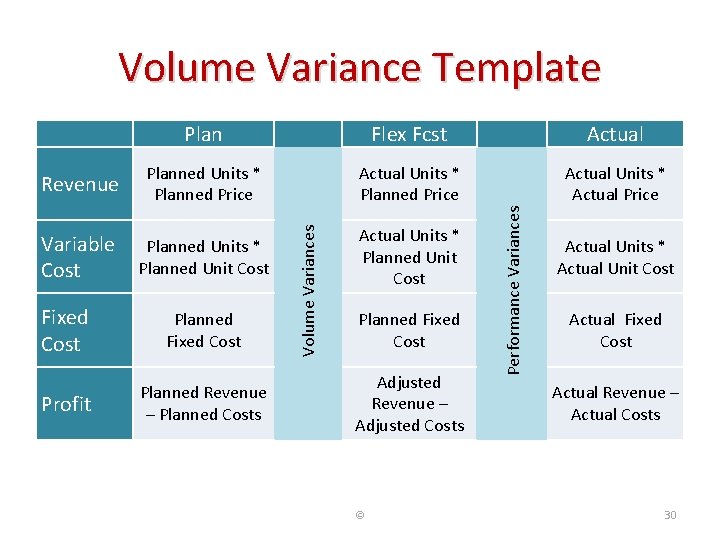
Volume Variance Template Flex Fcst Actual Planned Units * Planned Price Actual Units * Actual Price Variable Planned Units * Planned Unit Cost Fixed Cost Planned Fixed Cost Profit Planned Revenue – Planned Costs Actual Units * Planned Unit Cost Planned Fixed Cost Adjusted Revenue – Adjusted Costs © Performance Variances Revenue Plan Volume Variances Actual Units * Actual Unit Cost Actual Fixed Cost Actual Revenue – Actual Costs 30
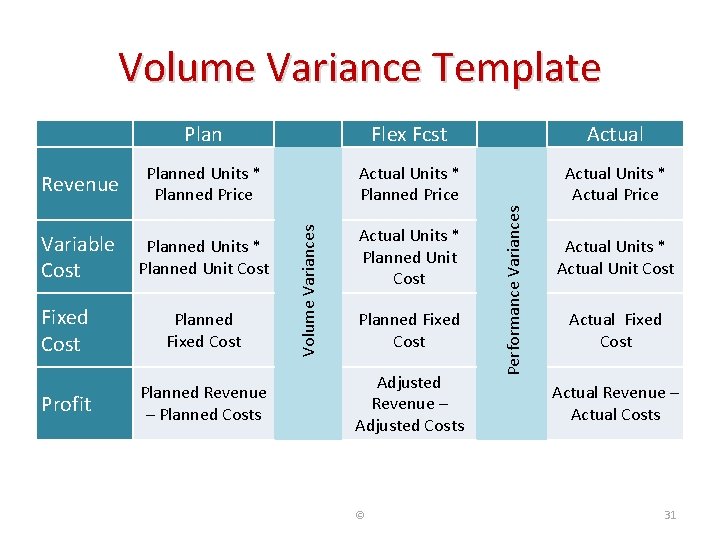
Volume Variance Template Flex Fcst Actual Planned Units * Planned Price Actual Units * Actual Price Variable Planned Units * Planned Unit Cost Fixed Cost Planned Fixed Cost Profit Planned Revenue – Planned Costs Actual Units * Planned Unit Cost Planned Fixed Cost Adjusted Revenue – Adjusted Costs © Performance Variances Revenue Plan Volume Variances Actual Units * Actual Unit Cost Actual Fixed Cost Actual Revenue – Actual Costs 31
Learning Check • How should we expect an increase in the number of units sold to affect variable cost? • The sum of the performance variances for revenue and total cost should equal? © 32
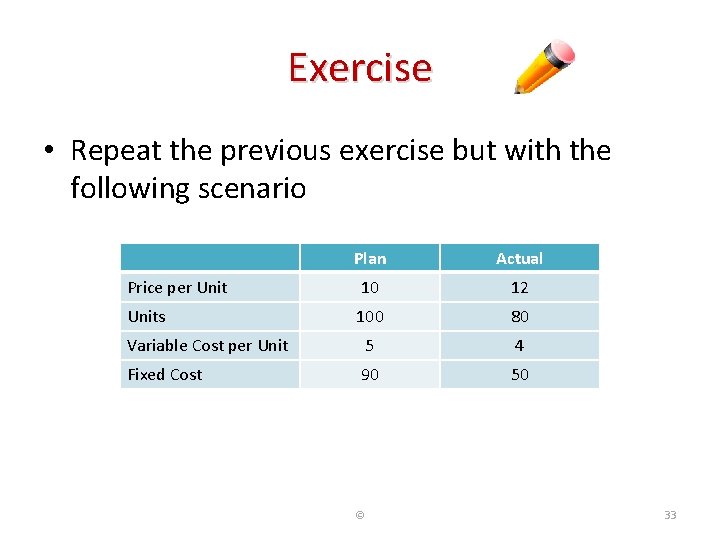
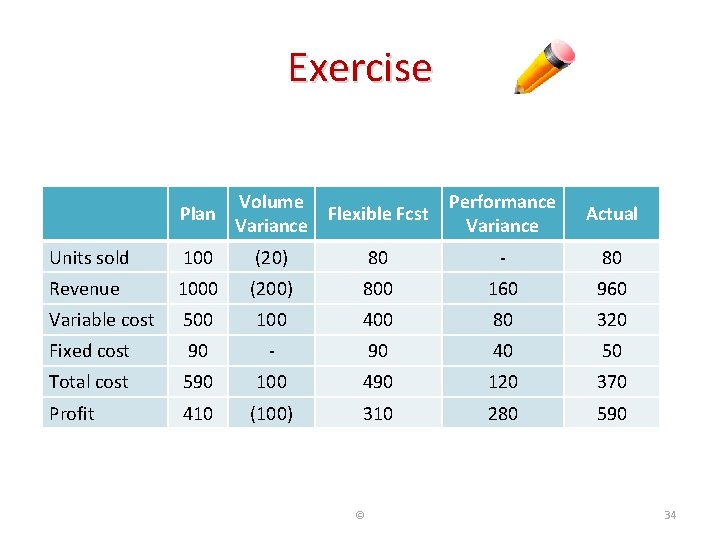
Exercise • Repeat the previous exercise but with the following scenario Plan Actual Price per Unit 10 12 Units 100 80 Variable Cost per Unit 5 4 Fixed Cost 90 50 © 33
Exercise Plan Volume Variance Flexible Fcst Performance Variance Actual Units sold 100 (20) 80 - 80 Revenue 1000 (200) 800 160 960 Variable cost 500 100 400 80 320 Fixed cost 90 - 90 40 50 Total cost 590 100 490 120 370 Profit 410 (100) 310 280 590 © 34
Practical Exercise © 35