
Calculate the speed of a water wave when










- Slides: 60
Calculate the speed of a water wave when waves 5. 0 m apart pass by at 40. 0 waves per minute
Chapter 16 Light
Light • The range of frequencies of electromagnetic waves that stimulate the retina of the eye
Electromagnetic Wave • Transverse waves made up of pulses moving through space that affect both electric & magnetic fields
Spectrum • An ordered arrangement of many frequencies or wavelengths of waves
Electromagnetic Spectrum • An ordered arrangement of all the electromagnetic waves
Ray • The straight line path of a light wave
Incident Ray • A ray striking a surface
Transmitted Ray • A ray passing through a substance
Reflected Ray • A ray bouncing off of another substance
Speed of Light • First Determined by Ole Roemer by observing the moons of Jupiter from opposite ends of Earth’s orbit.
Speed of Light • Correctly determined by Michelson by reflecting light from a spinning octagonal mirror.
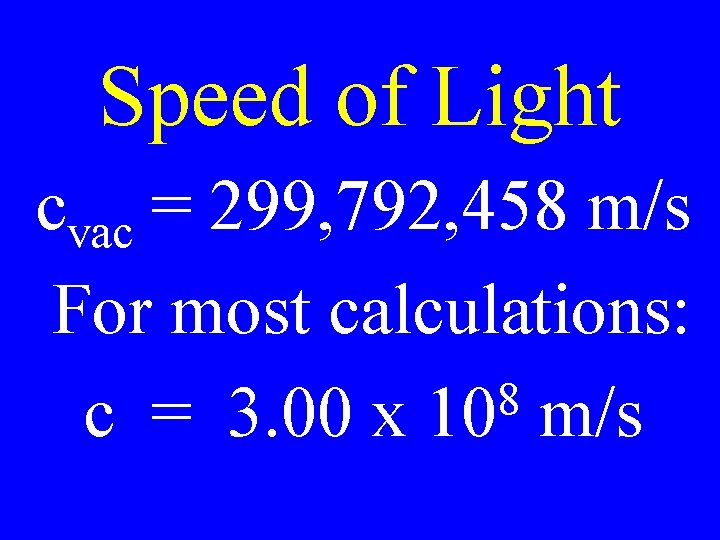
Speed of Light cvac = 299, 792, 458 m/s For most calculations: 8 c = 3. 00 x 10 m/s
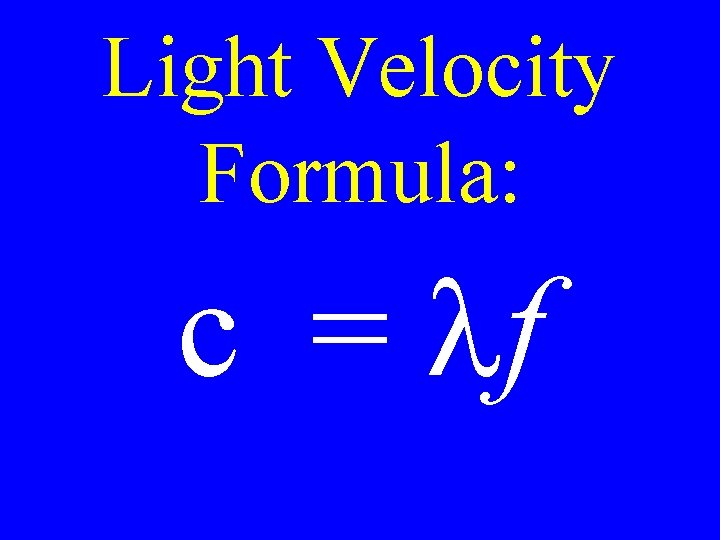
Light Velocity Formula: c = lf
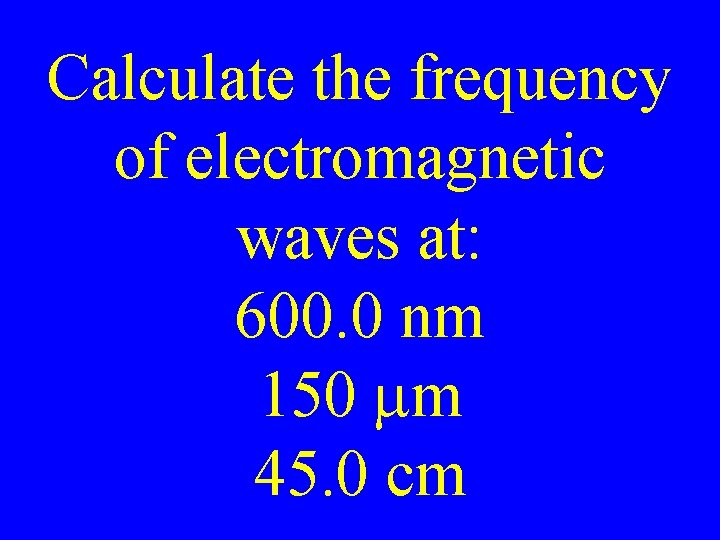
Calculate the frequency of electromagnetic waves at: 600. 0 nm 150 mm 45. 0 cm
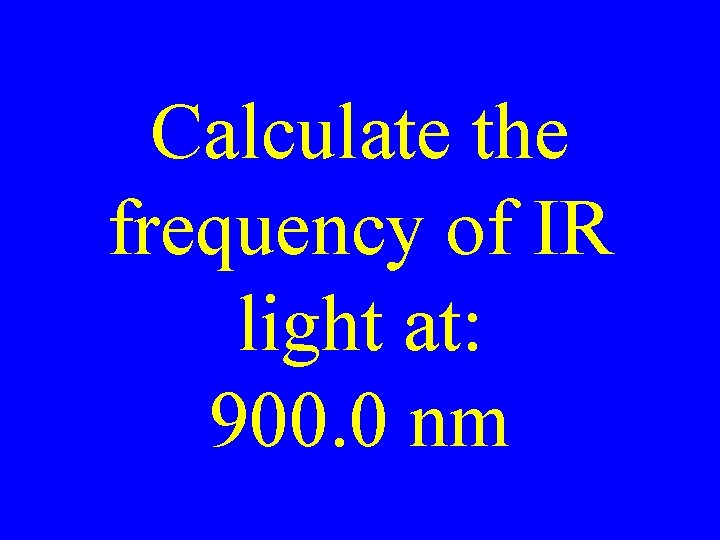
Calculate the frequency of IR light at: 900. 0 nm
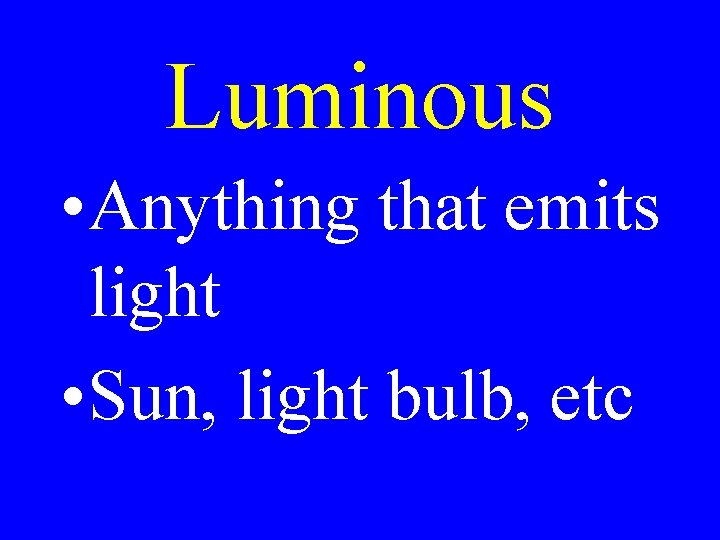
Luminous • Anything that emits light • Sun, light bulb, etc
Illuminated • Anything that reflects light • Moon, mirror, wall, etc
Luminous Flux (P) • The rate at which light is emitted
Lumens (lm) • The unit of luminous flux
Light from a bulb or source is emitted spherically from the source
We are usually interested in the illumination of a certain area
Illuminance (E) • The illumination of a surface
Lux (lx) • The unit for illumination 2 • lx = lm/m
Luminous Intensity (I) • The magnitude of the light source
Candela (cd) • Candle power of the unit for luminous intensity
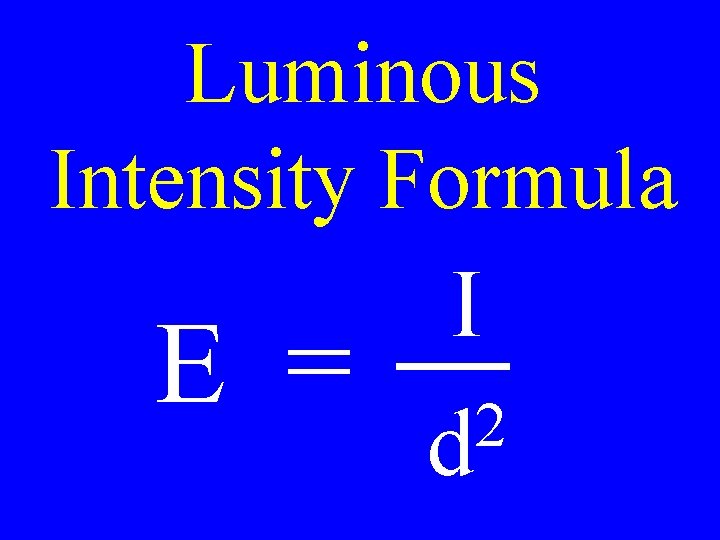
Luminous Intensity Formula E = I 2 d
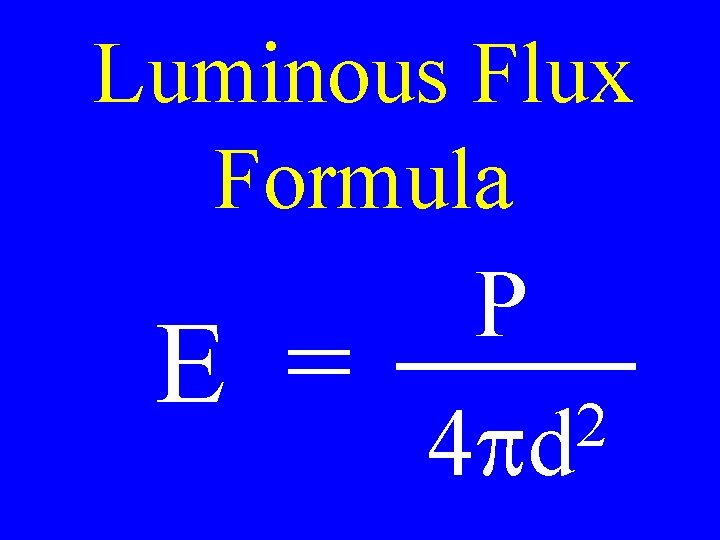
Luminous Flux Formula E = P 2 4 pd
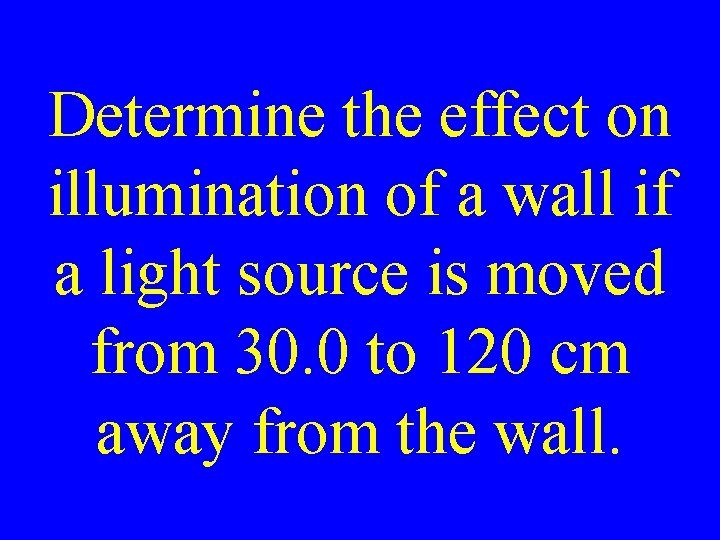
Determine the effect on illumination of a wall if a light source is moved from 30. 0 to 120 cm away from the wall.
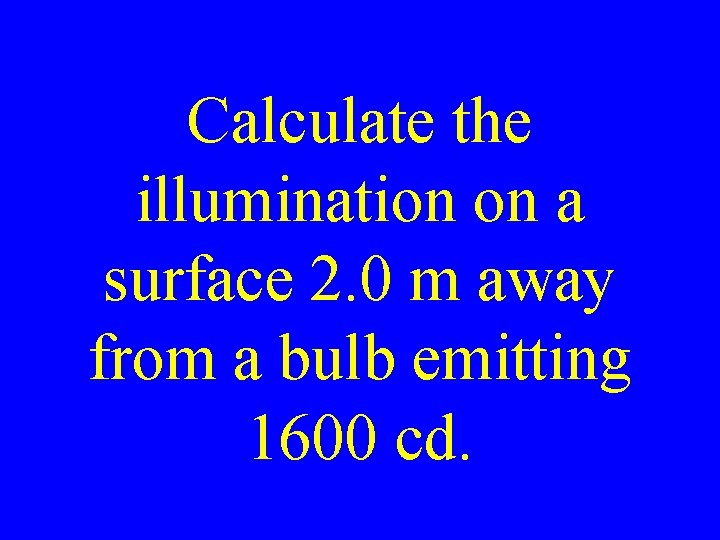
Calculate the illumination on a surface 2. 0 m away from a bulb emitting 1600 cd.
Calculate the illumination on a surface 3. 0 m away from a bulb emitting 2700 cd.
Transparent • Substances that allows light to be clearly transmitted through them
Translucent • Substances that allows light to be transmitted, though not clearly, through them
Opaque • Substances absorb or reflect all light striking them
Color • A perception caused when cones in the eyes are excited by certain frequencies or wavelengths of electromagnetic waves
Luminous Colors
Primary Colors • Red • Blue • Green
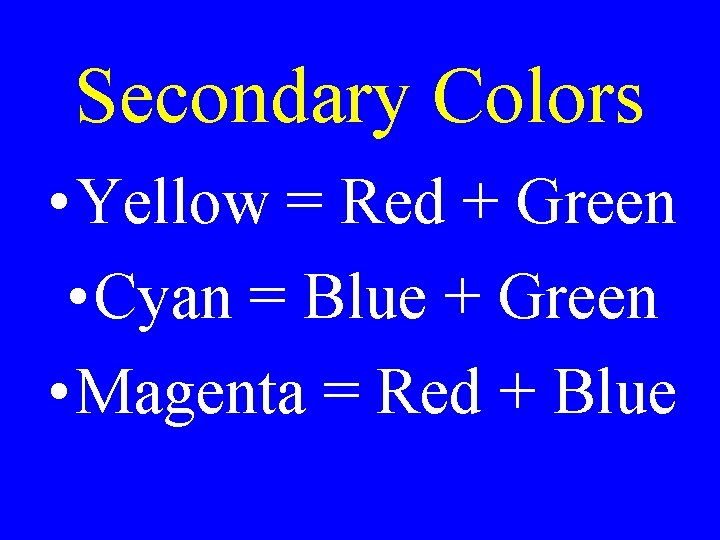
Secondary Colors • Colors produced by mixing primary colors
Secondary Colors • Yellow = Red + Green • Cyan = Blue + Green • Magenta = Red + Blue
Complimentary Colors • Two colors that when mixed produced white light
Complimentary Colors • Red + Cyan • Blue + Yellow • Green + Magenta
List the three primary colors & list each’s complementary color.
Illuminated Colors
Dyes • Molecules that absorb certain wavelengths of light; thus reflect others
Dyes • Dyes are made up of molecules which are too small to be seen with a microscope
Dyes • When dissolved, form colored solutions that allow light to pass through
Pigments • Materials that absorb certain wavelengths of light; thus reflect others
Pigments • Pigments are made up of particles large enough to be seen with a microscope
Pigments • When dissolved, form suspensions that reflect light and are opaque
Primary Pigments • A pigment that absorbs a primary color
Primary Pigments • Yellow • Cyan • Magenta
Secondary Pigments • A pigment that absorbs two primary colors; thus reflect the third
Secondary Pigments • They are the primary colors: red, blue, & green
Thin Film Interference • Constructive & destructive effects of interference causing a rainbow appearance on a thin film
Thin Film Interference • Wavelengths are reinforced when the film is ¼ l, ¾ l, 5/4 l, etc
Electromagnetic waves are transverse with vibrations like sin waves vibrating at o 360 from the ray
Polarized Light • A light wave vibrating in only one direction
Polarized Light • Can be produced by passing regular light through a polarized lens
Polarizer • A screen with very fine slits all being parallel to each other
Calculate the frequency & period of light with a wavelength of 450 nm