
Calculate Schedule and Cost Variances with Earned Value













- Slides: 63
Calculate Schedule and Cost Variances with Earned Value Analysis Intermediate Cost Analysis and Management © Dale R. Geiger 2011 1
How Can We Better Manage Large, Complex, Non Repetitive Projects? © Dale R. Geiger 2011 2
Terminal Learning Objective • Task: Calculate Schedule and Cost Variances with Earned Value Analysis • Condition: You are training to become an ACE with access to ICAM course handouts, readings, and spreadsheet tools and awareness of Operational Environment (OE)/Contemporary Operational Environment (COE) variables and actors. • Standard: with at least 80% accuracy: • Describe theory of Earned Value Analysis • Explain the concept of schedule and cost variances in context of Earned Value Analysis • Prepare AAR reconciliation using Earned Value Analysis © Dale R. Geiger 2011 3
Introduction • In subsequent lessons we will be dealing with • Organization based control • Role based control • Output based control • Here we would like to start with a simpler concept • Project management and control • The question is “how can we perform better in completing tasks or projects? ” © Dale R. Geiger 2011 4
Definition of Project • Projects are • Discrete tasks rather than continuous operations • Often one-time or infrequent rather than repeated • Frequently complex, ambiguous, or pioneering • Tasks that require a significant length of time © Dale R. Geiger 2011 5
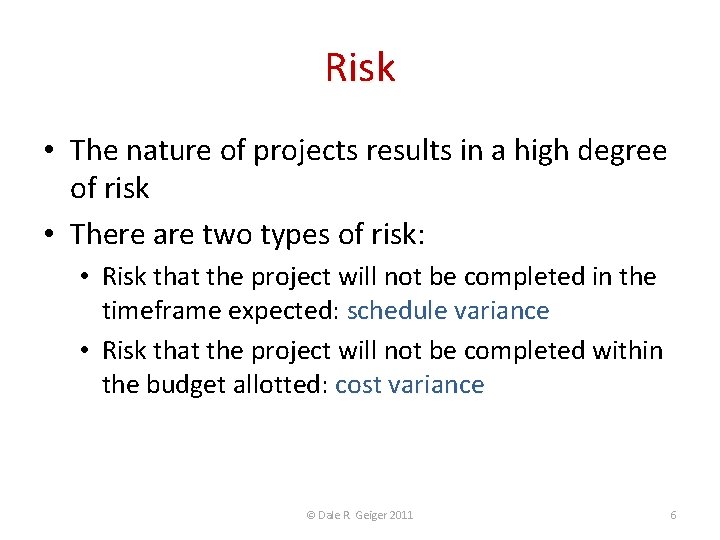
Risk • The nature of projects results in a high degree of risk • There are two types of risk: • Risk that the project will not be completed in the timeframe expected: schedule variance • Risk that the project will not be completed within the budget allotted: cost variance © Dale R. Geiger 2011 6
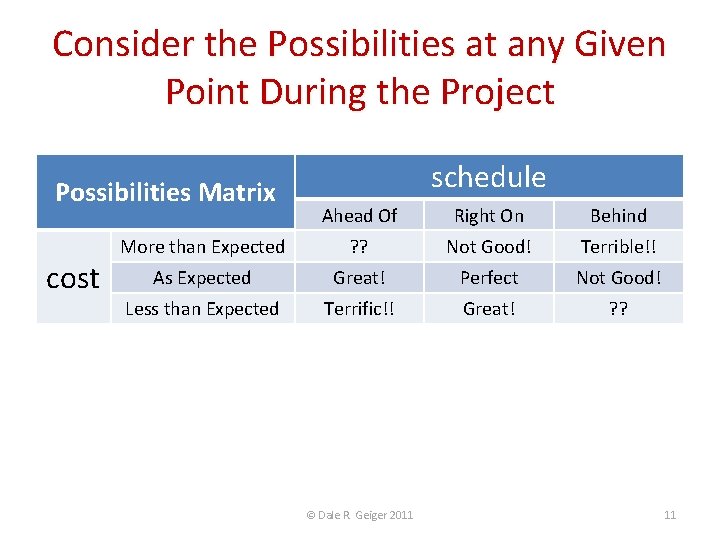
Consider the Possibilities at any Given Point During the Project Possibilities Matrix cost schedule Ahead Of Right On Behind More than Expected As Expected Perfect Less than Expected • Being right on schedule and at the expected cost is perfect (but rarely happens) © Dale R. Geiger 2011 7
Consider the Possibilities at any Given Point During the Project Possibilities Matrix cost schedule Ahead Of Right On Behind More than Expected As Expected Great! Less than Expected Terrific!! Great! • Being ahead of or on schedule and at or less than expected cost is a good thing © Dale R. Geiger 2011 8
Consider the Possibilities at any Given Point During the Project Possibilities Matrix cost schedule Ahead Of More than Expected As Expected Right On Behind Not Good! Terrible!! Not Good! Less than Expected • Being behind or on schedule and at or more than expected cost is not a good thing © Dale R. Geiger 2011 9
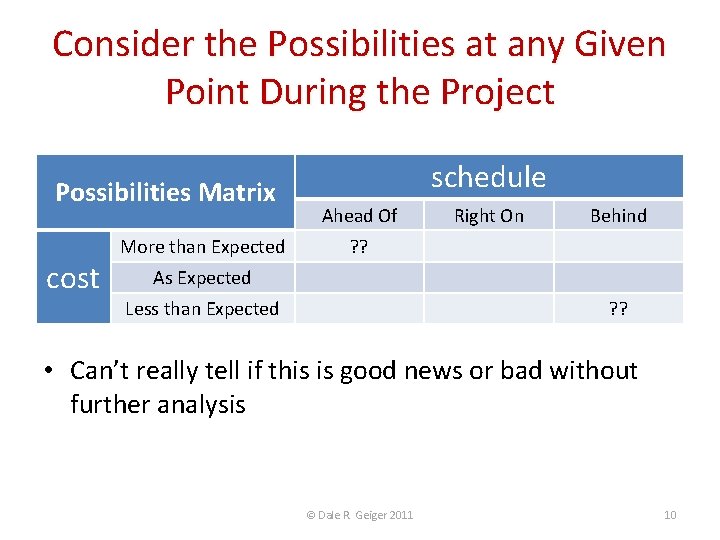
Consider the Possibilities at any Given Point During the Project Possibilities Matrix cost More than Expected schedule Ahead Of Right On Behind ? ? As Expected Less than Expected ? ? • Can’t really tell if this is good news or bad without further analysis © Dale R. Geiger 2011 10
Consider the Possibilities at any Given Point During the Project Possibilities Matrix cost schedule Ahead Of Right On Behind More than Expected ? ? Not Good! Terrible!! As Expected Great! Perfect Not Good! Less than Expected Terrific!! Great! ? ? © Dale R. Geiger 2011 11
Earned Value Analysis • Earned value management (EVM) provides an common set of metrics for measuring both • Schedule variance and • Cost Variance • EVM combined with AAR offers a template for cost management and control of projects © Dale R. Geiger 2011 12
Earned Value Analysis • There are many resources available for more in depth study of Earned Value Analysis/Management • See the Earned Value Management website: www. acq. osd. mil/pm • Follow links to Defense Acquisition University training programs • Familiarize yourself with the wealth of additional material and number of courses available within the Do. D community © Dale R. Geiger 2011 13
Requirements for Success • The four requirements for successful cost management and control remain the same • Leadership: actively engaged in understanding and improving performance • Cost staff: supporting leadership with analysis, insight, and advice • Process: the AAR where accountable subordinates explain costs and schedules and ways to improve both • Measurement: schedule and cost variances as provided by the EVA © Dale R. Geiger 2011 14
What Does Earned Value Mean? • Since there are risks to both cost and schedule some method is needed to link the two • Earned value measures what has been accomplished in terms of planned (budgeted) cost • In this sense it is similar to the flexible forecast we used previously in analyzing volume variance • Just like in the flexible forecast we will use the original planning factors to evaluate (in dollar terms) how much more or less work has been done © Dale R. Geiger 2011 15
Learning Check • What are some of the characteristics of projects that may pose management challenges? • What are the two categories of risk related to projects? © Dale R. Geiger 2011 16
Starting Point: The Plan (Budget) • Just as in analyzing volume and performance variance we must start with an expectation • This is the plan or budget • The plan or budget must define two of the following three variables in the equation: cost = output x cost per output • Some measure of output (like units) • A measure of cost per output • The total cost • Furthermore, the plan defines these variables for all time periods or milestones within the project © Dale R. Geiger 2011 17
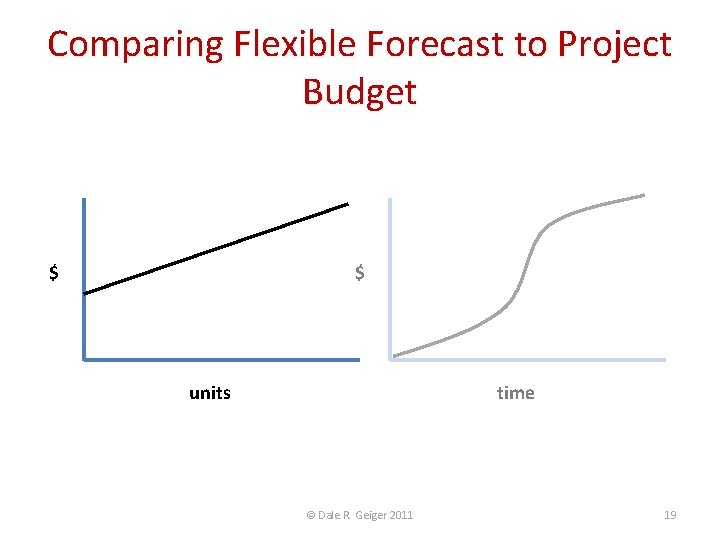
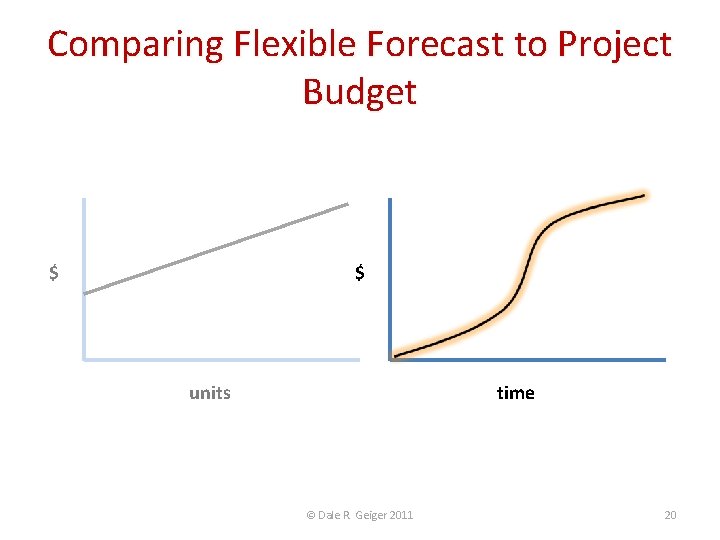
One Difference: Non-Linearity Possible • Volume variance recognizes that cost fits the equation • Cost = variable cost per unit x units + fixed cost • Resulting in a linear relationship in plotting $ versus units • Earned value analysis planning is likely to be non-linear • This is to say that cost and effort will not increase at a constant rate when plotting $ versus time © Dale R. Geiger 2011 18
Comparing Flexible Forecast to Project Budget $ $ units time © Dale R. Geiger 2011 19
Comparing Flexible Forecast to Project Budget $ $ time units © Dale R. Geiger 2011 20
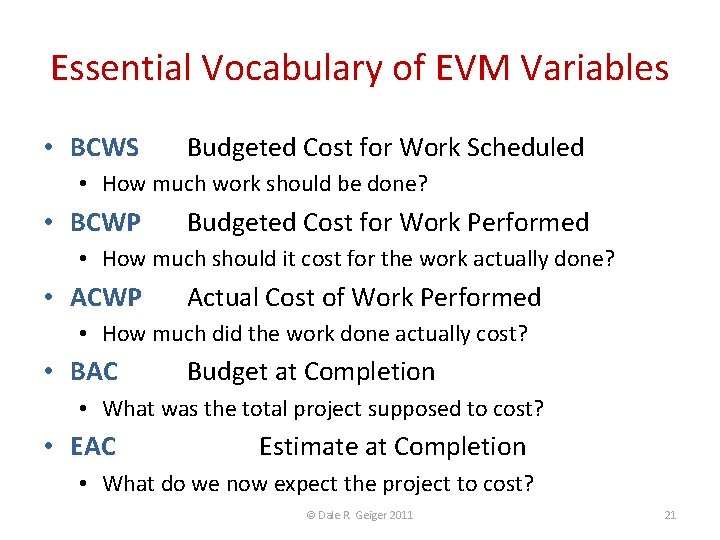
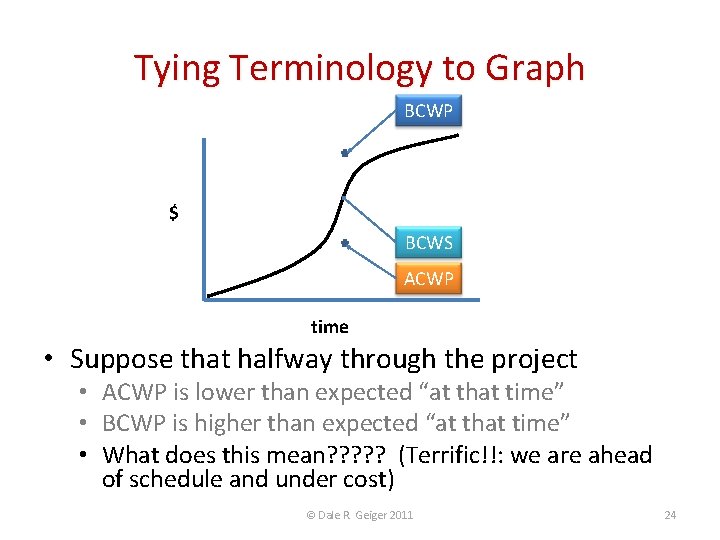
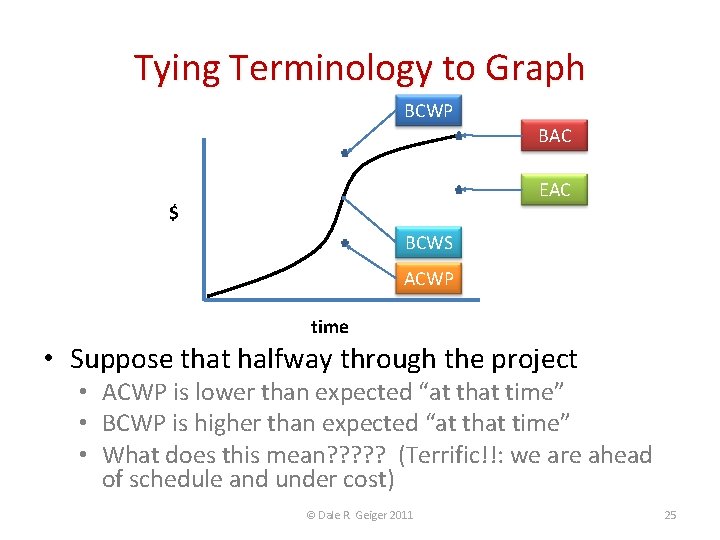
Essential Vocabulary of EVM Variables • BCWS Budgeted Cost for Work Scheduled • How much work should be done? • BCWP Budgeted Cost for Work Performed • How much should it cost for the work actually done? • ACWP Actual Cost of Work Performed • How much did the work done actually cost? • BAC Budget at Completion • What was the total project supposed to cost? • EAC Estimate at Completion • What do we now expect the project to cost? © Dale R. Geiger 2011 21
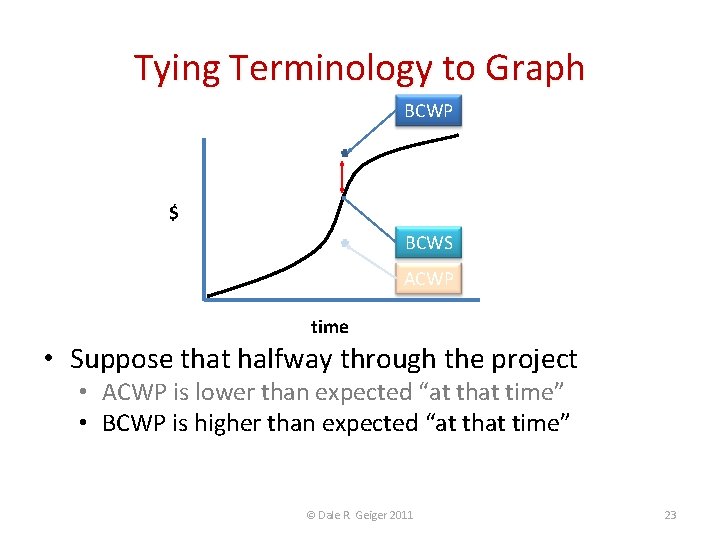
Tying Terminology to Graph $ BCWS ACWP time • Suppose that halfway through the project • ACWP is lower than expected “at that time” • BCWP is higher than expected “at that time” • What does this mean? ? ? (Terrific!!: we are ahead of schedule and under cost) © Dale R. Geiger 2011 22
Tying Terminology to Graph BCWP $ BCWS ACWP time • Suppose that halfway through the project • ACWP is lower than expected “at that time” • BCWP is higher than expected “at that time” • What does this mean? ? ? (Terrific!!: we are ahead of schedule and under cost) © Dale R. Geiger 2011 23
Tying Terminology to Graph BCWP $ BCWS ACWP time • Suppose that halfway through the project • ACWP is lower than expected “at that time” • BCWP is higher than expected “at that time” • What does this mean? ? ? (Terrific!!: we are ahead of schedule and under cost) © Dale R. Geiger 2011 24
Tying Terminology to Graph BCWP BAC EAC $ BCWS ACWP time • Suppose that halfway through the project • ACWP is lower than expected “at that time” • BCWP is higher than expected “at that time” • What does this mean? ? ? (Terrific!!: we are ahead of schedule and under cost) © Dale R. Geiger 2011 25
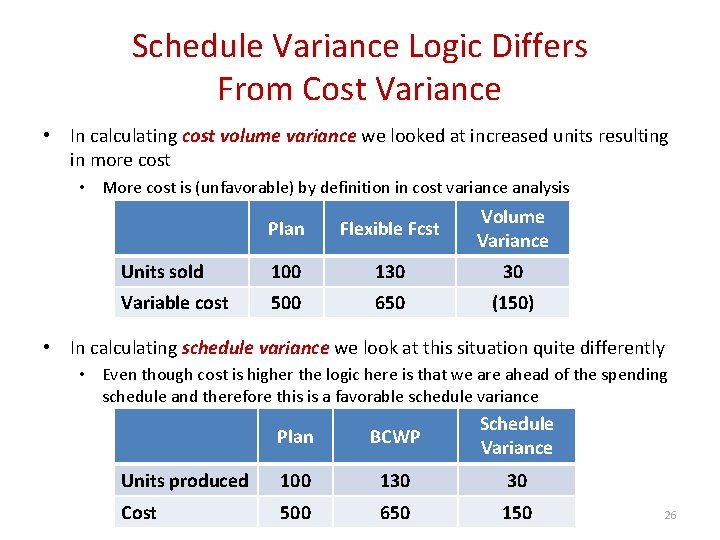
Schedule Variance Logic Differs From Cost Variance • In calculating cost volume variance we looked at increased units resulting in more cost • More cost is (unfavorable) by definition in cost variance analysis Plan Flexible Fcst Volume Variance Units sold 100 130 30 Variable cost 500 650 (150) • In calculating schedule variance we look at this situation quite differently • Even though cost is higher the logic here is that we are ahead of the spending schedule and therefore this is a favorable schedule variance Plan BCWP Schedule Variance Units produced 100 130 30 Cost 500© Dale R. Geiger 650 2011 150 26
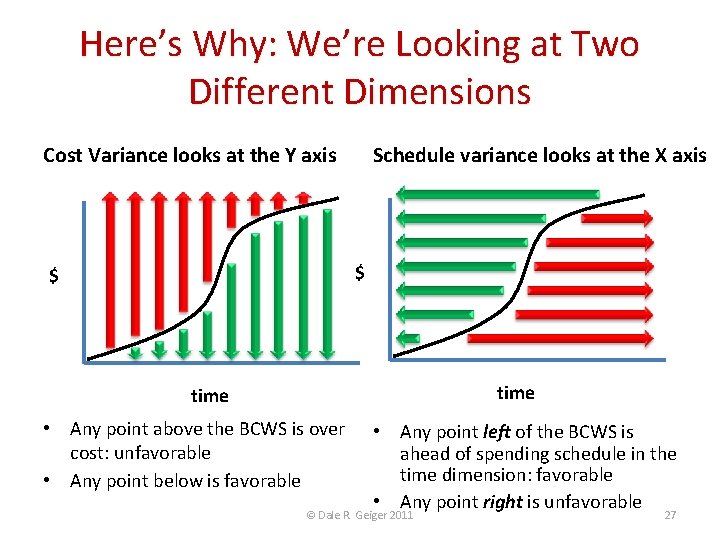
Here’s Why: We’re Looking at Two Different Dimensions Cost Variance looks at the Y axis Schedule variance looks at the X axis $ $ time • Any point above the BCWS is over cost: unfavorable • Any point below is favorable • Any point left of the BCWS is ahead of spending schedule in the time dimension: favorable • Any point right is unfavorable © Dale R. Geiger 2011 27
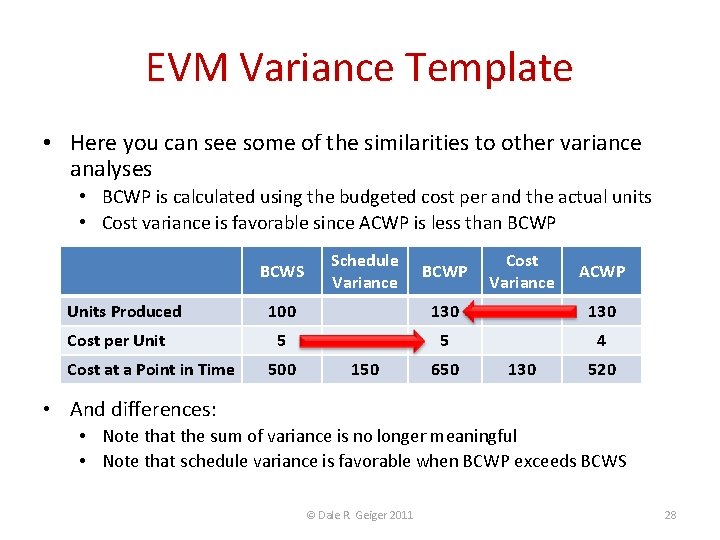
EVM Variance Template • Here you can see some of the similarities to other variance analyses • BCWP is calculated using the budgeted cost per and the actual units • Cost variance is favorable since ACWP is less than BCWP BCWS Units Produced Cost per Unit Cost at a Point in Time Schedule Variance BCWP Cost Variance ACWP 100 130 5 5 4 500 150 650 130 520 • And differences: • Note that the sum of variance is no longer meaningful • Note that schedule variance is favorable when BCWP exceeds BCWS © Dale R. Geiger 2011 28
EVM Variance Summary • Schedule Variance = BCWP – BCWS • Logic: Increased cost of work performed means that more schedule has been completed: a favorable schedule variance • Decreased cost of work performed means that less schedule has been completed: an (unfavorable) schedule variance • Cost Variance = BCWP – ACWP • Logic: Like a typical cost variance less actual cost than budgeted is a favorable variance • More actual cost than budgeted is an (unfavorable) variance © Dale R. Geiger 2011 29
Calculating EAC: Estimate at Completion • One other very useful metric to calculate is the estimated cost at completion • There are numerous ways to estimate this • Detailed re-forecast of remaining costs – may be costly • Management guess – may be optimistic • Projection from results to date – assumes that we will finish remaining work with the same level of efficiency or inefficiency © Dale R. Geiger 2011 30
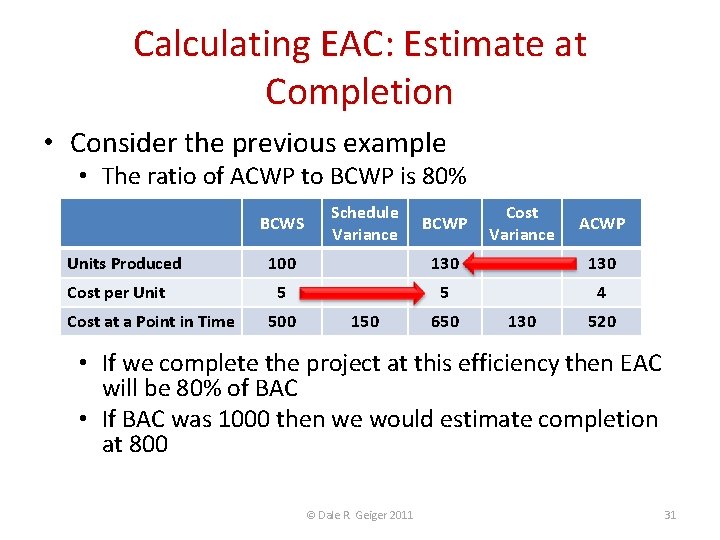
Calculating EAC: Estimate at Completion • Consider the previous example • The ratio of ACWP to BCWP is 80% BCWS Units Produced Cost per Unit Cost at a Point in Time Schedule Variance BCWP Cost Variance ACWP 100 130 5 5 4 500 150 650 130 520 • If we complete the project at this efficiency then EAC will be 80% of BAC • If BAC was 1000 then we would estimate completion at 800 © Dale R. Geiger 2011 31
Learning Check • What information does the comparison of BCWP to BCWS give? • What can be said about the project if ACWP is greater than BCWS? © Dale R. Geiger 2011 32
The Project Management AAR • Uses EVM metrics as part of the measurement input • Expects accountable subordinates to understand explain the variance • Seeks continuous improvement in both cost and schedule • There are many application opportunities for project management AARs • Acquisitions, research and development, experimentations, building and construction, BRAC, ARFORGEN, etc. © Dale R. Geiger 2011 33
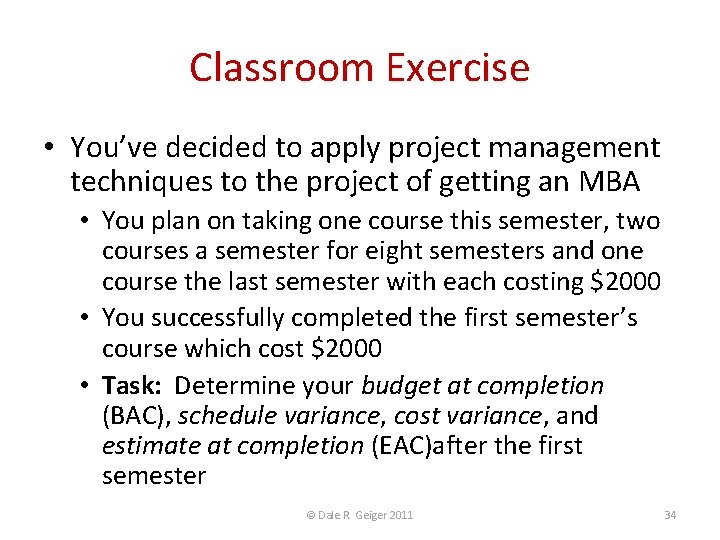
Classroom Exercise • You’ve decided to apply project management techniques to the project of getting an MBA • You plan on taking one course this semester, two courses a semester for eight semesters and one course the last semester with each costing $2000 • You successfully completed the first semester’s course which cost $2000 • Task: Determine your budget at completion (BAC), schedule variance, cost variance, and estimate at completion (EAC)after the first semester © Dale R. Geiger 2011 34
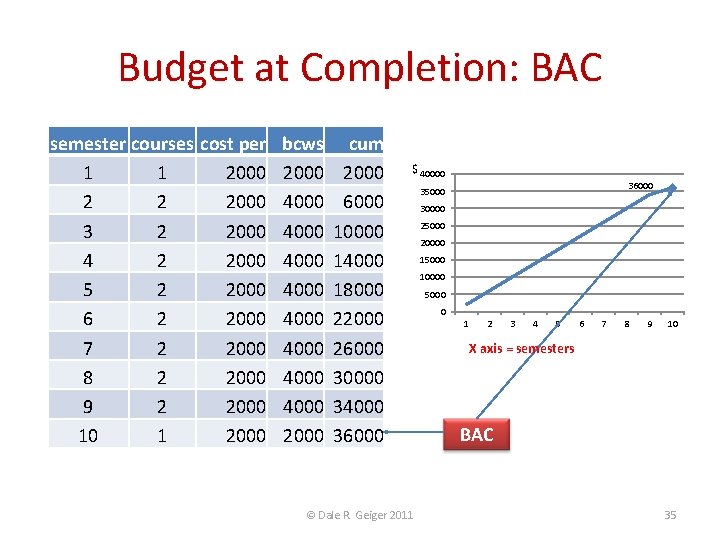
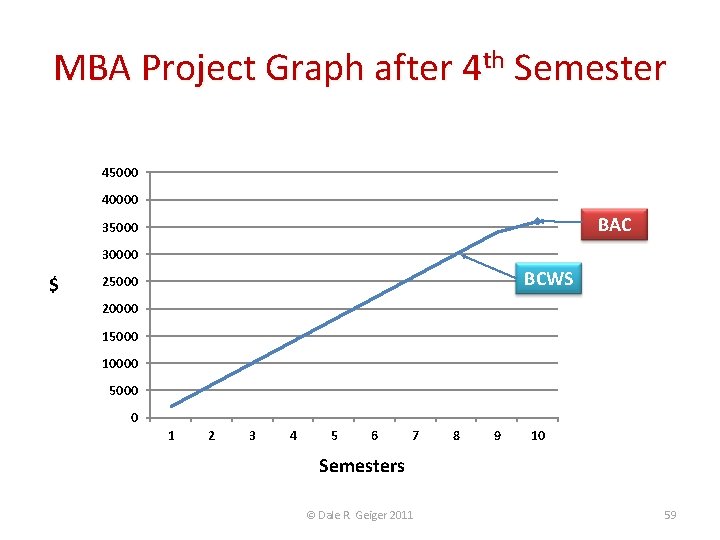
Budget at Completion: BAC semester courses cost per 1 1 2000 2 2 2000 3 2 2000 4 2 2000 5 2 2000 6 2 2000 7 2 2000 8 2 2000 9 2 2000 10 1 2000 bcws 2000 4000 4000 2000 cum 2000 6000 10000 14000 18000 22000 26000 30000 34000 36000 $ 40000 © Dale R. Geiger 2011 36000 35000 30000 25000 20000 15000 10000 5000 0 1 2 3 4 5 6 7 8 9 10 X axis = semesters BAC 35
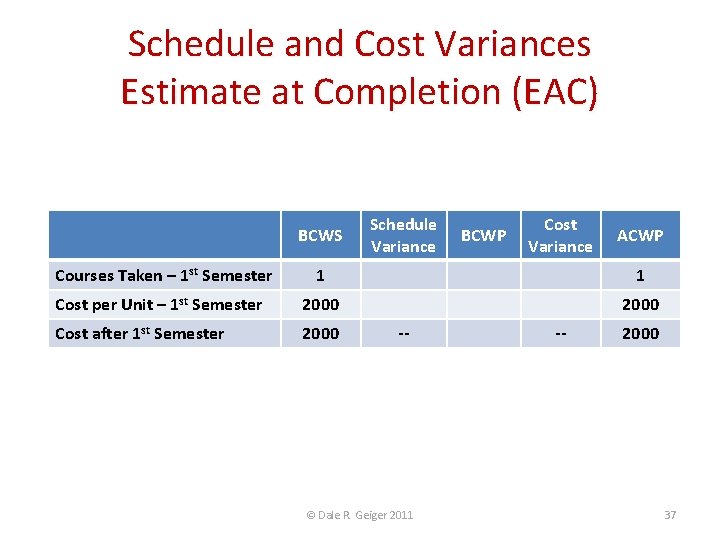
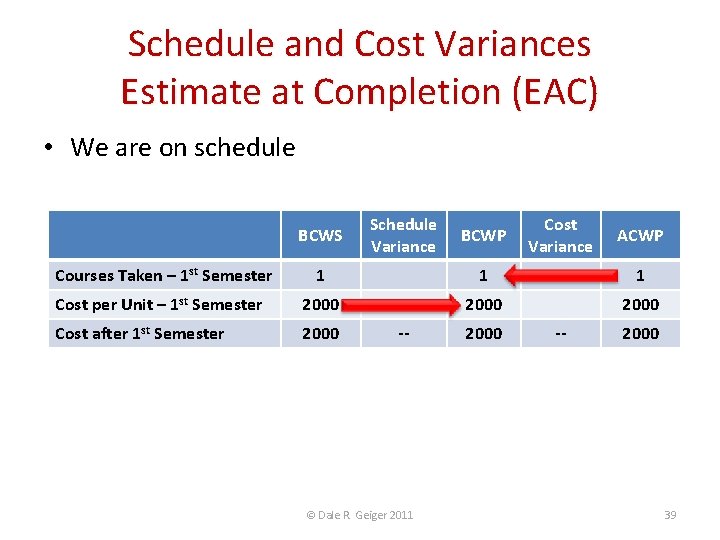
Schedule and Cost Variances Estimate at Completion (EAC) • We are on schedule and at cost expected: perfect BCWS Courses Taken – 1 st Semester 1 Cost per Unit – 1 st Semester 2000 Cost after 1 st Semester 2000 Schedule Variance BCWP Cost Variance ACWP -- • Cost Estimated At Completion (EAC) will be unchanged from the BAC since ACWP is same as BCWP © Dale R. Geiger 2011 36
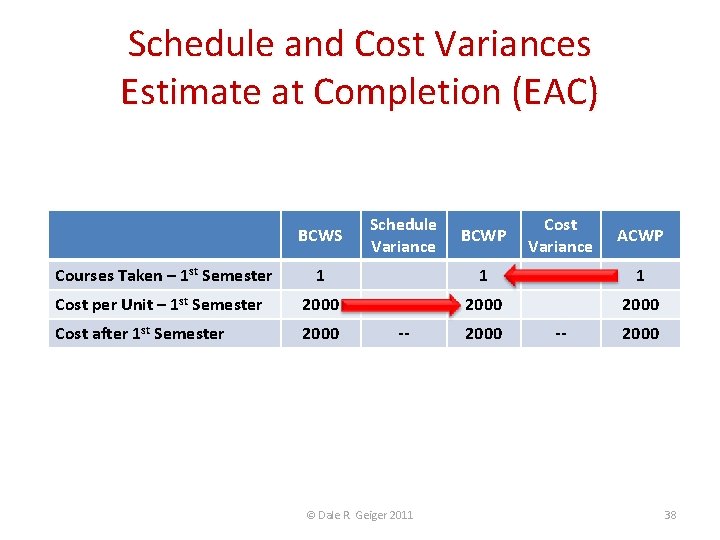
Schedule and Cost Variances Estimate at Completion (EAC) • We are on schedule and at cost expected: perfect BCWS Schedule Variance BCWP Cost Variance ACWP Courses Taken – 1 st Semester 1 1 Cost per Unit – 1 st Semester 2000 Cost after 1 st Semester 2000 -- -- 2000 • Cost Estimated At Completion (EAC) will be unchanged from the BAC since ACWP is same as BCWP © Dale R. Geiger 2011 37
Schedule and Cost Variances Estimate at Completion (EAC) • We are on schedule and at cost expected: perfect BCWS Schedule Variance BCWP Cost Variance ACWP Courses Taken – 1 st Semester 1 1 1 Cost per Unit – 1 st Semester 2000 Cost after 1 st Semester 2000 -- 2000 • Cost Estimated At Completion (EAC) will be unchanged from the BAC since ACWP is same as BCWP © Dale R. Geiger 2011 38
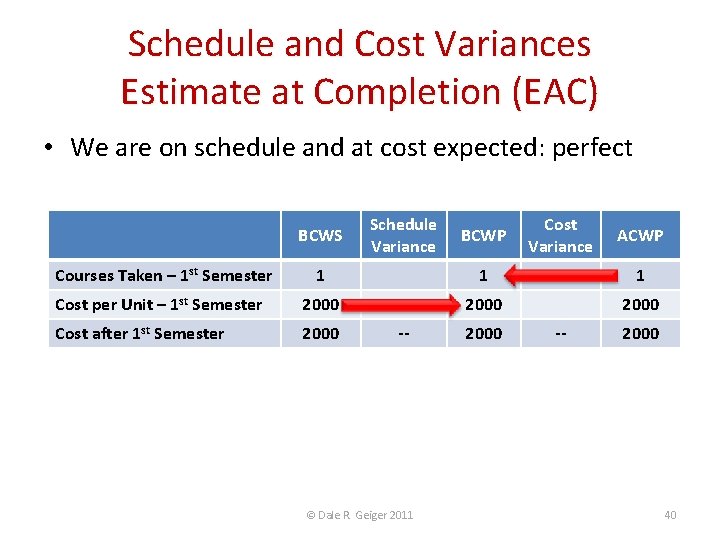
Schedule and Cost Variances Estimate at Completion (EAC) • We are on schedule and at cost expected: perfect BCWS Schedule Variance BCWP Cost Variance ACWP Courses Taken – 1 st Semester 1 1 1 Cost per Unit – 1 st Semester 2000 Cost after 1 st Semester 2000 -- 2000 • Cost Estimated At Completion (EAC) will be unchanged from the BAC since ACWP is same as BCWP © Dale R. Geiger 2011 39
Schedule and Cost Variances Estimate at Completion (EAC) • We are on schedule and at cost expected: perfect BCWS Schedule Variance BCWP Cost Variance ACWP Courses Taken – 1 st Semester 1 1 1 Cost per Unit – 1 st Semester 2000 Cost after 1 st Semester 2000 -- 2000 • Cost Estimated At Completion (EAC) will be unchanged from the BAC since ACWP is same as BCWP © Dale R. Geiger 2011 40
Schedule and Cost Variances Estimate at Completion (EAC) • We are on schedule and at cost expected: perfect BCWS Schedule Variance BCWP Cost Variance ACWP Courses Taken – 1 st Semester 1 1 1 Cost per Unit – 1 st Semester 2000 Cost after 1 st Semester 2000 -- 2000 • Cost Estimated At Completion (EAC) will be unchanged from the BAC since ACWP is same as BCWP © Dale R. Geiger 2011 41
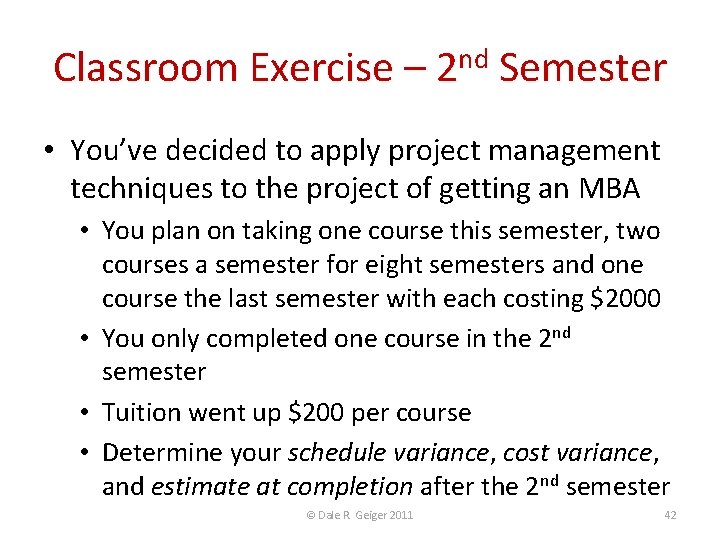
Classroom Exercise – 2 nd Semester • You’ve decided to apply project management techniques to the project of getting an MBA • You plan on taking one course this semester, two courses a semester for eight semesters and one course the last semester with each costing $2000 • You only completed one course in the 2 nd semester • Tuition went up $200 per course • Determine your schedule variance, cost variance, and estimate at completion after the 2 nd semester © Dale R. Geiger 2011 42
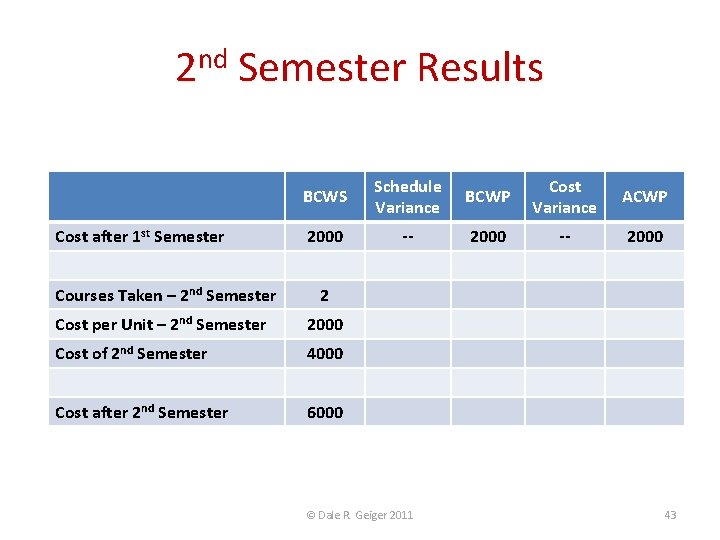
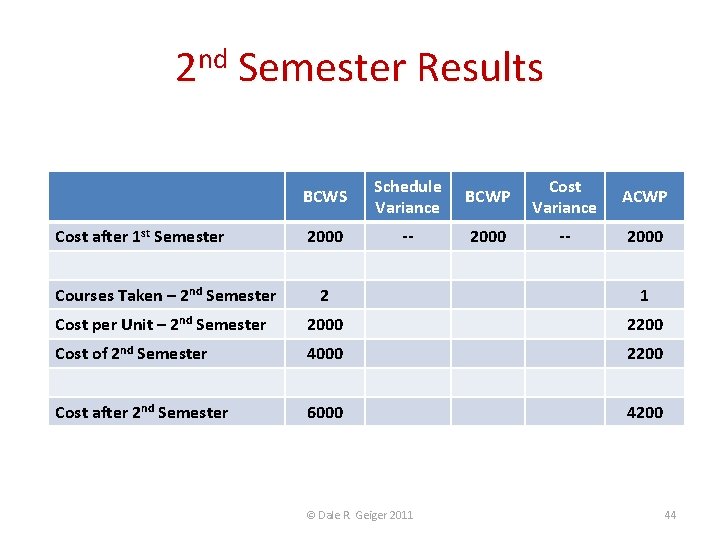
2 nd Semester Results • We are now behind schedule and over cost: terrible!! Cost after 1 st Semester BCWS Schedule Variance BCWP Cost Variance ACWP 2000 -- 2000 Courses Taken – 2 nd Semester 2 Cost per Unit – 2 nd Semester 2000 Cost of 2 nd Semester 4000 Cost after 2 nd Semester 6000 • ACWP is 105% of BCWP so EAC can be projected at 105% of BAC: (1. 05)36 K = 37. 8 K © Dale R. Geiger 2011 43
2 nd Semester Results • We are now behind schedule and over cost: terrible!! Cost after 1 st Semester BCWS Schedule Variance BCWP Cost Variance ACWP 2000 -- 2000 Courses Taken – 2 nd Semester 2 1 Cost per Unit – 2 nd Semester 2000 2200 Cost of 2 nd Semester 4000 2200 Cost after 2 nd Semester 6000 4200 • ACWP is 105% of BCWP so EAC can be projected at 105% of BAC: (1. 05)36 K = 37. 8 K © Dale R. Geiger 2011 44
2 nd Semester Results • We are now behind schedule and over cost: terrible!! Cost after 1 st Semester BCWS Schedule Variance BCWP Cost Variance ACWP 2000 -- 2000 Courses Taken – 2 nd Semester 2 1 1 Cost per Unit – 2 nd Semester 2000 2200 Cost of 2 nd Semester 4000 2200 Cost after 2 nd Semester 6000 4200 • ACWP is 105% of BCWP so EAC can be projected at 105% of BAC: (1. 05)36 K = 37. 8 K © Dale R. Geiger 2011 45
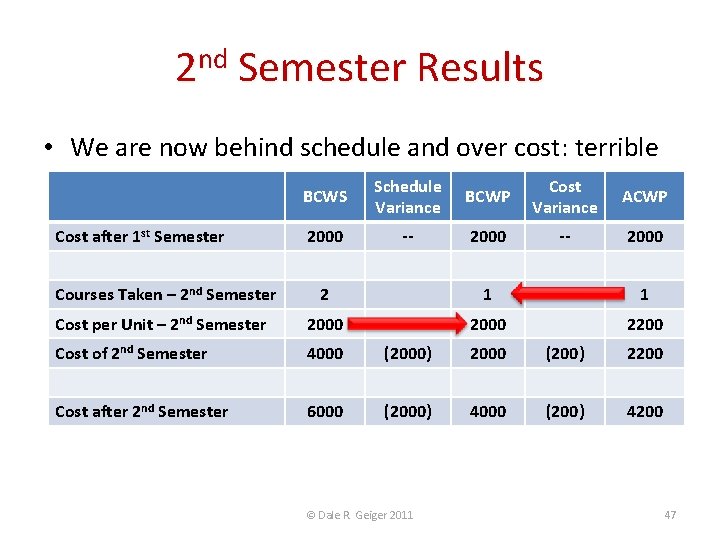
2 nd Semester Results • We are now behind schedule and over cost: terrible!! Cost after 1 st Semester BCWS Schedule Variance BCWP Cost Variance ACWP 2000 -- 2000 Courses Taken – 2 nd Semester 2 1 1 Cost per Unit – 2 nd Semester 2000 2200 Cost of 2 nd Semester 4000 (2000) 2000 (200) 2200 Cost after 2 nd Semester 6000 (2000) 4000 (200) 4200 • ACWP is 105% of BCWP so EAC can be projected at 105% of BAC: (1. 05)36 K = 37. 8 K © Dale R. Geiger 2011 46
2 nd Semester Results • We are now behind schedule and over cost: terrible!! Cost after 1 st Semester BCWS Schedule Variance BCWP Cost Variance ACWP 2000 -- 2000 Courses Taken – 2 nd Semester 2 1 1 Cost per Unit – 2 nd Semester 2000 2200 Cost of 2 nd Semester 4000 (2000) 2000 (200) 2200 Cost after 2 nd Semester 6000 (2000) 4000 (200) 4200 • ACWP is 105% of BCWP so EAC can be projected at 105% of BAC: (1. 05)36 K = 37. 8 K © Dale R. Geiger 2011 47
2 nd Semester Results • We are now behind schedule and over cost: terrible!! Cost after 1 st Semester BCWS Schedule Variance BCWP Cost Variance ACWP 2000 -- 2000 Courses Taken – 2 nd Semester 2 1 1 Cost per Unit – 2 nd Semester 2000 2200 Cost of 2 nd Semester 4000 (2000) 2000 (200) 2200 Cost after 2 nd Semester 6000 (2000) 4000 (200) 4200 • ACWP is 105% of BCWP so EAC can be projected at 105% of BAC: (1. 05)36 K = 37. 8 K © Dale R. Geiger 2011 48
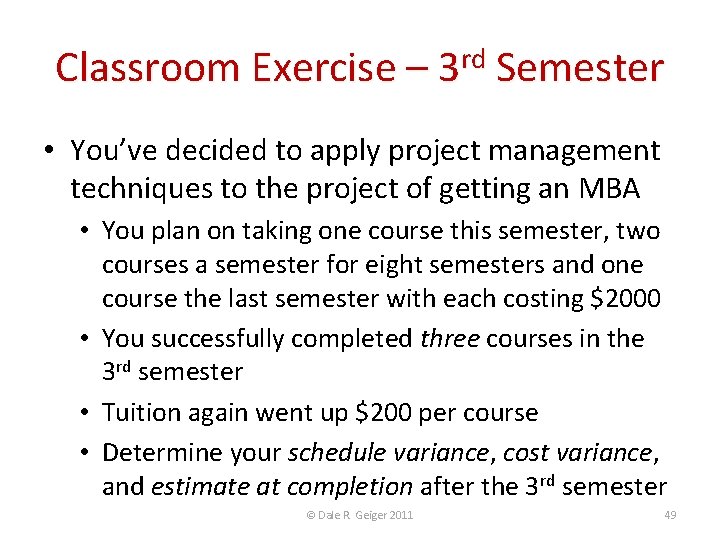
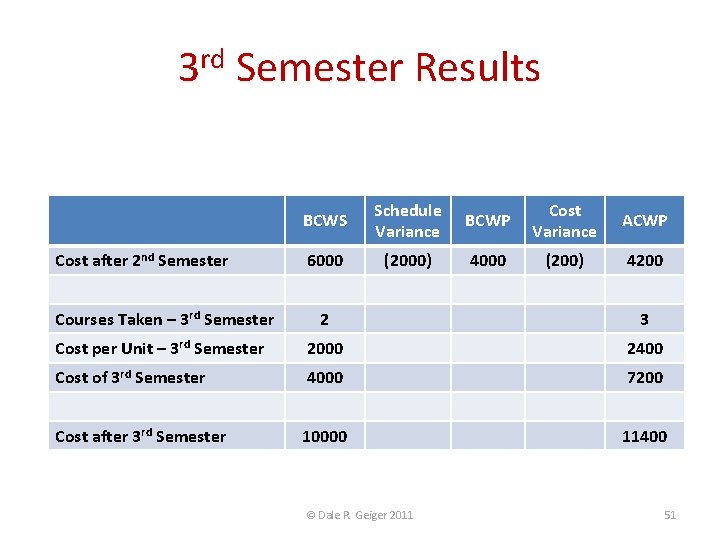
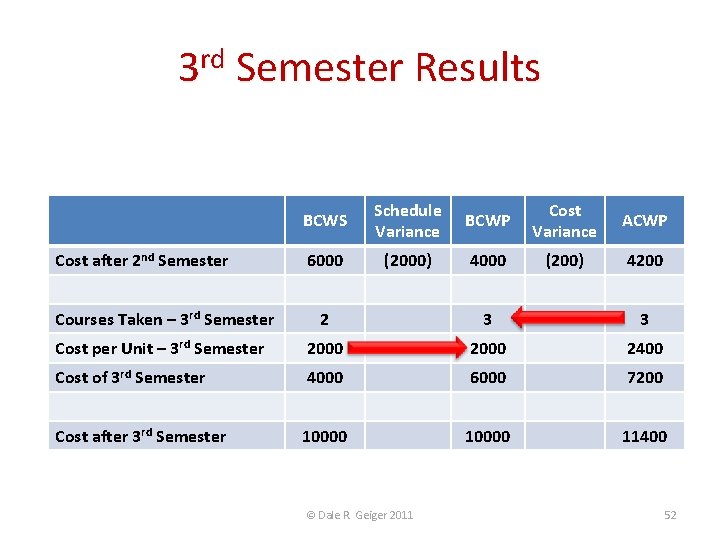
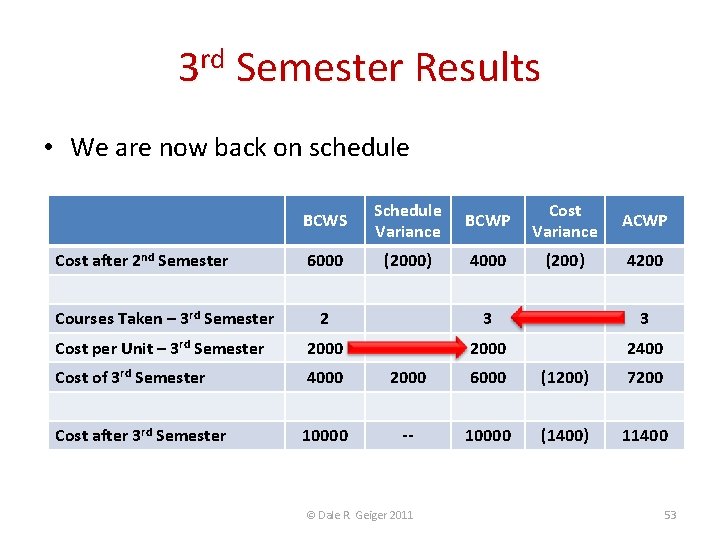
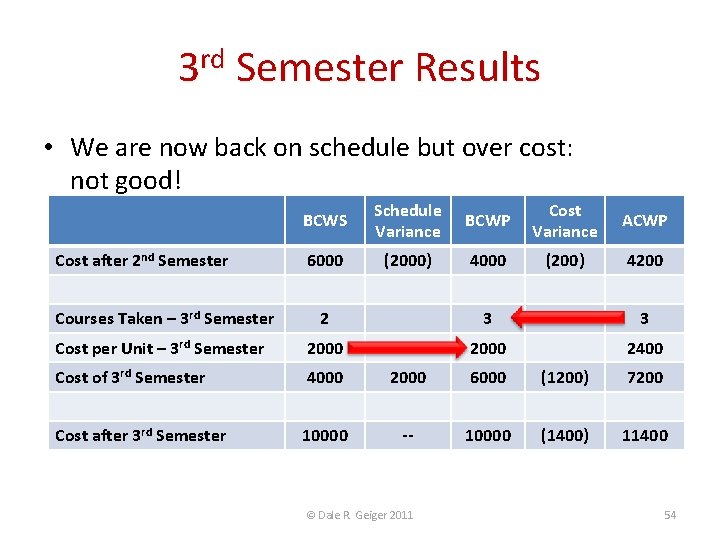
Classroom Exercise – 3 rd Semester • You’ve decided to apply project management techniques to the project of getting an MBA • You plan on taking one course this semester, two courses a semester for eight semesters and one course the last semester with each costing $2000 • You successfully completed three courses in the 3 rd semester • Tuition again went up $200 per course • Determine your schedule variance, cost variance, and estimate at completion after the 3 rd semester © Dale R. Geiger 2011 49
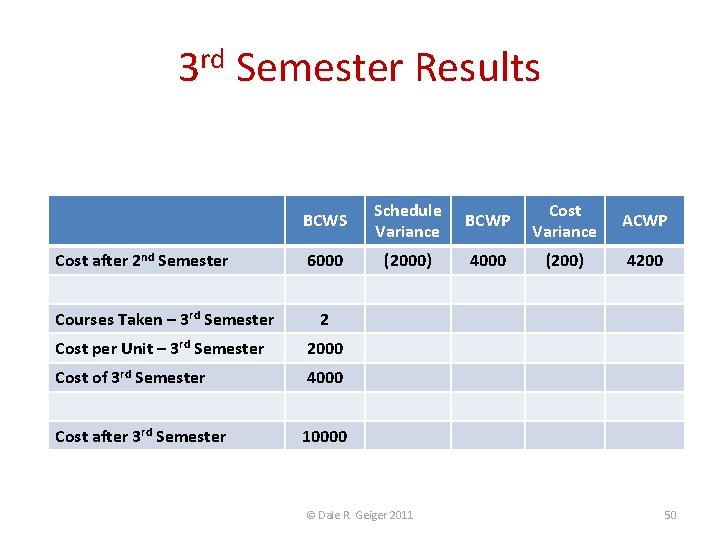
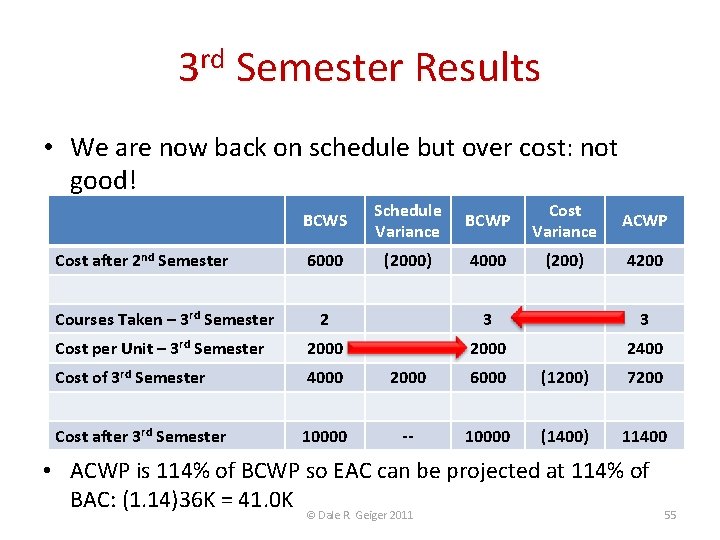
3 rd Semester Results • We are now back on schedule but over cost: not good! Cost after 2 nd Semester BCWS Schedule Variance BCWP Cost Variance ACWP 6000 (2000) 4000 (200) 4200 Courses Taken – 3 rd Semester 2 Cost per Unit – 3 rd Semester 2000 Cost of 3 rd Semester 4000 Cost after 3 rd Semester 10000 • ACWP is 114% of BCWP so EAC can be projected at 105% of BAC: (1. 14)36 K = 41. 0 K © Dale R. Geiger 2011 50
3 rd Semester Results • We are now back on schedule but over cost: not good! Cost after 2 nd Semester BCWS Schedule Variance BCWP Cost Variance ACWP 6000 (2000) 4000 (200) 4200 Courses Taken – 3 rd Semester 2 3 Cost per Unit – 3 rd Semester 2000 2400 Cost of 3 rd Semester 4000 7200 Cost after 3 rd Semester 10000 11400 • ACWP is 114% of BCWP so EAC can be projected at 105% of BAC: (1. 14)36 K = 41. 0 K © Dale R. Geiger 2011 51
3 rd Semester Results • We are now back on schedule but over cost: not good! Cost after 2 nd Semester BCWS Schedule Variance BCWP Cost Variance ACWP 6000 (2000) 4000 (200) 4200 Courses Taken – 3 rd Semester 2 3 3 Cost per Unit – 3 rd Semester 2000 2400 Cost of 3 rd Semester 4000 6000 7200 Cost after 3 rd Semester 10000 11400 • ACWP is 114% of BCWP so EAC can be projected at 105% of BAC: (1. 14)36 K = 41. 0 K © Dale R. Geiger 2011 52
3 rd Semester Results • We are now back on schedule but over cost: not good! Cost after 2 nd Semester BCWS Schedule Variance BCWP Cost Variance ACWP 6000 (2000) 4000 (200) 4200 Courses Taken – 3 rd Semester 2 3 3 Cost per Unit – 3 rd Semester 2000 2400 Cost of 3 rd Semester 4000 2000 6000 (1200) 7200 Cost after 3 rd Semester 10000 -- 10000 (1400) 11400 © Dale R. Geiger 2011 53
3 rd Semester Results • We are now back on schedule but over cost: not good! Cost after 2 nd Semester BCWS Schedule Variance BCWP Cost Variance ACWP 6000 (2000) 4000 (200) 4200 Courses Taken – 3 rd Semester 2 3 3 Cost per Unit – 3 rd Semester 2000 2400 Cost of 3 rd Semester 4000 2000 6000 (1200) 7200 Cost after 3 rd Semester 10000 -- 10000 (1400) 11400 © Dale R. Geiger 2011 54
3 rd Semester Results • We are now back on schedule but over cost: not good! Cost after 2 nd Semester BCWS Schedule Variance BCWP Cost Variance ACWP 6000 (2000) 4000 (200) 4200 Courses Taken – 3 rd Semester 2 3 3 Cost per Unit – 3 rd Semester 2000 2400 Cost of 3 rd Semester 4000 2000 6000 (1200) 7200 Cost after 3 rd Semester 10000 -- 10000 (1400) 11400 • ACWP is 114% of BCWP so EAC can be projected at 114% of BAC: (1. 14)36 K = 41. 0 K © Dale R. Geiger 2011 55
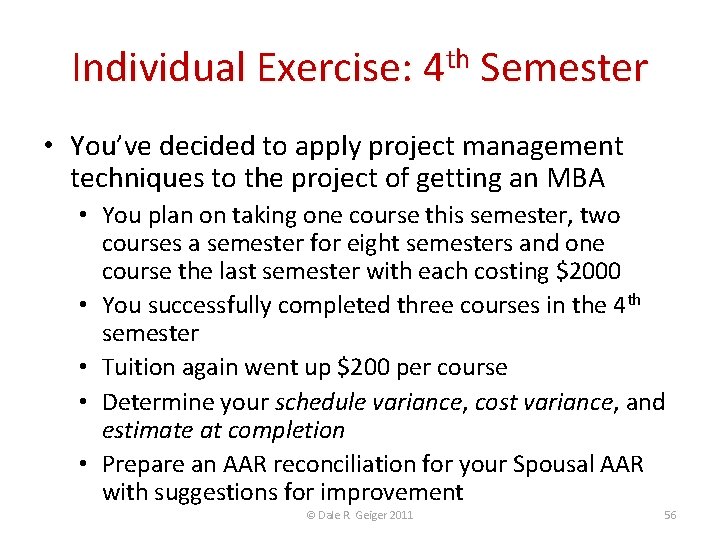
Individual Exercise: 4 th Semester • You’ve decided to apply project management techniques to the project of getting an MBA • You plan on taking one course this semester, two courses a semester for eight semesters and one course the last semester with each costing $2000 • You successfully completed three courses in the 4 th semester • Tuition again went up $200 per course • Determine your schedule variance, cost variance, and estimate at completion • Prepare an AAR reconciliation for your Spousal AAR with suggestions for improvement © Dale R. Geiger 2011 56
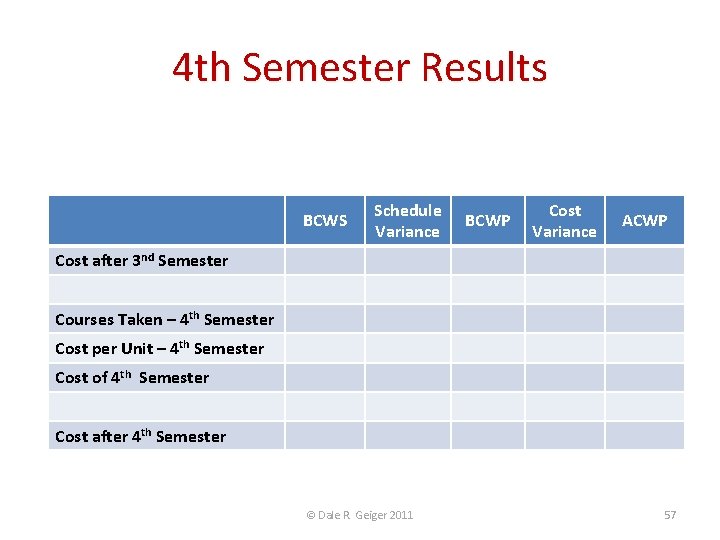
4 th Semester Results • We are now back on schedule but over cost: not good! BCWS Schedule Variance BCWP Cost Variance ACWP Cost after 3 nd Semester Courses Taken – 4 th Semester Cost per Unit – 4 th Semester Cost of 4 th Semester Cost after 4 th Semester • ACWP is 114% of BCWP so EAC can be projected at 114% of BAC: (1. 14)36 K = 41. 0 K © Dale R. Geiger 2011 57
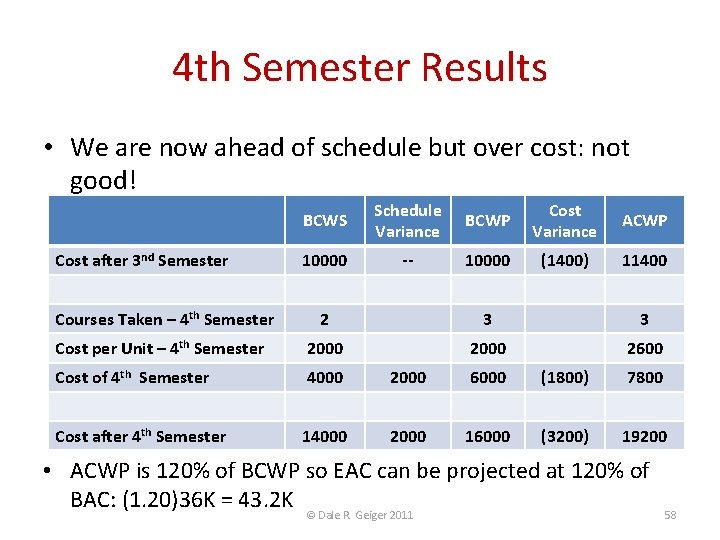
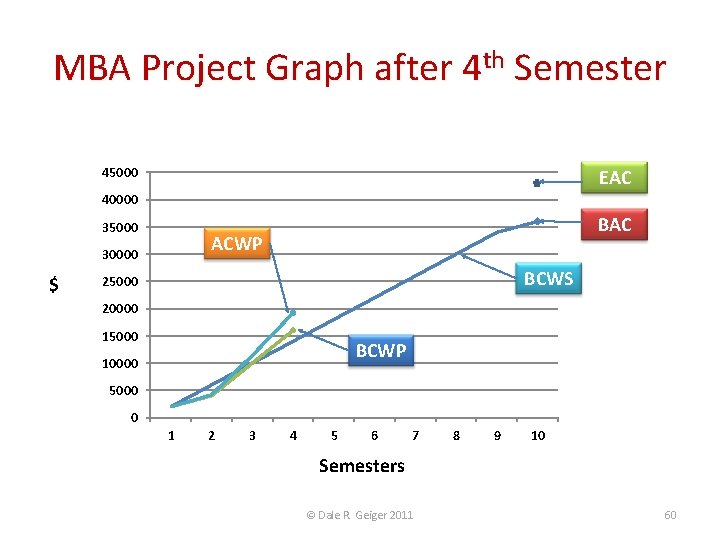
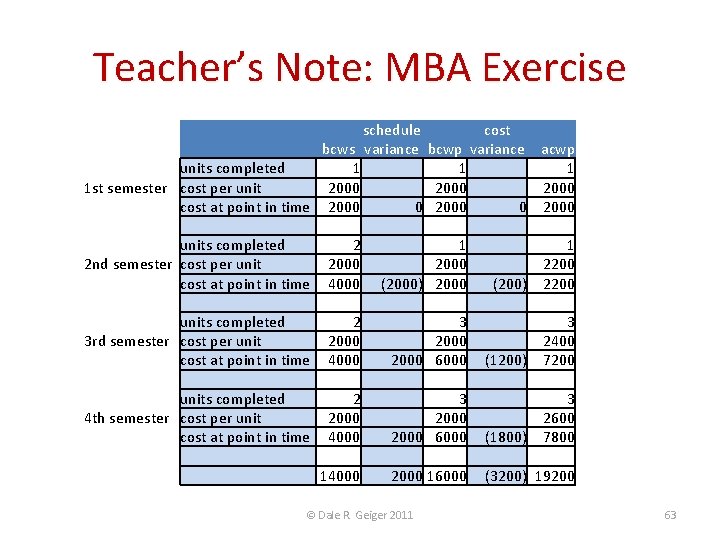
4 th Semester Results • We are now ahead of schedule but over cost: not good! Cost after 3 nd Semester BCWS Schedule Variance BCWP Cost Variance ACWP 10000 -- 10000 (1400) 11400 Courses Taken – 4 th Semester 2 3 3 Cost per Unit – 4 th Semester 2000 2600 Cost of 4 th Semester 4000 2000 6000 (1800) 7800 Cost after 4 th Semester 14000 2000 16000 (3200) 19200 • ACWP is 120% of BCWP so EAC can be projected at 120% of BAC: (1. 20)36 K = 43. 2 K © Dale R. Geiger 2011 58
MBA Project Graph after 4 th Semester 45000 40000 BAC 35000 30000 $ BCWS 25000 20000 15000 10000 5000 0 1 2 3 4 5 6 7 8 9 10 Semesters © Dale R. Geiger 2011 59
MBA Project Graph after 4 th Semester 45000 EAC 40000 35000 ACWP 30000 $ BAC BCWS 25000 20000 15000 BCWP 10000 5000 0 1 2 3 4 5 6 7 8 9 10 Semesters © Dale R. Geiger 2011 60
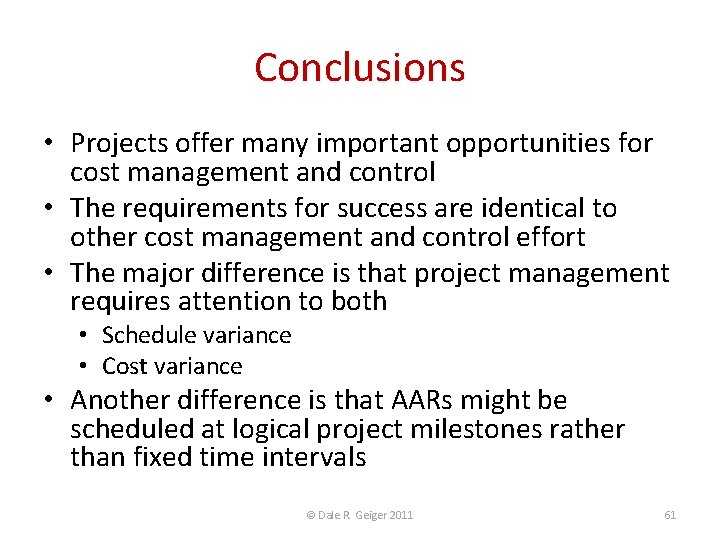
Conclusions • Projects offer many important opportunities for cost management and control • The requirements for success are identical to other cost management and control effort • The major difference is that project management requires attention to both • Schedule variance • Cost variance • Another difference is that AARs might be scheduled at logical project milestones rather than fixed time intervals © Dale R. Geiger 2011 61
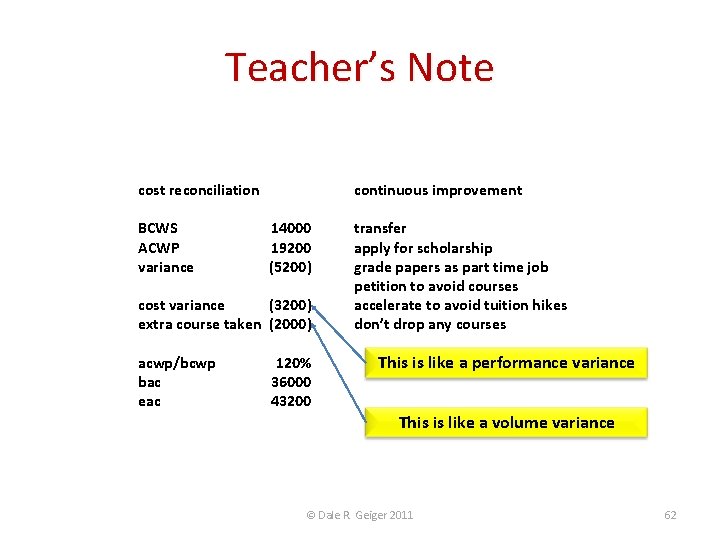
Teacher’s Note cost reconciliation BCWS ACWP variance continuous improvement 14000 19200 (5200) cost variance (3200) extra course taken (2000) acwp/bcwp bac eac 120% 36000 43200 transfer apply for scholarship grade papers as part time job petition to avoid courses accelerate to avoid tuition hikes don’t drop any courses This is like a performance variance This is like a volume variance © Dale R. Geiger 2011 62
Teacher’s Note: MBA Exercise schedule cost bcws variance bcwp variance acwp units completed 1 1 st semester cost per unit 2000 cost at point in time 2000 0 2000 units completed 2 nd semester cost per unit cost at point in time 2 2000 4000 1 2000 (2000) 2000 1 2200 (200) 2200 units completed 3 rd semester cost per unit cost at point in time 2 2000 4000 3 2000 6000 3 2400 (1200) 7200 units completed 4 th semester cost per unit cost at point in time 2 2000 4000 3 2000 6000 3 2600 (1800) 7800 14000 2000 16000 (3200) 19200 © Dale R. Geiger 2011 63