
Calculate Cost of Service with Multiple Cost Pools
- Slides: 72
Calculate Cost of Service with Multiple Cost Pools and Drivers Intermediate Cost Analysis and Management 1
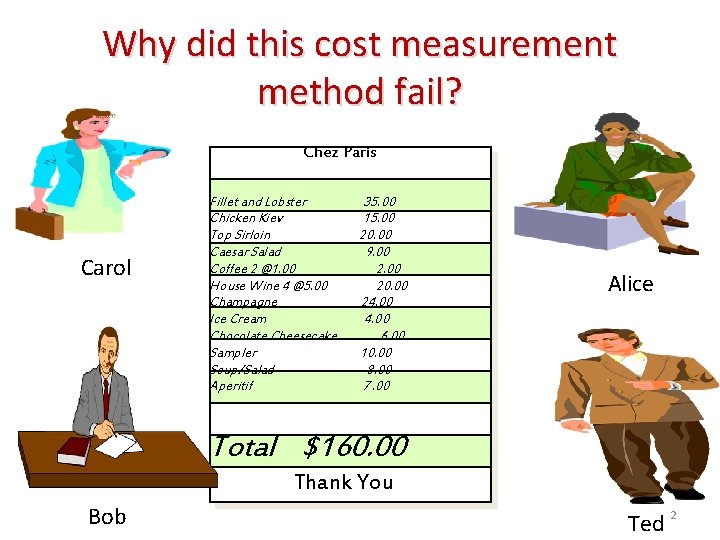
Why did this cost measurement method fail? Chez Paris Carol Fillet and Lobster Chicken Kiev Top Sirloin Caesar Salad Coffee 2 @1. 00 House Wine 4 @5. 00 Champagne Ice Cream Chocolate Cheesecake Sampler Soup/Salad Aperitif 35. 00 15. 00 20. 00 9. 00 20. 00 24. 00 6. 00 10. 00 8. 00 7. 00 Alice Total $160. 00 Thank You Bob Ted 2
Terminal Learning Objective • Task: Calculate Cost of Service with Multiple Cost Pools/Drivers • Condition: You are training to become an ACE with access to ICAM course handouts, readings, and spreadsheet tools and awareness of Operational Environment (OE)/Contemporary Operational Environment (COE) variables and actors • Standard: with at least 80% accuracy: • • • Identify 3 methods of distribution Discuss relative merits of each Describe need for homogeneity in pools/drivers Describe need for correlation between pool and driver Select suitable driver for cost pool 3
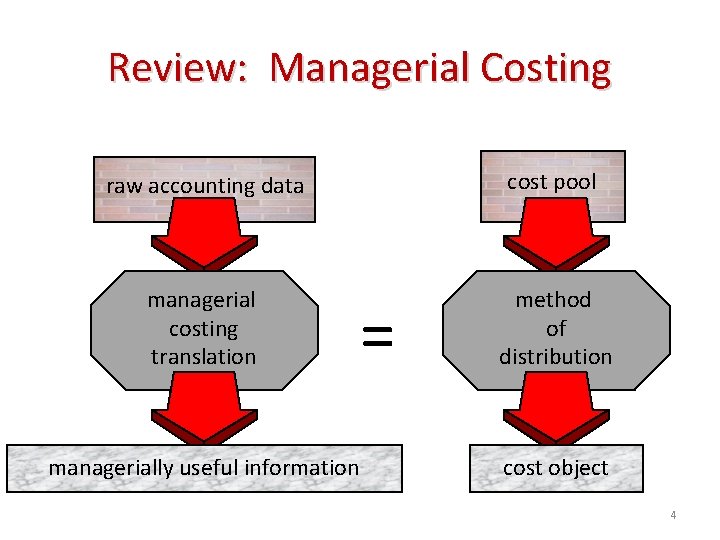
Review: Managerial Costing cost pool raw accounting data managerial costing translation managerially useful information = method of distribution cost object 4
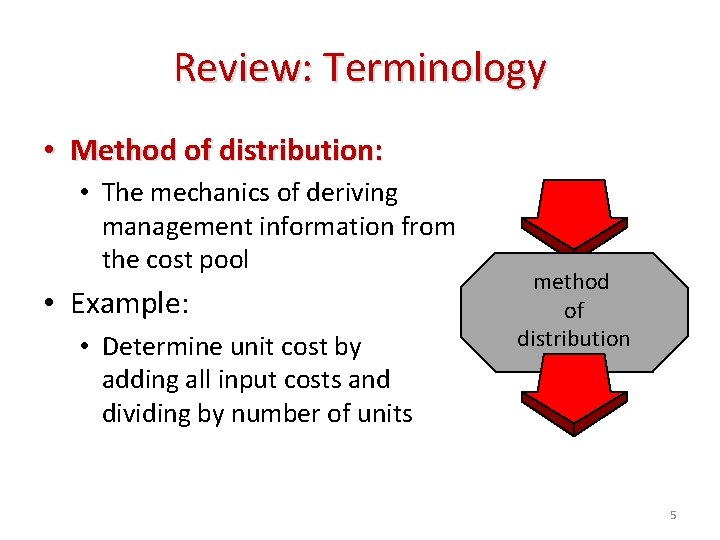
Review: Terminology • Method of distribution: • The mechanics of deriving management information from the cost pool • method Example: of distribution • Determine unit cost by adding all input costs and dividing by number of units 5
Alternative Methods of Distribution • Managers can obtain the needed view of cost in several ways Guessing: gut feel of cost distribution Direct costing: detailed record keeping of all incurred cost transactions by every cost object • Allocation: distribution of cost pool in the same proportion as a cost driver • • 6
Applications for Guessing • Simple situations where: • Cost of measurement error is small • Need for credibility is low guessing • Ability to hold someone and gut feel accountable is missing • Cost of cost measurement is high 7
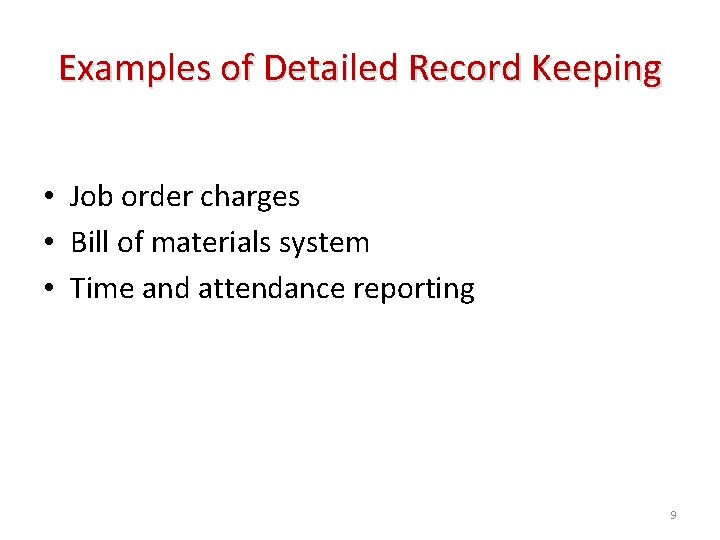
Detailed Record Keeping Applications • Labor cost can be accounted for by product through time and attendance reporting • Project costs can include detailed supplies and services record charged by job order keeping • Product material costs can be determined through bill of materials 8
Examples of Detailed Record Keeping • Job order charges • Bill of materials system • Time and attendance reporting 9
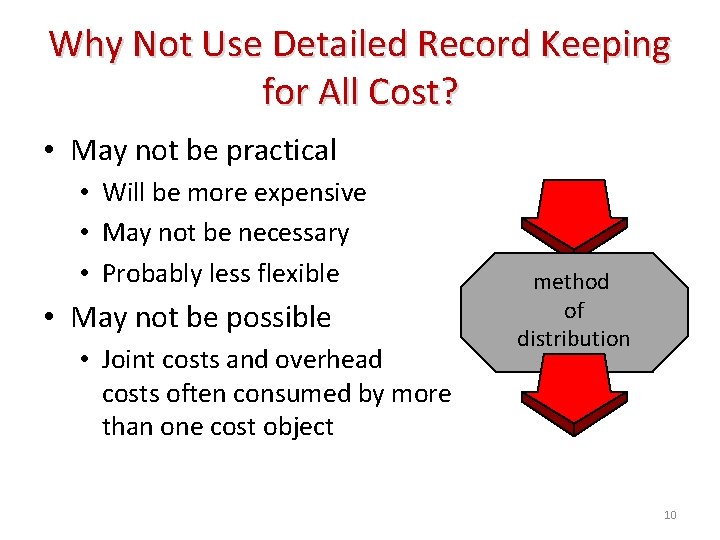
Why Not Use Detailed Record Keeping for All Cost? • May not be practical • Will be more expensive • May not be necessary • Probably less flexible • May not be possible method of distribution • Joint costs and overhead costs often consumed by more than one cost object 10
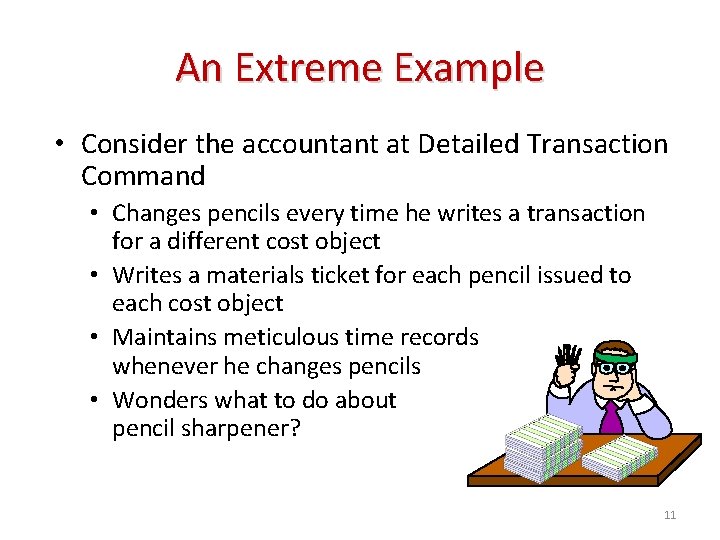
An Extreme Example • Consider the accountant at Detailed Transaction Command • Changes pencils every time he writes a transaction for a different cost object • Writes a materials ticket for each pencil issued to each cost object • Maintains meticulous time records whenever he changes pencils • Wonders what to do about cost of pencil sharpener? 11
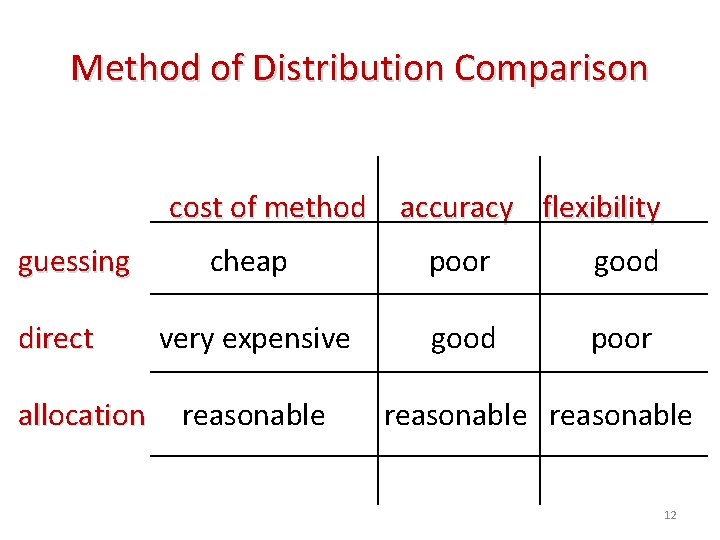
Method of Distribution Comparison cost of method accuracy flexibility guessing cheap guessing poor good direct very expensive good poor direct allocation reasonable allocation 12
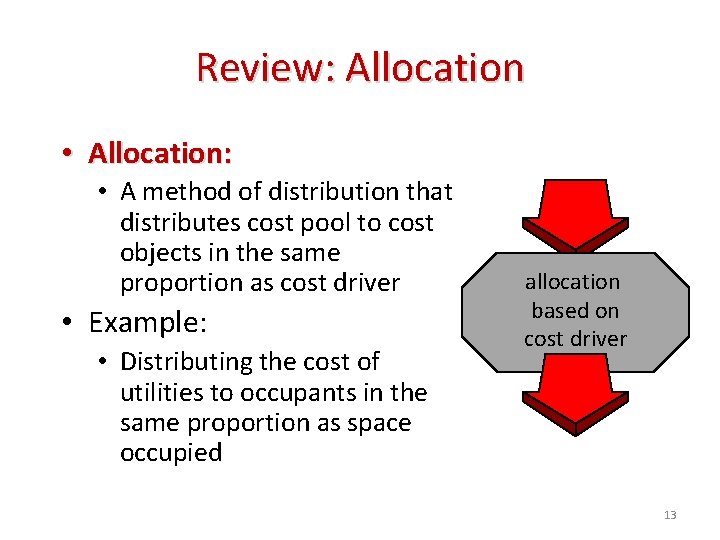
Review: Allocation • Allocation: • A method of distribution that distributes cost pool to cost objects in the same proportion as cost driver • Example: • Distributing the cost of utilities to occupants in the same proportion as space occupied allocation based on cost driver 13
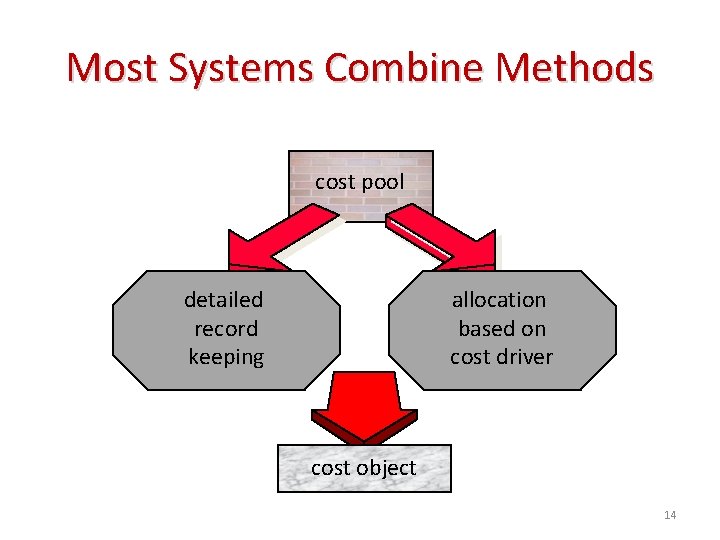
Most Systems Combine Methods cost pool detailed record keeping allocation based on cost driver cost object 14
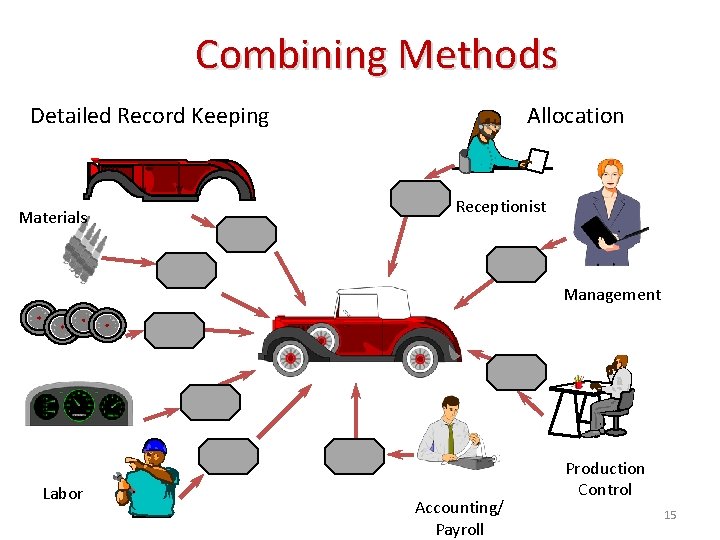
Combining Methods Detailed Record Keeping Materials Allocation Receptionist Management Labor Accounting/ Payroll Production Control 15
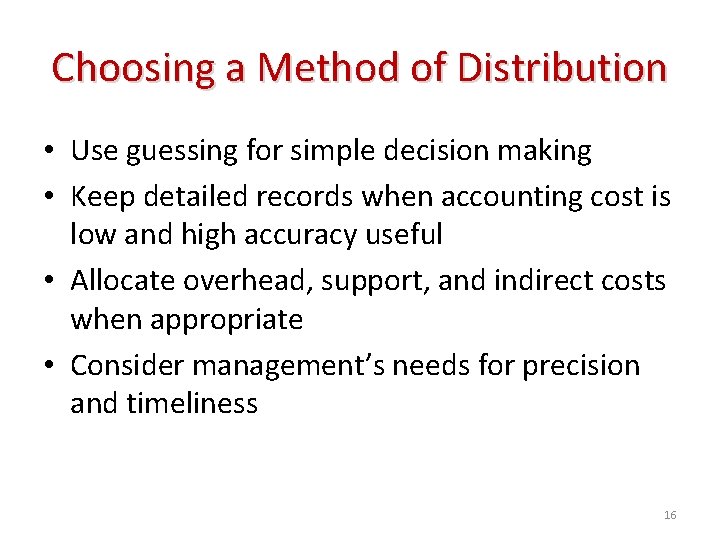
Choosing a Method of Distribution • Use guessing for simple decision making • Keep detailed records when accounting cost is low and high accuracy useful • Allocate overhead, support, and indirect costs when appropriate • Consider management’s needs for precision and timeliness 16
Discussion: Telephone Charges • Should these be allocated or charged via detailed, call-by-call records? • Issues to consider • What does management need? • Is telephoning a core mission or support function? • Are detailed records available? 17
Learning Check • Which method of distribution is the least expensive? • Which method is the most accurate? 18
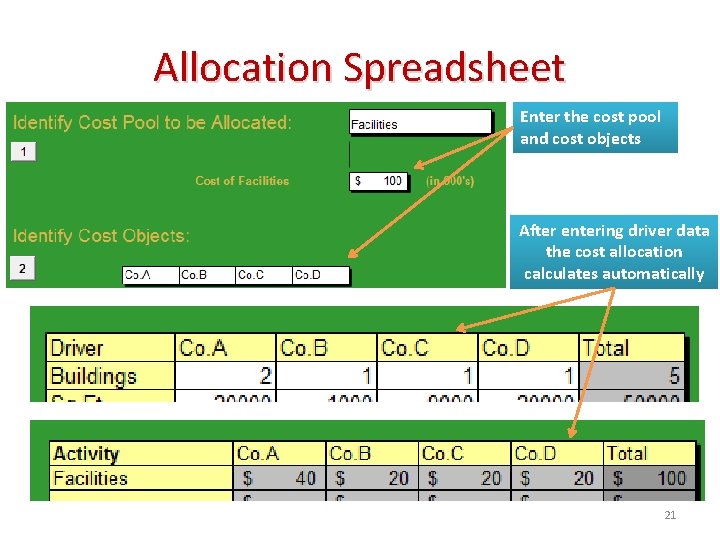
Facilities Case • An Army Installation has four Companies that occupy five buildings. Incurred costs of $100, 000 include utilities, building maintenance, and miscellaneous facilities related expenditures. New policies require the Installation to charge its costs back to Companies. • Using the Allocation Worksheet and the following information, prepare a cost allocation: Number of Buildings Company A 2 Company B 1 Company C 1 Company D 1 19
Consider: What are the cost objects? What is the cost driver? What is the rate per building? What is each company’s proportion? What assumptions are made in using number of buildings as a cost driver? • Is this a good method of distribution? • • • 20
Allocation Spreadsheet Enter the cost pool and cost objects After entering driver data the cost allocation calculates automatically 21
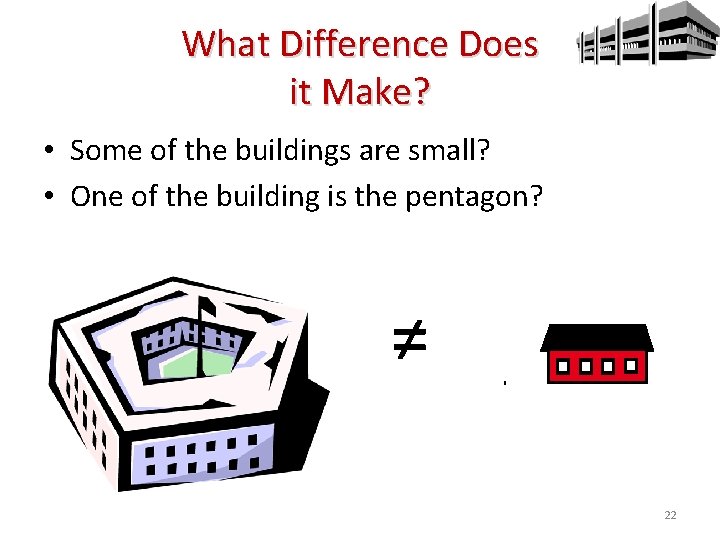
What Difference Does it Make? • Some of the buildings are small? • One of the building is the pentagon? ≠ 22
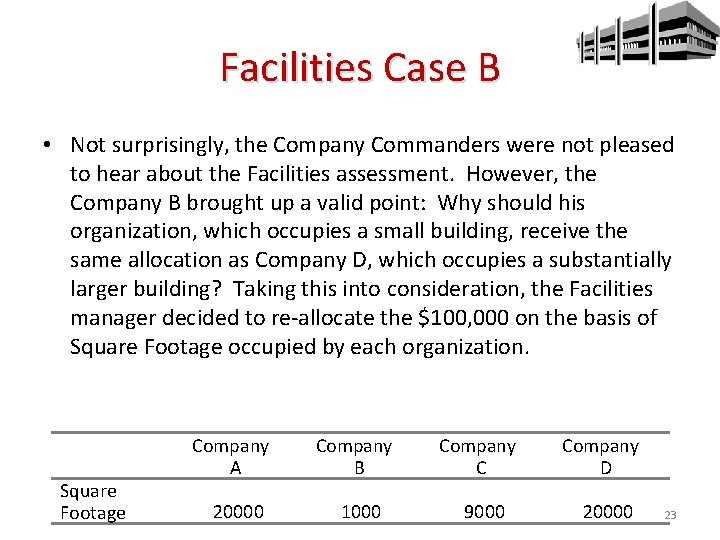
Facilities Case B • Not surprisingly, the Company Commanders were not pleased to hear about the Facilities assessment. However, the Company B brought up a valid point: Why should his organization, which occupies a small building, receive the same allocation as Company D, which occupies a substantially larger building? Taking this into consideration, the Facilities manager decided to re-allocate the $100, 000 on the basis of Square Footage occupied by each organization. Square Footage Company A 20000 Company B 1000 Company C 9000 Company D 20000 23
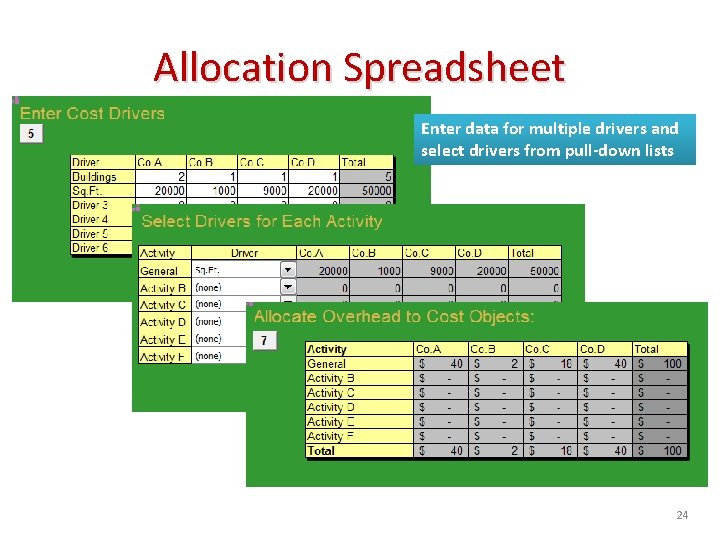
Allocation Spreadsheet Enter data for multiple drivers and select drivers from pull-down lists 24
Consider: • • • What are the cost objects? What is the cost driver? What is the rate per square foot? What is each company’s proportion? Is this a better method of distribution? Identify cross subsidizations and free goods created by the Case A method 25
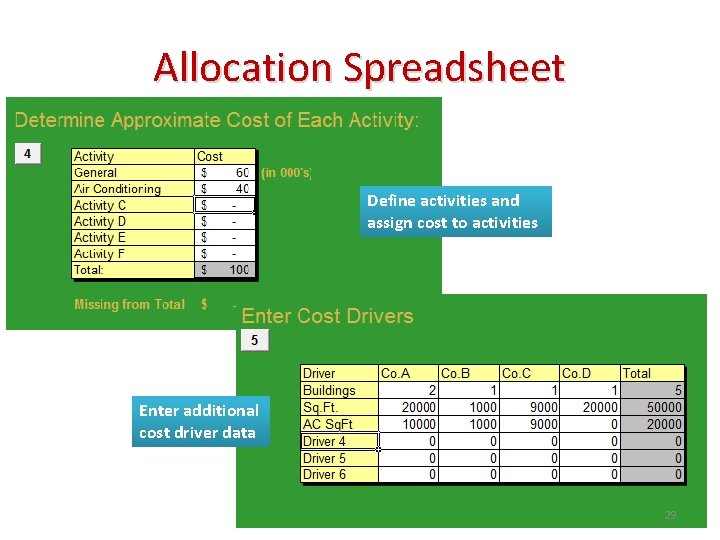
Facilities Case C • At this point, the manager of Company D protested. Yes, he did have a large building, but it was not air conditioned. By his estimates, which were reasonably accurate, forty percent of the facilities expenditures were air conditioning related. These expenses included the additional electricity, maintenance and repair needed to keep the air conditioning units running. 26
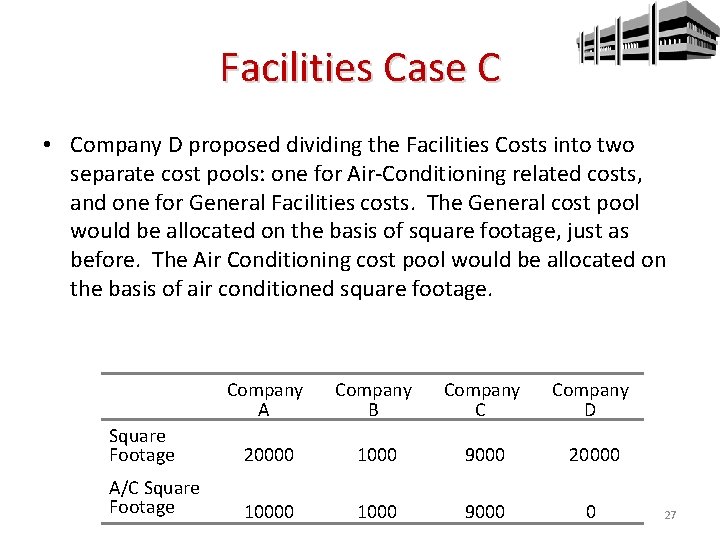
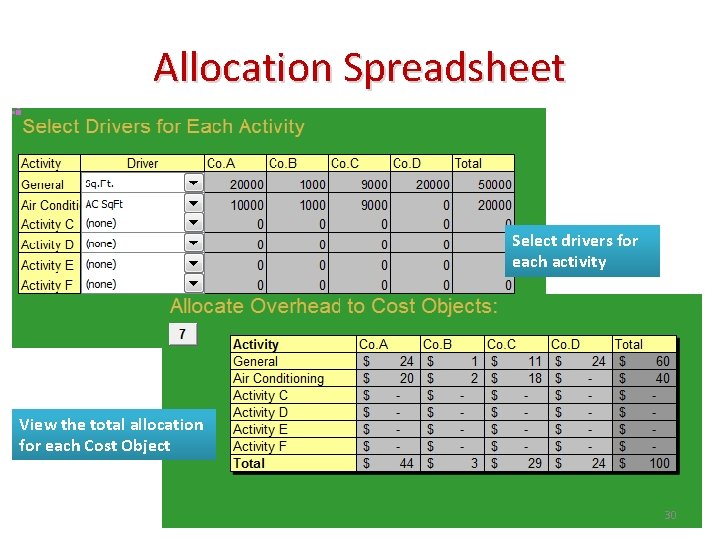
Facilities Case C • Company D proposed dividing the Facilities Costs into two separate cost pools: one for Air-Conditioning related costs, and one for General Facilities costs. The General cost pool would be allocated on the basis of square footage, just as before. The Air Conditioning cost pool would be allocated on the basis of air conditioned square footage. Company A Company B Company C Company D Square Footage 20000 1000 9000 20000 A/C Square Footage 10000 1000 9000 0 27
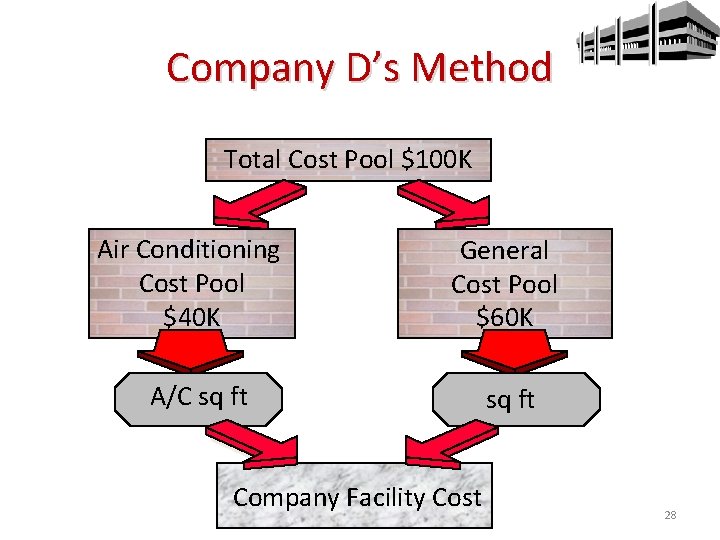
Company D’s Method Total Cost Pool $100 K Air Conditioning Cost Pool $40 K General Cost Pool $60 K A/C sq ft Company Facility Cost 28
Allocation Spreadsheet Define activities and assign cost to activities Enter additional cost driver data 29
Allocation Spreadsheet Select drivers for each activity View the total allocation for each Cost Object 30
Consider: • What is the new rate per square foot? • What is the rate per air conditioned square foot? • Identify any cross subsidizations and free goods created by Case B’s method • Is this a better method of distribution? • Why might this method not reflect true cost? 31
Good Method Test • Case A is a good method IF. . . • All buildings are the same • Case B is a good method IF. . . • All square feet are the same • Case C is a good method IF. . . • All general square feet are the same AND • All air conditioned square feet are the same 32
Don’t Forget Behavioral Impacts • What undesired behavior is encouraged with allocation by number of buildings • Combining buildings one roof • Expanding buildings when new building might make more sense • Rejecting assignment to small building • In-fighting to occupy large air conditioned buildings 33
Learning Check • What happens to an object’s overhead allocation as its proportion of cost driver increases? • If the unit of measure for the cost driver is dollars, what will be the unit of measure for the driver rate? 34
Assumptions • Making assumptions is inescapable in managerial costing • There is simply too much to measure and too many ways to measure it • Reasonable assumptions simplify and facilitate the measurement process • Bad assumptions result in poor management decision making 35
Homogeneity and Averaging • Allocation methods implicitly assume sameness or homogeneity • Allocating the dinner check based on number of eaters assumes that all eaters consume resources equally • Allocating facilities costs based on number of buildings assumes that all buildings consume facilities resources equally 36
Homogeneity and Averaging • The homogeneity assumption allows the use of average cost • To simplify the allocation process • To minimize the cost of measurement • To avoid detailed record keeping for every cost object 37
Cause and Effect Relationships • A cause and effect relationship means: • Increasing driver usage will cause more consumption of resources • Decreasing driver usage will cause less resource consumption • Allocating cost based on this driver will reflect the underlying economics of cost consumption and approximate true cost 38
Cause and Effect Relationships • Give the cost manager another target for managing cost • Managing the driver usage will result in managing cost • Allow managers to make rational decisions based on knowledge of true cost • Instead of over-consuming goods and services that appear to be free or low-cost 39
Common Examples of Cause - Effect Cost Drivers • • • Square footage Heating costs Number of employees Personnel costs Mileage Motor pool costs Computer hours Computer costs Others? 40
Learning Check • What is the underlying assumption when choosing a cost driver? • A cause-effect relationship means that when the driver usage is reduced, the will also decrease. 41
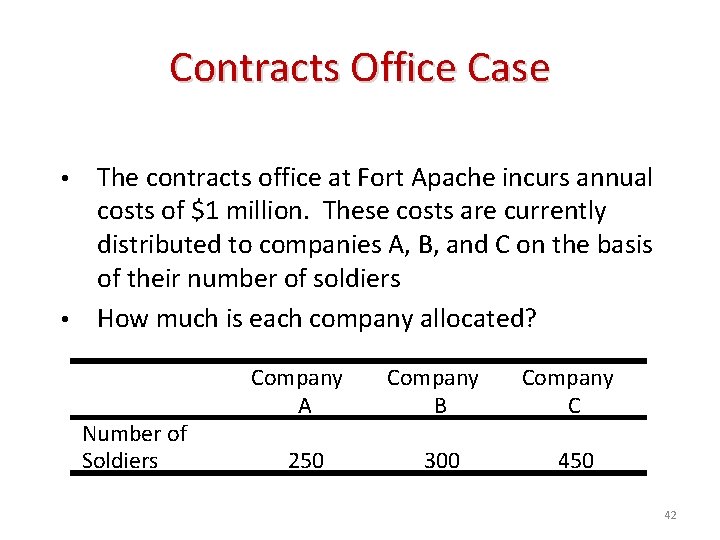
Contracts Office Case The contracts office at Fort Apache incurs annual costs of $1 million. These costs are currently distributed to companies A, B, and C on the basis of their number of soldiers • How much is each company allocated? • Number of Soldiers Company A 250 Company B 300 Company C 450 42
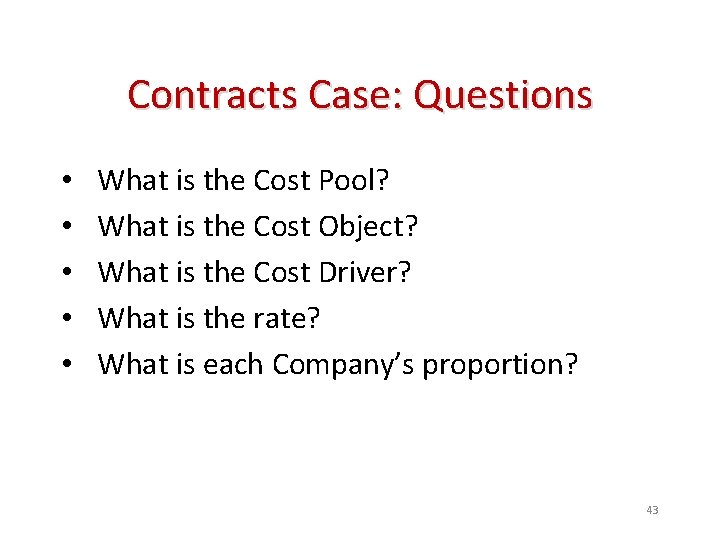
Contracts Case: Questions • • • What is the Cost Pool? What is the Cost Object? What is the Cost Driver? What is the rate? What is each Company’s proportion? 43
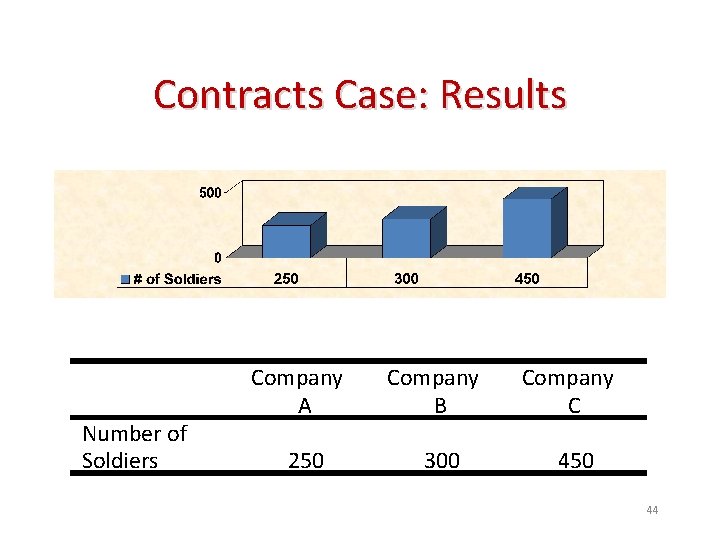
Contracts Case: Results Number of Soldiers Company A 250 Company B 300 Company C 450 44
Contracts Case: Discussion Questions • Is “number of soldiers” a good cost driver? • Will decreasing soldiers decrease consumption of contracts resources? • What undesired behaviors might be encouraged by this method of distribution? 45
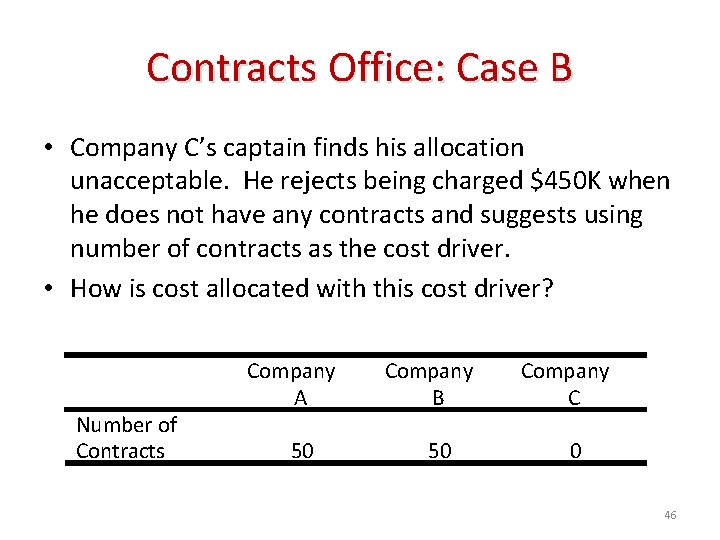
Contracts Office: Case B • Company C’s captain finds his allocation unacceptable. He rejects being charged $450 K when he does not have any contracts and suggests using number of contracts as the cost driver. • How is cost allocated with this cost driver? Number of Contracts Company A 50 Company B 50 Company C 0 46
Contracts Case B: Questions • • • What is the Cost Pool? What is the Cost Object? What is the Cost Driver? What is the rate? What is each Company’s proportion? 47
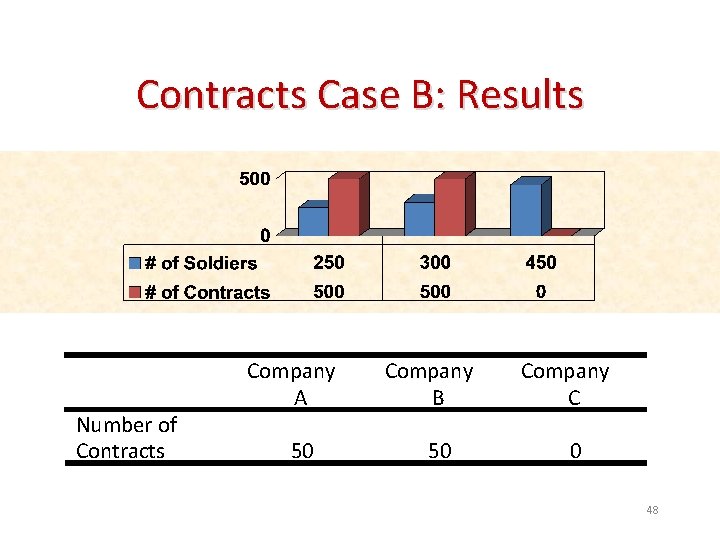
Contracts Case B: Results Number of Contracts Company A 50 Company B 50 Company C 0 48
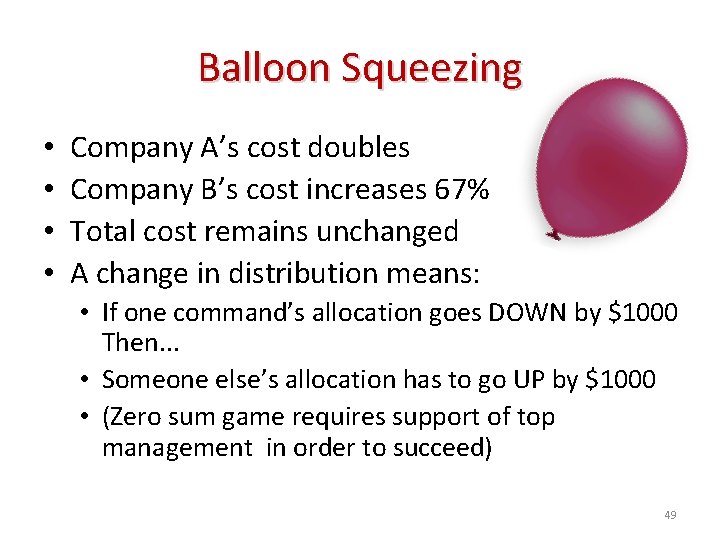
Balloon Squeezing • • Company A’s cost doubles Company B’s cost increases 67% Total cost remains unchanged A change in distribution means: • If one command’s allocation goes DOWN by $1000 Then. . . • Someone else’s allocation has to go UP by $1000 • (Zero sum game requires support of top management in order to succeed) 49
Contracts Case B: Discussion Questions • Is “number of contracts” a good cost driver? • Will decreasing number of contracts decrease consumption of contracts resources? • What undesired behaviors might be encouraged by this method? 50
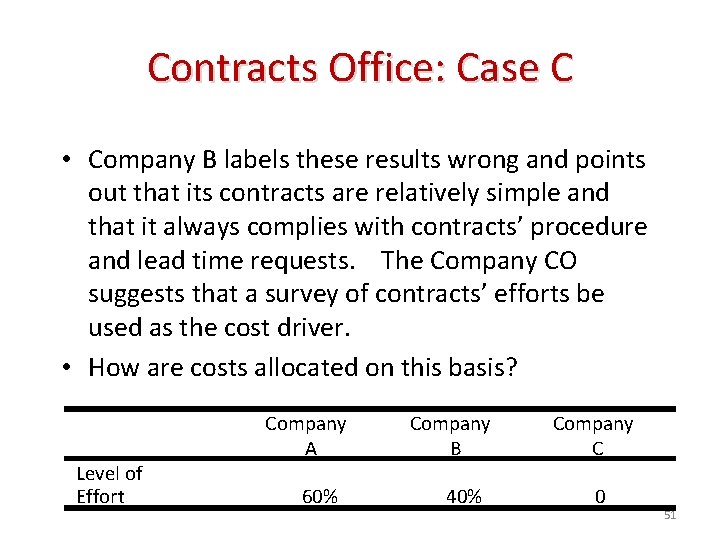
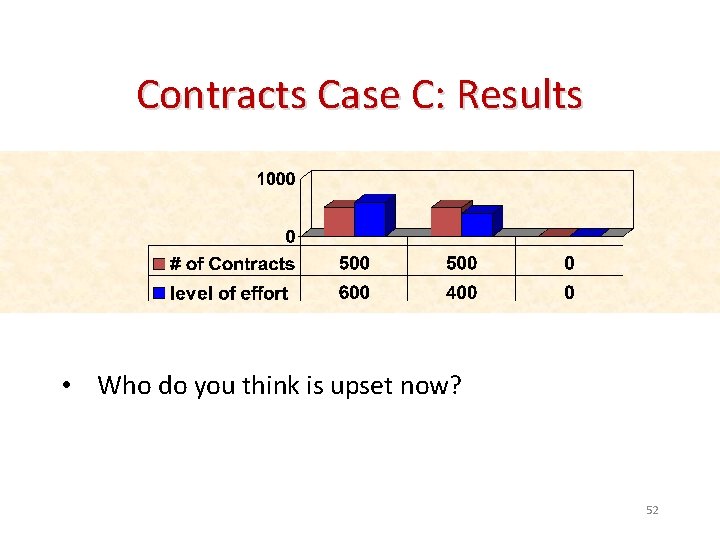
Contracts Office: Case C • Company B labels these results wrong and points out that its contracts are relatively simple and that it always complies with contracts’ procedure and lead time requests. The Company CO suggests that a survey of contracts’ efforts be used as the cost driver. • How are costs allocated on this basis? Level of Effort Company A 60% Company B 40% Company C 0 51
Contracts Case C: Results • Who do you think is upset now? 52
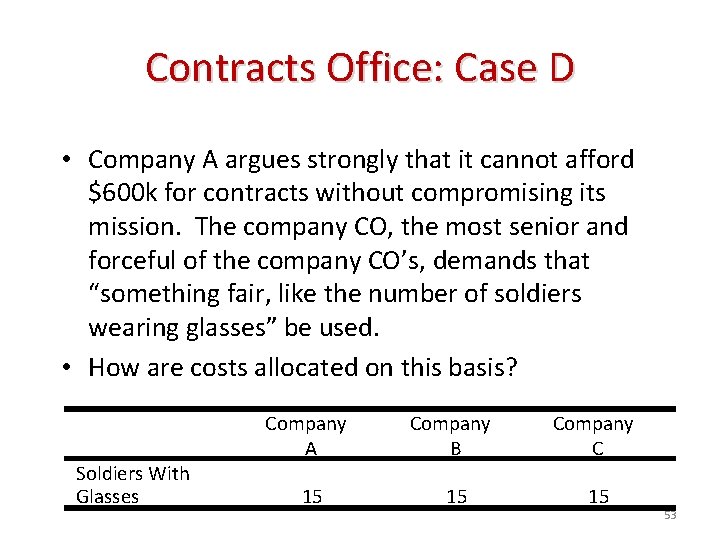
Contracts Office: Case D • Company A argues strongly that it cannot afford $600 k for contracts without compromising its mission. The company CO, the most senior and forceful of the company CO’s, demands that “something fair, like the number of soldiers wearing glasses” be used. • How are costs allocated on this basis? Soldiers With Glasses Company A 15 Company B 15 Company C 15 53
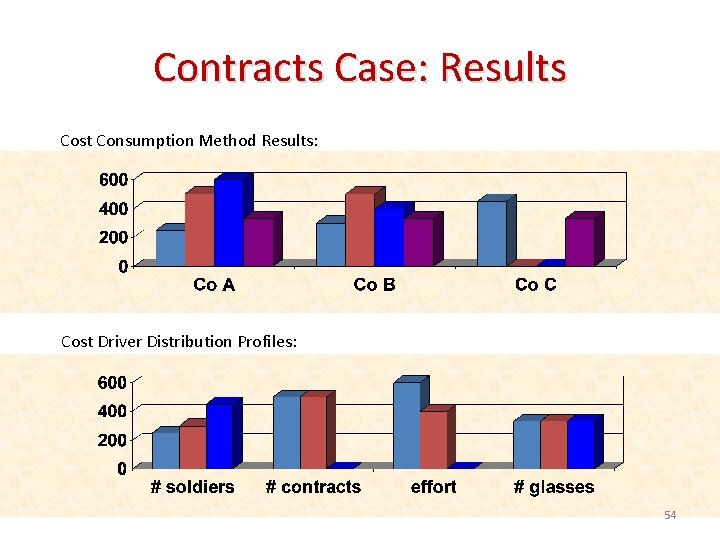
Contracts Case: Results Cost Consumption Method Results: Cost Driver Distribution Profiles: 54
Contracts: Discussion Questions • Is “number of soldiers wearing glasses” a good cost driver? • (Never forget that we accountants are trained to deal with nonsense) • Which driver would you recommend • If you are any of the company commanders? • If you are the installation commander? 55
Driver Selection: Issues to Consider • Does the proposed driver correlate with resource consumption? • Less driver causes less resource • More driver causes more resource • Does the proposed driver motivate desirable behavior? • Cost conscious managers will work to reduce the driver • Does less driver benefit the organization? 56
Contracts Case: Lessons • Using cost driver to allocate is easy • Choosing the right cost driver may be hard • Cannot ignore behavioral implications • So count on them • Design system to motivate desired behavior • True economic cost usually motivates the right cost management behavior 57
Learning Check • What does “balloon squeezing” mean? • What should be considered when choosing a cost driver? 58
Why Level of Effort Analysis? • Many costs are not easily correlated with cost objects • Less true in manufacturing • Very true in service • Level of effort analysis technique easily: allocation based on cost driver • Produces a customized driver of reasonable accuracy 59
Overhead: Likely Candidate for Level of Effort (LOE) • Overhead Areas Often Use LOE Since: • Work Usually Specialized and Not Consumed Uniformly by Line Organizations • Like the Contracts Office • Lack of Consumption Homogeneity May Mean that Common Drivers are Poor • i. e. Square Feet, Direct Labor Hours, Mileage, etc. , Do not Adequately Correlate to Cost Object Consumption of Overhead Resources 60
Developing LOE as a Driver • Interview Activity Manager • Concentrate on People’s “Efforts” Supporting Cost Objects • Find out What Proportion of Each Person’s Time would be “Invoiced” to Each Cost Object if Activity was a Business and Cost Object was a Customer 61
Precision and LOE • Activity Manager Will Only be Able to Make Rough Estimates • Estimates Get Better Over Time • Random Estimate Errors Tend to Offset • Systematic Error Can Induce Bias • Saliency Can Induce Bias 62
Beneficial By-Products • Staff/overhead organizations often misunderstand their role • It’s easy for staff to think they are line • Often helpful to organization when staff functions are forced to think of their line customers as paying the bills • Publicizing LOE creates a forum for cost and support issues 63
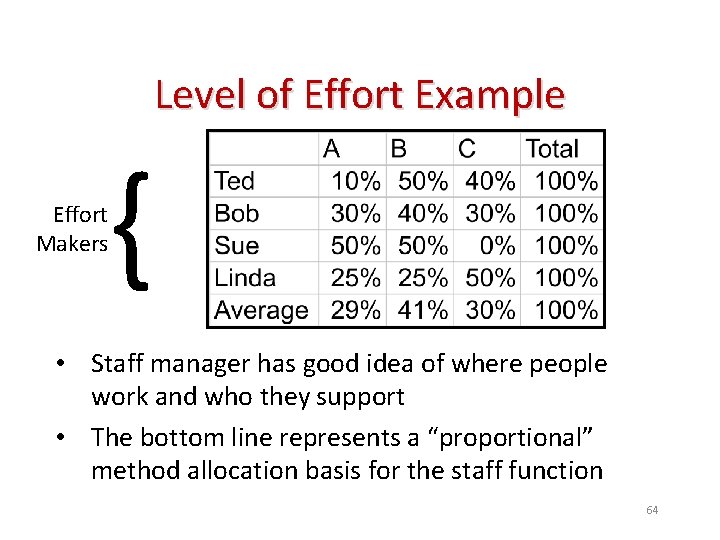
Level of Effort Example { Effort Makers • Staff manager has good idea of where people work and who they support • The bottom line represents a “proportional” method allocation basis for the staff function 64
Don’t Forget Homogeneity Assumption • Implicit assumptions: • Effort costs the same for each person • Other costs proportional to people • If Ted is a lawyer and others are paralegals, the level of effort is biased • Use weighting factor, or • Make two separate activities if bias is significant 65
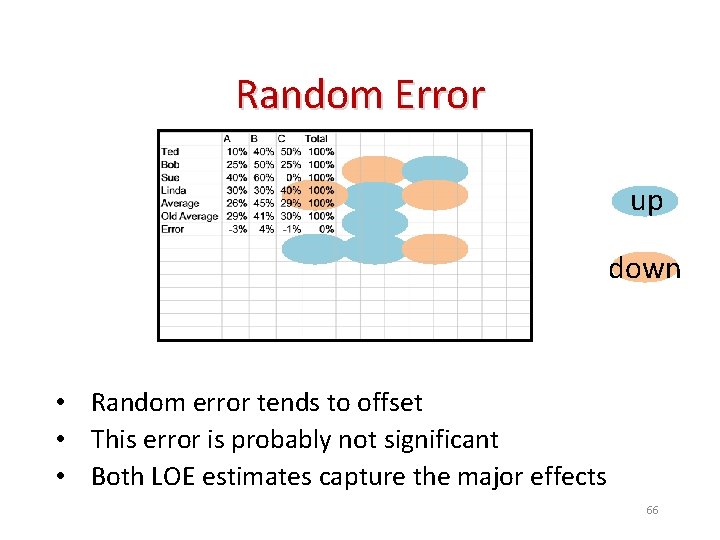
Random Error up down • Random error tends to offset • This error is probably not significant • Both LOE estimates capture the major effects 66
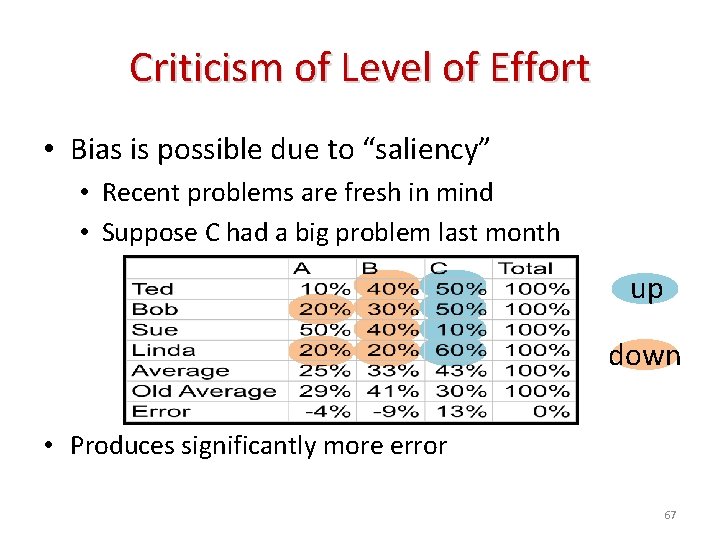
Criticism of Level of Effort • Bias is possible due to “saliency” • Recent problems are fresh in mind • Suppose C had a big problem last month up down • Produces significantly more error 67
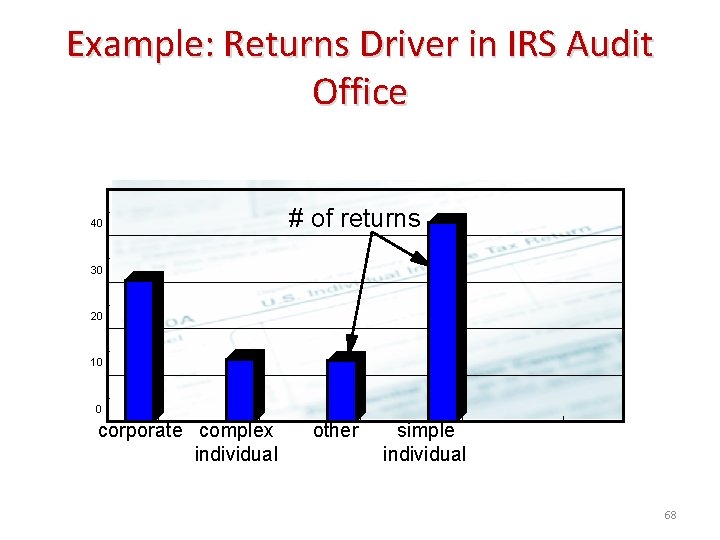
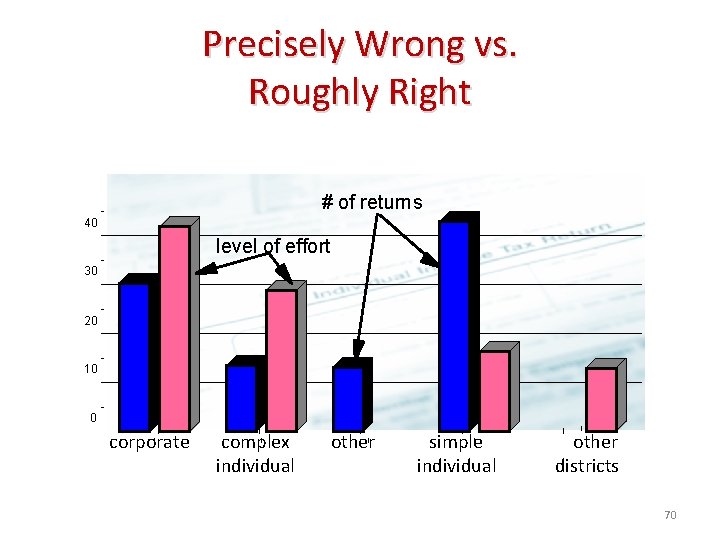
Example: Returns Driver in IRS Audit Office 40 # of returns 30 20 10 0 corporate complex individual other simple individual 68
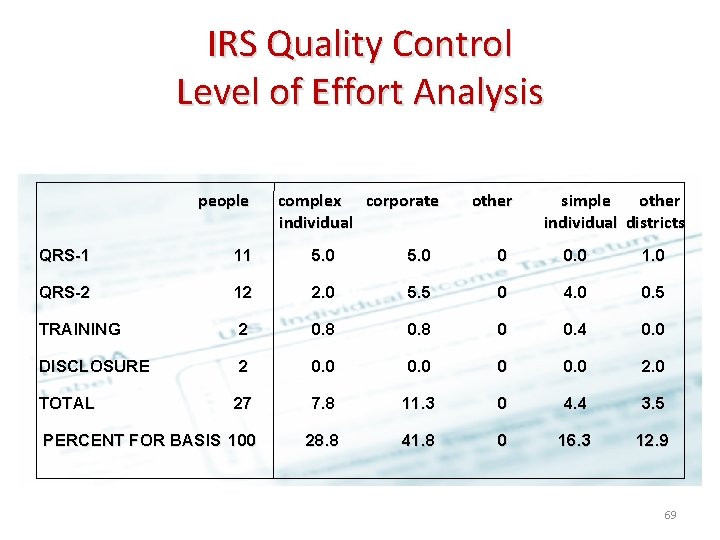
IRS Quality Control Level of Effort Analysis people complex corporate individual other simple other individual districts QRS-1 11 5. 0 0 0. 0 1. 0 QRS-2 12 2. 0 5. 5 0 4. 0 0. 5 TRAINING 2 0. 8 0 0. 4 0. 0 DISCLOSURE 2 0. 0 0 0. 0 27 7. 8 11. 3 0 4. 4 3. 5 PERCENT FOR BASIS 100 28. 8 41. 8 0 16. 3 12. 9 TOTAL 69
Precisely Wrong vs. Roughly Right # of returns 40 level of effort 30 20 10 0 corporate complex other simple other individual districts 70
Learning Check • Why is level of effort sometimes a better driver than a unit-based driver? • What is the primary criticism of the level of effort driver? 71
Practical Exercise 72