
CALCIUM OVEN INVESTIGATION EXPERIMENTAL MEASUREMENTS AND SIMULATION OF
![CALCIUM OVEN INVESTIGATION Experimental results (2) Ø [This work] Antoine’s coeff. For Ca A](https://slidetodoc.com/presentation_image_h2/fa5081c39285c58bb75ed86ba7276579/image-9.jpg "CALCIUM OVEN INVESTIGATION Experimental results (2) Ø [This work] Antoine’s coeff. For Ca A")
- Slides: 18
CALCIUM OVEN INVESTIGATION EXPERIMENTAL MEASUREMENTS AND SIMULATION OF AN ECRIS CALCIUM OVEN T. Thuillier 1 , A. Leduc 1, 2, L. Maunoury 2, O. Bajeat 2, P. Sole 1, J. Giraud 1 1 CNRS-LPSC, Universite Grenoble Alpes, INP Grenoble, France 2 GANIL, Universite Caen Normandie, France TUXZO 03 XXIVth Workshop on ECR Ion Sources East Lansing, Sept. 28 -30 th 2020 ECRIS 20, East Lansing, Tuesday September 29 th 2020 1
CALCIUM OVEN INVESTIGATION Outline Motivation Oven Design Measurements Simulation Conclusion ECRIS 20, East Lansing, Tuesday September 29 th 2020 2
CALCIUM OVEN INVESTIGATION Motivation Ø In ECRIS, atom to ion oven efficiency ranges from a few % to 20%, sometimes up to ~70% with wall recycling Ø 48 Ca is > 200 k€/g : it is worth trying to optimize the atom to ion conversion efficiency Ø How atoms are spatially distributed outward an oven? Can this distribution be optimized? Ø Can simulation reproduce experimental measurements? ECRIS 20, East Lansing, Tuesday September 29 th 2020 3
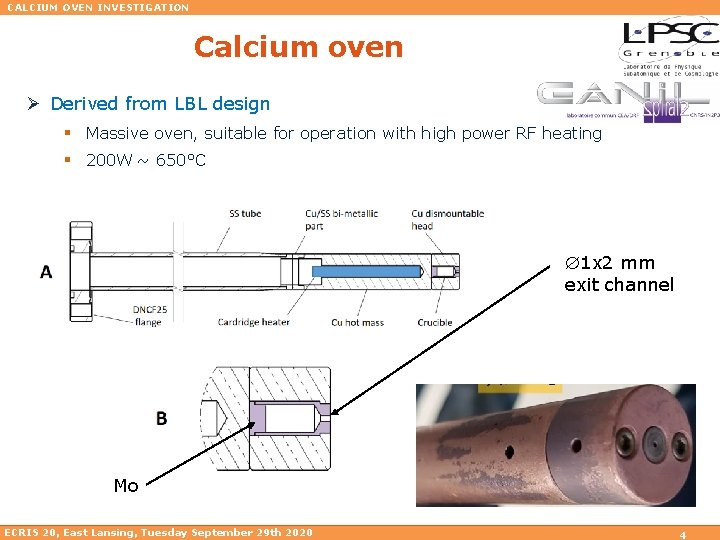
CALCIUM OVEN INVESTIGATION Calcium oven Ø Derived from LBL design § Massive oven, suitable for operation with high power RF heating § 200 W ~ 650°C 1 x 2 mm exit channel Mo ECRIS 20, East Lansing, Tuesday September 29 th 2020 4
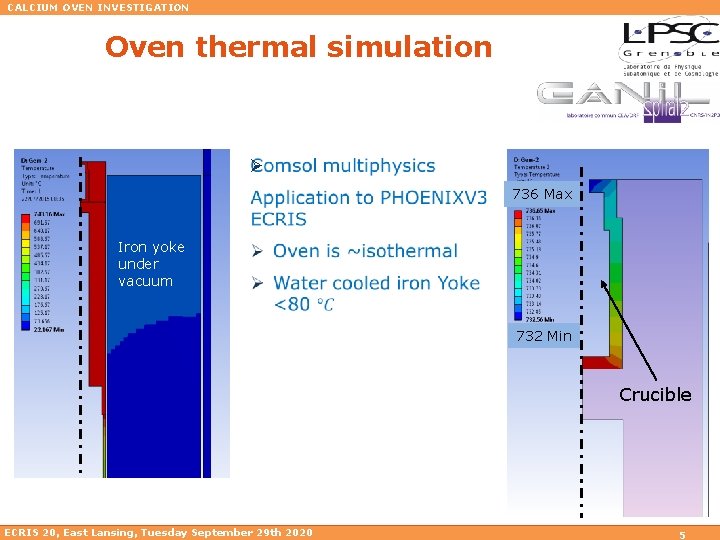
CALCIUM OVEN INVESTIGATION Oven thermal simulation Ø 736 Max Iron yoke under vacuum 732 Min Crucible ECRIS 20, East Lansing, Tuesday September 29 th 2020 5
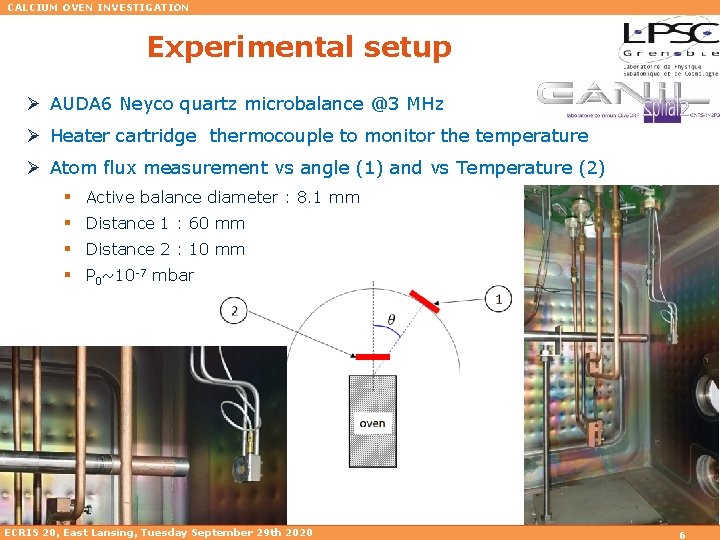
CALCIUM OVEN INVESTIGATION Experimental setup Ø AUDA 6 Neyco quartz microbalance @3 MHz Ø Heater cartridge thermocouple to monitor the temperature Ø Atom flux measurement vs angle (1) and vs Temperature (2) § § Active balance diameter : 8. 1 mm Distance 1 : 60 mm Distance 2 : 10 mm P 0~10 -7 mbar ECRIS 20, East Lansing, Tuesday September 29 th 2020 6
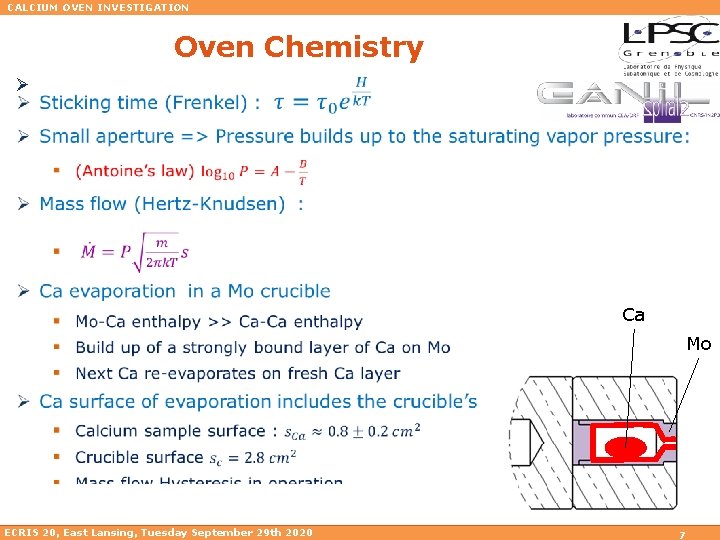
CALCIUM OVEN INVESTIGATION Oven Chemistry Ø Ca Mo ECRIS 20, East Lansing, Tuesday September 29 th 2020 7
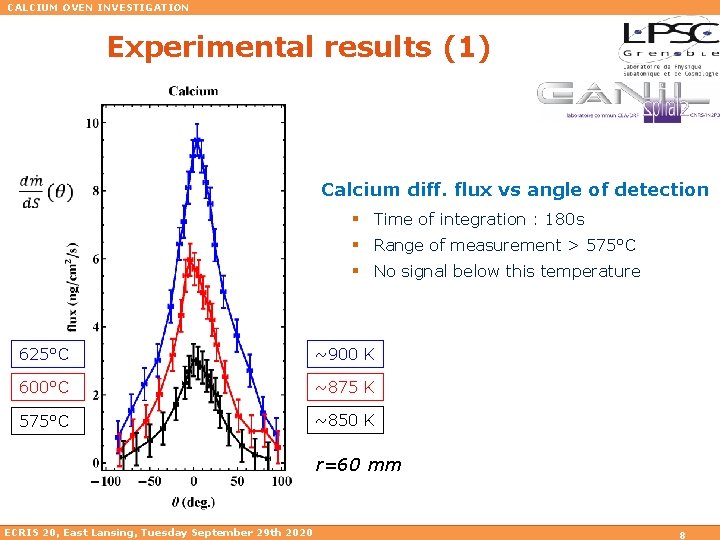
CALCIUM OVEN INVESTIGATION Experimental results (1) Calcium diff. flux vs angle of detection § Time of integration : 180 s § Range of measurement > 575°C § No signal below this temperature 625°C ~900 K 600°C ~875 K 575°C ~850 K r=60 mm ECRIS 20, East Lansing, Tuesday September 29 th 2020 8
CALCIUM OVEN INVESTIGATION Experimental results (2) Ø [This work] Antoine’s coeff. For Ca A [1] B [1] 10. 34 8, 94 x 103 This work 8. 98 7, 79 x 103 [1] S. DUSHMAN and J/M. LAFFERTY – Scientific foundationsof vacuum technique. 806 p. , 2 nd ed. New York, Wiley and. Sons (1962). ECRIS 20, East Lansing, Tuesday September 29 th 2020 9
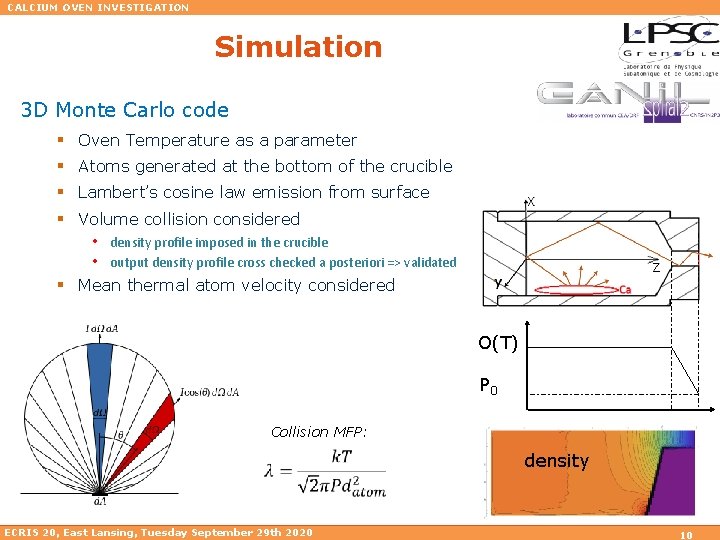
CALCIUM OVEN INVESTIGATION Simulation 3 D Monte Carlo code § § Oven Temperature as a parameter Atoms generated at the bottom of the crucible Lambert’s cosine law emission from surface Volume collision considered • density profile imposed in the crucible • output density profile cross checked a posteriori => validated § Mean thermal atom velocity considered O(T) P 0 Collision MFP: density ECRIS 20, East Lansing, Tuesday September 29 th 2020 10
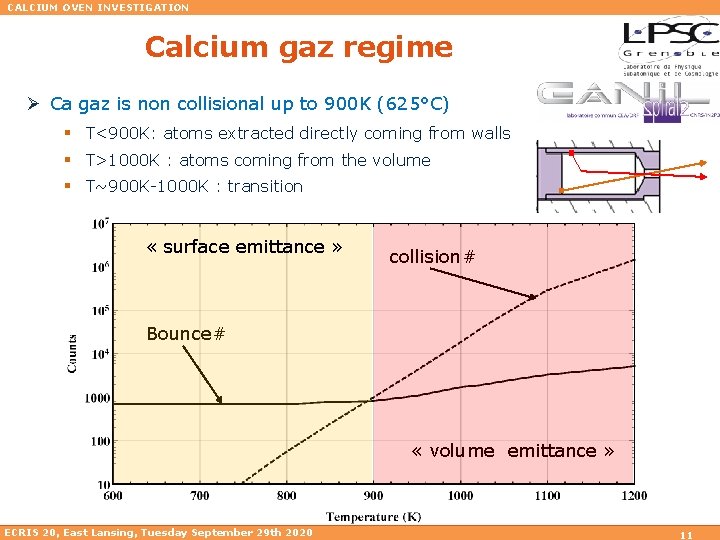
CALCIUM OVEN INVESTIGATION Calcium gaz regime Ø Ca gaz is non collisional up to 900 K (625°C) § T<900 K: atoms extracted directly coming from walls § T>1000 K : atoms coming from the volume § T~900 K-1000 K : transition « surface emittance » collision# Bounce# « volume emittance » ECRIS 20, East Lansing, Tuesday September 29 th 2020 11
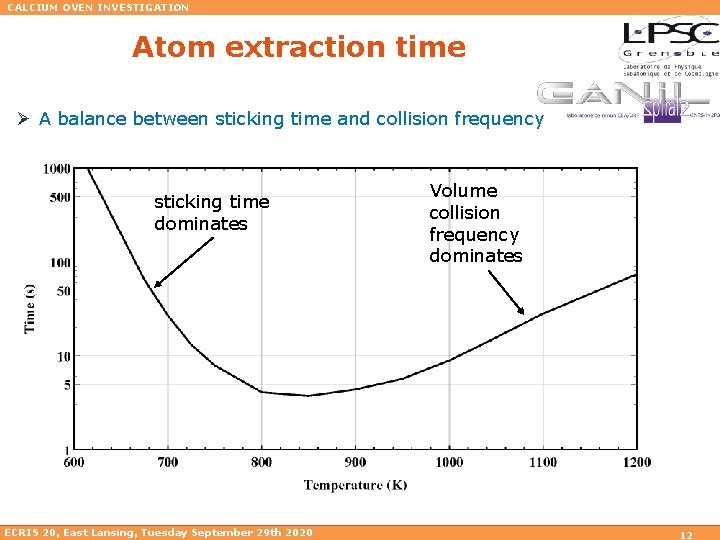
CALCIUM OVEN INVESTIGATION Atom extraction time Ø A balance between sticking time and collision frequency sticking time dominates ECRIS 20, East Lansing, Tuesday September 29 th 2020 Volume collision frequency dominates 12
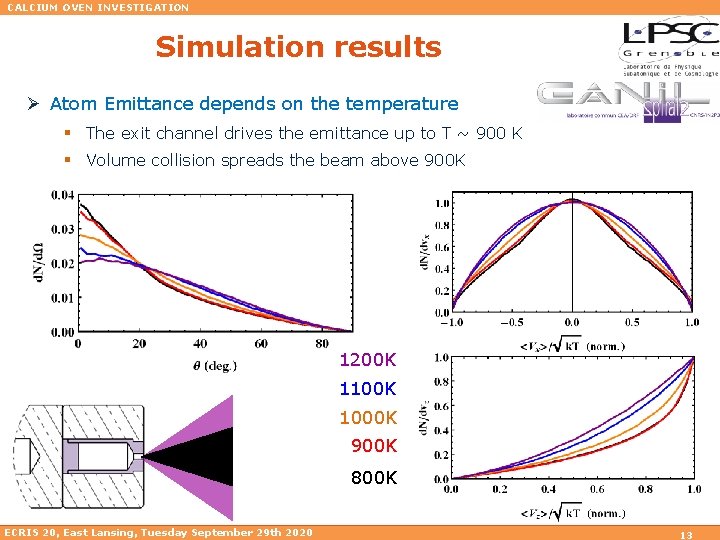
CALCIUM OVEN INVESTIGATION Simulation results Ø Atom Emittance depends on the temperature § The exit channel drives the emittance up to T ~ 900 K § Volume collision spreads the beam above 900 K 1200 K 1100 K 1000 K 900 K 800 K ECRIS 20, East Lansing, Tuesday September 29 th 2020 13
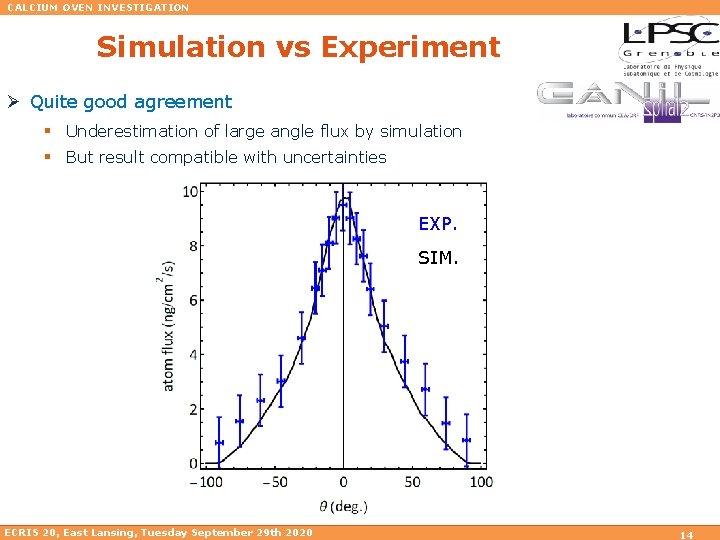
CALCIUM OVEN INVESTIGATION Simulation vs Experiment Ø Quite good agreement § Underestimation of large angle flux by simulation § But result compatible with uncertainties EXP. SIM. ECRIS 20, East Lansing, Tuesday September 29 th 2020 14
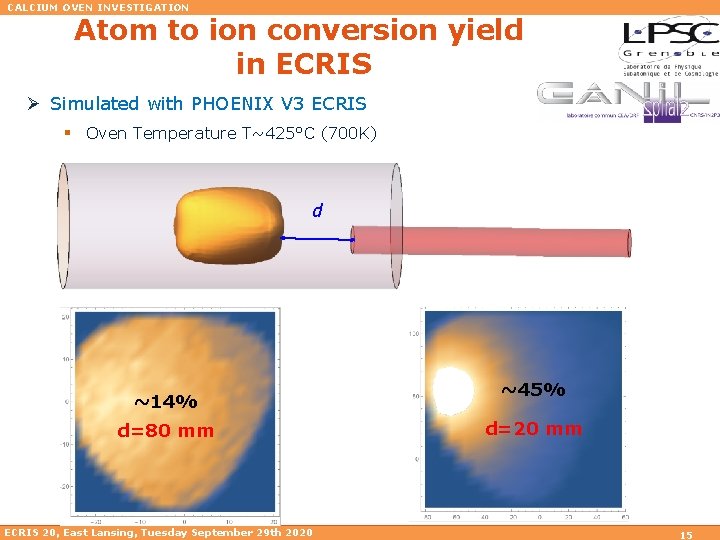
CALCIUM OVEN INVESTIGATION Atom to ion conversion yield in ECRIS Ø Simulated with PHOENIX V 3 ECRIS § Oven Temperature T~425°C (700 K) d ~14% d=80 mm ECRIS 20, East Lansing, Tuesday September 29 th 2020 ~45% d=20 mm 15
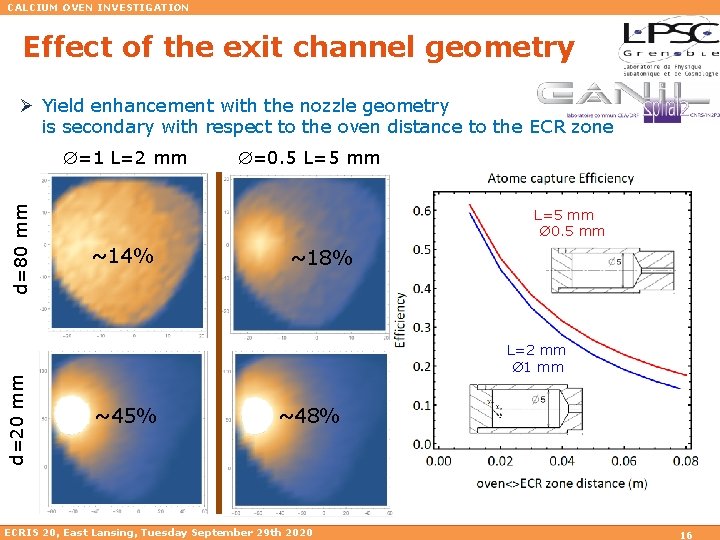
CALCIUM OVEN INVESTIGATION Effect of the exit channel geometry Ø Yield enhancement with the nozzle geometry is secondary with respect to the oven distance to the ECR zone d=20 mm d=80 mm =1 L=2 mm =0. 5 L=5 mm 0. 5 mm ~14% ~18% L=2 mm 1 mm ~45% ~48% ECRIS 20, East Lansing, Tuesday September 29 th 2020 16
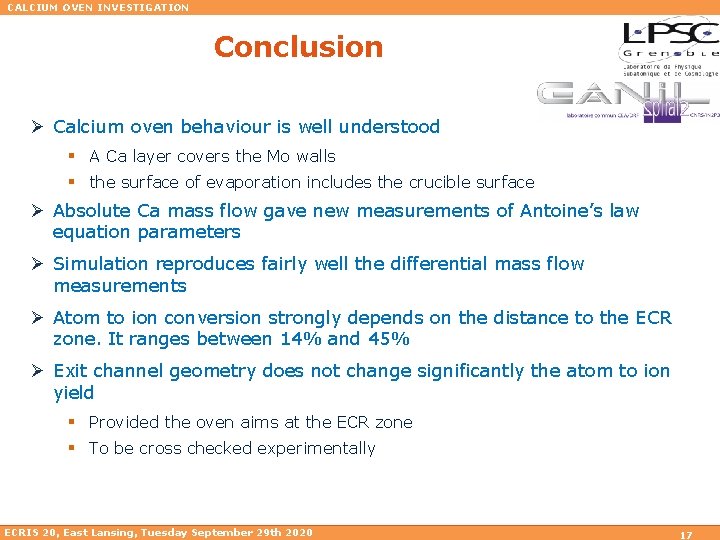
CALCIUM OVEN INVESTIGATION Conclusion Ø Calcium oven behaviour is well understood § A Ca layer covers the Mo walls § the surface of evaporation includes the crucible surface Ø Absolute Ca mass flow gave new measurements of Antoine’s law equation parameters Ø Simulation reproduces fairly well the differential mass flow measurements Ø Atom to ion conversion strongly depends on the distance to the ECR zone. It ranges between 14% and 45% Ø Exit channel geometry does not change significantly the atom to ion yield § Provided the oven aims at the ECR zone § To be cross checked experimentally ECRIS 20, East Lansing, Tuesday September 29 th 2020 17
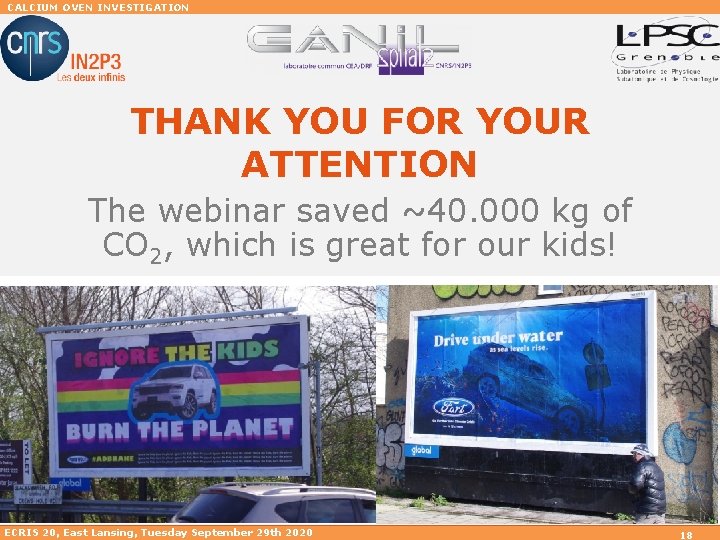
CALCIUM OVEN INVESTIGATION THANK YOU FOR YOUR ATTENTION The webinar saved ~40. 000 kg of CO 2, which is great for our kids! ECRIS 20, East Lansing, Tuesday September 29 th 2020 18