
Calcium imaging revealed epilepticlike neuronal behavior in cortical
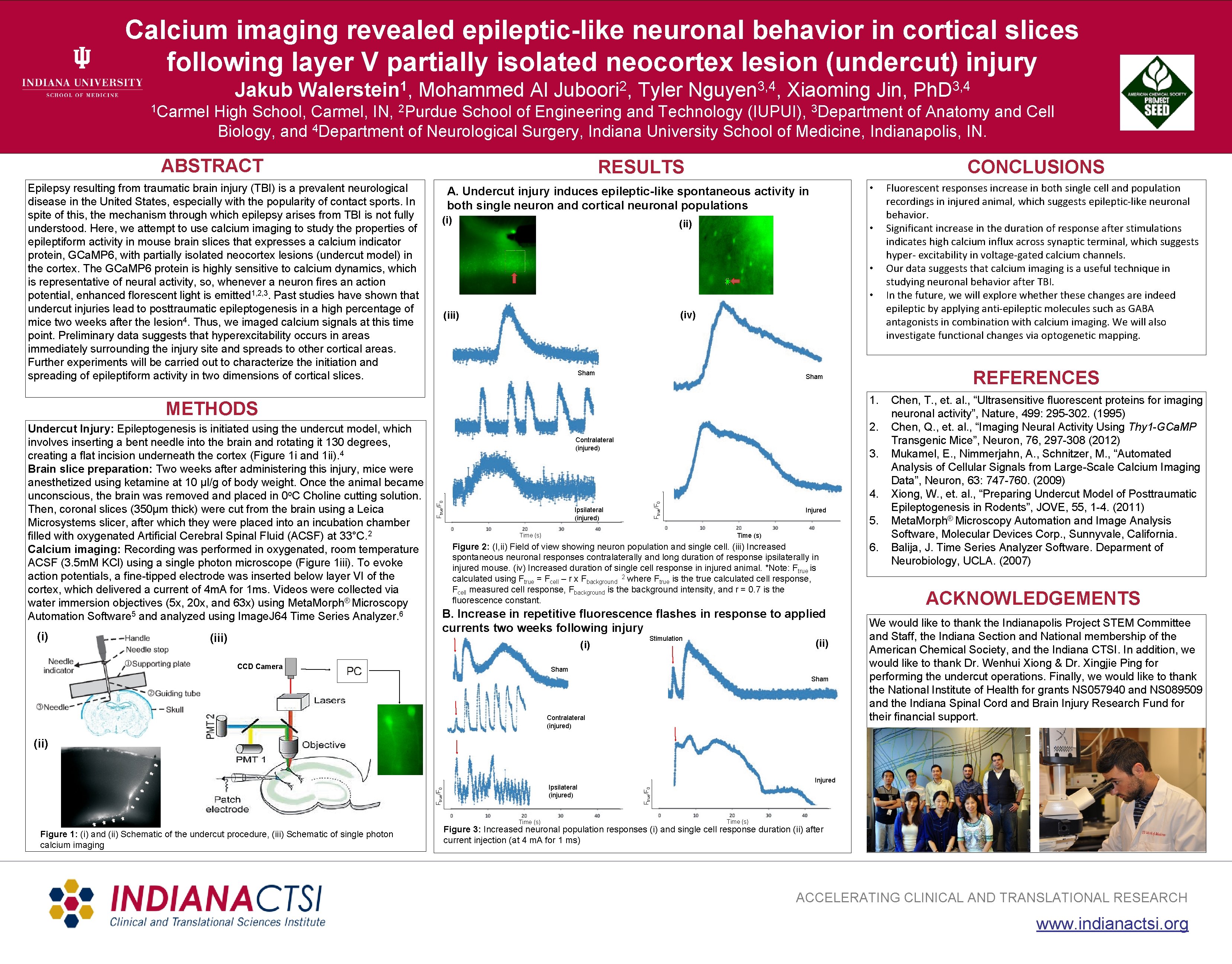
Calcium imaging revealed epileptic-like neuronal behavior in cortical slices following layer V partially isolated neocortex lesion (undercut) injury Jakub 1 Carmel 1 Walerstein , Mohammed Al 2 Juboori , Tyler 3, 4 Nguyen , Xiaoming Jin, High School, Carmel, IN, 2 Purdue School of Engineering and Technology (IUPUI), 3 Department of Anatomy and Cell Biology, and 4 Department of Neurological Surgery, Indiana University School of Medicine, Indianapolis, IN. ABSTRACT Epilepsy resulting from traumatic brain injury (TBI) is a prevalent neurological disease in the United States, especially with the popularity of contact sports. In spite of this, the mechanism through which epilepsy arises from TBI is not fully understood. Here, we attempt to use calcium imaging to study the properties of epileptiform activity in mouse brain slices that expresses a calcium indicator protein, GCa. MP 6, with partially isolated neocortex lesions (undercut model) in the cortex. The GCa. MP 6 protein is highly sensitive to calcium dynamics, which is representative of neural activity, so, whenever a neuron fires an action potential, enhanced florescent light is emitted 1, 2, 3. Past studies have shown that undercut injuries lead to posttraumatic epileptogenesis in a high percentage of mice two weeks after the lesion 4. Thus, we imaged calcium signals at this time point. Preliminary data suggests that hyperexcitability occurs in areas immediately surrounding the injury site and spreads to other cortical areas. Further experiments will be carried out to characterize the initiation and spreading of epileptiform activity in two dimensions of cortical slices. CONCLUSIONS RESULTS • A. Undercut injury induces epileptic-like spontaneous activity in both single neuron and cortical neuronal populations (i) (ii) • • • (iv) (iii) Sham 1. (iii) 2. Contralateral (injured) 3. Ftrue/F 0 4. Ftrue/F 0 Undercut Injury: Epileptogenesis is initiated using the undercut model, which involves inserting a bent needle into the brain and rotating it 130 degrees, creating a flat incision underneath the cortex (Figure 1 i and 1 ii). 4 Brain slice preparation: Two weeks after administering this injury, mice were anesthetized using ketamine at 10 μl/g of body weight. Once the animal became unconscious, the brain was removed and placed in 0 o. C Choline cutting solution. Then, coronal slices (350μm thick) were cut from the brain using a Leica Microsystems slicer, after which they were placed into an incubation chamber filled with oxygenated Artificial Cerebral Spinal Fluid (ACSF) at 33°C. 2 Calcium imaging: Recording was performed in oxygenated, room temperature ACSF (3. 5 m. M KCl) using a single photon microscope (Figure 1 iii). To evoke action potentials, a fine-tipped electrode was inserted below layer VI of the cortex, which delivered a current of 4 m. A for 1 ms. Videos were collected via water immersion objectives (5 x, 20 x, and 63 x) using Meta. Morph® Microscopy Automation Software 5 and analyzed using Image. J 64 Time Series Analyzer. 6 Ipsilateral (injured) Injured 5. Time (s) Figure 2: (I, ii) Field of view showing neuron population and single cell. (iii) Increased spontaneous neuronal responses contralaterally and long duration of response ipsilaterally in injured mouse. (iv) Increased duration of single cell response in injured animal. *Note: Ftrue is calculated using Ftrue = Fcell – r x Fbackground 2 where Ftrue is the true calculated cell response, Fcell measured cell response, Fbackground is the background intensity, and r = 0. 7 is the fluorescence constant. B. Increase in repetitive fluorescence flashes in response to applied currents two weeks following injury (i) CCD Camera Stimulation (ii) Sham Contralateral (injured) Fluorescent responses increase in both single cell and population recordings in injured animal, which suggests epileptic-like neuronal behavior. Significant increase in the duration of response after stimulations indicates high calcium influx across synaptic terminal, which suggests hyper- excitability in voltage-gated calcium channels. Our data suggests that calcium imaging is a useful technique in studying neuronal behavior after TBI. In the future, we will explore whether these changes are indeed epileptic by applying anti-epileptic molecules such as GABA antagonists in combination with calcium imaging. We will also investigate functional changes via optogenetic mapping. REFERENCES Sham METHODS (i) 3, 4 Ph. D 6. Chen, T. , et. al. , “Ultrasensitive fluorescent proteins for imaging neuronal activity”, Nature, 499: 295 -302. (1995) Chen, Q. , et. al. , “Imaging Neural Activity Using Thy 1 -GCa. MP Transgenic Mice”, Neuron, 76, 297 -308 (2012) Mukamel, E. , Nimmerjahn, A. , Schnitzer, M. , “Automated Analysis of Cellular Signals from Large-Scale Calcium Imaging Data”, Neuron, 63: 747 -760. (2009) Xiong, W. , et. al. , “Preparing Undercut Model of Posttraumatic Epileptogenesis in Rodents”, JOVE, 55, 1 -4. (2011) Meta. Morph® Microscopy Automation and Image Analysis Software, Molecular Devices Corp. , Sunnyvale, California. Balija, J. Time Series Analyzer Software. Deparment of Neurobiology, UCLA. (2007) ACKNOWLEDGEMENTS We would like to thank the Indianapolis Project STEM Committee and Staff, the Indiana Section and National membership of the American Chemical Society, and the Indiana CTSI. In addition, we would like to thank Dr. Wenhui Xiong & Dr. Xingjie Ping for performing the undercut operations. Finally, we would like to thank the National Institute of Health for grants NS 057940 and NS 089509 and the Indiana Spinal Cord and Brain Injury Research Fund for their financial support. (ii) Time (s) Figure 1: (i) and (ii) Schematic of the undercut procedure, (iii) Schematic of single photon calcium imaging Ftrue/F 0 Ipsilateral (injured) Injured Time (s) Figure 3: Increased neuronal population responses (i) and single cell response duration (ii) after current injection (at 4 m. A for 1 ms) ACCELERATING CLINICAL AND TRANSLATIONAL RESEARCH www. indianactsi. org
- Slides: 1