
Calcium hydroxide Temporary root canal filling Subbase Component
Calcium hydroxide Temporary root canal filling Subbase Component of sealers
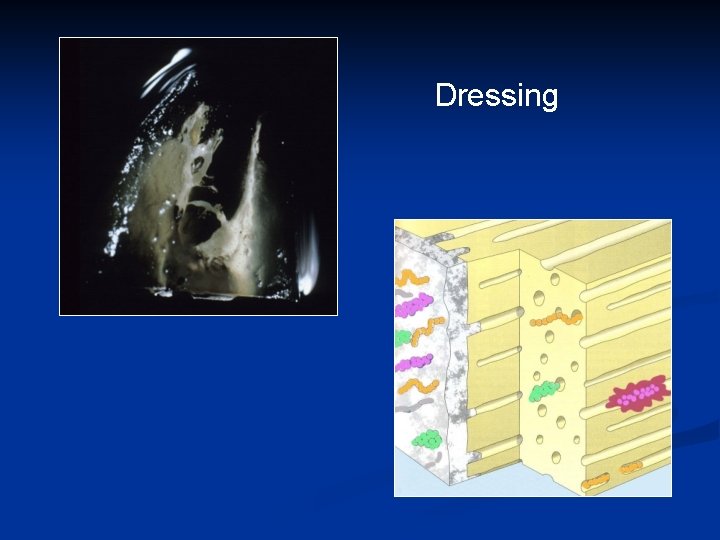
Dressing
Calcium hydroxide Short term action 1 – 2 weeks Desinfection, haemostasis n
Calcium hydroxide Midle term action 2 – 3 months n Apexification Chronic form of apical periodontitis
Calcium hydroxide Long term action 3 months and more n Prevention of resprption
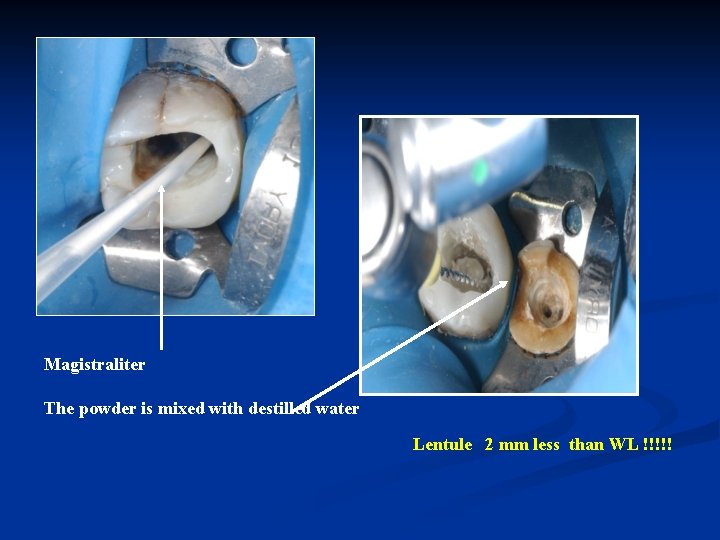
Magistraliter The powder is mixed with destilled water Lentule 2 mm less than WL !!!!!
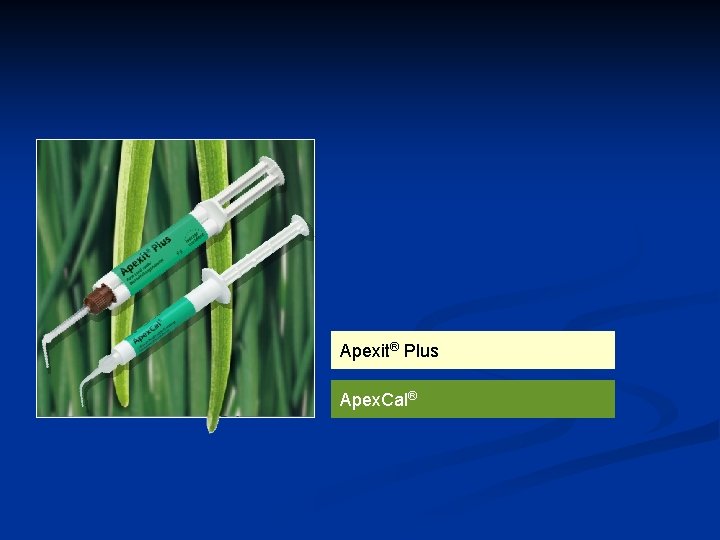
Apexit® Plus Apex. Cal®
Root canal filling
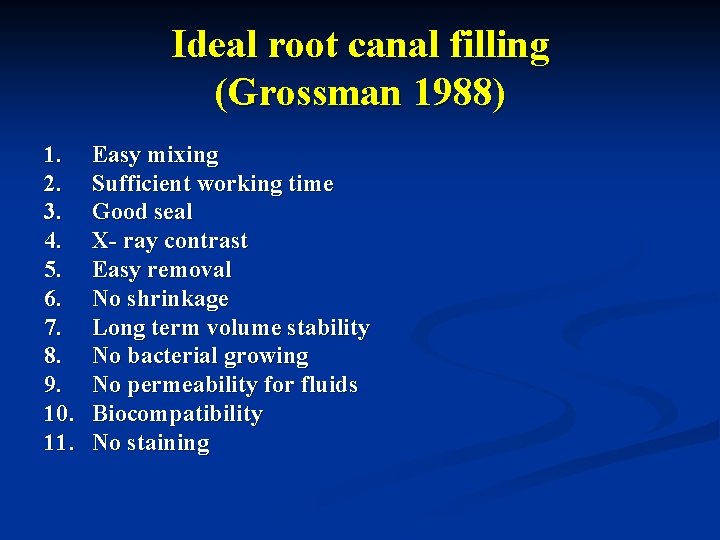
Ideal root canal filling (Grossman 1988) 1. 2. 3. 4. 5. 6. 7. 8. 9. 10. 11. Easy mixing Sufficient working time Good seal X- ray contrast Easy removal No shrinkage Long term volume stability No bacterial growing No permeability for fluids Biocompatibility No staining
Classification of root canal fillings Ø Solid Ø Semisolid Ø Pastes

Guttapercha Dried juice of the Taban tree (Isonandra percha) (gutta) 1, 4 - polyisoprene Crystallin structure (60%) Brittle
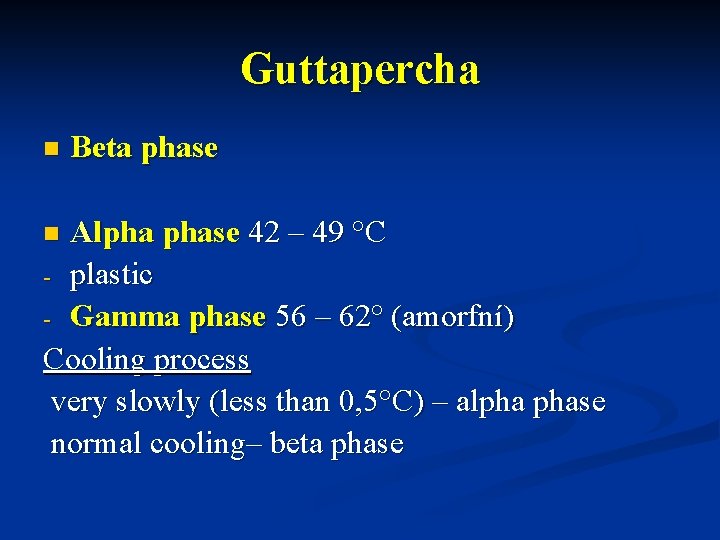
Guttapercha n Beta phase Alpha phase 42 – 49 °C - plastic - Gamma phase 56 – 62° (amorfní) Cooling process very slowly (less than 0, 5°C) – alpha phase normal cooling– beta phase n
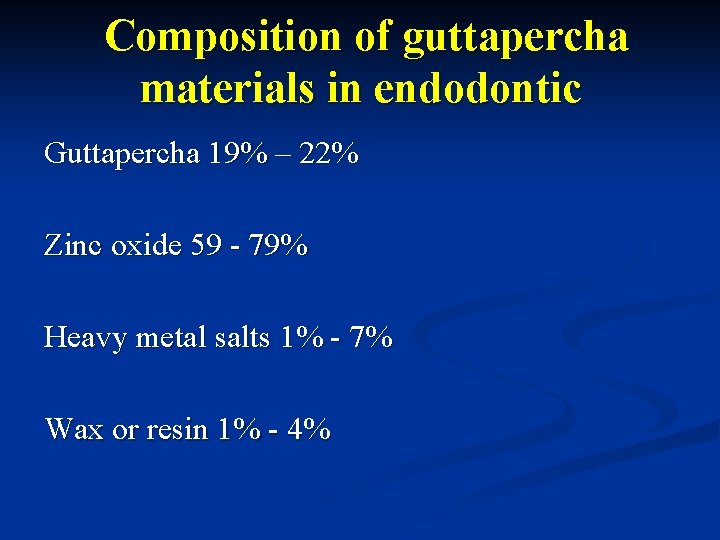
Composition of guttapercha materials in endodontic Guttapercha 19% – 22% Zinc oxide 59 - 79% Heavy metal salts 1% - 7% Wax or resin 1% - 4%
Resilon (Pentron) Ø Thermoplastic synthetic polymer Ø Points or material for injection Composition: Polyester polymers Bioactive glass Radioopaque fillers (bismuthum oxichlorid a and baryum sulphate)
Silver or titanium cones Ø No good seal Ø Silver cones - corrosion
Sealery Chemically curing plastic materiáls Good adhesion to root canal walls as well as solid cones X- ray contrast Biocompatibility
Sealers Zinc Oxide-Eugenol Chloropercha Calciumhydroxide Resins Glasionomer Silicone
Sealers Importance Filling of the spaces between the solid cones Seal of the root canal filling
Zinc - Oxid Eugenol Powder: Zinc oxide Liquid: Eugenol Acidic resins Good adhesivity, antimikrobial effect, cytotoxic. resorbable)
Zink Oxid Eugenol sealers Pulp Canal Sealer (Kerr, USA)) Tubuli- Seal (Kerr, USA) Caryosan (Spofa Dental, ČR)
Chloropercha Powder Canadian balsam Resins Guttapercha Zinc oxide Liquid: Chloroform Resins
Chloropercha Vlastnosti: Good adhesivity Shrinkage Toxicity
Calciumhydroxide sealers Base ( powder) Calcium hydroxide Zinc oxide Other components and vehicula
Kalciumhydroxidové sealery Catalystr (paste) Zinc stearat Titanium dioxide Baryum sulphate or Eugenol, . Eukalypt others
Kalciumhydroxide sealers Ø Increase of the healig potential of periapical tissues Ø Antibacterial effect Easy manipulation But! Resorbable if not homogeneus Not suitable for the single cone technique Ø
Resins Ø Rezorcin formaldehyd Ø Epoxide Ø Polyketone Ø Metacrylate
Rezorcin formaldehydové pryskyřice Toxicity N 2, Endomethason, Riebler´s paste, Foredent

Epoxide resin Ø Base (powder, paste) Bismuth oxid Titanium dioxide Hexametylentetramine (Silver) Ø Catalyst (liquide, paste) Bisphenoldiglycidylether
Epoxide resin Advantages Ø Long working time Ø Hydrophilic (good penetration) Ø Good adhesion to the root canal walls Ø Volume stability Ø No dissolution Ø Antibacterial
Epoxide resin (disadvantages) Ø Difficult removal Ø Staining Ø Initiatiory roxicity No suitable for the single cone technique !
Polyketone Ø Base Zinc oxide Bismuth phosphate Hexametylentetramine Ø Lequid Bisphenolglycidylether and other components
Polyketone (advantages and disadvantages) Advantages Good adhesion No contraction No dissolution Disadvantages High stickness Not removable Products: Diaket, Diaket A (3 M ESPE)
Methacrylate resins Endo Re. Z (Ultradent) – UDMA For injection – single cone technique Epiphany (Pentron) Bis- GMA, etoxy bif- GMA, hydrophilic bifunctional methacrylates Calcium hydroxide, baryum sulphate, baryum glass silica. Sealer in combination with Resilon

Glasionomer sealers Ø Base (powder) Aluminium silicate glass Ø Liquid Polyacrylic acid, polymaleic acid, tartaric acid
Glasionomer sealers (Advantages and disadvantages) Advantages: Curing under wett conditions, chemical bonding to hard dental tissues, no staining Disadvantages Short working time, difficult removal, porous Products Ketac Endo (3 M ESPE), Endion (VOCO)

Silicon based sealers Polyvinylsiloxane (ev. in mixture with powdered guttapercha Biocompatibility Hydrofillic Further investigation desirable.
Root canal fillings - forms Ø Points (Cones) Ø Materials for injection Ø Plastic materials
- Slides: 37