
Calcium channel blockers Or Calcium antagonists In the
Calcium channel blockers Or Calcium antagonists
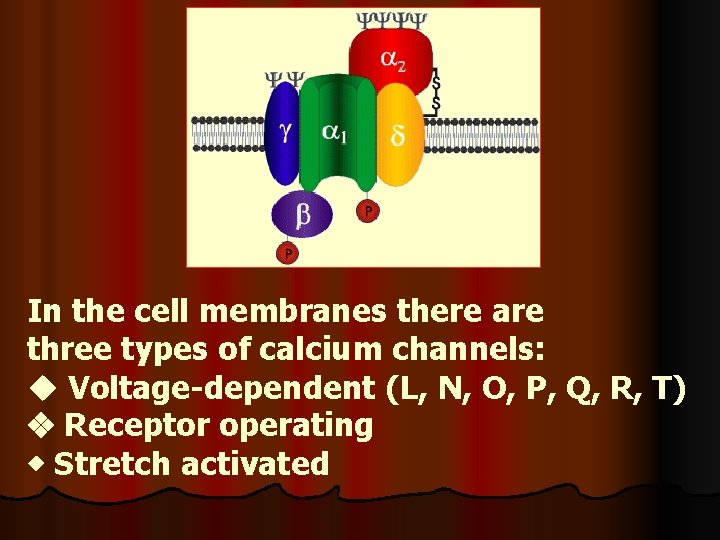
In the cell membranes there are three types of calcium channels: u Voltage-dependent (L, N, O, P, Q, R, T) Receptor operating Stretch activated
CCBs bind to L-type calcium channels located on the vascular smooth muscle, cardiac myocytes, and cardiac nodal tissue (sinoatrial and atrioventricular nodes). These channels are responsible for regulating the influx of calcium into muscle cells, which in turn stimulates smooth muscle contraction and cardiac myocyte contraction. In cardiac nodal tissue, L-type calcium channels play an important role in pacemaker currents and inphase 0 of the action potentials.
Therefore, by blocking calcium entry into the cell, CCBs cause vascular smooth muscle relaxation (vasodilation), - decreased myocardial force generation (negative inotropy), - decreased heart rate (negative chronotropy), - decreased conduction velocity within the heart (negative dromotropy), particularly at the atrioventricular node.
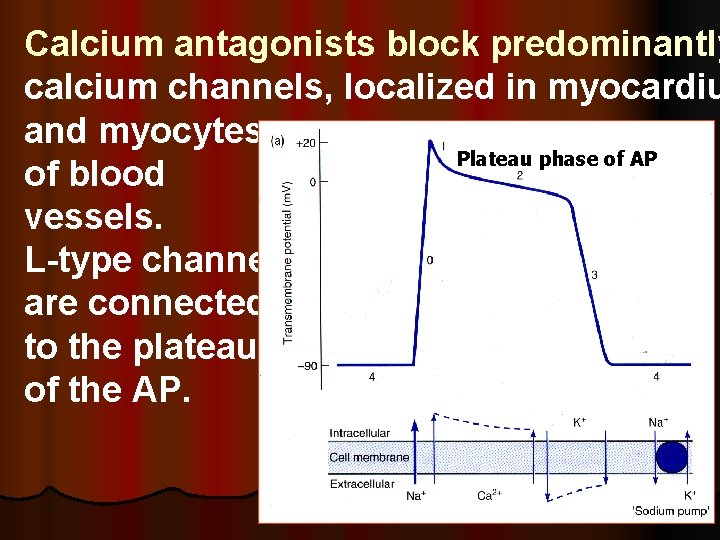
Calcium antagonists block predominantly calcium channels, localized in myocardiu and myocytes Plateau phase of AP of blood vessels. L-type channels are connected to the plateau of the AP.
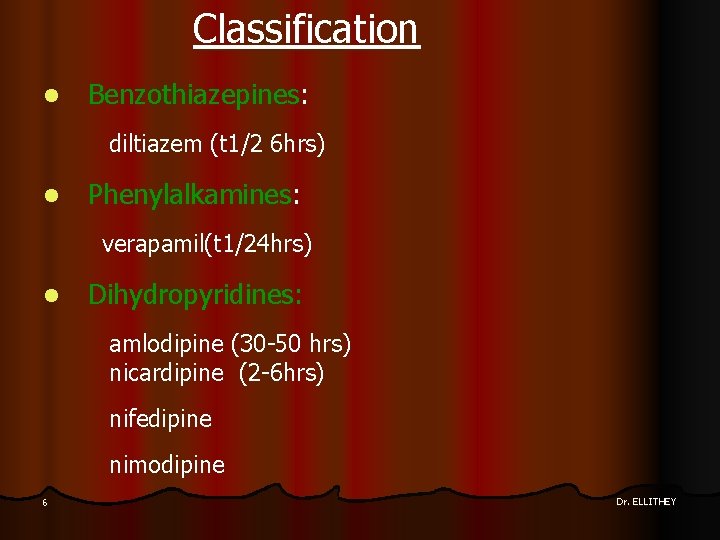
Classification l Benzothiazepines: diltiazem (t 1/2 6 hrs) l Phenylalkamines: verapamil(t 1/24 hrs) l Dihydropyridines: amlodipine (30 -50 hrs) nicardipine (2 -6 hrs) nifedipine nimodipine 6 Dr. ELLITHEY

Calcium Channel Blockers l Verapamil Very ( Cardioselective) l Nifedipine - HTN Nice (vascular sm muscle selective) l Diltiazem - arrythmias Drugs (intermediate selectivity)
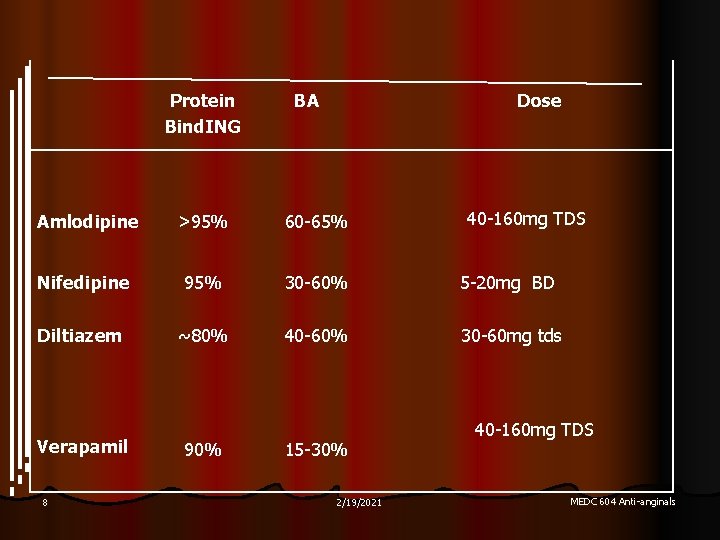
Protein Bind. ING Amlodipine >95% Nifedipine 95% Diltiazem ~80% Verapamil 8 90% BA Dose 40 -160 mg TDS 60 -65% 30 -60% 5 -20 mg BD 40 -60% 30 -60 mg tds 15 -30% 2/19/2021 40 -160 mg TDS MEDC 604 Anti-anginals
Verapamil is relatively selective for the myocardium, and is less effective as a systemic vasodilator drug. This drug has a very important role in treating angina (by reducing myocardial oxygen demand reversing coronary vasospasm) and arrhythmias. Diltiazem is intermediate between verapamil and dihydropyridines in its selectivity for vascular calcium channels. By having both cardiac depressant and vasodilator actions, diltiazem is able to reduce arterial pressure without producing the same degree of reflex cardiac stimulation caused by dihydropyridines
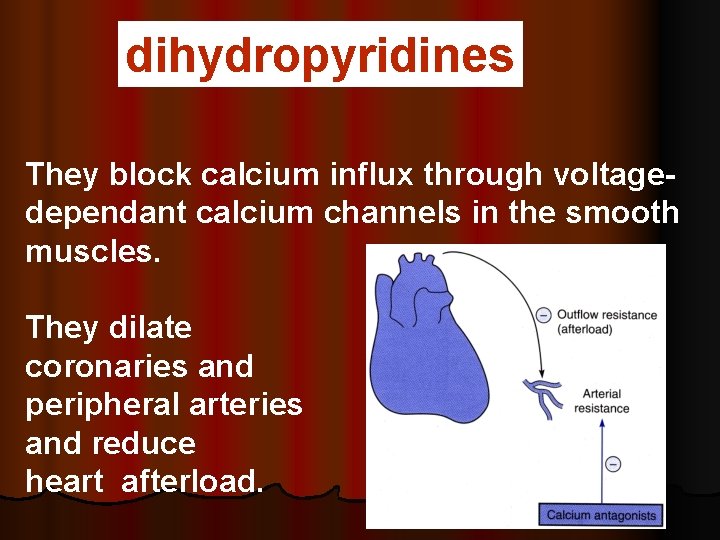
dihydropyridines They block calcium influx through voltagedependant calcium channels in the smooth muscles. They dilate coronaries and peripheral arteries and reduce heart afterload.
Dihydropyridines reduce coronary and peripheral vascular resistance, decrease blood pressure and myocardial oxygen consumption. But they don’t have negative inotropic, chrono-tropic and dromotropic effect in comparison to verapamil and diltiazem, which increase baroreflex sensibility.

Uses
Hypertension By causing vascular smooth muscle relaxation, CCBs decrease systemic vascular resistance, which lowers arterial blood pressure. These drugs primarily affect arterial resistance vessels, with only minimal effects on venous capacitance vessels.
Angina The anti-anginal effects of CCBs are derived from their vasodilator and cardiodepressant actions. Systemic vasodilation reduces arterial pressure, which reduces ventricular afterload , thereby decreasing oxygen demand. The more cardioselective CCBs (verapamil and diltiazem) decrease heart rate and contractility, which leads to a reduction in myocardial oxygen demand. CCBs can also dilate coronary arteries and prevent or reverse coronary vasospasm (as occurs in Printzmetal's variant angina), thereby increasing oxygen supply to the myocardium.
dihydropyridines They are not, however, generally used to treat angina because their powerful systemic vasodilator and pressure lowering effects can lead to reflex cardiac stimulation (tachycardia and increased inotropy), which can dramatically increase myocardial oxygen demand.
Arrhythmias The antiarrhythmic properties (Class IV antiarrhythmics) of CCBs are related to their ability to decrease the firing rate of pacemaker sites within the heart, but more importantly are related to their ability to decrease conduction velocity and prolong repolarization, especially at the atrioventricular node. This latter action at the atrioventricular node helps to block reentrymechanisms, which can cause supraventricular tachycardia.
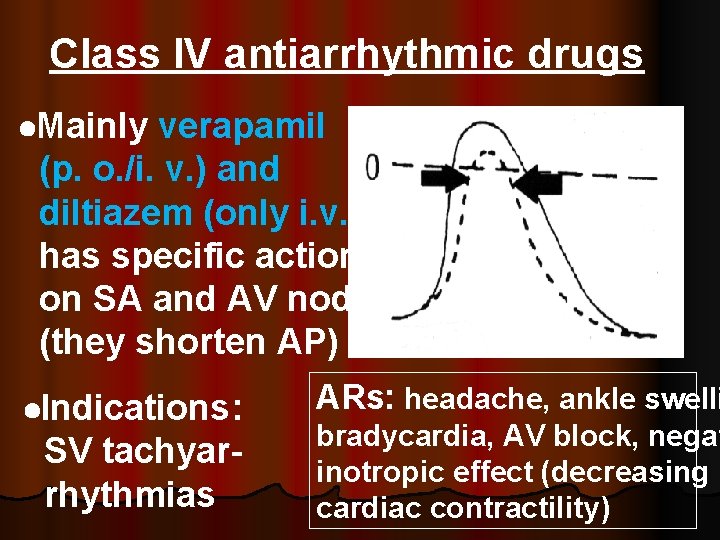
Class IV antiarrhythmic drugs Mainly verapamil (p. o. /i. v. ) and diltiazem (only i. v. ) has specific action on SA and AV node (they shorten AP) Indications: SV tachyarrhythmias ARs: headache, ankle swelli bradycardia, AV block, negat inotropic effect (decreasing cardiac contractility)
Main indications Arterial hypertension a) Dihydropyridines b) Verapamil SR and Diltiazem SR Coronary heart disease a) Dihydropyridines b) Verapamil SR and Diltiazem SR Ischemic cerebral stroke Cinnarizine, Flunarizine, Nimodipine SV tachyarrhythmias: Verapamil, Diltiazem Migraine (in remission periods) Flunarizine, Verapamil Beta-blockers + dihydropyridines: YES (OK) Beta-blockers + Verapamil or Diltiazem = NO
. C/I The cardiac selective, non-dihydropyridine CCBs can cause excessive bradycardia, impaired electrical conduction (e. g. , atrioventricular nodal block), and depressed contractility. Therefore, patients having preexistent bradycardia, conduction defects, or heart failure caused by systolic dysfunction should not be given CCBs, they should not be administered to patients being treated with a beta-blocker because beta-blockers also depress cardiac electrical and mechanical activity and therefore the addition of a CCB augments the effects of beta-blockade
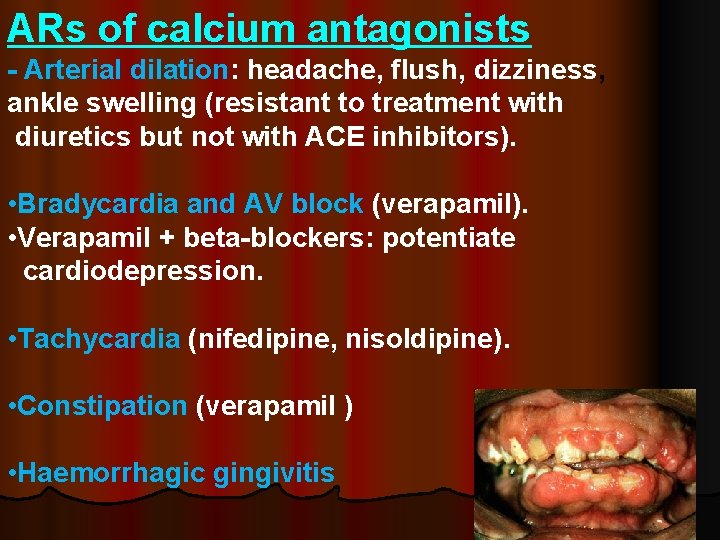
ARs of calcium antagonists - Arterial dilation: headache, flush, dizziness, ankle swelling (resistant to treatment with diuretics but not with ACE inhibitors). • Bradycardia and AV block (verapamil). • Verapamil + beta-blockers: potentiate cardiodepression. • Tachycardia (nifedipine, nisoldipine). • Constipation (verapamil ) • Haemorrhagic gingivitis

Thank you
- Slides: 21