
Calc AB Vocabulary Tips Tricks Horizontal Asymptotes Example
Calc AB Vocabulary Tips & Tricks
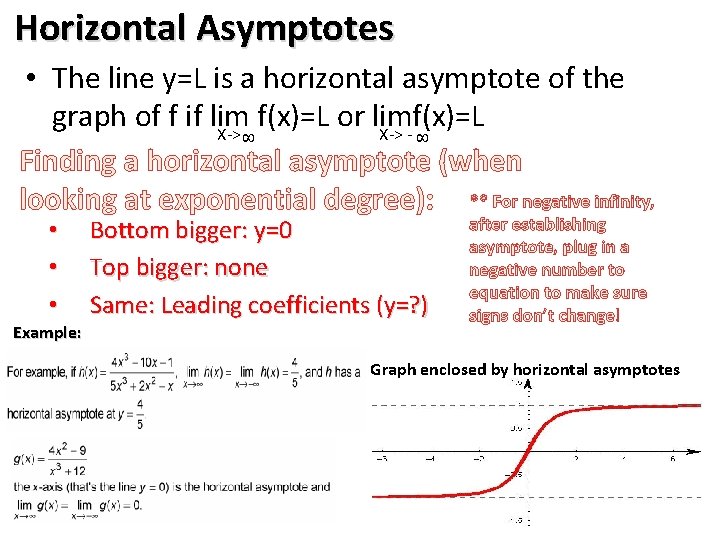
Horizontal Asymptotes • • • Example: 8 8 • The line y=L is a horizontal asymptote of the graph of f if lim f(x)=L or limf(x)=L X-> Finding a horizontal asymptote (when looking at exponential degree): ** For negative infinity, Bottom bigger: y=0 Top bigger: none Same: Leading coefficients (y=? ) after establishing asymptote, plug in a negative number to equation to make sure signs don’t change! Graph enclosed by horizontal asymptotes
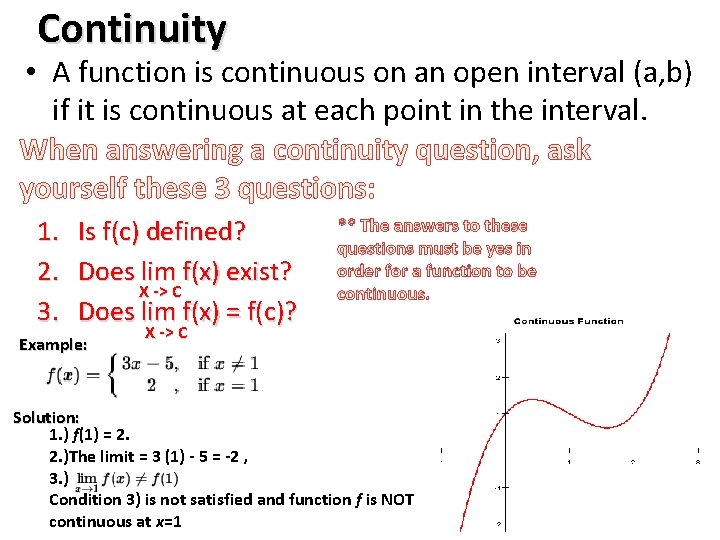
Continuity • A function is continuous on an open interval (a, b) if it is continuous at each point in the interval. When answering a continuity question, ask yourself these 3 questions: 1. 2. 3. Is f(c) defined? Does lim f(x) exist? X -> C Does lim f(x) = f(c)? Example: ** The answers to these questions must be yes in order for a function to be continuous. X -> C Solution: 1. ) f(1) = 2. 2. )The limit = 3 (1) - 5 = -2 , 3. ) Condition 3) is not satisfied and function f is NOT continuous at x=1
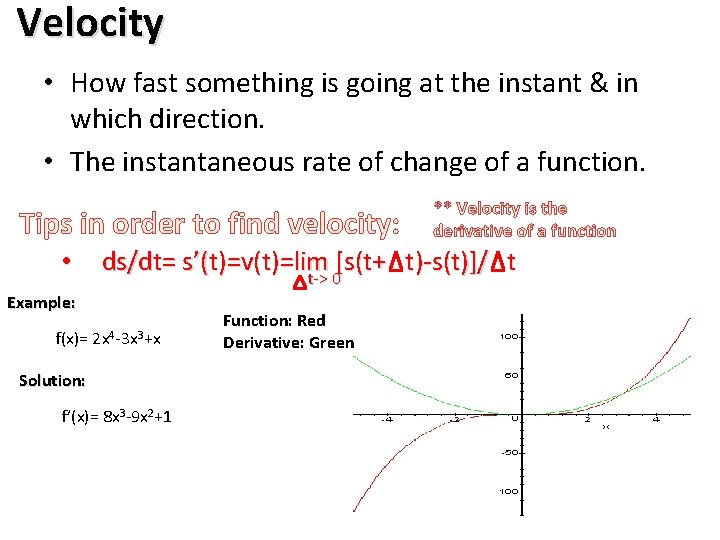
Velocity • How fast something is going at the instant & in which direction. • The instantaneous rate of change of a function. Tips in order to find velocity: • ** Velocity is the derivative of a function ds/dt= s’(t)=v(t)=lim [s(t+ t)-s(t)]/ t t-> 0 Example: f(x)= 2 x 4 -3 x 3+x Solution: f’(x)= 8 x 3 -9 x 2+1 t-> 0 Function: Red Derivative: Green

Acceleration • Instantaneous rate of change of velocity. • How quickly a body speeds up or slows down. • How fast velocity is changing with respect to time. ** Acceleration is the derivative of a Tips to help find acceleration: second function • • Example: s’’(t)= d 2(s)/dt 2 v’(t)= d(v)/d(t)=a(t) Function: Teal Velocity: Red Acceleration: Blue

Speed • How fast an object is going no matter which direction. • Measures the rate at which the position changes Example: Speed= |velocity| 1. Speed is increasing when the signs of the acceleration and velocity are either both positive or both negative. 2. Speed is decreasing if acceleration and velocity have opposite signs.

Differentiation • The process of taking the derivative of a function. Differentiability implies continuity: • If f is differentiable at x=c then f is continuous at f=c. Basic differentiation rules & techniques: • • d/d(x)[c]=0 Power rule: • d/d(x)[xn]=nx(n-1) Constant multiple rule: • d/d(x)[cf(x)]=cf’(x) Sum & Difference rule: • d/d(x)(u +/- v)= du/dx +/- dv/dx Example: f(x)=x 4 f’(x)= 4 x 3 f(x)=5 x 6 f’(x)= 30 x 5
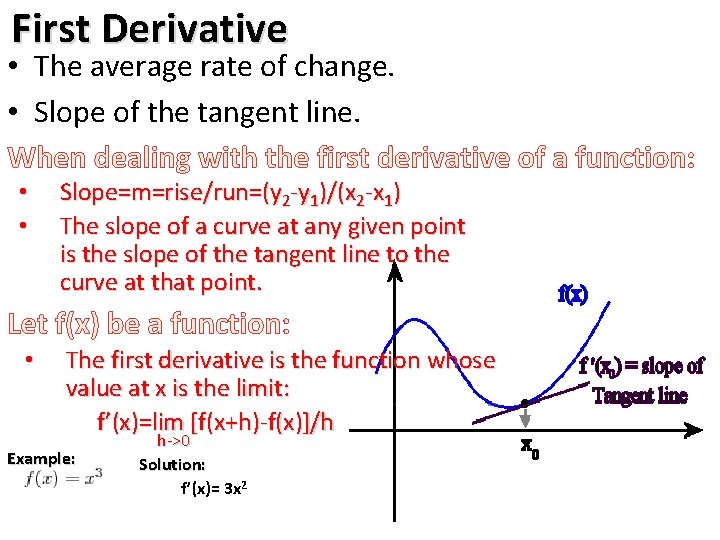
First Derivative • The average rate of change. • Slope of the tangent line. When dealing with the first derivative of a function: • • Slope=m=rise/run=(y 2 -y 1)/(x 2 -x 1) The slope of a curve at any given point is the slope of the tangent line to the curve at that point. Let f(x) be a function: • The first derivative is the function whose value at x is the limit: f’(x)=lim [f(x+h)-f(x)]/h Example: h->0 Solution: f’(x)= 3 x 2
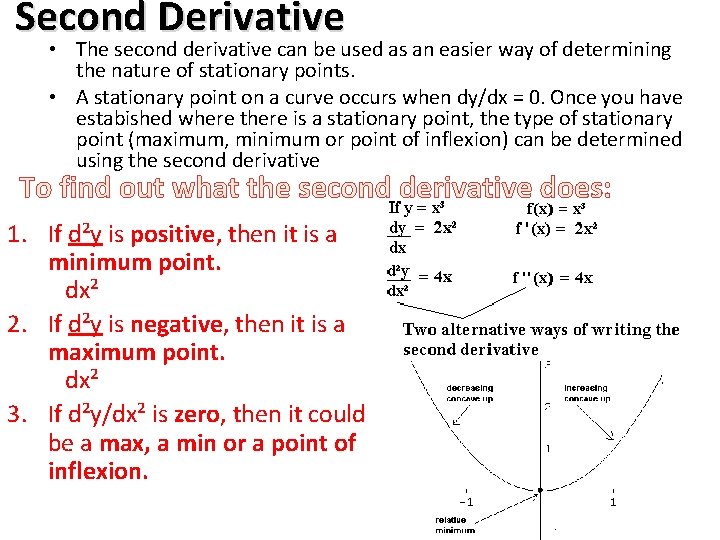
Second Derivative • The second derivative can be used as an easier way of determining the nature of stationary points. • A stationary point on a curve occurs when dy/dx = 0. Once you have estabished where there is a stationary point, the type of stationary point (maximum, minimum or point of inflexion) can be determined using the second derivative To find out what the second derivative does: 1. If d²y is positive, then it is a minimum point. dx² 2. If d²y is negative, then it is a maximum point. dx² 3. If d²y/dx² is zero, then it could be a max, a min or a point of inflexion.
![Product Rule • dy/dx[f(x)g(x)]=f(x)g’(x)+g(x)f’(x) • dy/dx[uv]=uv’+vu’ ** Product rule is always Tricks to remember:](http://slidetodoc.com/presentation_image/0082c385767d49952d7c570c4447734e/image-10.jpg "Product Rule • dy/dx[f(x)g(x)]=f(x)g’(x)+g(x)f’(x) • dy/dx[uv]=uv’+vu’ ** Product rule is always Tricks to remember:")
Product Rule • dy/dx[f(x)g(x)]=f(x)g’(x)+g(x)f’(x) • dy/dx[uv]=uv’+vu’ ** Product rule is always Tricks to remember: • plus! First x derivative of second + second x derivative of first Example: f(x)=(x 2 -2 x+1)(x 3 -1) f’(x)= (2 x-2)(x 3 -1) + (3 x 2)(x 2 -2 x+1) =5 x 4 -8 x 3+3 x 2+2
![Quotient Rule • dy/dx[u/v]=(vu’-uv’)/v 2 Tricks to remember: • • ** Don’t forget to](http://slidetodoc.com/presentation_image/0082c385767d49952d7c570c4447734e/image-11.jpg "Quotient Rule • dy/dx[u/v]=(vu’-uv’)/v 2 Tricks to remember: • • ** Don’t forget to")
Quotient Rule • dy/dx[u/v]=(vu’-uv’)/v 2 Tricks to remember: • • ** Don’t forget to distribute the negative! [(bottom x derivative of the top) – (top x derivative of bottom)]/bottom squared Lo di hi minus hi di lo over lo lo! Example:
![Chain Rule • d/d(x)[f(g(x))]=f’[g(x)]g’(x) Tricks to remember: 1. 2. 3. ** Don’t forget derivative](http://slidetodoc.com/presentation_image/0082c385767d49952d7c570c4447734e/image-12.jpg "Chain Rule • d/d(x)[f(g(x))]=f’[g(x)]g’(x) Tricks to remember: 1. 2. 3. ** Don’t forget derivative")
Chain Rule • d/d(x)[f(g(x))]=f’[g(x)]g’(x) Tricks to remember: 1. 2. 3. ** Don’t forget derivative of the inside!! Bring exponent down to the front. Subtract one from the exponent. Multiply by the derivative of the inside equation. Example:
![Mean Value Theorem • If f is continuous on the closed interval [a, b]](http://slidetodoc.com/presentation_image/0082c385767d49952d7c570c4447734e/image-13.jpg "Mean Value Theorem • If f is continuous on the closed interval [a, b]")
Mean Value Theorem • If f is continuous on the closed interval [a, b] & differentiable on the open interval (a, b) then there exists a number c in (a, b) such ** MVT in short: The that: f’(c)=[f(b)-f(a)]/[b-a] average rate of change To determine if the MVT applies: over the entire interval is 1. Do derivative of the equation. 2. Plug in interval points on right side of equation. 3. Solve for x (factor, quadratic, etc. ) Example: equal to the instantaneous rate of change at some point on the interval (a, b).
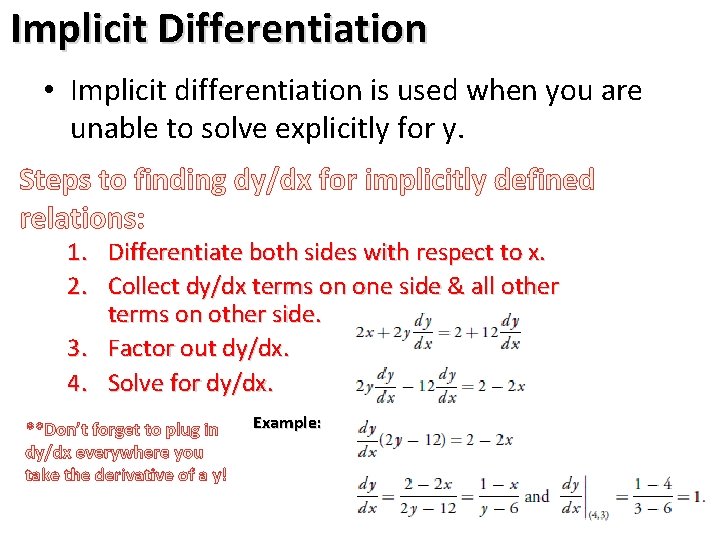
Implicit Differentiation • Implicit differentiation is used when you are unable to solve explicitly for y. Steps to finding dy/dx for implicitly defined relations: 1. Differentiate both sides with respect to x. 2. Collect dy/dx terms on one side & all other terms on other side. 3. Factor out dy/dx. 4. Solve for dy/dx. **Don’t forget to plug in dy/dx everywhere you take the derivative of a y! Example:
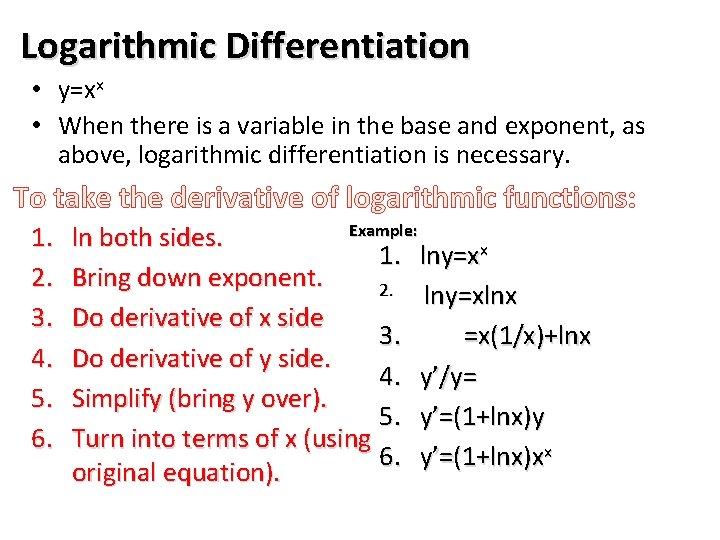
Logarithmic Differentiation • y=xx • When there is a variable in the base and exponent, as above, logarithmic differentiation is necessary. To take the derivative of logarithmic functions: 1. 2. 3. 4. 5. 6. Example: ln both sides. 1. lny=xx Bring down exponent. 2. lny=xlnx Do derivative of x side 3. =x(1/x)+lnx Do derivative of y side. 4. y’/y= Simplify (bring y over). 5. y’=(1+lnx)y Turn into terms of x (using 6. y’=(1+lnx)xx original equation).
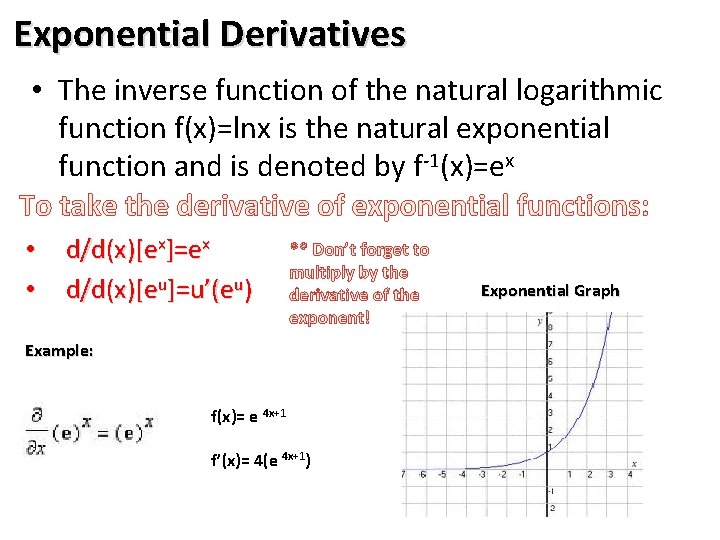
Exponential Derivatives • The inverse function of the natural logarithmic function f(x)=lnx is the natural exponential function and is denoted by f-1(x)=ex To take the derivative of exponential functions: • • d/d(x)[ex]=ex d/d(x)[eu]=u’(eu) ** Don’t forget to multiply by the derivative of the exponent! Example: f(x)= e 4 x+1 f’(x)= 4(e 4 x+1) Exponential Graph
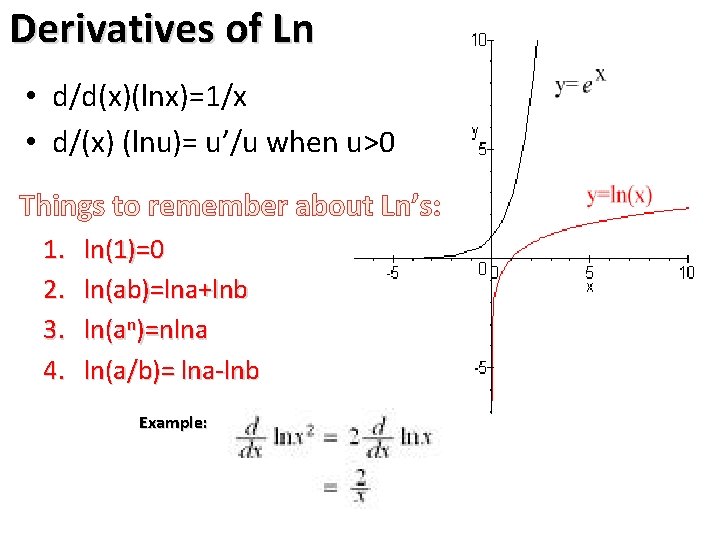
Derivatives of Ln • d/d(x)(lnx)=1/x • d/(x) (lnu)= u’/u when u>0 Things to remember about Ln’s: 1. 2. 3. 4. ln(1)=0 ln(ab)=lna+lnb ln(an)=nlna ln(a/b)= lna-lnb Example:
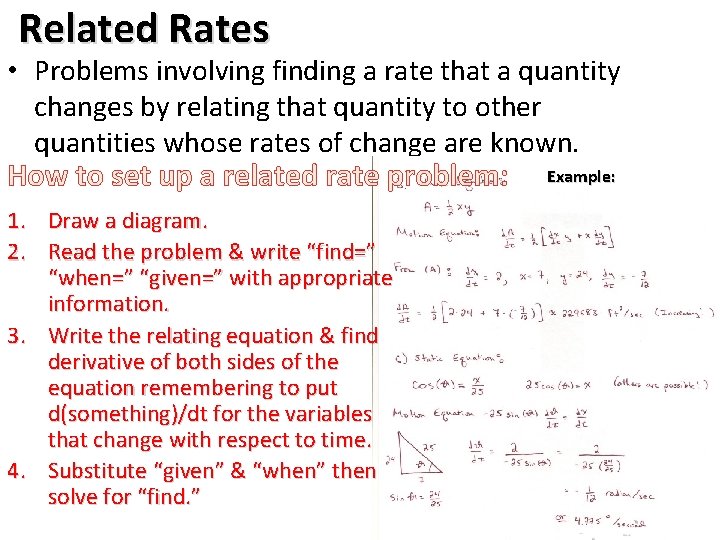
Related Rates • Problems involving finding a rate that a quantity changes by relating that quantity to other quantities whose rates of change are known. How to set up a related rate problem: Example: 1. 2. Draw a diagram. Read the problem & write “find=” “when=” “given=” with appropriate information. 3. Write the relating equation & find derivative of both sides of the equation remembering to put d(something)/dt for the variables that change with respect to time. 4. Substitute “given” & “when” then solve for “find. ”
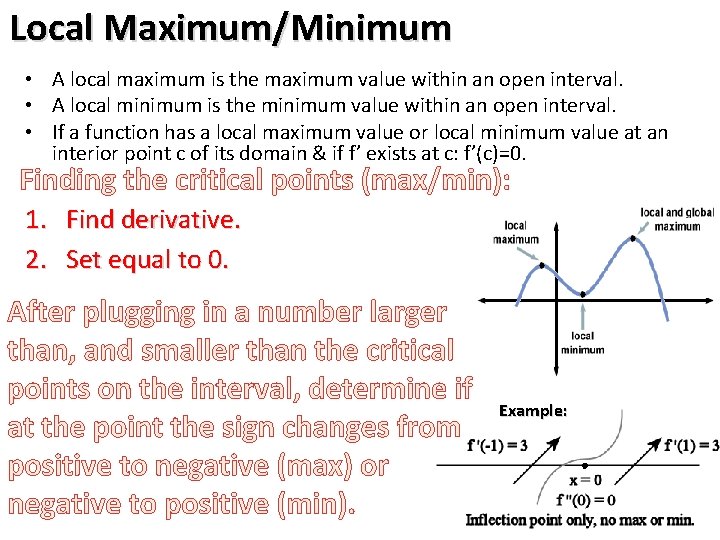
Local Maximum/Minimum • A local maximum is the maximum value within an open interval. • A local minimum is the minimum value within an open interval. • If a function has a local maximum value or local minimum value at an interior point c of its domain & if f’ exists at c: f’(c)=0. Finding the critical points (max/min): 1. Find derivative. 2. Set equal to 0. After plugging in a number larger than, and smaller than the critical points on the interval, determine if at the point the sign changes from positive to negative (max) or negative to positive (min). Example:
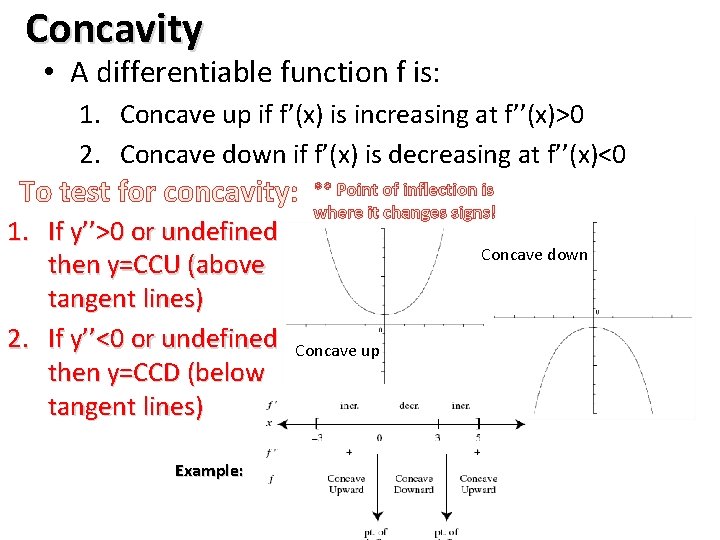
Concavity • A differentiable function f is: 1. Concave up if f’(x) is increasing at f’’(x)>0 2. Concave down if f’(x) is decreasing at f’’(x)<0 To test for concavity: 1. If y’’>0 or undefined then y=CCU (above tangent lines) 2. If y’’<0 or undefined then y=CCD (below tangent lines) Example: ** Point of inflection is where it changes signs! Concave down Concave up
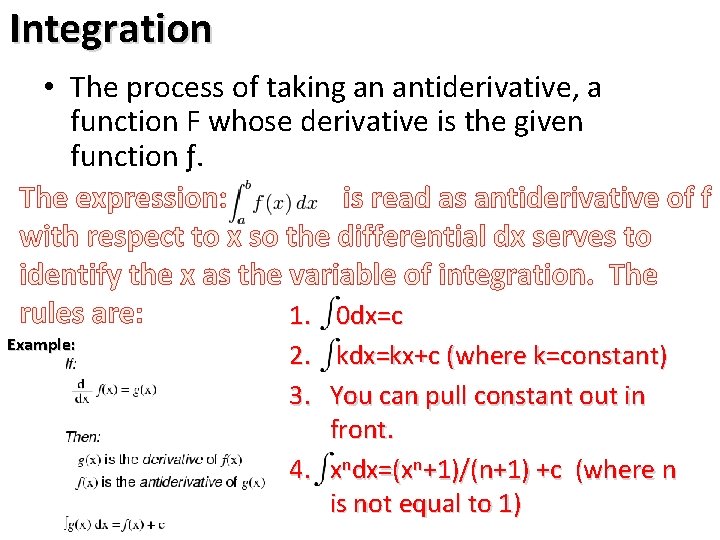
Integration • The process of taking an antiderivative, a function F whose derivative is the given function ƒ. The expression: is read as antiderivative of f with respect to x so the differential dx serves to identify the x as the variable of integration. The rules are: 1. 0 dx=c Example: 2. kdx=kx+c (where k=constant) 3. You can pull constant out in front. 4. xndx=(xn+1)/(n+1) +c (where n is not equal to 1)
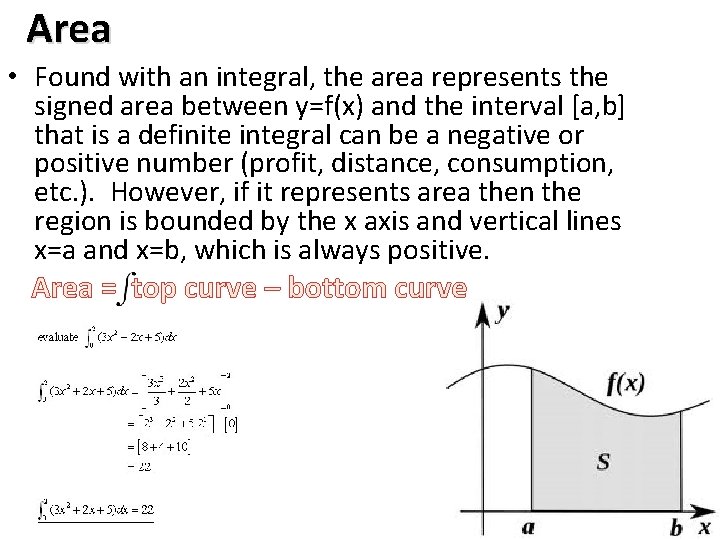
Area • Found with an integral, the area represents the signed area between y=f(x) and the interval [a, b] that is a definite integral can be a negative or positive number (profit, distance, consumption, etc. ). However, if it represents area then the region is bounded by the x axis and vertical lines x=a and x=b, which is always positive. Area = top curve – bottom curve
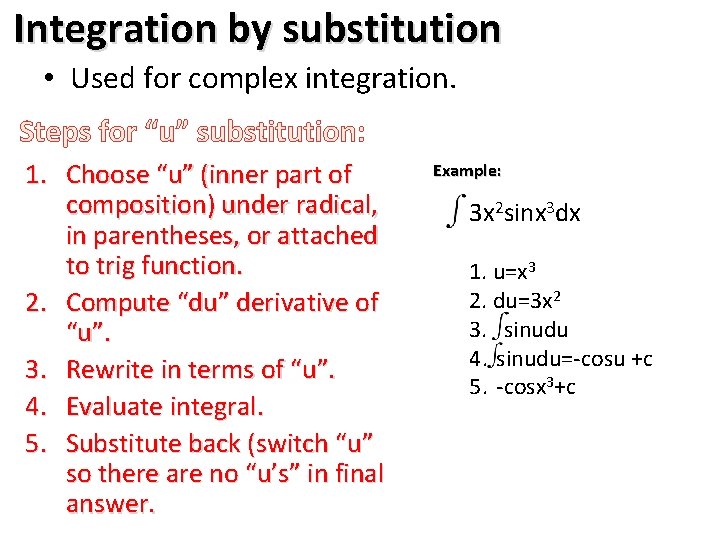
Integration by substitution • Used for complex integration. Steps for “u” substitution: 1. Choose “u” (inner part of composition) under radical, in parentheses, or attached to trig function. 2. Compute “du” derivative of “u”. 3. Rewrite in terms of “u”. 4. Evaluate integral. 5. Substitute back (switch “u” so there are no “u’s” in final answer. Example: 3 x 2 sinx 3 dx 1. u=x 3 2. du=3 x 2 3. sinudu 4. sinudu=-cosu +c 5. -cosx 3+c
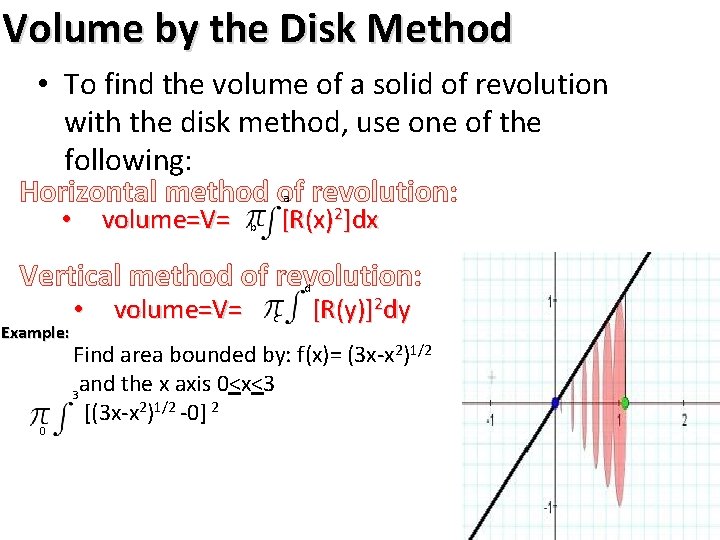
Volume by the Disk Method • To find the volume of a solid of revolution with the disk method, use one of the following: Horizontal method of revolution: a 2]dx volume=V= [R(x) b • Vertical method of revolution: Example: 0 • d 2 dy volume=V= [R(y)] c Find area bounded by: f(x)= (3 x-x 2)1/2 and the x axis 0<x<3 3 [(3 x-x 2)1/2 -0] 2
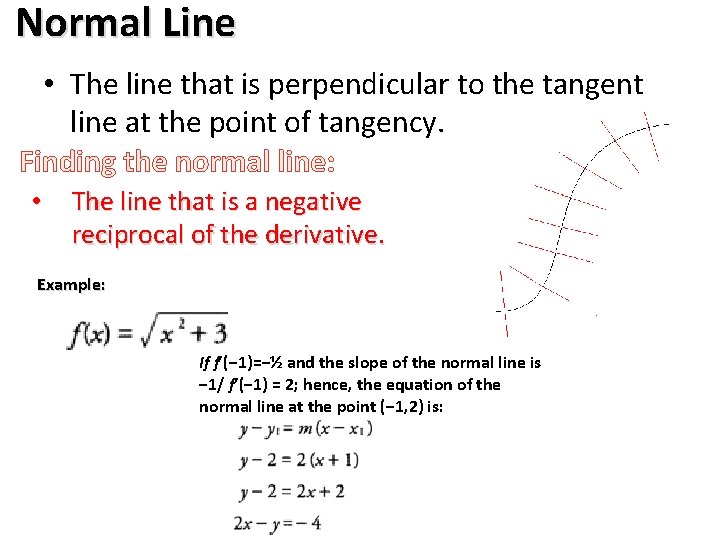
Normal Line • The line that is perpendicular to the tangent line at the point of tangency. Finding the normal line: • The line that is a negative reciprocal of the derivative. Example: If f′(− 1)=−½ and the slope of the normal line is − 1/ f′(− 1) = 2; hence, the equation of the normal line at the point (− 1, 2) is:
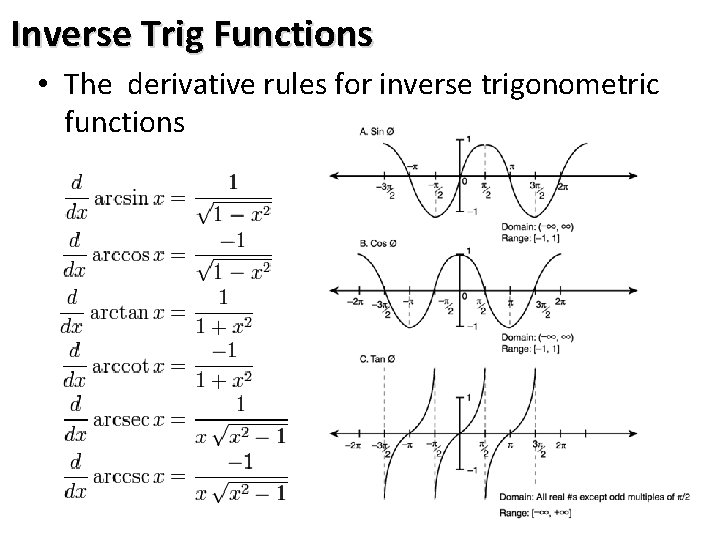
Inverse Trig Functions • The derivative rules for inverse trigonometric functions
- Slides: 26