
CAISO Public Key Infrastructure Supporting Secure ICCP Leslie
CAISO Public Key Infrastructure: Supporting Secure ICCP Leslie De. Anda Senior Information Security Analyst, Information Security, CAISO EMS Users Group Conference Austin, Texas September 24 th, 2007
Secure ICCP Data sharing between systems is necessary ICCP’s inherent lack of security Regulations require security controls be implemented 2
Basic Trust Model When two parties engage in a transaction they must: 1. Mutually trust each other's identity 2. Trust that both parties are allowed to engage in the transaction 3. Trust that no third party can know the details of the transaction 4. Trust that no third party can change any part of the transaction 5. Trust that neither party can deny having engaged in the transaction 6. Trust that a record of the transaction is kept for future reference 3
Public Key Infrastructure Overview Infrastructure which enables secure communication over unsecured networks, utilizing public and private key pairs obtained through a trusted authority. Public and private keys are created simultaneously, and have a direct correlation Private key must never be divulged. . . If so, the certificate must be revoked and reissued Can be used in a variety of ways to support security requirements 4
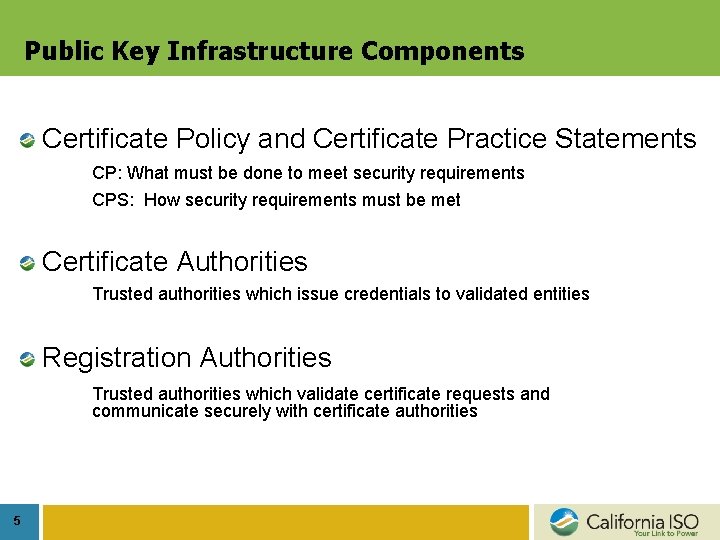
Public Key Infrastructure Components Certificate Policy and Certificate Practice Statements CP: What must be done to meet security requirements CPS: How security requirements must be met Certificate Authorities Trusted authorities which issue credentials to validated entities Registration Authorities Trusted authorities which validate certificate requests and communicate securely with certificate authorities 5
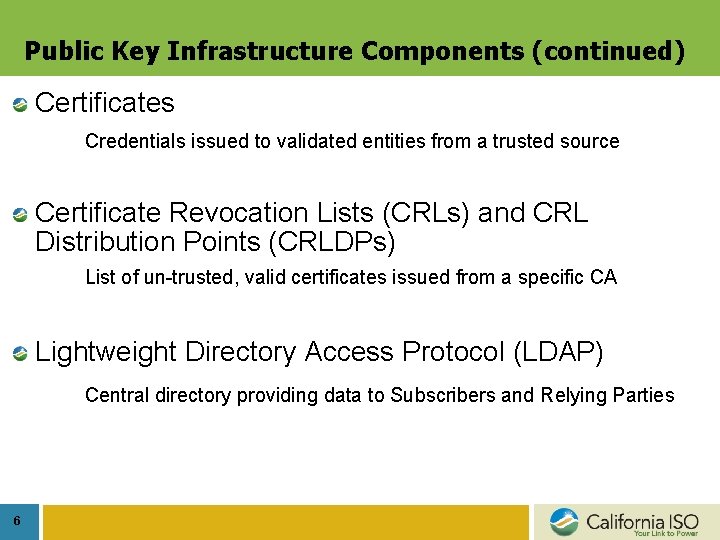
Public Key Infrastructure Components (continued) Certificates Credentials issued to validated entities from a trusted source Certificate Revocation Lists (CRLs) and CRL Distribution Points (CRLDPs) List of un-trusted, valid certificates issued from a specific CA Lightweight Directory Access Protocol (LDAP) Central directory providing data to Subscribers and Relying Parties 6
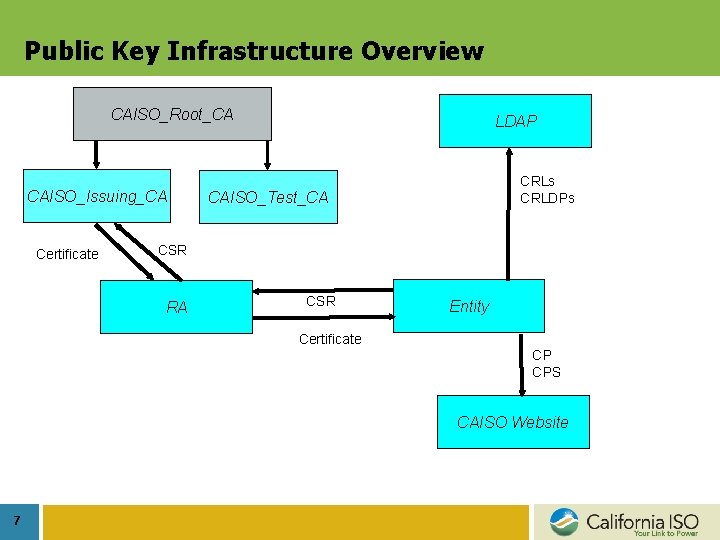
Public Key Infrastructure Overview CAISO_Root_CA CAISO_Issuing_CA Certificate LDAP CRLs CRLDPs CAISO_Test_CA CSR RA CSR Entity Certificate CP CPS CAISO Website 7
Certificate and Key Lifecycle 8
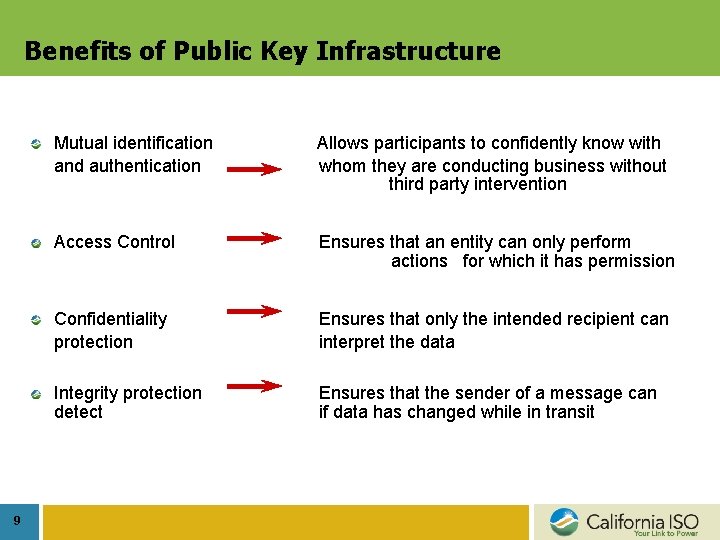
Benefits of Public Key Infrastructure 9 Mutual identification and authentication Allows participants to confidently know with whom they are conducting business without third party intervention Access Control Ensures that an entity can only perform actions for which it has permission Confidentiality protection Ensures that only the intended recipient can interpret the data Integrity protection detect Ensures that the sender of a message can if data has changed while in transit
Questions ? ? Contact Information: Leslie De. Anda, Sr. Information Security Analyst, CAISO ldeanda@caiso. com or (916) 351 -2211 10
- Slides: 10