
CAI Masterclass Sustainable Development and Programme Design sharing
CAI Masterclass Sustainable Development and Programme Design sharing innovative DMU practices Wednesday 8 th July 2020

Session Aims • Share principles and examples of embedding sustainable development in taught courses • Provide opportunities for group discussion and questions Format: Short presentations and Q&A Recorded for future reference (DMU use only) 2
1: Why? • [Use chat window to note what made you want to come along] 3
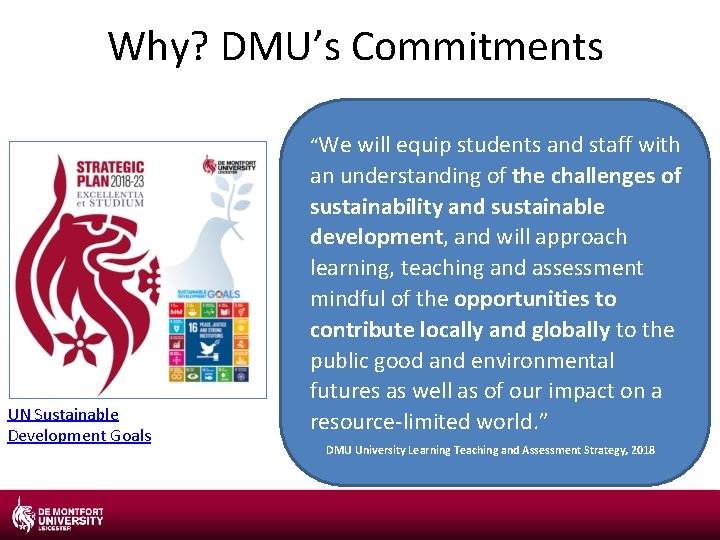
Why? DMU’s Commitments “We will equip students and staff with UN Sustainable Development Goals an understanding of the challenges of sustainability and sustainable development, and will approach learning, teaching and assessment mindful of the opportunities to contribute locally and globally to the public good and environmental futures as well as of our impact on a resource-limited world. ” DMU University Learning Teaching and Assessment Strategy, 2018
Why? Students, Society and Community all Benefit c. 90% of UK university students want universities to actively incorporate sustainability in programmes (NUS) 75% of 900 global businesses believe that a broad based sustainability skills gap exists (IEMA) “Service Learning”: integrating community service with the student experience so that each strengthens each other. ” 5
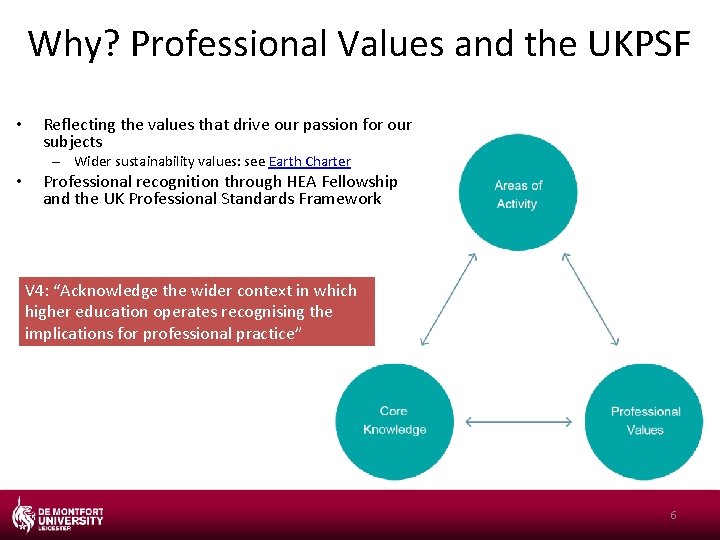
Why? Professional Values and the UKPSF • Reflecting the values that drive our passion for our subjects – Wider sustainability values: see Earth Charter • Professional recognition through HEA Fellowship and the UK Professional Standards Framework V 4: “Acknowledge the wider context in which higher education operates recognising the implications for professional practice” 6
![2: How? • [Use chat window to note specific questions you have] 7](http://slidetodoc.com/presentation_image/5cb63773c152c4e43a3458f83bde7f1c/image-7.jpg "2: How? • [Use chat window to note specific questions you have] 7")
2: How? • [Use chat window to note specific questions you have] 7
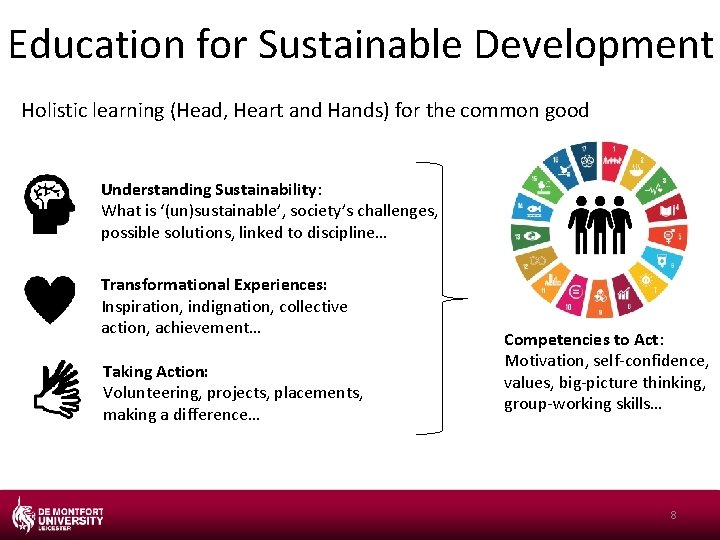
Education for Sustainable Development Holistic learning (Head, Heart and Hands) for the common good Understanding Sustainability: What is ‘(un)sustainable’, society’s challenges, possible solutions, linked to discipline… Transformational Experiences: Inspiration, indignation, collective action, achievement… Taking Action: Volunteering, projects, placements, making a difference… Competencies to Act: Motivation, self-confidence, values, big-picture thinking, group-working skills… 8
At Programme Level Key issues to consider: 1. 2. 3. Learning Outcomes: Engagement with sustainability or the SDGs reflected in one or more assessments in core modules Pedagogy: Experiential learning activities addressing real-world problems on campus or in wider community Co-curricular links: Linkages to community events, trips, volunteering, student societies (e. g. ‘Enactus’, ‘Map the System’) Support available on https: //esdg. our. dmu. ac. uk – case studies, introduction to ESD guidance (e. g. QAA/HEA) and one-page planning toolkits (e. g. “Ten Ingredients”) 9
DMU Examples • School of Fashion and Textiles (Carolyn Hardaker) • Engineering Programmes (John Gow) • Leicester Castle Business School (Steven Baguley) 10
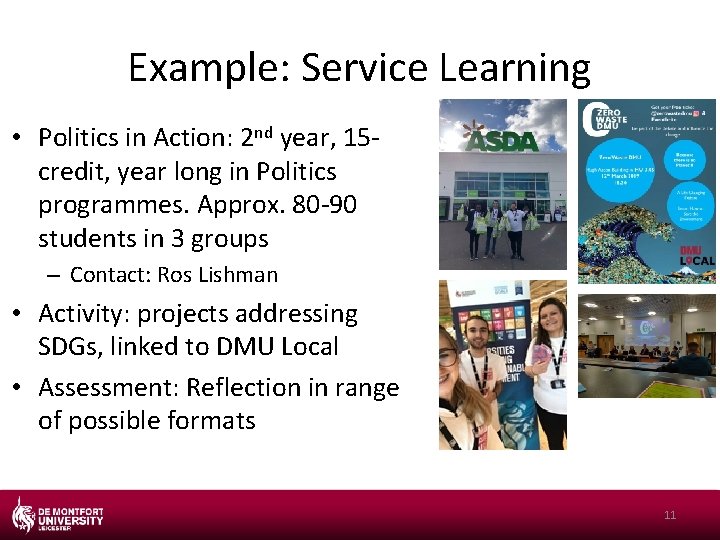
Example: Service Learning • Politics in Action: 2 nd year, 15 credit, year long in Politics programmes. Approx. 80 -90 students in 3 groups – Contact: Ros Lishman • Activity: projects addressing SDGs, linked to DMU Local • Assessment: Reflection in range of possible formats 11
Example: Service Learning Politics in Action ESD Outcomes: • Knowledge: many students had little/no awareness and understanding before module; developed critical engagement and reflection; feeds into other modules and engagement activities; 100% (n=40) of students in wk 21 (2018/19) confirmed module had contributed to their understanding and knowledge of UN SDGs • Competencies: organisation of the module enables students to develop collaborative thinking and working – linked to employability/graduate skills (QAA Politics & IR Subject Benchmark); gained volunteering hours • Transformative learning: many examples where involvement in module and projects has changed behaviour and commitment to sustainability • Taking action: focus of the module is to raise awareness of relevance and application of UN SDGs at a local level and to facilitate local action; emphasis on practice (rather than theory – which the students appreciate); students proud of achievements 12
Example: Module Design Process • ‘Influences on Wellbeing’ – new level 4 module in School of Nursing and Midwifery (from 2022) – Contact: Penny Tremayne • Process – Half-day session with course team, CELT and ESD project, focus on learning outcomes and assessment – Follow-up meetings/email to integrate sustainability • Outcome – ‘Sustainable Integrated Care’ as core concept in module, linking sustainability competencies with subject-specific skills – Plans for specific sessions to introduce core concepts 13
Support and Resources • About Sustainability and ESD – https: //esdg. our. dmu. ac. uk/a bout/introducing-esdg/ • DMU Case Studies – https: //esdg. our. dmu. ac. uk/s taff/case-studies/ • One-page planning toolkits – https: //esdg. our. dmu. ac. uk/s taff/planning-toolkits/ 14
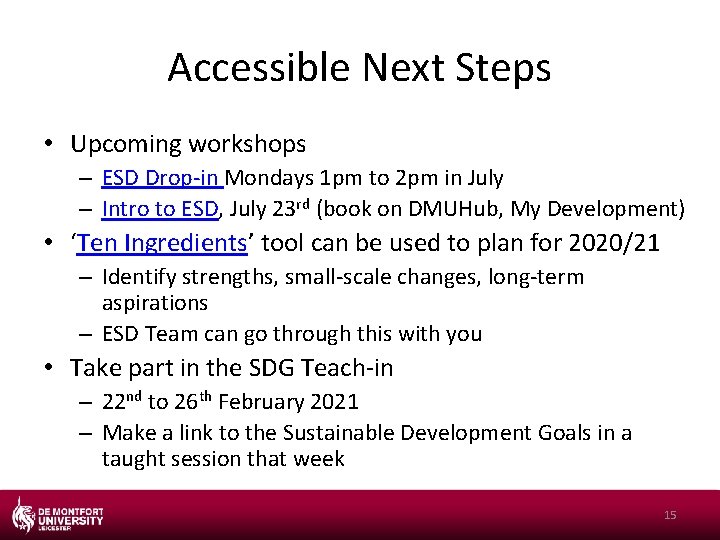
Accessible Next Steps • Upcoming workshops – ESD Drop-in Mondays 1 pm to 2 pm in July – Intro to ESD, July 23 rd (book on DMUHub, My Development) • ‘Ten Ingredients’ tool can be used to plan for 2020/21 – Identify strengths, small-scale changes, long-term aspirations – ESD Team can go through this with you • Take part in the SDG Teach-in – 22 nd to 26 th February 2021 – Make a link to the Sustainable Development Goals in a taught session that week 15
Get Actively Involved • Follow @Sustainable. DMU on social media • Join ESD Forum – Quarterly meetings and email list – Email Andrew Reeves areeves@dmu. ac. uk 16
Q&A and Discussion ESD Project Coordinator: Andrew Reeves areeves@dmu. ac. uk ESD Academic Development Lead: Ian Coleman ian. coleman@dmu. ac. uk 17
- Slides: 17