
CADENZA Training Program Background Rapidly aging population health
CADENZA Training Program
Background • Rapidly aging population: health and social care challenges • Elders have diverse and complex needs cross-cut organizational and professional boundaries requiring a coordinated inter-agency and inter-professional response
CADENZA • HKJC Charities Trust : HK$ 380 million for 5 years • A Jockey Club Initiative for Seniors - to promote innovative elderly services through inter-disciplinary co-operation - to produce a new generation of leaders in gerontology - …………. .
CADENZA Comprises 4 components: • Public education • Training for front-line care workers and professionals who work with elders • A community model to promote interdisciplinary elderly care • Evaluation
Cadenza Training Program • NSN funded with HK$ 74 million for 5 years as from 2008 • An interdisciplinary training program designed to provide general and professional education in gerontology for – General public – Informal caregivers – Professional social and health care workers
Objectives • Increase public awareness of the health and social care needs of the aging population. • Foster positive attitude towards aging. • Equip informal and family caregivers with basic knowledge & skills in aged care. • Enhance the professional expertise of social and health care workers in gerontological care.
Format • Use of major themes in gerontology to define a continuum of training over the 5 years
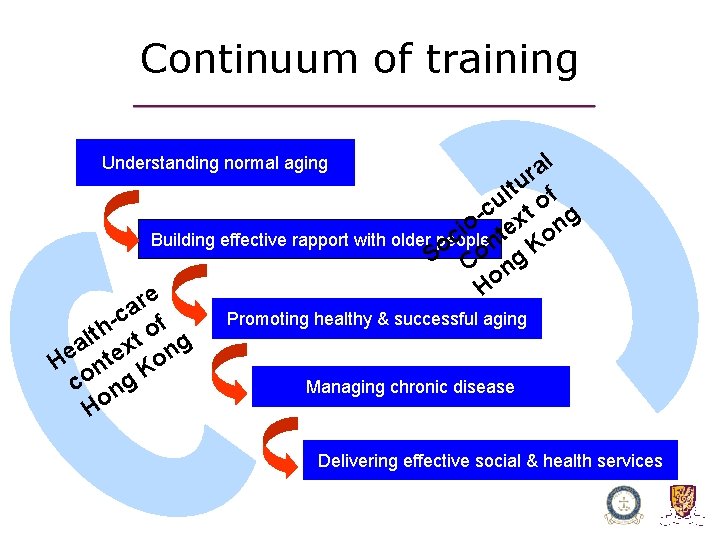
Continuum of training l a r u lt of u c xt g io te on c Building effective rapport with older people n K o o S C g n o H e r ca f Promoting healthy & successful aging h o lt xt g a n e e t H n Ko co ng Managing chronic disease o H Understanding normal aging Delivering effective social & health services
Teaching & learning modes • General public – Monthly roadshows – District-based seminars for the public – Web-site for public education – Educational leaflets and booklets – Yearly carnivals
Teaching and learning modes • Informal caregivers – District-based course & workshops. – Supplemented with written & audio-visual learning materials. – District-based self-help groups.
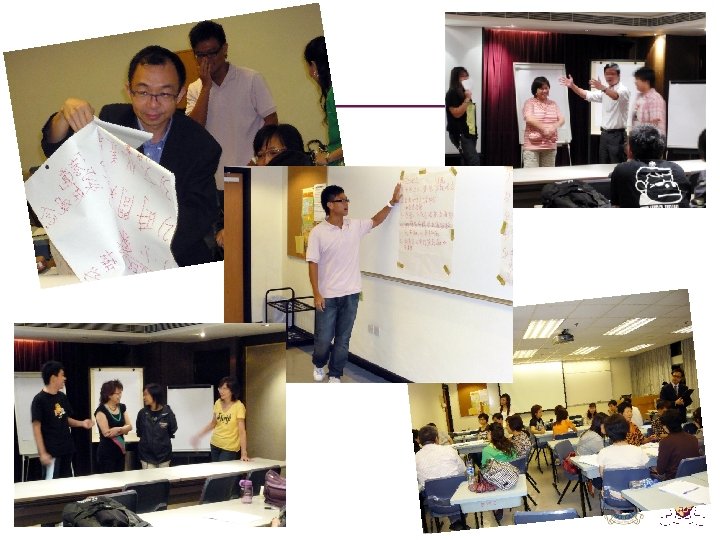
Teaching and learning modes • Professional social and health care workers – Self-directed web-based courses – Face-to-face seminars and tutorials – Clinical practicum as appropriate
Human Resources • An inter-professional Cadenza training team: - social worker - clinical psychologist - physiotherapist - occupational therapist - nurse + administrative support
Participant Profile For professional courses: • Nurses • PTs and OTs • Doctors • Social Workers • Medical technologists • Secondary school teachers • Others eg. lawyers, priests
Evaluation Plan • Accessibility of and satisfaction with the program • Public’s attitude towards ageing and older people • Attitude, knowledge and skills of professionals
Preliminary Insights re IPE Essential elements for establishing IPE programs: • Shared interest/ commitment: IPE is the norm rather than the exception • Building horizontal bridges: formal and informal structures and opportunities for sharing • Administrative support and resources
Preliminary Insights re IPE Essential elements for establishing IPE programs: • Training in collaborative skills • Teachers qualified to teach IPE courses/ programs • Partnership with community • Rewards for collaborative endeavours
Last but not least…. . • Research to evaluate the impact of IPE and its contribution both the process elements and outcomes
- Slides: 18