
Cadbury Beverages Inc Crush Brand By Steven Gutowitz

Cadbury Beverages, Inc. Crush Brand By: Steven Gutowitz Grant Marlowe Josh Winkler
Summary Cadbury Schweppes PLC is the world’s third largest soft drink marketer. Total annual sales in 1989 were $4. 6 billion. Primary Competitors include Pepsi. Co. and Coca-Cola. PLC acquired the Crush carbonated beverage brand in 1989 for $220 million. 3 distribution channels involved in carbonated soft drink sales. (Concentrate Producers, Bottlers, Retail Outlets. ) Orange Flavor soda accounts for 3. 9% of soft drink sales. Cadbury Schweppes faces the challenge of ‘re-vitalizing’ the Crush Soft Drink Brand.
Flavors • Crush Frozen Orange Dream • Crush Tropical Punch[5] Crush Fruity Red[6] • Crush Ginger Beer • Crush Grapefruit • Crush Grape • Crush Lemon[7] • Crush Lemon-Lime[5] • Crush Nectar • Crush Orange[5] • Crush Peach[5] • Crush Peach Sour[6] • Crush Pear • Crush Pineapp le[5] Pineapple[5] • Crush Pink Grapefruit[6] • Crush Red Cream • Crush Red Licorice[6] • Crush Root Beer • Crush Sarsi • Crush Soda Water (Kuwait, 1970 s– 1990 s) • Crush Sour Apple (briefly offered in 2005) • Crush Strawberries 'n' Cream • Crush Strawberry[5] • Crush Strawberry Lemonade • Crush Wild Cherry Cola[7] • Crush Watermelon • Diet Crush Cream Soda • Diet Crush Grape
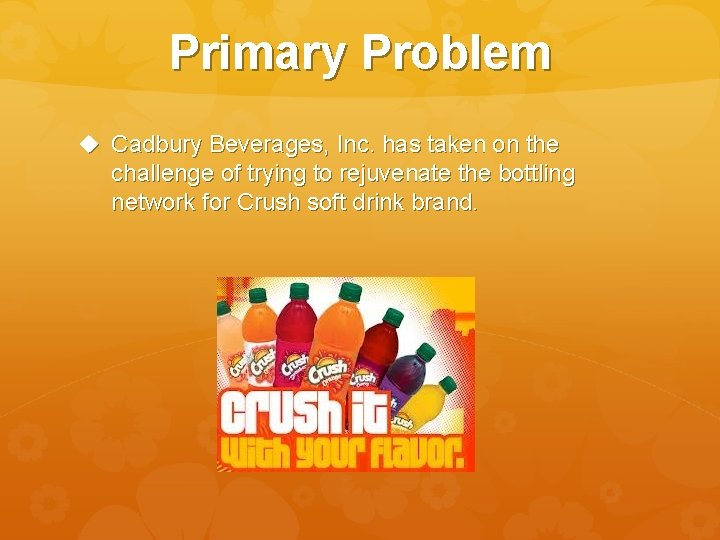
Primary Problem u Cadbury Beverages, Inc. has taken on the challenge of trying to rejuvenate the bottling network for Crush soft drink brand.
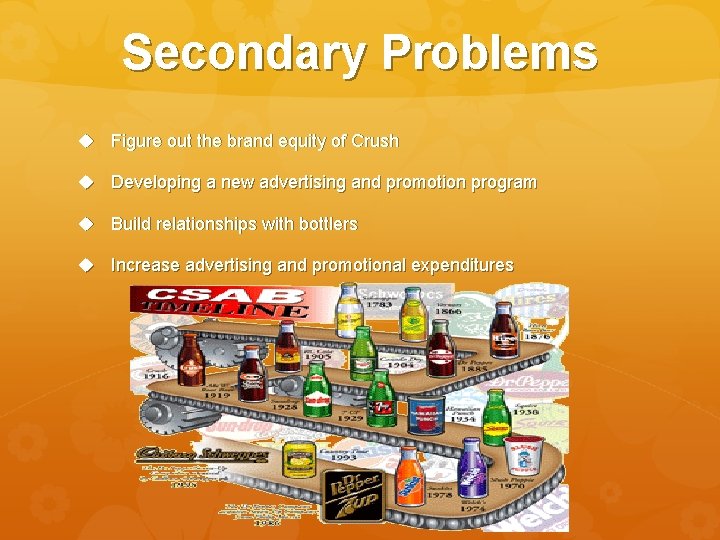
Secondary Problems u Figure out the brand equity of Crush u Developing a new advertising and promotion program u Build relationships with bottlers u Increase advertising and promotional expenditures
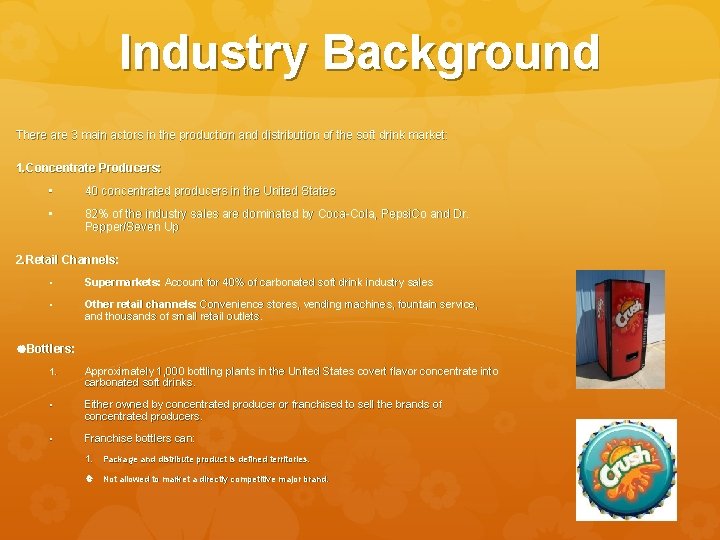
Industry Background There are 3 main actors in the production and distribution of the soft drink market: 1. Concentrate Producers: • 40 concentrated producers in the United States • 82% of the industry sales are dominated by Coca-Cola, Pepsi. Co and Dr. Pepper/Seven Up 2. Retail Channels: • Supermarkets: Account for 40% of carbonated soft drink industry sales • Other retail channels: Convenience stores, vending machines, fountain service, and thousands of small retail outlets. |Bottlers: 1. Approximately 1, 000 bottling plants in the United States covert flavor concentrate into carbonated soft drinks. • Either owned by concentrated producer or franchised to sell the brands of concentrated producers. • Franchise bottlers can: 1. Package and distribute product is defined territories. | Not allowed to market a directly competitive major brand.

SWOT Analysis STRENGTHS WEAKNESSES • 4 th Largest soft drink marketer in the US. • High name awareness in the markets served by existing and new bottlers. • High brand awareness in big cities • Possible cannibalization with Sunkist • Low advertising compared to competitors • Low market share • Low market coverage • (one more) OPPORTUNITES THREATS • American consumers drink more soft drinks then tap water. • Market for diet products has increased over the years • Many different ways to advertise and promote • More than 900 registered brand names for soft drinks in US. • Cola accounts for slightly less than 2/3 of total carbonated soft drink sales • Entrance of Pepsi. Co Mandarin Orange Slice could take market share. • Minute Maid and Mandarin Orange slice accounted for 84% of all advertising expenditures in the orange category.
Consumer Analysis u Married women with children under the age of 18. u Respond favorably to price. (use of point-of-sale promotions, displays, etc. ) u Purchases are somewhat seasonal. • Sales are slightly higher in the summer months u Diet products are more pronounced among consumers over 25 years old while teenagers and younger consumers drink regular soft drinks.

Competitor Analysis Market Share Pepsi. Co- Mandarin Orange Slice=20. 8% Cadbury- Sunkist= 14. 4% Coca Cola- Minute Maid Orange= 14% Cadbury- Orange Crush= 7. 5% Position -Minute Maid Orange- emphasis on its orange flavor (18 -34) -Sunkist- focused on the teen lifestyle (12 -24) -Orange Slice- focused on the contemporary youth culture (18 -24) -Crush- focused on their bold imagery with thirst quenching benefits (13 -29) Variety of Merchandising Promotions Used -“Dealer loader” is a premium given to retailers -End-of-aisle displays/other types of free standing displays -Shelf banners -Sponsorships of local sports and entertainment events, plastic cups and napkins featuring the brand logo -Coupons, on-package promotions, and sweepstakes
Corporation Analysis Dec. 12 th 1989 • Cadbury Schweppes PLC (London, England) • Beverage Division: Cadbury Beverages, Inc. (Stamford, Connecticut) • Product’s Sold Include: Tonic Water, Club Soda, Ginger Ale, Root Beer, Sunkist, Crush, Mott’s Apple Juice. • World Wide sales of $4. 6 billion in 1989 • One of the World’s Largest Multinational Firms. 4 th largest soft drink marketer in the United States. 3. 4% market share.

Additional Questions 3 -What is Cadbury Beverages relative competitive position in the U. S. soft drink industry? in the orange category? • Bold User Imagery with thirst quenching benefit. Teens 13 -29. • “Dont Just quench it, CRUSH it. ” • Two Liter 64%, Cans 31%
Odd Facts • Clayton J. Howell included the word "crush" in the original soft drink's name to refer to the process of extracting oils from oranges. • Crush Cherry made its debut in 2010, continuing Crush's spectacular growth
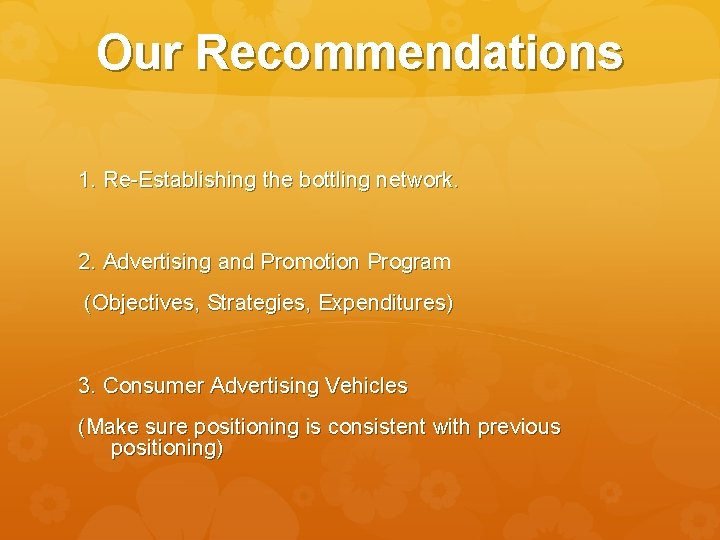
Our Recommendations 1. Re-Establishing the bottling network. 2. Advertising and Promotion Program (Objectives, Strategies, Expenditures) 3. Consumer Advertising Vehicles (Make sure positioning is consistent with previous positioning)
- Slides: 13