
CactusG Experiments with a GridEnabled Computational Framework Dave
Cactus-G: Experiments with a Grid-Enabled Computational Framework Dave Angulo, Ian Foster Chuang Liu, Matei Ripeanu, Michael Russell Distributed Systems Laboratory University of Chicago & Argonne National Laboratory Gabrielle Allen, Thomas Dramlitsch, Ed Seidel, Thomas Radke Max-Planck-Institut für Gravitationsphysik UCSD, UIUC, U. Tenn Gr. ADS Groups
Overview l l Research goals: Why Cactus-G Context: Numerical relativity, Cactus, dynamic Grid computing l The Cactus-G Grid-enabled framework l Cactus and Gr. ADS – The Cactus Worm model problem – Dynamic resource selection & code migration – Experimental results l Future directions & lessons learned Grid Application Development Software Project
Research Goals l Investigate methods and structures for efficient Grid execution via in-depth study of a demanding application, including – Constructs for adapting to heterogeneity – Constructs for dynamic resource acquisition l l Create testbed for Gr. ADSoft components, as they emerge Investigate utility of computational frameworks as facilitator of Grid computing Grid Application Development Software Project

Context (1): Numerical Relativity l Numerical simulation of extreme astrophysical events: colliding black holes, neutron stars, etc. – Understand physics – Predict gravitational wave forms l Relativistic effects => Einstein eqns – Computationally intensive (can be 1000 s flops/grid point) – 3 -D simulations only recently possible: demanding users LIGO gravitational Grid Application Development Software Project wave observatory Colliding black holes
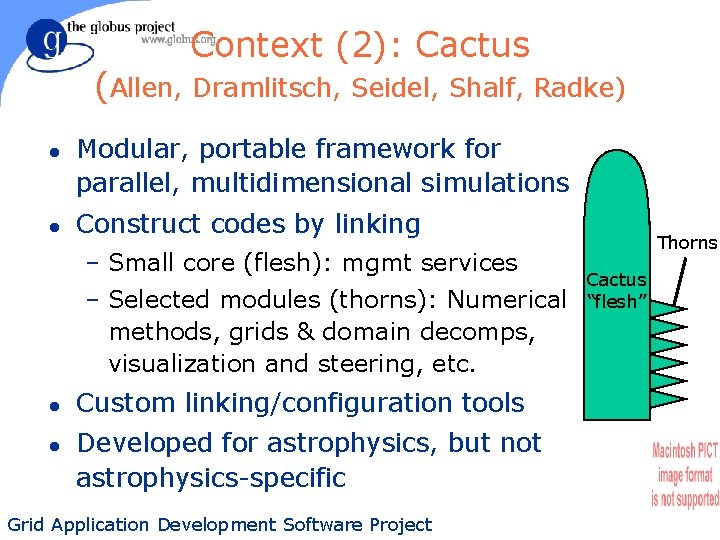
Context (2): Cactus (Allen, Dramlitsch, Seidel, Shalf, Radke) l l Modular, portable framework for parallel, multidimensional simulations Construct codes by linking – Small core (flesh): mgmt services – Selected modules (thorns): Numerical methods, grids & domain decomps, visualization and steering, etc. l l Custom linking/configuration tools Developed for astrophysics, but not astrophysics-specific Grid Application Development Software Project Thorns Cactus “flesh”
Context (3): Dynamic Grid Computing l Application behaviors in a Grid environment: – Identify fastest/cheapest/biggest resources – Configure for efficient execution – Detect need for new resources or behaviors (e. g. , due to resource slowdown, new subtasks, new appln regime, user steering, new resource available) – Adapt, and/or discover new resources; invoke subtasks on new resources and/or migrate l We have users who want these behaviors; we also have the enabling machinery Grid Application Development Software Project
Cactus-G: An Application Framework for Dynamic Grid Computing l l Cactus thorns for active management of application behavior and resource use Heterogeneous resources, e. g. : – Irregular decompositions – Variable halo for managing message size – Msg compression (comp/comm tradeoff) – Comms scheduling for comp/comm overlap l Dynamic resource behaviors/demands, e. g. : – Perf monitoring, contract violation detection – Dynamic resource discovery & migration – User notification and steering Grid Application Development Software Project
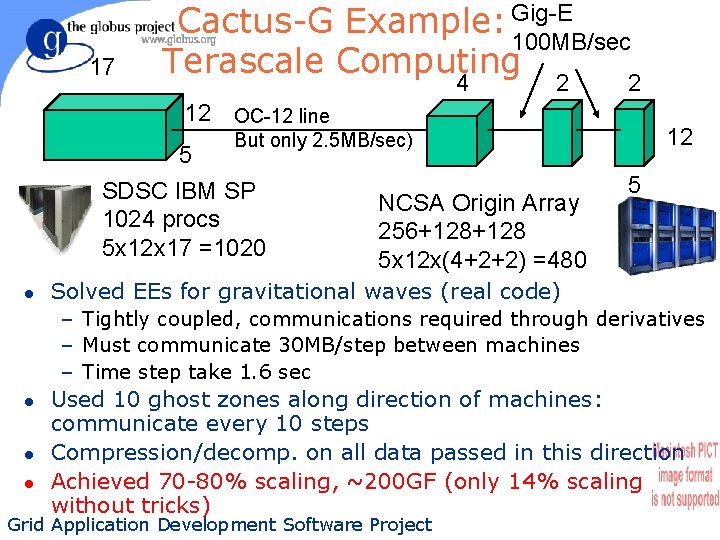
17 Cactus-G Example: Gig-E 100 MB/sec Terascale Computing 4 2 2 12 OC-12 line 12 But only 2. 5 MB/sec) 5 SDSC IBM SP 1024 procs 5 x 12 x 17 =1020 l NCSA Origin Array 256+128 5 x 12 x(4+2+2) =480 5 Solved EEs for gravitational waves (real code) – Tightly coupled, communications required through derivatives – Must communicate 30 MB/step between machines – Time step take 1. 6 sec l l l Used 10 ghost zones along direction of machines: communicate every 10 steps Compression/decomp. on all data passed in this direction Achieved 70 -80% scaling, ~200 GF (only 14% scaling without tricks) Grid Application Development Software Project
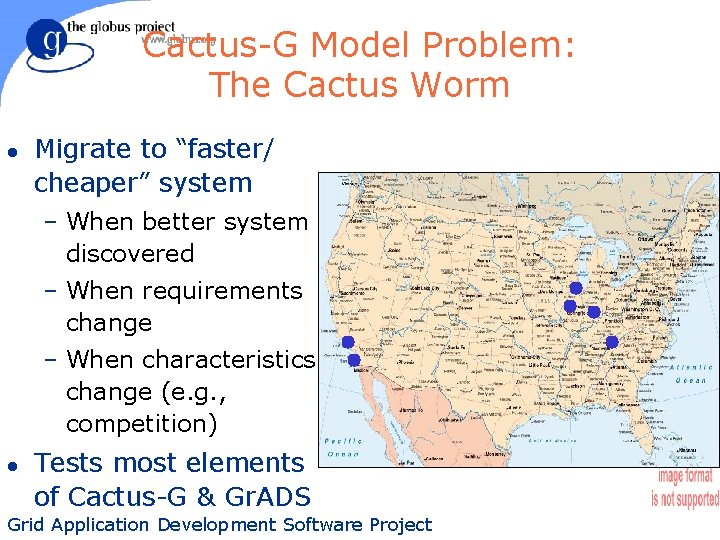
Cactus-G Model Problem: The Cactus Worm l Migrate to “faster/ cheaper” system – When better system discovered – When requirements change – When characteristics change (e. g. , competition) l Tests most elements of Cactus-G & Gr. ADS Grid Application Development Software Project
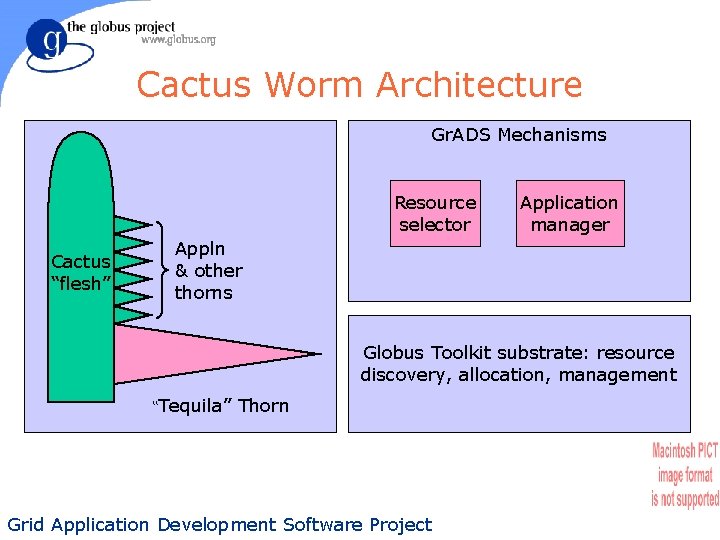
Cactus Worm Architecture Gr. ADS Mechanisms Resource selector Cactus “flesh” Application manager Appln & other thorns Globus Toolkit substrate: resource discovery, allocation, management “Tequila” Thorn Grid Application Development Software Project
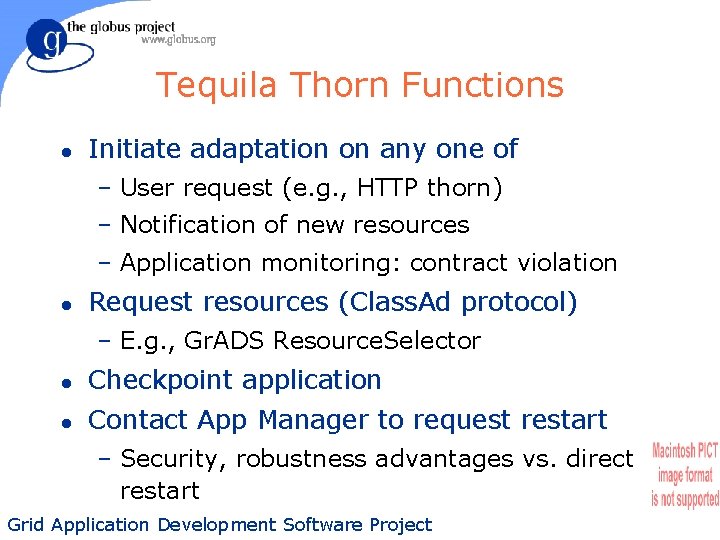
Tequila Thorn Functions l Initiate adaptation on any one of – User request (e. g. , HTTP thorn) – Notification of new resources – Application monitoring: contract violation l Request resources (Class. Ad protocol) – E. g. , Gr. ADS Resource. Selector l Checkpoint application l Contact App Manager to request restart – Security, robustness advantages vs. direct restart Grid Application Development Software Project
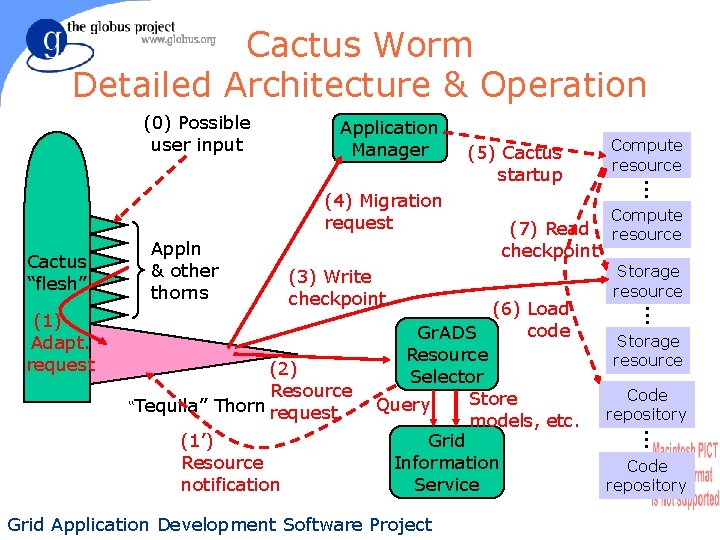
Cactus Worm Detailed Architecture & Operation (0) Possible user input Application Manager Cactus “flesh” (3) Write checkpoint (2) Resource “Tequila” Thorn request (6) Load code Gr. ADS Resource Selector Store Query models, etc. Grid Information Service Grid Application Development Software Project Storage resource Code repository … (1’) Resource notification Compute (7) Read resource checkpoint … (1) Adapt. request Appln & other thorns Compute resource … (4) Migration request (5) Cactus startup Code repository
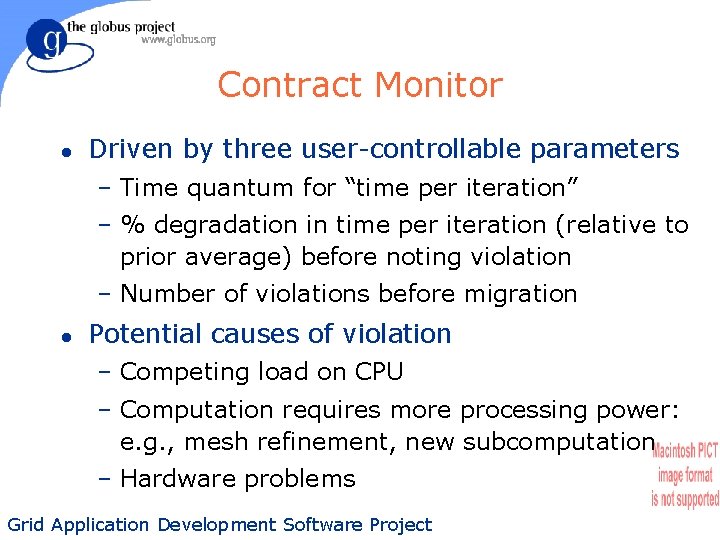
Contract Monitor l Driven by three user-controllable parameters – Time quantum for “time per iteration” – % degradation in time per iteration (relative to prior average) before noting violation – Number of violations before migration l Potential causes of violation – Competing load on CPU – Computation requires more processing power: e. g. , mesh refinement, new subcomputation – Hardware problems Grid Application Development Software Project
Current Status l We have developed – Tequila thorn: monitoring, selection, control – Resource. Selector (via Class. Ad protocol) – Cactus performance model l We have demonstrated on Gr. ADS Macro Grid – Contract monitoring for multiprocessor runs – Dynamic resource selection – Migration Grid Application Development Software Project
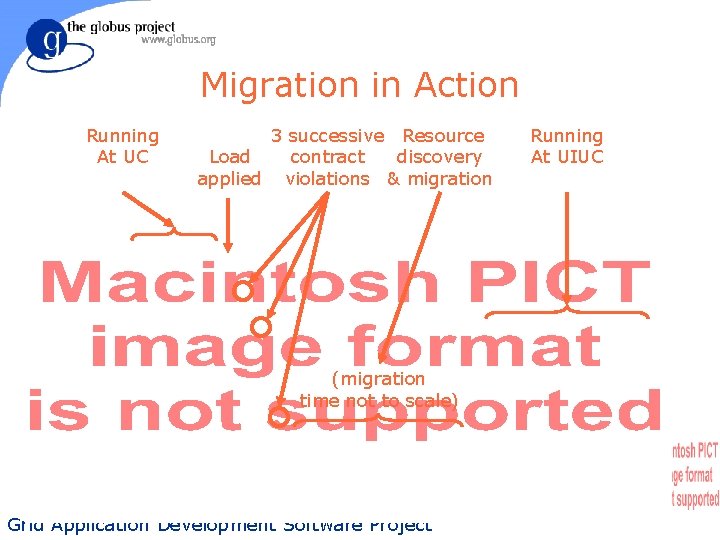
Migration in Action Running At UC 3 successive Resource contract discovery Load applied violations & migration (migration time not to scale) Grid Application Development Software Project Running At UIUC
Ongoing and Future Work: New and Improved Capabilities l l Optimize migration process Use performance models during selection – And include cost of migration & information about future computation in the model l Matchmaker-based Resource. Selector – Separation of concerns between resource characterization and selection – Study resource characterization process, use NWS-based prediction techniques l Dynamic notification of availability of “better” resources Grid Application Development Software Project
Ongoing and Future Work: Further Integration with Gr. ADSoft l Contract monitoring – Pablo – Issues: determining which thorns are monitored, or if flesh is monitored l l Program Preparation System Configurable Object Program and Application Launcher – Cactus has its own launcher and compiles its own code Grid Application Development Software Project
Lessons Learned and Outcomes l Lessons learned – A real & demanding application can exploit adaptive techniques to execute efficiently in Grid environments – Even a relatively regular application can incorporate a range of useful mechanisms for adaptive behaviors & resource demands l Outcomes – Prototype Cactus-G framework: wonderful experimental platform Grid Application Development Software Project
- Slides: 18