
Caching Principles and Paging Performance CS3013 Operating Systems



- Slides: 27
Caching Principles and Paging Performance CS-3013 Operating Systems Hugh C. Lauer (Slides include materials from Modern Operating Systems, 3 rd ed. , by Andrew Tanenbaum and from Operating System Concepts, 7 th ed. , by Silbershatz, Galvin, & Gagne) CS-3013, C-Term 2012 Caching Principles and Paging Performance 1
Fundamental Observation • Paging allows us to treat physical memory as a cache of virtual memory • Therefore, all of the principles and issues of caches apply to paging • … especially paging performance CS-3013, C-Term 2012 Caching Principles and Paging Performance 2
Definition — Cache • A small subset of active items held in small, fast storage while most of the items remain in much larger, slower storage • Includes mechanisms for – Recognizing what items are in the cache and for accessing them quickly – Bringing things into cache and throwing them out again CS-3013, C-Term 2012 Caching Principles and Paging Performance 3
Note on Caches and Caching • This topic is not adequately covered in Tanenbaum or most other Operating System textbooks. Caching is a fundamental, • Silbershatz, Galvin, & Gagne cross-cutting concept with broad application to allperformance somewhat areas of computing science and to many areas of system design, embedded systems, etc. discuss paging • It is treated extensively in Computer Architecture textbooks CS-3013, C-Term 2012 Caching Principles and Paging Performance 4
Paging — Two Examples of Caches • Paged Virtual Memory – Very large, mostly stored on (slow) disk – Small working set in (fast) RAM during execution • Page tables – Very large, mostly stored in (slow) RAM – Small working set stored in (fast) TLB registers CS-3013, C-Term 2012 Caching Principles and Paging Performance 5
Caching is Ubiquitous in Computing • Transaction processing • Keep records of today’s departures in RAM or local storage while records of future flights are on remote database • Program execution • Keep the bytes near the current program counter in on-chip memory while rest of program is in RAM • File management • Keep disk maps of open files in RAM while retaining maps of all files on disk • Game design • Keep nearby environment in cache of each character • … CS-3013, C-Term 2012 Caching Principles and Paging Performance 6
Caching issues y r e v t! a s i is l s i t Th ortan imp • When to put something in the cache • What to throw out to create cache space for new items • How to keep cached item and stored item in sync after one or the other is updated • How to keep multiple caches in sync across processors or machines • Size of cache needed to be effective • Size of cache items for efficiency • … CS-3013, C-Term 2012 Caching Principles and Paging Performance 7
General Observation on Caching • We create caches because • There is not enough fast memory to hold everything we need • Memory that is large enough is too slow • Performance metric for all caches is EAT • Effective Access Time • Goal is to make overall performance close to cache memory performance • By taking advantage of locality — temporal and spatial • By burying a small number of accesses to slow memory under many, many accesses to fast memory CS-3013, C-Term 2012 Caching Principles and Paging Performance 8
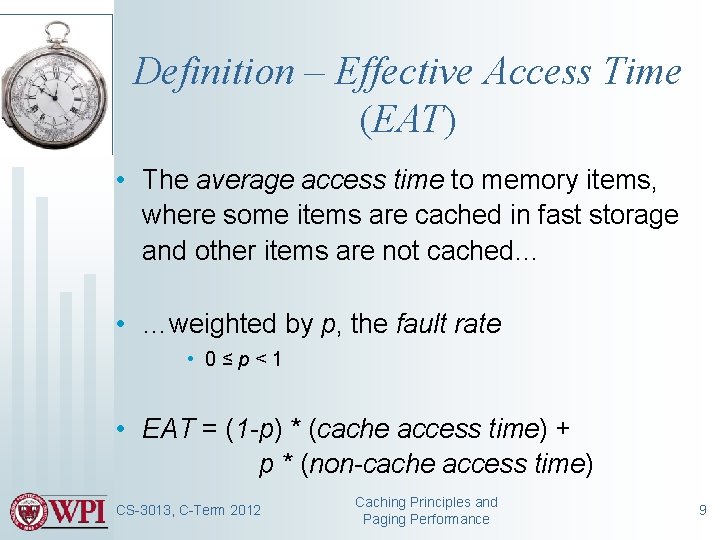
Definition – Effective Access Time (EAT) • The average access time to memory items, where some items are cached in fast storage and other items are not cached… • …weighted by p, the fault rate • 0≤p<1 • EAT = (1 -p) * (cache access time) + p * (non-cache access time) CS-3013, C-Term 2012 Caching Principles and Paging Performance 9
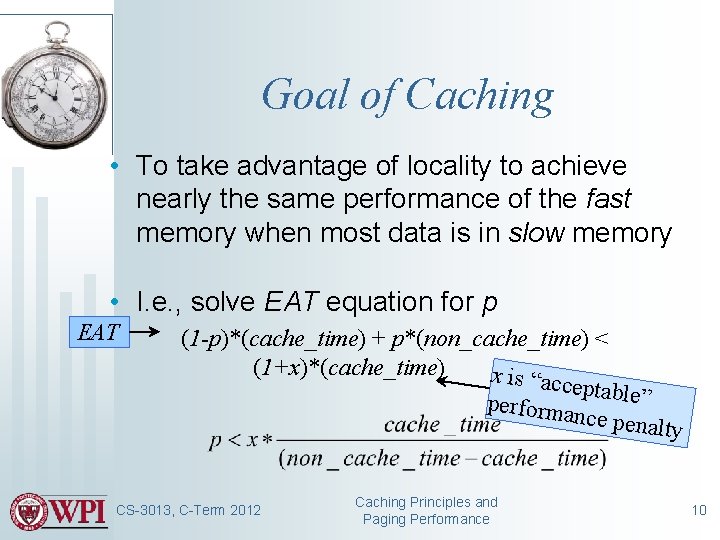
Goal of Caching • To take advantage of locality to achieve nearly the same performance of the fast memory when most data is in slow memory • I. e. , solve EAT equation for p EAT (1 -p)*(cache_time) + p*(non_cache_time) < (1+x)*(cache_time) x is “acce ptable” performa nce pena lty CS-3013, C-Term 2012 Caching Principles and Paging Performance 10
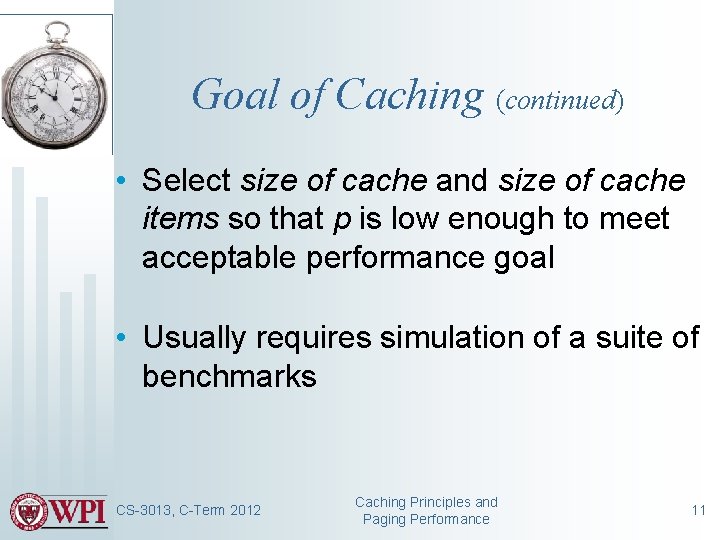
Goal of Caching (continued) • Select size of cache and size of cache items so that p is low enough to meet acceptable performance goal • Usually requires simulation of a suite of benchmarks CS-3013, C-Term 2012 Caching Principles and Paging Performance 11
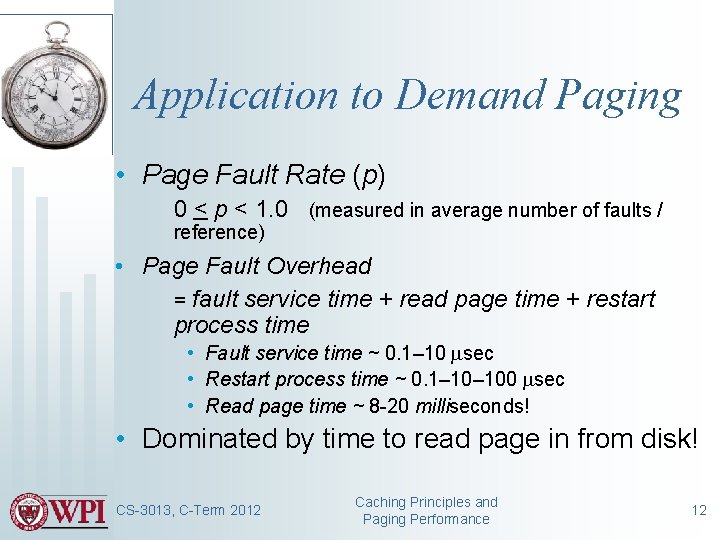
Application to Demand Paging • Page Fault Rate (p) 0 < p < 1. 0 (measured in average number of faults / reference) • Page Fault Overhead = fault service time + read page time + restart process time • Fault service time ~ 0. 1– 10 sec • Restart process time ~ 0. 1– 100 sec • Read page time ~ 8 -20 milliseconds! • Dominated by time to read page in from disk! CS-3013, C-Term 2012 Caching Principles and Paging Performance 12
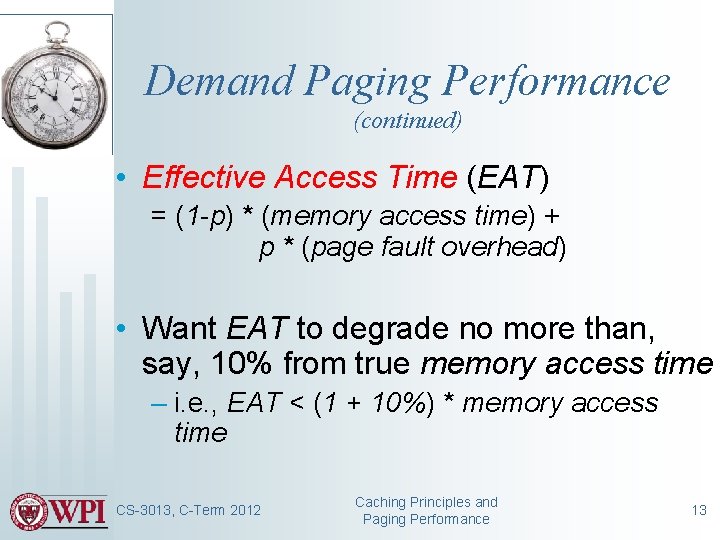
Demand Paging Performance (continued) • Effective Access Time (EAT) = (1 -p) * (memory access time) + p * (page fault overhead) • Want EAT to degrade no more than, say, 10% from true memory access time – i. e. , EAT < (1 + 10%) * memory access time CS-3013, C-Term 2012 Caching Principles and Paging Performance 13
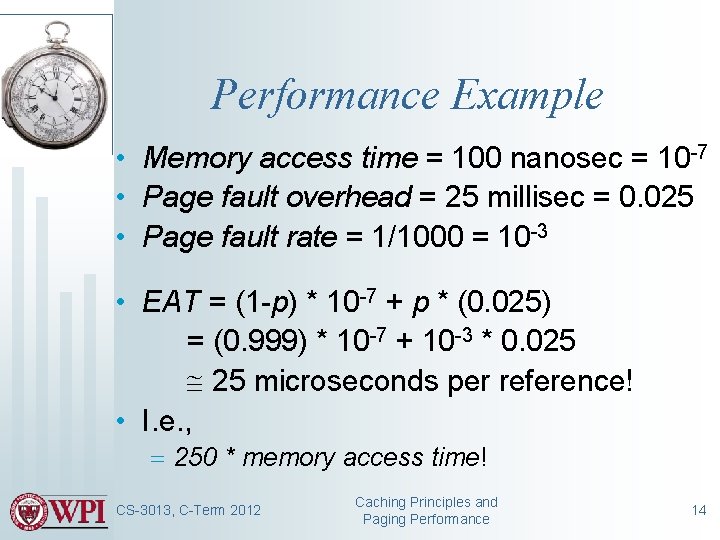
Performance Example • Memory access time = 100 nanosec = 10 -7 • Page fault overhead = 25 millisec = 0. 025 • Page fault rate = 1/1000 = 10 -3 • EAT = (1 -p) * 10 -7 + p * (0. 025) = (0. 999) * 10 -7 + 10 -3 * 0. 025 25 microseconds per reference! • I. e. , = 250 * memory access time! CS-3013, C-Term 2012 Caching Principles and Paging Performance 14
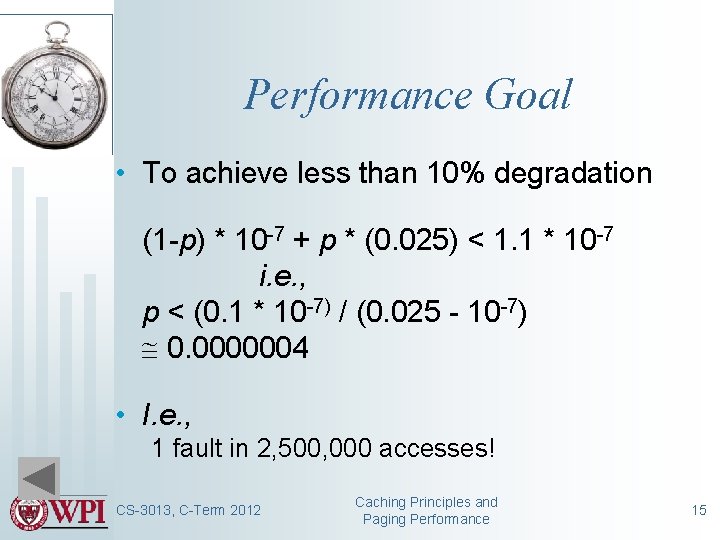
Performance Goal • To achieve less than 10% degradation (1 -p) * 10 -7 + p * (0. 025) < 1. 1 * 10 -7 i. e. , p < (0. 1 * 10 -7) / (0. 025 - 10 -7) 0. 0000004 • I. e. , 1 fault in 2, 500, 000 accesses! CS-3013, C-Term 2012 Caching Principles and Paging Performance 15
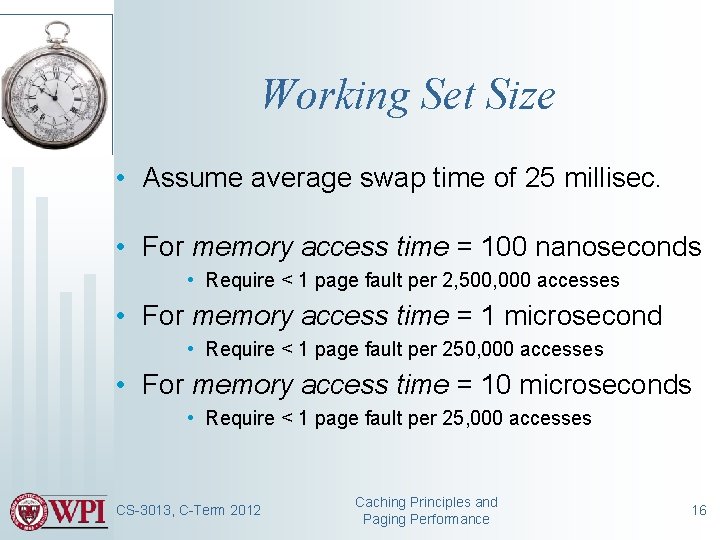
Working Set Size • Assume average swap time of 25 millisec. • For memory access time = 100 nanoseconds • Require < 1 page fault per 2, 500, 000 accesses • For memory access time = 1 microsecond • Require < 1 page fault per 250, 000 accesses • For memory access time = 10 microseconds • Require < 1 page fault per 25, 000 accesses CS-3013, C-Term 2012 Caching Principles and Paging Performance 16
Object Lesson • Working sets must get larger in proportion to memory speed! • Disk speed ~ constant (nearly) • I. e. , faster computers need larger physical memories to exploit the speed! CS-3013, C-Term 2012 Caching Principles and Paging Performance 17
Class Discussion 1. What is first thing to do when the PC you bought last year becomes too slow? 2. What else might help? 3. Can we do the same analysis on TLB performance? CS-3013, C-Term 2012 Caching Principles and Paging Performance 18
TLB fault performance • Assumptions – m = memory access time = 100 nsec – t = TLB load time from memory = 300 nsec =3*m • Goal is < 5% penalty for TLB misses – I. e. , EAT < 1. 05 * m • How low does TLB fault rate need to be? CS-3013, C-Term 2012 Caching Principles and Paging Performance 19
TLB fault performance • Assumptions – m = memory access time = 100 nsec – t = TLB load time from memory = 300 nsec =3*m • Goal is < 5% penalty for TLB misses – I. e. , EAT < 1. 05 * m • EAT = (1 -p) * m + p * t < 1. 05 *m p < (0. 05 * m) / (t – m) = 0. 05 * m / 2 * m = 0. 025 • I. e. , TLB fault rate should be < 1 per 40 accesses! CS-3013, C-Term 2012 Caching Principles and Paging Performance 20
TLB fault performance (continued) • Q: How large should TLB be so that TLB faults are not onerous, in these l a c gi t circumstances? o l n o ath preve p : ay e ! t r o e N es m eth g s o a t l c la goa • A: Somewhat less than 40 entries • Assuming a reasonable degree of locality! CS-3013, C-Term 2012 Caching Principles and Paging Performance 21
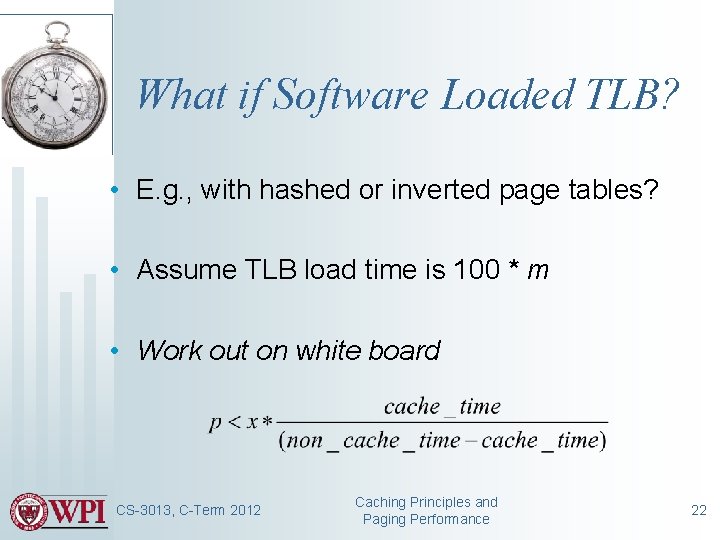
What if Software Loaded TLB? • E. g. , with hashed or inverted page tables? • Assume TLB load time is 100 * m • Work out on white board CS-3013, C-Term 2012 Caching Principles and Paging Performance 22
Summary of this Topic • A quantitative way of estimating how large the cache needs to be to avoid excessive thrashing, where – Cache = Working set in physical memory – Cache = TLB size in hardware • Applicable to all forms of caching CS-3013, C-Term 2012 Caching Principles and Paging Performance 23
General Observation on Caching • We create caches because • There is not enough fast memory to hold everything we need • Memory that is large enough is too slow • Performance metric for all caches is EAT • Effective Access Time • Goal is to make overall performance close to cache memory performance • By taking advantage of locality — temporal and spatial • By burying a small number of accesses to slow memory under many, many accesses to fast memory CS-3013, C-Term 2012 Caching Principles and Paging Performance 24
Cache Applications • Physical memory: cache of virtual memory • I. e. , RAM over disk • TLB: cache of page table entries • I. e. , Registers over RAM • Processor L 2 cache: over RAM • I. e. , nanosecond memory over 10’s of nanoseconds • Processor L 1 cache: over L 2 cache • I. e. , picosecond registers over nanosecond memory • … CS-3013, C-Term 2012 Caching Principles and Paging Performance 25
Cache Applications (continued) • Recently accessed blocks of a file • I. e. , RAM over disk blocks • Today’s airline flights • I. e. , local disk over remote disk CS-3013, C-Term 2012 Caching Principles and Paging Performance 26
Questions? CS-3013, C-Term 2012 Caching Principles and Paging Performance 27