
Cache Writing Performance Today well finish up with
![Prefetching, cont. § Remember this graph? int array[SIZE]; int A = 0; Actual Data](https://slidetodoc.com/presentation_image/6bada3f2713a8ddeaf3a7fb6789a4b2a/image-19.jpg "Prefetching, cont. § Remember this graph? int array[SIZE]; int A = 0; Actual Data")
![Hardware Stream Prefetching int array[SIZE]; int A = 0; § Inner loop has very](https://slidetodoc.com/presentation_image/6bada3f2713a8ddeaf3a7fb6789a4b2a/image-20.jpg "Hardware Stream Prefetching int array[SIZE]; int A = 0; § Inner loop has very")
- Slides: 23
Cache Writing & Performance § Today we’ll finish up with caches; we’ll cover: — Writing to caches: keeping memory consistent & write-allocation. — We’ll try to quantify the benefits of different cache designs, and see how caches affect overall performance. — How we can get the data into the cache before we need it with prefetching. 9/25/2020 Cache performance 1
Four important questions 1. When we copy a block of data from main memory to the cache, where exactly should we put it? 2. How can we tell if a word is already in the cache, or if it has to be fetched from main memory first? 3. Eventually, the small cache memory might fill up. To load a new block from main RAM, we’d have to replace one of the existing blocks in the cache. . . which one? 4. How can write operations be handled by the memory system? § Previous lectures answered the first 3. Today, we consider the 4 th. 9/25/2020 Cache performance 2
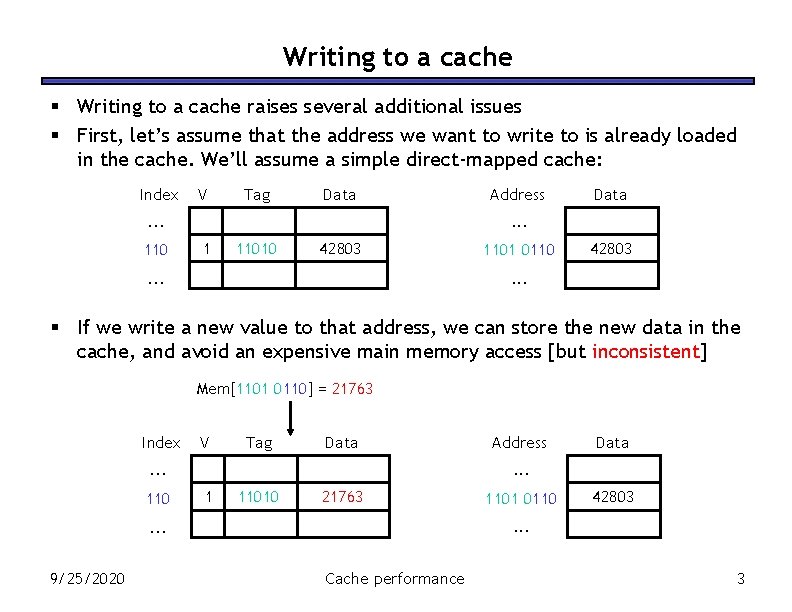
Writing to a cache § Writing to a cache raises several additional issues § First, let’s assume that the address we want to write to is already loaded in the cache. We’ll assume a simple direct-mapped cache: Index V Tag Data . . . 110 Address Data . . . 1 11010 42803 . . . 1101 0110 42803 . . . § If we write a new value to that address, we can store the new data in the cache, and avoid an expensive main memory access [but inconsistent] Mem[1101 0110] = 21763 Index V Tag Data 1 11010 21763 1101 0110 42803 . . . 9/25/2020 Data . . . 110 Address Cache performance 3
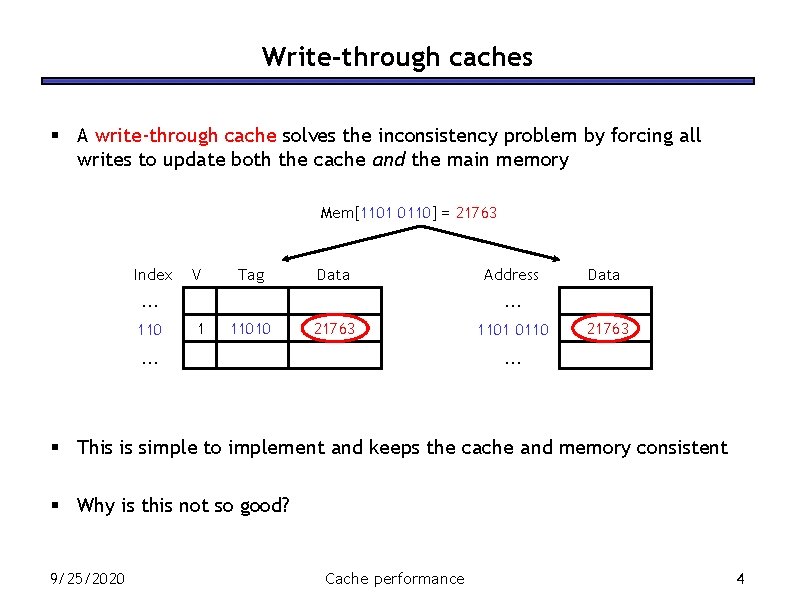
Write-through caches § A write-through cache solves the inconsistency problem by forcing all writes to update both the cache and the main memory Mem[1101 0110] = 21763 Index V Tag Data . . . 110 Address Data . . . 1 11010 21763 . . . 1101 0110 21763 . . . § This is simple to implement and keeps the cache and memory consistent § Why is this not so good? 9/25/2020 Cache performance 4
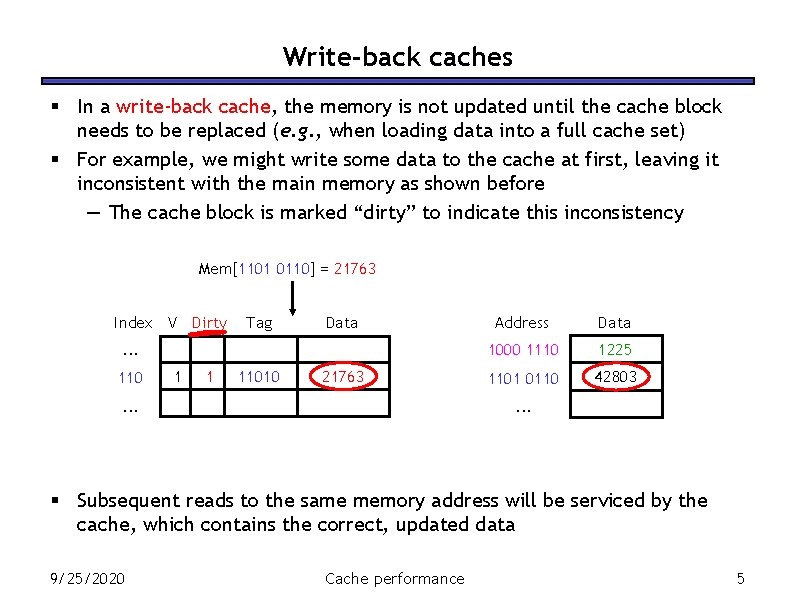
Write-back caches § In a write-back cache, the memory is not updated until the cache block needs to be replaced (e. g. , when loading data into a full cache set) § For example, we might write some data to the cache at first, leaving it inconsistent with the main memory as shown before — The cache block is marked “dirty” to indicate this inconsistency Mem[1101 0110] = 21763 Index V Dirty Tag Data . . . 110 1 1 11010 21763 . . . Address Data 1000 1110 1225 1101 0110 42803 . . . § Subsequent reads to the same memory address will be serviced by the cache, which contains the correct, updated data 9/25/2020 Cache performance 5
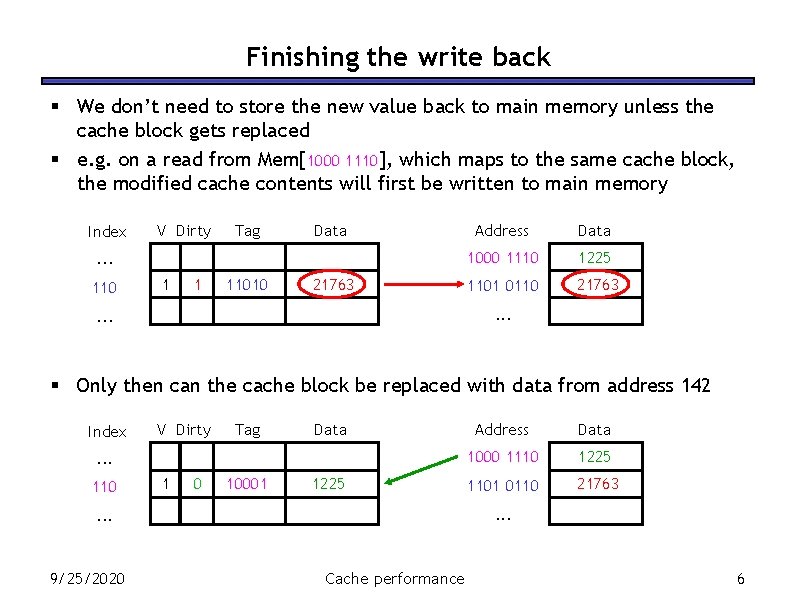
Finishing the write back § We don’t need to store the new value back to main memory unless the cache block gets replaced § e. g. on a read from Mem[1000 1110], which maps to the same cache block, the modified cache contents will first be written to main memory Index V Dirty Tag Data . . . 110 1 1 11010 21763 Address Data 1000 1110 1225 1101 0110 21763 . . . § Only then can the cache block be replaced with data from address 142 Index V Dirty Tag Data . . . 110 1 0 10001 1225 Data 1000 1110 1225 1101 0110 21763 . . . 9/25/2020 Address Cache performance 6
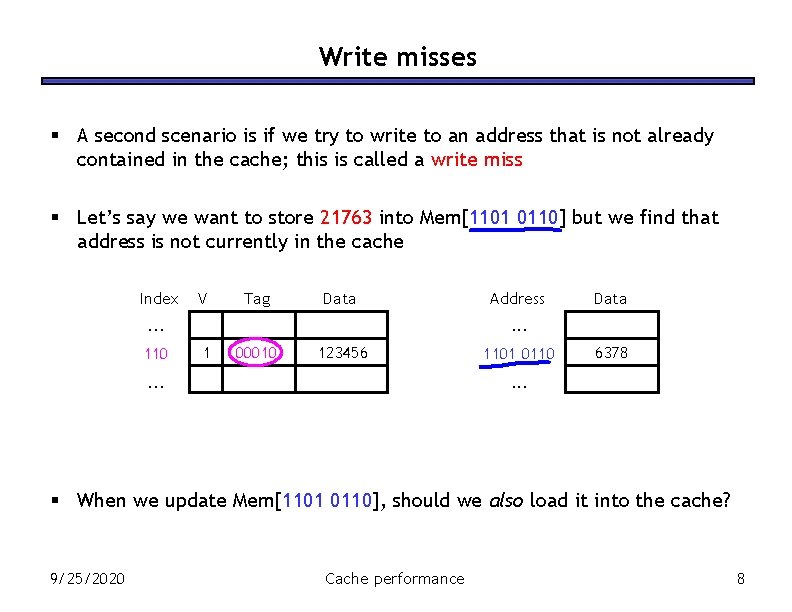
Write misses § A second scenario is if we try to write to an address that is not already contained in the cache; this is called a write miss § Let’s say we want to store 21763 into Mem[1101 0110] but we find that address is not currently in the cache Index V Tag Data . . . 110 Address Data . . . 1 00010 123456 . . . 1101 0110 6378 . . . § When we update Mem[1101 0110], should we also load it into the cache? 9/25/2020 Cache performance 8
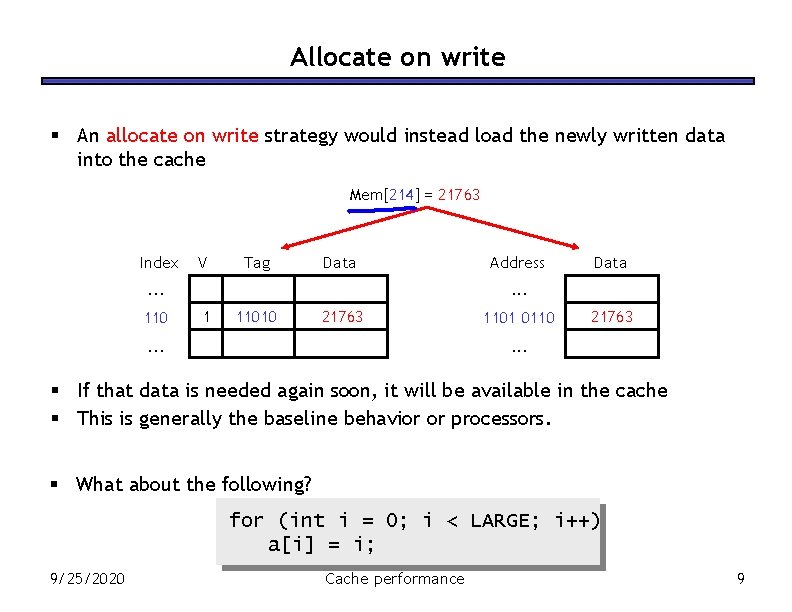
Allocate on write § An allocate on write strategy would instead load the newly written data into the cache Mem[214] = 21763 Index V Tag Data . . . 110 Address Data . . . 1 11010 21763 . . . 1101 0110 21763 . . . § If that data is needed again soon, it will be available in the cache § This is generally the baseline behavior or processors. § What about the following? for (int i = 0; i < LARGE; i++) a[i] = i; 9/25/2020 Cache performance 9
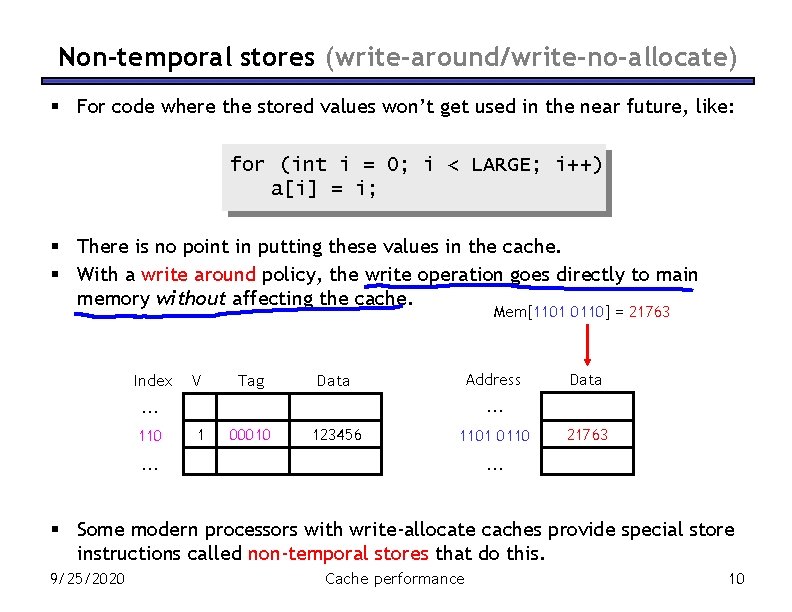
Non-temporal stores (write-around/write-no-allocate) § For code where the stored values won’t get used in the near future, like: for (int i = 0; i < LARGE; i++) a[i] = i; § There is no point in putting these values in the cache. § With a write around policy, the write operation goes directly to main memory without affecting the cache. Mem[1101 0110] = 21763 Index V Tag Address Data . . . 110 Data 1 00010 123456 1101 0110 21763 . . . § Some modern processors with write-allocate caches provide special store instructions called non-temporal stores that do this. 9/25/2020 Cache performance 10
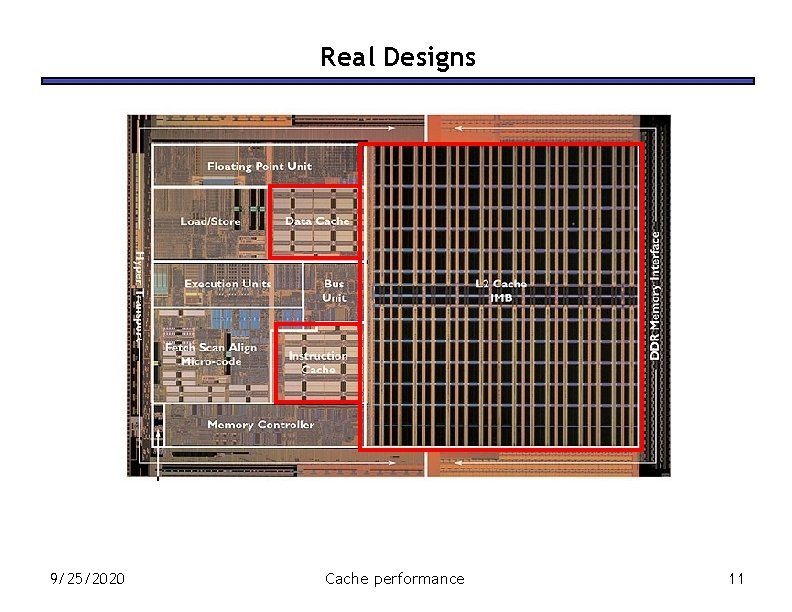
Real Designs 9/25/2020 Cache performance 11
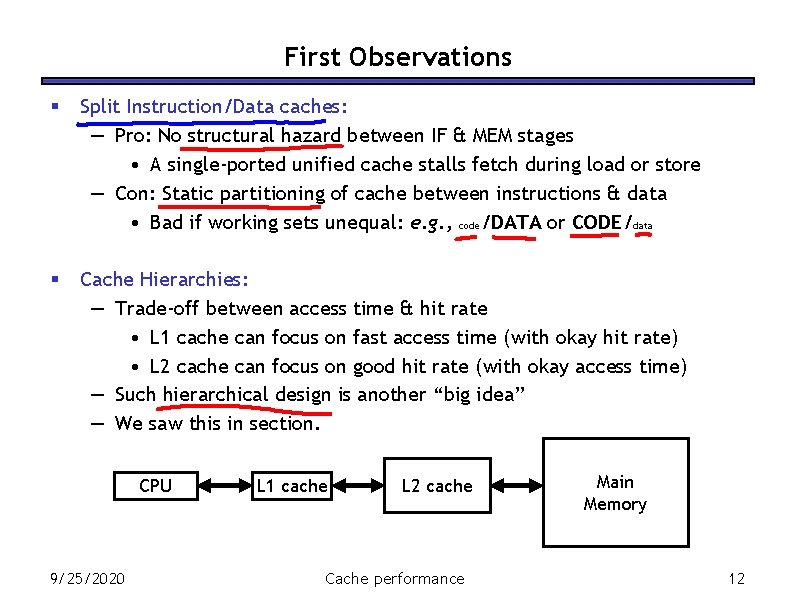
First Observations § Split Instruction/Data caches: — Pro: No structural hazard between IF & MEM stages • A single-ported unified cache stalls fetch during load or store — Con: Static partitioning of cache between instructions & data • Bad if working sets unequal: e. g. , code/DATA or CODE/data § Cache Hierarchies: — Trade-off between access time & hit rate • L 1 cache can focus on fast access time (with okay hit rate) • L 2 cache can focus on good hit rate (with okay access time) — Such hierarchical design is another “big idea” — We saw this in section. CPU 9/25/2020 L 1 cache L 2 cache Cache performance Main Memory 12
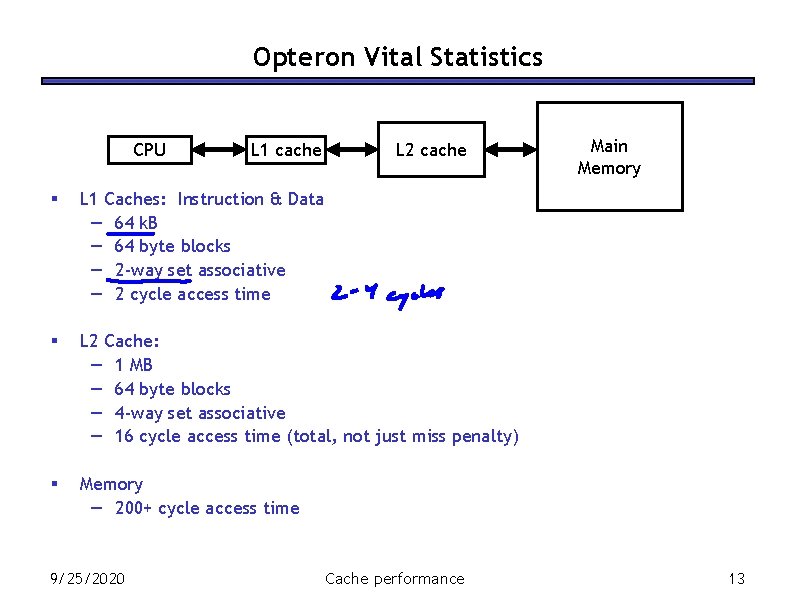
Opteron Vital Statistics CPU L 1 cache L 2 cache § L 1 Caches: Instruction & Data — 64 k. B — 64 byte blocks — 2 -way set associative — 2 cycle access time § L 2 Cache: — 1 MB — 64 byte blocks — 4 -way set associative — 16 cycle access time (total, not just miss penalty) § Memory — 200+ cycle access time 9/25/2020 Cache performance Main Memory 13
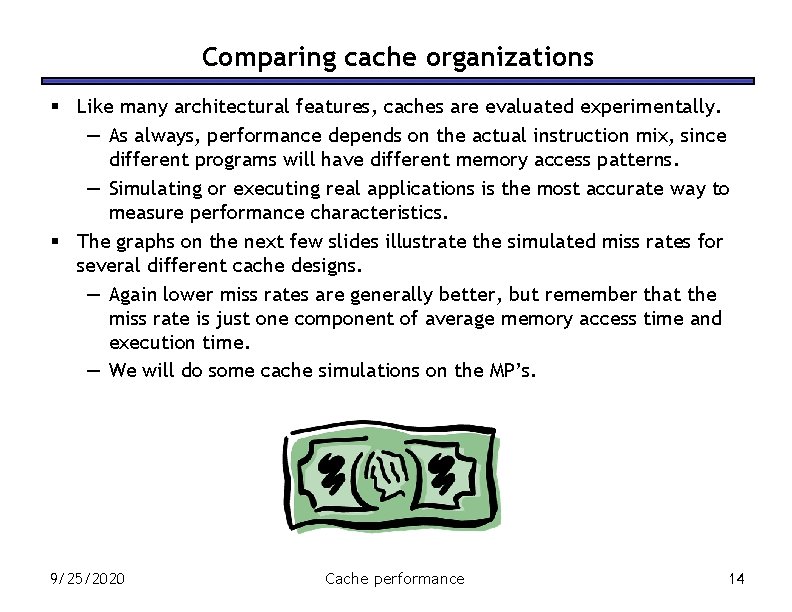
Comparing cache organizations § Like many architectural features, caches are evaluated experimentally. — As always, performance depends on the actual instruction mix, since different programs will have different memory access patterns. — Simulating or executing real applications is the most accurate way to measure performance characteristics. § The graphs on the next few slides illustrate the simulated miss rates for several different cache designs. — Again lower miss rates are generally better, but remember that the miss rate is just one component of average memory access time and execution time. — We will do some cache simulations on the MP’s. 9/25/2020 Cache performance 14
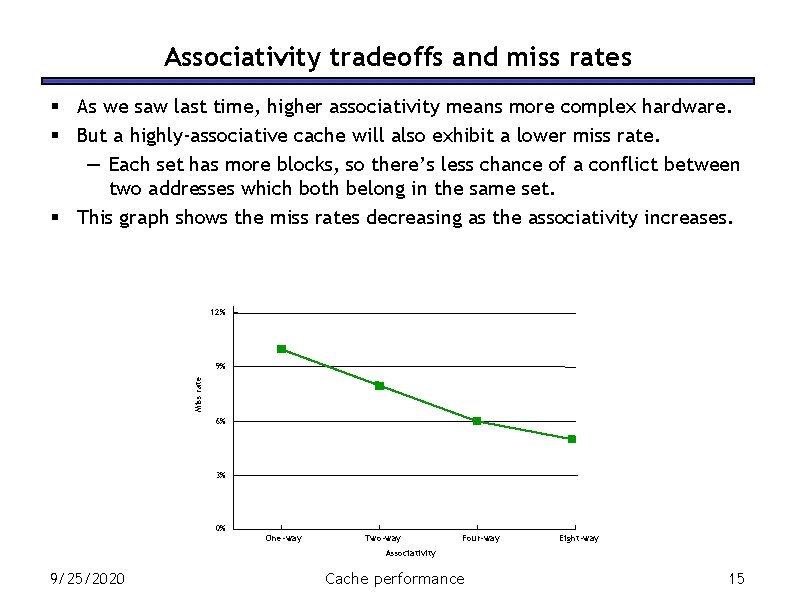
Associativity tradeoffs and miss rates § As we saw last time, higher associativity means more complex hardware. § But a highly-associative cache will also exhibit a lower miss rate. — Each set has more blocks, so there’s less chance of a conflict between two addresses which both belong in the same set. § This graph shows the miss rates decreasing as the associativity increases. 12% Miss rate 9% 6% 3% 0% One-way Two-way Four-way Eight-way Associativity 9/25/2020 Cache performance 15
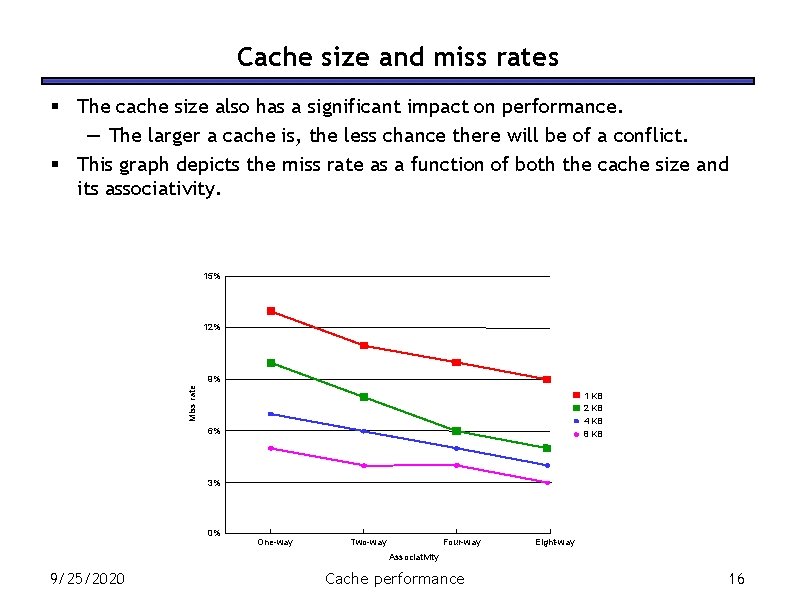
Cache size and miss rates § The cache size also has a significant impact on performance. — The larger a cache is, the less chance there will be of a conflict. § This graph depicts the miss rate as a function of both the cache size and its associativity. 15% 12% Miss rate 9% 1 KB 2 KB 4 KB 8 KB 6% 3% 0% One-way Two-way Four-way Eight-way Associativity 9/25/2020 Cache performance 16
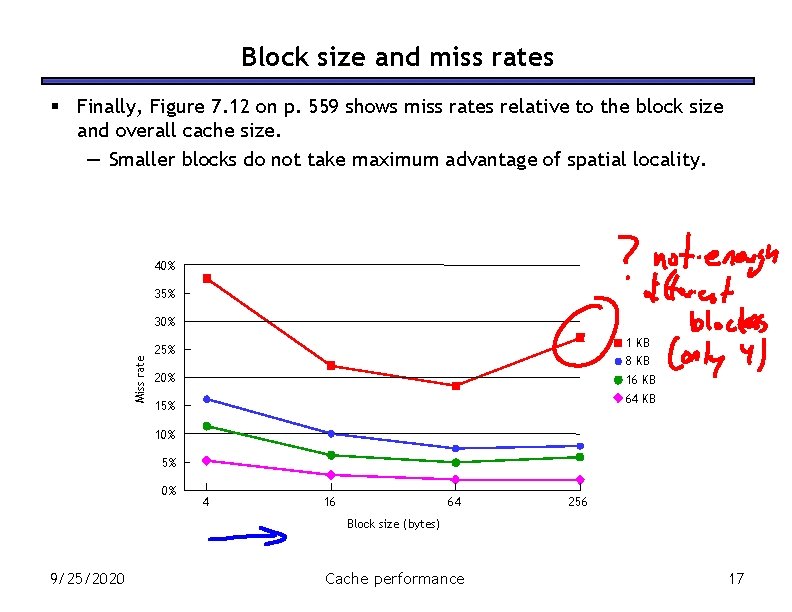
Block size and miss rates § Finally, Figure 7. 12 on p. 559 shows miss rates relative to the block size and overall cache size. — Smaller blocks do not take maximum advantage of spatial locality. 40% 35% Miss rate 30% 1 KB 25% 8 KB 20% 16 KB 64 KB 15% 10% 5% 0% 4 16 64 256 Block size (bytes) 9/25/2020 Cache performance 17
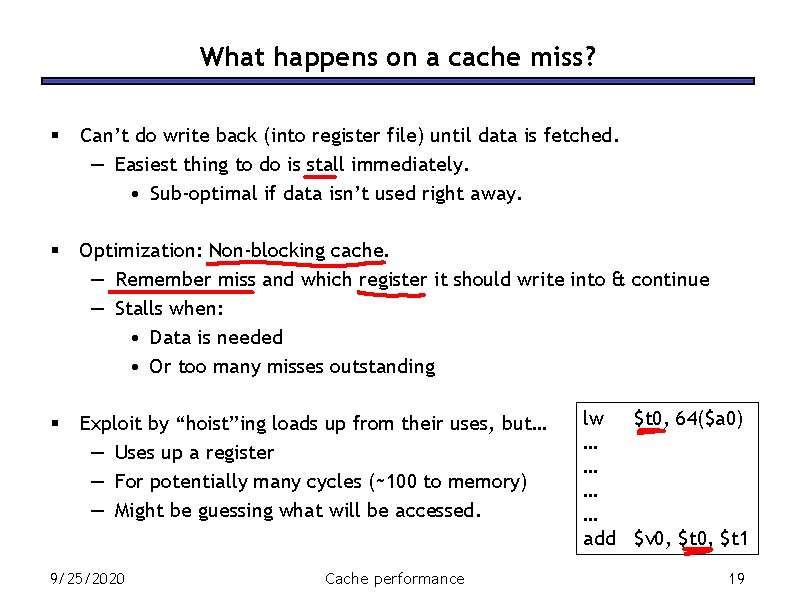
What happens on a cache miss? § Can’t do write back (into register file) until data is fetched. — Easiest thing to do is stall immediately. • Sub-optimal if data isn’t used right away. § Optimization: Non-blocking cache. — Remember miss and which register it should write into & continue — Stalls when: • Data is needed • Or too many misses outstanding § Exploit by “hoist”ing loads up from their uses, but… — Uses up a register — For potentially many cycles (~100 to memory) — Might be guessing what will be accessed. 9/25/2020 Cache performance lw $t 0, 64($a 0) … … add $v 0, $t 1 19
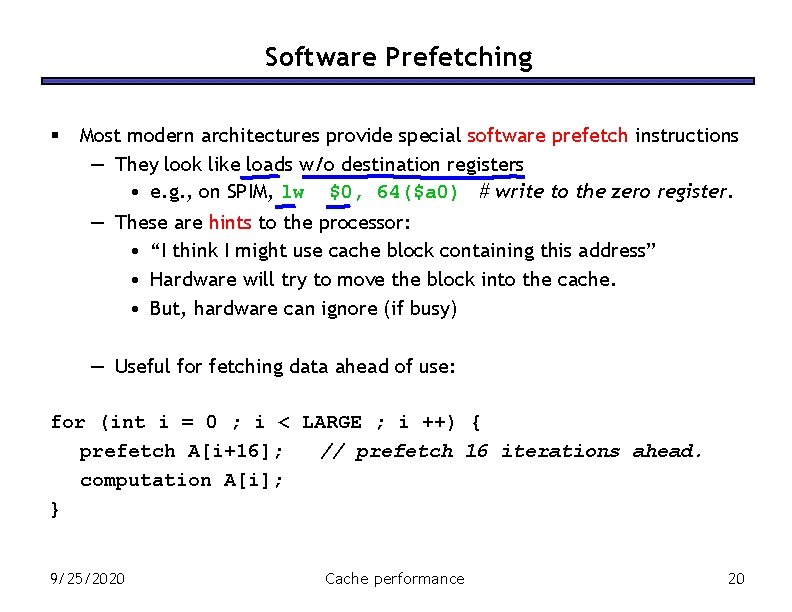
Software Prefetching § Most modern architectures provide special software prefetch instructions — They look like loads w/o destination registers • e. g. , on SPIM, lw $0, 64($a 0) # write to the zero register. — These are hints to the processor: • “I think I might use cache block containing this address” • Hardware will try to move the block into the cache. • But, hardware can ignore (if busy) — Useful for fetching data ahead of use: for (int i = 0 ; i < LARGE ; i ++) { prefetch A[i+16]; // prefetch 16 iterations ahead. computation A[i]; } 9/25/2020 Cache performance 20
Prefetching, cont. § Remember this graph? int array[SIZE]; int A = 0; Actual Data from remsun 2. ews. uiuc. edu for (int i = 0 ; i < 200000 ; ++ i) { for (int j = 0 ; j < SIZE ; ++ j) { A += array[j]; } } time 20 Intel Core 2 Duo 18 16 Time (in seconds) 14 12 10 time 8 6 size 4 2 0 0 9/25/2020 20000 Cache performance 40000 60000 SIZE 80000 100000 120000 21
Hardware Stream Prefetching int array[SIZE]; int A = 0; § Inner loop has very simple access pattern. — A, A+4, A+8, A+12, … — What is called a stream § § We can easily build hardware to recognize streams If we get a pair of sequential misses (blocks X, X+1), predict a stream. — Fetch the next two blocks (X+2, X+3) § Continue fetching the stream if the prefetch blocks accessed. — If X+2 is read/written, prefetch X+4 … § As confidence in stream increases, increase # of outstanding prefetches — If we get to X+8, have prefetches for X+9, X+10, X+11, X+12, X+13 § Can learn strides as well (X, X+16, X+32, …) and (X, X-1, X-2, …) 9/25/2020 Cache performance for (int i = 0 ; i < 200000 ; ++ i) { for (int j = 0 ; j < SIZE ; ++ j) { A += array[j]; } } 22
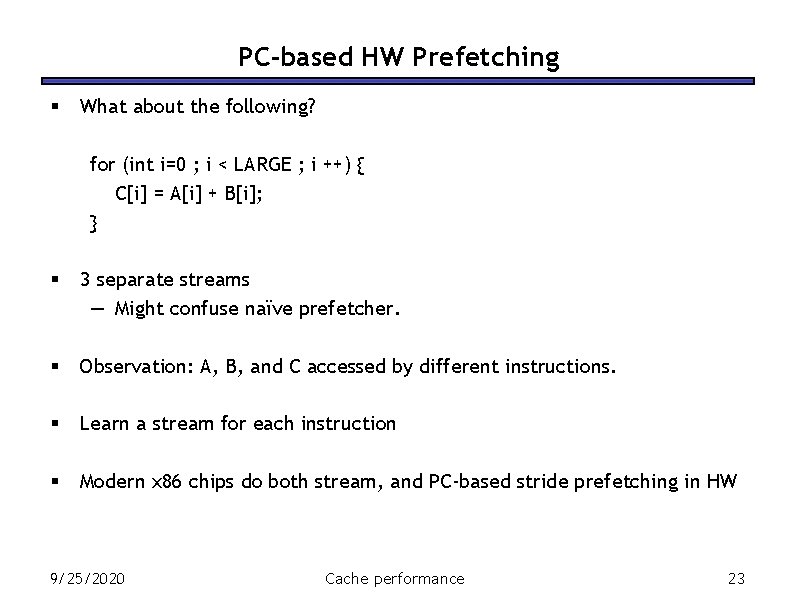
PC-based HW Prefetching § What about the following? for (int i=0 ; i < LARGE ; i ++) { C[i] = A[i] + B[i]; } § 3 separate streams — Might confuse naïve prefetcher. § Observation: A, B, and C accessed by different instructions. § Learn a stream for each instruction § Modern x 86 chips do both stream, and PC-based stride prefetching in HW 9/25/2020 Cache performance 23
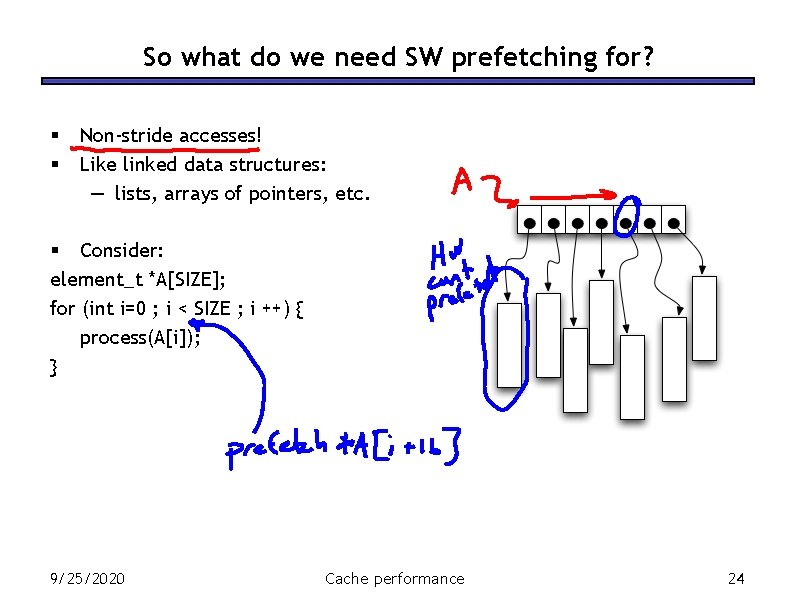
So what do we need SW prefetching for? § § Non-stride accesses! Like linked data structures: — lists, arrays of pointers, etc. § Consider: element_t *A[SIZE]; for (int i=0 ; i < SIZE ; i ++) { process(A[i]); } 9/25/2020 Cache performance 24
Summary § Writing to a cache poses a couple of interesting issues. — Write-through and write-back policies keep the cache consistent with main memory in different ways for write hits. — Write-around allocate-on-write are two strategies to handle write misses, differing in whether updated data is loaded into the cache. § Hardware prefetching handles most streams and strides. — We’ll talk later about 1 limitation. § Software prefetching is useful for linked data structures — Must be added by programmer (or very smart compiler) § Next time, we’ll look at cache-conscious programming. 9/25/2020 Cache performance 25