
Cache Coherence Recall the memory wall In multiprocessors
- Slides: 39
Cache Coherence • Recall the memory wall – In multiprocessors the wall might even be higher! – Contention on shared-bus – Time to travel through an interconnection network • In addition to the 3 C’s of the cache hierarchy – Cache coherence misses • Cache coherence protocols – Shared-bus: Snoopy protocols – Other interconnection schemes: Directory protocols Cache Coherence. CSE 471 1
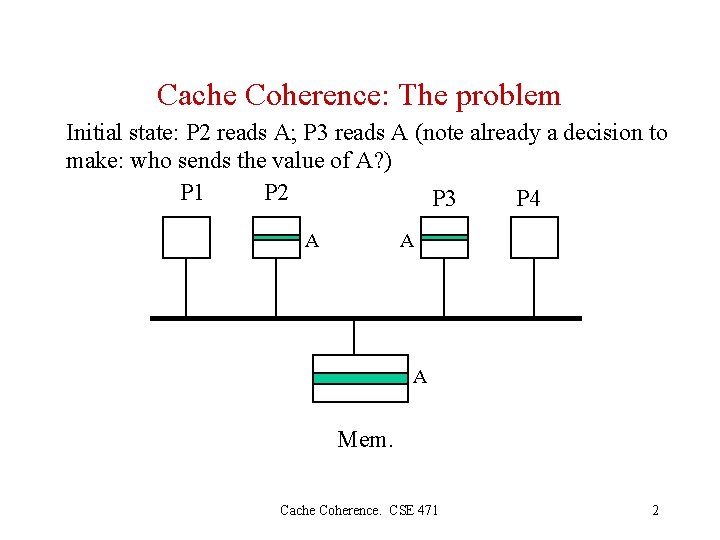
Cache Coherence: The problem Initial state: P 2 reads A; P 3 reads A (note already a decision to make: who sends the value of A? ) P 1 P 2 P 3 P 4 A A A Mem. Cache Coherence. CSE 471 2
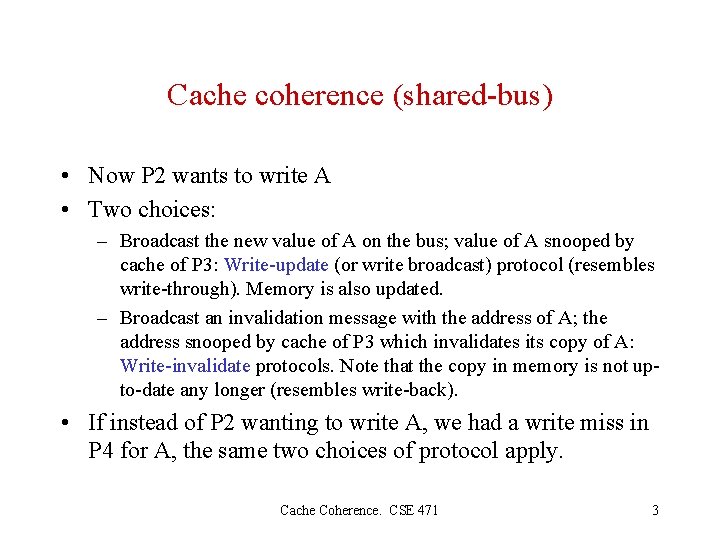
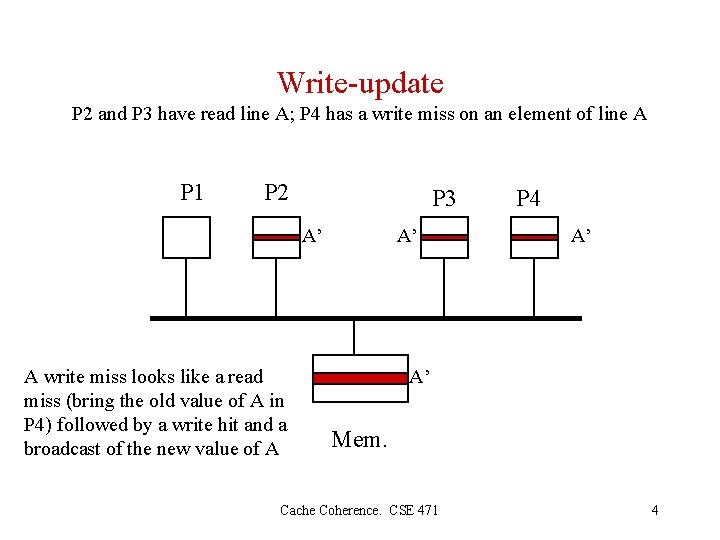
Cache coherence (shared-bus) • Now P 2 wants to write A • Two choices: – Broadcast the new value of A on the bus; value of A snooped by cache of P 3: Write-update (or write broadcast) protocol (resembles write-through). Memory is also updated. – Broadcast an invalidation message with the address of A; the address snooped by cache of P 3 which invalidates its copy of A: Write-invalidate protocols. Note that the copy in memory is not upto-date any longer (resembles write-back). • If instead of P 2 wanting to write A, we had a write miss in P 4 for A, the same two choices of protocol apply. Cache Coherence. CSE 471 3
Write-update P 2 and P 3 have read line A; P 4 has a write miss on an element of line A P 1 P 2 P 3 A’ A write miss looks like a read miss (bring the old value of A in P 4) followed by a write hit and a broadcast of the new value of A A’ P 4 A’ A’ Mem. Cache Coherence. CSE 471 4
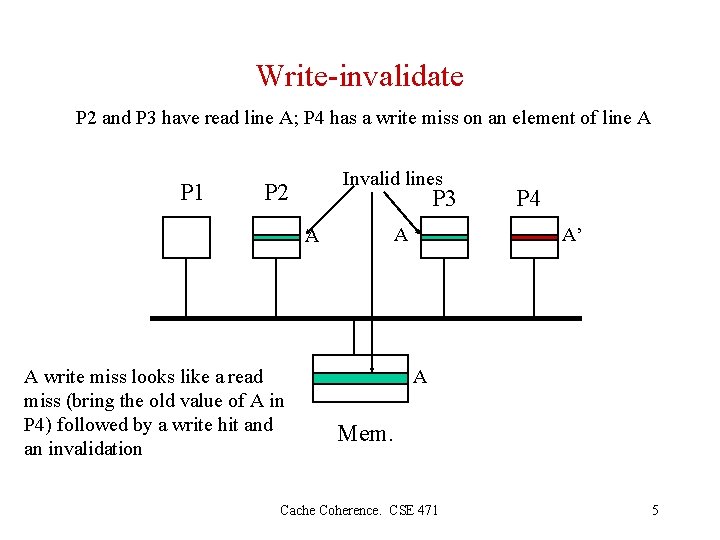
Write-invalidate P 2 and P 3 have read line A; P 4 has a write miss on an element of line A P 1 Invalid lines P 2 P 3 A A write miss looks like a read miss (bring the old value of A in P 4) followed by a write hit and an invalidation A P 4 A’ A Mem. Cache Coherence. CSE 471 5
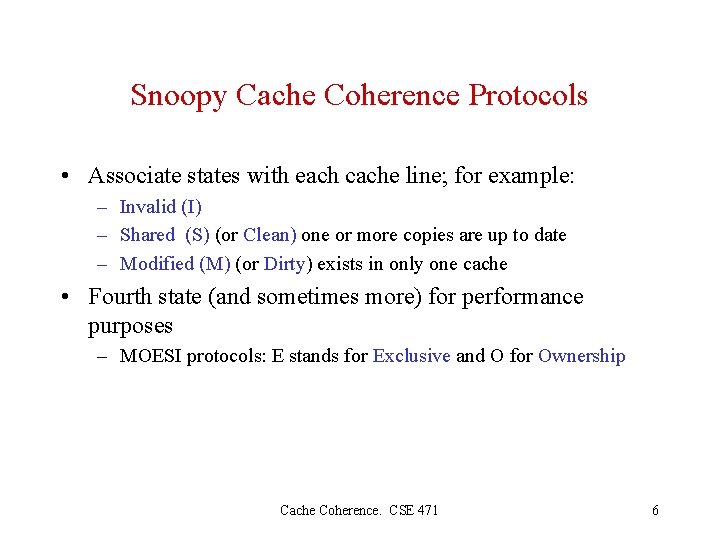
Snoopy Cache Coherence Protocols • Associate states with each cache line; for example: – Invalid (I) – Shared (S) (or Clean) one or more copies are up to date – Modified (M) (or Dirty) exists in only one cache • Fourth state (and sometimes more) for performance purposes – MOESI protocols: E stands for Exclusive and O for Ownership Cache Coherence. CSE 471 6
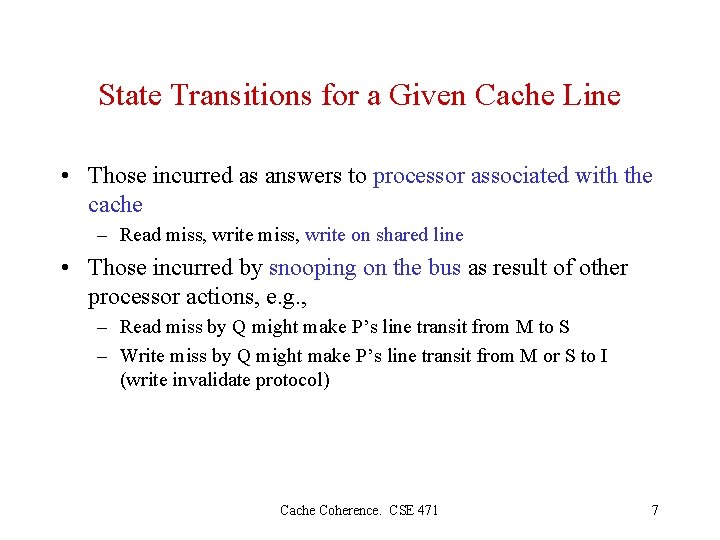
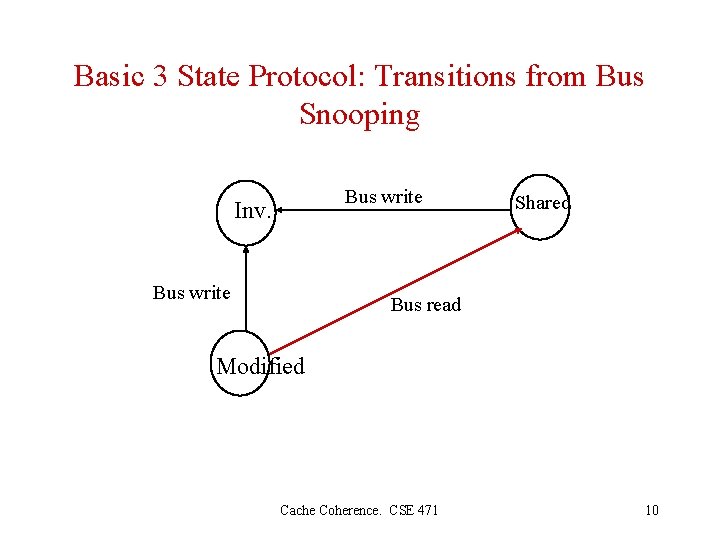
State Transitions for a Given Cache Line • Those incurred as answers to processor associated with the cache – Read miss, write on shared line • Those incurred by snooping on the bus as result of other processor actions, e. g. , – Read miss by Q might make P’s line transit from M to S – Write miss by Q might make P’s line transit from M or S to I (write invalidate protocol) Cache Coherence. CSE 471 7
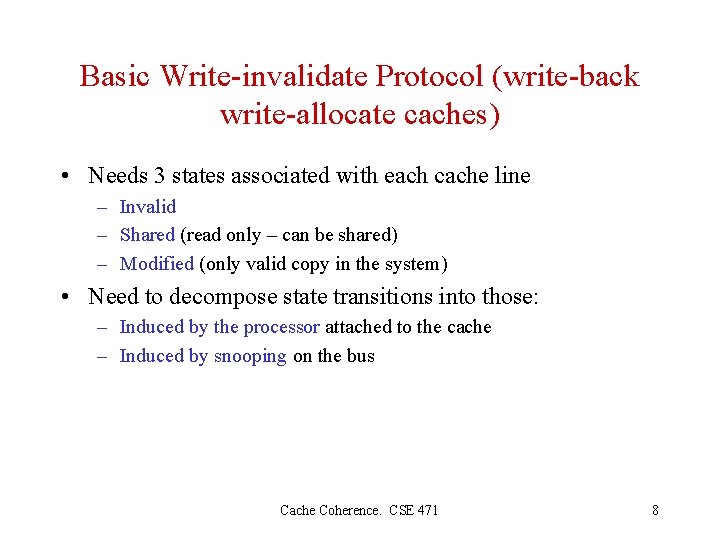
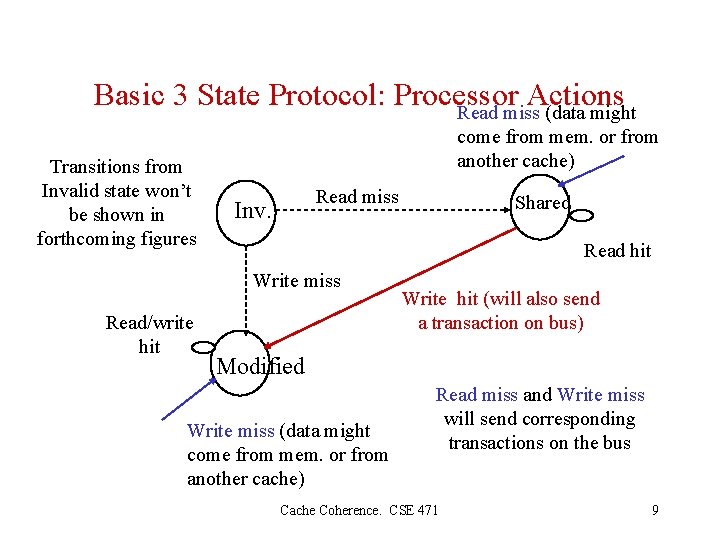
Basic Write-invalidate Protocol (write-back write-allocate caches) • Needs 3 states associated with each cache line – Invalid – Shared (read only – can be shared) – Modified (only valid copy in the system) • Need to decompose state transitions into those: – Induced by the processor attached to the cache – Induced by snooping on the bus Cache Coherence. CSE 471 8
Basic 3 State Protocol: Processor Actions Read miss (data might Transitions from Invalid state won’t be shown in forthcoming figures come from mem. or from another cache) Read miss Inv. Read hit Write miss Read/write hit Shared Write hit (will also send a transaction on bus) Modified Write miss (data might come from mem. or from another cache) Read miss and Write miss will send corresponding transactions on the bus Cache Coherence. CSE 471 9
Basic 3 State Protocol: Transitions from Bus Snooping Bus write Inv. Bus write Shared Bus read Modified Cache Coherence. CSE 471 10
Snoopy protocol implementation • Simple 3 -state fsm? • Yes but – Many more “internal states” because of write buffers, lock-up free caches, prefetching, split-transaction bus etc. – Example: split-transaction bus. Caches A and B have line L in state I and cache C has it in state S. Both A and B want to write L at the same time. – Split-transaction means for A and B (in this case) “Request to read” and for C “Data transfer” But the 2 “Request for read” should not arrive at C before the “Data transfer”. Need for intermediate states Cache Coherence. CSE 471 11
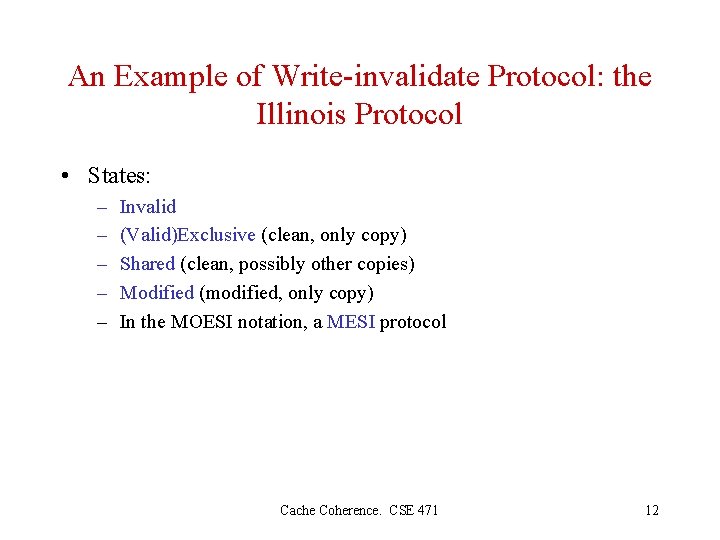
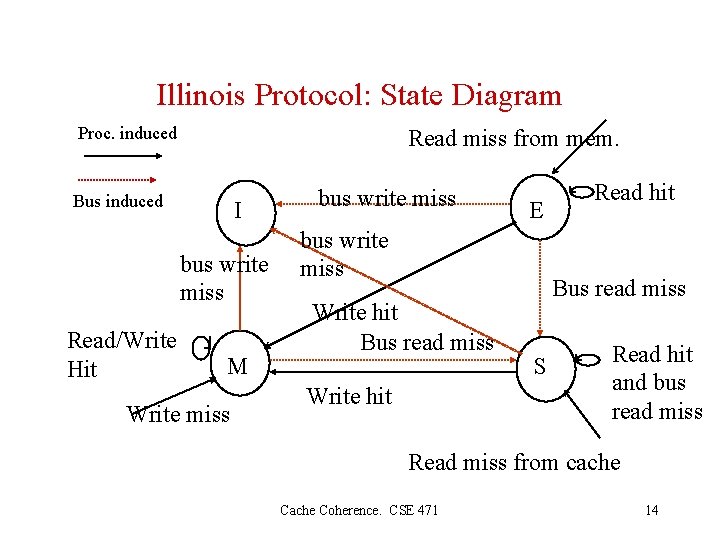
An Example of Write-invalidate Protocol: the Illinois Protocol • States: – – – Invalid (Valid)Exclusive (clean, only copy) Shared (clean, possibly other copies) Modified (modified, only copy) In the MOESI notation, a MESI protocol Cache Coherence. CSE 471 12
Illinois Protocol: Design Decisions • The Exclusive state is there to enhance performance – On a write to a line in E state, no need to send an invalidation message (occurs often for private variables). • On a read miss with no cache having the line in Modified state – Who sends the data: memory or cache (if any)? • Answer: cache for that particular protocol; other protocols might use the memory – If more than one cache, which one? • Answer: the first to grab the bus (tri-state devices) Cache Coherence. CSE 471 13
Illinois Protocol: State Diagram Proc. induced Read miss from mem. Bus induced I bus write miss Read/Write Hit M Write miss bus write miss E bus write miss Write hit Bus read miss Write hit Read hit Bus read miss S Read hit and bus read miss Read miss from cache Coherence. CSE 471 14
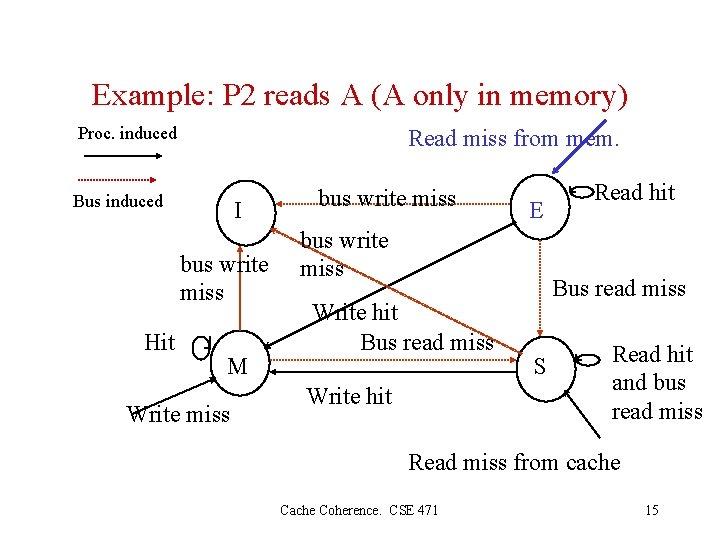
Example: P 2 reads A (A only in memory) Proc. induced Read miss from mem. Bus induced I bus write miss Hit M Write miss bus write miss E bus write miss Write hit Bus read miss Write hit Read hit Bus read miss S Read hit and bus read miss Read miss from cache Coherence. CSE 471 15
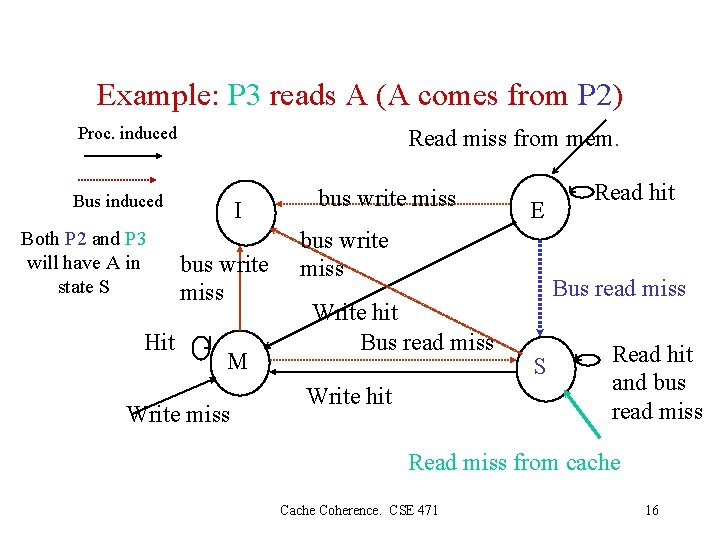
Example: P 3 reads A (A comes from P 2) Proc. induced Read miss from mem. Bus induced Both P 2 and P 3 will have A in state S Hit I bus write miss M Write miss bus write miss E bus write miss Write hit Bus read miss Write hit Read hit Bus read miss S Read hit and bus read miss Read miss from cache Coherence. CSE 471 16
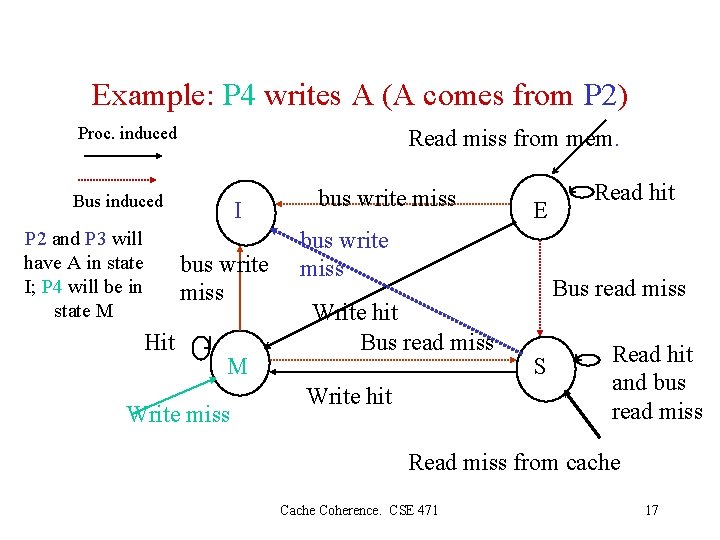
Example: P 4 writes A (A comes from P 2) Proc. induced Read miss from mem. Bus induced P 2 and P 3 will have A in state I; P 4 will be in state M I bus write miss Hit M Write miss bus write miss E bus write miss Write hit Bus read miss Write hit Read hit Bus read miss S Read hit and bus read miss Read miss from cache Coherence. CSE 471 17
Cache Parameters for Multiprocessors • In addition to the 3 C’s types of misses, add a 4 th C: coherence misses • As cache sizes increase, the misses due to the 3 C’s decrease but coherence misses increase • Shared data has been shown to have less spatial locality than private data; hence large line sizes could be detrimental • Large line sizes induce more false sharing – P 1 writes the first part of line A; P 2 writes the second part. From the coherence protocol viewpoint, both look like “write A” Cache Coherence. CSE 471 18
Performance of Snoopy Protocols • Protocol performance depends on the length of a write run • Write run: sequence of write references by 1 processor to a shared address (or shared line) uninterrupted by either access by another processor or replacement – Long write runs better to have write invalidate – Short write runs better to have write update • There have been proposals to make the choice between protocols at run time – Competitive algorithms Cache Coherence. CSE 471 19
What About Cache Hierarchies? • Implement snoopy protocol at L 2 (board-level) cache • Impose multilevel inclusion property – Encode in L 2 whether the line (or part of it if lines in L 2 are longer than lines in L 1) is in L 1 (1 bit/line or subblock) – Disrupt L 1 on bus transactions from other processors only if data is there, i. e. , L 2 shields L 1 from unnecessary checks – Total inclusion might be expensive (need for large associativity) if several L 1’s share a common L 2 (like in clusters). Instead use partial inclusion (i. e. , possibility of slightly over invalidating L 1) Cache Coherence. CSE 471 20
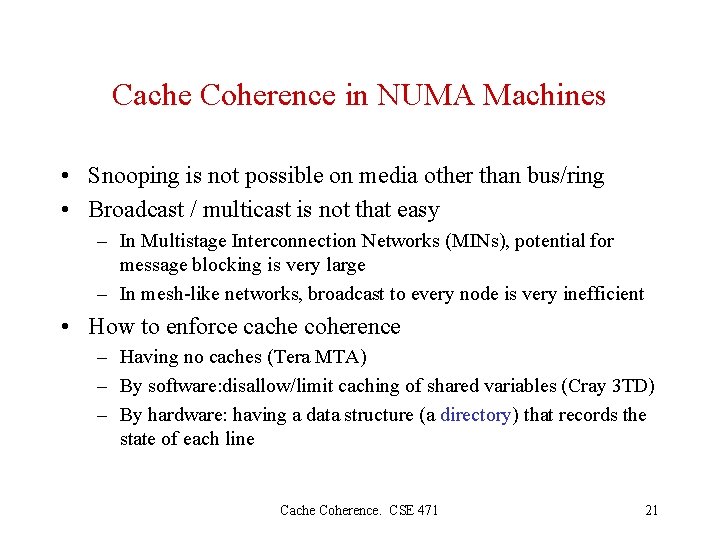
Cache Coherence in NUMA Machines • Snooping is not possible on media other than bus/ring • Broadcast / multicast is not that easy – In Multistage Interconnection Networks (MINs), potential for message blocking is very large – In mesh-like networks, broadcast to every node is very inefficient • How to enforce cache coherence – Having no caches (Tera MTA) – By software: disallow/limit caching of shared variables (Cray 3 TD) – By hardware: having a data structure (a directory) that records the state of each line Cache Coherence. CSE 471 21
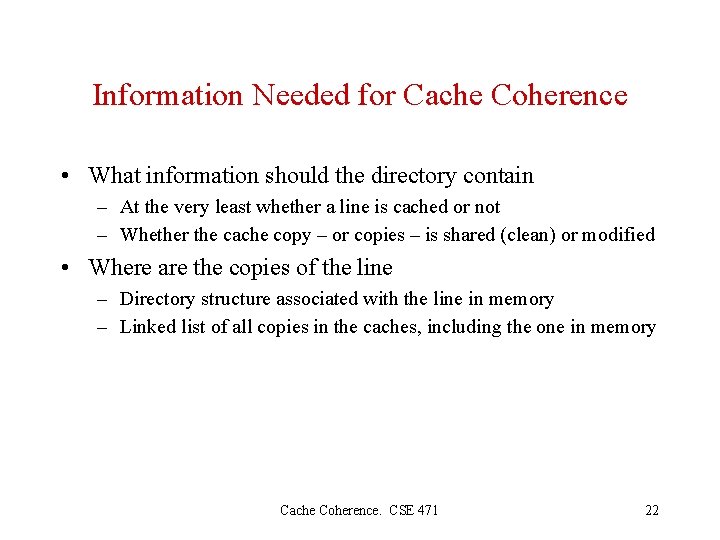
Information Needed for Cache Coherence • What information should the directory contain – At the very least whether a line is cached or not – Whether the cache copy – or copies – is shared (clean) or modified • Where are the copies of the line – Directory structure associated with the line in memory – Linked list of all copies in the caches, including the one in memory Cache Coherence. CSE 471 22
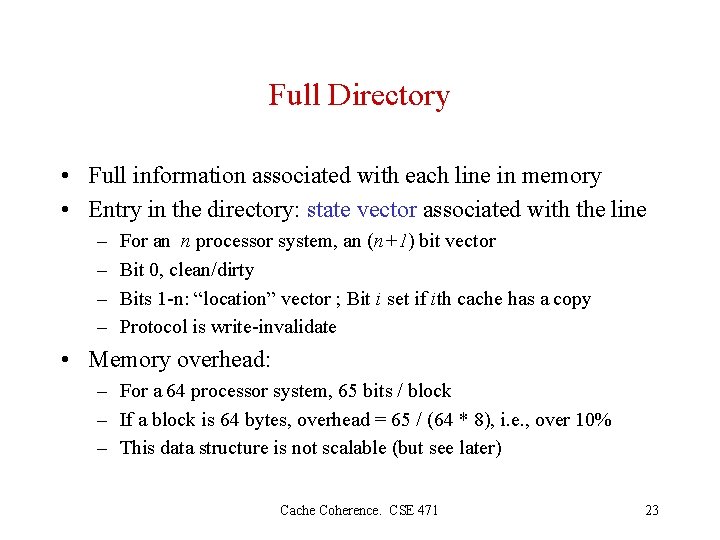
Full Directory • Full information associated with each line in memory • Entry in the directory: state vector associated with the line – – For an n processor system, an (n+1) bit vector Bit 0, clean/dirty Bits 1 -n: “location” vector ; Bit i set if ith cache has a copy Protocol is write-invalidate • Memory overhead: – For a 64 processor system, 65 bits / block – If a block is 64 bytes, overhead = 65 / (64 * 8), i. e. , over 10% – This data structure is not scalable (but see later) Cache Coherence. CSE 471 23
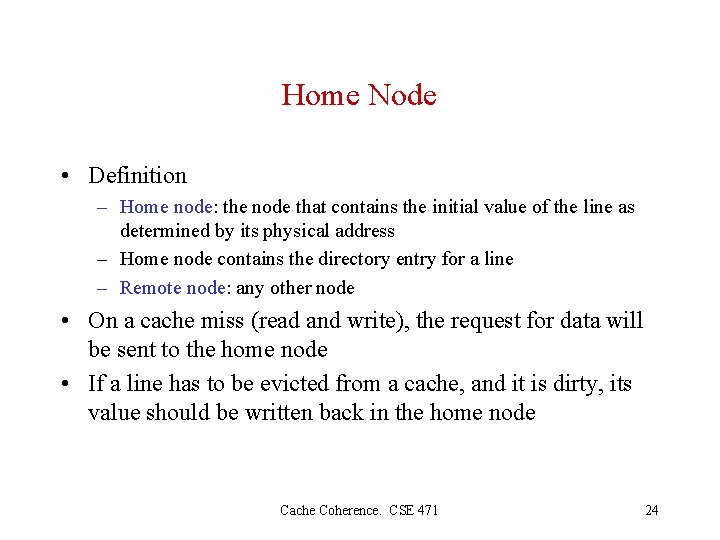
Home Node • Definition – Home node: the node that contains the initial value of the line as determined by its physical address – Home node contains the directory entry for a line – Remote node: any other node • On a cache miss (read and write), the request for data will be sent to the home node • If a line has to be evicted from a cache, and it is dirty, its value should be written back in the home node Cache Coherence. CSE 471 24
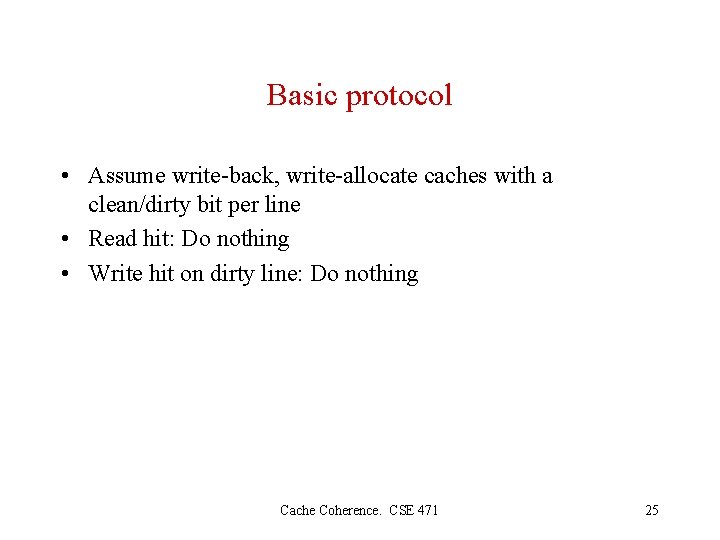
Basic protocol • Assume write-back, write-allocate caches with a clean/dirty bit per line • Read hit: Do nothing • Write hit on dirty line: Do nothing Cache Coherence. CSE 471 25
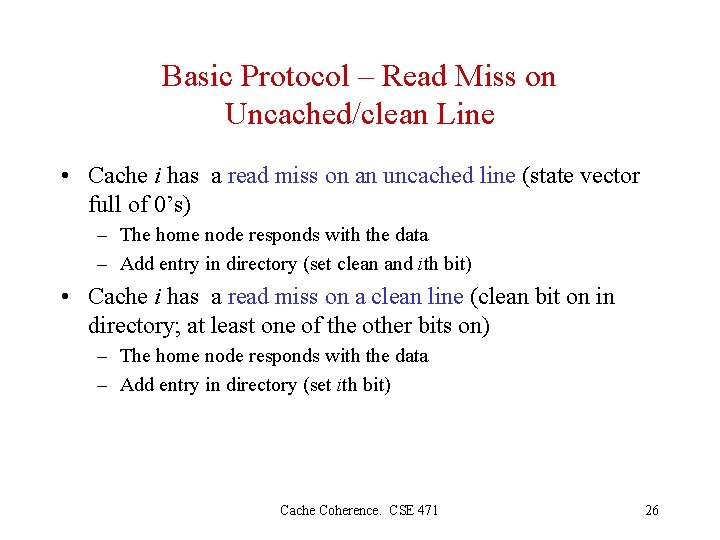
Basic Protocol – Read Miss on Uncached/clean Line • Cache i has a read miss on an uncached line (state vector full of 0’s) – The home node responds with the data – Add entry in directory (set clean and ith bit) • Cache i has a read miss on a clean line (clean bit on in directory; at least one of the other bits on) – The home node responds with the data – Add entry in directory (set ith bit) Cache Coherence. CSE 471 26
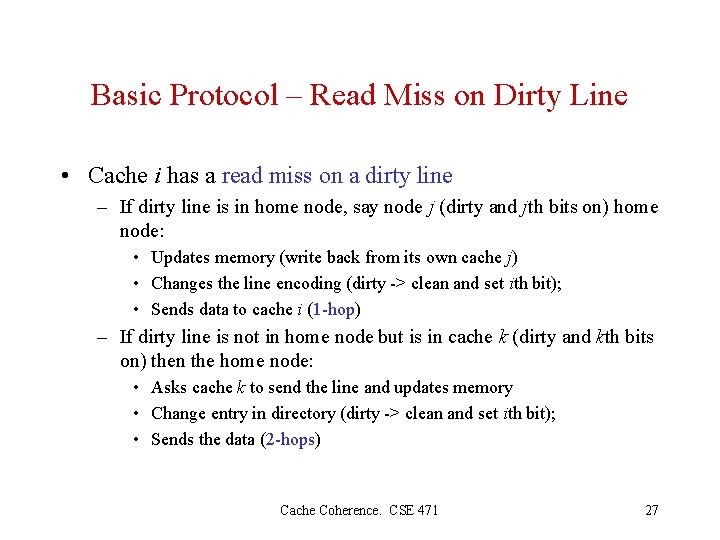
Basic Protocol – Read Miss on Dirty Line • Cache i has a read miss on a dirty line – If dirty line is in home node, say node j (dirty and jth bits on) home node: • Updates memory (write back from its own cache j) • Changes the line encoding (dirty -> clean and set ith bit); • Sends data to cache i (1 -hop) – If dirty line is not in home node but is in cache k (dirty and kth bits on) then the home node: • Asks cache k to send the line and updates memory • Change entry in directory (dirty -> clean and set ith bit); • Sends the data (2 -hops) Cache Coherence. CSE 471 27
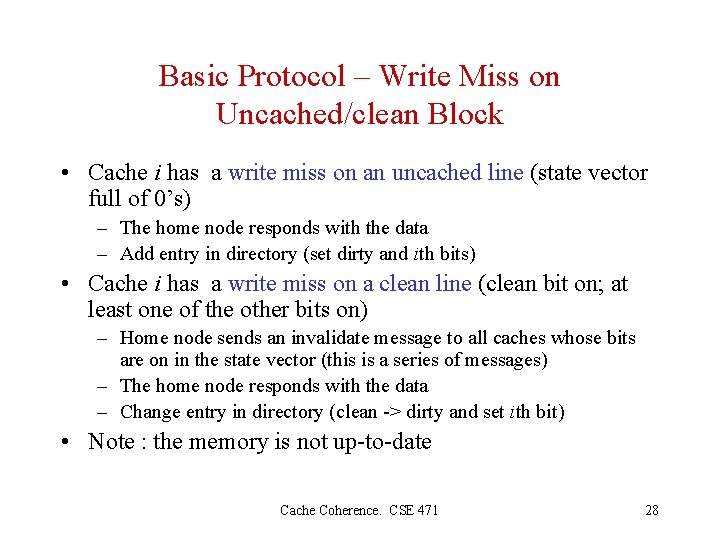
Basic Protocol – Write Miss on Uncached/clean Block • Cache i has a write miss on an uncached line (state vector full of 0’s) – The home node responds with the data – Add entry in directory (set dirty and ith bits) • Cache i has a write miss on a clean line (clean bit on; at least one of the other bits on) – Home node sends an invalidate message to all caches whose bits are on in the state vector (this is a series of messages) – The home node responds with the data – Change entry in directory (clean -> dirty and set ith bit) • Note : the memory is not up-to-date Cache Coherence. CSE 471 28
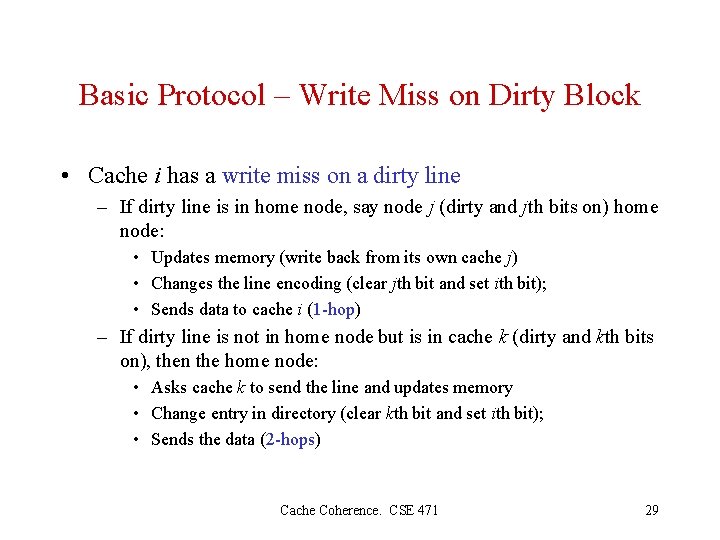
Basic Protocol – Write Miss on Dirty Block • Cache i has a write miss on a dirty line – If dirty line is in home node, say node j (dirty and jth bits on) home node: • Updates memory (write back from its own cache j) • Changes the line encoding (clear jth bit and set ith bit); • Sends data to cache i (1 -hop) – If dirty line is not in home node but is in cache k (dirty and kth bits on), then the home node: • Asks cache k to send the line and updates memory • Change entry in directory (clear kth bit and set ith bit); • Sends the data (2 -hops) Cache Coherence. CSE 471 29
Basic Protocol – Request to Write a Clean Block • Cache i wants to write one of its lines which is clean – Known because clean/dirty bits also exist in the cache metadata – Perform as in write miss on a clean block except that the memory does not have to send the data Cache Coherence. CSE 471 30
Basic Protocol - Replacing a Line • What happens when a line is replaced – If dirty, it is of course written back and its state becomes a vector of 0’s – If clean could either “do nothing” but then encoding is wrong leading to possibly unneeded invalidations (and acks) or could send message and modify state vector accordingly (reset corresponding bit) – Acks are necessary to ensure correctness mostly if messages can be delivered out of order Cache Coherence. CSE 471 31
The Most Economical (Memory-wise) Protocol • Recall the minimal number of states needed – Not cached anywhere (i. e. , valid in home memory) – Cached in one or more caches but not modified (clean) – Cached in one cache and modified (dirty) • Simply encode the states (2 -bit protocol) and perform broadcast invalidations (expensive because most often the data is not shared by many processors) • Fourth state to enhance performance, say exclusive (E): – Cached in one cache only and still clean: no need to broadcast invalidations on a request for that cache to write its clean line. The cache metadata must include an Exclusive state also (set on reading a line that is not cached anywhere) Cache Coherence. CSE 471 32
2 -bit Protocol • Differences with full directory protocol – Of course no bit setting in “location” vector – On a read miss to uncached line go to state exclusive (in directory and in cache) – On “request to write a clean line” from a cache that has the line in exclusive state, if the line is still in exclusive state in the directory, no need to broadcast invalidations – On a read miss to an exclusive line, change state to clean – On a write miss to clean and to exclusive line from another cache and read/write miss to dirty line, need to send a broadcast invalidate signal to all processors; in the case of dirty, the one with the copy of the line will send it back along with its ack. Cache Coherence. CSE 471 33
Need for Partial Directories • Full directory not scalable. – Location vector depends on number of processors – Might become too much memory overhead • 2 -bit protocol invalidations are costly • Observation: Sharing is often limited to a small number of processors – Instead of full directory, have room for a limited number of processor id’s. Cache Coherence. CSE 471 34
Examples of Partial Directories • Coarse bit-vector – Share a “location” bit among 2 or 4 or 8 processors etc. – Advantage: scalable since fixed amount of memory/line • Dynamic pointer (many variations) – Directory for a block has 1 bit for local cache, one or more fields for a limited number of other caches, and possibly a pointer to a linked list in memory for overflow. – Need to “reclaim” pointers on clean replacements and/or to invalidate blindly if there is overflow – Protocols are Diri. B (i pointers and broadcast) or Diri. NB (i pointers and No Broadcast, i. e. , forced invalidations) Cache Coherence. CSE 471 35
Directories in the Cache -- The SCI Approach • Copies of lines residing in various caches are linked via a doubly linked list – Doubly linked so that it is easy to insert/delete • Header in the line’s home node memory – Insertions “between” home node and new cache • Economical in memory space – Proportional to cache space rather than memory space • Invalidations can be lengthy (list traversal) Cache Coherence. CSE 471 36
A Caveat about Cache Coherence Protocols • They are more complex in the details than they look! • Snoopy protocols – Writes are not atomic (first detect write miss and send request on the bus; then get line and write data -- only then should the line become dirty) – The cache controller must implement “pending states” for situations which would allow more than one cache to write data in a linek, or replace a dirty line, i. e. , write in memory – Things become more complex for split-transaction buses – Things become even more complex for lock-up free caches (but it’s manageable) Cache Coherence. CSE 471 37
Subtleties in Directory Protocols • No transaction is atomic. • If they were treated as atomic, deadlock could occur – – Assume line A from home node X is dirty in P 1 Assume line B from home node Y is dirty in P 2 P 1 reads miss on B and P 2 reads miss on A Home node Y generates a “purge” for B in P 2 and Home node X generates a “purge” for A in P 1 – Both P 1 and P 2 wait for their read misses and cannot answer the home node purges hence deadlock. • So assume non-atomicity of transactions and allow only one in-flight transaction per line (nack any other while one is in progress) Cache Coherence. CSE 471 38
Problems with Buffering • Directory and cache controllers might have to send/receive many messages at the same time – Protocols must take into account finite amount of buffers – This leads to possibility of deadlocks – This is even more important for 2 -bit protocol with lots of broadcasts – Solutions involve one or more of the following • separate networks for requests and replies so that requests don’t block replies which free buffer space • each request reserves buffer room for its reply • use of nacks and of retries Cache Coherence. CSE 471 39