
CACFP Training for New Staff CACFP Overview Child


- Slides: 71
CACFP Training for New Staff
CACFP Overview Child and Adult Care Food Program: A federal program that provides reimbursement to centers, day care homes, adult day services, outside school age programs, and at risk sites for qualifying meals and snacks served to participants. Its goal is to help improve and maintain the health and nutritional well being of children and adults in care while promoting the development of good eating habits. Programs serve Children age 12 and younger Migrant children age 15 and under Youth through age 18 in At Risk programs & Emergency Shelters Adult participants who are functionally impaired & Adults over 60 years of age enrolled in Adult day services
Applicants � Licensed Child Care Centers (Independent or Multi-Sponsored) ◦ Non Profits ◦ Incorporated For Profits ◦ Head Start Centers (25% of the children enrolled must be approved for Free or Reduced) � Emergency Shelters � After School At Risk Snack and Supper programs � Outside School Age Programs( OSHCC) � Licensed Adult Day Centers � Licensed & Legal Unregulated Home Daycare Providers through Sponsorships
TRAINING REQUIREMENTS 7 CFR 226. 16(d)(2)(3) 7 CFR 226. 17 (b)(10) � In House Training is required for staff prior to participation � Annually thereafter � The State Agency will ensure that content and frequency is in compliance when reviewed ◦ Dated Attendance record, sign in sheet and agenda with the location of the training
Training Topics for New Staff � Record ◦ ◦ ◦ Keeping Requirements* Eligibility Meal counts* Portion Menu* Attendance- time in and out Budgets/tracking systems/receipts Required forms, posters, statements � Meal Patterns � Point of Service � Civil Rights* � Claim Submission * � Reimbursement Systems* � Claim Review Procedures*
�RECORDKEEPING REQUIREMENTS
Recordkeeping Maintenance 7 CFR 226. 10(d) 226. 15€ � All CACFP records must be kept for at least 3 years. Check for last state audit that may require records be kept until the audit is complete. ◦ ◦ ◦ ◦ � � Current year and previous year must be kept onsite Income Eligibility Forms for all attending participants if required Monthly Free, Reduced, and Paid Lists All Claim Records Child Enrollments Provider Records Menus Meal counts Production reports/Portion Menu Copy of Agreement Memos Receipts Medical forms Proof of Training Race and Ethnicity Collection Previous years may be archived, but must be made immediately available upon request. Agency must have knowledge as to where they are stored and who has access. All files must be made available at the time of review if required
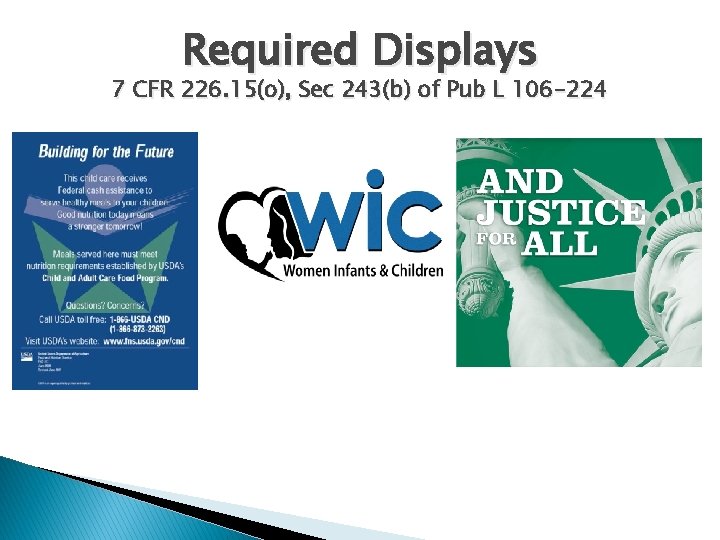
Required Displays 7 CFR 226. 15(o), Sec 243(b) of Pub L 106 -224
� � � Name changes Recordkeeping Changes to send to SA Address changes Tier changes License capacity changes Changes regarding the claiming of a provider’s own children and children enrolled in excess of licensed capacity Change of staff involved in the CACFP, i. e. , director, CACFP managers, financial staff, etc. (non- profits may need Board approval for authorized agreement or claim signers) Budgetary changes Enrollment numbers � Additions and Deletions for a Sponsored Center or Provider � Budgets with 15% increase or decrease *Updated license numbers & effective dates don’t need to be sent to SA, but must be recorded. ANY outdated license MUST be checked for renewal status before a Claim can be made for the home or center.
RECORDKEEPING REQUIREMENTS: Income Eligibility Determination
Home Provider Eligibility � � � All home providers must have a current valid daycare license and an approved agreement signed with their CACFP sponsoring organization. Every child enrolled must have a parent signed and dated enrollment form before program reimbursements can be received. Reimbursement for each provider is based on a Tier system. ◦ Tier 2: All providers are eligible for this lower reimbursement rate ◦ Tier 1: Providers are eligible to receive a higher reimbursement based on area school data, address census data, or provider income. � A completed Provider Income Eligibility Form is required for a Home provider eligible by their own income ◦ Tier 2 MIXED: The higher Tier rate can be received for individual children in care based on information gathered from a required eligibility form (“Dear Parent T 2”).
Center Eligibility � All independent and center sponsors must have a current approved signed agreement with the SA that includes an estimated number of children/adults that may be eligible in “Free”, “Reduced Price”, or “Paid” categories, determined with completed Income Eligibility Forms. (IEF’s) � Income Eligibility Forms ( IEF’s) are NOT REQUIRED for children residing in Emergency Shelters or At Risk After School Care Programs. These children are automatically categorized as “Free. ”
Eligibility Form Distribution & Collection 7 CFR 226. 23 € (1)(i) & 7 CFR 226. 23€(2) � Income Eligibility Forms ( IEF) and Free and Reduced Price Guidelines as well as instructions for filling out these forms are provided by email through the SA Agreement Administrator. � Approved IEF’s are valid for one year from the beginning of the month signed and must be updated yearly ◦ Agencies may choose the start date they will use for all clients- either the date signed by parent/guardian or by the agency staff. (Cannot pick and choose per client) � These forms and guidelines are reissued yearly by July 1. Any child signed up after July 1 should use most current IEF
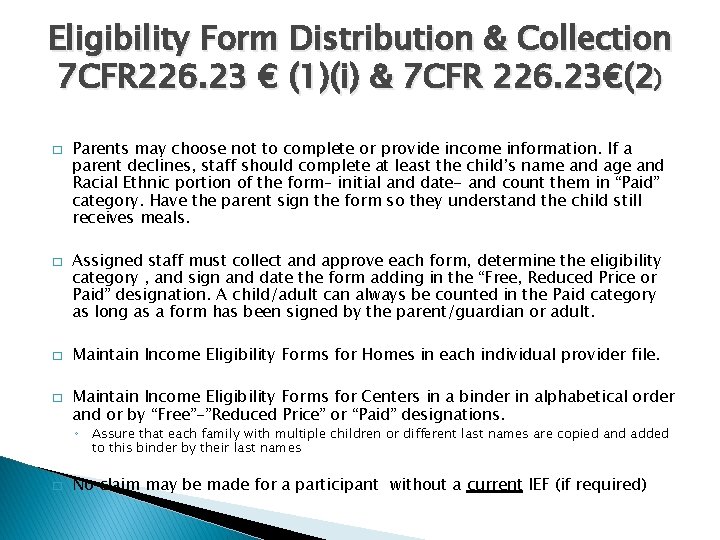
Eligibility Form Distribution & Collection 7 CFR 226. 23 € (1)(i) & 7 CFR 226. 23€(2) � � Parents may choose not to complete or provide income information. If a parent declines, staff should complete at least the child’s name and age and Racial Ethnic portion of the form– initial and date- and count them in “Paid” category. Have the parent sign the form so they understand the child still receives meals. Assigned staff must collect and approve each form, determine the eligibility category , and sign and date the form adding in the “Free, Reduced Price or Paid” designation. A child/adult can always be counted in the Paid category as long as a form has been signed by the parent/guardian or adult. Maintain Income Eligibility Forms for Homes in each individual provider file. Maintain Income Eligibility Forms for Centers in a binder in alphabetical order and or by “Free”-”Reduced Price” or “Paid” designations. ◦ Assure that each family with multiple children or different last names are copied and added to this binder by their last names � No claim may be made for a participant without a current IEF (if required)
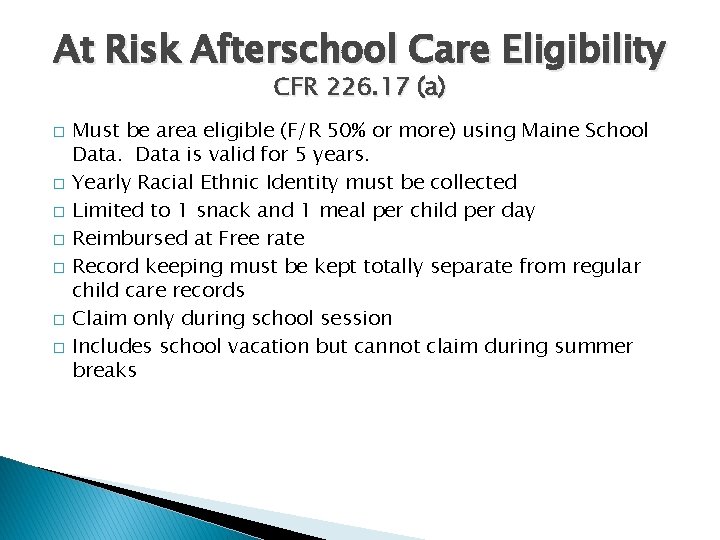
At Risk Afterschool Care Eligibility CFR 226. 17 (a) � � � � Must be area eligible (F/R 50% or more) using Maine School Data is valid for 5 years. Yearly Racial Ethnic Identity must be collected Limited to 1 snack and 1 meal per child per day Reimbursed at Free rate Record keeping must be kept totally separate from regular child care records Claim only during school session Includes school vacation but cannot claim during summer breaks
Tracking Free- Reduced and Paid Eligibility
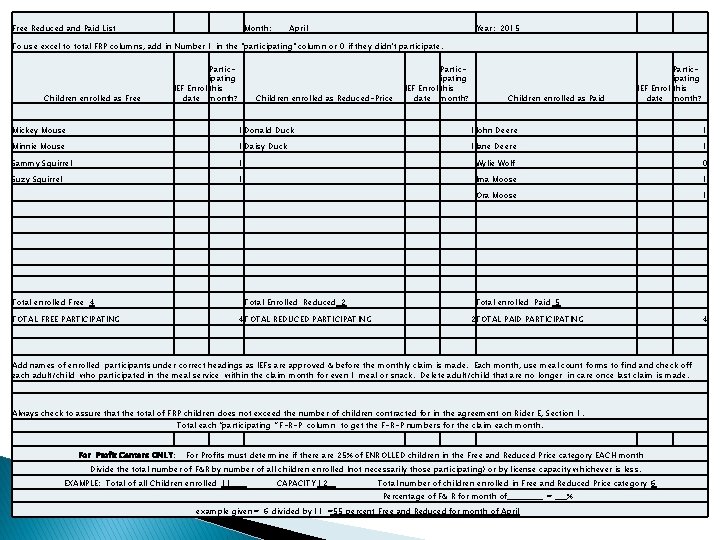
Free Reduced and Paid List Month: April Year: 2015 To use excel to total FRP columns, add in Number 1 in the "participating" column or 0 if they didn't participate. Children enrolled as Free Participating IEF Enrollthis date month? Children enrolled as Reduced-Price Participating IEF Enrollthis date month? Children enrolled as Paid Participating IEF Enrollthis date month? Mickey Mouse 1 Donald Duck 1 John Deere 1 Minnie Mouse 1 Daisy Duck 1 Jane Deere 1 Sammy Squirrel 1 Wylie Wolf 0 Suzy Squirrel 1 Ima Moose 1 Ora Moose 1 Total enrolled Free 4 Total Enrolled Reduced 2 Total enrolled Paid 5 TOTAL FREE PARTICIPATING 4 TOTAL REDUCED PARTICIPATING 2 TOTAL PAID PARTICIPATING 4 Add names of enrolled participants under correct headings as IEFs are approved & before the monthly claim is made. Each month, use meal count forms to find and check off each adult/child who participated in the meal service within the claim month for even 1 meal or snack. Delete adult/child that are no longer in care once last claim is made. Always check to assure that the total of FRP children does not exceed the number of children contracted for in the agreement on Rider E, Section 1. Total each “participating “ F-R-P column to get the F-R-P numbers for the claim each month. For Profit Centers ONLY: For Profits must determine if there are 25% of ENROLLED children in the Free and Reduced Price category EACH month Divide the total number of F&R by number of all children enrolled (not necessarily those participating) or by license capacity whichever is less. EXAMPLE: Total of all Children enrolled 11 CAPACITY 12 Total number of children enrolled in Free and Reduced Price category 6 Percentage of F& R for month of_____ = ___% example given= 6 divided by 11 =55 percent Free and Reduced for month of April
Tracking “Free, Reduced and Paid” Eligibility Each MONTH the center/agency must determine the number of adults/ children participating in each of the three categories (F-R-P) in order to claim meal benefits § Early each month, update this saved master list with the current date. Add all incoming IEFs to the list, as stated above. Add all new IEF’s to binder or file. Alphabetizing the names each month makes comparison with meal count forms easier. § Delete any child/adult from the F-R-P list that has left care and will no longer be claimed for meals that month. DO NOT destroy these IEF’s. Either leave in the binder for the fiscal year or add to a deleted section readily available for review. § If a adult/child is on the meal count form but is not listed on the FRP list and/or does not have a current IEF –the meals and snacks consumed cannot be claimed for reimbursement because the IEF is the enrollment form and current enrollment is required.
FOR PROFIT Center Eligibility � � For profit centers can receive meal benefits each month only if there are 25 % of enrolled (not participating) adults or children eligible for Free or Reduced Price meals. Each month, the 25% qualifier must be determined, and no claim may be filed for centers in which fewer than 25% of enrolled participants fall below 185% of the Federal Poverty Guidelines. * Using a separate F-R-P list for each center, determine the number of children/adults enrolled. *Divide this number by the total licensed capacity or the total enrolled – whichever is less. * Add this information to each center’s F-R-P list.
RECORD KEEPING REQUIREMENTS: MEAL COUNTS & Point of Service
Meal Counts 7 CFR 226. 15€(4) 7 CFR 226 -17(b)(9) � Centers complete meal counts at the Point of Service � Day Care Home providers complete meal counts by the end of each day � Attendance records must be kept, and a separate record must be kept for meal counts
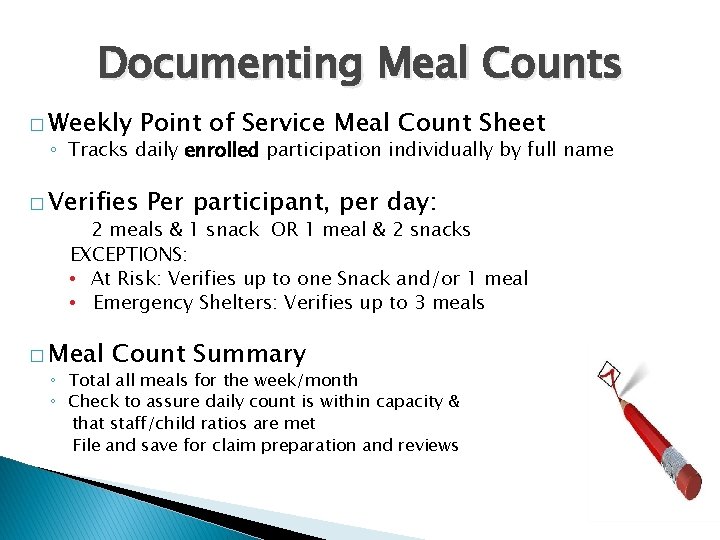
Documenting Meal Counts � Weekly Point of Service Meal Count Sheet ◦ Tracks daily enrolled participation individually by full name � Verifies Per participant, per day: 2 meals & 1 snack OR 1 meal & 2 snacks EXCEPTIONS: • At Risk: Verifies up to one Snack and/or 1 meal • Emergency Shelters: Verifies up to 3 meals � Meal Count Summary ◦ Total all meals for the week/month ◦ Check to assure daily count is within capacity & that staff/child ratios are met File and save for claim preparation and reviews
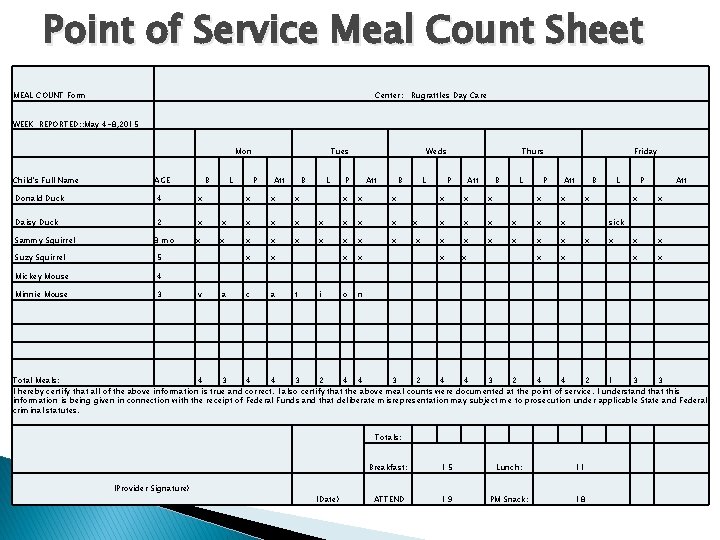
Point of Service Meal Count Sheet MEAL COUNT Form Center: Rugrattles Day Care WEEK REPORTED: : May 4 -8, 2015 Mon Child's Full Name AGE Donald Duck 4 x x x x x Daisy Duck 2 x x x x sick Sammy Squirrel 8 mo x x x x x Suzy Squirrel 5 x x x x x x Mickey Mouse 4 Minnie Mouse 3 v a c a t i o n B L Tues P Att B L Weds P Att B L Thurs P Att B L Friday P Att B L P x Att x Total Meals: 4 3 4 4 3 2 4 4 2 1 3 3 I hereby certify that all of the above information is true and correct. I also certify that the above meal counts were documented at the point of service. I understand that this information is being given in connection with the receipt of Federal Funds and that deliberate misrepresentation may subject me to prosecution under applicable State and Federal criminal statutes. Totals: (Provider Signature) (Date) Breakfast: 15 Lunch: 11 ATTEND 19 PM Snack: 18
Infant Meal Count � Always add Infants to the daily/weekly meal count sheet. � Infant meals do not have to follow the meal times listed for older children - they are fed as needed- up to 2 meals and 1 snack per day.
Claim Submission and Review Procedure � � � Claims must be submitted/postmarked to CACFP within 60 calendar days of the last day of the claim month. This includes all the first time submissions as well as any upwards revisions. CACFP will use the date stamped by the post office as date mailed. What is your edit check method? Claims must be error free. When a claim is submitted with an error, it must be corrected and postmarked/received by the original 60 calendar day deadline date. If an invalid or incomplete claim is sent, the Financial Resource Specialist will, by email, contact the person who signed the claim form. An email response to the correction that should be made will be attached to the original claim form. Claims must be processed within 45 days by CACFP and the DHHS Financial Services Center. CACFP will notify institutions within 15 days of receipt of any incomplete or incorrect claim which must be revised for payment. The SA will explain the reasons that the claim cannot be processed as received, as part of the notification. If the State agency disallows any payment the Right of Appeals will be included.
It is the procedure of the DHHS Financial Services Center and CACFP that if a check is lost due to mail delivery, a vendor must wait 30 calendar days to have a check reissued. 1 in 3 exception policy: If a claim is not submitted within 60 calendar days from the end of the claim month, you can request a 1 in 3 exception to get the claim paid. The Agreement Administrator will request a corrective action plan from the sponsor/institution requesting the one in three. The one in three will not be granted until the corrective action plan has been accepted and reviewed. If requesting for multiple months the one and three can only pay one claim. State agency must provide appeal rights when request to FNS is denied.
RECORD KEEPING REQUIREMENTS �Menus, Portion Menus and Production Reports
MENUS � Menus for ages 1 and over must list specific components served that meet each meal pattern within USDA guidelines ◦ Breakfast- Lunch/Supper- AM, PM, or Evening Snack � Must � Any be posted daily menu/component change must be made to the posted menu before the meal/snack is served.
Menu Disclaimers: � � � Must include Civil Rights non-discrimination statement if sent or published off site “This institution is an equal opportunity provider” it must be the same size font as the rest of the document Must include 100% juice disclaimer juice. ” “All juices served are 100% Must include milk disclaimer or be able to show requirement compliance “Participants 24 months and older will be served 1 % or fat-free milk. ” Whole milk is recommended for children 12 -23 months � � Identify the main ingredients counted in a mixed fruit /vegetable item. Identify the main components counted in a main dish. (Pizza, casseroles, sandwiches).
CACFP MEAL PATTERN REQUIREMENTS and Modifications
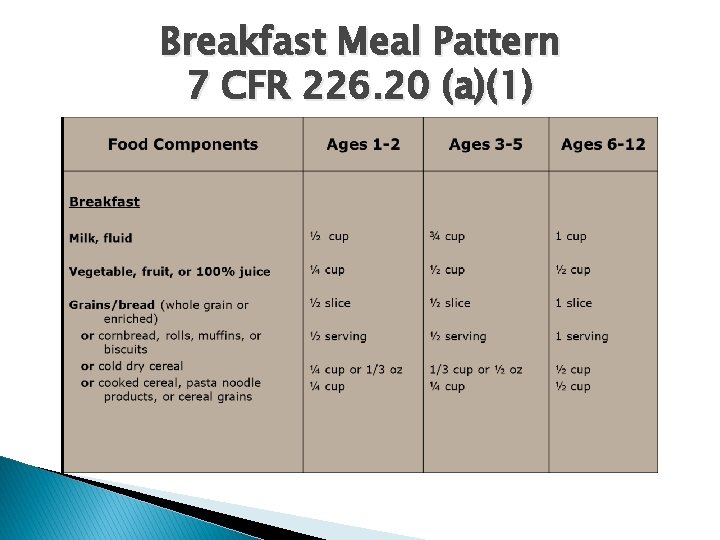
Breakfast Meal Pattern 7 CFR 226. 20 (a)(1)
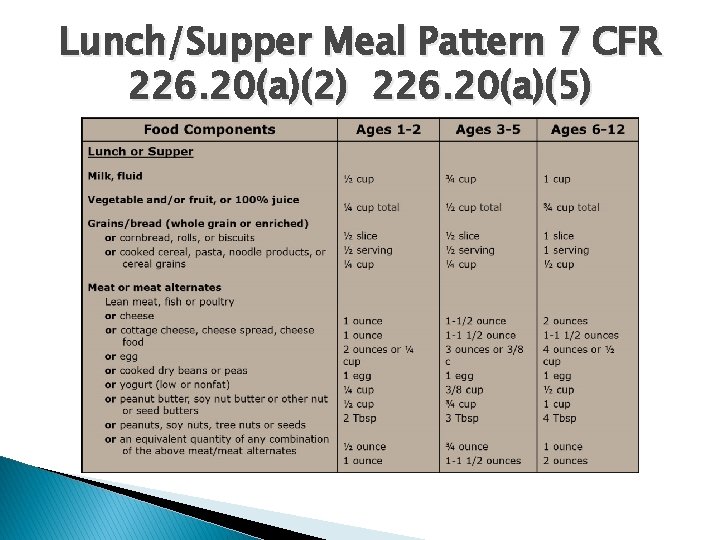
Lunch/Supper Meal Pattern 7 CFR 226. 20(a)(2) 226. 20(a)(5)
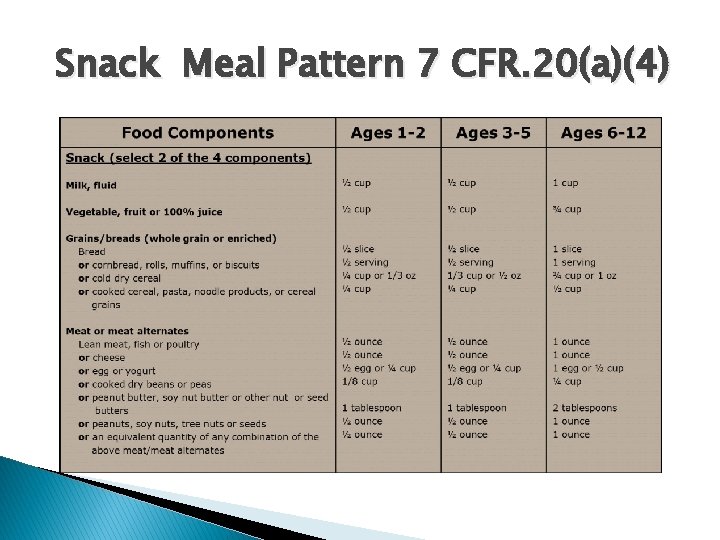
Snack Meal Pattern 7 CFR. 20(a)(4)
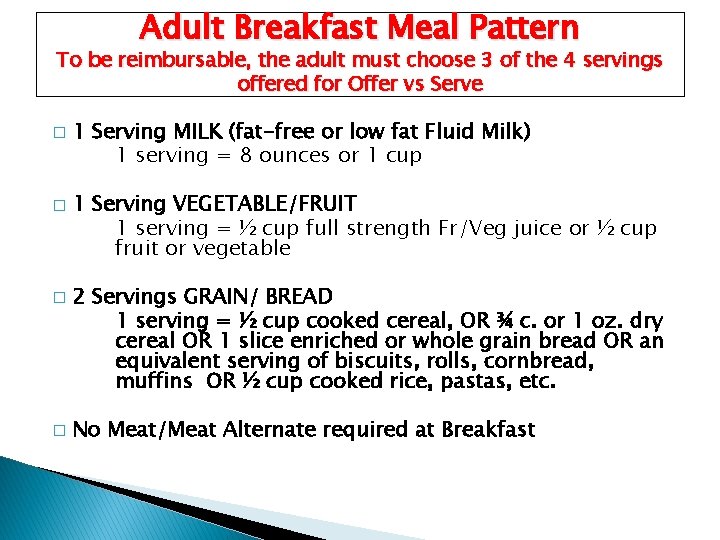
Adult Breakfast Meal Pattern To be reimbursable, the adult must choose 3 of the 4 servings offered for Offer vs Serve � � 1 Serving MILK (fat-free or low fat Fluid Milk) 1 serving = 8 ounces or 1 cup 1 Serving VEGETABLE/FRUIT 1 serving = ½ cup full strength Fr/Veg juice or ½ cup fruit or vegetable 2 Servings GRAIN/ BREAD 1 serving = ½ cup cooked cereal, OR ¾ c. or 1 oz. dry cereal OR 1 slice enriched or whole grain bread OR an equivalent serving of biscuits, rolls, cornbread, muffins OR ½ cup cooked rice, pastas, etc. No Meat/Meat Alternate required at Breakfast
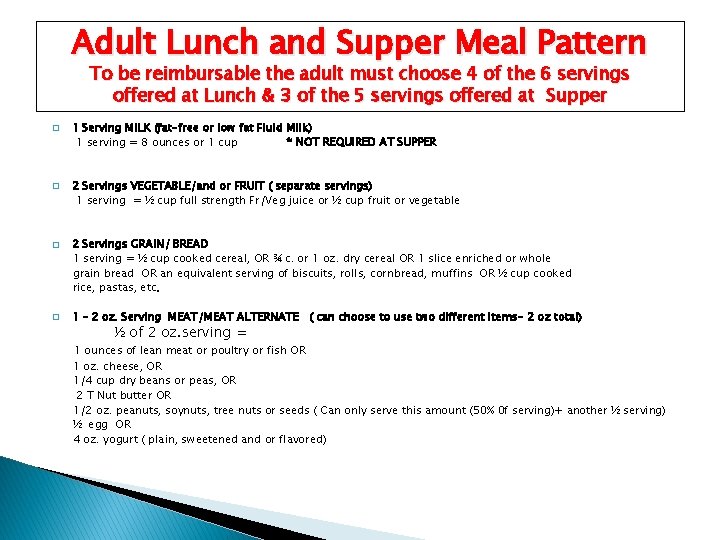
Adult Lunch and Supper Meal Pattern To be reimbursable the adult must choose 4 of the 6 servings offered at Lunch & 3 of the 5 servings offered at Supper � � 1 Serving MILK (fat-free or low fat Fluid Milk) 1 serving = 8 ounces or 1 cup * NOT REQUIRED AT SUPPER 2 Servings VEGETABLE/and or FRUIT ( separate servings) 1 serving = ½ cup full strength Fr/Veg juice or ½ cup fruit or vegetable 2 Servings GRAIN/ BREAD 1 serving = ½ cup cooked cereal, OR ¾ c. or 1 oz. dry cereal OR 1 slice enriched or whole grain bread OR an equivalent serving of biscuits, rolls, cornbread, muffins OR ½ cup cooked rice, pastas, etc. 1 – 2 oz. Serving MEAT/MEAT ALTERNATE ( can choose to use two different items- 2 oz total) ½ of 2 oz. serving = 1 ounces of lean meat or poultry or fish OR 1 oz. cheese, OR 1/4 cup dry beans or peas, OR 2 T Nut butter OR 1/2 oz. peanuts, soynuts, tree nuts or seeds ( Can only serve this amount (50% 0 f serving)+ another ½ serving) ½ egg OR 4 oz. yogurt ( plain, sweetened and or flavored)
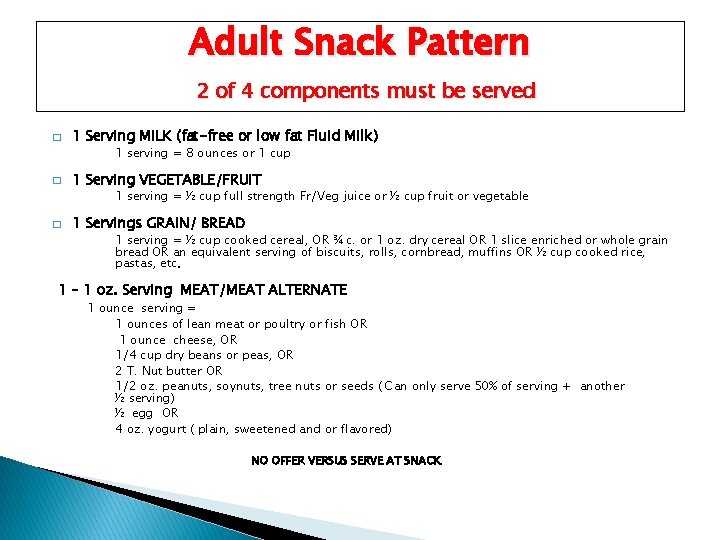
Adult Snack Pattern 2 of 4 components must be served � 1 Serving MILK (fat-free or low fat Fluid Milk) 1 serving = 8 ounces or 1 cup � 1 Serving VEGETABLE/FRUIT 1 serving = ½ cup full strength Fr/Veg juice or ½ cup fruit or vegetable � 1 Servings GRAIN/ BREAD 1 serving = ½ cup cooked cereal, OR ¾ c. or 1 oz. dry cereal OR 1 slice enriched or whole grain bread OR an equivalent serving of biscuits, rolls, cornbread, muffins OR ½ cup cooked rice, pastas, etc. 1 – 1 oz. Serving MEAT/MEAT ALTERNATE 1 ounce serving = 1 ounces of lean meat or poultry or fish OR 1 ounce cheese, OR 1/4 cup dry beans or peas, OR 2 T. Nut butter OR 1/2 oz. peanuts, soynuts, tree nuts or seeds ( Can only serve 50% of serving + another ½ serving) ½ egg OR 4 oz. yogurt ( plain, sweetened and or flavored) NO OFFER VERSUS SERVE AT SNACK
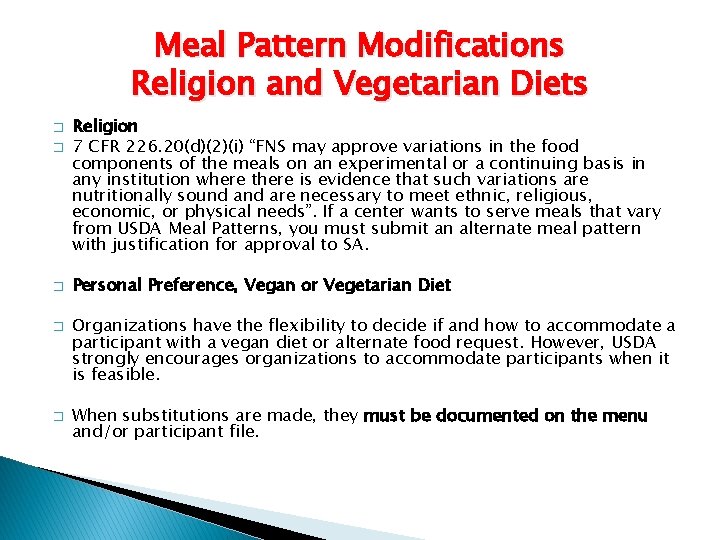
Meal Pattern Modifications Religion and Vegetarian Diets � � � Religion 7 CFR 226. 20(d)(2)(i) “FNS may approve variations in the food components of the meals on an experimental or a continuing basis in any institution where there is evidence that such variations are nutritionally sound are necessary to meet ethnic, religious, economic, or physical needs”. If a center wants to serve meals that vary from USDA Meal Patterns, you must submit an alternate meal pattern with justification for approval to SA. Personal Preference, Vegan or Vegetarian Diet Organizations have the flexibility to decide if and how to accommodate a participant with a vegan diet or alternate food request. However, USDA strongly encourages organizations to accommodate participants when it is feasible. When substitutions are made, they must be documented on the menu and/or participant file.
Meal Pattern Modifications Dietary 7 CFR 226. 20 (h) � � USDA regulations require special meals be provided to a disabled participant whose condition requires special medical foods, food substitutions, or textural modifications Participants who cannot consume fluid milk due to special dietary needs (e. g. lactose intolerant), other than a disability, may be served a non-dairy beverage that is nutritionally equivalent to fluid milk. � � Check the SA list of nutritionally equivalent substitutes that are approved Juice and water cannot be offered as milk substitutes. Meals with juice and water in place of milk are not reimbursable.
Meal Pattern Modifications Documentation � Special Dietary Need or Food (Milk) Intolerance � Written request for a non-dairy substitute from a parent or guardian � The non-dairy beverage must be nutritionally equivalent to milk � Check the SA list of substitutes that are approved � The written request must include: ◦ The food or choice of foods to be substituted ◦ The food or foods to be omitted from the participant’s diet
RECORD KEEPING REQUIREMENTS Medical Statements
Medical Statements Required Documentation � Disability or Life Threatening Allergy Written Statement from a MEDICAL AUTHORITY A Licensed Physician, Physician Assistant or Nurse Practitioner. o The non-dairy beverage does not need to be nutritionally equivalent to milk o The medical statement must include: Identification of the disability or dietary condition which restricts the participants' diet o The food or foods to be omitted from the participant’s diet o The food or choice of foods to be substituted
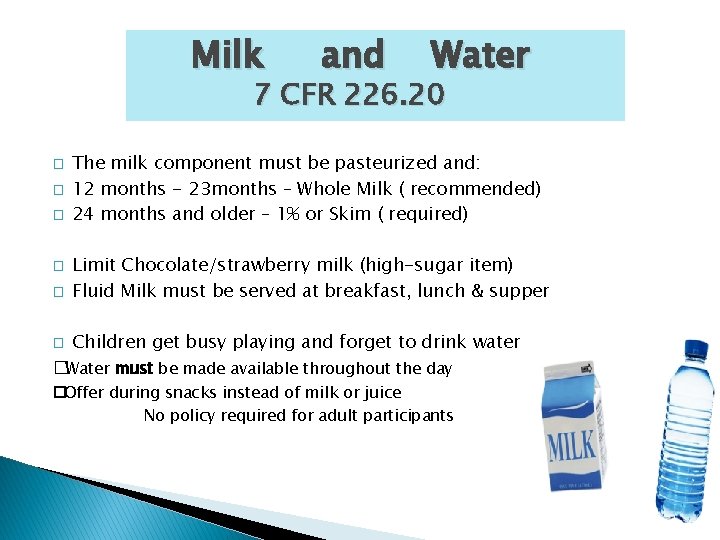
Milk and Water 7 CFR 226. 20 � � � The milk component must be pasteurized and: 12 months - 23 months – Whole Milk ( recommended) 24 months and older – 1% or Skim ( required) � Limit Chocolate/strawberry milk (high-sugar item) Fluid Milk must be served at breakfast, lunch & supper � Children get busy playing and forget to drink water � �Water must be made available throughout the day �Offer during snacks instead of milk or juice No policy required for adult participants
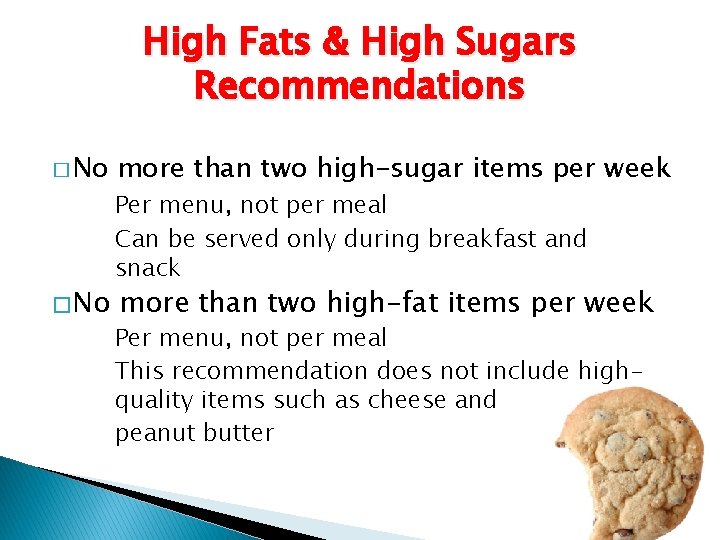
High Fats & High Sugars Recommendations � No more than two high-sugar items per week Per menu, not per meal Can be served only during breakfast and snack more than two high-fat items per week Per menu, not per meal This recommendation does not include highquality items such as cheese and peanut butter
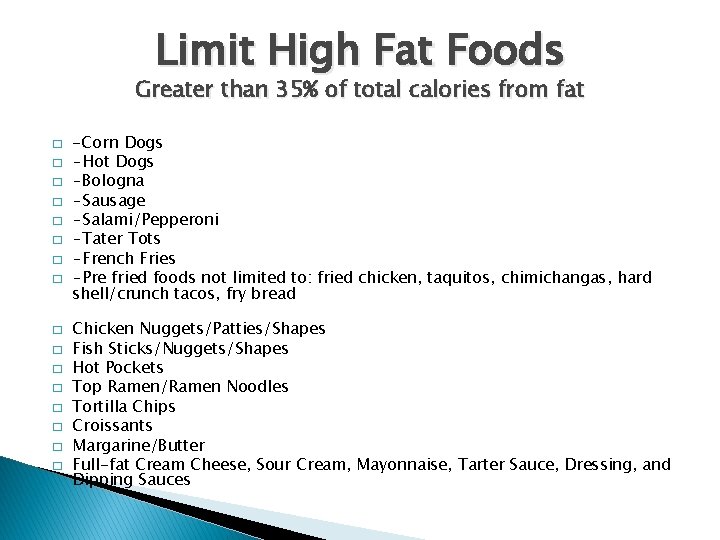
Limit High Fat Foods Greater than 35% of total calories from fat � � � � -Corn Dogs ‒Hot Dogs ‒Bologna ‒Sausage ‒Salami/Pepperoni ‒Tater Tots ‒French Fries ‒Pre fried foods not limited to: fried chicken, taquitos, chimichangas, hard shell/crunch tacos, fry bread Chicken Nuggets/Patties/Shapes Fish Sticks/Nuggets/Shapes Hot Pockets Top Ramen/Ramen Noodles Tortilla Chips Croissants Margarine/Butter Full-fat Cream Cheese, Sour Cream, Mayonnaise, Tarter Sauce, Dressing, and Dipping Sauces
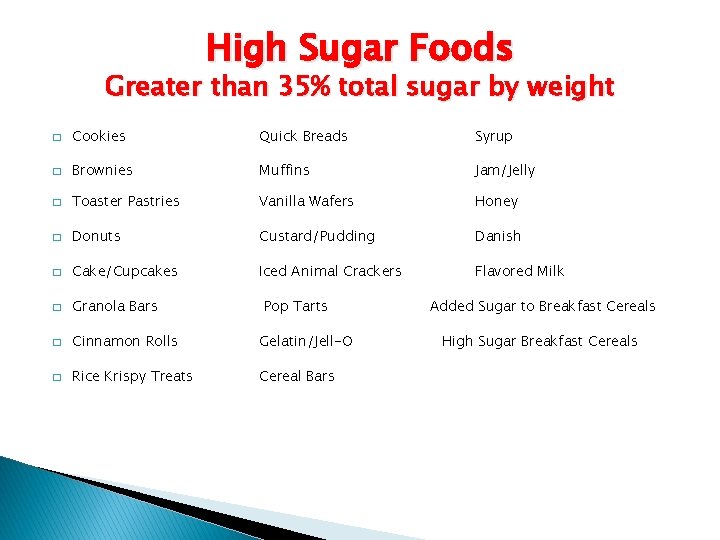
High Sugar Foods Greater than 35% total sugar by weight � Cookies Quick Breads Syrup � Brownies Muffins Jam/Jelly � Toaster Pastries Vanilla Wafers Honey � Donuts Custard/Pudding Danish � Cake/Cupcakes Iced Animal Crackers Flavored Milk � Granola Bars � Cinnamon Rolls Gelatin/Jell-O � Rice Krispy Treats Cereal Bars Pop Tarts Added Sugar to Breakfast Cereals High Sugar Breakfast Cereals
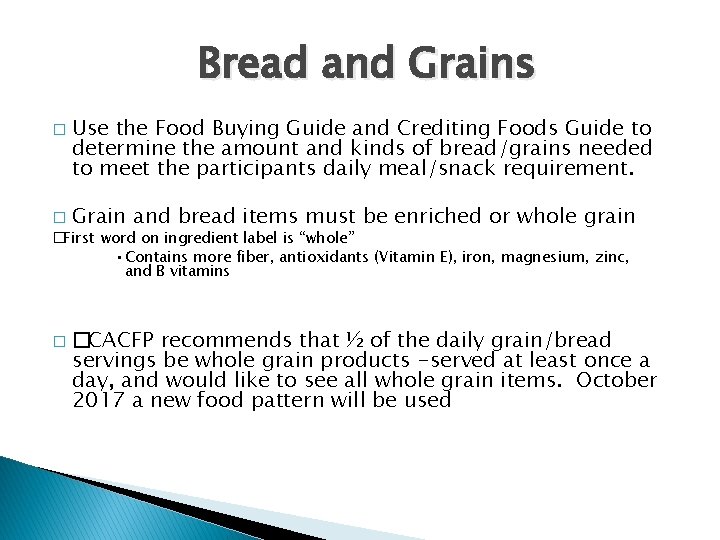
Bread and Grains � Use the Food Buying Guide and Crediting Foods Guide to determine the amount and kinds of bread/grains needed to meet the participants daily meal/snack requirement. � Grain and bread items must be enriched or whole grain �First word on ingredient label is “whole” • Contains more fiber, antioxidants (Vitamin E), iron, magnesium, zinc, and B vitamins � �CACFP recommends that ½ of the daily grain/bread servings be whole grain products -served at least once a day, and would like to see all whole grain items. October 2017 a new food pattern will be used
Meats and Meat Alternates � Use the Food Charts, Food Buying Guide and Creditable Food Guide to determine the amount and kind of meat/ meat alternates needed to meet the participants daily meal/snack requirement. � When serving mixed foods/casseroles list the meat /meat alternate that will meet the required amount of this component.
Fruits/Vegetables � Use the Food Charts, Food Buying Guide and Creditable Food Guide to determine the amount and kind of fruit/vegetables needed to meet the participants daily meal/snack requirement.
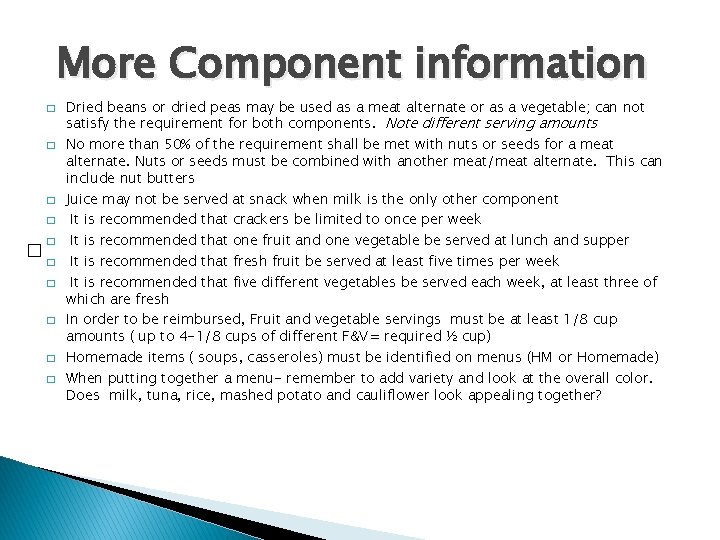
More Component information � � � Dried beans or dried peas may be used as a meat alternate or as a vegetable; can not satisfy the requirement for both components. Note different serving amounts No more than 50% of the requirement shall be met with nuts or seeds for a meat alternate. Nuts or seeds must be combined with another meat/meat alternate. This can include nut butters Juice may not be served at snack when milk is the only other component It is recommended that crackers be limited to once per week It is recommended that one fruit and one vegetable be served at lunch and supper It is recommended that fresh fruit be served at least five times per week It is recommended that five different vegetables be served each week, at least three of which are fresh In order to be reimbursed, Fruit and vegetable servings must be at least 1/8 cup amounts ( up to 4 -1/8 cups of different F&V= required ½ cup) Homemade items ( soups, casseroles) must be identified on menus (HM or Homemade) When putting together a menu- remember to add variety and look at the overall color. Does milk, tuna, rice, mashed potato and cauliflower look appealing together?
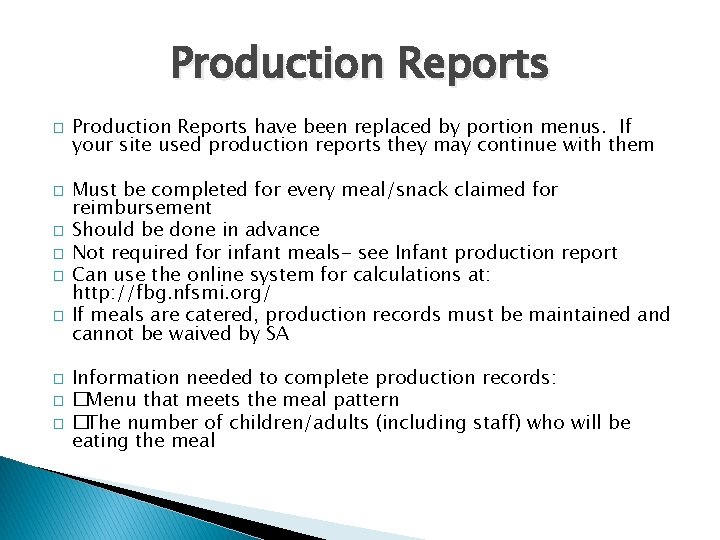
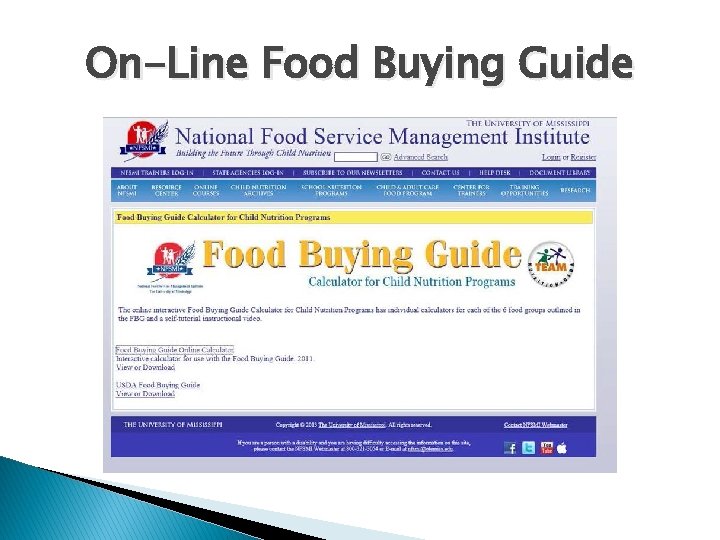
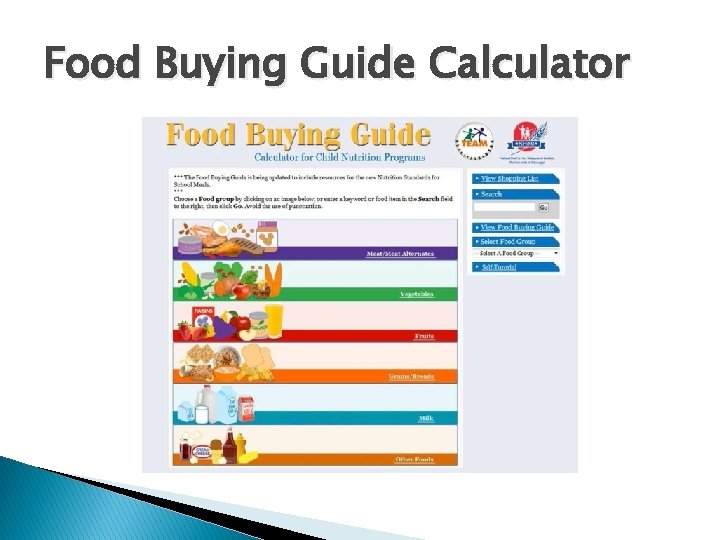
Production Reports � � � � � Production Reports have been replaced by portion menus. If your site used production reports they may continue with them Must be completed for every meal/snack claimed for reimbursement Should be done in advance Not required for infant meals- see Infant production report Can use the online system for calculations at: http: //fbg. nfsmi. org/ If meals are catered, production records must be maintained and cannot be waived by SA Information needed to complete production records: �Menu that meets the meal pattern �The number of children/adults (including staff) who will be eating the meal
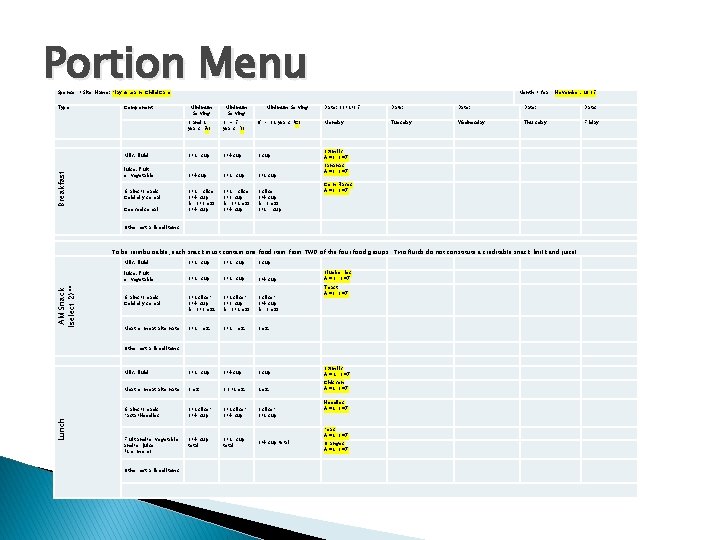
Portion Menu Sponsor / Site Name: Play & Learn Child Care Type Component 1 and 2 years (A) 3 - 5 years (B) Lunch AM Snack (select 2)** Breakfast Milk, fluid Minimum Serving 1/2 cup Minimum Serving 3/4 cup Minimum Serving Month / Year November, 2015 Date: 11/2/15 Date: 6 – 12 years (C) Monday Tuesday Wednesday Thursday Friday 1 cup 1% milk A=3 B=7 Bananas A=3 B=7 Corn Flakes A=3 B=7 Juice, fruit or vegetable 1/4 cup 1/2 cup Grains/Breads Cold dry cereal Cooked cereal 1/2 slice 1/4 cup (or 1/3 oz) 1/4 cup 1/2 slice 1/3 cup (or 1/2 oz) 1/4 cup 1 slice 3/4 cup (or 1 oz) 1/2 cup Other extra food items To be reimbursable, each snack must contain one food item from TWO of the four food groups. Two fluids do not constitute a creditable snack (milk and juice). Blueberries A= 3 B=7 Toast A=3 B=7 1 cup 1% milk A= 2 B=7 1 1/2 oz. Chicken A=2 B=7 1/2 slice* 1/4 cup Noodles A=2 B=7 1 slice* 1/2 cup Fruit and/or vegetable and/or juice (2 or more) 1/2 cup total 3/4 cup total Peas A=2 B=7 1/4 cup total Oranges A=2 B=7 Other extra food items Milk, fluid 1/2 cup 1 cup Juice, fruit or vegetable 1/2 cup 3/4 cup Grains/Breads Cold dry cereal 1/2 slice* 1/4 cup (or 1/3 oz). 1/2 slice* 1/3 cup (or 1/2 oz) 1 slice* 3/4 cup (or 1 oz) Meat or meat alternate 1/2 1 oz. Other extra food items Milk, fluid 1/2 cup 3/4 cup Meat or meat alternate 1 oz. Grains/Breads Pasta/Noodles oz.
Portion Menu � Portion menus let the State Agency know that you are aware of the minimum serving sizes needed to feed the children in your care. � For each age group you will list the number of children/adults you expect to feed and the components that you will be feeding them.
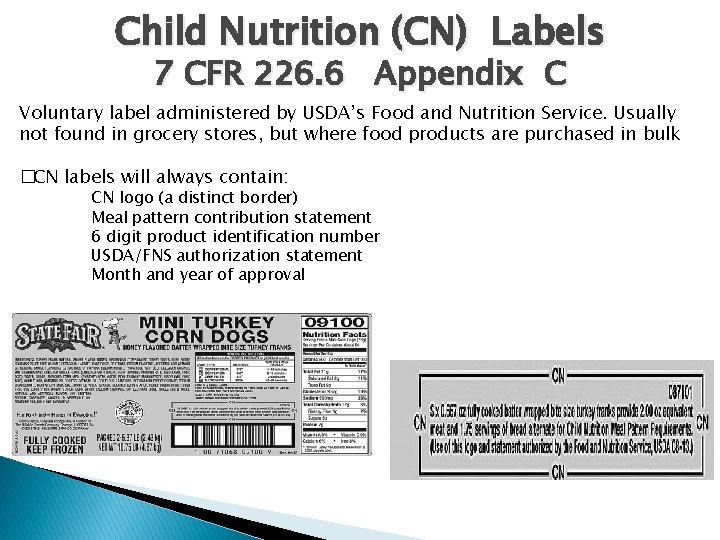
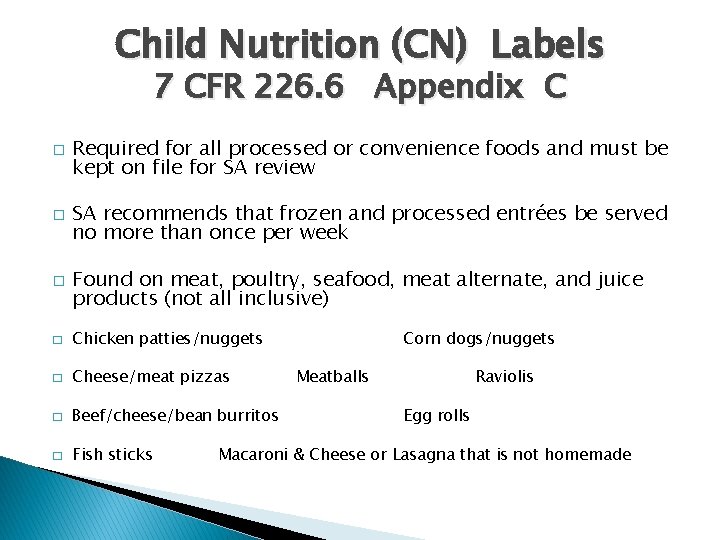
Child Nutrition (CN) Labels 7 CFR 226. 6 Appendix C Voluntary label administered by USDA’s Food and Nutrition Service. Usually not found in grocery stores, but where food products are purchased in bulk �CN labels will always contain: CN logo (a distinct border) Meal pattern contribution statement 6 digit product identification number USDA/FNS authorization statement Month and year of approval
Child Nutrition (CN) Labels 7 CFR 226. 6 Appendix C � � � Required for all processed or convenience foods and must be kept on file for SA review SA recommends that frozen and processed entrées be served no more than once per week Found on meat, poultry, seafood, meat alternate, and juice products (not all inclusive) � Chicken patties/nuggets � Cheese/meat pizzas � Beef/cheese/bean burritos � Fish sticks Corn dogs/nuggets Meatballs Raviolis Egg rolls Macaroni & Cheese or Lasagna that is not homemade
On-Line Food Buying Guide
Food Buying Guide Calculator
Infant Feeding
Infant Guidelines � CACFP centers and homes must offer program meals to all eligible enrolled* children *“a child whose parent or guardian has submitted to an institution a signed document which indicates that the child is enrolled for child care” � Must offer the infant a meal that complies with program requirements � Parent/guardian may decline what is offered and supply the infant’s meals instead (Provider must supply at least 1 component to claim the meal once an infant begins eating solid food).
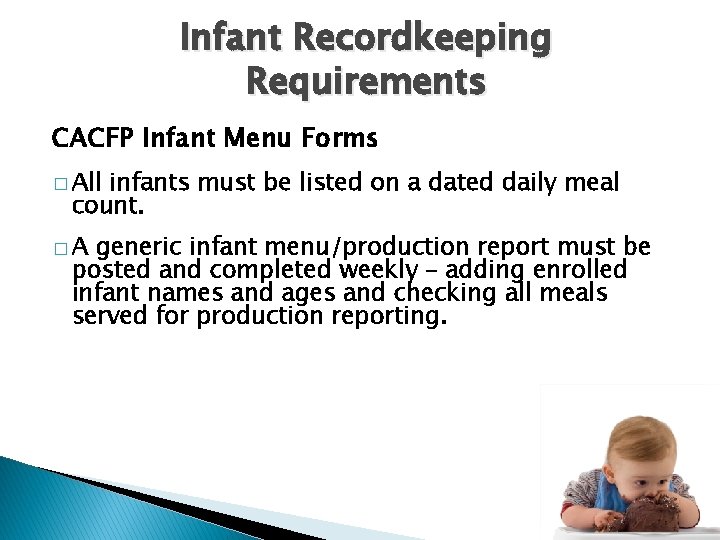
Infant Recordkeeping Requirements CACFP Infant Menu Forms � All infants must be listed on a dated daily meal count. �A generic infant menu/production report must be posted and completed weekly – adding enrolled infant names and ages and checking all meals served for production reporting.
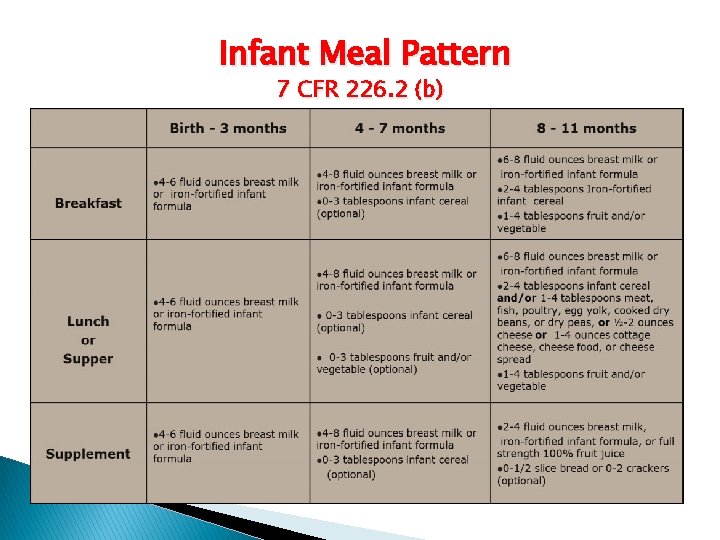
Infant Meal Pattern 7 CFR 226. 2 (b)
Breast Milk Optimal food for babies � USDA recommends breast milk in place of formula from birth through 11 months � Centers and day care homes may continue to serve babies over 12 months of age their mother’s milk as long as the mother is able and wishes to provide it � Breast milk is a substitute for cow’s milk in the CACFP Meal Pattern for Children � Breast milk fed by the parent or pumped, is reimbursable through CACFP
Infant Meal Pattern � Ensure that all food served to infants is creditable Review the infant section of the Creditable Food Guide for more information � Prepared fruits and vegetables ( blended or jar foods) Must list fruit/vegetable as the first ingredient � Formula and Infant cereal Must be iron-fortified Label must state “with iron” or “iron-fortified” Cereal must be infant cereal, not breakfast cereal or other grains
Infant Meals Birth – 3 months �Reimbursable Meals: �Parent-provided breast milk �Center-provided formula �Parent-provided formula
Infant Meals 4 months – 7 months � Reimbursable meals when the infant is only drinking formula or breast milk: Parent-provided breast milk or formula Center-provided formula � Reimbursable meals when the infant is developmentally ready to eat solid foods:
Day Care Home Providers Breastfeeding � To claim meals served to the provider’s own child, the infant must be 1. eligible for free and reduced price meals 2. enrolled in the day care program 3. participating in the program during the time of meal service � At least one other nonresident child must also be enrolled in the day care program and participating in the meal service
Infant Meals 8 months- 11 months � Reimbursable Meals: ◦ All meal components are required to be offered at breakfast and lunch. Grain component is optional at lunch. ◦ Center must supply at least one of the meal components
Duration of Meal Service � Must be no more than two hours per meal service � 2 hours between meal service is recommended � Meal time changes should be listed on agreement yearly- but changes do not need to be reported to SA.
� All Safety and Sanitation in Meal Service stored foods must be sealed, labeled, and dated. � Thermometers must be in both the refrigerator and freezer ◦ Cold food must be kept at or below 40°F until served ◦ Hot food must be kept at or above 140°F until served � Ensure your center is in compliance with Licensing and with any local food service ordinances � Food Safety/Sanitation classes are highly recommended for all food service staff
RESOURCES � CACFP Maine Web Site � CACFP /USDA/FNS web site � SNAP ED web site � CACFP Handbooks � Nemours “Best Practices For Healthy Eating” � Infant Feeding Guide � Partnership for Food Safety Education ( web) � Let’s Move � I am Moving I am Learning
Questions