
Cable Model Voltage Clamp Propagation of an Action
Cable Model Voltage Clamp Propagation of an Action Potential Illustrations are taken from: J. Malmivuo, R. Plonsey, Bioelectromagnetism, Oxford Press, 1995 http: //butler. cc. tut. fi/~malmivuo/bem/book/ EE-515 Bioelectricity & Biomagnetism 2002 Fall Murat 1
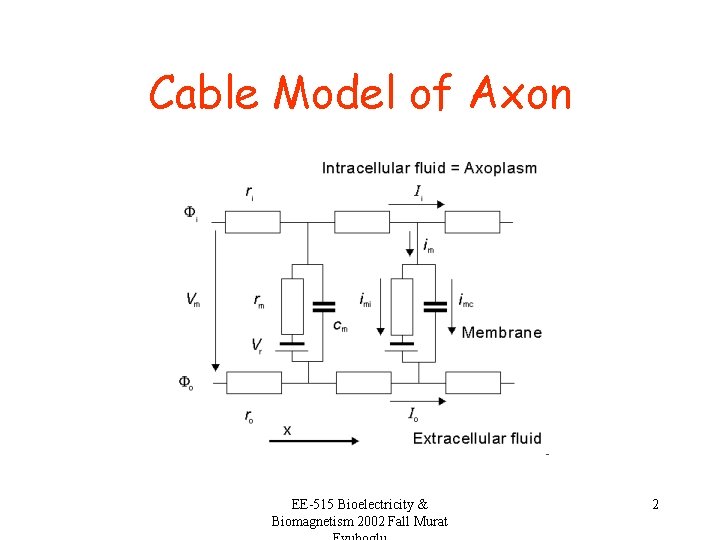
Cable Model of Axon EE-515 Bioelectricity & Biomagnetism 2002 Fall Murat 2
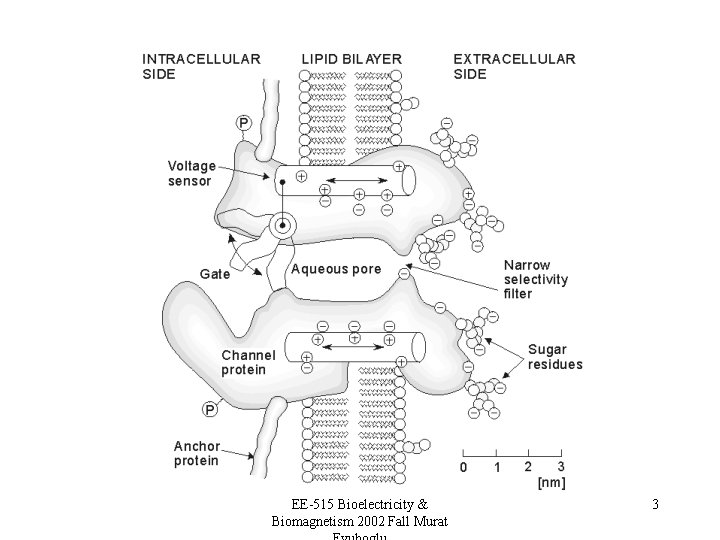
EE-515 Bioelectricity & Biomagnetism 2002 Fall Murat 3
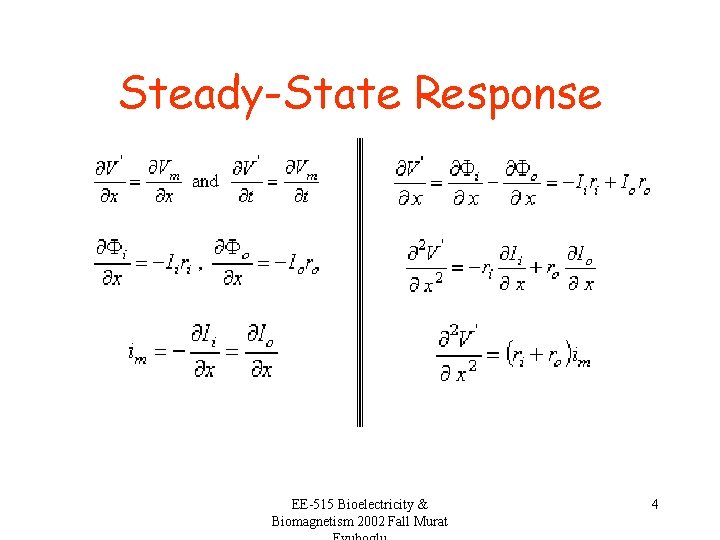
Steady-State Response EE-515 Bioelectricity & Biomagnetism 2002 Fall Murat 4
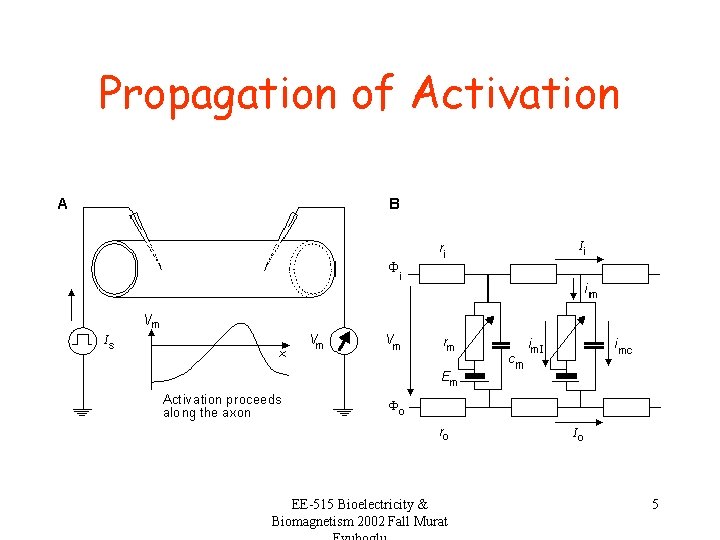
Propagation of Activation EE-515 Bioelectricity & Biomagnetism 2002 Fall Murat 5

Uniform Current Injection EE-515 Bioelectricity & Biomagnetism 2002 Fall Murat 6
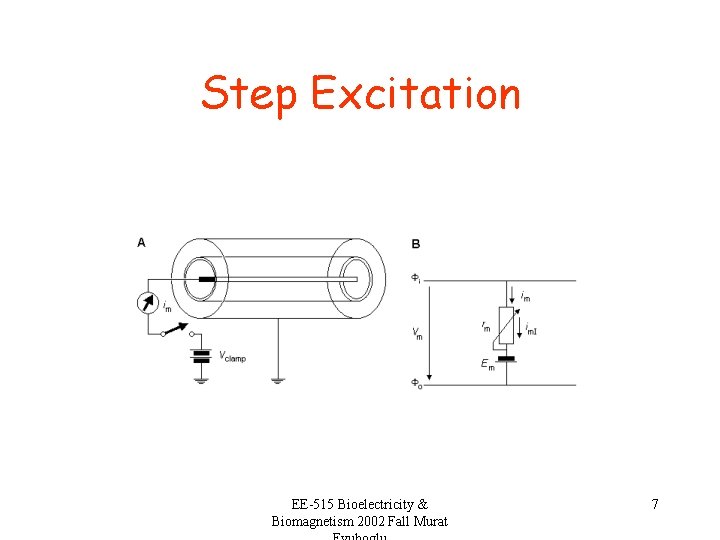
Step Excitation EE-515 Bioelectricity & Biomagnetism 2002 Fall Murat 7
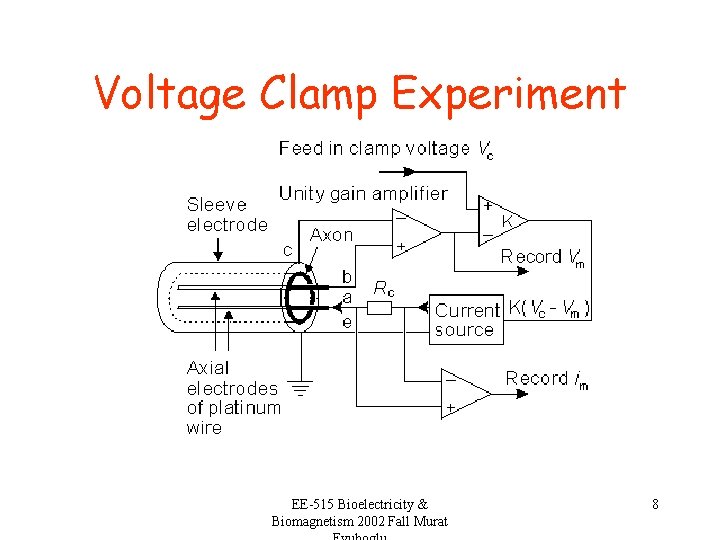
Voltage Clamp Experiment EE-515 Bioelectricity & Biomagnetism 2002 Fall Murat 8
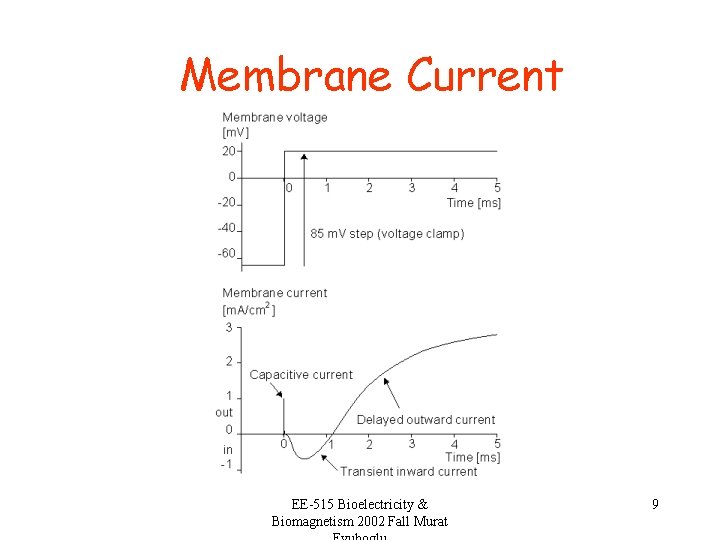
Membrane Current EE-515 Bioelectricity & Biomagnetism 2002 Fall Murat 9
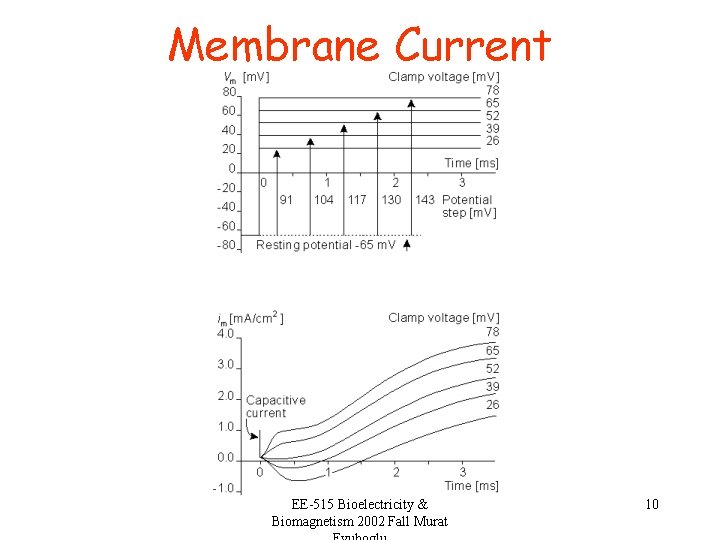
Membrane Current EE-515 Bioelectricity & Biomagnetism 2002 Fall Murat 10
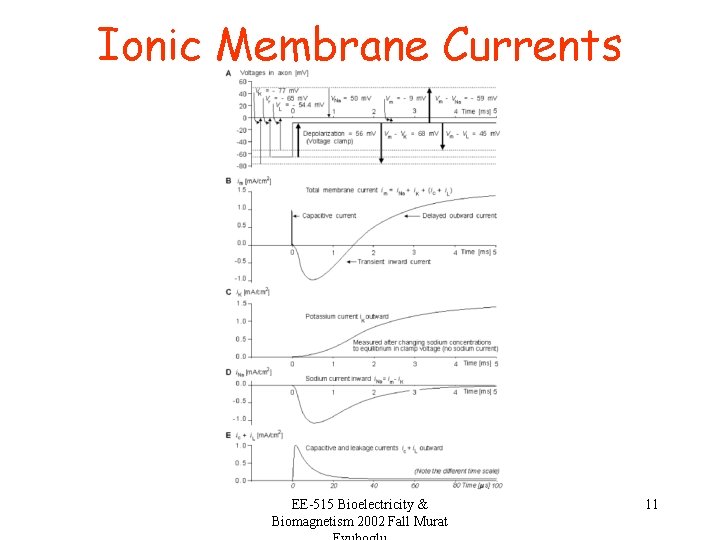
Ionic Membrane Currents EE-515 Bioelectricity & Biomagnetism 2002 Fall Murat 11
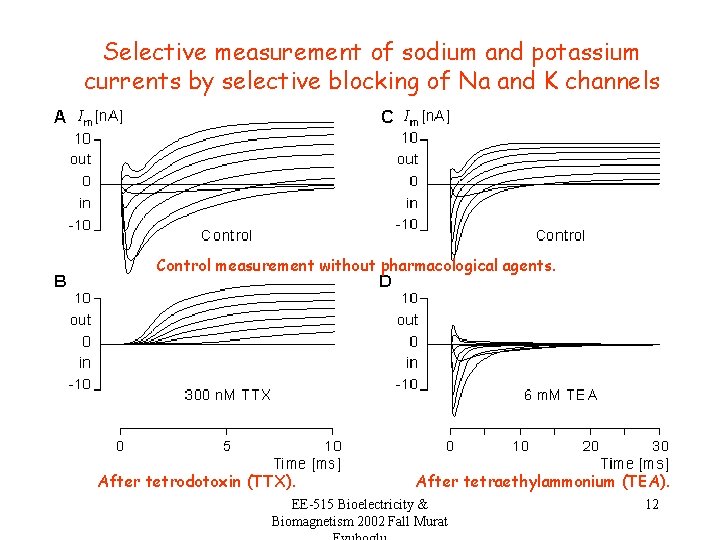
Selective measurement of sodium and potassium currents by selective blocking of Na and K channels Control measurement without pharmacological agents. After tetrodotoxin (TTX). After tetraethylammonium (TEA). EE-515 Bioelectricity & Biomagnetism 2002 Fall Murat 12
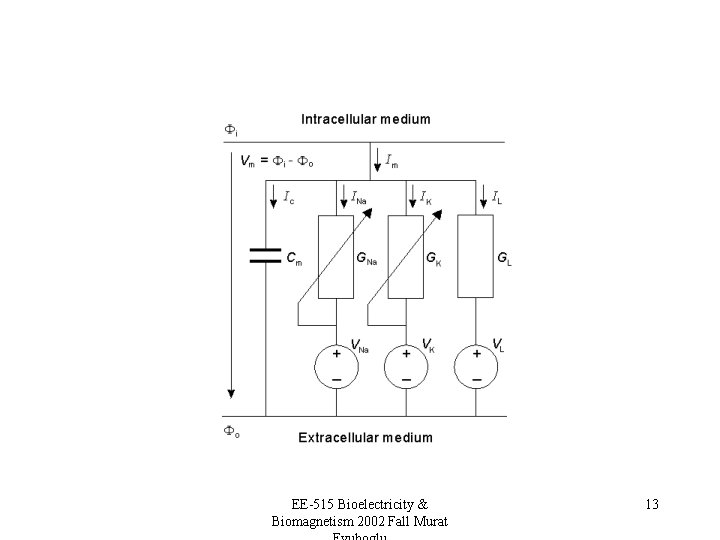
EE-515 Bioelectricity & Biomagnetism 2002 Fall Murat 13
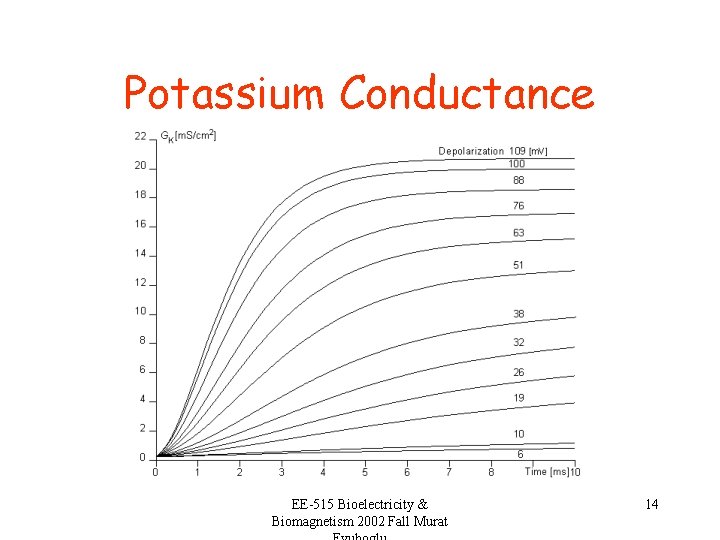
Potassium Conductance EE-515 Bioelectricity & Biomagnetism 2002 Fall Murat 14
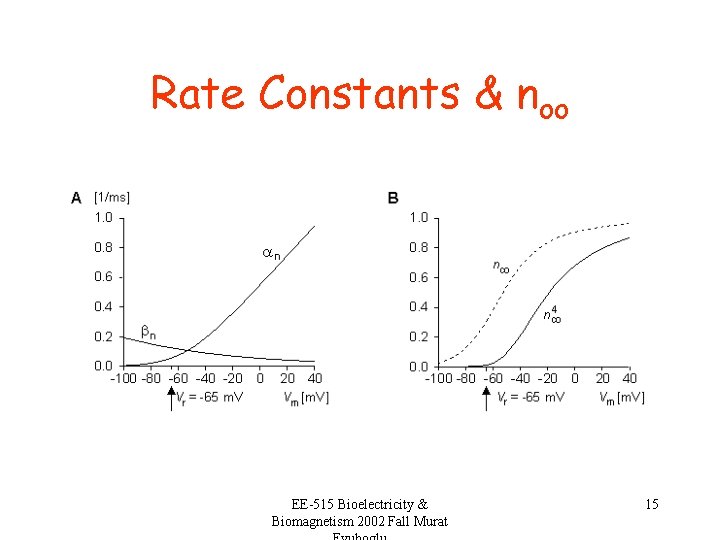
Rate Constants & noo EE-515 Bioelectricity & Biomagnetism 2002 Fall Murat 15
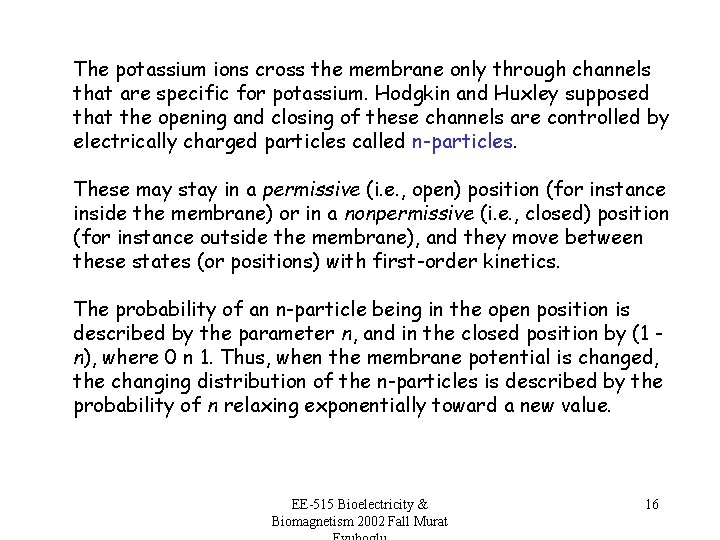
The potassium ions cross the membrane only through channels that are specific for potassium. Hodgkin and Huxley supposed that the opening and closing of these channels are controlled by electrically charged particles called n-particles. These may stay in a permissive (i. e. , open) position (for instance inside the membrane) or in a nonpermissive (i. e. , closed) position (for instance outside the membrane), and they move between these states (or positions) with first-order kinetics. The probability of an n-particle being in the open position is described by the parameter n, and in the closed position by (1 n), where 0 n 1. Thus, when the membrane potential is changed, the changing distribution of the n-particles is described by the probability of n relaxing exponentially toward a new value. EE-515 Bioelectricity & Biomagnetism 2002 Fall Murat 16
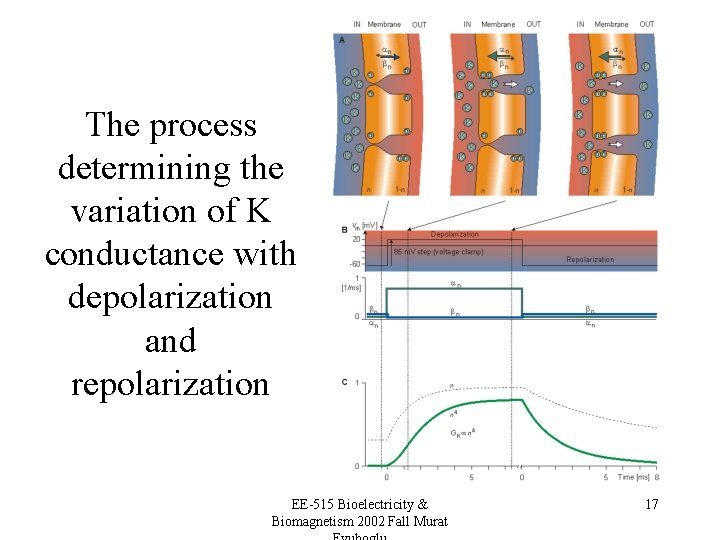
The process determining the variation of K conductance with depolarization and repolarization EE-515 Bioelectricity & Biomagnetism 2002 Fall Murat 17
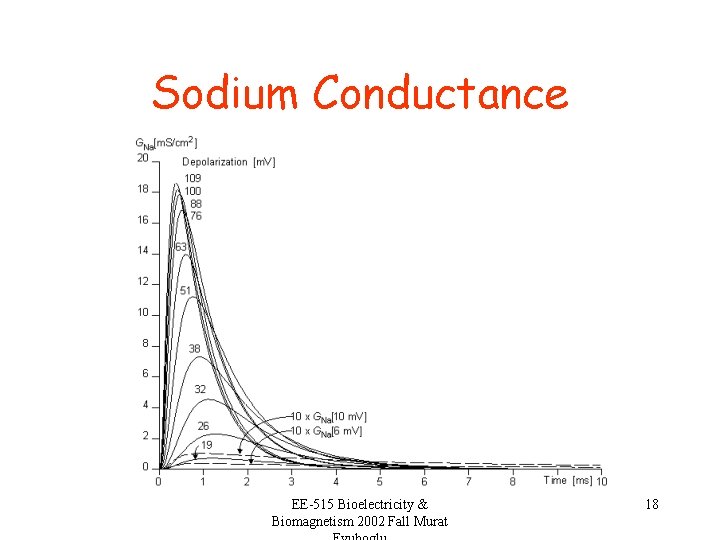
Sodium Conductance EE-515 Bioelectricity & Biomagnetism 2002 Fall Murat 18
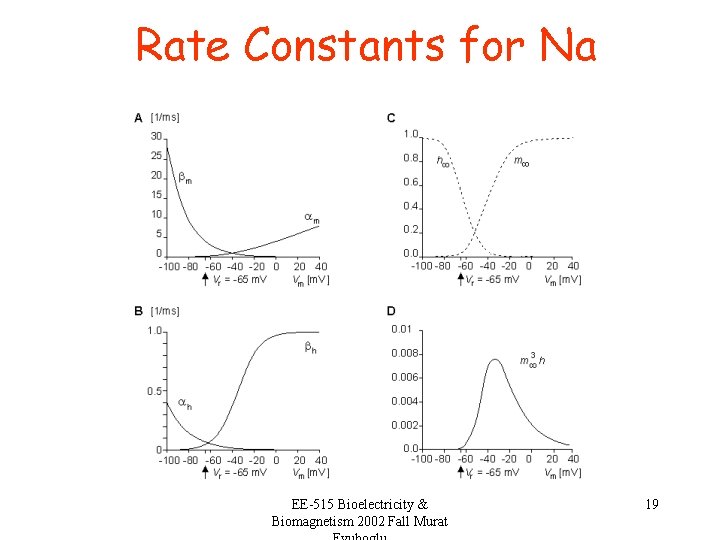
Rate Constants for Na EE-515 Bioelectricity & Biomagnetism 2002 Fall Murat 19
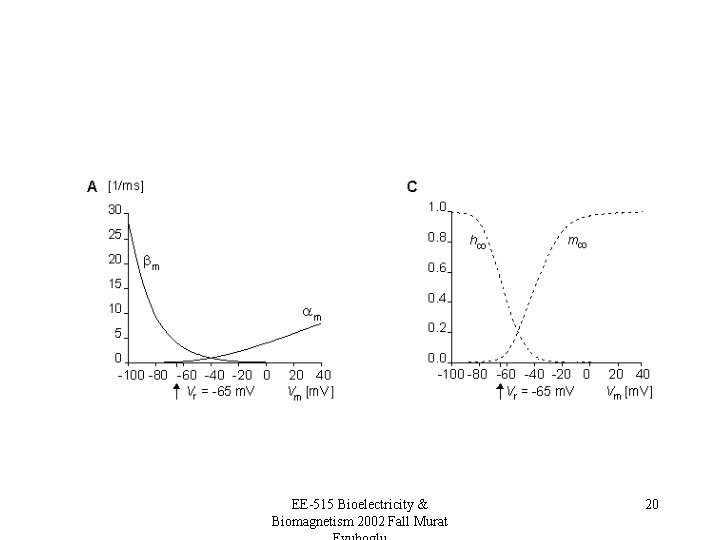
EE-515 Bioelectricity & Biomagnetism 2002 Fall Murat 20
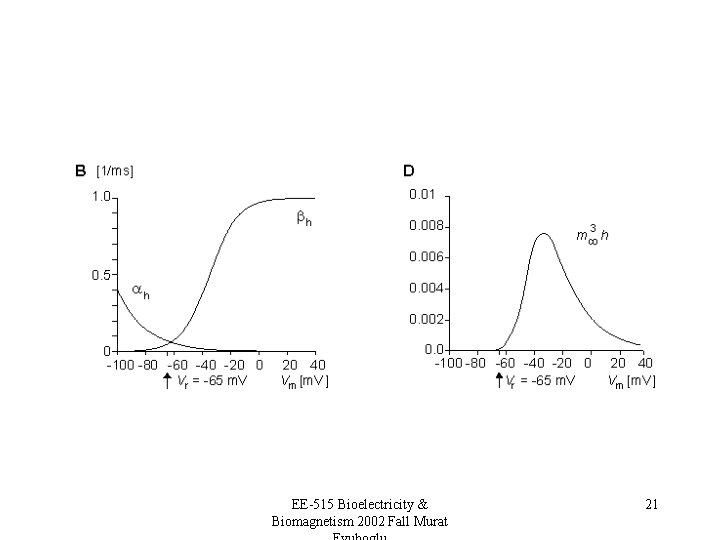
EE-515 Bioelectricity & Biomagnetism 2002 Fall Murat 21
The behavior of sodium conductance is initially similar to that of potassium conductance, except that the speed of the conductance increase during depolarization is about 10 times faster. The rise in sodium conductance occurs well before the rise in potassium conductance becomes appreciable. Hodgkin and Huxley assumed again that at the sodium channels certain electrically charged particles called m-particles exist whose position control the opening of the channel. Thus they have two states, open (permissive) and closed (nonpermissive); the proportion m expresses the fraction of these particles in the open state (for instance inside the membrane) and (1 - m) the fraction in the closed state (for instance outside the membrane), where 0 m 1. EE-515 Bioelectricity & Biomagnetism 2002 Fall Murat 22
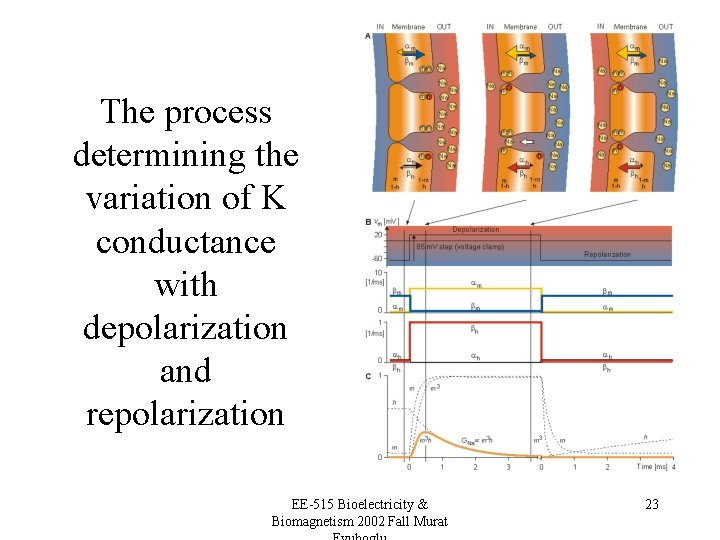
The process determining the variation of K conductance with depolarization and repolarization EE-515 Bioelectricity & Biomagnetism 2002 Fall Murat 23
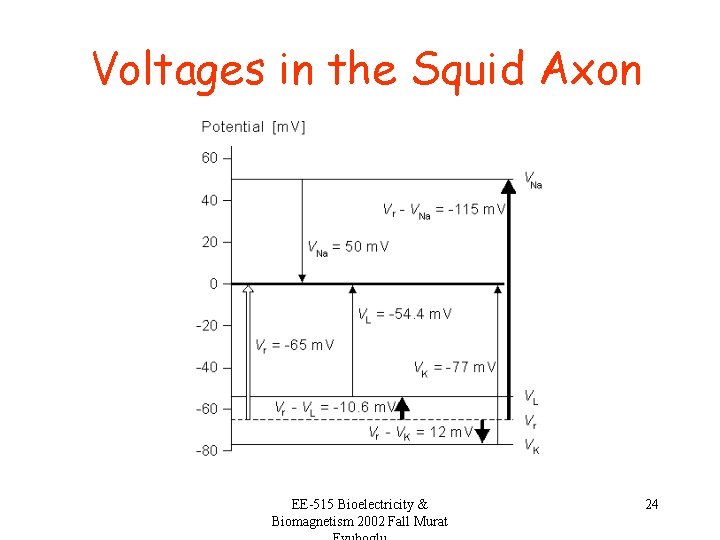
Voltages in the Squid Axon EE-515 Bioelectricity & Biomagnetism 2002 Fall Murat 24
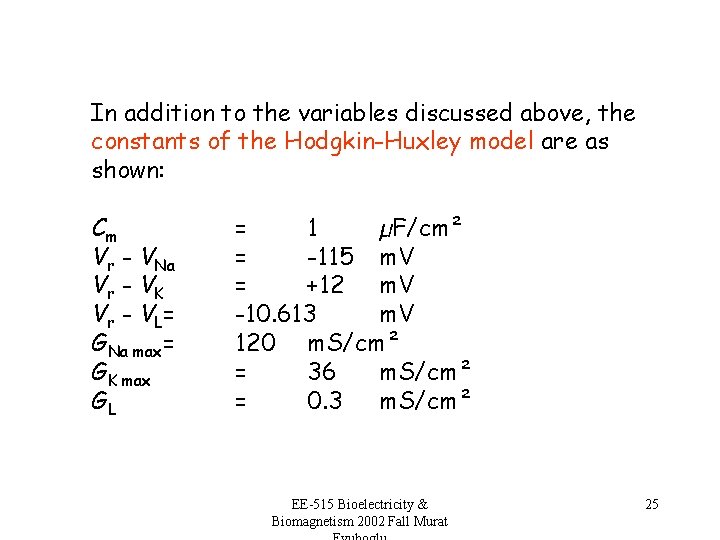
In addition to the variables discussed above, the constants of the Hodgkin-Huxley model are as shown: Cm Vr - VNa Vr - VK Vr - VL = GNa max= GK max GL = 1 µF/cm² = -115 m. V = +12 m. V -10. 613 m. V 120 m. S/cm² = 36 m. S/cm² = 0. 3 m. S/cm² EE-515 Bioelectricity & Biomagnetism 2002 Fall Murat 25
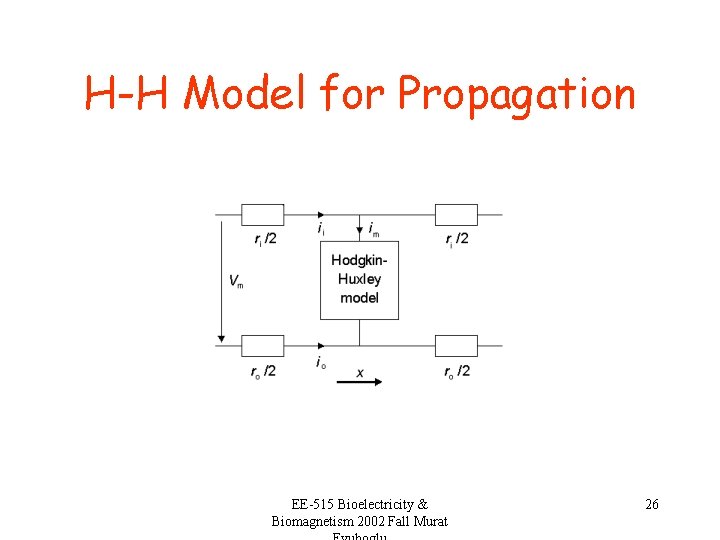
H-H Model for Propagation EE-515 Bioelectricity & Biomagnetism 2002 Fall Murat 26
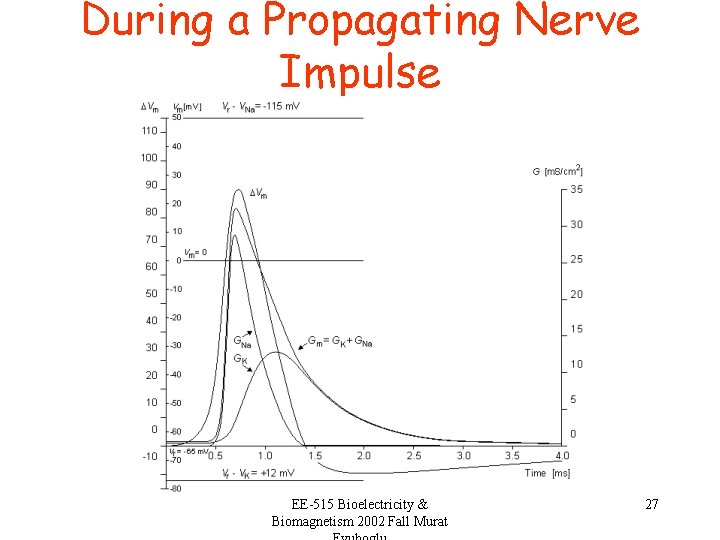
During a Propagating Nerve Impulse EE-515 Bioelectricity & Biomagnetism 2002 Fall Murat 27
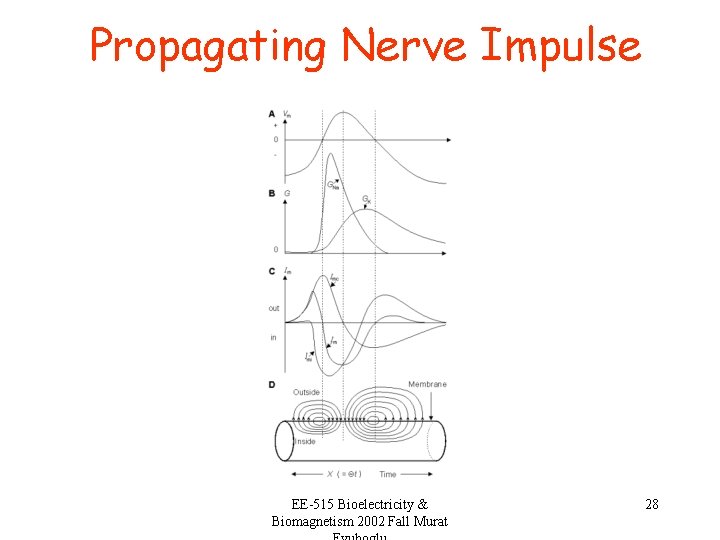
Propagating Nerve Impulse EE-515 Bioelectricity & Biomagnetism 2002 Fall Murat 28
End of the Lecture EE-515 Bioelectricity & Biomagnetism 2002 Fall Murat 29
- Slides: 29