
C Wiesner FRANZ and SmallScale AcceleratorDriven Neutron Sources
- Slides: 26
C. Wiesner, FRANZ and Small-Scale Accelerator-Driven Neutron Sources May 5, 2015 FRANZ and Small-Scale Accelerator-Driven Neutron Sources C. Wiesner*, S. Alzubaidi, M. Droba, M. Heilmann, O. Hinrichs, B. Klump, O. Meusel, D. Noll , O. Payir, H. Podlech, U. Ratzinger, R. Reifarth, A. Schempp, S. Schmidt, P. Schneider, M. Schwarz , W. Schweizer, K. Volk, C. Wagner, IAP, Goethe-Universität Frankfurt am Main *wiesner@iap. uni-frankfurt. de IPAC'15, Richmond, VA
C. Wiesner, FRANZ and Small-Scale Accelerator-Driven Neutron Sources May 5, 2015 Outline 1) Introduction: Neutron Production 2) Small-Scale Accelerator-Driven Facilities • Concept & Opportunities • Challenges: High-Intensity Beam, High-Power Target, Time Structure 3) Frankfurt Neutron Source FRANZ 4) Conclusion
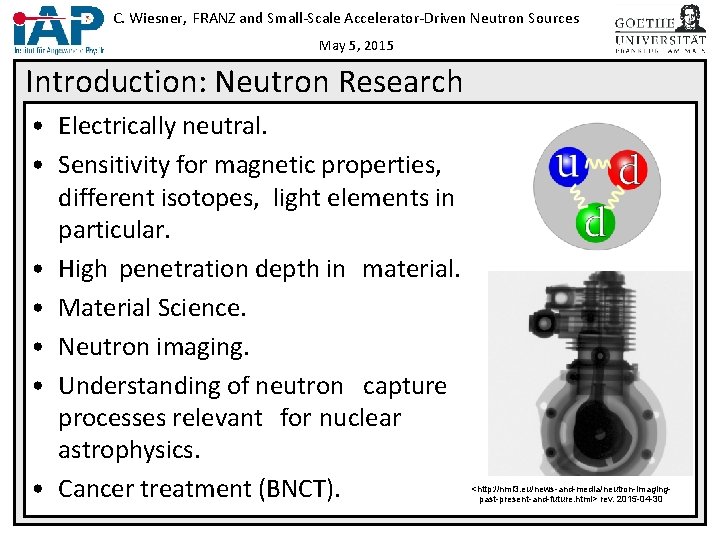
C. Wiesner, FRANZ and Small-Scale Accelerator-Driven Neutron Sources May 5, 2015 Introduction: Neutron Research • Electrically neutral. • Sensitivity for magnetic properties, different isotopes, light elements in particular. • High penetration depth in material. • Material Science. • Neutron imaging. • Understanding of neutron capture processes relevant for nuclear astrophysics. • Cancer treatment (BNCT). <http: //nmi 3. eu/news-and-media/neutron-imagingpast-present-and-future. html> rev. 2015 -04 -30
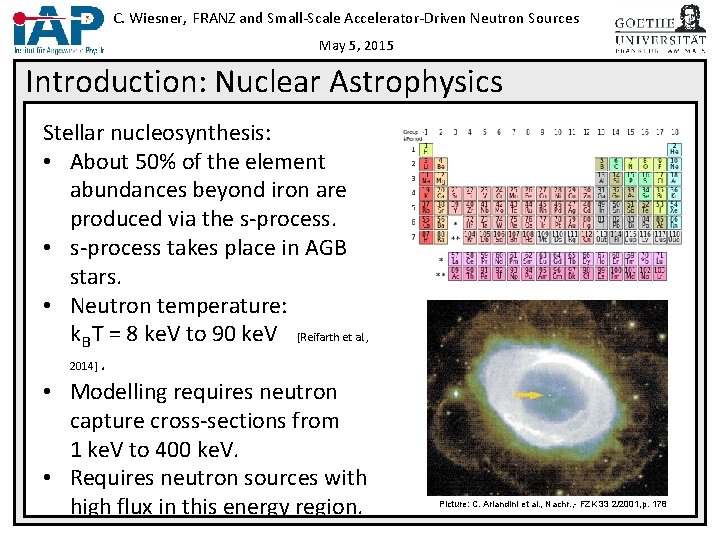
C. Wiesner, FRANZ and Small-Scale Accelerator-Driven Neutron Sources May 5, 2015 Introduction: Nuclear Astrophysics Stellar nucleosynthesis: • About 50% of the element abundances beyond iron are produced via the s-process. • s-process takes place in AGB stars. • Neutron temperature: k B T = 8 ke. V to 90 ke. V [Reifarth et al. , 2014]. • Modelling requires neutron capture cross-sections from 1 ke. V to 400 ke. V. • Requires neutron sources with high flux in this energy region. Picture: C. Arlandini et al. , Nachr. , - FZK 33 2/2001, p. 178
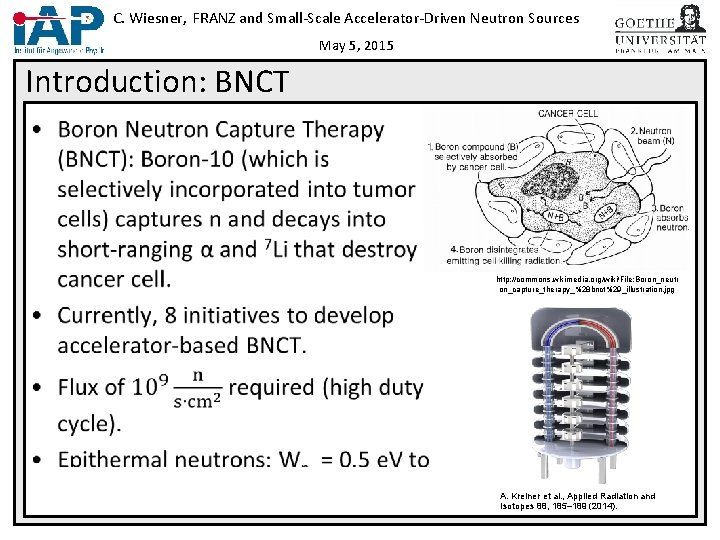
C. Wiesner, FRANZ and Small-Scale Accelerator-Driven Neutron Sources May 5, 2015 Introduction: BNCT • http: //commons. wikimedia. org/wiki/File: Boron_neutr on_capture_therapy_%28 bnct%29_illustration. jpg A. Kreiner et al. , Applied Radiation and Isotopes 88, 185– 189 (2014).
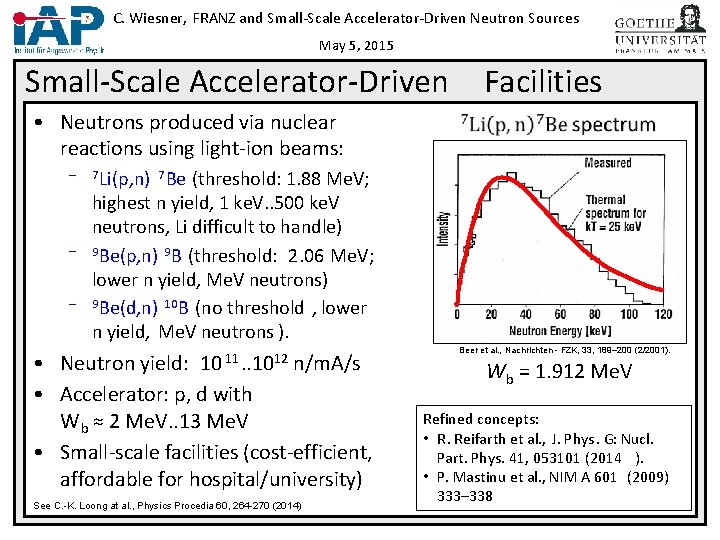
C. Wiesner, FRANZ and Small-Scale Accelerator-Driven Neutron Sources May 5, 2015 Small-Scale Accelerator-Driven Facilities • Neutrons produced via nuclear reactions using light-ion beams: – – – 7 Li(p, n) 7 Be (threshold: 1. 88 Me. V; highest n yield, 1 ke. V. . 500 ke. V neutrons, Li difficult to handle) 9 Be(p, n) 9 B (threshold: 2. 06 Me. V; lower n yield, Me. V neutrons) 9 Be(d, n) 10 B (no threshold , lower n yield, Me. V neutrons ). • Neutron yield: n/m. A/s • Accelerator: p, d with W b ≈ 2 Me. V. . 13 Me. V • Small-scale facilities (cost-efficient, affordable for hospital/university) 10 11. . 1012 See C. -K. Loong at al. , Physics Procedia 60, 264 -270 (2014) Beer et al. , Nachrichten - FZK, 33, 189– 200 (2/2001). W b = 1. 912 Me. V Refined concepts: • R. Reifarth et al. , J. Phys. G: Nucl. Part. Phys. 41, 053101 (2014 ). • P. Mastinu et al. , NIM A 601 (2009) 333– 338
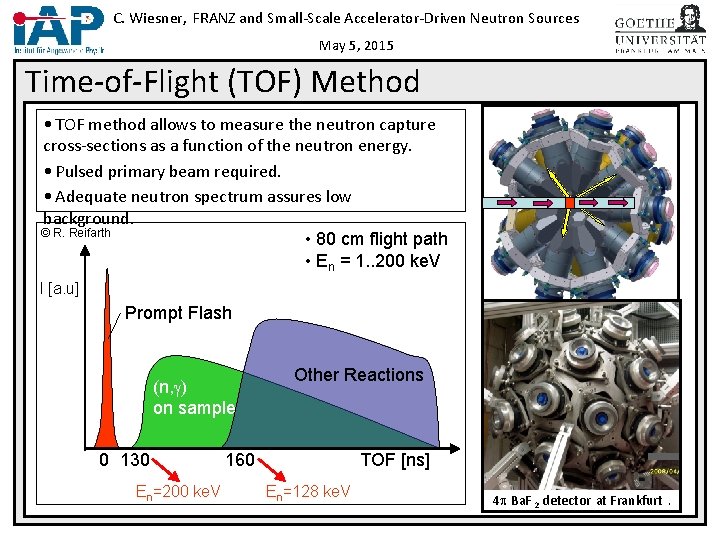
C. Wiesner, FRANZ and Small-Scale Accelerator-Driven Neutron Sources May 5, 2015 Time-of-Flight (TOF) Method • TOF method allows to measure the neutron capture cross-sections as a function of the neutron energy. • Pulsed primary beam required. • Adequate neutron spectrum assures low background. © R. Reifarth • 80 cm flight path • En = 1. . 200 ke. V I [a. u] Prompt Flash (n, g) on sample 0 130 En=200 ke. V Other Reactions 160 TOF [ns] En=128 ke. V 4 p Ba. F 2 detector at Frankfurt.
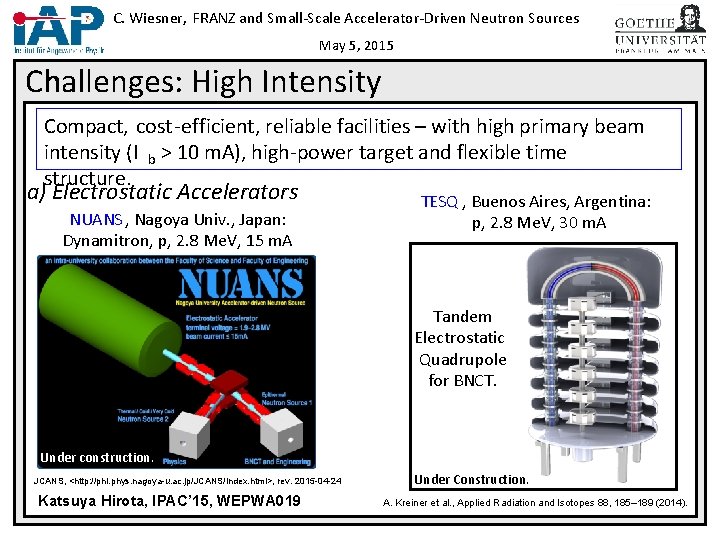
C. Wiesner, FRANZ and Small-Scale Accelerator-Driven Neutron Sources May 5, 2015 Challenges: High Intensity Compact, cost-efficient, reliable facilities – with high primary beam intensity (I b > 10 m. A), high-power target and flexible time structure. a) Electrostatic Accelerators NUANS , Nagoya Univ. , Japan: Dynamitron, p, 2. 8 Me. V, 15 m. A TESQ , Buenos Aires, Argentina: p, 2. 8 Me. V, 30 m. A Tandem Electrostatic Quadrupole for BNCT. Under construction. JCANS, <http: //phi. phys. nagoya-u. ac. jp/JCANS/index. html>, rev. 2015 -04 -24 Katsuya Hirota, IPAC’ 15, WEPWA 019 Under Construction. A. Kreiner et al. , Applied Radiation and Isotopes 88, 185– 189 (2014).
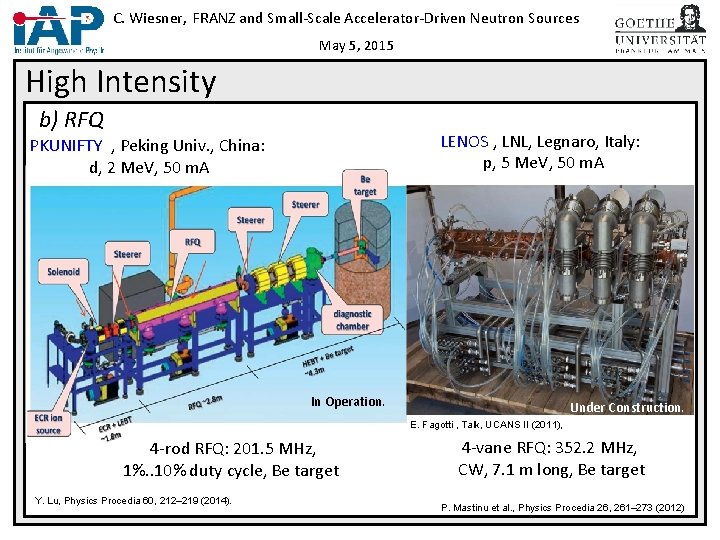
C. Wiesner, FRANZ and Small-Scale Accelerator-Driven Neutron Sources May 5, 2015 High Intensity b) RFQ LENOS , LNL, Legnaro, Italy: p, 5 Me. V, 50 m. A PKUNIFTY , Peking Univ. , China: d, 2 Me. V, 50 m. A In Operation. Under Construction. E. Fagotti , Talk, UCANS II (2011), 4 -rod RFQ: 201. 5 MHz, 1%. . 10% duty cycle, Be target Y. Lu, Physics Procedia 60, 212– 219 (2014). 4 -vane RFQ: 352. 2 MHz, CW, 7. 1 m long, Be target P. Mastinu et al. , Physics Procedia 26, 261– 273 (2012)
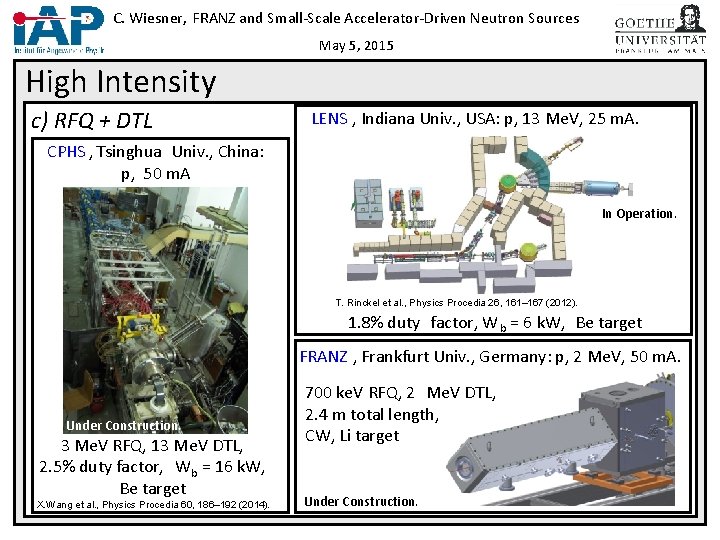
C. Wiesner, FRANZ and Small-Scale Accelerator-Driven Neutron Sources May 5, 2015 High Intensity c) RFQ + DTL LENS , Indiana Univ. , USA: p, 13 Me. V, 25 m. A. CPHS , Tsinghua Univ. , China: p, 50 m. A In Operation. T. Rinckel et al. , Physics Procedia 26, 161– 167 (2012). 1. 8% duty factor, W b = 6 k. W, Be target FRANZ , Frankfurt Univ. , Germany: p, 2 Me. V, 50 m. A. Under Construction. 3 Me. V RFQ, 13 Me. V DTL, 2. 5% duty factor, W b = 16 k. W, Be target X. Wang et al. , Physics Procedia 60, 186– 192 (2014). 700 ke. V RFQ, 2 Me. V DTL, 2. 4 m total length, CW, Li target Under Construction.
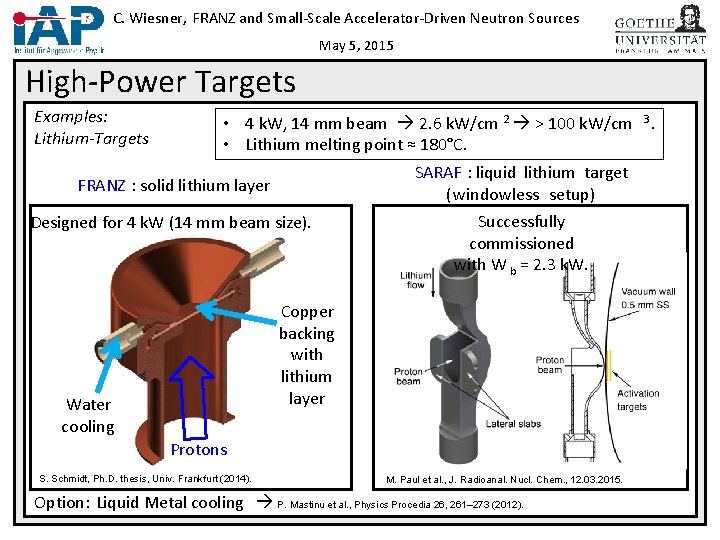
C. Wiesner, FRANZ and Small-Scale Accelerator-Driven Neutron Sources May 5, 2015 High-Power Targets Examples: Lithium-Targets • 4 k. W, 14 mm beam 2. 6 k. W/cm 2 > 100 k. W/cm 3. • Lithium melting point ≈ 180°C. FRANZ : solid lithium layer Designed for 4 k. W (14 mm beam size). SARAF : liquid lithium target ( windowless setup) Successfully commissioned with W b = 2. 3 k. W. Copper backing with lithium layer Water cooling Protons S. Schmidt, Ph. D. thesis, Univ. Frankfurt (2014). M. Paul et al. , J. Radioanal. Nucl. Chem. , 12. 03. 2015. Option: Liquid Metal cooling P. Mastinu et al. , Physics Procedia 26, 261– 273 (2012).
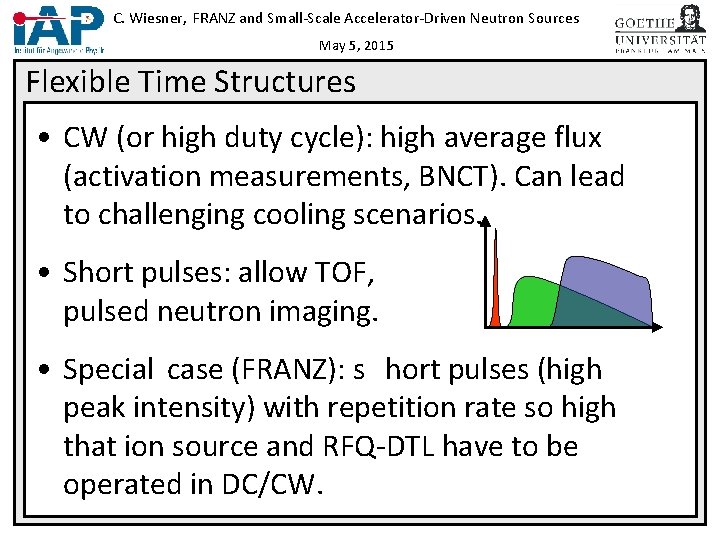
C. Wiesner, FRANZ and Small-Scale Accelerator-Driven Neutron Sources May 5, 2015 Flexible Time Structures • CW (or high duty cycle): high average flux (activation measurements, BNCT). Can lead to challenging cooling scenarios. • Short pulses: allow TOF, pulsed neutron imaging. • Special case (FRANZ): s hort pulses (high peak intensity) with repetition rate so high that ion source and RFQ-DTL have to be operated in DC/CW.
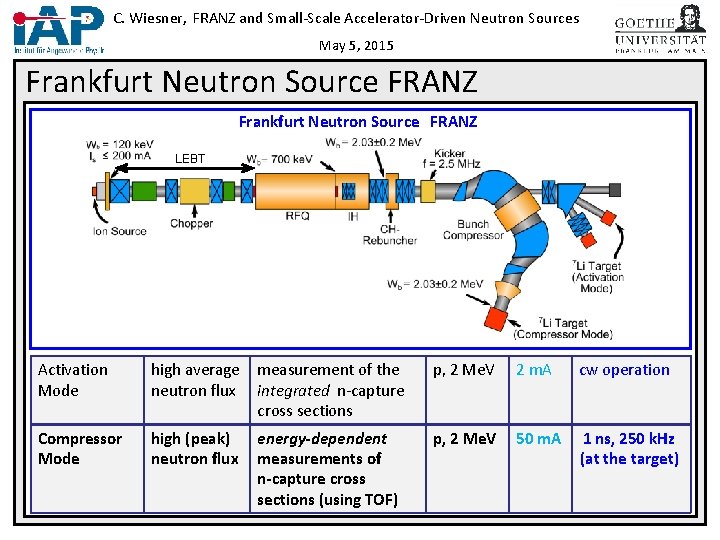
C. Wiesner, FRANZ and Small-Scale Accelerator-Driven Neutron Sources May 5, 2015 Frankfurt Neutron Source FRANZ LEBT Activation Mode high average neutron flux measurement of the integrated n-capture cross sections p, 2 Me. V 2 m. A cw operation Compressor Mode high (peak) neutron flux energy-dependent measurements of n-capture cross sections (using TOF) p, 2 Me. V 50 m. A 1 ns, 250 k. Hz (at the target)
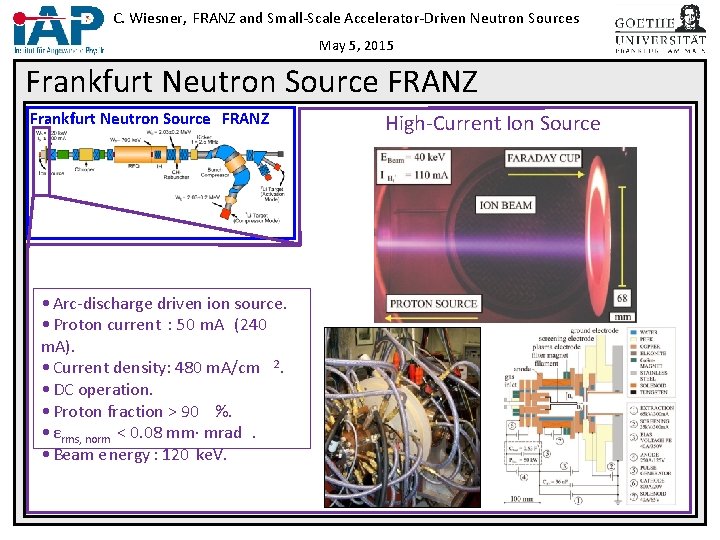
C. Wiesner, FRANZ and Small-Scale Accelerator-Driven Neutron Sources May 5, 2015 Frankfurt Neutron Source FRANZ • Arc-discharge driven ion source. • Proton current : 50 m. A (240 m. A). • Current density: 480 m. A/cm 2. • DC operation. • Proton fraction > 90 %. • εrms, norm < 0. 08 mm∙ mrad. • Beam energy : 120 ke. V. High-Current Ion Source
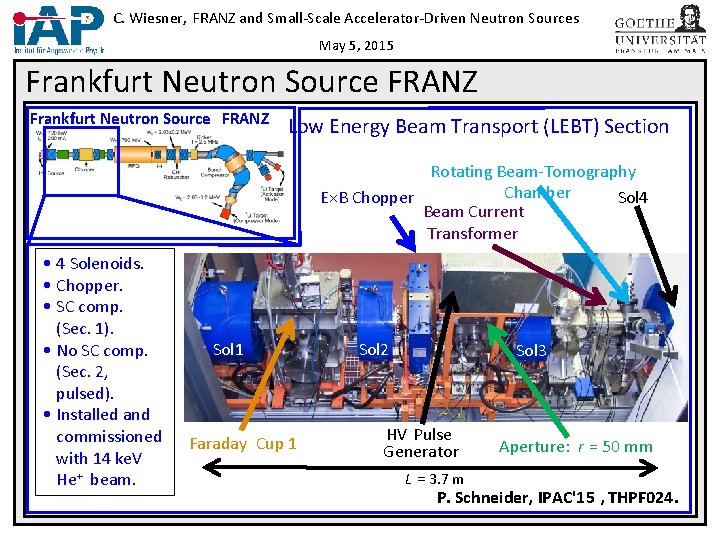
C. Wiesner, FRANZ and Small-Scale Accelerator-Driven Neutron Sources May 5, 2015 Frankfurt Neutron Source FRANZ Low Energy Beam Transport (LEBT) Section Rotating Beam-Tomography Chamber Sol 4 E×B Chopper Beam Current Transformer • 4 Solenoids. • Chopper. • SC comp. (Sec. 1). • No SC comp. (Sec. 2, pulsed). • Installed and commissioned with 14 ke. V He + beam. Sol 1 Faraday Cup 1 Sol 2 Sol 3 HV Pulse Generator L = 3. 7 m Aperture: r = 50 mm P. Schneider, IPAC'15 , THPF 024.
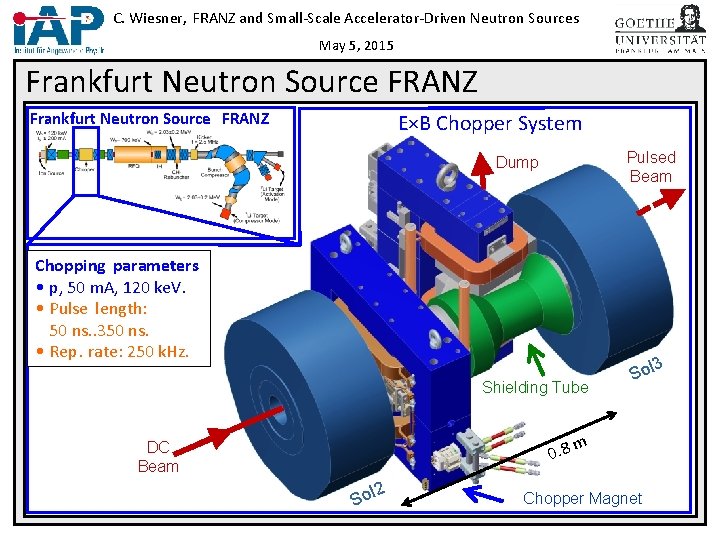
C. Wiesner, FRANZ and Small-Scale Accelerator-Driven Neutron Sources May 5, 2015 Frankfurt Neutron Source FRANZ E×B Chopper System Pulsed Beam Dump Chopping parameters • p, 50 m. A, 120 ke. V. • Pulse length: 50 ns. . 350 ns. • Rep. rate: 250 k. Hz. 3 Shielding Tube 0. 8 DC Beam 2 Sol m Chopper Magnet
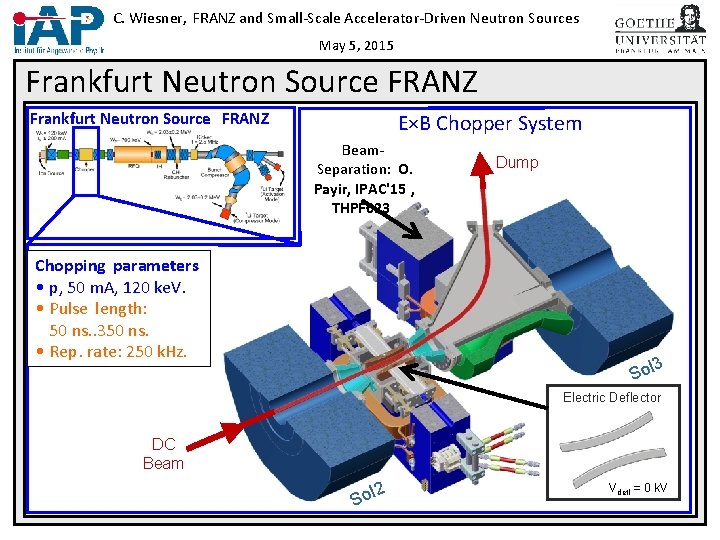
C. Wiesner, FRANZ and Small-Scale Accelerator-Driven Neutron Sources May 5, 2015 Frankfurt Neutron Source FRANZ E×B Chopper System Beam. Separation: O. Payir, IPAC'15 , THPF 023 Chopping parameters • p, 50 m. A, 120 ke. V. • Pulse length: 50 ns. . 350 ns. • Rep. rate: 250 k. Hz. Dump 3 Sol Electric Deflector DC Beam 2 Sol Vdefl = 0 k. V
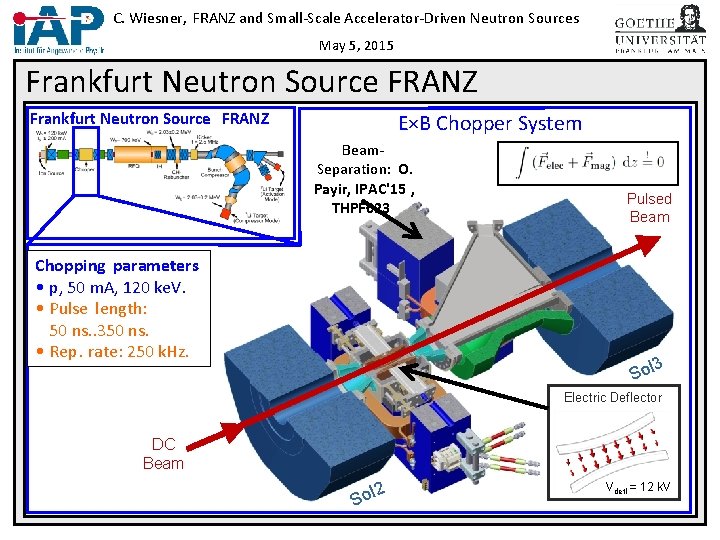
C. Wiesner, FRANZ and Small-Scale Accelerator-Driven Neutron Sources May 5, 2015 Frankfurt Neutron Source FRANZ E×B Chopper System Beam. Separation: O. Payir, IPAC'15 , THPF 023 Chopping parameters • p, 50 m. A, 120 ke. V. • Pulse length: 50 ns. . 350 ns. • Rep. rate: 250 k. Hz. Pulsed Beam 3 Sol Electric Deflector DC Beam 2 Sol Vdefl = 12 k. V
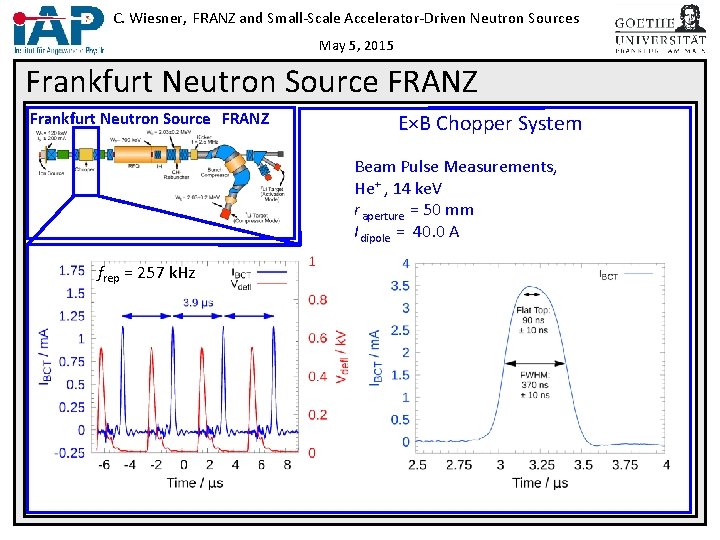
C. Wiesner, FRANZ and Small-Scale Accelerator-Driven Neutron Sources May 5, 2015 Frankfurt Neutron Source FRANZ E×B Chopper System Beam Pulse Measurements, He + , 14 ke. V r aperture = 50 mm I dipole = 40. 0 A frep = 257 k. Hz
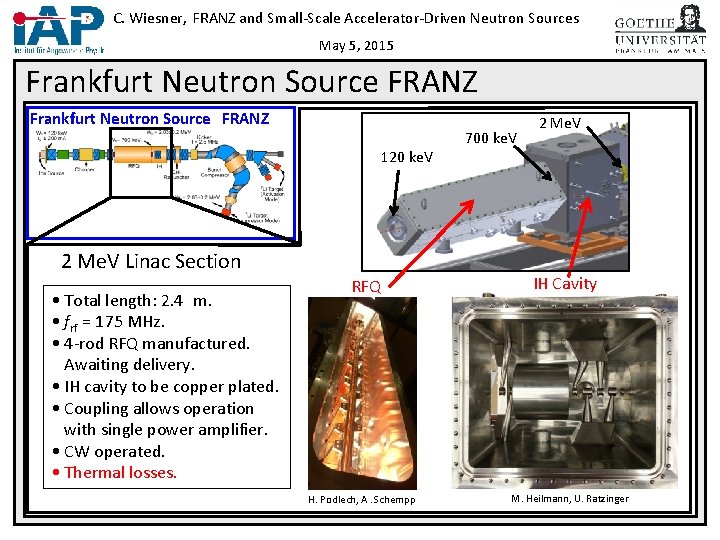
C. Wiesner, FRANZ and Small-Scale Accelerator-Driven Neutron Sources May 5, 2015 Frankfurt Neutron Source FRANZ 120 ke. V 2 Me. V Linac Section • Total length: 2. 4 m. • frf = 175 MHz. • 4 -rod RFQ manufactured. Awaiting delivery. • IH cavity to be copper plated. • Coupling allows operation with single power amplifier. • CW operated. • Thermal losses. RFQ H. Podlech, A. Schempp 700 ke. V 2 Me. V IH Cavity M. Heilmann, U. Ratzinger
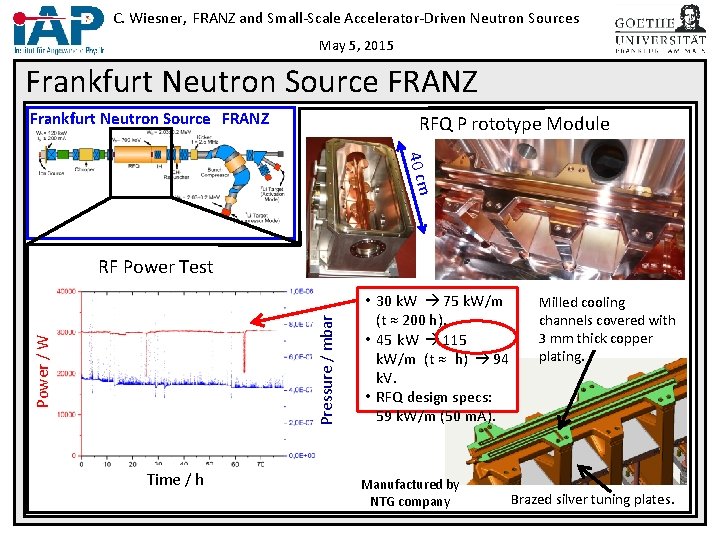
C. Wiesner, FRANZ and Small-Scale Accelerator-Driven Neutron Sources May 5, 2015 Frankfurt Neutron Source FRANZ RFQ P rototype Module 40 cm Power / W Pressure / mbar RF Power Test Time / h • 30 k. W 75 k. W/m (t ≈ 200 h). • 45 k. W 115 k. W/m (t ≈ h) 94 k. V. • RFQ design specs: 59 k. W/m (50 m. A). Manufactured by NTG company Milled cooling channels covered with 3 mm thick copper plating. Brazed silver tuning plates.
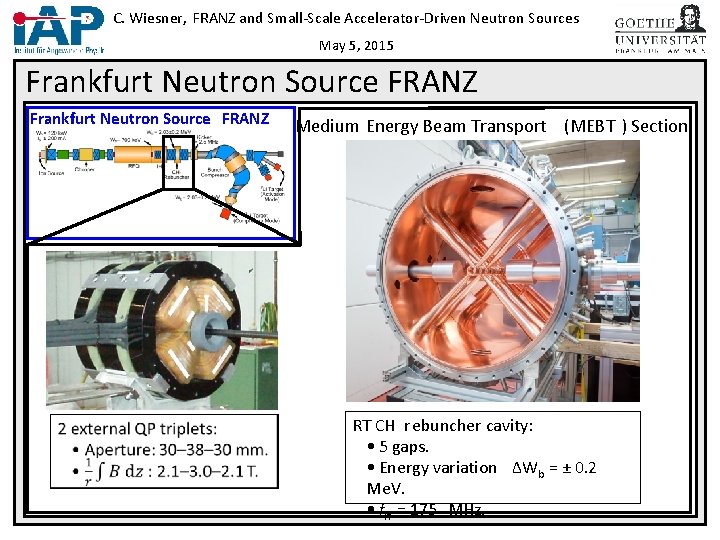
C. Wiesner, FRANZ and Small-Scale Accelerator-Driven Neutron Sources May 5, 2015 Frankfurt Neutron Source FRANZ Medium Energy Beam Transport (MEBT ) Section RT CH rebuncher cavity: • 5 gaps. • Energy variation ΔW b = ± 0. 2 Me. V. • frf = 175 MHz.
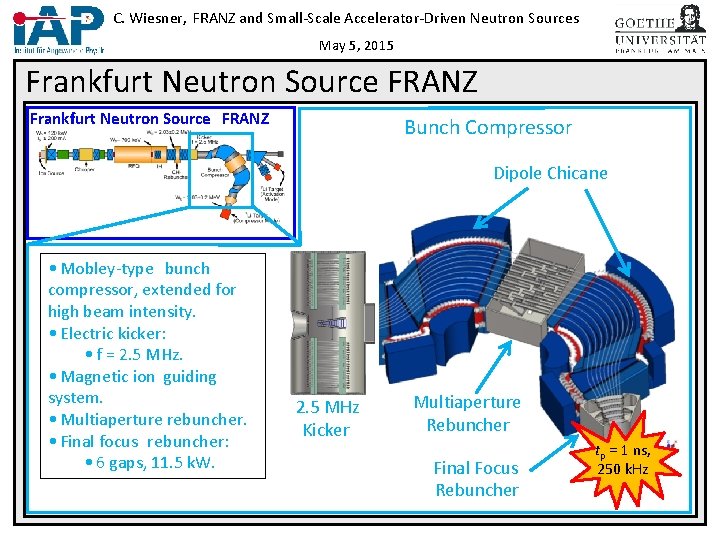
C. Wiesner, FRANZ and Small-Scale Accelerator-Driven Neutron Sources May 5, 2015 Frankfurt Neutron Source FRANZ Bunch Compressor Dipole Chicane • Mobley-type bunch compressor, extended for high beam intensity. • Electric kicker: • f = 2. 5 MHz. • Magnetic ion guiding system. • Multiaperture rebuncher. • Final focus rebuncher: • 6 gaps, 11. 5 k. W. 2. 5 MHz Kicker Multiaperture Rebuncher Final Focus Rebuncher tp = 1 ns, 250 k. Hz
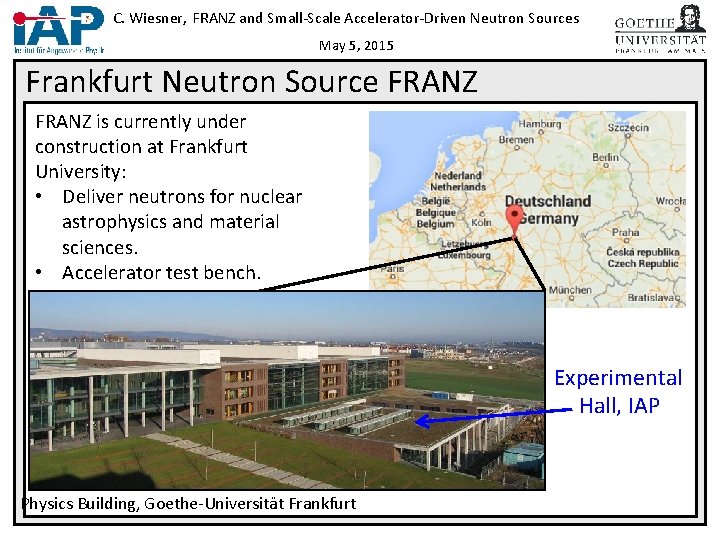
C. Wiesner, FRANZ and Small-Scale Accelerator-Driven Neutron Sources May 5, 2015 Frankfurt Neutron Source FRANZ is currently under construction at Frankfurt University: • Deliver neutrons for nuclear astrophysics and material sciences. • Accelerator test bench. • Education of students in accelerator physics. Experimental Hall, IAP Physics Building, Goethe-Universität Frankfurt
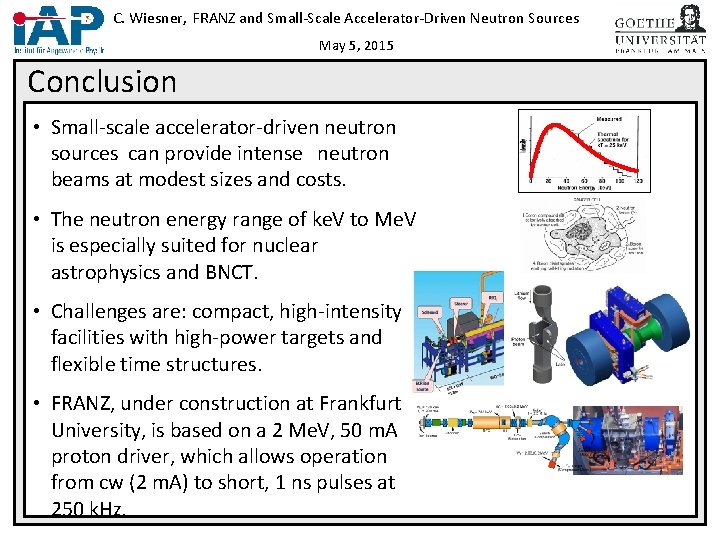
C. Wiesner, FRANZ and Small-Scale Accelerator-Driven Neutron Sources May 5, 2015 Conclusion • Small-scale accelerator-driven neutron sources can provide intense neutron beams at modest sizes and costs. • The neutron energy range of ke. V to Me. V is especially suited for nuclear astrophysics and BNCT. • Challenges are: compact, high-intensity facilities with high-power targets and flexible time structures. • FRANZ, under construction at Frankfurt University, is based on a 2 Me. V, 50 m. A proton driver, which allows operation from cw (2 m. A) to short, 1 ns pulses at 250 k. Hz.
C. Wiesner, FRANZ and Small-Scale Accelerator-Driven Neutron Sources May 5, 2015 Thanks to many colleagues for fruitful discussions and for sharing thoughts and material. Thanks to Andres Kreiner and Arik Kreisel for providing me with additional information. Thanks to S. Alzubaidi, M. Droba, M. Heilmann, O. Hinrichs, B. Klump , O. Meusel, D. Noll, O. Payir, H. Podlech, U. Ratzinger, R. Reifarth , A. Schempp, S. Schmidt, P. Schneider, M. Schwarz, W. Schweizer, K. Volk, C. Wagner. Thank you for your attention!