
C Review Part 1 Mechanics Part 2 Basics
C++ Review Part 1: Mechanics Part 2: Basics Part 3: References Part 4: Const Part 5: Inheritance Part 6: Libraries Acknowledgement: Adapted from: Brown CS 123 http: //www. cs. brown. edu/courses/cs 123/resources/c++_mini_course. ppt
C++ Review Part 1: Mechanics
C++ is a superset of C • New Features include – Classes (Object Oriented) – Templates (Standard Template Library) – Operator Overloading – Slightly cleaner memory operations 3

Some C++ code Segment. h Segment. cpp #ifndef __SEGMENT_HEADER__ #define __SEGMENT_HEADER__ #include "Segment. h" #include "Point. h" class Point; class Segment { public: Segment(); virtual ~Segment(); private: Point *m_p 0, *m_p 1; }; Segment: : Segment() { m_p 0 = new Point(0, 0); m_p 1 = new Point(1, 1); } Segment: : ~Segment() { delete m_p 0; delete m_p 1; } #endif // __SEGMENT_HEADER__ 4
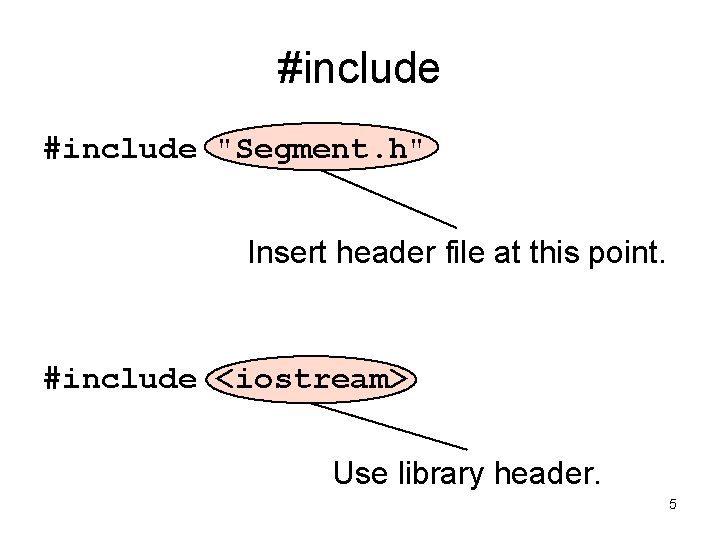
#include "Segment. h" Insert header file at this point. #include <iostream> Use library header. 5
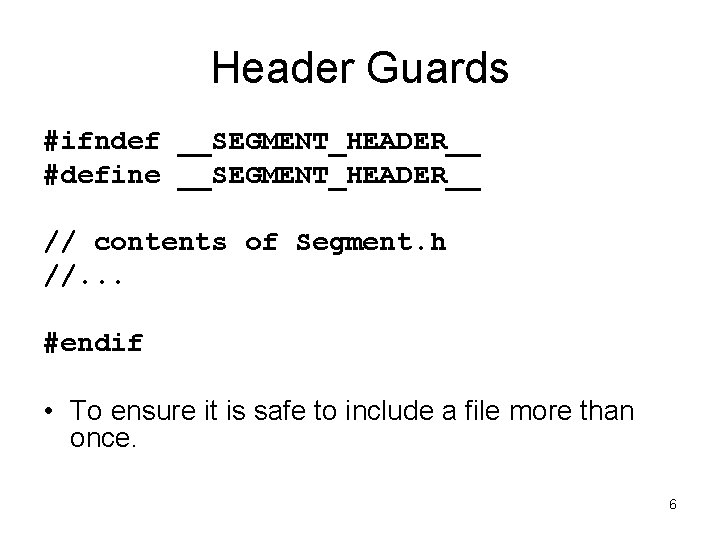
Header Guards #ifndef __SEGMENT_HEADER__ #define __SEGMENT_HEADER__ // contents of Segment. h //. . . #endif • To ensure it is safe to include a file more than once. 6
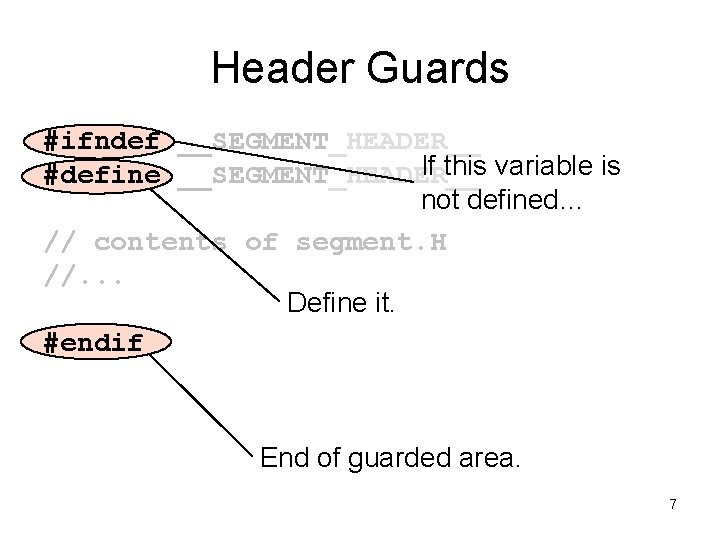
Header Guards #ifndef __SEGMENT_HEADER__ If this variable is #define __SEGMENT_HEADER__ not defined… // contents of segment. H //. . . Define it. #endif • To ensure it is safe to include a file more than once. End of guarded area. 7
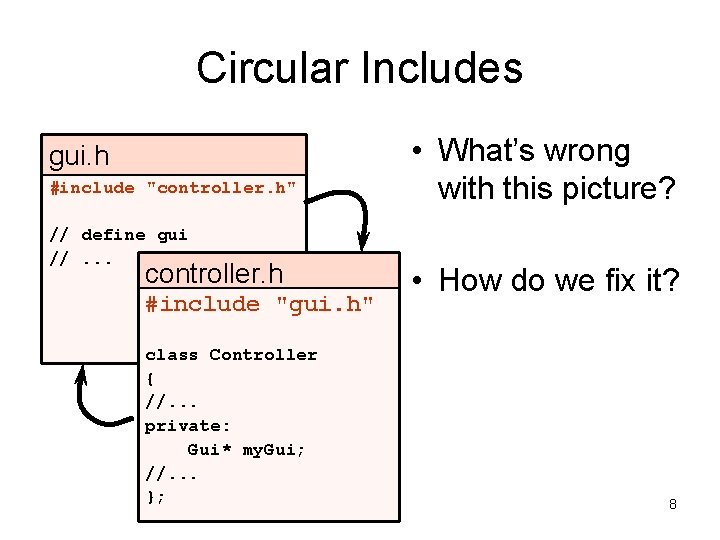
Circular Includes gui. h #include "controller. h" // define gui //. . . controller. h #include "gui. h" class Controller { //. . . private: Gui* my. Gui; //. . . }; • What’s wrong with this picture? • How do we fix it? 8
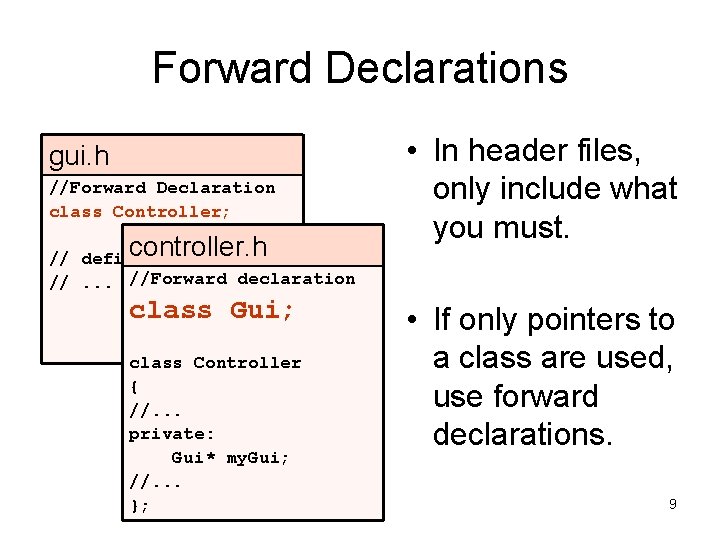
Forward Declarations gui. h //Forward Declaration class Controller; controller. h // define gui //. . . //Forward declaration class Gui; class Controller { //. . . private: Gui* my. Gui; //. . . }; • In header files, only include what you must. • If only pointers to a class are used, use forward declarations. 9
C++ Review Part 2: Basics
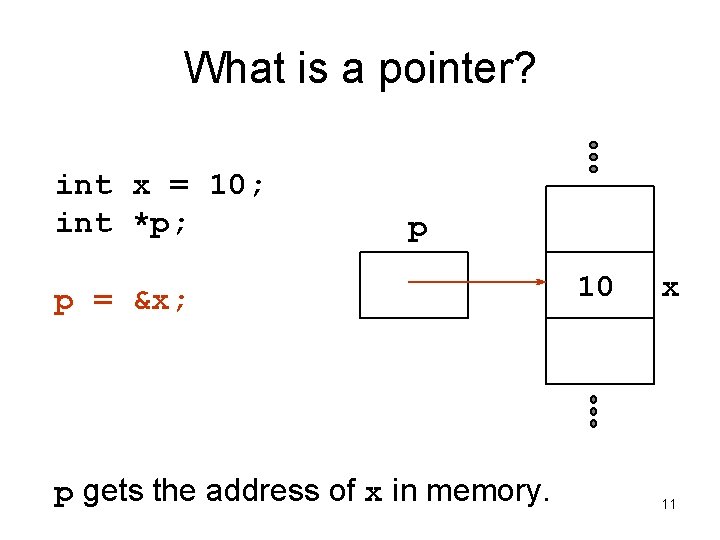
What is a pointer? int x = 10; int *p; p p = &x; p gets the address of x in memory. 10 x 11
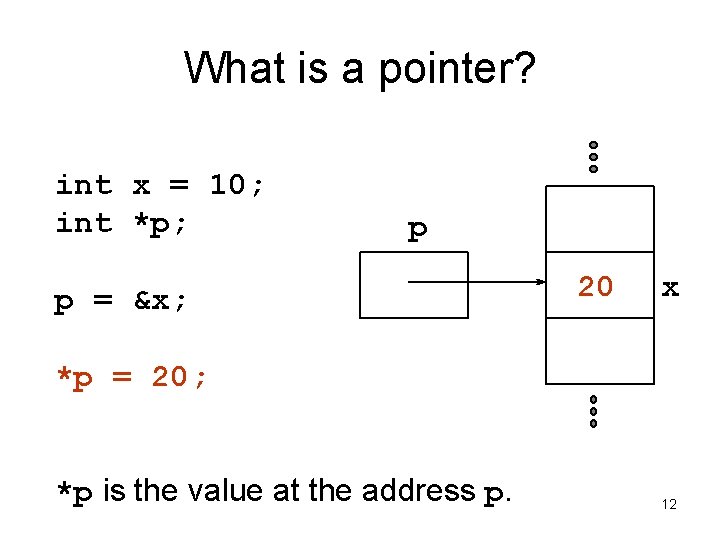
What is a pointer? int x = 10; int *p; p p = &x; 20 x *p = 20; *p is the value at the address p. 12
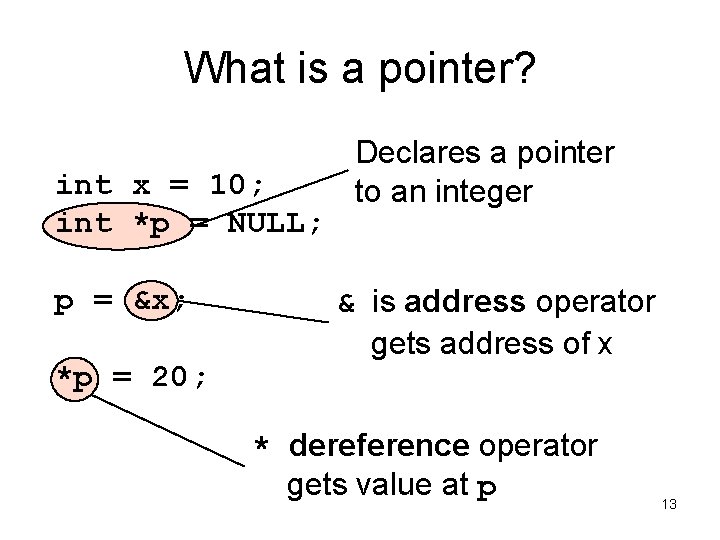
What is a pointer? int x = 10; int *p = NULL; p = &x; *p = 20; Declares a pointer to an integer & is address operator gets address of x * dereference operator gets value at p 13
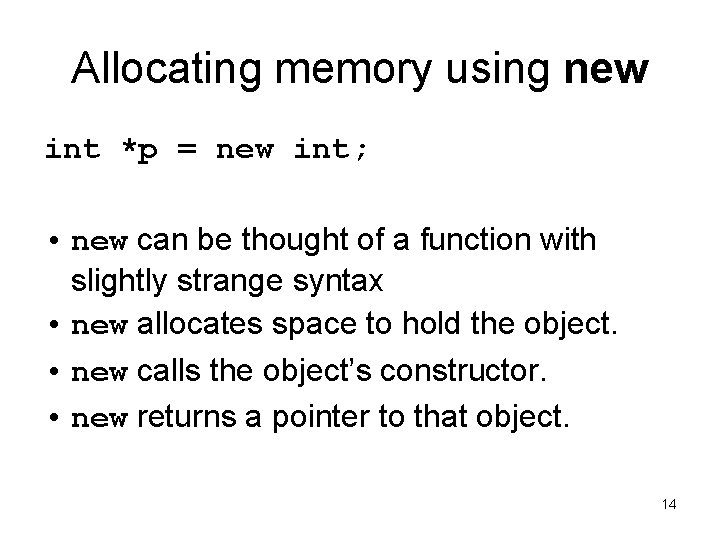
Allocating memory using new int *p = new int; • new can be thought of a function with slightly strange syntax • new allocates space to hold the object. • new calls the object’s constructor. • new returns a pointer to that object. 14
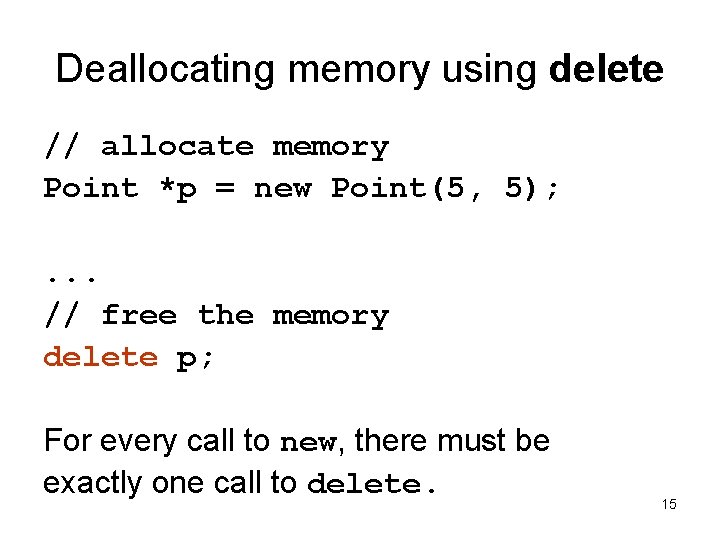
Deallocating memory using delete // allocate memory Point *p = new Point(5, 5); . . . // free the memory delete p; For every call to new, there must be exactly one call to delete. 15
![Using new with arrays int x = 10; int* nums 1 = new int[10];](http://slidetodoc.com/presentation_image_h/2ae43927cf7598336e9e5a4af5ddd8ee/image-16.jpg "Using new with arrays int x = 10; int* nums 1 = new int[10];")
Using new with arrays int x = 10; int* nums 1 = new int[10]; int* nums 2 = new int[x]; // ok • Initializes an array of 10 integers on the heap. • C++ equivalent of the following C code int* nums = (int*)malloc(x * sizeof(int)); 16
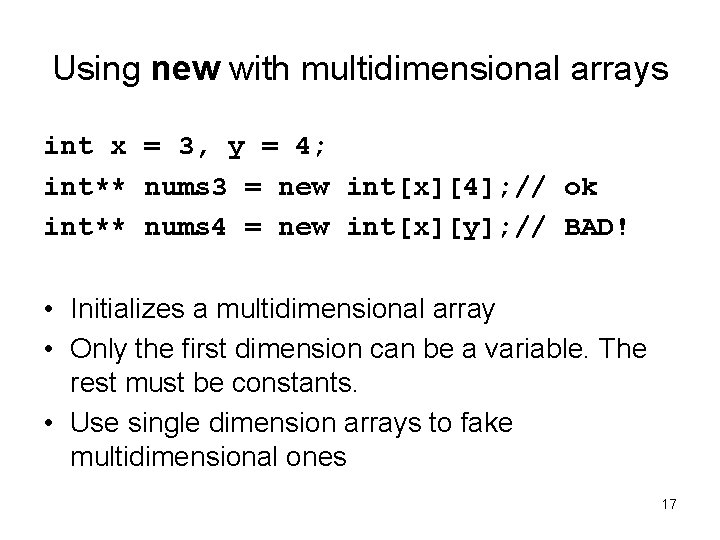
Using new with multidimensional arrays int x = 3, y = 4; int** nums 3 = new int[x][4]; // ok int** nums 4 = new int[x][y]; // BAD! • Initializes a multidimensional array • Only the first dimension can be a variable. The rest must be constants. • Use single dimension arrays to fake multidimensional ones 17
![Using delete on arrays // allocate memory int* nums 1 = new int[10]; int*](http://slidetodoc.com/presentation_image_h/2ae43927cf7598336e9e5a4af5ddd8ee/image-18.jpg "Using delete on arrays // allocate memory int* nums 1 = new int[10]; int*")
Using delete on arrays // allocate memory int* nums 1 = new int[10]; int* nums 3 = new int[x][4][5]; . . . // free the memory delete[] nums 1; delete[] nums 3; • Have to use delete[]. 18
Destructors • delete calls the object’s destructor. • delete frees space occupied by the object. • A destructor cleans up after the object. • Releases resources such as memory. 19
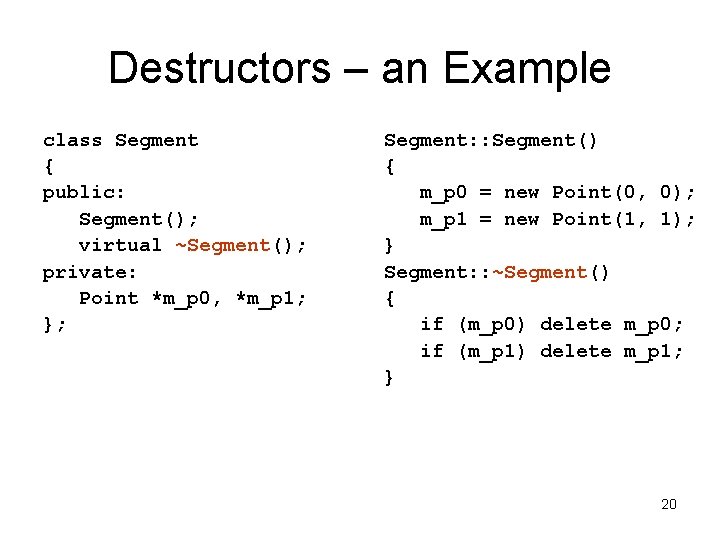
Destructors – an Example class Segment { public: Segment(); virtual ~Segment(); private: Point *m_p 0, *m_p 1; }; Segment: : Segment() { m_p 0 = new Point(0, 0); m_p 1 = new Point(1, 1); } Segment: : ~Segment() { if (m_p 0) delete m_p 0; if (m_p 1) delete m_p 1; } 20
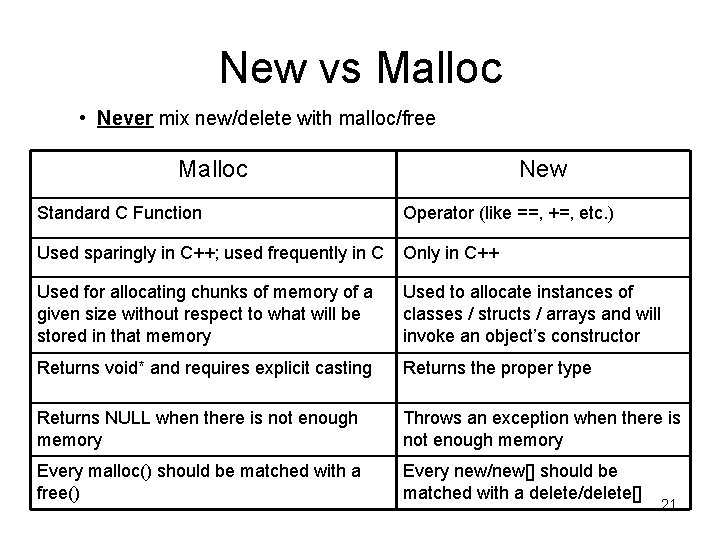
New vs Malloc • Never mix new/delete with malloc/free Malloc New Standard C Function Operator (like ==, +=, etc. ) Used sparingly in C++; used frequently in C Only in C++ Used for allocating chunks of memory of a given size without respect to what will be stored in that memory Used to allocate instances of classes / structs / arrays and will invoke an object’s constructor Returns void* and requires explicit casting Returns the proper type Returns NULL when there is not enough memory Throws an exception when there is not enough memory Every malloc() should be matched with a free() Every new/new[] should be matched with a delete/delete[] 21
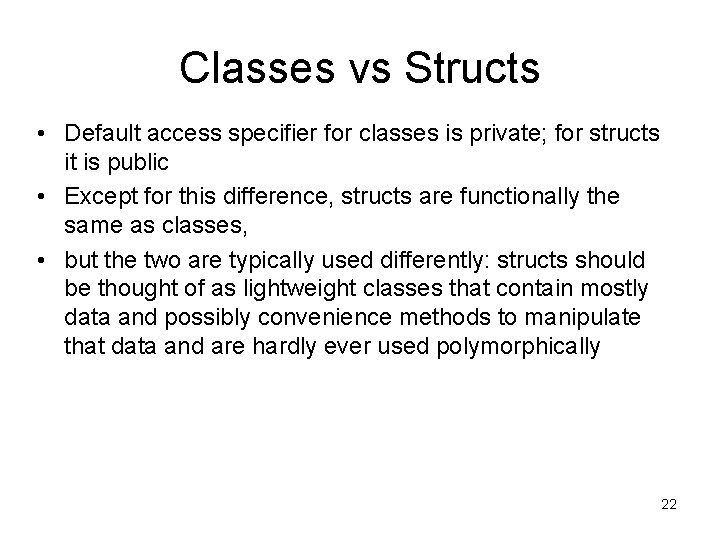
Classes vs Structs • Default access specifier for classes is private; for structs it is public • Except for this difference, structs are functionally the same as classes, • but the two are typically used differently: structs should be thought of as lightweight classes that contain mostly data and possibly convenience methods to manipulate that data and are hardly ever used polymorphically 22
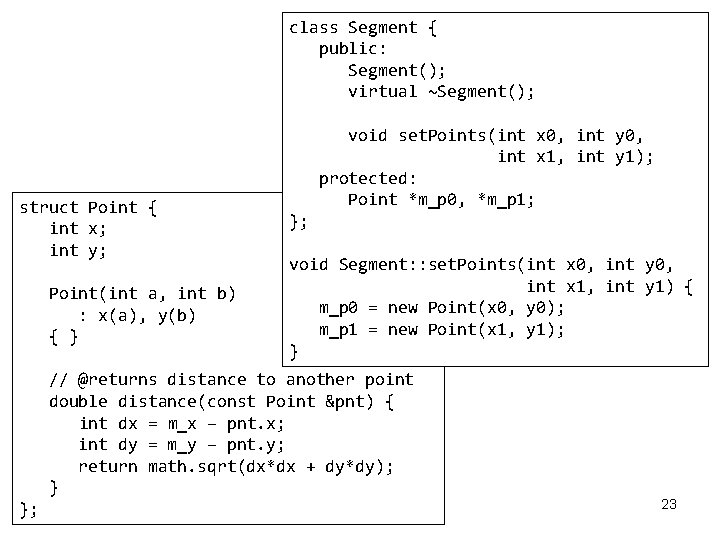
class Segment { public: Segment(); virtual ~Segment(); struct Point { int x; int y; Point(int a, int b) : x(a), y(b) { } void set. Points(int x 0, int y 0, int x 1, int y 1); protected: Point *m_p 0, *m_p 1; }; void Segment: : set. Points(int x 0, int y 0, int x 1, int y 1) { m_p 0 = new Point(x 0, y 0); m_p 1 = new Point(x 1, y 1); } // @returns distance to another point double distance(const Point &pnt) { int dx = m_x – pnt. x; int dy = m_y – pnt. y; return math. sqrt(dx*dx + dy*dy); } }; 23
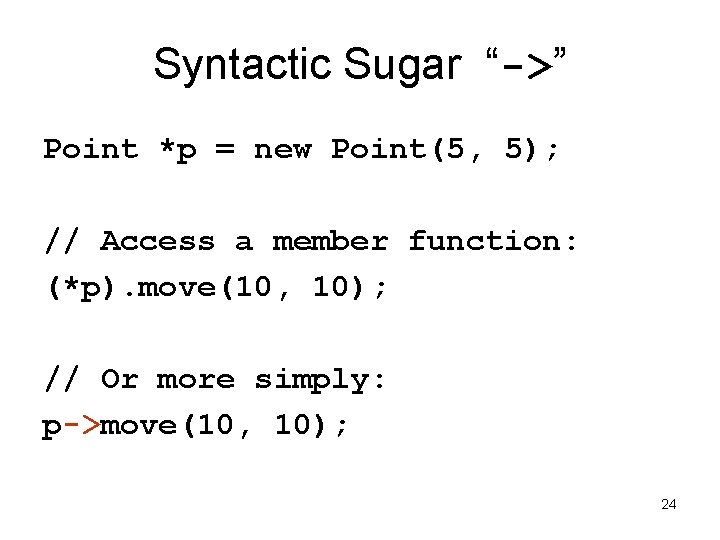
Syntactic Sugar “->” Point *p = new Point(5, 5); // Access a member function: (*p). move(10, 10); // Or more simply: p->move(10, 10); 24
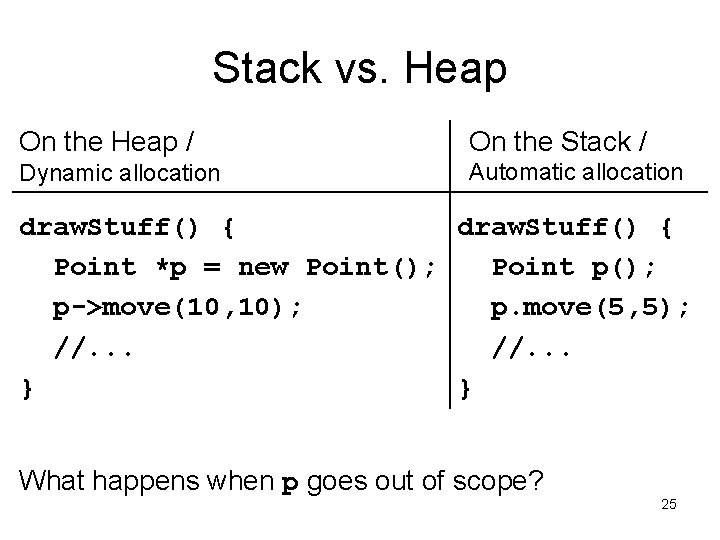
Stack vs. Heap On the Heap / On the Stack / Dynamic allocation Automatic allocation draw. Stuff() { Point *p = new Point(); Point p(); p->move(10, 10); p. move(5, 5); //. . . } } What happens when p goes out of scope? 25
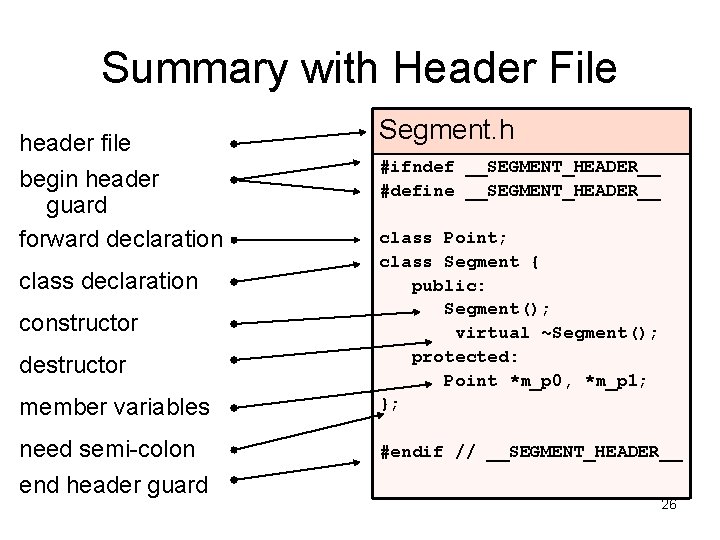
Summary with Header File header file begin header guard forward declaration class declaration constructor destructor member variables need semi-colon end header guard Segment. h #ifndef __SEGMENT_HEADER__ #define __SEGMENT_HEADER__ class Point; class Segment { public: Segment(); virtual ~Segment(); protected: Point *m_p 0, *m_p 1; }; #endif // __SEGMENT_HEADER__ 26
C++ Review Part 3: References 27
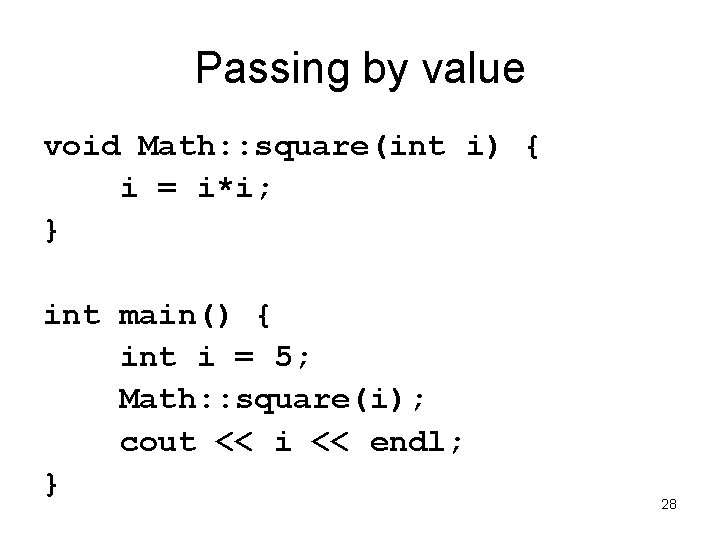
Passing by value void Math: : square(int i) { i = i*i; } int main() { int i = 5; Math: : square(i); cout << i << endl; } 28
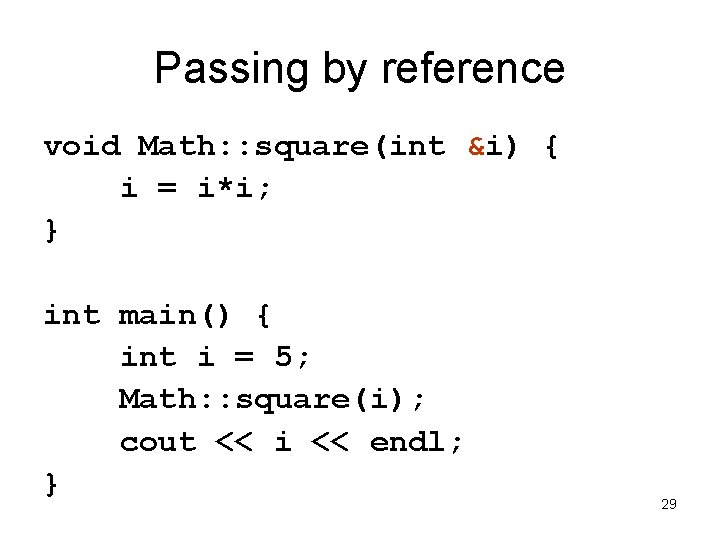
Passing by reference void Math: : square(int &i) { i = i*i; } int main() { int i = 5; Math: : square(i); cout << i << endl; } 29
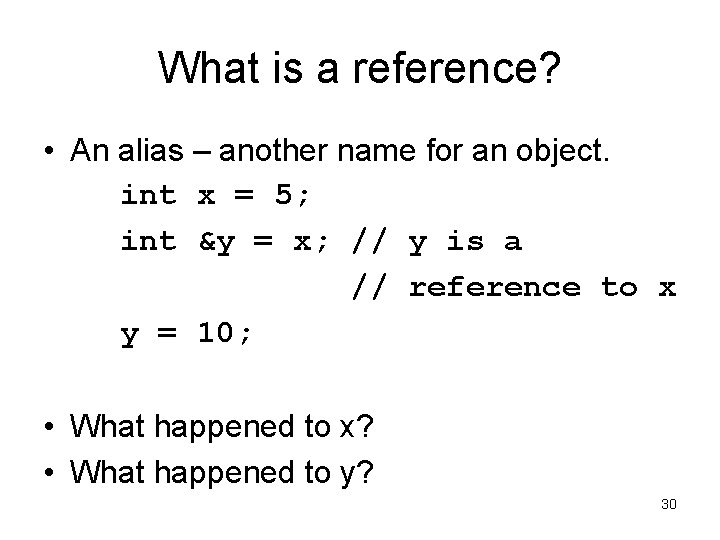
What is a reference? • An alias – another name for an object. int x = 5; int &y = x; // y is a // reference to x y = 10; • What happened to x? • What happened to y? 30
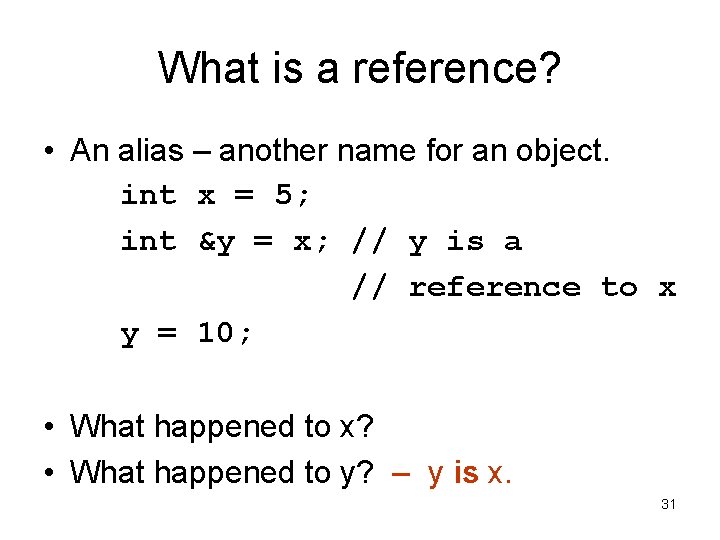
What is a reference? • An alias – another name for an object. int x = 5; int &y = x; // y is a // reference to x y = 10; • What happened to x? • What happened to y? – y is x. 31
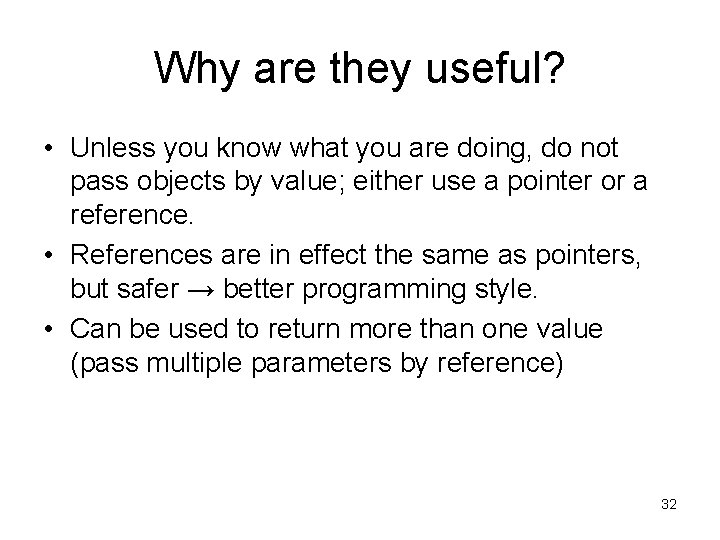
Why are they useful? • Unless you know what you are doing, do not pass objects by value; either use a pointer or a reference. • References are in effect the same as pointers, but safer → better programming style. • Can be used to return more than one value (pass multiple parameters by reference) 32
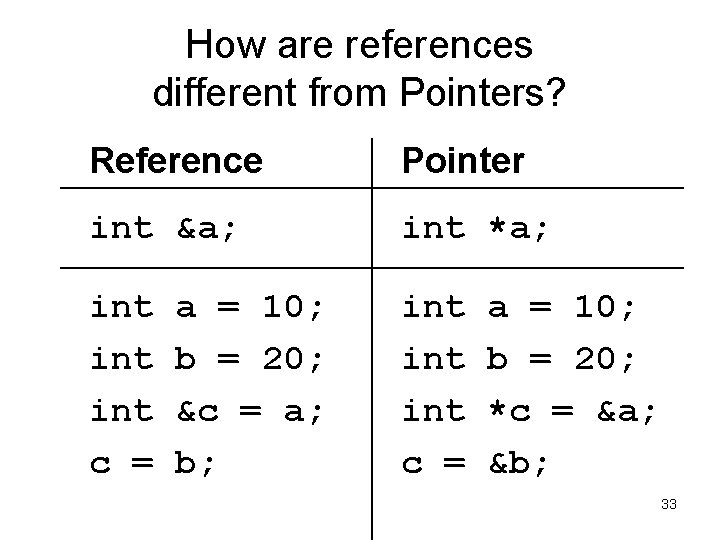
How are references different from Pointers? Reference Pointer int &a; int *a; int int int c = a = 10; b = 20; &c = a; b; a = 10; b = 20; *c = &a; &b; 33
C++ Review Part 4: const 34
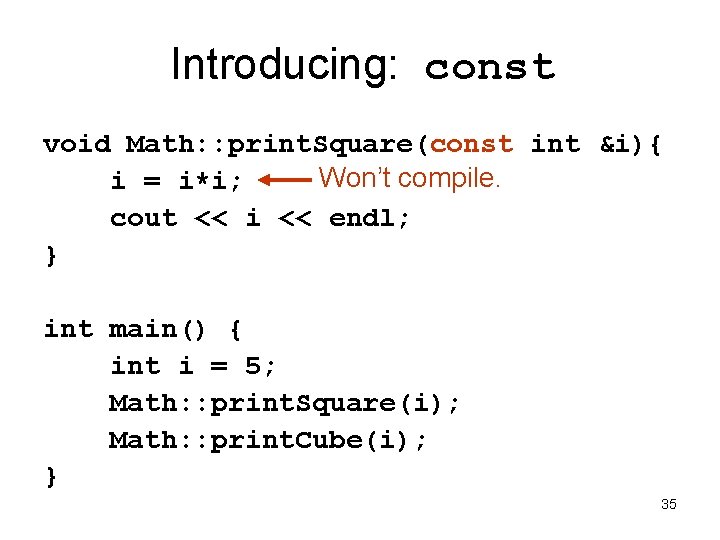
Introducing: const void Math: : print. Square(const int &i){ Won’t compile. i = i*i; cout << i << endl; } int main() { int i = 5; Math: : print. Square(i); Math: : print. Cube(i); } 35
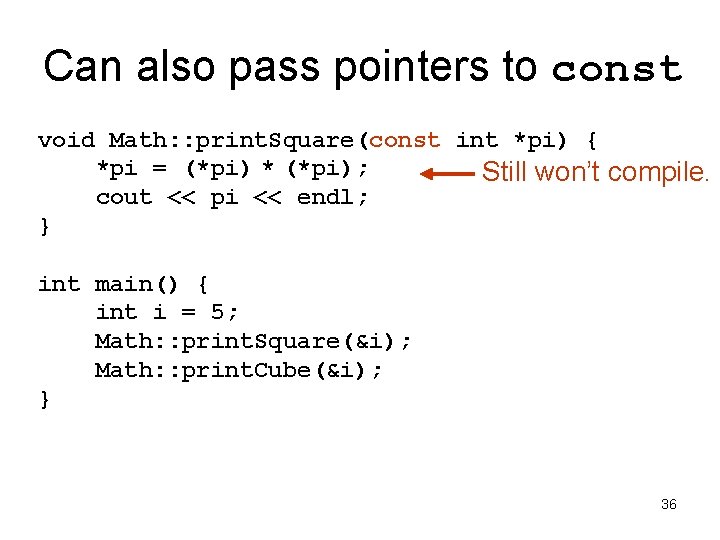
Can also pass pointers to const void Math: : print. Square(const int *pi) { *pi = (*pi) * (*pi); Still won’t compile. cout << pi << endl; } int main() { int i = 5; Math: : print. Square(&i); Math: : print. Cube(&i); } 36
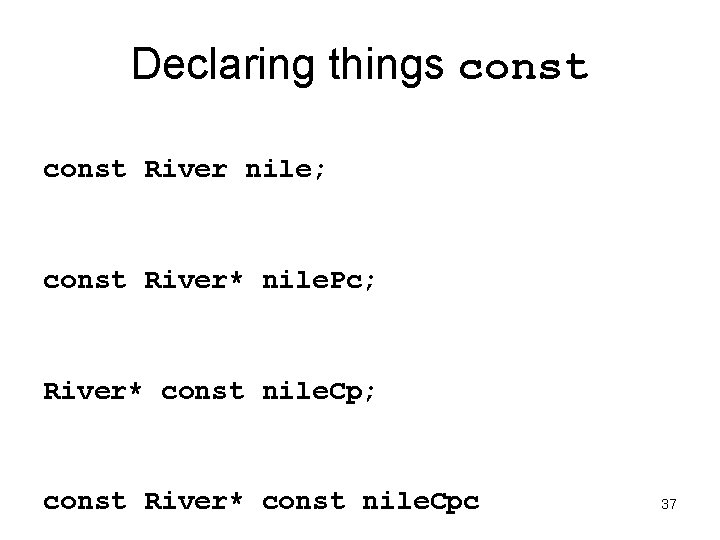
Declaring things const River nile; const River* nile. Pc; River* const nile. Cp; const River* const nile. Cpc 37
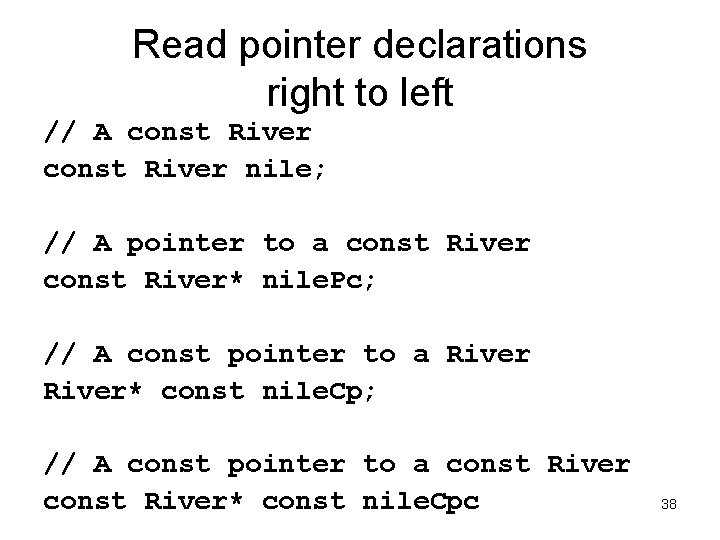
Read pointer declarations right to left // A const River nile; // A pointer to a const River* nile. Pc; // A const pointer to a River* const nile. Cp; // A const pointer to a const River* const nile. Cpc 38
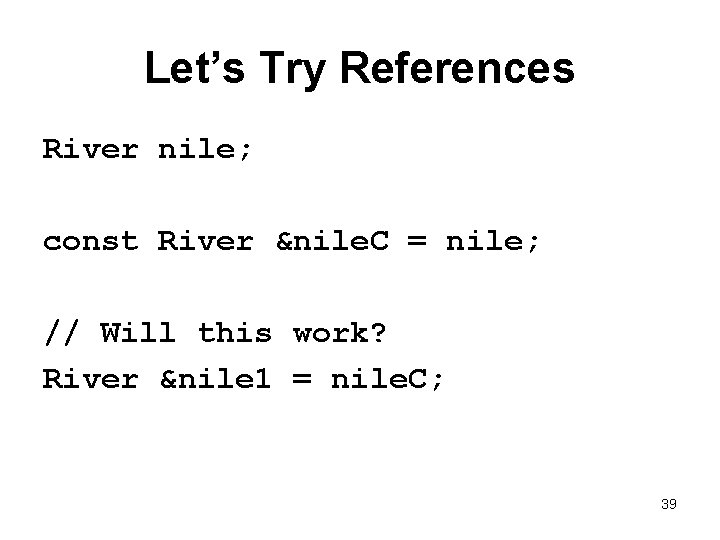
Let’s Try References River nile; const River &nile. C = nile; // Will this work? River &nile 1 = nile. C; 39
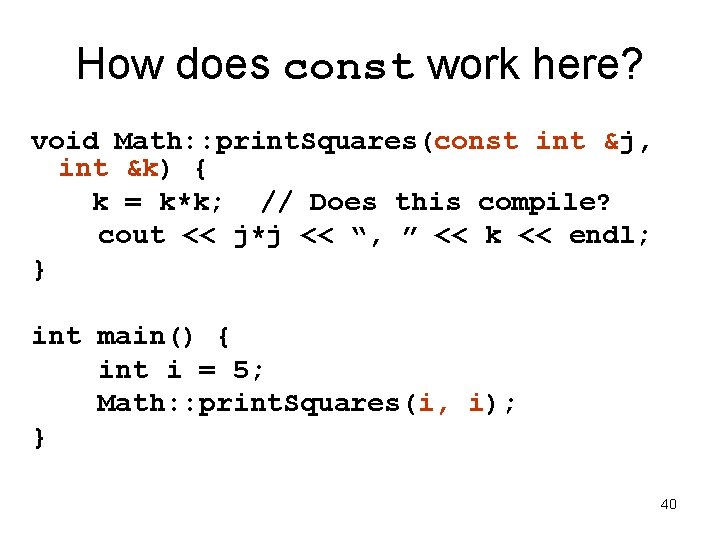
How does const work here? void Math: : print. Squares(const int &j, int &k) { k = k*k; // Does this compile? cout << j*j << “, ” << k << endl; } int main() { int i = 5; Math: : print. Squares(i, i); } 40
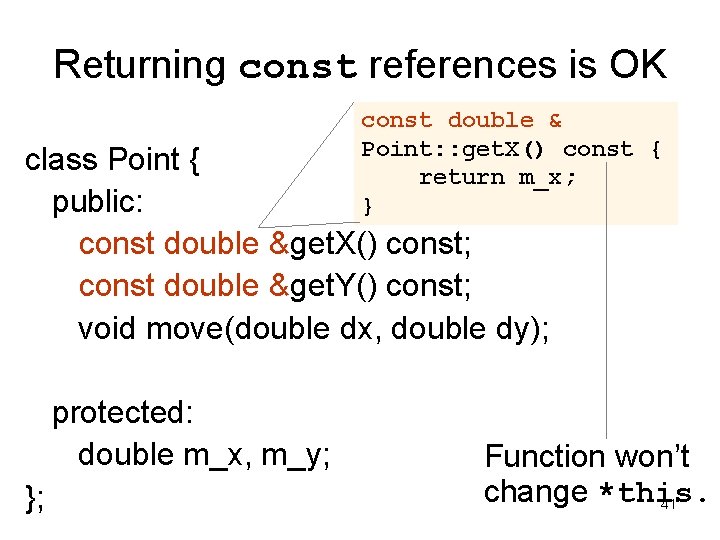
Returning const references is OK const double & Point: : get. X() const { return m_x; } class Point { public: const double &get. X() const; const double &get. Y() const; void move(double dx, double dy); protected: double m_x, m_y; }; Function won’t change *this. 41
C++ Review Part 5: Inheritance 42
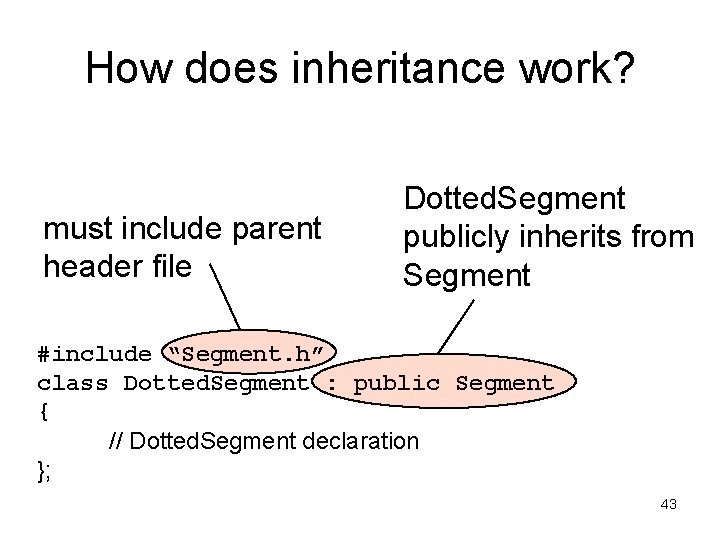
How does inheritance work? must include parent header file Dotted. Segment publicly inherits from Segment #include “Segment. h” class Dotted. Segment : public Segment { // Dotted. Segment declaration }; 43
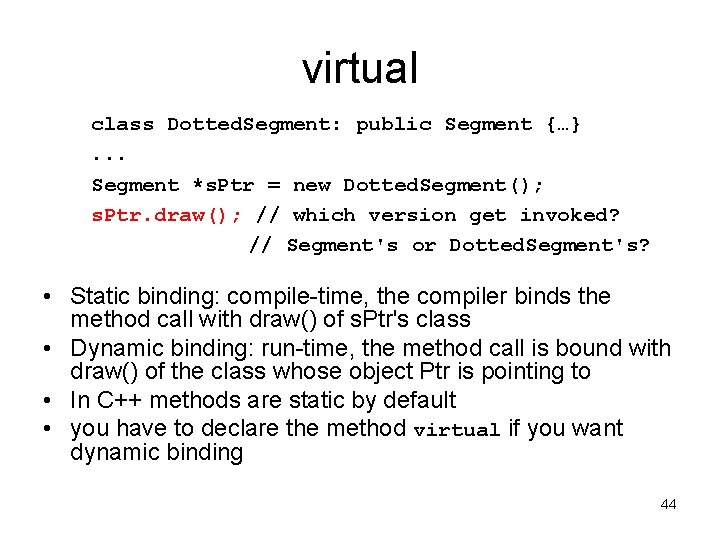
virtual class Dotted. Segment: public Segment {…}. . . Segment *s. Ptr = new Dotted. Segment(); s. Ptr. draw(); // which version get invoked? // Segment's or Dotted. Segment's? • Static binding: compile-time, the compiler binds the method call with draw() of s. Ptr's class • Dynamic binding: run-time, the method call is bound with draw() of the class whose object Ptr is pointing to • In C++ methods are static by default • you have to declare the method virtual if you want dynamic binding 44
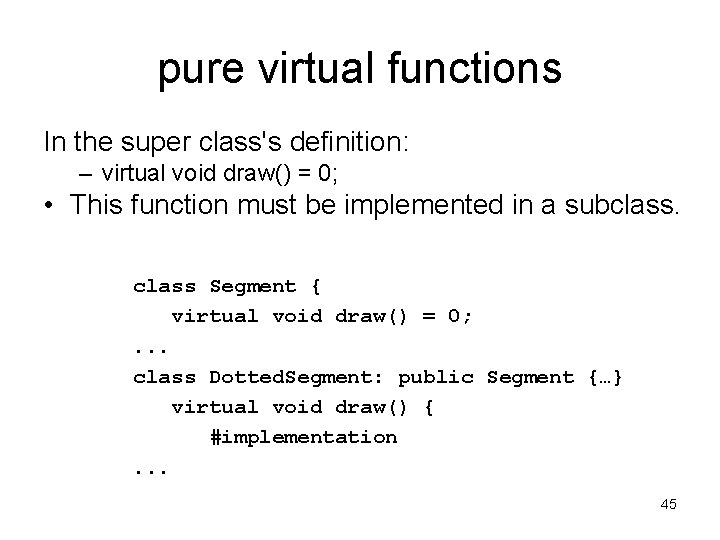
pure virtual functions In the super class's definition: – virtual void draw() = 0; • This function must be implemented in a subclass Segment { virtual void draw() = 0; . . . class Dotted. Segment: public Segment {…} virtual void draw() { #implementation. . . 45
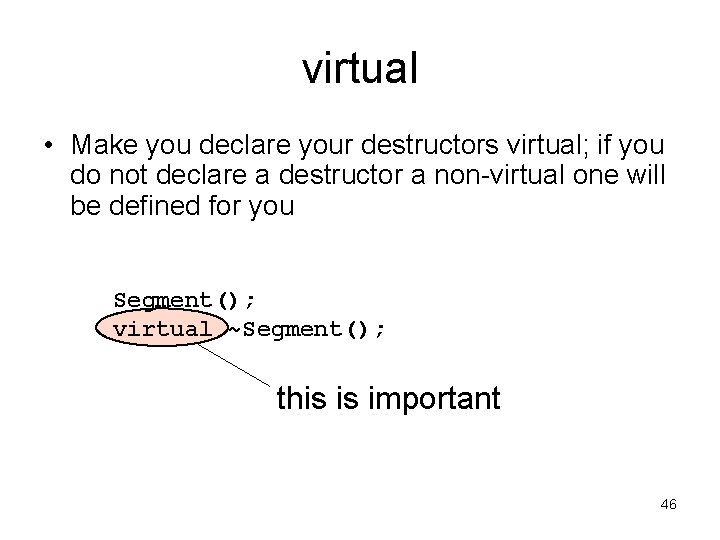
virtual • Make you declare your destructors virtual; if you do not declare a destructor a non-virtual one will be defined for you Segment(); virtual ~Segment(); this is important 46
C++ Review Part 6: Libraries 47
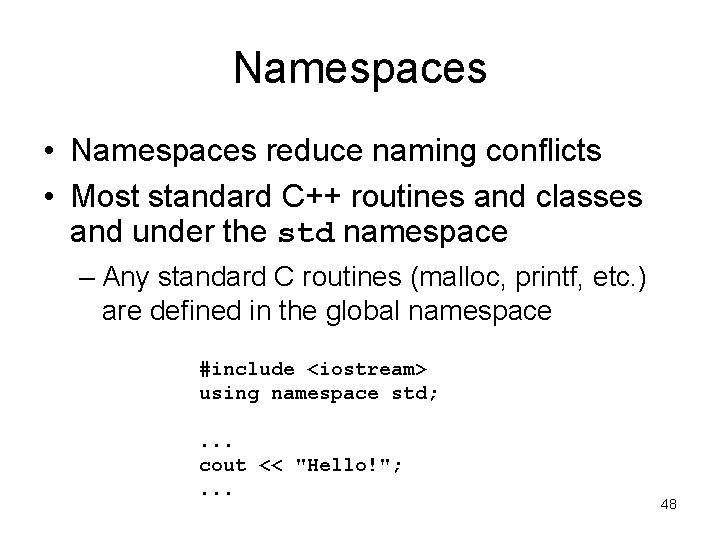
Namespaces • Namespaces reduce naming conflicts • Most standard C++ routines and classes and under the std namespace – Any standard C routines (malloc, printf, etc. ) are defined in the global namespace #include <iostream> using namespace std; . . . cout << "Hello!"; . . . 48
STL • Standard Template Library • Contains well-written, templated implementations of MOST data structures and algorithms – Templates allow generic programming – Allows you to easily store anything without writing a container yourself • Will give you the most hideous compile errors ever if you use them even slightly incorrectly! 49
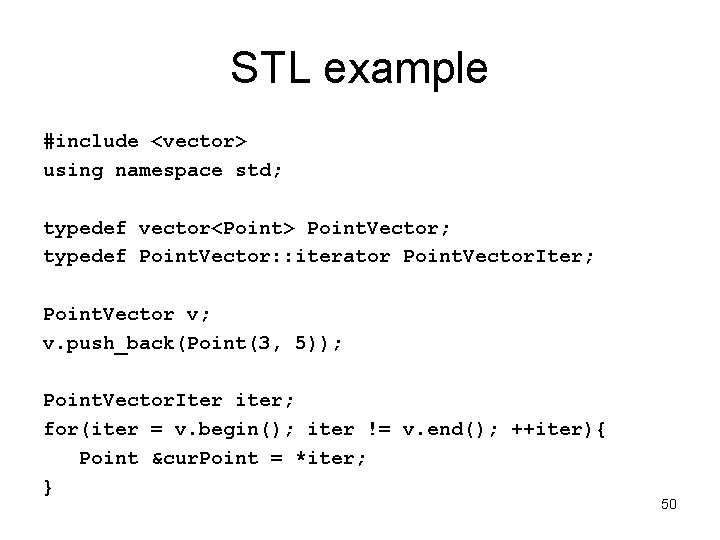
STL example #include <vector> using namespace std; typedef vector<Point> Point. Vector; typedef Point. Vector: : iterator Point. Vector. Iter; Point. Vector v; v. push_back(Point(3, 5)); Point. Vector. Iter iter; for(iter = v. begin(); iter != v. end(); ++iter){ Point &cur. Point = *iter; } 50
- Slides: 50