
C Q T Paragraph A formula for creating

- Slides: 7
C. Q. T. Paragraph A formula for creating effective expository paragraphs
�Every paragraph needs a topic sentence. This is a broad statement that introduces your topic WITHOUT introducing the story or characters. �One would assume most hunters would not show compassion towards their prey. �This is a broad statement about hunters and compassion, but NOT about “The Most Dangerous Game” and/or the characters. Introductory/Hook sentence
� Every paragraph has to start with a topic sentence (if one paragraph, it will be your thesis) � Your thesis needs to clearly state your argument: ◦ It also has T. A. G. : title, author, genre � In Richard Connell’s short story “The Most Dangerous Game, ” Whitney is characterized as a compassionate person. � It is clear from this sentence what this paragraph will prove Topic Sentence/ Thesis Statement
� The next sentence(s) should provide context for the quote. Context is the information that we need to know in order to understand what’s going on in our example. (Who? What? Where? ) � Both hunters, Whitney and Rainsford are sharing stories and ideas about hunting big game while aboard the yacht on their way to hunt jaguars. Whitney addresses the question if animals have feelings. � Now we know what is going on in the quote that is coming next; namely, that this is the part where the characters give their opinions on the subject of animals having feelings. C is for CONTEXT
� This is where the you supply the evidence. Quotes are best because they show the author’s exact words, which makes it easier to show the author’s meaning and, by extension, your argument/thesis. � Whitney states, “’Even so, I rather think [animals] understand one thing-fear. The fear of pain and the fear of death’” (2). � This quote is used because he is speaking honestly and saying that he believes animals understand fear, pain, and death at the same level as humans. � Also notice the MLA citation: no “pg. ” or “line” or anything extra and the period goes after the parentheses Q is for QUOTE
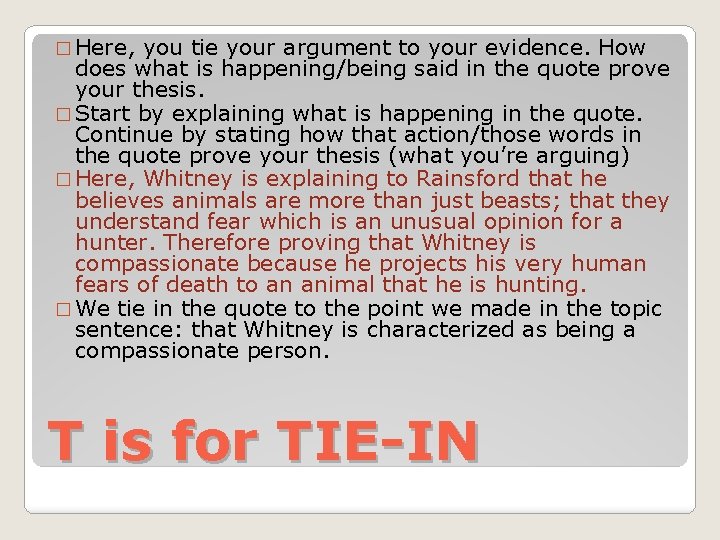
� Here, you tie your argument to your evidence. How does what is happening/being said in the quote prove your thesis. � Start by explaining what is happening in the quote. Continue by stating how that action/those words in the quote prove your thesis (what you’re arguing) � Here, Whitney is explaining to Rainsford that he believes animals are more than just beasts; that they understand fear which is an unusual opinion for a hunter. Therefore proving that Whitney is compassionate because he projects his very human fears of death to an animal that he is hunting. � We tie in the quote to the point we made in the topic sentence: that Whitney is characterized as being a compassionate person. T is for TIE-IN
� Since in our sample we discussed Whitney’s thoughts, we could then go on to discuss Rainsford opposing view and what his words say by again providing C, Q, T � Otherwise (or after our Whitney example), we would here write a sentence to transition to the next topic, connecting it to what we would be discussing next. � See how easy it is? ? Now it’s your turn… Next, continue examples or provide a transition to the next topic.