
C Pointers Copies from SEE C programming course
![Use of pointers • Data structures struct student. Data. Type { char last[50]; char](https://slidetodoc.com/presentation_image_h2/54992695eac5959264ebe6d01ca081bd/image-4.jpg "Use of pointers • Data structures struct student. Data. Type { char last[50]; char")
![Assume the variable definitions int vals[]={4, 7, 11}; int *valptr = vals; Examples of](https://slidetodoc.com/presentation_image_h2/54992695eac5959264ebe6d01ca081bd/image-12.jpg "Assume the variable definitions int vals[]={4, 7, 11}; int *valptr = vals; Examples of")
![Ponters to Constant const double tax. Rates[] = {0. 65, 0. 8, 0. 75};](https://slidetodoc.com/presentation_image_h2/54992695eac5959264ebe6d01ca081bd/image-20.jpg "Ponters to Constant const double tax. Rates[] = {0. 65, 0. 8, 0. 75};")
![The Relationship Between Arrays and Pointers int vals[] = {4, 7, 11}; cout <<](https://slidetodoc.com/presentation_image_h2/54992695eac5959264ebe6d01ca081bd/image-26.jpg "The Relationship Between Arrays and Pointers int vals[] = {4, 7, 11}; cout <<")
![Pointers in Expressions int vals[]={4, 7, 11}; int *valptr = vals; • What is](https://slidetodoc.com/presentation_image_h2/54992695eac5959264ebe6d01ca081bd/image-27.jpg "Pointers in Expressions int vals[]={4, 7, 11}; int *valptr = vals; • What is")
![Array Access Array access method Example array name and [ ] vals[2] = 17;](https://slidetodoc.com/presentation_image_h2/54992695eac5959264ebe6d01ca081bd/image-28.jpg "Array Access Array access method Example array name and [ ] vals[2] = 17;")
![Array Access vals[i] is equivalent to the pointer notation *(vals + i) • No](https://slidetodoc.com/presentation_image_h2/54992695eac5959264ebe6d01ca081bd/image-29.jpg "Array Access vals[i] is equivalent to the pointer notation *(vals + i) • No")
![Assume the variable definitions: int vals[]={4, 7, 11}; int *valptr = vals; Example of](https://slidetodoc.com/presentation_image_h2/54992695eac5959264ebe6d01ca081bd/image-30.jpg "Assume the variable definitions: int vals[]={4, 7, 11}; int *valptr = vals; Example of")
![Assume the variable definitions: int vals[]={4, 7, 11}; int *valptr = vals; Example of](https://slidetodoc.com/presentation_image_h2/54992695eac5959264ebe6d01ca081bd/image-31.jpg "Assume the variable definitions: int vals[]={4, 7, 11}; int *valptr = vals; Example of")
![Assume the variable definitions int vals[] = {4, 7, 11}; int *valptr = vals;](https://slidetodoc.com/presentation_image_h2/54992695eac5959264ebe6d01ca081bd/image-32.jpg "Assume the variable definitions int vals[] = {4, 7, 11}; int *valptr = vals;")
![Dynamic Memory Allocation array. Ptr = new double[25]; • Program may terminate if there](https://slidetodoc.com/presentation_image_h2/54992695eac5959264ebe6d01ca081bd/image-34.jpg "Dynamic Memory Allocation array. Ptr = new double[25]; • Program may terminate if there")
![• Use delete to free dynamic memory delete count; • Use delete []](https://slidetodoc.com/presentation_image_h2/54992695eac5959264ebe6d01ca081bd/image-36.jpg "• Use delete to free dynamic memory delete count; • Use delete []")
- Slides: 37
C++ Pointers Copies from SEE C++ programming course and from Starting Out with C++: Early Objects, 8/E by Tony Gaddis, Judy Walters and Godfrey Muganda
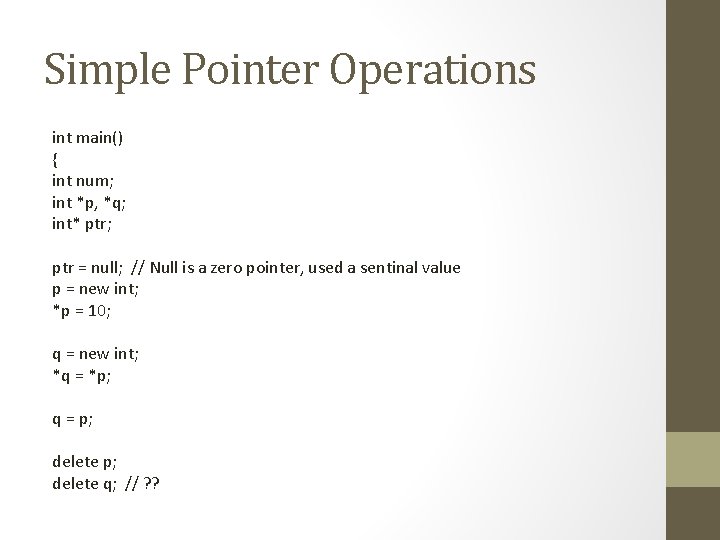
Simple Pointer Operations int main() { int num; int *p, *q; int* ptr; ptr = null; // Null is a zero pointer, used a sentinal value p = new int; *p = 10; q = new int; *q = *p; q = p; delete q; // ? ?
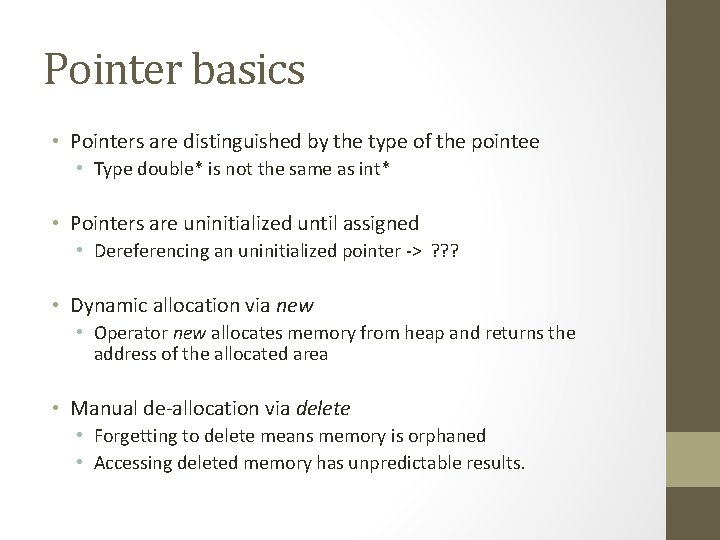
Pointer basics • Pointers are distinguished by the type of the pointee • Type double* is not the same as int* • Pointers are uninitialized until assigned • Dereferencing an uninitialized pointer -> ? ? ? • Dynamic allocation via new • Operator new allocates memory from heap and returns the address of the allocated area • Manual de-allocation via delete • Forgetting to delete means memory is orphaned • Accessing deleted memory has unpredictable results.
Use of pointers • Data structures struct student. Data. Type { char last[50]; char first[50]; char address[100]; char phone [10]; }; A course has pointers to enrolled students struct course. Data. Type { char dept[[50]; char namet[50]; Vector <student. Data. Type*> students };
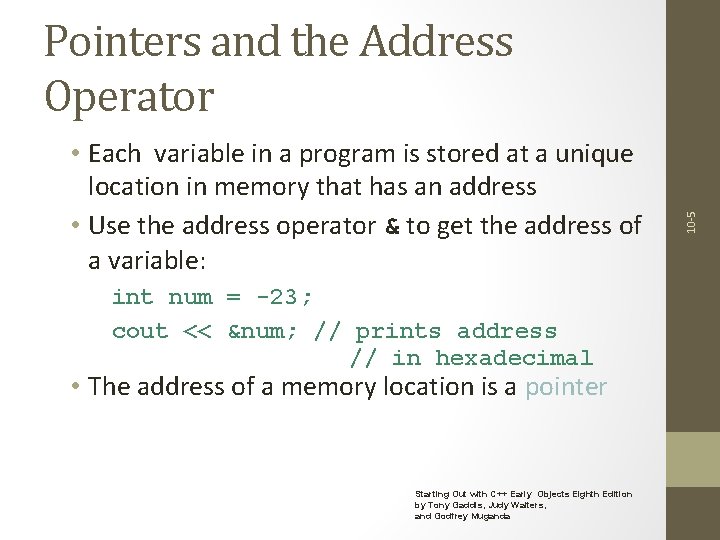
• Each variable in a program is stored at a unique location in memory that has an address • Use the address operator & to get the address of a variable: int num = -23; cout << # // prints address // in hexadecimal • The address of a memory location is a pointer Starting Out with C++ Early Objects Eighth Edition by Tony Gaddis, Judy Walters, and Godfrey Muganda 10 -5 Pointers and the Address Operator
Pointer Variables 10 -6 • Pointer variable (pointer): a variable that holds an address • Pointers provide an alternate way to access memory locations
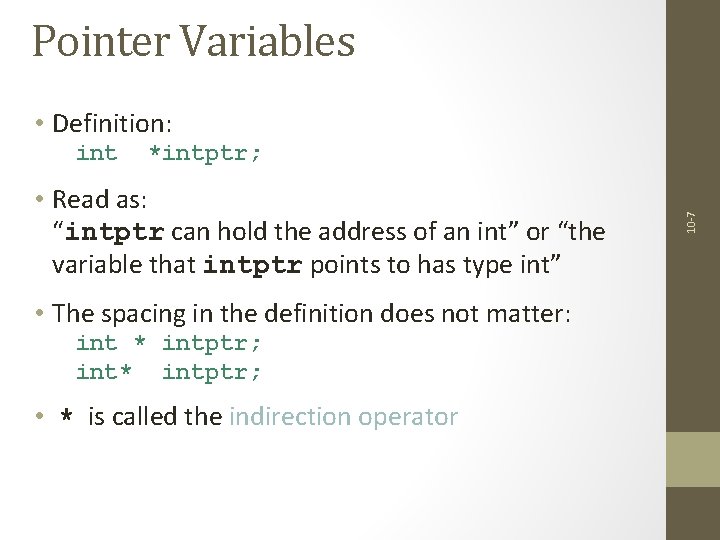
Pointer Variables • Definition: *intptr; • Read as: “intptr can hold the address of an int” or “the variable that intptr points to has type int” • The spacing in the definition does not matter: int * intptr; int* intptr; • * is called the indirection operator 10 -7 int
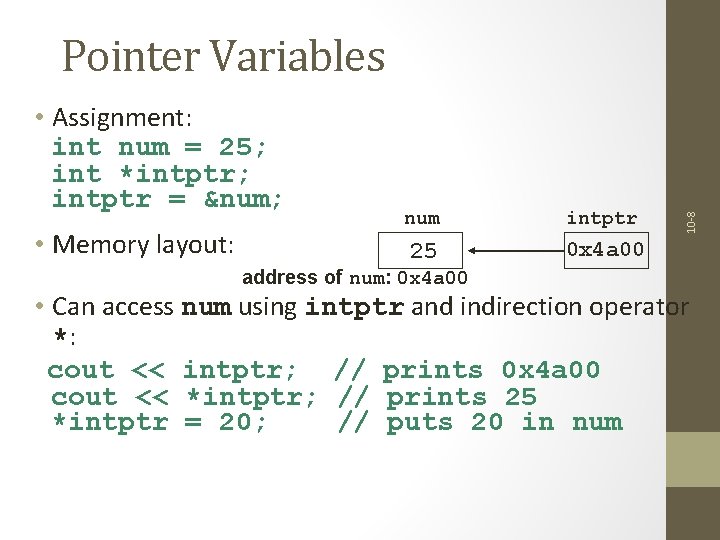
• Assignment: int num = 25; int *intptr; intptr = # • Memory layout: num intptr 25 0 x 4 a 00 address of num: 0 x 4 a 00 10 -8 Pointer Variables • Can access num using intptr and indirection operator *: cout << intptr; // prints 0 x 4 a 00 cout << *intptr; // prints 25 *intptr = 20; // puts 20 in num
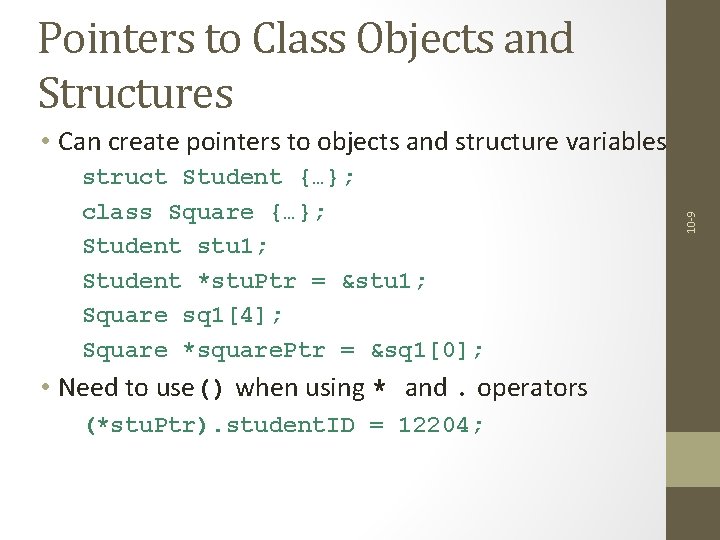
Pointers to Class Objects and Structures struct Student {…}; class Square {…}; Student stu 1; Student *stu. Ptr = &stu 1; Square sq 1[4]; Square *square. Ptr = &sq 1[0]; • Need to use() when using * and. operators (*stu. Ptr). student. ID = 12204; 10 -9 • Can create pointers to objects and structure variables
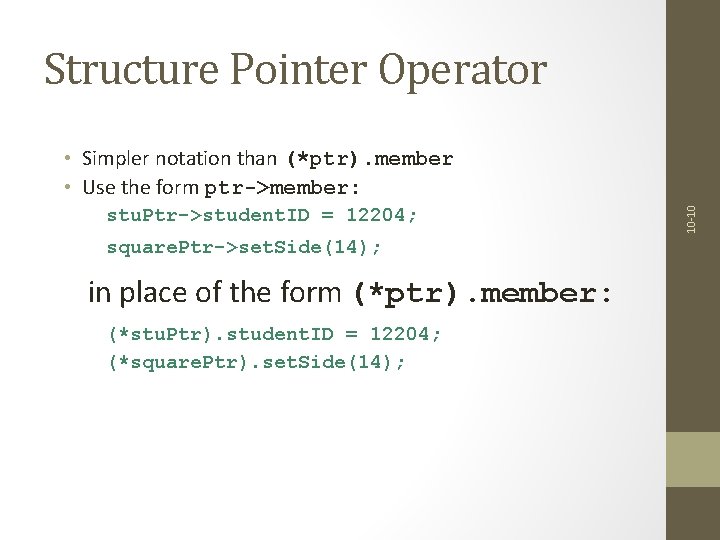
Structure Pointer Operator stu. Ptr->student. ID = 12204; square. Ptr->set. Side(14); in place of the form (*ptr). member: (*stu. Ptr). student. ID = 12204; (*square. Ptr). set. Side(14); 10 -10 • Simpler notation than (*ptr). member • Use the form ptr->member:
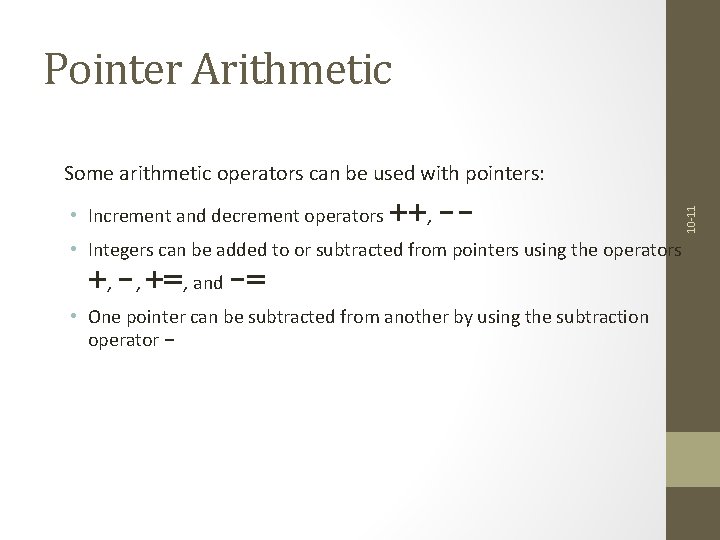
Pointer Arithmetic • Increment and decrement operators ++, - • Integers can be added to or subtracted from pointers using the operators +, -, +=, and -= • One pointer can be subtracted from another by using the subtraction operator - 10 -11 Some arithmetic operators can be used with pointers:
Assume the variable definitions int vals[]={4, 7, 11}; int *valptr = vals; Examples of use of ++ and -valptr++; // points at 7 valptr--; // now points at 4 10 -12 Pointer Arithmetic
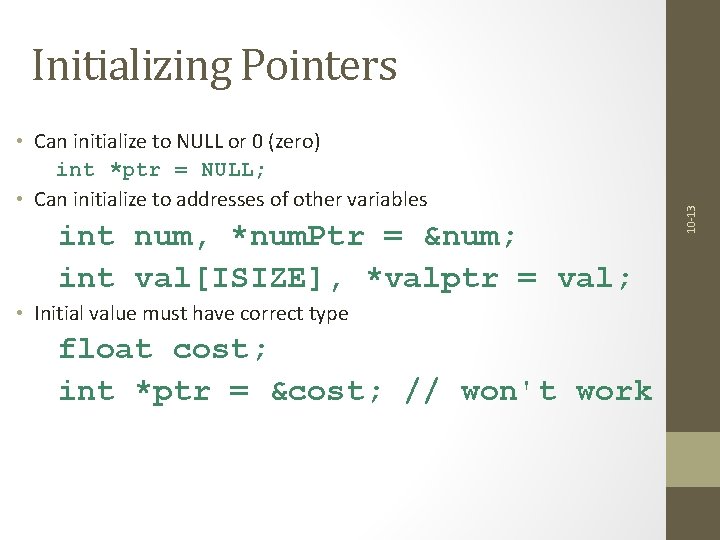
• Can initialize to NULL or 0 (zero) int *ptr = NULL; • Can initialize to addresses of other variables int num, *num. Ptr = # int val[ISIZE], *valptr = val; • Initial value must have correct type float cost; int *ptr = &cost; // won't work 10 -13 Initializing Pointers
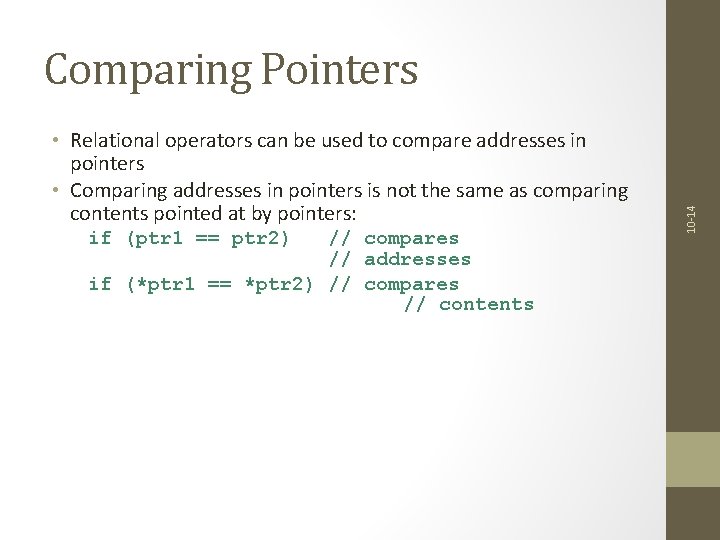
• Relational operators can be used to compare addresses in pointers • Comparing addresses in pointers is not the same as comparing contents pointed at by pointers: if (ptr 1 == ptr 2) // compares // addresses if (*ptr 1 == *ptr 2) // compares // contents 10 -14 Comparing Pointers
• A pointer can be a parameter • It works like a reference parameter to allow changes to argument from within a function • A pointer parameter must be explicitly dereferenced to access the contents at that address 10 -15 Pointers as Function Parameters
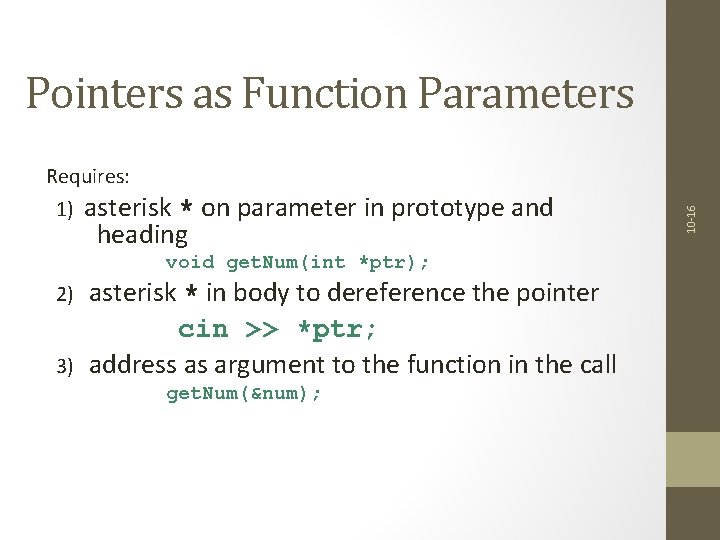
Requires: 1) asterisk * on parameter in prototype and heading void get. Num(int *ptr); 2) 3) asterisk * in body to dereference the pointer cin >> *ptr; address as argument to the function in the call get. Num(&num); 10 -16 Pointers as Function Parameters
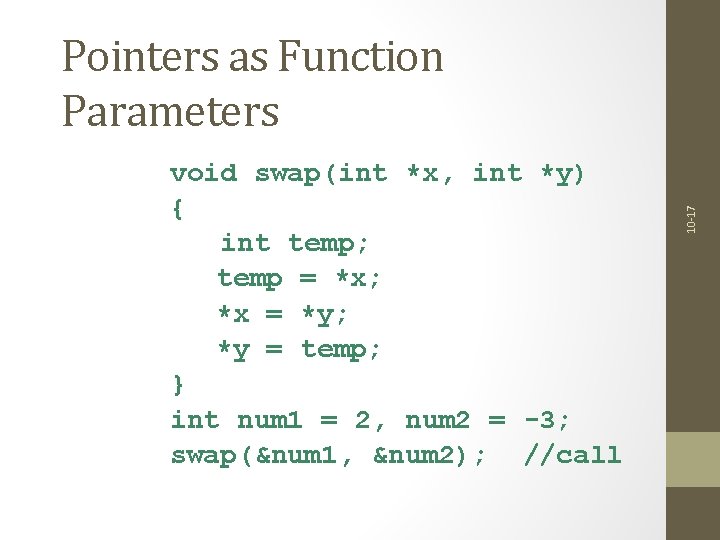
void swap(int *x, int *y) { int temp; temp = *x; *x = *y; *y = temp; } int num 1 = 2, num 2 = -3; swap(&num 1, &num 2); //call 10 -17 Pointers as Function Parameters
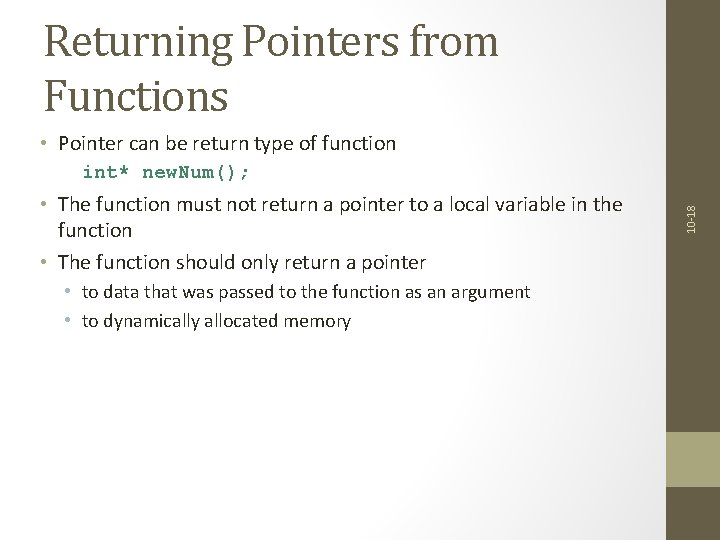
Returning Pointers from Functions • Pointer can be return type of function • The function must not return a pointer to a local variable in the function • The function should only return a pointer • to data that was passed to the function as an argument • to dynamically allocated memory 10 -18 int* new. Num();
• Pointer to a constant: cannot change the value that is pointed at • Constant pointer: the address in the pointer cannot change after the pointer is initialized 10 -19 Ponters to Constants and Constant Pointers
Ponters to Constant const double tax. Rates[] = {0. 65, 0. 8, 0. 75}; const double *rate. Ptr; • Use const keyword for pointers in function headers to protect data from modification from within function 10 -20 • Must use const keyword in pointer definition:
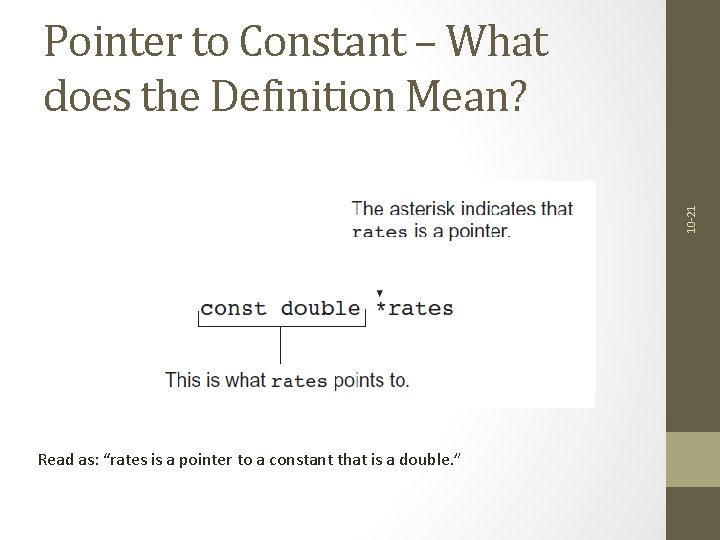
10 -21 Pointer to Constant – What does the Definition Mean? Read as: “rates is a pointer to a constant that is a double. ”
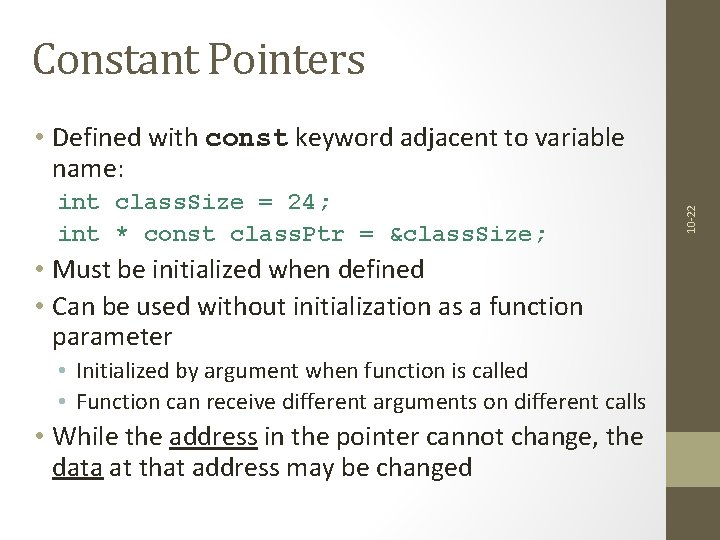
Constant Pointers int class. Size = 24; int * const class. Ptr = &class. Size; • Must be initialized when defined • Can be used without initialization as a function parameter • Initialized by argument when function is called • Function can receive different arguments on different calls • While the address in the pointer cannot change, the data at that address may be changed 10 -22 • Defined with const keyword adjacent to variable name:
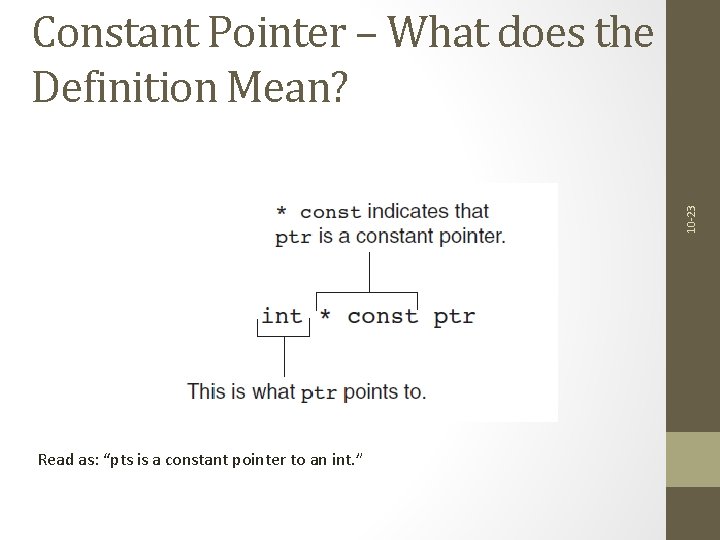
10 -23 Constant Pointer – What does the Definition Mean? Read as: “pts is a constant pointer to an int. ”
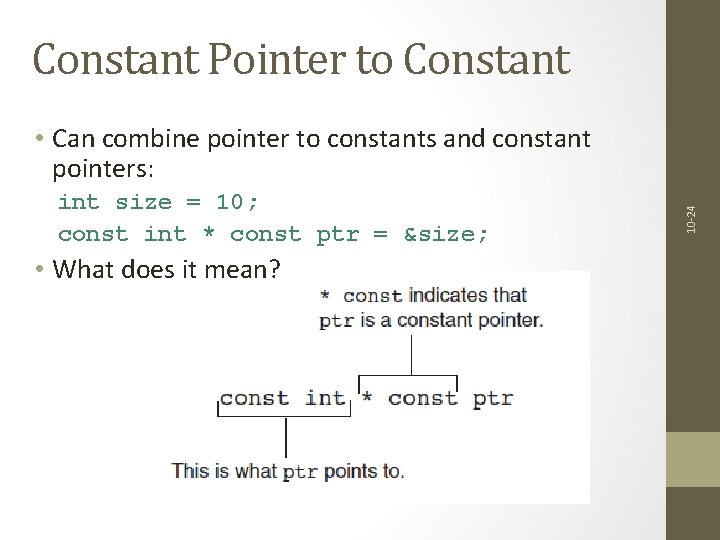
Constant Pointer to Constant int size = 10; const int * const ptr = &size; • What does it mean? 10 -24 • Can combine pointer to constants and constant pointers:
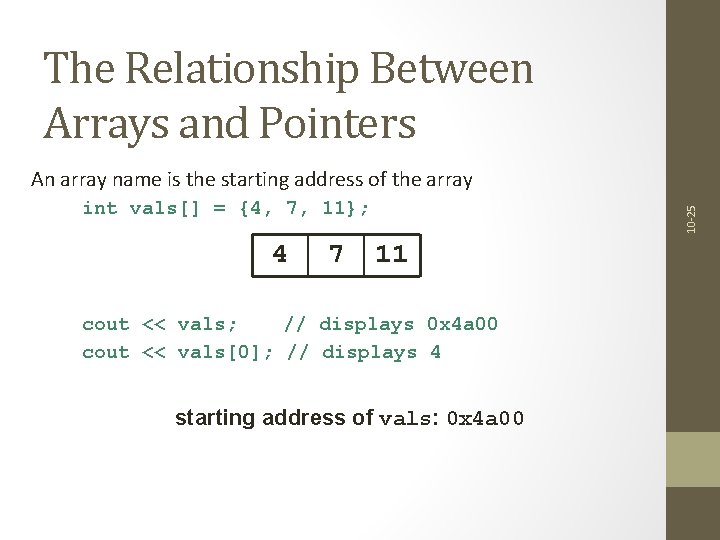
The Relationship Between Arrays and Pointers An array name is the starting address of the array 4 7 10 -25 int vals[] = {4, 7, 11}; 11 cout << vals; // displays 0 x 4 a 00 cout << vals[0]; // displays 4 starting address of vals: 0 x 4 a 00
The Relationship Between Arrays and Pointers int vals[] = {4, 7, 11}; cout << *vals; // displays 4 • A pointer can be used as an array name int *valptr = vals; cout << valptr[1]; // displays 7 10 -26 • An array name can be used as a pointer constant
Pointers in Expressions int vals[]={4, 7, 11}; int *valptr = vals; • What is valptr + 1? • It means (address in valptr) + (1 * size of an int) cout << *(valptr+1); // displays 7 cout << *(valptr+2); // displays 11 • Must use ( ) in expression 10 -27 • Given:
Array Access Array access method Example array name and [ ] vals[2] = 17; pointer to array and [ ] valptr[2] = 17; array name and subscript arithmetic *(vals+2) = 17; pointer to array and subscript arithmetic *(valptr+2) = 17; 10 -28 Array elements can be accessed in many ways
Array Access vals[i] is equivalent to the pointer notation *(vals + i) • No bounds checking is performed on array access 10 -29 • Array notation
Assume the variable definitions: int vals[]={4, 7, 11}; int *valptr = vals; Example of the use of + to add an int to a pointer: cout << *(valptr + 2) This statement will print 11 10 -30 More on Pointer Arithmetic
Assume the variable definitions: int vals[]={4, 7, 11}; int *valptr = vals; Example of use of +=: valptr = vals; // points at 4 valptr += 2; // points at 11 10 -31 More on Pointer Arithmetic
Assume the variable definitions int vals[] = {4, 7, 11}; int *valptr = vals; Example of pointer subtraction valptr += 2; cout << valptr - val; This statement prints 2: the number of ints between valptr and val 10 -32 More on Pointer Arithmetic
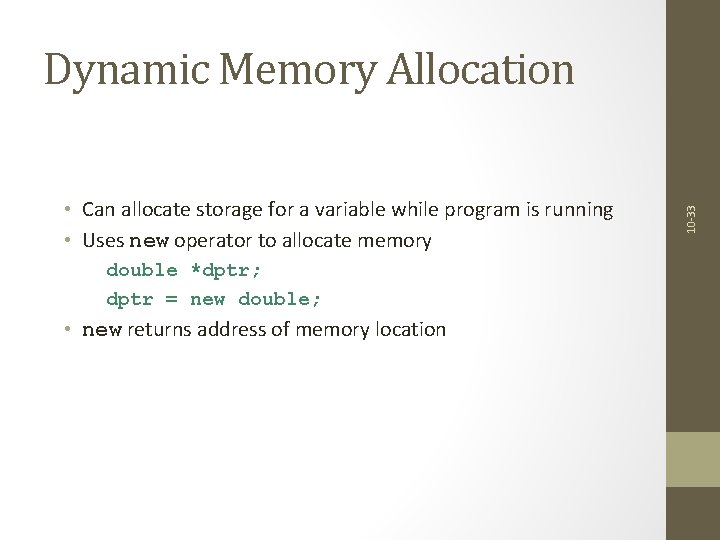
• Can allocate storage for a variable while program is running • Uses new operator to allocate memory double *dptr; dptr = new double; • new returns address of memory location 10 -33 Dynamic Memory Allocation
Dynamic Memory Allocation array. Ptr = new double[25]; • Program may terminate if there is not sufficient memory • Can then use [ ] or pointer arithmetic to access array 10 -34 • Can also use new to allocate array
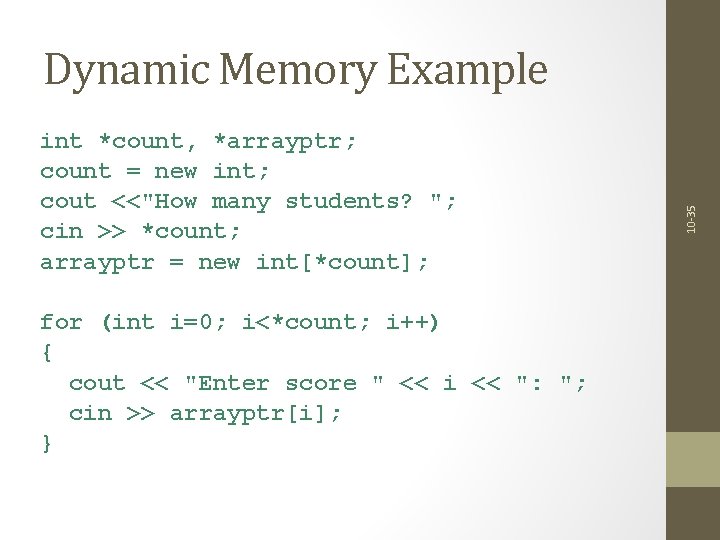
int *count, *arrayptr; count = new int; cout <<"How many students? "; cin >> *count; arrayptr = new int[*count]; for (int i=0; i<*count; i++) { cout << "Enter score " << i << ": "; cin >> arrayptr[i]; } 10 -35 Dynamic Memory Example
• Use delete to free dynamic memory delete count; • Use delete [] to free dynamic array memory delete [] arrayptr; • Only use delete with dynamic memory! 10 -36 Releasing Dynamic Memory
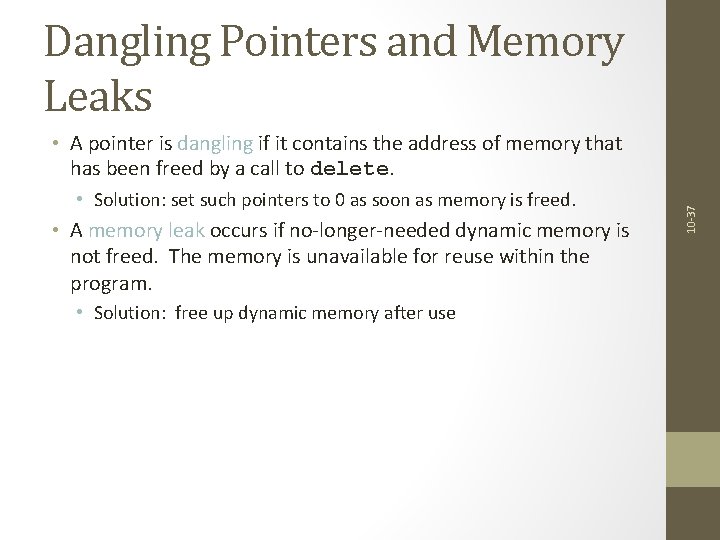
Dangling Pointers and Memory Leaks • Solution: set such pointers to 0 as soon as memory is freed. • A memory leak occurs if no-longer-needed dynamic memory is not freed. The memory is unavailable for reuse within the program. • Solution: free up dynamic memory after use 10 -37 • A pointer is dangling if it contains the address of memory that has been freed by a call to delete.