
C Lab 2 Intermediate Pointers Basic Structures Goals
C Lab 2 Intermediate Pointers & Basic Structures
Goals ● Review Pointers ○ Referencing/Dereferencing ○ ● free ● malloc ● structs
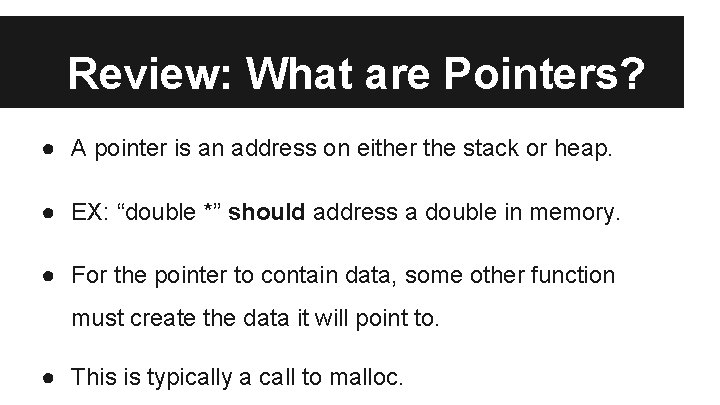
Review: What are Pointers? ● A pointer is an address on either the stack or heap. ● EX: “double *” should address a double in memory. ● For the pointer to contain data, some other function must create the data it will point to. ● This is typically a call to malloc.
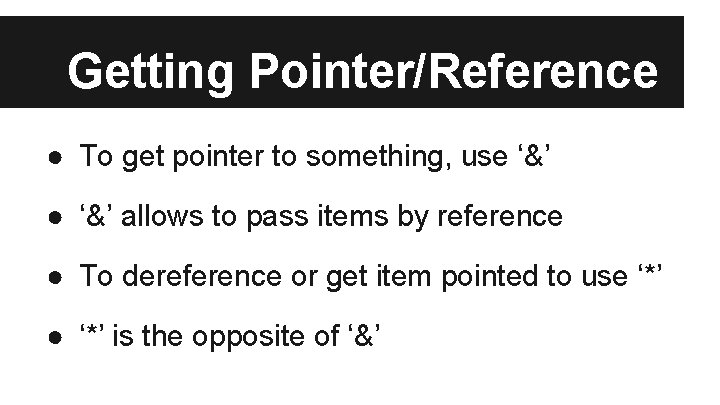
Getting Pointer/Reference ● To get pointer to something, use ‘&’ ● ‘&’ allows to pass items by reference ● To dereference or get item pointed to use ‘*’ ● ‘*’ is the opposite of ‘&’
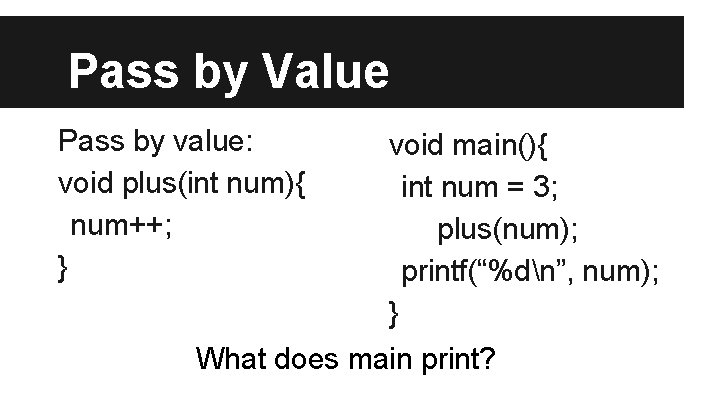
Pass by Value Pass by value: void plus(int num){ num++; } void main(){ int num = 3; plus(num); printf(“%dn”, num); } What does main print?
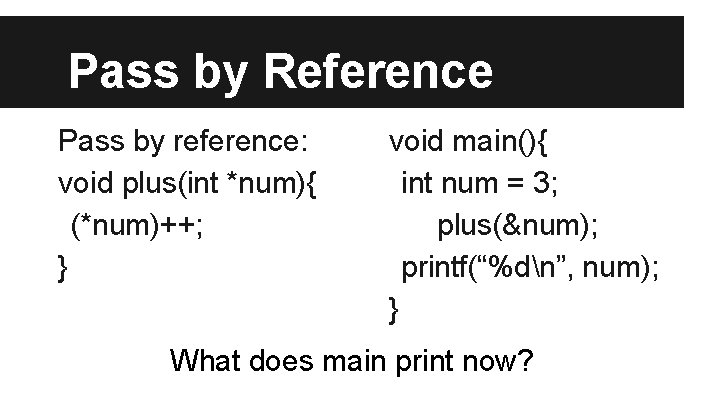
Pass by Reference Pass by reference: void plus(int *num){ (*num)++; } void main(){ int num = 3; plus(&num); printf(“%dn”, num); } What does main print now?
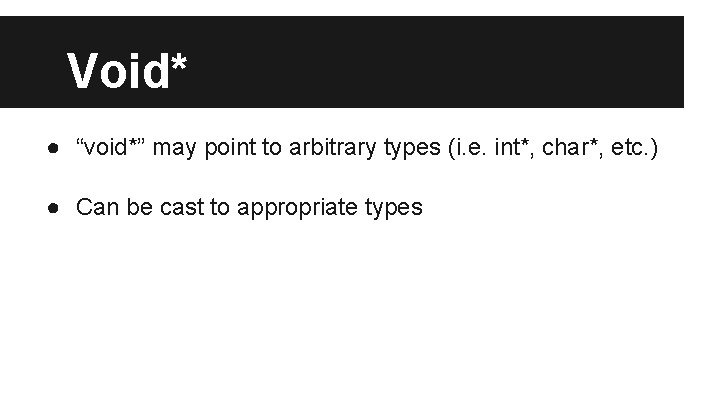
Void* ● “void*” may point to arbitrary types (i. e. int*, char*, etc. ) ● Can be cast to appropriate types
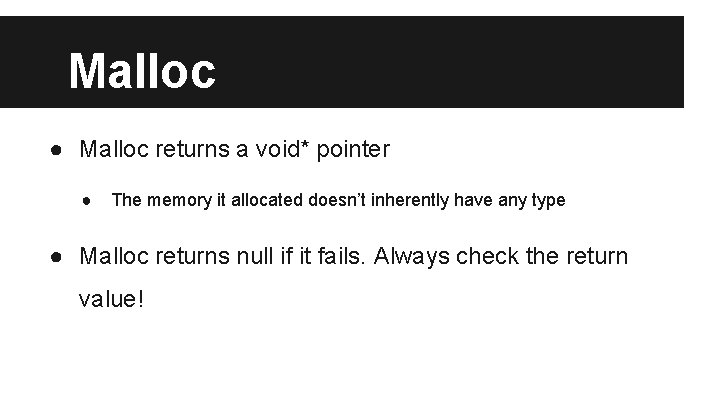
Malloc ● Malloc returns a void* pointer ● The memory it allocated doesn’t inherently have any type ● Malloc returns null if it fails. Always check the return value!
Structs ● Personalized types, somewhat like classes ● May contain items of choice ● Often the basis of (data) structures
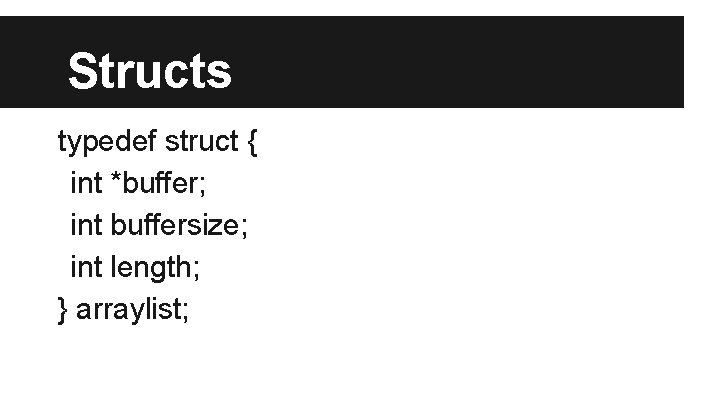
Structs typedef struct { int *buffer; int buffersize; int length; } arraylist;
Editing Struct Fields ● You may declare structs on the stack ● You may access/edit fields of struct using ‘. ’ ● Think about why this works (Hint: pointers)
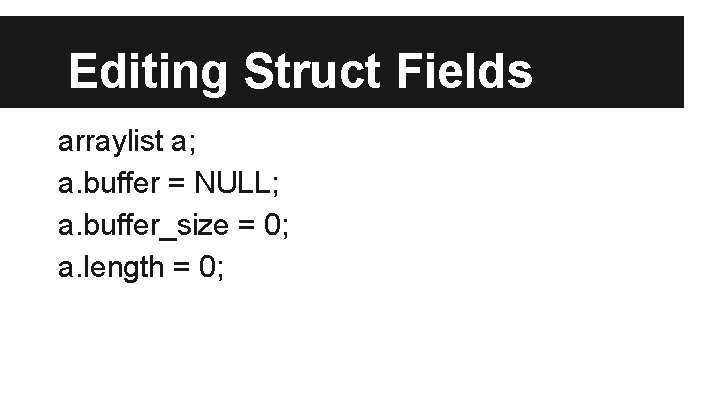
Editing Struct Fields arraylist a; a. buffer = NULL; a. buffer_size = 0; a. length = 0;
Editing Struct Fields ● You may declare structs on the heap ● Now you access/edit fields using ‘->’ ● This syntax is more helpful visually
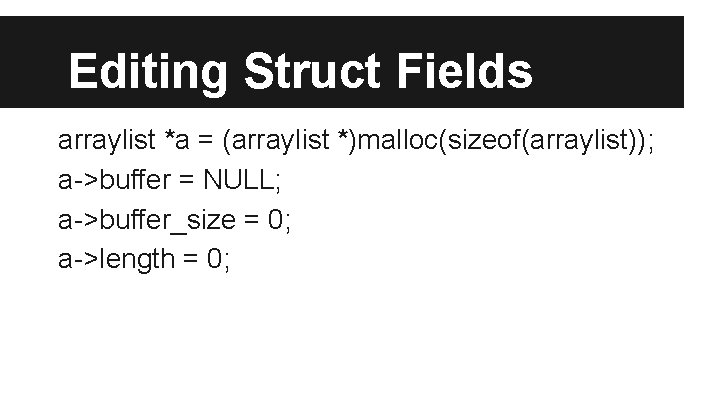
Editing Struct Fields arraylist *a = (arraylist *)malloc(sizeof(arraylist)); a->buffer = NULL; a->buffer_size = 0; a->length = 0;
Default values and null Null is a pointer value going “nowhere” If a pointer shouldn’t be pointing at anything set it to null In C, values aren’t initialized to any particular value -They take whatever happened to be in memory
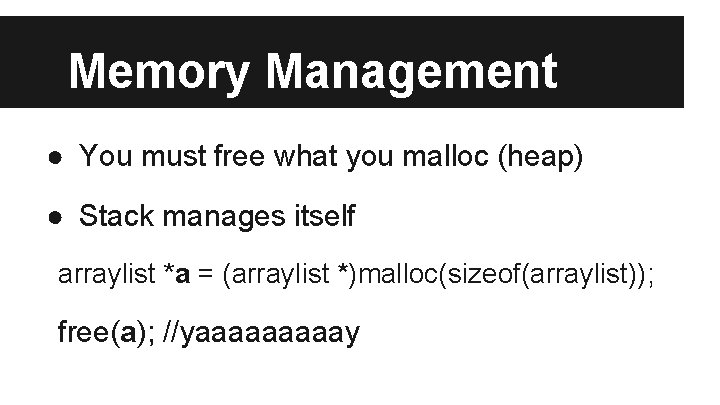
Memory Management ● You must free what you malloc (heap) ● Stack manages itself arraylist *a = (arraylist *)malloc(sizeof(arraylist)); free(a); //yaaaaay
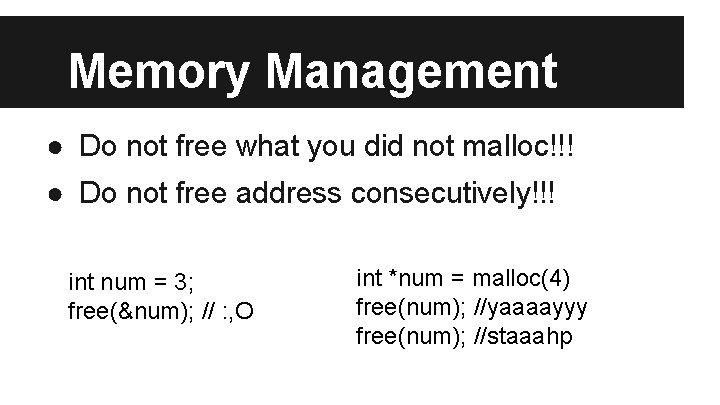
Memory Management ● Do not free what you did not malloc!!! ● Do not free address consecutively!!! int num = 3; free(&num); // : , O int *num = malloc(4) free(num); //yaaaayyy free(num); //staaahp

Memory Takeaways ● Only free what has been malloc’d ● Only free malloc’d memory once ● For more on stack vs. heap: http: //gribblelab. org/CBootcamp/7_Memory_Stack_vs_Heap. html#sec-4
References From the C reference manual: ● Pointers: 4. 5. 2, 5. 3 ● Structs: 5. 6 ● Free: 16. 1 (near end), 16. 1. 1
- Slides: 19