
C is Fun Part Seven at TurbineWarner Bros
C++ is Fun – Part Seven at Turbine/Warner Bros. ! Russell Hanson
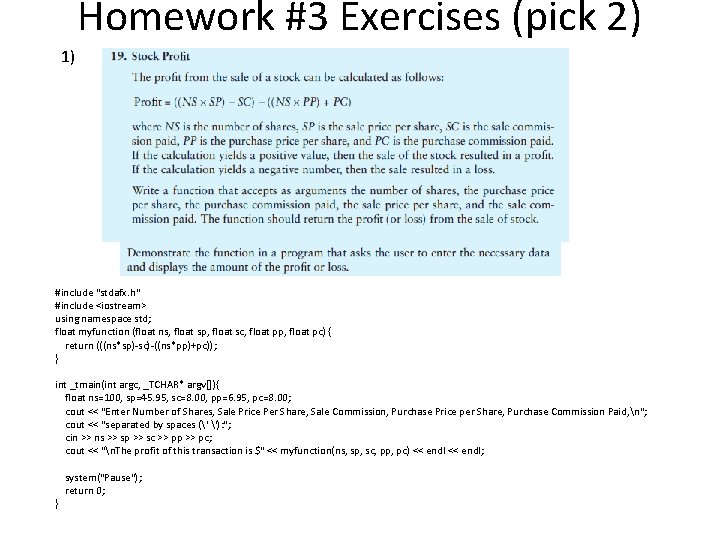
Homework #3 Exercises (pick 2) 1) #include "stdafx. h" #include <iostream> using namespace std; float myfunction (float ns, float sp, float sc, float pp, float pc) { return (((ns*sp)-sc)-((ns*pp)+pc)); } int _tmain(int argc, _TCHAR* argv[]){ float ns=100, sp=45. 95, sc=8. 00, pp=6. 95, pc=8. 00; cout << "Enter Number of Shares, Sale Price Per Share, Sale Commission, Purchase Price per Share, Purchase Commission Paid, n"; cout << "separated by spaces (' '): "; cin >> ns >> sp >> sc >> pp >> pc; cout << "n. The profit of this transaction is $" << myfunction(ns, sp, sc, pp, pc) << endl; } system("Pause"); return 0;
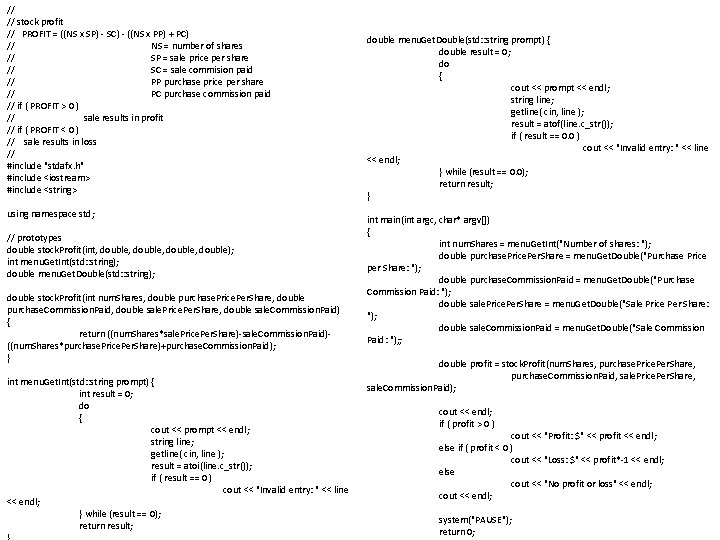
// // stock profit // PROFIT = ((NS x SP) - SC) - ((NS x PP) + PC) // NS = number of shares // SP = sale price per share // SC = sale commision paid // PP purchase price per share // PC purchase commission paid // if ( PROFIT > 0 ) // sale results in profit // if ( PROFIT < 0 ) // sale results in loss // #include "stdafx. h" #include <iostream> #include <string> using namespace std; // prototypes double stock. Profit(int, double, double); int menu. Get. Int(std: : string); double menu. Get. Double(std: : string); double stock. Profit(int num. Shares, double purchase. Price. Per. Share, double purchase. Commission. Paid, double sale. Price. Per. Share, double sale. Commission. Paid) { return ((num. Shares*sale. Price. Per. Share)-sale. Commission. Paid)((num. Shares*purchase. Price. Per. Share)+purchase. Commission. Paid); } int menu. Get. Int(std: : string prompt) { int result = 0; do { cout << prompt << endl; string line; getline( cin, line ); result = atoi(line. c_str()); if ( result == 0 ) cout << "Invalid entry: " << line << endl; } while (result == 0); return result; double menu. Get. Double(std: : string prompt) { double result = 0; do { cout << prompt << endl; string line; getline( cin, line ); result = atof(line. c_str()); if ( result == 0. 0 ) cout << "Invalid entry: " << line << endl; } while (result == 0. 0); return result; } int main(int argc, char* argv[]) { int num. Shares = menu. Get. Int("Number of shares: "); double purchase. Price. Per. Share = menu. Get. Double("Purchase Price per Share: "); double purchase. Commission. Paid = menu. Get. Double("Purchase Commission Paid: "); double sale. Price. Per. Share = menu. Get. Double("Sale Price Per Share: "); double sale. Commission. Paid = menu. Get. Double("Sale Commission Paid: "); ; double profit = stock. Profit(num. Shares, purchase. Price. Per. Share, purchase. Commission. Paid, sale. Price. Per. Share, sale. Commission. Paid); cout << endl; if ( profit > 0 ) cout << "Profit: $" << profit << endl; else if ( profit < 0 ) cout << "Loss: $" << profit*-1 << endl; else cout << "No profit or loss" << endl; cout << endl; system("PAUSE"); return 0;
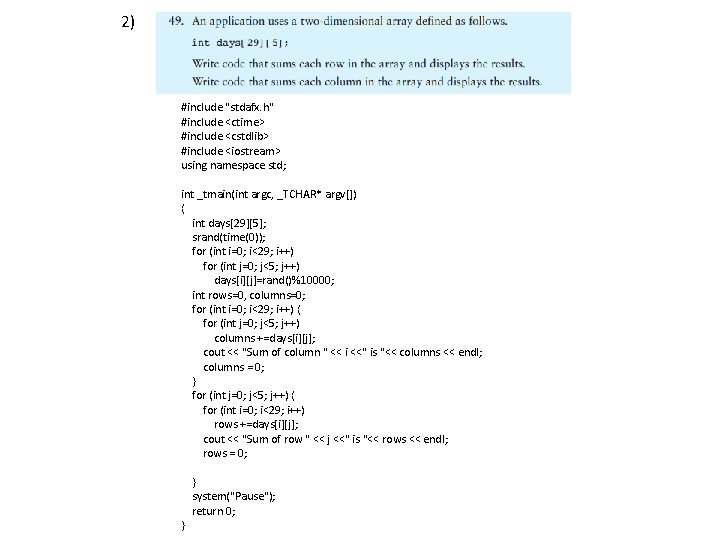
2) #include "stdafx. h" #include <ctime> #include <cstdlib> #include <iostream> using namespace std; int _tmain(int argc, _TCHAR* argv[]) { int days[29][5]; srand(time(0)); for (int i=0; i<29; i++) for (int j=0; j<5; j++) days[i][j]=rand()%10000; int rows=0, columns=0; for (int i=0; i<29; i++) { for (int j=0; j<5; j++) columns +=days[i][j]; cout << "Sum of column " << i <<" is "<< columns << endl; columns = 0; } for (int j=0; j<5; j++) { for (int i=0; i<29; i++) rows +=days[i][j]; cout << "Sum of row " << j <<" is "<< rows << endl; rows = 0; } } system("Pause"); return 0;
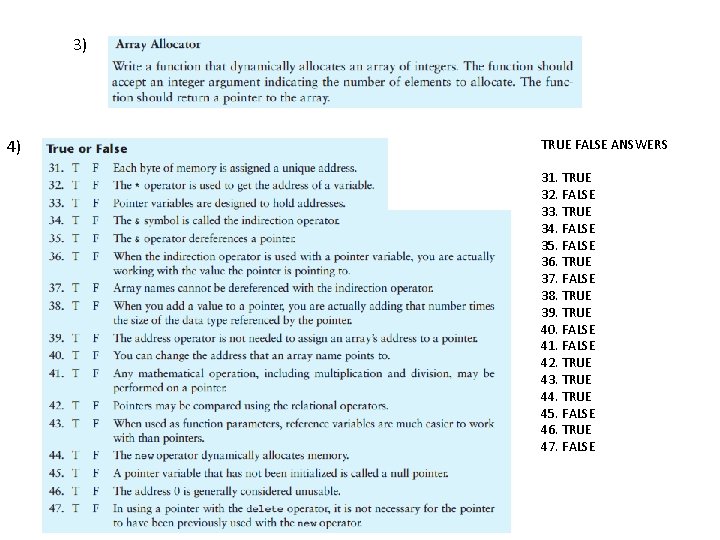
3) 4) TRUE FALSE ANSWERS 31. TRUE 32. FALSE 33. TRUE 34. FALSE 35. FALSE 36. TRUE 37. FALSE 38. TRUE 39. TRUE 40. FALSE 41. FALSE 42. TRUE 43. TRUE 44. TRUE 45. FALSE 46. TRUE 47. FALSE

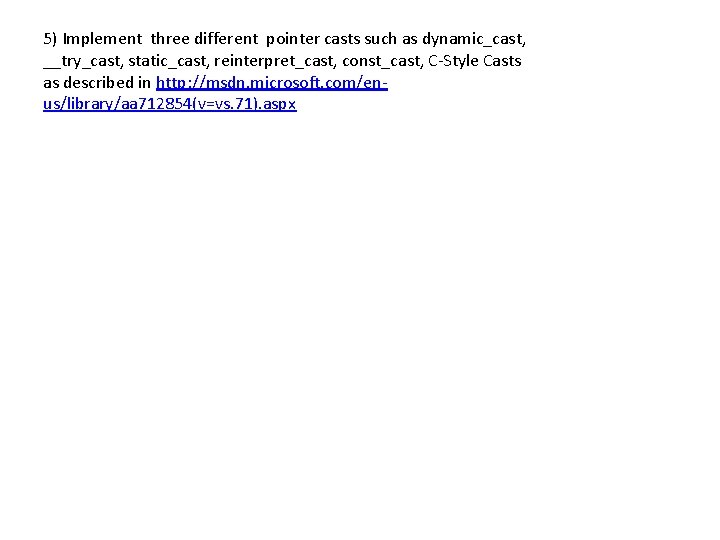
5) Implement three different pointer casts such as dynamic_cast, __try_cast, static_cast, reinterpret_cast, const_cast, C-Style Casts as described in http: //msdn. microsoft. com/enus/library/aa 712854(v=vs. 71). aspx
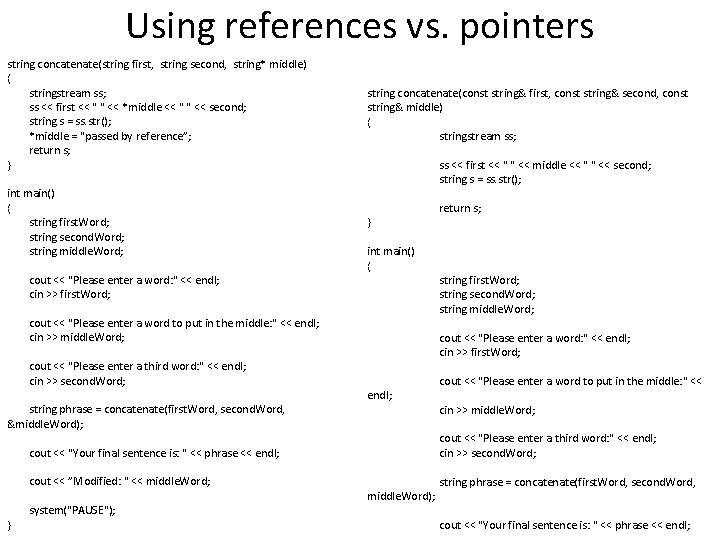
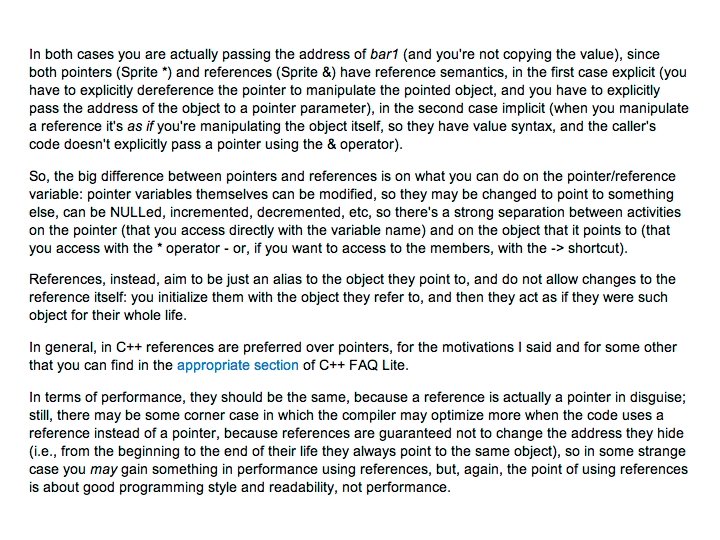
Using references vs. pointers string concatenate(string first, string second, string* middle) { stringstream ss; ss << first << " " << *middle << " " << second; string s = ss. str(); *middle = "passed by reference”; return s; } string concatenate(const string& first, const string& second, const string& middle) { stringstream ss; int main() { string first. Word; string second. Word; string middle. Word; } cout << "Please enter a word: " << endl; cin >> first. Word; ss << first << " " << middle << " " << second; string s = ss. str(); int main() { cout << "Please enter a word to put in the middle: " << endl; cin >> middle. Word; } string first. Word; string second. Word; string middle. Word; cout << "Please enter a word: " << endl; cin >> first. Word; cout << "Please enter a third word: " << endl; cin >> second. Word; string phrase = concatenate(first. Word, second. Word, &middle. Word); return s; endl; cout << "Please enter a word to put in the middle: " << cin >> middle. Word; cout << "Your final sentence is: " << phrase << endl; cout << "Please enter a third word: " << endl; cin >> second. Word; cout << ”Modified: " << middle. Word; string phrase = concatenate(first. Word, second. Word, system("PAUSE"); middle. Word); cout << "Your final sentence is: " << phrase << endl;
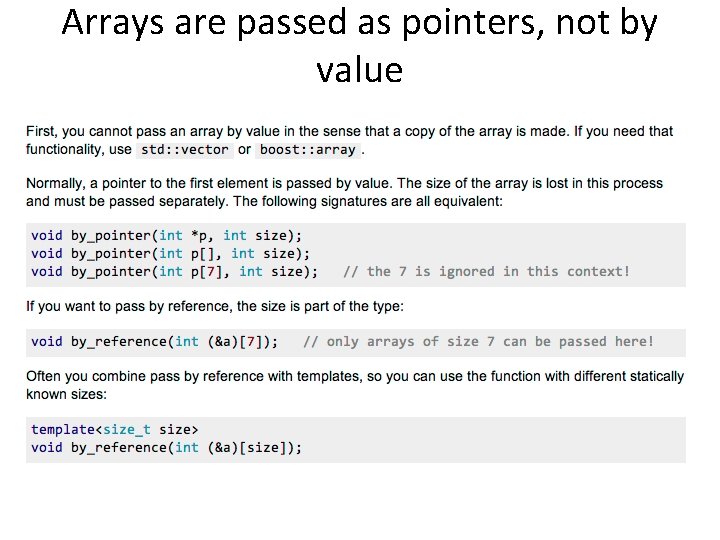
Arrays are passed as pointers, not by value
![// prototype(s) void mysort(int[], int, bool); // equivalent to void mysort(int*, int, bool); void](http://slidetodoc.com/presentation_image/4a868c92bd1230d59298e51a46f24041/image-12.jpg "// prototype(s) void mysort(int[], int, bool); // equivalent to void mysort(int*, int, bool); void")
// prototype(s) void mysort(int[], int, bool); // equivalent to void mysort(int*, int, bool); void display_array(int[], int); int main(int argc, char *argv[]) { int test. Desc[] = {6, 1, 2, 5, 3, 9}; int items = sizeof(test. Desc)/sizeof(int); display_array(test. Desc, items); // sort descending by reference mysort(test. Desc, items, true); display_array(test. Desc, items); void mysort(int list[], int size, bool desc) { int match; int temp; for (int i = size - 1; i > 0; i--) { match = 0; int test. Asc[] = {1, 6, 100, 200, 2, 5, 3, 9, 60}; items = sizeof(test. Asc)/sizeof(int); for (int j = 1; j <= i; j++) { if (desc) { display_array(test. Asc, items); // sort ascending by reference mysort(test. Asc, items, false); display_array(test. Asc, items); } } else { return 0; } } } // swap values temp = list[match]; list[match] = list[i]; list[i] = temp; } if ( list[j] < list[match] ) match = j; if (list[j] > list[match]) match = j;
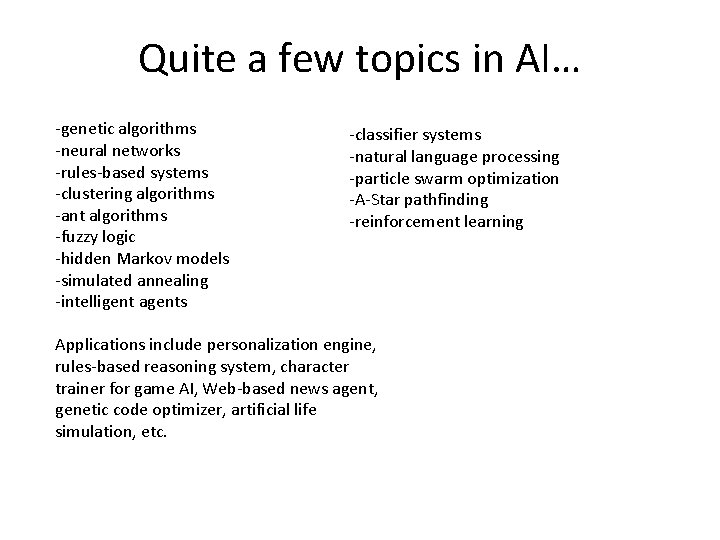
Quite a few topics in AI… -genetic algorithms -neural networks -rules-based systems -clustering algorithms -ant algorithms -fuzzy logic -hidden Markov models -simulated annealing -intelligent agents -classifier systems -natural language processing -particle swarm optimization -A-Star pathfinding -reinforcement learning Applications include personalization engine, rules-based reasoning system, character trainer for game AI, Web-based news agent, genetic code optimizer, artificial life simulation, etc.
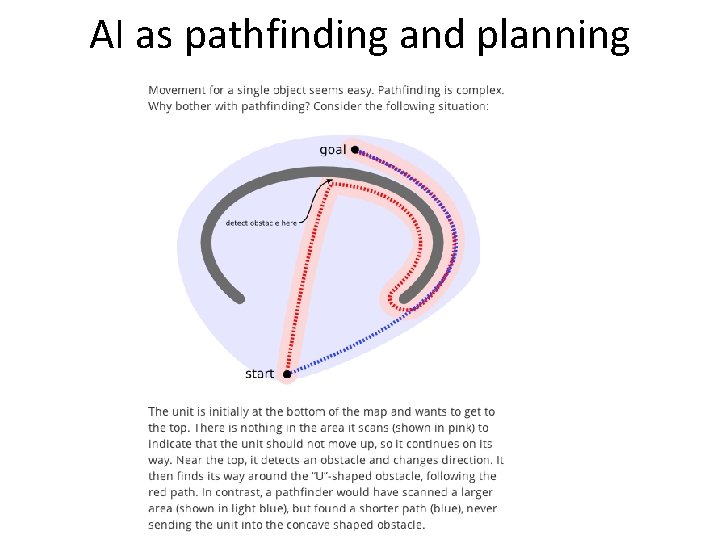
AI as pathfinding and planning
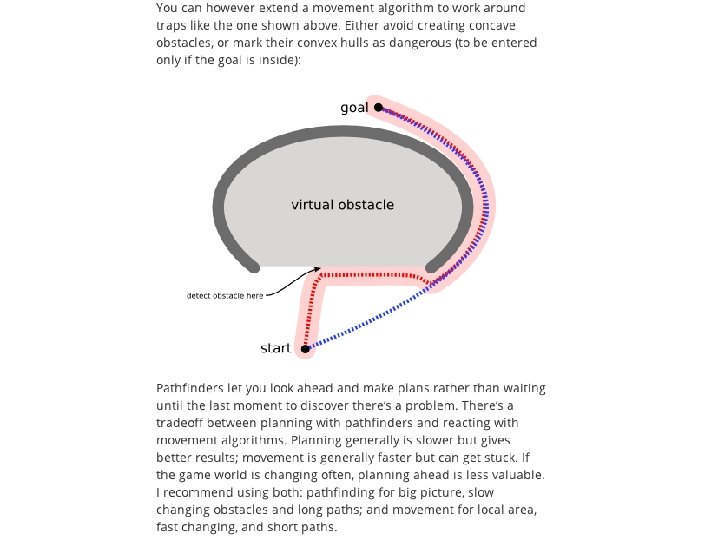
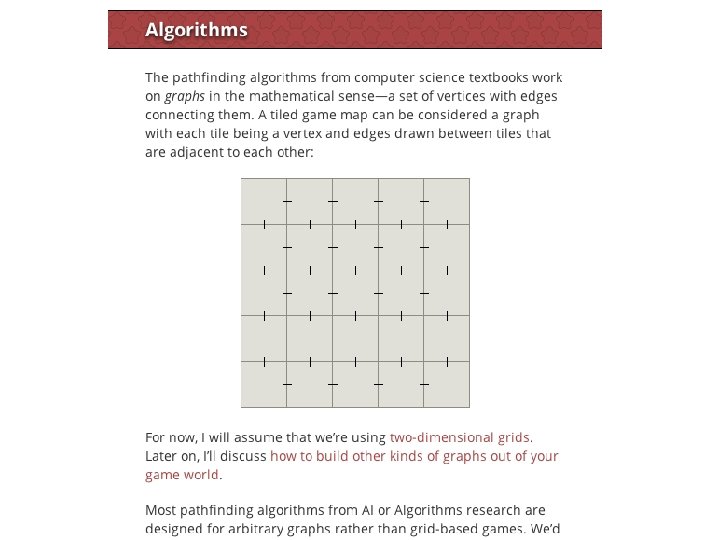
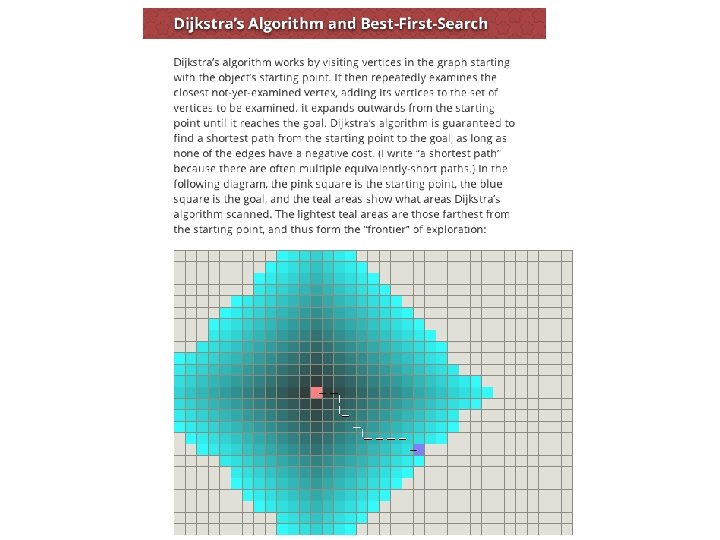


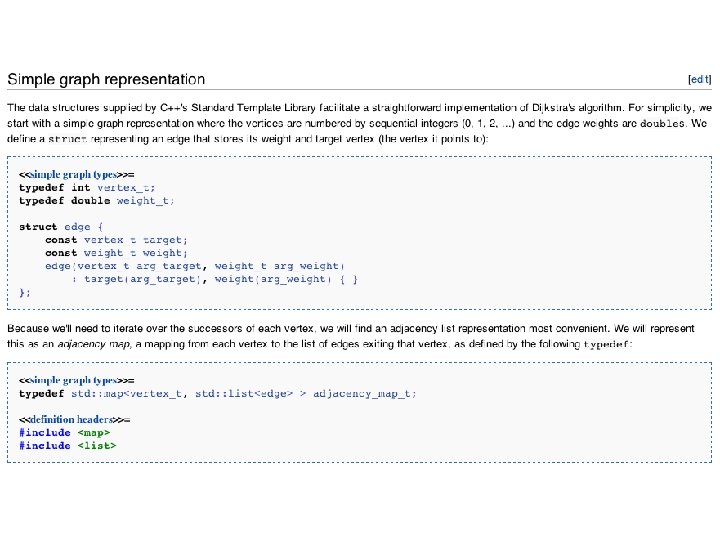
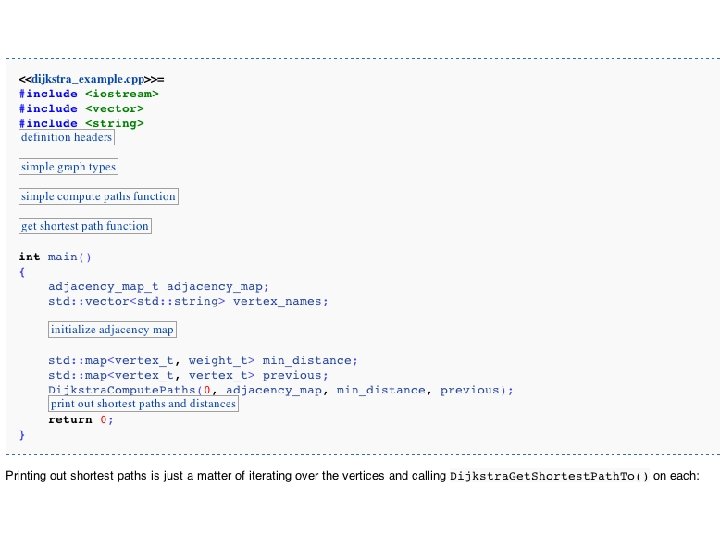
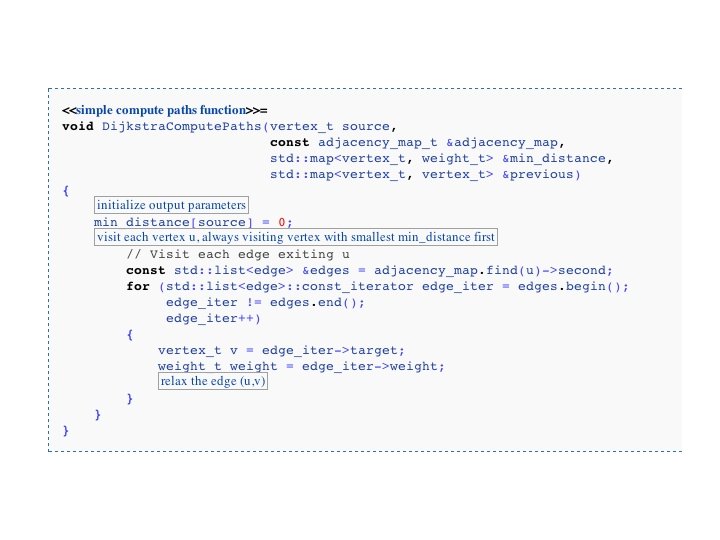
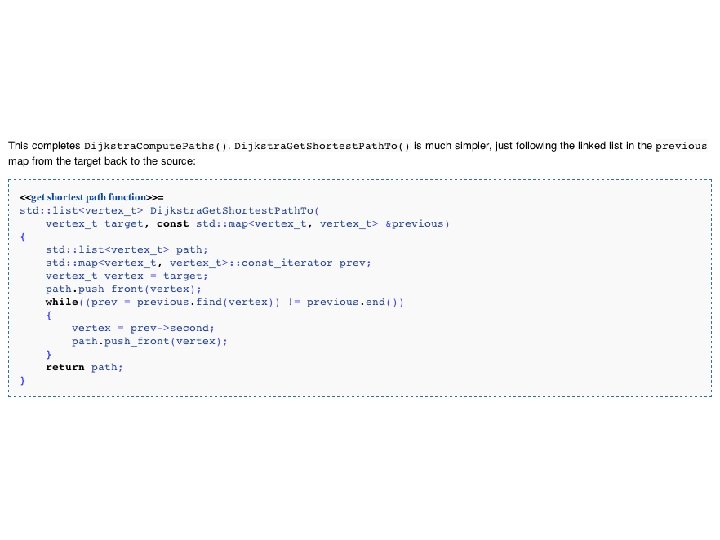
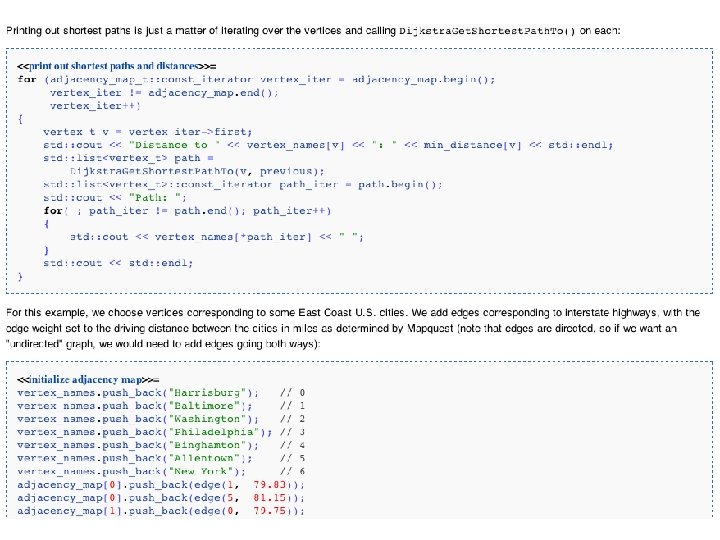
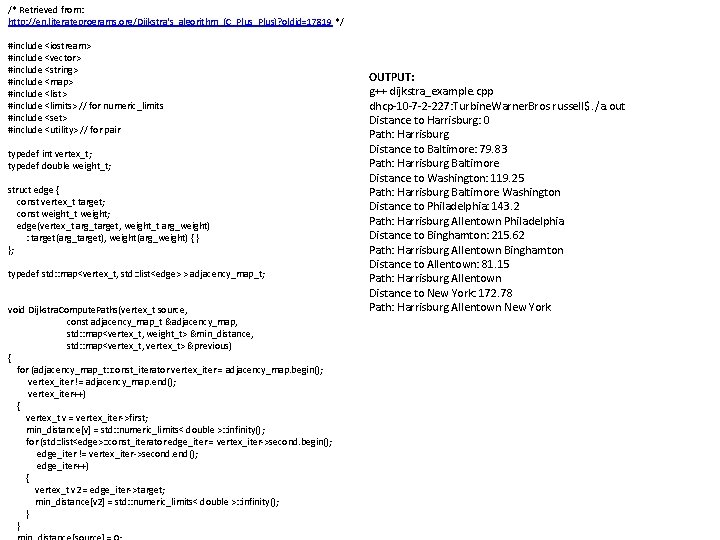
/* Retrieved from: http: //en. literateprograms. org/Dijkstra's_algorithm_(C_Plus)? oldid=17819 */ #include <iostream> #include <vector> #include <string> #include <map> #include <list> #include <limits> // for numeric_limits #include <set> #include <utility> // for pair typedef int vertex_t; typedef double weight_t; struct edge { const vertex_t target; const weight_t weight; edge(vertex_t arg_target, weight_t arg_weight) : target(arg_target), weight(arg_weight) { } }; typedef std: : map<vertex_t, std: : list<edge> > adjacency_map_t; void Dijkstra. Compute. Paths(vertex_t source, const adjacency_map_t &adjacency_map, std: : map<vertex_t, weight_t> &min_distance, std: : map<vertex_t, vertex_t> &previous) { for (adjacency_map_t: : const_iterator vertex_iter = adjacency_map. begin(); vertex_iter != adjacency_map. end(); vertex_iter++) { vertex_t v = vertex_iter->first; min_distance[v] = std: : numeric_limits< double >: : infinity(); for (std: : list<edge>: : const_iterator edge_iter = vertex_iter->second. begin(); edge_iter != vertex_iter->second. end(); edge_iter++) { vertex_t v 2 = edge_iter->target; min_distance[v 2] = std: : numeric_limits< double >: : infinity(); } } OUTPUT: g++ dijkstra_example. cpp dhcp-10 -7 -2 -227: Turbine. Warner. Bros russell$. /a. out Distance to Harrisburg: 0 Path: Harrisburg Distance to Baltimore: 79. 83 Path: Harrisburg Baltimore Distance to Washington: 119. 25 Path: Harrisburg Baltimore Washington Distance to Philadelphia: 143. 2 Path: Harrisburg Allentown Philadelphia Distance to Binghamton: 215. 62 Path: Harrisburg Allentown Binghamton Distance to Allentown: 81. 15 Path: Harrisburg Allentown Distance to New York: 172. 78 Path: Harrisburg Allentown New York
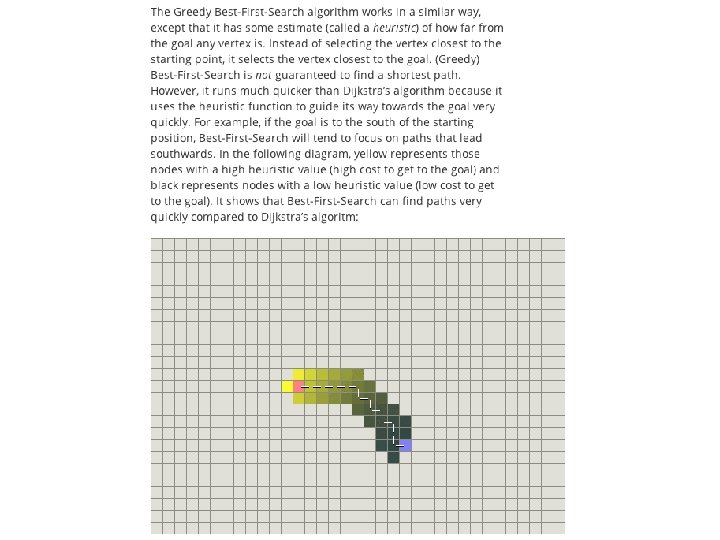
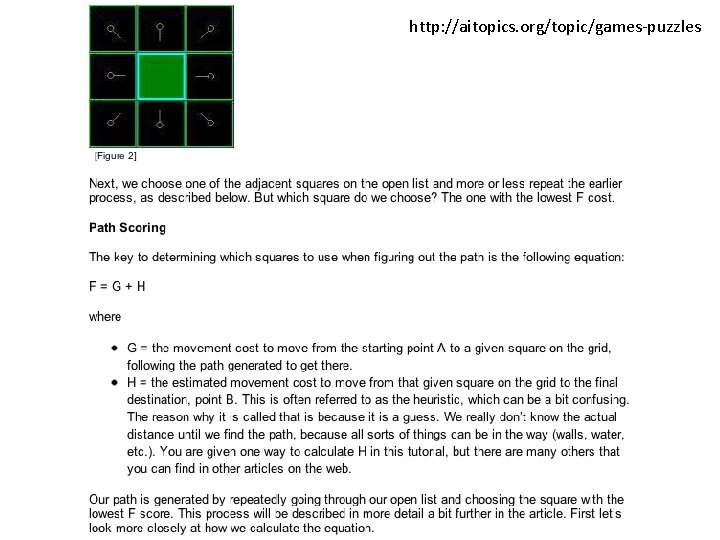
http: //aitopics. org/topic/games-puzzles
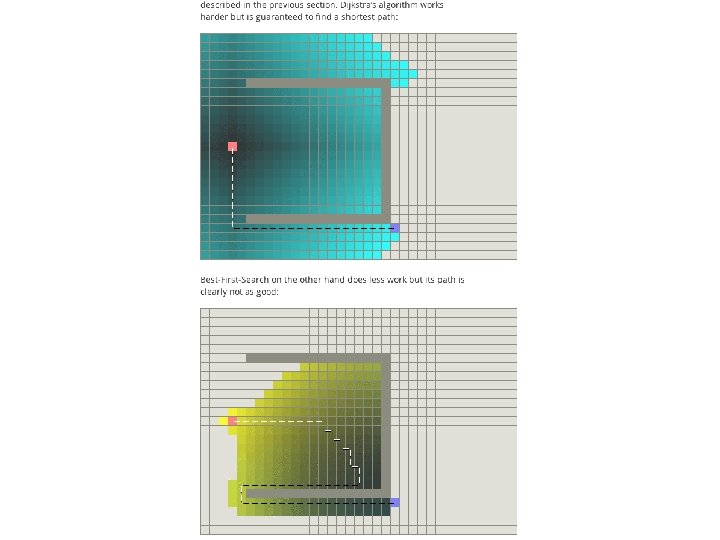
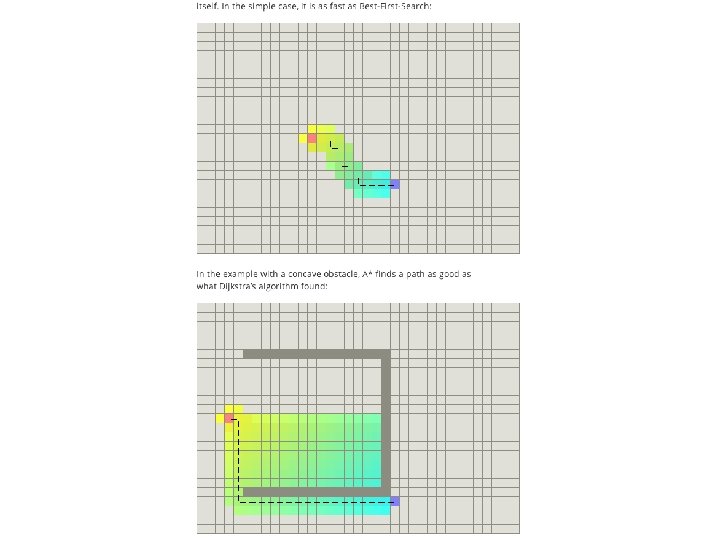
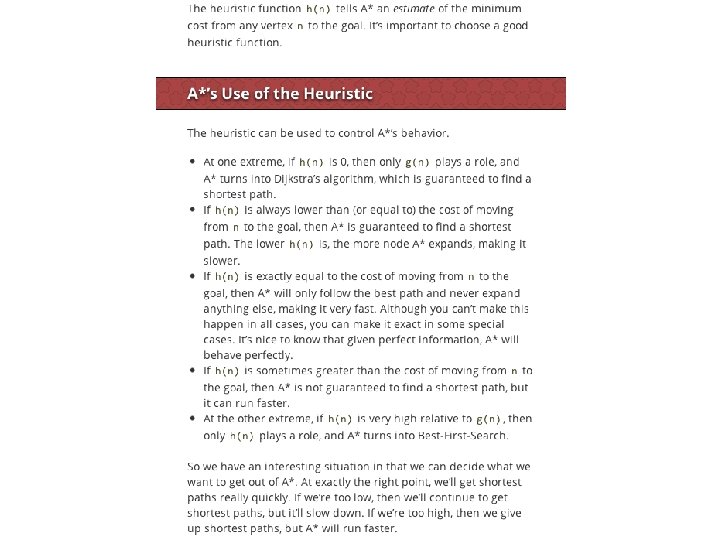
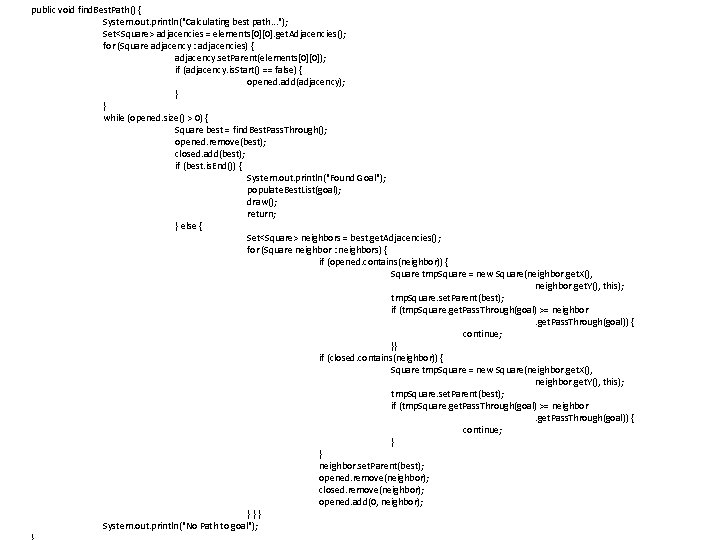
public void find. Best. Path() { System. out. println("Calculating best path. . . "); Set<Square> adjacencies = elements[0][0]. get. Adjacencies(); for (Square adjacency : adjacencies) { adjacency. set. Parent(elements[0][0]); if (adjacency. is. Start() == false) { opened. add(adjacency); } } while (opened. size() > 0) { Square best = find. Best. Pass. Through(); opened. remove(best); closed. add(best); if (best. is. End()) { System. out. println("Found Goal"); populate. Best. List(goal); draw(); return; } else { Set<Square> neighbors = best. get. Adjacencies(); for (Square neighbor : neighbors) { if (opened. contains(neighbor)) { Square tmp. Square = new Square(neighbor. get. X(), neighbor. get. Y(), this); tmp. Square. set. Parent(best); if (tmp. Square. get. Pass. Through(goal) >= neighbor. get. Pass. Through(goal)) { continue; }} if (closed. contains(neighbor)) { Square tmp. Square = new Square(neighbor. get. X(), neighbor. get. Y(), this); tmp. Square. set. Parent(best); if (tmp. Square. get. Pass. Through(goal) >= neighbor. get. Pass. Through(goal)) { continue; } } neighbor. set. Parent(best); opened. remove(neighbor); closed. remove(neighbor); opened. add(0, neighbor); }}} System. out. println("No Path to goal");
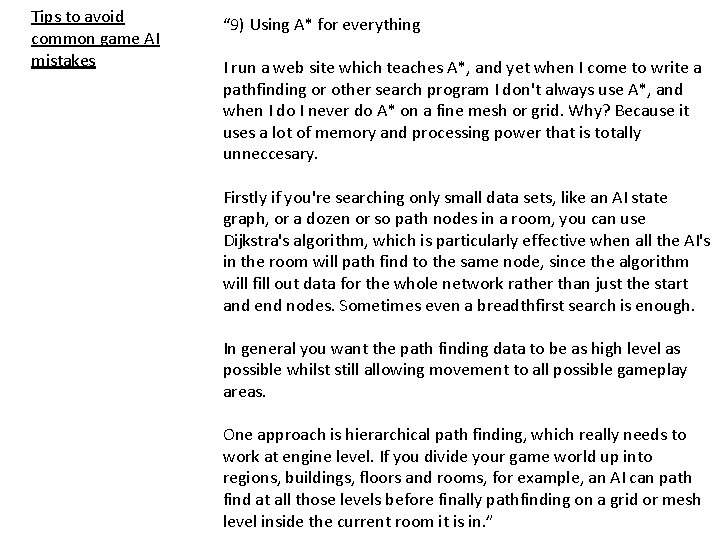
Tips to avoid common game AI mistakes “ 9) Using A* for everything I run a web site which teaches A*, and yet when I come to write a pathfinding or other search program I don't always use A*, and when I do I never do A* on a fine mesh or grid. Why? Because it uses a lot of memory and processing power that is totally unneccesary. Firstly if you're searching only small data sets, like an AI state graph, or a dozen or so path nodes in a room, you can use Dijkstra's algorithm, which is particularly effective when all the AI's in the room will path find to the same node, since the algorithm will fill out data for the whole network rather than just the start and end nodes. Sometimes even a breadthfirst search is enough. In general you want the path finding data to be as high level as possible whilst still allowing movement to all possible gameplay areas. One approach is hierarchical path finding, which really needs to work at engine level. If you divide your game world up into regions, buildings, floors and rooms, for example, an AI can path find at all those levels before finally pathfinding on a grid or mesh level inside the current room it is in. ”
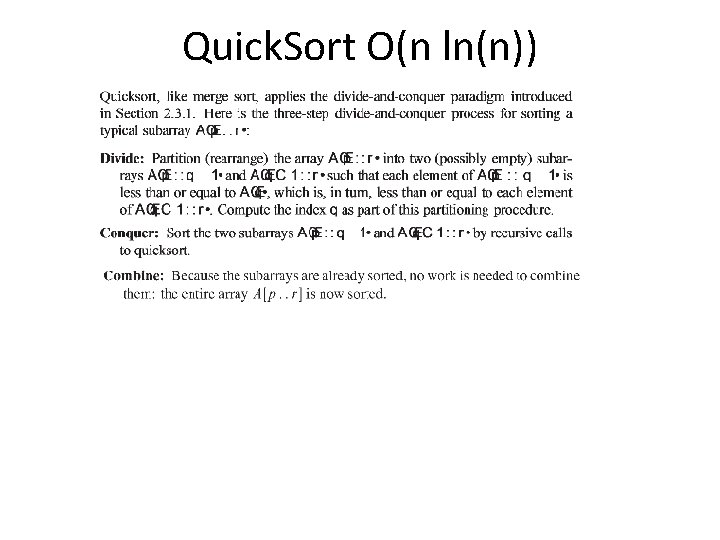
Quick. Sort O(n ln(n))


How to install boost & Ogre Mac: Run the following command: sudo port install boost Windows: http: //www. boost. org/users/download/
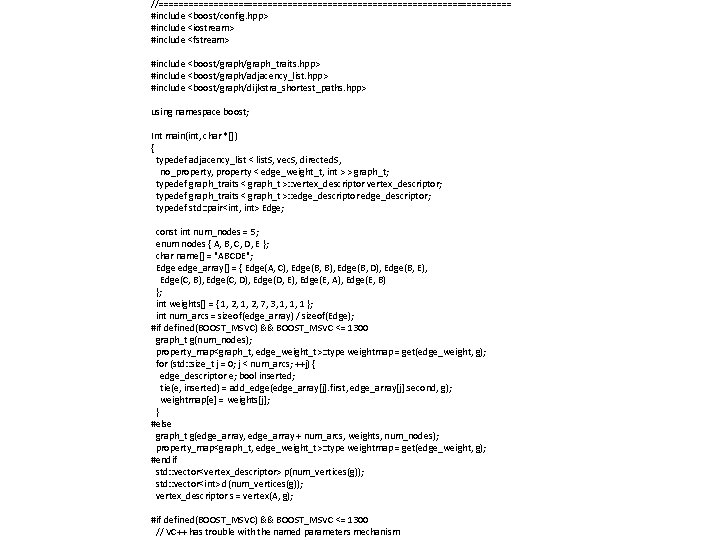
//==================================== #include <boost/config. hpp> #include <iostream> #include <fstream> #include <boost/graph_traits. hpp> #include <boost/graph/adjacency_list. hpp> #include <boost/graph/dijkstra_shortest_paths. hpp> using namespace boost; Int main(int, char *[]) { typedef adjacency_list < list. S, vec. S, directed. S, no_property, property < edge_weight_t, int > > graph_t; typedef graph_traits < graph_t >: : vertex_descriptor; typedef graph_traits < graph_t >: : edge_descriptor; typedef std: : pair<int, int> Edge; const int num_nodes = 5; enum nodes { A, B, C, D, E }; char name[] = "ABCDE"; Edge edge_array[] = { Edge(A, C), Edge(B, B), Edge(B, D), Edge(B, E), Edge(C, B), Edge(C, D), Edge(D, E), Edge(E, A), Edge(E, B) }; int weights[] = { 1, 2, 7, 3, 1, 1, 1 }; int num_arcs = sizeof(edge_array) / sizeof(Edge); #if defined(BOOST_MSVC) && BOOST_MSVC <= 1300 graph_t g(num_nodes); property_map<graph_t, edge_weight_t>: : type weightmap = get(edge_weight, g); for (std: : size_t j = 0; j < num_arcs; ++j) { edge_descriptor e; bool inserted; tie(e, inserted) = add_edge(edge_array[j]. first, edge_array[j]. second, g); weightmap[e] = weights[j]; } #else graph_t g(edge_array, edge_array + num_arcs, weights, num_nodes); property_map<graph_t, edge_weight_t>: : type weightmap = get(edge_weight, g); #endif std: : vector<vertex_descriptor> p(num_vertices(g)); std: : vector<int> d(num_vertices(g)); vertex_descriptor s = vertex(A, g); #if defined(BOOST_MSVC) && BOOST_MSVC <= 1300 // VC++ has trouble with the named parameters mechanism
![property_map<graph_t, vertex_index_t>: : type indexmap = get(vertex_index, g); dijkstra_shortest_paths(g, s, &p[0], &d[0], weightmap, indexmap,](http://slidetodoc.com/presentation_image/4a868c92bd1230d59298e51a46f24041/image-39.jpg "property_map<graph_t, vertex_index_t>: : type indexmap = get(vertex_index, g); dijkstra_shortest_paths(g, s, &p[0], &d[0], weightmap, indexmap,")
property_map<graph_t, vertex_index_t>: : type indexmap = get(vertex_index, g); dijkstra_shortest_paths(g, s, &p[0], &d[0], weightmap, indexmap, std: : less<int>(), closed_plus<int>(), (std: : numeric_limits<int>: : max)(), 0, default_dijkstra_visitor()); #else dijkstra_shortest_paths(g, s, predecessor_map(&p[0]). distance_map(&d[0])); #endif std: : cout << "distances and parents: " << std: : endl; graph_traits < graph_t >: : vertex_iterator vi, vend; for (tie(vi, vend) = vertices(g); vi != vend; ++vi) { std: : cout << "distance(" << name[*vi] << ") = " << d[*vi] << ", "; std: : cout << "parent(" << name[*vi] << ") = " << name[p[*vi]] << std: : endl; } std: : cout << std: : endl; std: : ofstream dot_file("figs/dijkstra-eg. dot"); dot_file << "digraph D {n" << " rankdir=LRn" << " size="4, 3"n" << " ratio="fill"n" << " edge[style="bold"]n" << " node[shape="circle"]n"; } graph_traits < graph_t >: : edge_iterator ei, ei_end; for (tie(ei, ei_end) = edges(g); ei != ei_end; ++ei) { graph_traits < graph_t >: : edge_descriptor e = *ei; graph_traits < graph_t >: : vertex_descriptor u = source(e, g), v = target(e, g); dot_file << name[u] << " -> " << name[v] << "[label="" << get(weightmap, e) << """; if (p[v] == u) dot_file << ", color="black""; else dot_file << ", color="grey""; dot_file << "]"; } dot_file << "}"; return EXIT_SUCCESS;
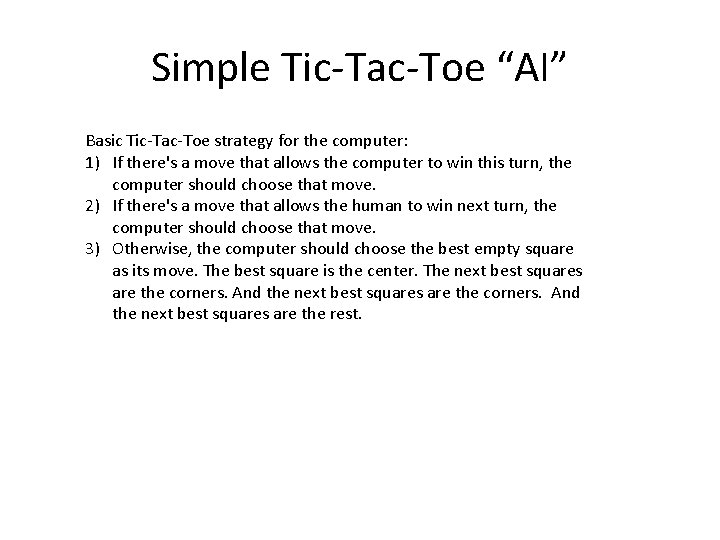
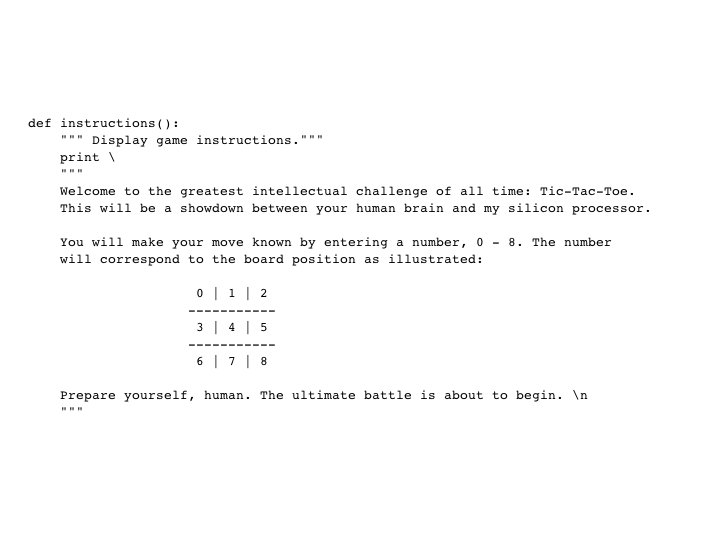
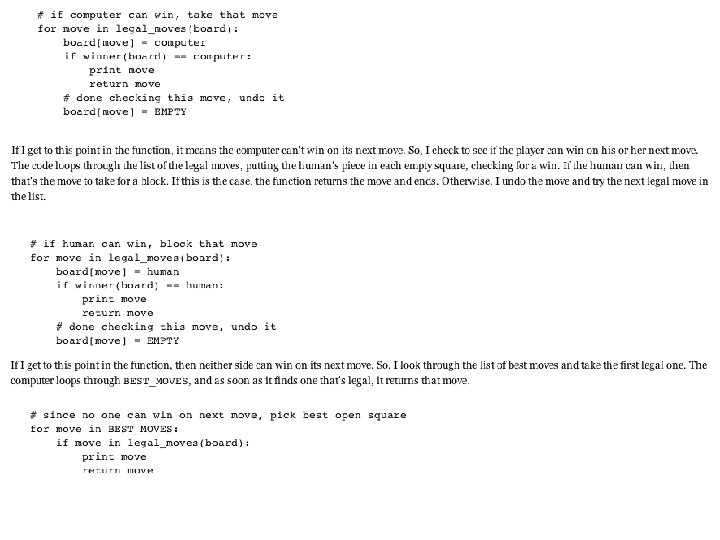
Simple Tic-Tac-Toe “AI” Basic Tic-Tac-Toe strategy for the computer: 1) If there's a move that allows the computer to win this turn, the computer should choose that move. 2) If there's a move that allows the human to win next turn, the computer should choose that move. 3) Otherwise, the computer should choose the best empty square as its move. The best square is the center. The next best squares are the corners. And the next best squares are the rest.
ENDE
- Slides: 43