
C is Fun Part Five at TurbineWarner Bros
C++ is Fun – Part Five at Turbine/Warner Bros. ! Russell Hanson
Discussion Please fill in the paper with two things you would like more information or clarification on that we’ve covered already, that you want covered in the future, or that would help you with your project: items “A” and “B. ” “Like understanding simile, metaphor, and hyperbole without knowing the letters. ”
Going over Homework #2
Homework for Next Monday (pick two) 1) Write a class for a character in gameplay, with set() and get() methods. You should be able to get() or set() the player’s health, location, direction of movement, velocity, and any gear he/she has with him. What character data should be public or protected or private? What data structure should be used for the player’s direction or current location? What data structure should be used for his/her gear? Write how a driver class can interact with the character class, by updating, interacting with other characters, or interacting with the environment. 2) Design and implement a blackjack or twenty-one game using the randomization functions we have used for cards/suits. Allow playing against the computer as the “house. ” Reveal all the cards at the end of a hand. 3) Write a function mysort() that takes an array of integers or floating point values and returns them sorted from least to greatest. Bonus 1: Pass the array by reference and change the original array. Bonus 2: Include an option to sort the array from greatest to least. 4) Make a dice rolling program that rolls two dice of any number of sides. Bonus: Implement a standard dice game of your choice (http: //en. wikipedia. org/wiki/List_of_dice_games). 5) Outline how to implement the game Pong using pseudocode and/or class diagrams (http: //en. wikipedia. org/wiki/Class_diagram). Bonus: Implement one of these classes.

Homework for Next Monday (pick two) 6) Write a concatenate function that takes a variable number of arguments (may or may not be of different data types) and returns their concatenation as a string. 7) Overload the ‘+’ operator to concatenate not only strings but also integers and/or floating point numbers. 8) Write a. cpp file that uses a function prototype and default parameters for a function.
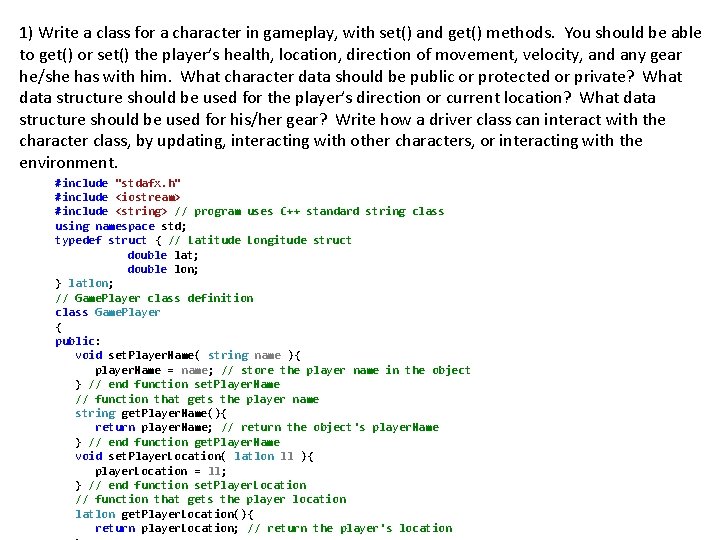
1) Write a class for a character in gameplay, with set() and get() methods. You should be able to get() or set() the player’s health, location, direction of movement, velocity, and any gear he/she has with him. What character data should be public or protected or private? What data structure should be used for the player’s direction or current location? What data structure should be used for his/her gear? Write how a driver class can interact with the character class, by updating, interacting with other characters, or interacting with the environment. #include "stdafx. h" #include <iostream> #include <string> // program uses C++ standard string class using namespace std; typedef struct { // Latitude Longitude struct double lat; double lon; } latlon; // Game. Player class definition class Game. Player { public: void set. Player. Name( string name ){ player. Name = name; // store the player name in the object } // end function set. Player. Name // function that gets the player name string get. Player. Name(){ return player. Name; // return the object's player. Name } // end function get. Player. Name void set. Player. Location( latlon ll ){ player. Location = ll; } // end function set. Player. Location // function that gets the player location latlon get. Player. Location(){ return player. Location; // return the player's location

using namespace std; typedef struct { // Latitude Longitude struct double lat; double lon; } latlon; // Game. Player class definition class Game. Player { public: void set. Player. Name( string name ){ player. Name = name; // store the player name in the object } // end function set. Player. Name // function that gets the player name string get. Player. Name(){ return player. Name; // return the object's player. Name } // end function get. Player. Name void set. Player. Location( latlon ll ){ player. Location = ll; } // end function set. Player. Location // function that gets the player location latlon get. Player. Location(){ return player. Location; // return the player's location } // function that displays a welcome message void display. Message(){ cout << "Welcome to the game n" << get. Player. Name() << "!" << endl; cout << "Your location is n Latitude: " << player. Location. lat << " Longitude: " << player. Location. lon << endl; } // end function display. Message private: string player. Name; // course name for this Game. Player latlon player. Location; }; // end class Game. Player // function main begins program execution int main(){ string name. Of. Player; latlon player. Location; Game. Player my. Game. Player; // display initial value of player. Name cout << "Initial player name is: " << my. Game. Player. get. Player. Name() << endl; cout << "n. Please enter the player name: " << endl; getline( cin, name. Of. Player ); my. Game. Player. set. Player. Name( name. Of. Player ); cout << "n. Please enter the player latitude: " << endl; cin >> player. Location. lat; cout << "n. Please enter the player longitude: " << endl; cin >> player. Location. lon; my. Game. Player. set. Player. Location( player. Location ); cout << endl; // outputs a blank line my. Game. Player. display. Message(); system("PAUSE"); } // end main
Implementing mapping applications https: //github. com/downloads/mapnik/mapnik-v 2. 1. 0. tar. bz 2
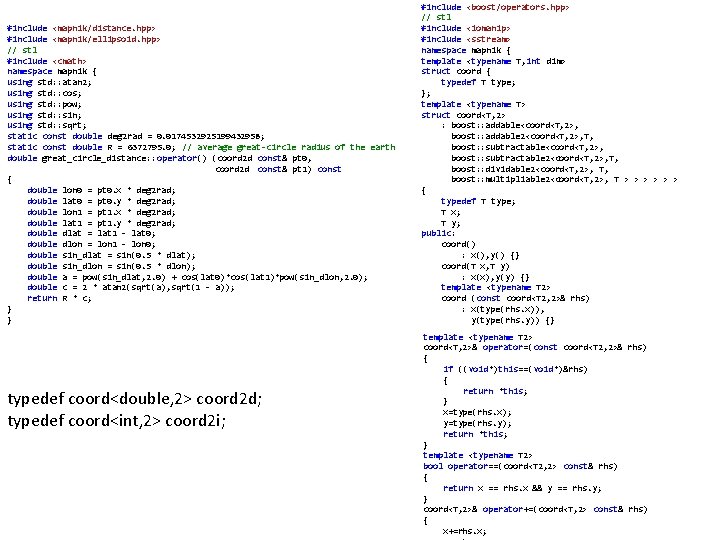
#include <mapnik/distance. hpp> #include <mapnik/ellipsoid. hpp> // stl #include <cmath> namespace mapnik { using std: : atan 2; using std: : cos; using std: : pow; using std: : sin; using std: : sqrt; static const double deg 2 rad = 0. 0174532925199432958; static const double R = 6372795. 0; // average great-circle radius of the earth double great_circle_distance: : operator() (coord 2 d const& pt 0, coord 2 d const& pt 1) const { double lon 0 = pt 0. x * deg 2 rad; double lat 0 = pt 0. y * deg 2 rad; double lon 1 = pt 1. x * deg 2 rad; double lat 1 = pt 1. y * deg 2 rad; double dlat = lat 1 - lat 0; double dlon = lon 1 - lon 0; double sin_dlat = sin(0. 5 * dlat); double sin_dlon = sin(0. 5 * dlon); double a = pow(sin_dlat, 2. 0) + cos(lat 0)*cos(lat 1)*pow(sin_dlon, 2. 0); double c = 2 * atan 2(sqrt(a), sqrt(1 - a)); return R * c; } } typedef coord<double, 2> coord 2 d; typedef coord<int, 2> coord 2 i; #include <boost/operators. hpp> // stl #include <iomanip> #include <sstream> namespace mapnik { template <typename T, int dim> struct coord { typedef T type; }; template <typename T> struct coord<T, 2> : boost: : addable<coord<T, 2>, boost: : addable 2<coord<T, 2>, T, boost: : subtractable<coord<T, 2>, boost: : subtractable 2<coord<T, 2>, T, boost: : dividable 2<coord<T, 2>, T, boost: : multipliable 2<coord<T, 2>, T > > > { typedef T type; T x; T y; public: coord() : x(), y() {} coord(T x, T y) : x(x), y(y) {} template <typename T 2> coord (const coord<T 2, 2>& rhs) : x(type(rhs. x)), y(type(rhs. y)) {} template <typename T 2> coord<T, 2>& operator=(const coord<T 2, 2>& rhs) { if ((void*)this==(void*)&rhs) { return *this; } x=type(rhs. x); y=type(rhs. y); return *this; } template <typename T 2> bool operator==(coord<T 2, 2> const& rhs) { return x == rhs. x && y == rhs. y; } coord<T, 2>& operator+=(coord<T, 2> const& rhs) { x+=rhs. x;

2) Design and implement a blackjack or twenty-one game using the randomization functions we have used for cards/suits. Allow playing against the computer as the “house. ” Reveal all the cards at the end of a hand. class Card { public: int Value; char Suit; std: : string Name; Card(int v, char s, std: : string n): Value(v), Suit(s), Name(n) { }; Card(): Value(0), Suit('? '), Name("Error") { }; ~Card() { }; }; class Deck { public: std: : vector<Card> fulldeck; void Shuffle() { unsigned randocard; srand(time(0)); for (unsigned i=fulldeck. size(); i>0; i--) { if (i == 0) randocard = 0; // no, not very random is it? else randocard = rand() % i; fulldeck. push_back(fulldeck[randocard]); fulldeck. erase(fulldeck. begin()+randocard); } // for loop }; // Shuffle Card Draw() { fulldeck. push_back(fulldeck[0]); fulldeck. erase(fulldeck. begin()); return fulldeck[fulldeck. size()-1]; }; // Draw a card (sure, we return a card, but we shuffle it in the back immediately) // Because you're not going to go through 52 cards in a 1 v 1 game! int Count. Aces() { int aces = 0; for (unsigned i=0; i<fulldeck. size(); ++i) if (fulldeck[i]. Value == 11) aces++; return aces; }; // Count Aces int Count. Cards() { int cards = 0; for (unsigned i=0; i<fulldeck. size(); ++i) cards += fulldeck[i]. Value; return cards; }; // Count Cards int Evaluate. Hand() { int hand = Count. Cards(); if (hand < 22) return hand; int aces = Count. Aces(); if (aces == 0) return -1; for (int i=0; i<aces; i++) { hand -= 10; if (hand < 22) return hand; } return -1; // you're out of aces, pal. suck it. }; // return -1 if bust. Deck() { }; // empty hands use default constructor
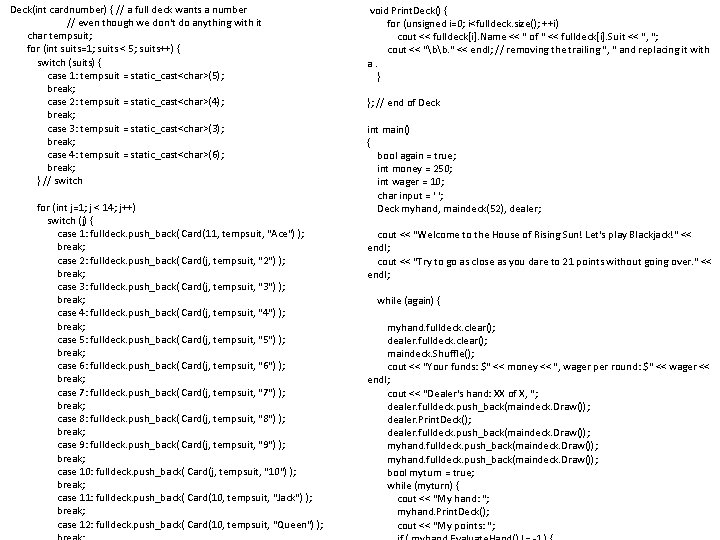
Deck(int cardnumber) { // a full deck wants a number // even though we don't do anything with it char tempsuit; for (int suits=1; suits < 5; suits++) { switch (suits) { case 1: tempsuit = static_cast<char>(5); break; case 2: tempsuit = static_cast<char>(4); break; case 3: tempsuit = static_cast<char>(3); break; case 4: tempsuit = static_cast<char>(6); break; } // switch for (int j=1; j < 14; j++) switch (j) { case 1: fulldeck. push_back( Card(11, tempsuit, "Ace") ); break; case 2: fulldeck. push_back( Card(j, tempsuit, "2") ); break; case 3: fulldeck. push_back( Card(j, tempsuit, "3") ); break; case 4: fulldeck. push_back( Card(j, tempsuit, "4") ); break; case 5: fulldeck. push_back( Card(j, tempsuit, "5") ); break; case 6: fulldeck. push_back( Card(j, tempsuit, "6") ); break; case 7: fulldeck. push_back( Card(j, tempsuit, "7") ); break; case 8: fulldeck. push_back( Card(j, tempsuit, "8") ); break; case 9: fulldeck. push_back( Card(j, tempsuit, "9") ); break; case 10: fulldeck. push_back( Card(j, tempsuit, "10") ); break; case 11: fulldeck. push_back( Card(10, tempsuit, "Jack") ); break; case 12: fulldeck. push_back( Card(10, tempsuit, "Queen") ); void Print. Deck() { for (unsigned i=0; i<fulldeck. size(); ++i) cout << fulldeck[i]. Name << " of " << fulldeck[i]. Suit << ", "; cout << "bb. " << endl; // removing the trailing ", " and replacing it with a. } }; // end of Deck int main() { bool again = true; int money = 250; int wager = 10; char input = ' '; Deck myhand, maindeck(52), dealer; cout << "Welcome to the House of Rising Sun! Let's play Blackjack!" << endl; cout << "Try to go as close as you dare to 21 points without going over. " << endl; while (again) { myhand. fulldeck. clear(); dealer. fulldeck. clear(); maindeck. Shuffle(); cout << "Your funds: $" << money << ", wager per round: $" << wager << endl; cout << "Dealer's hand: XX of X, "; dealer. fulldeck. push_back(maindeck. Draw()); dealer. Print. Deck(); dealer. fulldeck. push_back(maindeck. Draw()); myhand. fulldeck. push_back(maindeck. Draw()); bool myturn = true; while (myturn) { cout << "My hand: "; myhand. Print. Deck(); cout << "My points: ";
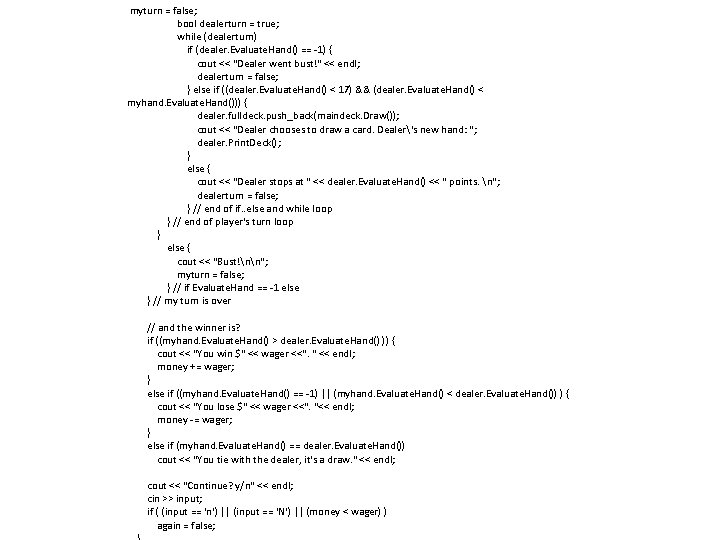
myturn = false; bool dealerturn = true; while (dealerturn) if (dealer. Evaluate. Hand() == -1) { cout << "Dealer went bust!" << endl; dealerturn = false; } else if ((dealer. Evaluate. Hand() < 17) && (dealer. Evaluate. Hand() < myhand. Evaluate. Hand())) { dealer. fulldeck. push_back(maindeck. Draw()); cout << "Dealer chooses to draw a card. Dealer's new hand: "; dealer. Print. Deck(); } else { cout << "Dealer stops at " << dealer. Evaluate. Hand() << " points. n"; dealerturn = false; } // end of if. . else and while loop } // end of player's turn loop } else { cout << "Bust!nn"; myturn = false; } // if Evaluate. Hand == -1 else } // my turn is over // and the winner is? if ((myhand. Evaluate. Hand() > dealer. Evaluate. Hand() )) { cout << "You win $" << wager <<". " << endl; money += wager; } else if ((myhand. Evaluate. Hand() == -1) || (myhand. Evaluate. Hand() < dealer. Evaluate. Hand()) ) { cout << "You lose $" << wager <<". "<< endl; money -= wager; } else if (myhand. Evaluate. Hand() == dealer. Evaluate. Hand()) cout << "You tie with the dealer, it's a draw. " << endl; cout << "Continue? y/n" << endl; cin >> input; if ( (input == 'n') || (input == 'N') || (money < wager) ) again = false;
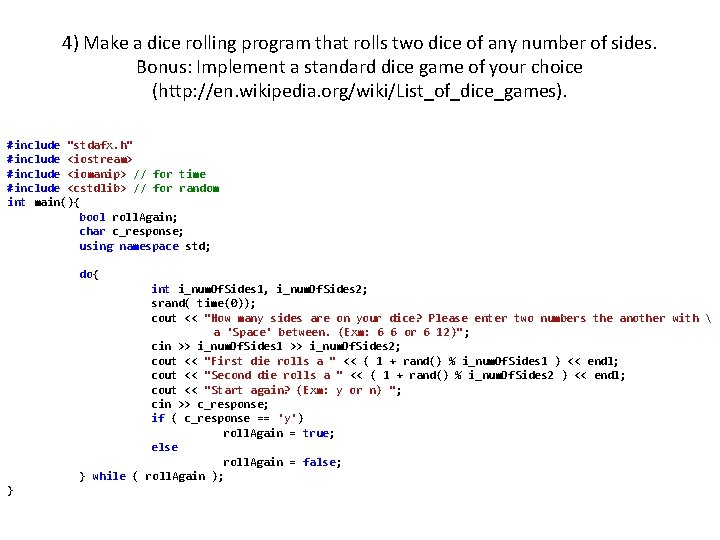
4) Make a dice rolling program that rolls two dice of any number of sides. Bonus: Implement a standard dice game of your choice (http: //en. wikipedia. org/wiki/List_of_dice_games). #include "stdafx. h" #include <iostream> #include <iomanip> // for time #include <cstdlib> // for random int main(){ bool roll. Again; char c_response; using namespace std; do{ int i_num. Of. Sides 1, i_num. Of. Sides 2; srand( time(0)); cout << "How many sides are on your dice? Please enter two numbers the another with a 'Space' between. (Exm: 6 6 or 6 12)" ; cin >> i_num. Of. Sides 1 >> i_num. Of. Sides 2; cout << "First die rolls a " << ( 1 + rand() % i_num. Of. Sides 1 ) << endl; cout << "Second die rolls a " << ( 1 + rand() % i_num. Of. Sides 2 ) << endl; cout << "Start again? (Exm: y or n) "; cin >> c_response; if ( c_response == 'y') roll. Again = true; else roll. Again = false; } while ( roll. Again ); }
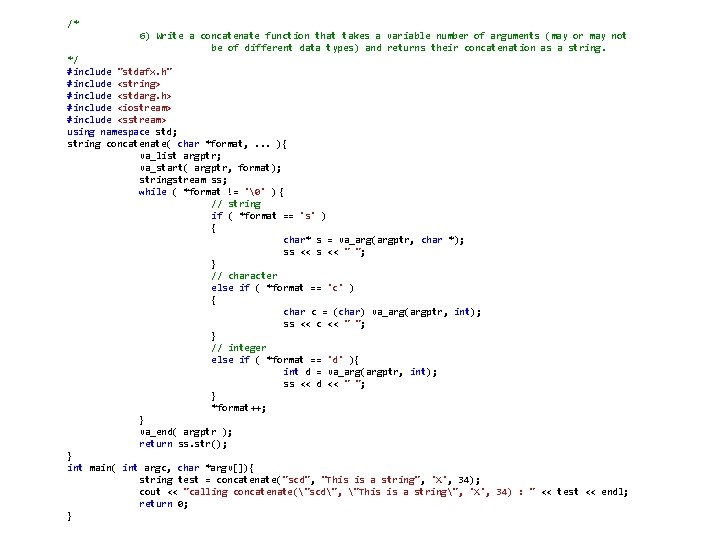
/* 6) Write a concatenate function that takes a variable number of arguments (may or may not be of different data types) and returns their concatenation as a string. */ #include "stdafx. h" #include <string> #include <stdarg. h> #include <iostream> #include <sstream> using namespace std; string concatenate( char *format, . . . ){ va_list argptr; va_start( argptr, format); stringstream ss; while ( *format != '' ) { // string if ( *format == 's' ) { char* s = va_arg(argptr, char *); ss << " "; } // character else if ( *format == 'c' ) { char c = (char) va_arg(argptr, int); ss << c << " "; } // integer else if ( *format == 'd' ){ int d = va_arg(argptr, int); ss << d << " "; } *format++; } va_end( argptr ); return ss. str(); } int main( int argc, char *argv[]){ string test = concatenate("scd", "This is a string", 'X', 34); cout << "calling concatenate("scd", "This is a string", 'X', 34) : " << test << endl; return 0; }
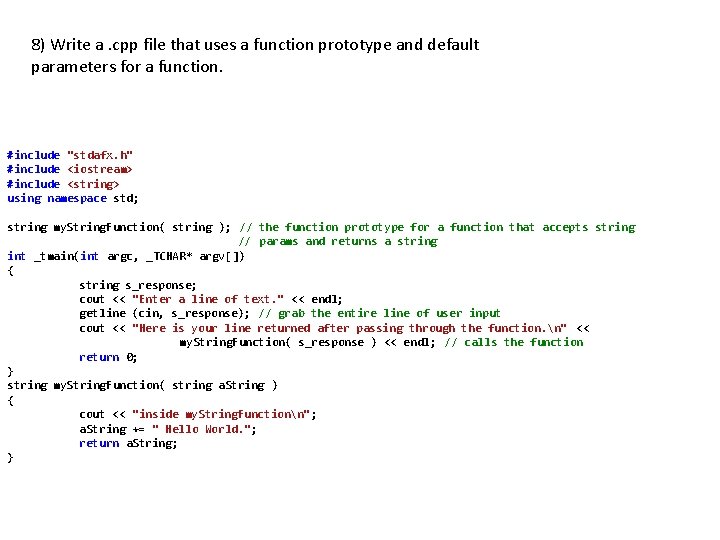
8) Write a. cpp file that uses a function prototype and default parameters for a function. #include "stdafx. h" #include <iostream> #include <string> using namespace std; string my. String. Function( string ); // the function prototype for a function that accepts string // params and returns a string int _tmain(int argc, _TCHAR* argv[]) { string s_response; cout << "Enter a line of text. " << endl; getline (cin, s_response); // grab the entire line of user input cout << "Here is your line returned after passing through the function. n" << my. String. Function( s_response ) << endl; // calls the function return 0; } string my. String. Function( string a. String ) { cout << "inside my. String. Functionn"; a. String += " Hello World. "; return a. String; }
You can download the source code for all the textbook examples here: "Starting Out with C++: From Control Structures through Objects, 7/e" Gaddis ISBN: 0132576252 Source code and appendices can be found at http: //media. pearsoncmg. com/ph/esm/ecs_gaddis_sowcpp_7/CS Support/Assorted. zip
For advanced students who want a challenge • Download, install, and compile Ogre 3 D • http: //www. ogre 3 d. org/tikiwiki/Setting+Up+A n+Application+-+Visual+Studio • OR: • http: //www. unrealengine. com/udk/ • OR: • http: //www. garagegames. com/products/torq ue-3 d/overview
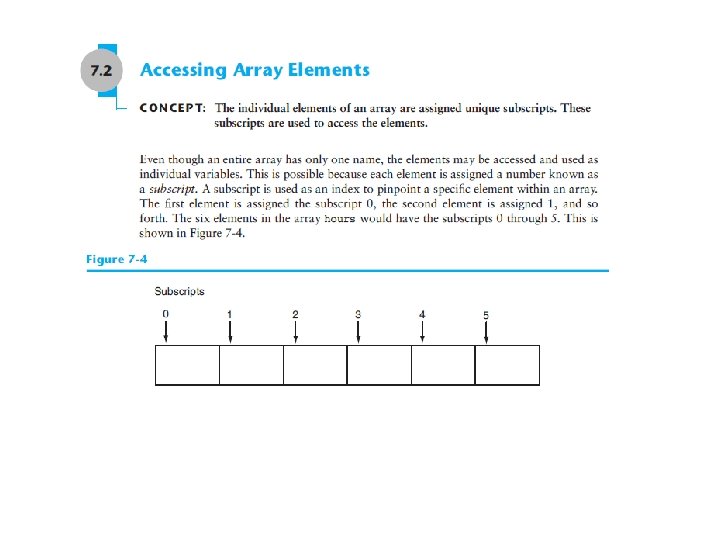
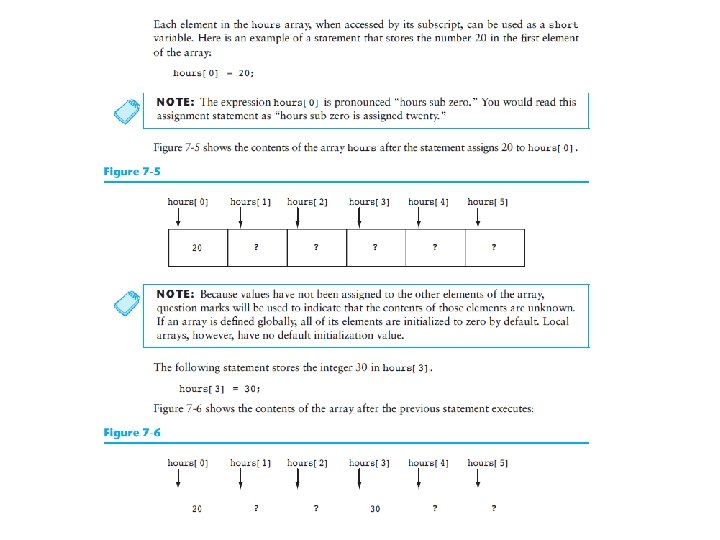
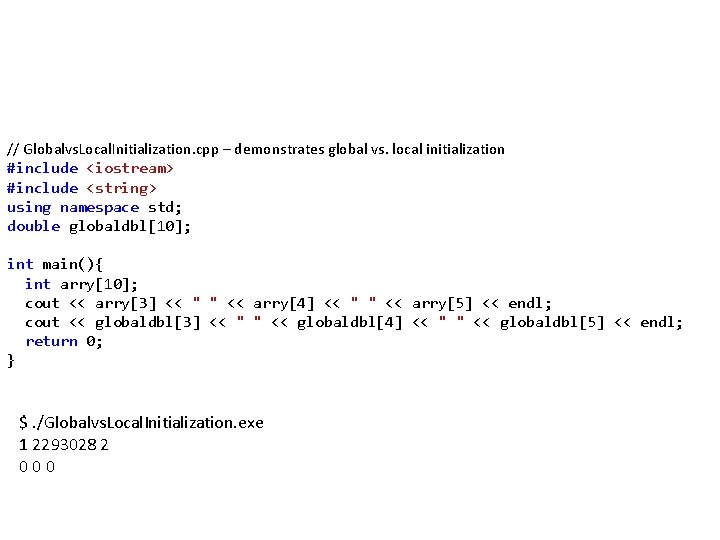
// Globalvs. Local. Initialization. cpp – demonstrates global vs. local initialization #include <iostream> #include <string> using namespace std; double globaldbl[10]; int main(){ int arry[10]; cout << arry[3] << " " << arry[4] << " " << arry[5] << endl; cout << globaldbl[3] << " " << globaldbl[4] << " " << globaldbl[5] << endl; return 0; } $. /Globalvs. Local. Initialization. exe 1 2293028 2 000
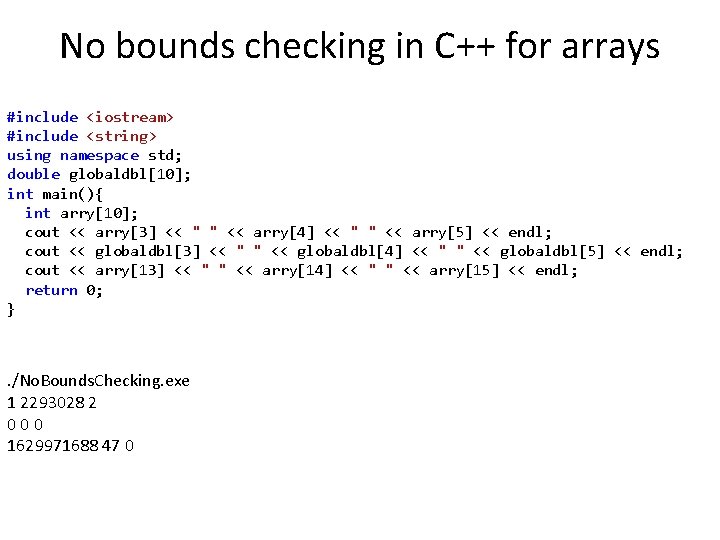
No bounds checking in C++ for arrays #include <iostream> #include <string> using namespace std; double globaldbl[10]; int main(){ int arry[10]; cout << arry[3] << " " << arry[4] << " " << arry[5] << endl; cout << globaldbl[3] << " " << globaldbl[4] << " " << globaldbl[5] << endl; cout << arry[13] << " " << arry[14] << " " << arry[15] << endl; return 0; } . /No. Bounds. Checking. exe 1 2293028 2 000 1629971688 47 0
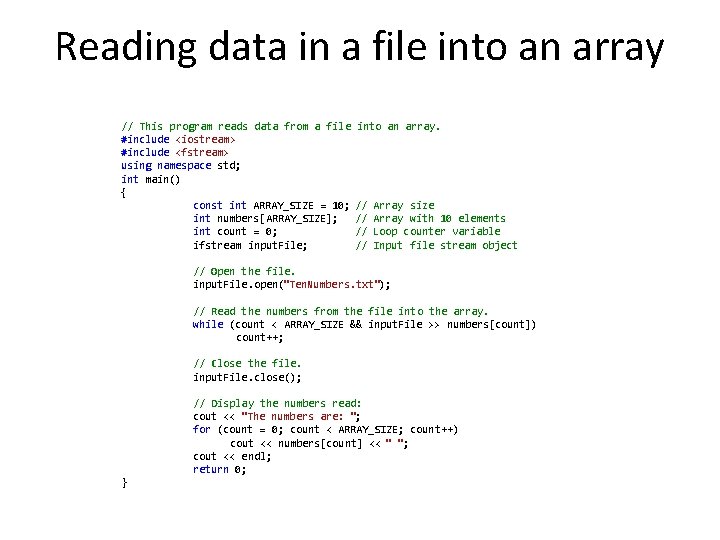
Reading data in a file into an array // This program reads data from a file #include <iostream> #include <fstream> using namespace std; int main() { const int ARRAY_SIZE = 10; int numbers[ARRAY_SIZE]; int count = 0; ifstream input. File; into an array. // // Array size Array with 10 elements Loop counter variable Input file stream object // Open the file. input. File. open("Ten. Numbers. txt"); // Read the numbers from the file into the array. while (count < ARRAY_SIZE && input. File >> numbers[count]) count++; // Close the file. input. File. close(); // Display the numbers read: cout << "The numbers are: "; for (count = 0; count < ARRAY_SIZE; count++) cout << numbers[count] << " "; cout << endl; return 0; }
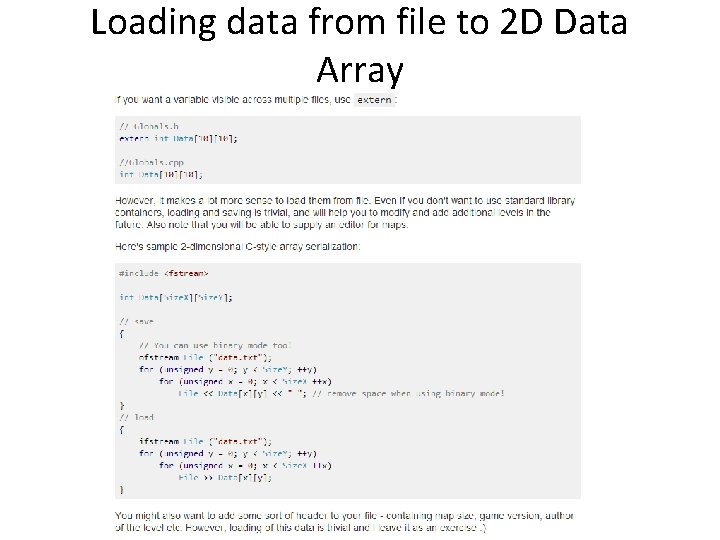
Loading data from file to 2 D Data Array
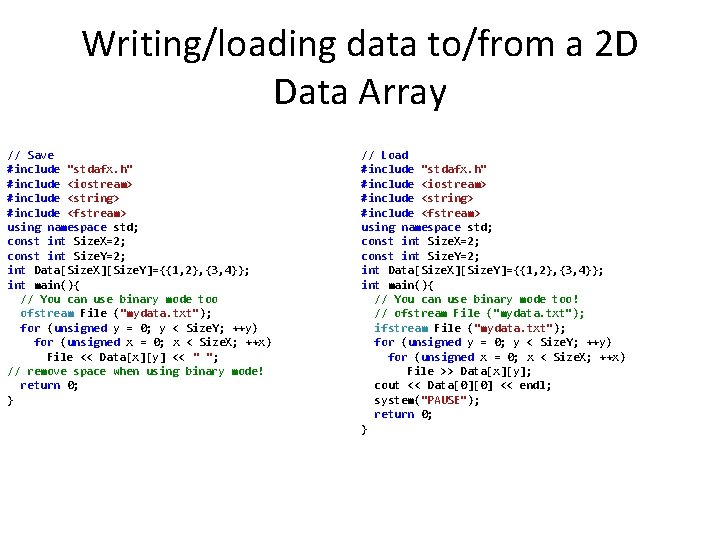
Writing/loading data to/from a 2 D Data Array // Save #include "stdafx. h" #include <iostream> #include <string> #include <fstream> using namespace std; const int Size. X=2; const int Size. Y=2; int Data[Size. X][Size. Y]={{1, 2}, {3, 4}}; int main(){ // You can use binary mode too ofstream File ("mydata. txt"); for (unsigned y = 0; y < Size. Y; ++y) for (unsigned x = 0; x < Size. X; ++x) File << Data[x][y] << " "; // remove space when using binary mode! return 0; } // Load #include "stdafx. h" #include <iostream> #include <string> #include <fstream> using namespace std; const int Size. X=2; const int Size. Y=2; int Data[Size. X][Size. Y]={{1, 2}, {3, 4}}; int main(){ // You can use binary mode too! // ofstream File ("mydata. txt"); ifstream File ("mydata. txt"); for (unsigned y = 0; y < Size. Y; ++y) for (unsigned x = 0; x < Size. X; ++x) File >> Data[x][y]; cout << Data[0][0] << endl; system("PAUSE"); return 0; }
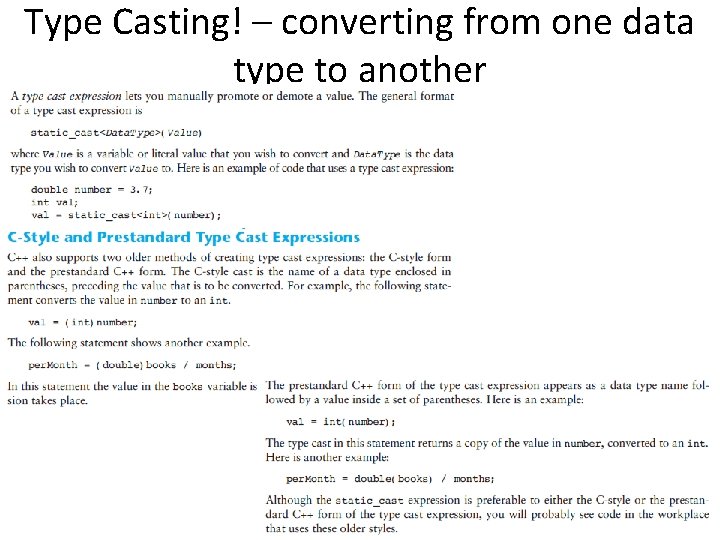
Type Casting! – converting from one data type to another
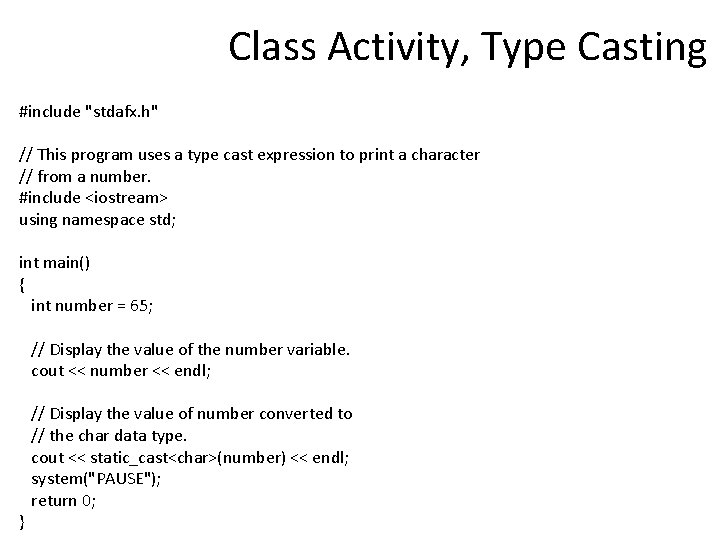
Class Activity, Type Casting #include "stdafx. h" // This program uses a type cast expression to print a character // from a number. #include <iostream> using namespace std; int main() { int number = 65; // Display the value of the number variable. cout << number << endl; } // Display the value of number converted to // the char data type. cout << static_cast<char>(number) << endl; system("PAUSE"); return 0;
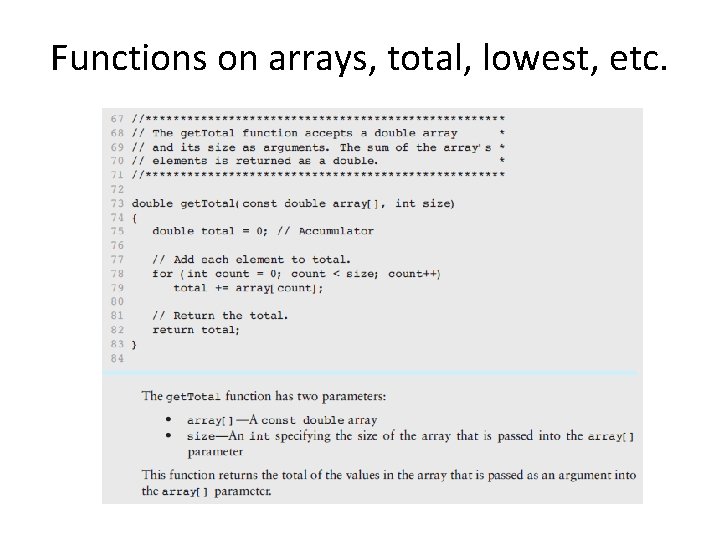
Functions on arrays, total, lowest, etc.
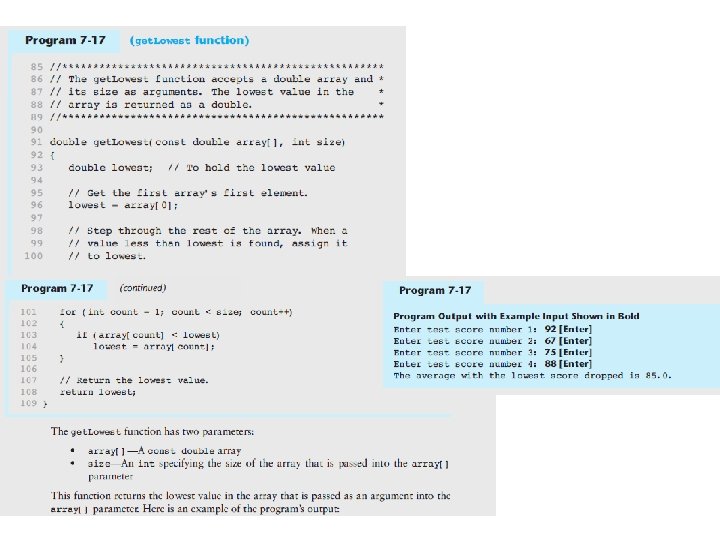
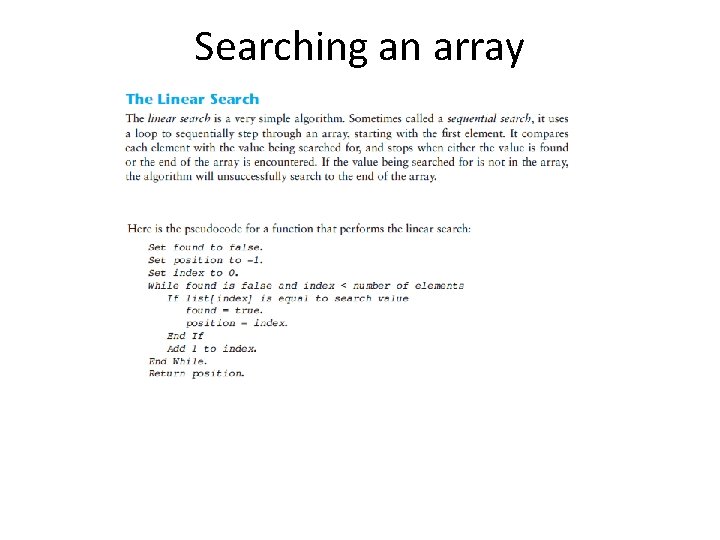
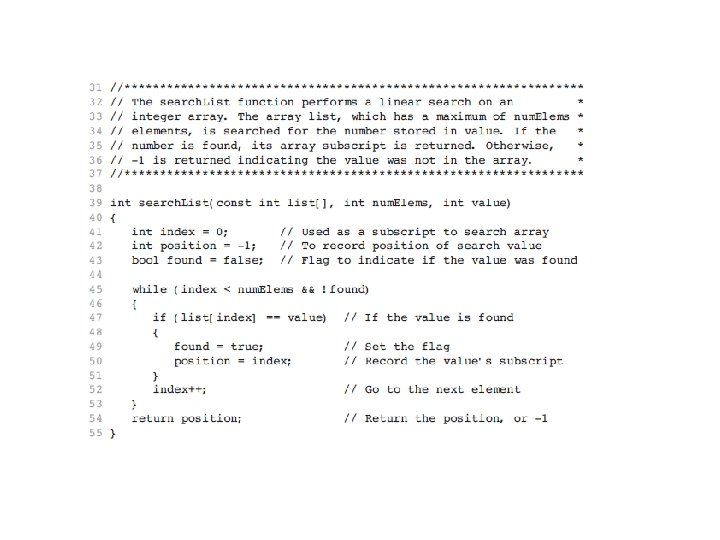
Searching an array
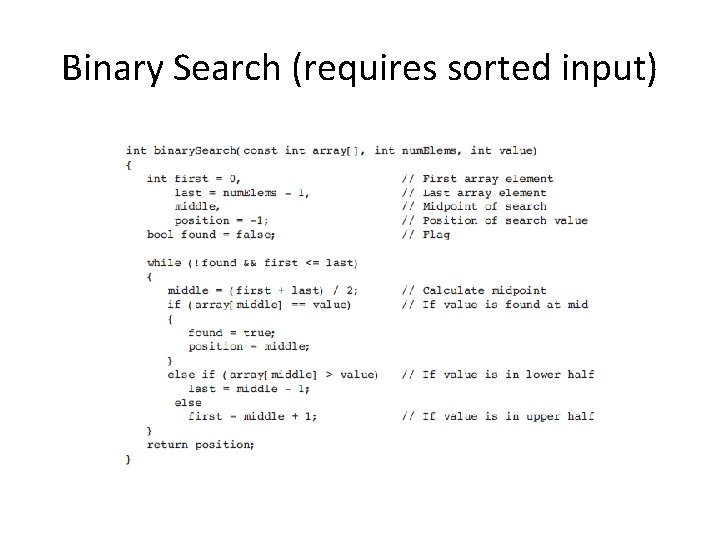
Binary Search (requires sorted input)
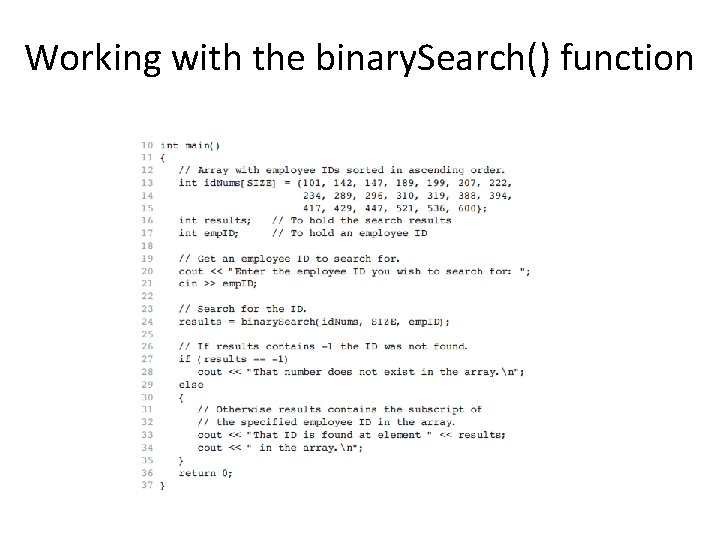
Working with the binary. Search() function
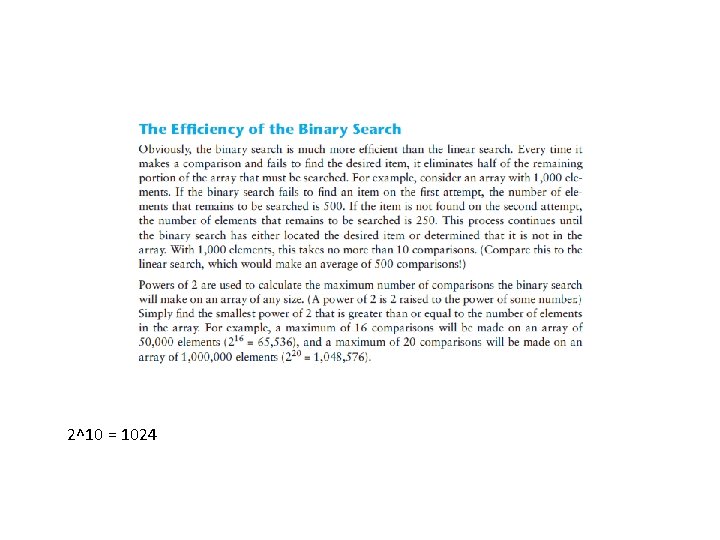
2^10 = 1024
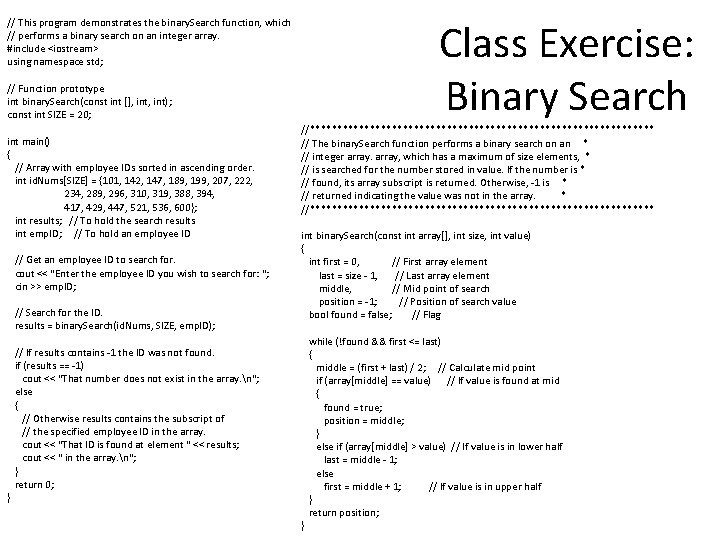
// This program demonstrates the binary. Search function, which // performs a binary search on an integer array. #include <iostream> using namespace std; Class Exercise: Binary Search // Function prototype int binary. Search(const int [], int); const int SIZE = 20; int main() { // Array with employee IDs sorted in ascending order. int id. Nums[SIZE] = {101, 142, 147, 189, 199, 207, 222, 234, 289, 296, 310, 319, 388, 394, 417, 429, 447, 521, 536, 600}; int results; // To hold the search results int emp. ID; // To hold an employee ID // Get an employee ID to search for. cout << "Enter the employee ID you wish to search for: "; cin >> emp. ID; // Search for the ID. results = binary. Search(id. Nums, SIZE, emp. ID); } //******************************** // The binary. Search function performs a binary search on an * // integer array, which has a maximum of size elements, * // is searched for the number stored in value. If the number is * // found, its array subscript is returned. Otherwise, -1 is * // returned indicating the value was not in the array. * //******************************** int binary. Search(const int array[], int size, int value) { int first = 0, // First array element last = size - 1, // Last array element middle, // Mid point of search position = -1; // Position of search value bool found = false; // Flag // If results contains -1 the ID was not found. if (results == -1) cout << "That number does not exist in the array. n"; else { // Otherwise results contains the subscript of // the specified employee ID in the array. cout << "That ID is found at element " << results; cout << " in the array. n"; } return 0; } while (!found && first <= last) { middle = (first + last) / 2; // Calculate mid point if (array[middle] == value) // If value is found at mid { found = true; position = middle; } else if (array[middle] > value) // If value is in lower half last = middle - 1; else first = middle + 1; // If value is in upper half } return position;

Sorting an array
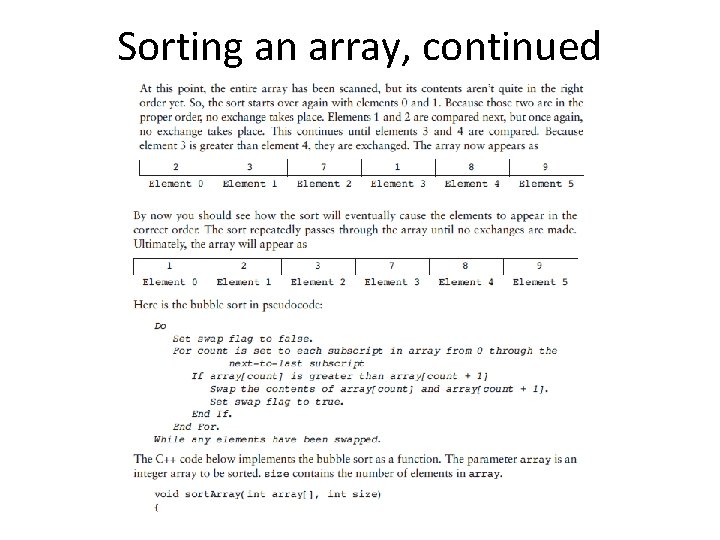
Sorting an array, continued
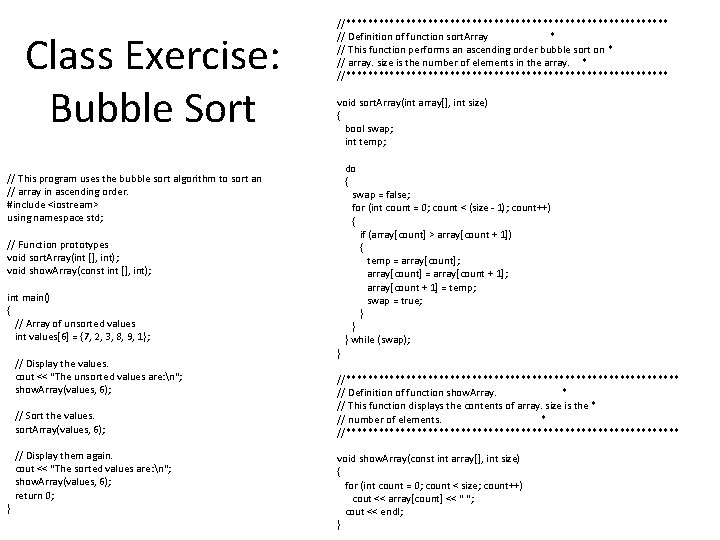
Class Exercise: Bubble Sort //****************************** // Definition of function sort. Array * // This function performs an ascending order bubble sort on * // array. size is the number of elements in the array. * //****************************** void sort. Array(int array[], int size) { bool swap; int temp; // This program uses the bubble sort algorithm to sort an // array in ascending order. #include <iostream> using namespace std; // Function prototypes void sort. Array(int [], int); void show. Array(const int [], int); int main() { // Array of unsorted values int values[6] = {7, 2, 3, 8, 9, 1}; // Display the values. cout << "The unsorted values are: n"; show. Array(values, 6); // Sort the values. sort. Array(values, 6); } // Display them again. cout << "The sorted values are: n"; show. Array(values, 6); return 0; } do { swap = false; for (int count = 0; count < (size - 1); count++) { if (array[count] > array[count + 1]) { temp = array[count]; array[count] = array[count + 1]; array[count + 1] = temp; swap = true; } } } while (swap); //******************************* // Definition of function show. Array. * // This function displays the contents of array. size is the * // number of elements. * //******************************* void show. Array(const int array[], int size) { for (int count = 0; count < size; count++) cout << array[count] << " "; cout << endl; }

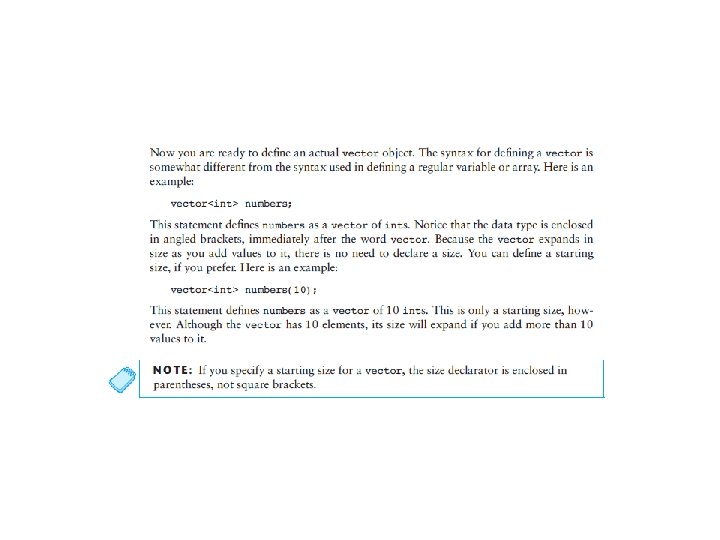
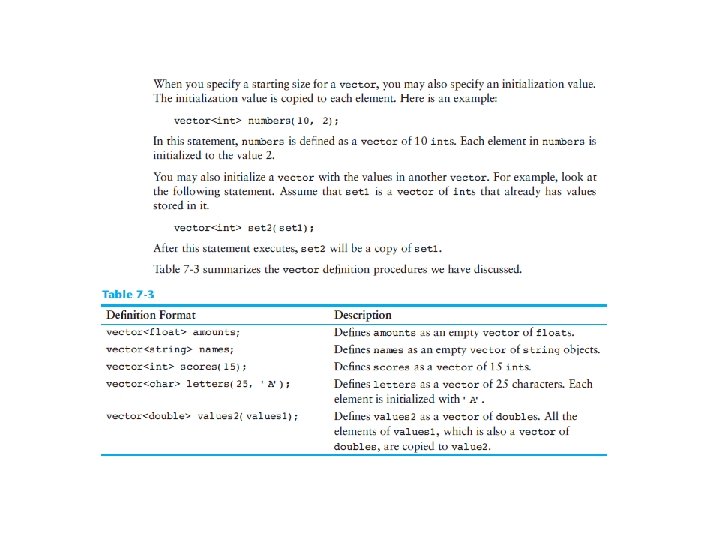
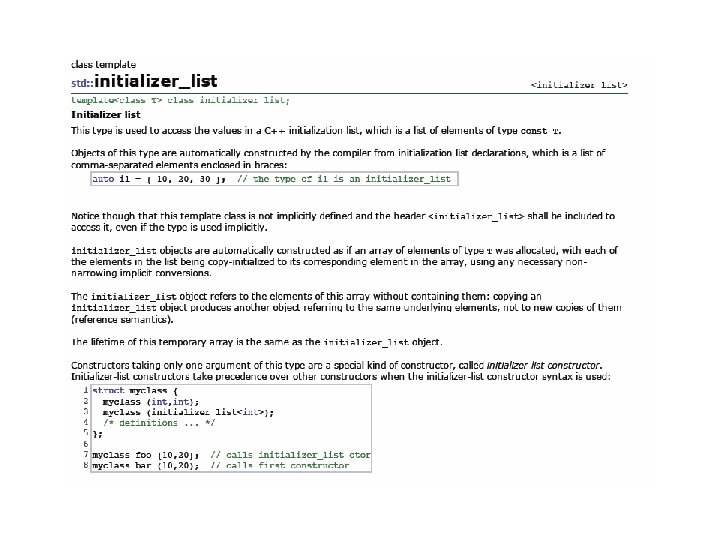
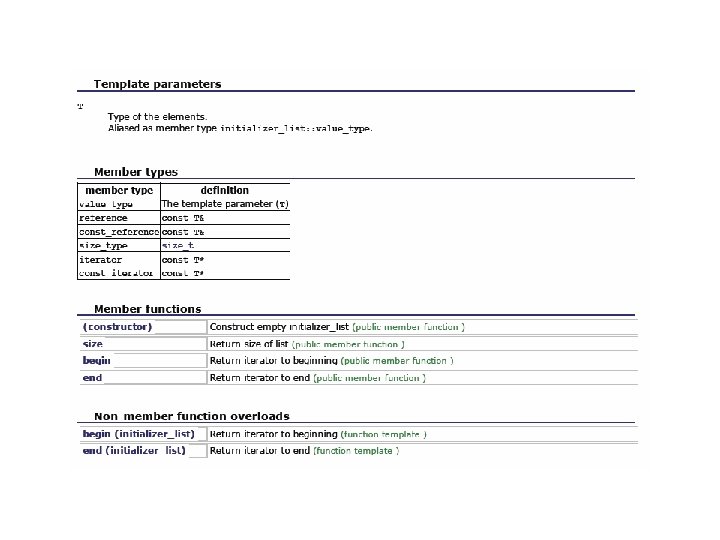
Vectors vs. Arrays
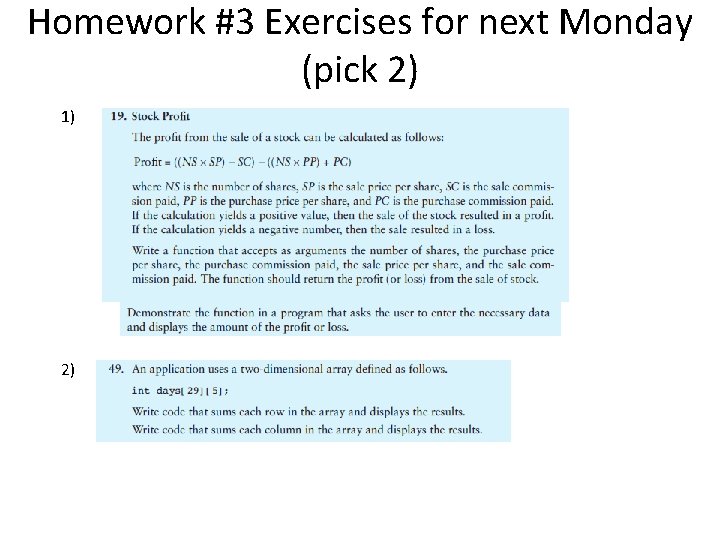
Homework #3 Exercises for next Monday (pick 2) 1) 2)
- Slides: 43