
C elegans as a model organism Kavya Leo
- Slides: 15
C. elegans as a model organism Kavya Leo Vakkayil 20101080, BS-MS IISER PUNE 12/1/2020 Kavya Leo 1
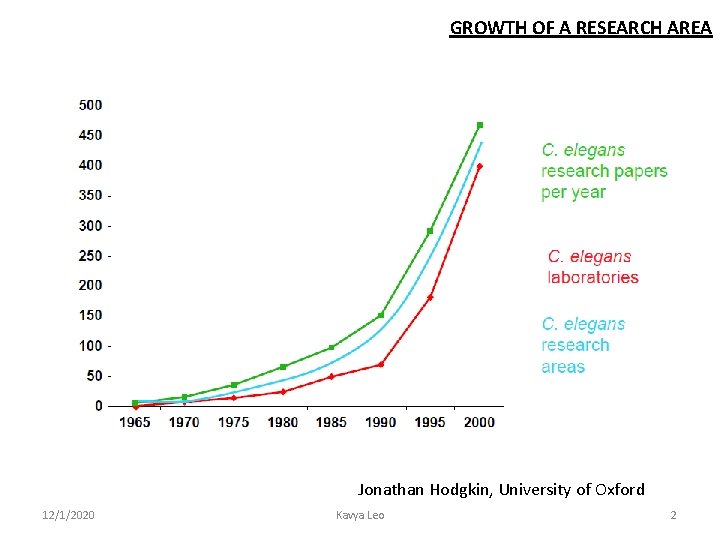
GROWTH OF A RESEARCH AREA Jonathan Hodgkin, University of Oxford 12/1/2020 Kavya Leo 2
1. An introduction to C. elegans • Anatomy • Life cycle 2. A short history of C. elegans research 3. Advantages and applications of C. elegans 4. C. elegans in biology@IISER PUNE 12/1/2020 Kavya Leo 3
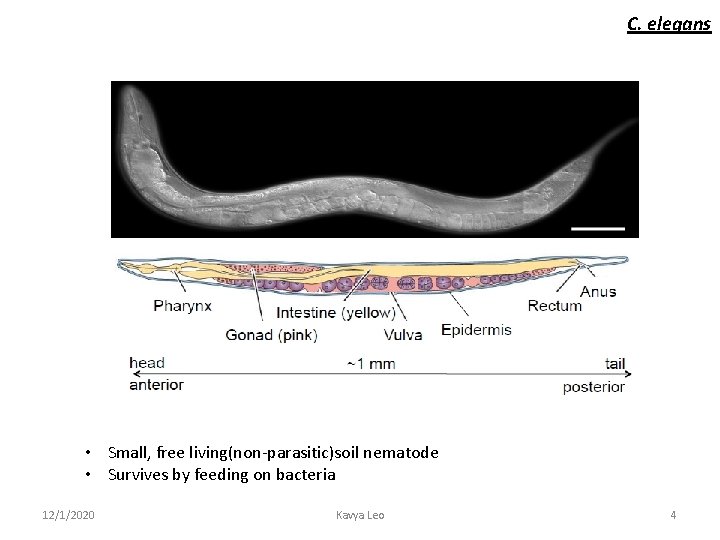
C. elegans • Small, free living(non-parasitic)soil nematode • Survives by feeding on bacteria 12/1/2020 Kavya Leo 4
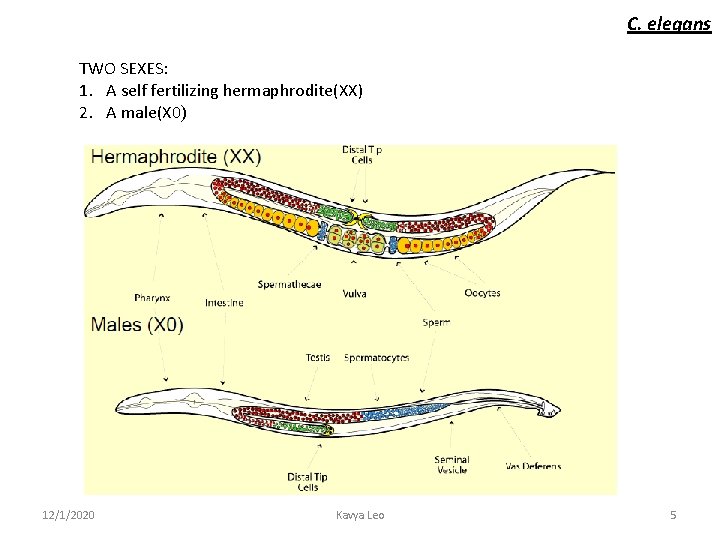
C. elegans TWO SEXES: 1. A self fertilizing hermaphrodite(XX) 2. A male(X 0) 12/1/2020 Kavya Leo 5
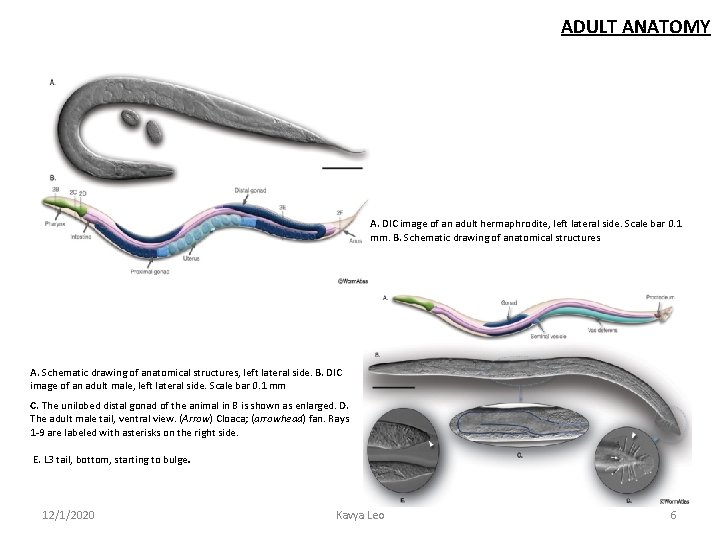
ADULT ANATOMY A. DIC image of an adult hermaphrodite, left lateral side. Scale bar 0. 1 mm. B. Schematic drawing of anatomical structures A. Schematic drawing of anatomical structures, left lateral side. B. DIC image of an adult male, left lateral side. Scale bar 0. 1 mm C. The unilobed distal gonad of the animal in B is shown as enlarged. D. The adult male tail, ventral view. (Arrow) Cloaca; (arrowhead) fan. Rays 1 -9 are labeled with asterisks on the right side. . E. L 3 tail, bottom, starting to bulge 12/1/2020 Kavya Leo 6
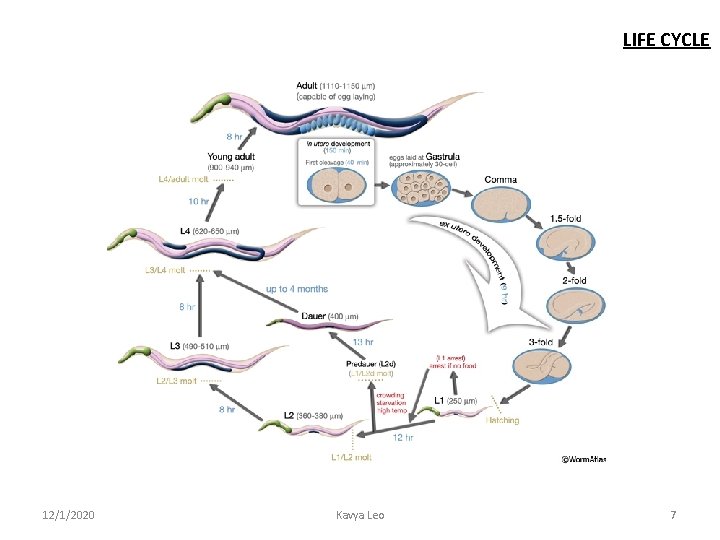
LIFE CYCLE 12/1/2020 Kavya Leo 7
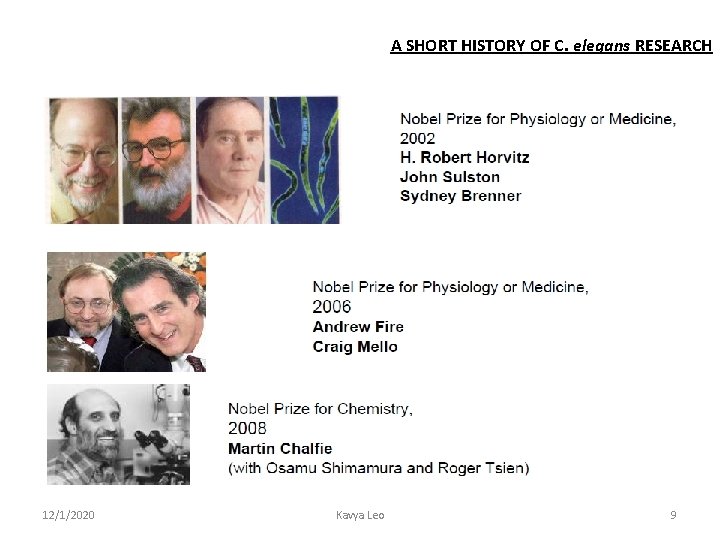
A SHORT HISTORY OF C. elegans RESEARCH • Developed by Sydney Brenner(1963). • Mutants published by Brenner(1974). • Post embryonic cell lineages determined (Sulston and Horwitz, 1976). • Programmed cell death( Horwitz, 1982). • Complete embryonic cell lineages determined( Deppe et al, Sulston 1983). • Complete connectivity of nervous system was established(1986). • RNAi and mi. RNA discovered in worms(1991 -98)(Nobel Prize: Fire, Mello 2006). • First use of GFP in animals(1994) (Nobel Prize: Chalfie, 2008). • First animal whose whole genome was sequenced(97 Mb, now 100. 3 Mb). 12/1/2020 Kavya Leo 8
A SHORT HISTORY OF C. elegans RESEARCH 12/1/2020 Kavya Leo 9
ADVANTAGES OF C. elegans AS A RESEARCH TOOL • • • • Simple Easy to grow Short life cycle Powerful genetic studies can be conducted(Both self fertile and cross fertile) Transparent Small Invariant cell lineage Fully described anatomy and development Completely sequenced genome Tools like RNAi knockdowns can be performed Stocks can be frozen and preserved No expensive animal house costs, CHEAP TO MAINTAIN! Present no biohazard Large size of progeny 12/1/2020 Kavya Leo 10
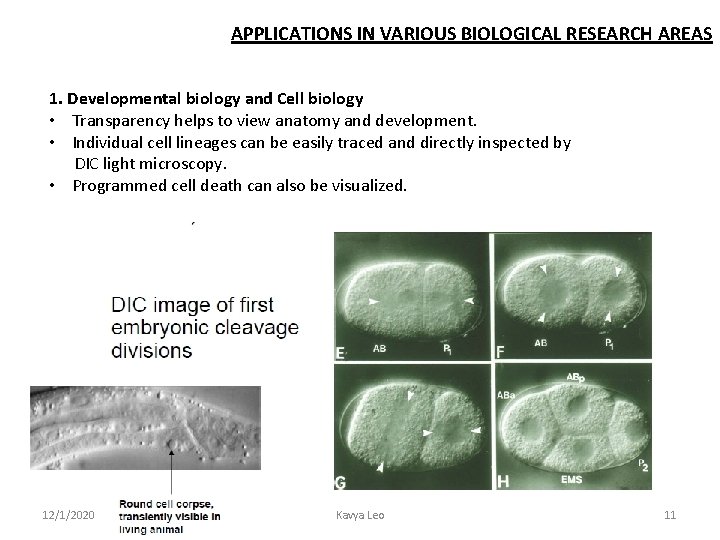
APPLICATIONS IN VARIOUS BIOLOGICAL RESEARCH AREAS 1. Developmental biology and Cell biology • Transparency helps to view anatomy and development. • Individual cell lineages can be easily traced and directly inspected by DIC light microscopy. • Programmed cell death can also be visualized. 12/1/2020 Kavya Leo 11
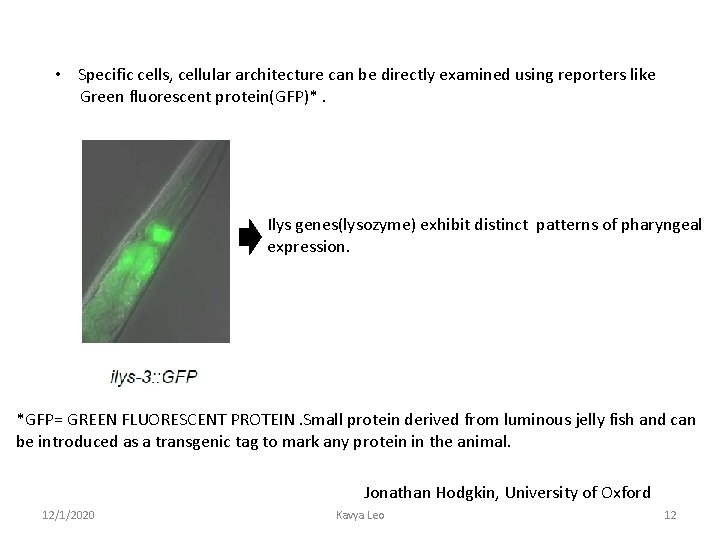
• Specific cells, cellular architecture can be directly examined using reporters like Green fluorescent protein(GFP)*. Ilys genes(lysozyme) exhibit distinct patterns of pharyngeal expression. *GFP= GREEN FLUORESCENT PROTEIN. Small protein derived from luminous jelly fish and can be introduced as a transgenic tag to mark any protein in the animal. Jonathan Hodgkin, University of Oxford 12/1/2020 Kavya Leo 12
2. Neurobiology • Act as a model for neuronal development and function. • No brain per say, but have sophisticated nervous system(302 neurons/959 cells). • C. elegans responds to chemo attractants/repellants. • Laser beams(selective cutting of neurons) and electrophysiology studies can be conducted. • Connectome (the complete wiring diagram) have been established. 3. Aging • Short life span helps to conduct genetic screens to find longevity genes. 4. Human disease studies • ~75% of human disease genes have potential C. elegans homologs. • ~40 -50% have a C. elegans ortholog. 12/1/2020 Kavya Leo 13
C. elegans RESEARCH IN IISER PUNE Biochemical and genetic characterization of chromatin organizer protein Dve-1 and its role in C. elegans development and aging. The present study seeks to elucidate the mechanism by which chromatin organization impacts organismal aging by studying C. elegans protein (Defective proventriculus) Dve-1. • Identify genetic and physical interactors of C. elegans Dve 1. • Generate C. elegans strains mutated in Dve 1 and characterize the function of Dve 1 during C. elegans development and aging. 12/1/2020 Kavya Leo 14
THANK YOU 12/1/2020 Kavya Leo 15