
C Classes Member Class Objects Constructor Initializer Lists
C++ Classes Member Class Objects, Constructor Initializer Lists, const, Reference and static Members October 21 © 2003, Bryan J. Higgs
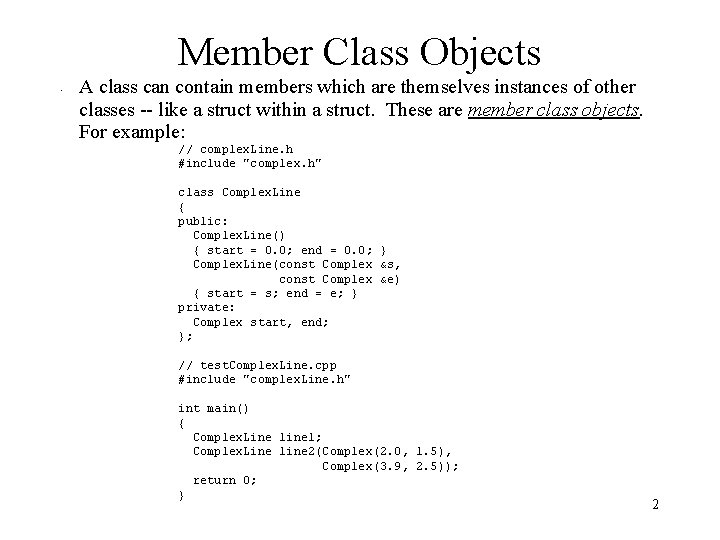
Member Class Objects • A class can contain members which are themselves instances of other classes -- like a struct within a struct. These are member class objects. For example: // complex. Line. h #include "complex. h" class Complex. Line { public: Complex. Line() { start = 0. 0; end = 0. 0; } Complex. Line(const Complex &s, const Complex &e) { start = s; end = e; } private: Complex start, end; }; // test. Complex. Line. cpp #include "complex. Line. h" int main() { Complex. Line line 1; Complex. Line line 2(Complex(2. 0, 1. 5), Complex(3. 9, 2. 5)); return 0; } 2
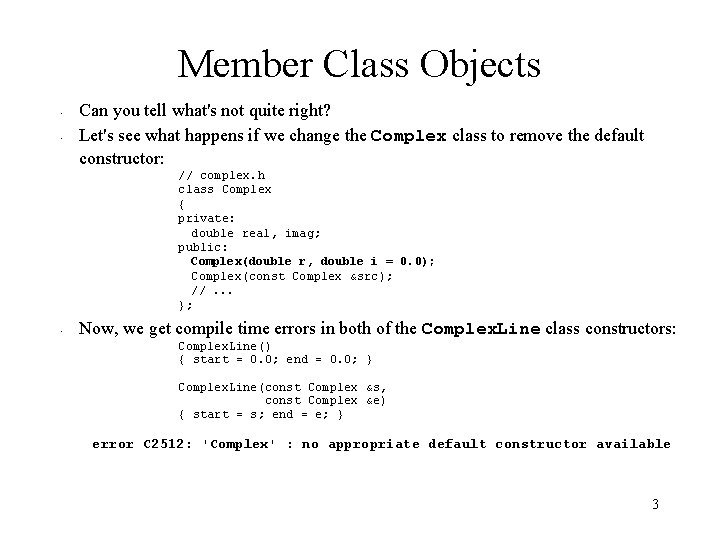
Member Class Objects • • Can you tell what's not quite right? Let's see what happens if we change the Complex class to remove the default constructor: // complex. h class Complex { private: double real, imag; public: Complex(double r, double i = 0. 0); Complex(const Complex &src); //. . . }; • Now, we get compile time errors in both of the Complex. Line class constructors: Complex. Line() { start = 0. 0; end = 0. 0; } Complex. Line(const Complex &s, const Complex &e) { start = s; end = e; } error C 2512: 'Complex' : no appropriate default constructor available 3
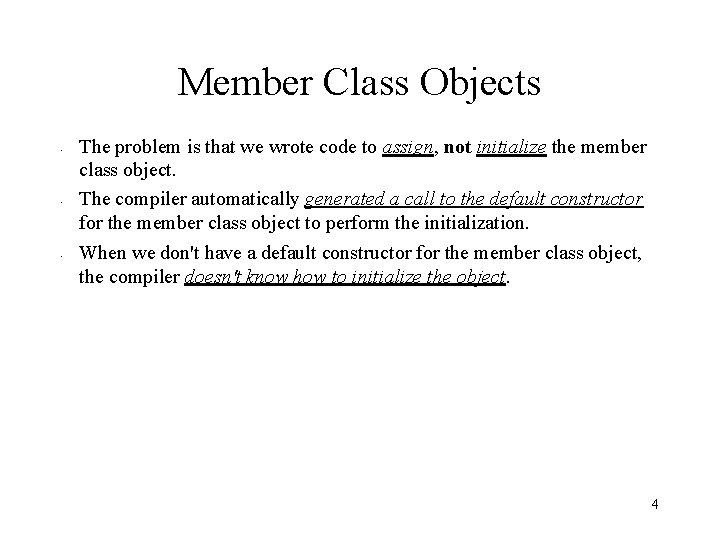
Member Class Objects • • • The problem is that we wrote code to assign, not initialize the member class object. The compiler automatically generated a call to the default constructor for the member class object to perform the initialization. When we don't have a default constructor for the member class object, the compiler doesn't know how to initialize the object. 4
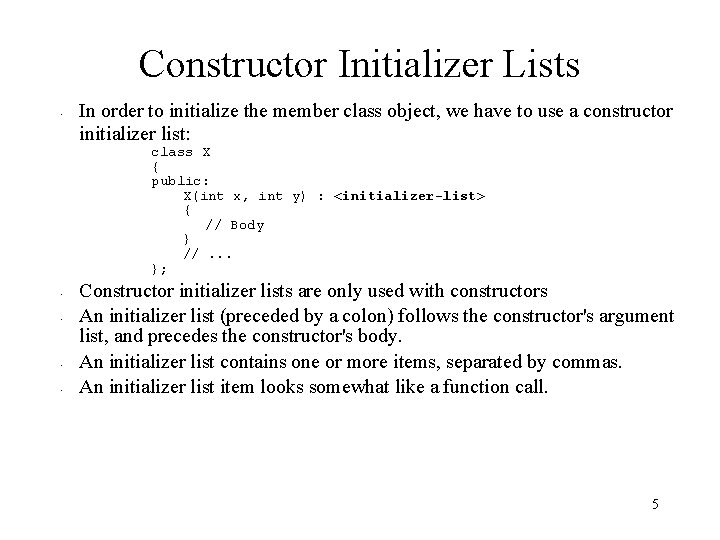
Constructor Initializer Lists • In order to initialize the member class object, we have to use a constructor initializer list: class X { public: X(int x, int y) : <initializer-list> { // Body } //. . . }; • • Constructor initializer lists are only used with constructors An initializer list (preceded by a colon) follows the constructor's argument list, and precedes the constructor's body. An initializer list contains one or more items, separated by commas. An initializer list item looks somewhat like a function call. 5
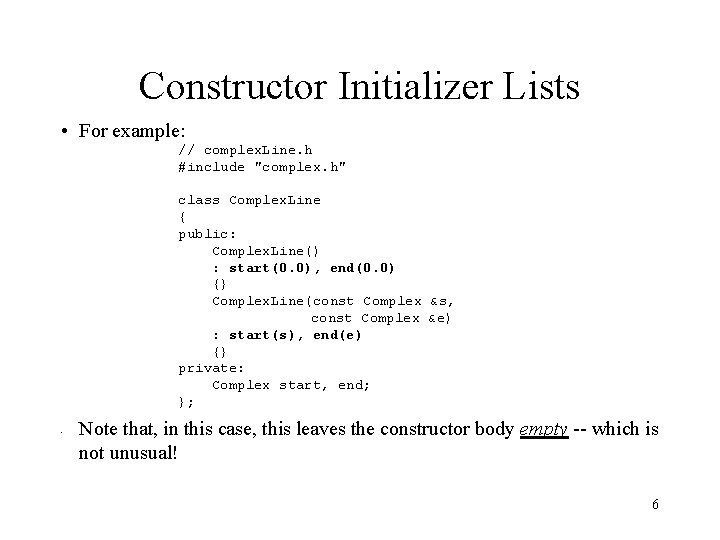
Constructor Initializer Lists • For example: // complex. Line. h #include "complex. h" class Complex. Line { public: Complex. Line() : start(0. 0), end(0. 0) {} Complex. Line(const Complex &s, const Complex &e) : start(s), end(e) {} private: Complex start, end; }; • Note that, in this case, this leaves the constructor body empty -- which is not unusual! 6

Constructor Initializer Lists • • While you can get away with using assignment in constructors, it is something to be discouraged! Why? – Because it's important to understand that you're initializing, not assigning and: – Because it's more efficient to use initialization. Remember that the compiler will try to initialize things for you, even if you don't do it. 7
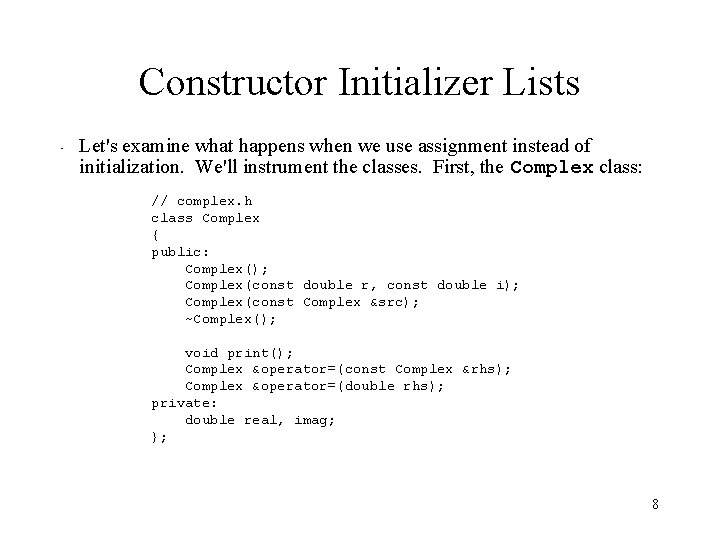
Constructor Initializer Lists • Let's examine what happens when we use assignment instead of initialization. We'll instrument the classes. First, the Complex class: // complex. h class Complex { public: Complex(); Complex(const double r, const double i); Complex(const Complex &src); ~Complex(); void print(); Complex &operator=(const Complex &rhs); Complex &operator=(double rhs); private: double real, imag; }; 8
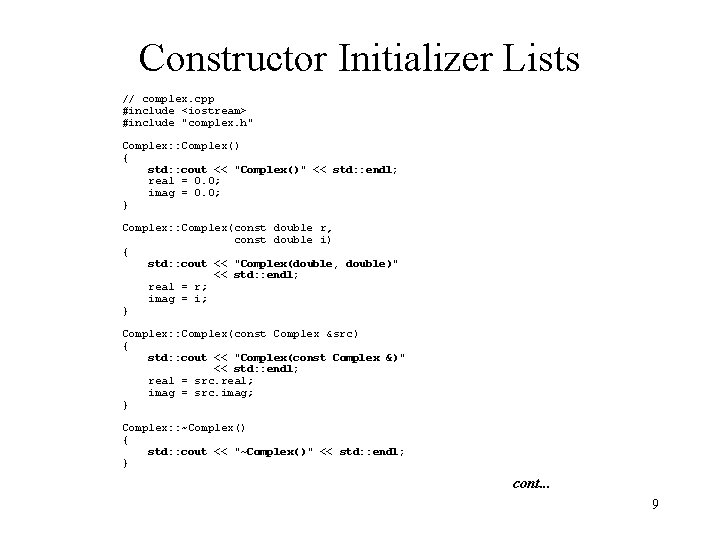
Constructor Initializer Lists // complex. cpp #include <iostream> #include "complex. h" Complex: : Complex() { std: : cout << "Complex()" << std: : endl; real = 0. 0; imag = 0. 0; } Complex: : Complex(const double r, const double i) { std: : cout << "Complex(double, double)" << std: : endl; real = r; imag = i; } Complex: : Complex(const Complex &src) { std: : cout << "Complex(const Complex &)" << std: : endl; real = src. real; imag = src. imag; } Complex: : ~Complex() { std: : cout << "~Complex()" << std: : endl; } cont. . . 9
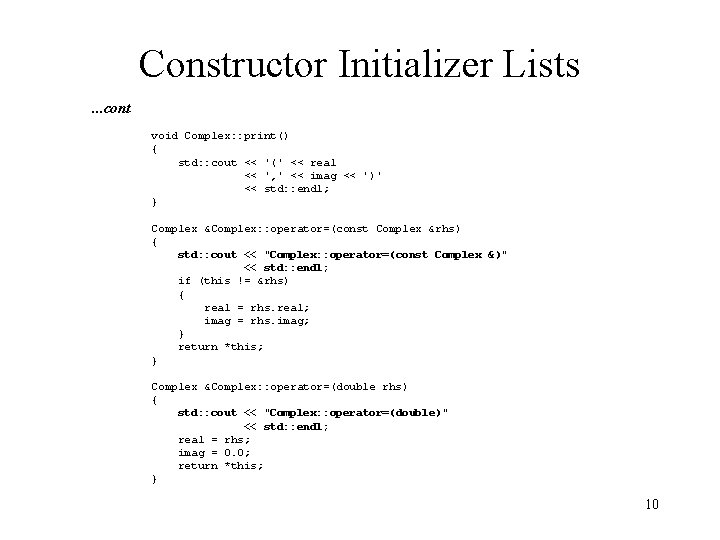
Constructor Initializer Lists. . . cont void Complex: : print() { std: : cout << '(' << real << ', ' << imag << ')' << std: : endl; } Complex &Complex: : operator=(const Complex &rhs) { std: : cout << "Complex: : operator=(const Complex &)" << std: : endl; if (this != &rhs) { real = rhs. real; imag = rhs. imag; } return *this; } Complex &Complex: : operator=(double rhs) { std: : cout << "Complex: : operator=(double)" << std: : endl; real = rhs; imag = 0. 0; return *this; } 10
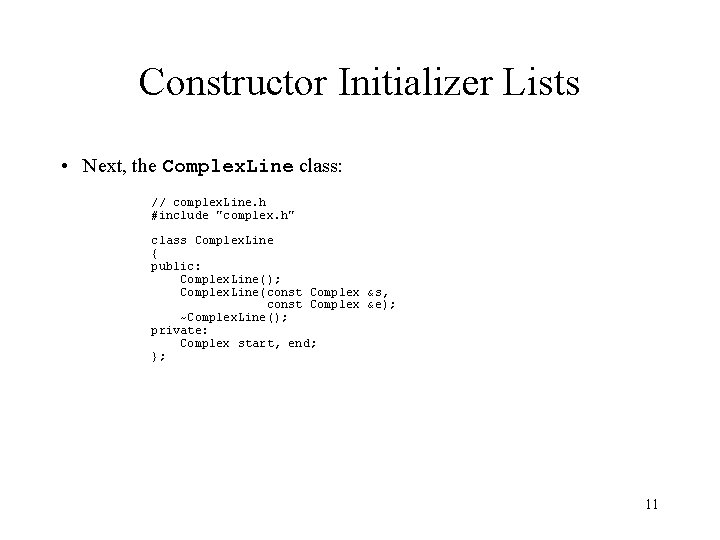
Constructor Initializer Lists • Next, the Complex. Line class: // complex. Line. h #include "complex. h" class Complex. Line { public: Complex. Line(); Complex. Line(const Complex &s, const Complex &e); ~Complex. Line(); private: Complex start, end; }; 11
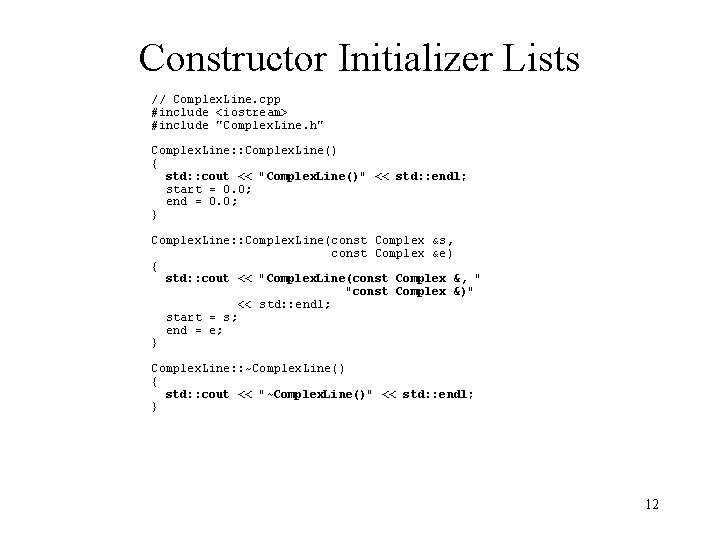
Constructor Initializer Lists // Complex. Line. cpp #include <iostream> #include "Complex. Line. h" Complex. Line: : Complex. Line() { std: : cout << "Complex. Line()" << std: : endl; start = 0. 0; end = 0. 0; } Complex. Line: : Complex. Line(const Complex &s, const Complex &e) { std: : cout << "Complex. Line(const Complex &, " "const Complex &)" << std: : endl; start = s; end = e; } Complex. Line: : ~Complex. Line() { std: : cout << "~Complex. Line()" << std: : endl; } 12
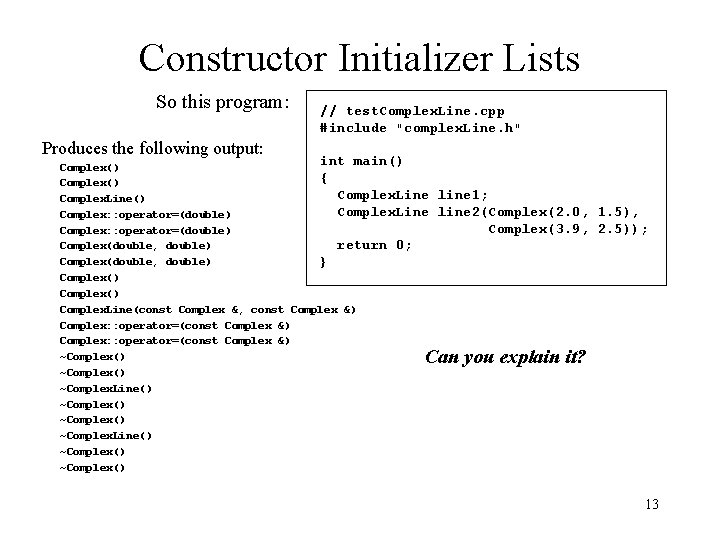
Constructor Initializer Lists So this program: // test. Complex. Line. cpp #include "complex. Line. h" Produces the following output: int main() Complex() { Complex() Complex. Line() Complex. Line Complex: : operator=(double) return 0; Complex(double, double) } Complex() Complex. Line(const Complex &, const Complex &) Complex: : operator=(const Complex &) ~Complex() ~Complex. Line() ~Complex() line 1; line 2(Complex(2. 0, 1. 5), Complex(3. 9, 2. 5)); Can you explain it? 13
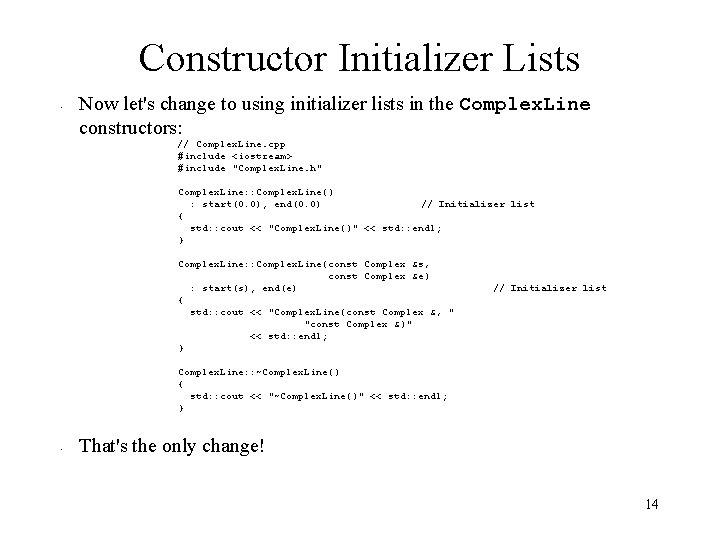
Constructor Initializer Lists • Now let's change to using initializer lists in the Complex. Line constructors: // Complex. Line. cpp #include <iostream> #include "Complex. Line. h" Complex. Line: : Complex. Line() : start(0. 0), end(0. 0) // Initializer list { std: : cout << "Complex. Line()" << std: : endl; } Complex. Line: : Complex. Line(const Complex &s, const Complex &e) : start(s), end(e) { std: : cout << "Complex. Line(const Complex &, " "const Complex &)" << std: : endl; } // Initializer list Complex. Line: : ~Complex. Line() { std: : cout << "~Complex. Line()" << std: : endl; } • That's the only change! 14
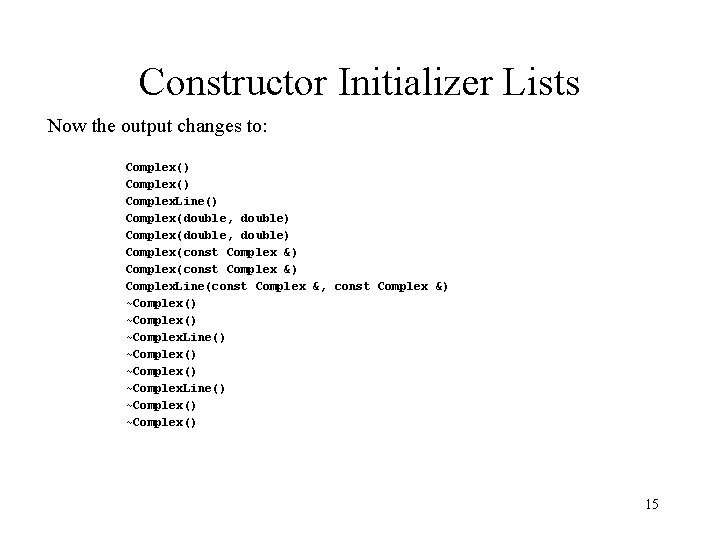
Constructor Initializer Lists Now the output changes to: Complex() Complex. Line() Complex(double, double) Complex(const Complex &) Complex. Line(const Complex &, const Complex &) ~Complex() ~Complex. Line() ~Complex() 15
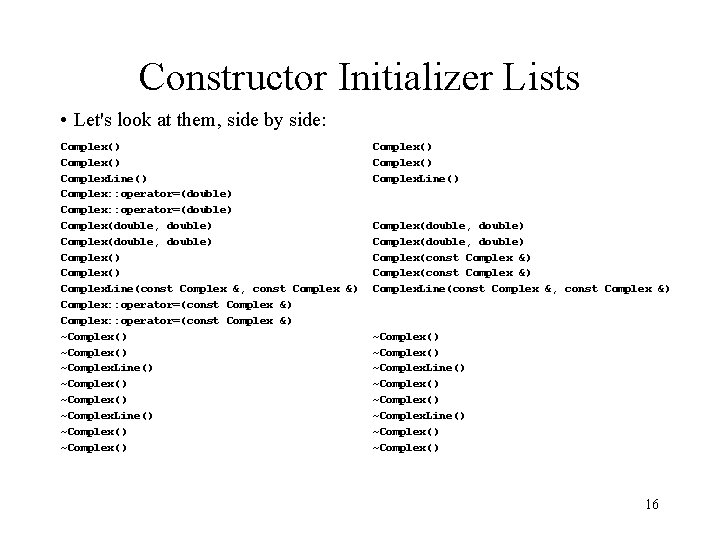
Constructor Initializer Lists • Let's look at them, side by side: Complex() Complex. Line() Complex: : operator=(double) Complex(double, double) Complex() Complex. Line(const Complex &, const Complex &) Complex: : operator=(const Complex &) ~Complex() ~Complex. Line() ~Complex() Complex. Line() Complex(double, double) Complex(const Complex &) Complex. Line(const Complex &, const Complex &) ~Complex() ~Complex. Line() ~Complex() 16
Constructor Initializer Lists • In other words, we've: – Eliminated four calls to operator= – Changed two calls to default constructors into calls to copy constructors . . . and this was a trivially simple class. In non-trivial classes, you can produce significant savings! 17
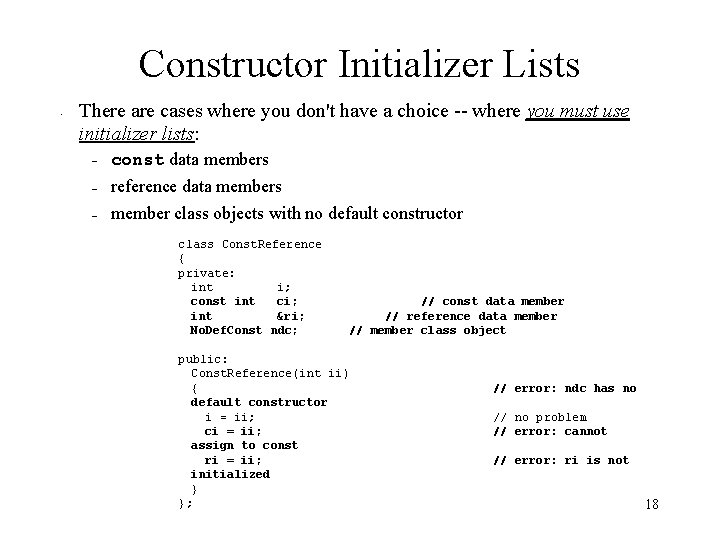
Constructor Initializer Lists • There are cases where you don't have a choice -- where you must use initializer lists: – – – const data members reference data members member class objects with no default constructor class Const. Reference { private: int i; const int ci; int &ri; No. Def. Const ndc; // const data member // reference data member // member class object public: Const. Reference(int ii) { default constructor i = ii; ci = ii; assign to const ri = ii; initialized } }; // error: ndc has no // no problem // error: cannot // error: ri is not 18
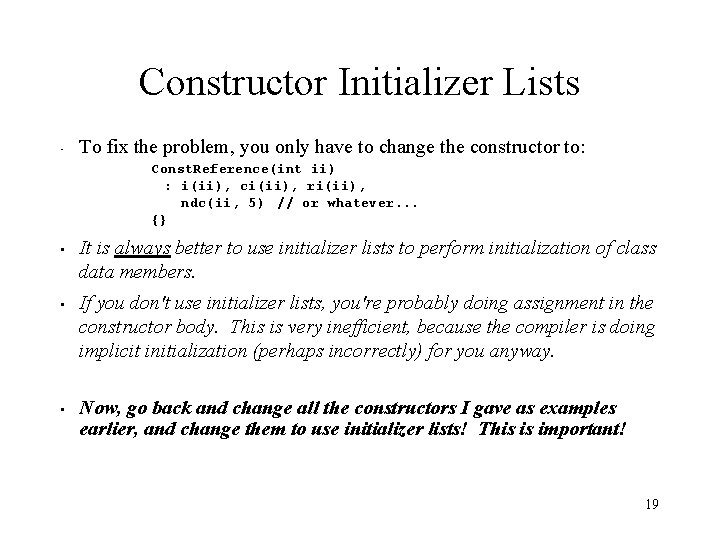
Constructor Initializer Lists • To fix the problem, you only have to change the constructor to: Const. Reference(int ii) : i(ii), ci(ii), ri(ii), ndc(ii, 5) // or whatever. . . {} • • • It is always better to use initializer lists to perform initialization of class data members. If you don't use initializer lists, you're probably doing assignment in the constructor body. This is very inefficient, because the compiler is doing implicit initialization (perhaps incorrectly) for you anyway. Now, go back and change all the constructors I gave as examples earlier, and change them to use initializer lists! This is important! 19
const Members • C++ has: – const data members – const member functions • It should be clear that a const data member of a class: – – – must be initialized (possibly via a default constructor) in the containing class constructors may not change during the lifetime of the class instance (that's the meaning of const) This can be useful; it is too seldom used! 20
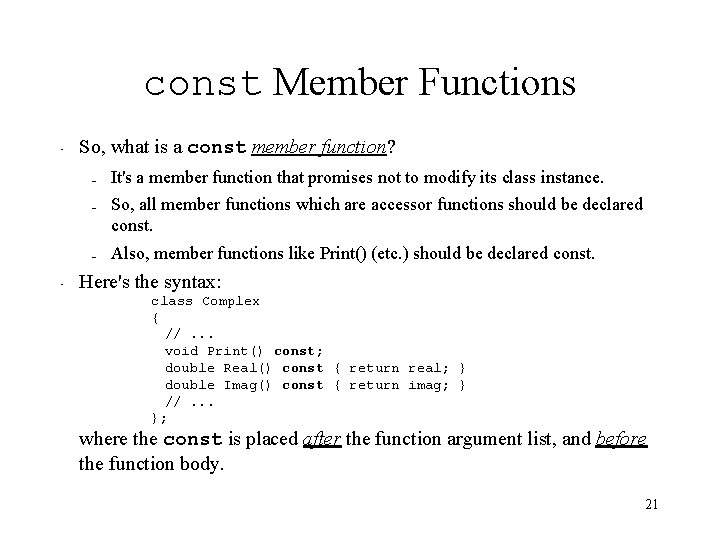
const Member Functions • So, what is a const member function? – – – • It's a member function that promises not to modify its class instance. So, all member functions which are accessor functions should be declared const. Also, member functions like Print() (etc. ) should be declared const. Here's the syntax: class Complex { //. . . void Print() const; double Real() const { return real; } double Imag() const { return imag; } //. . . }; where the const is placed after the function argument list, and before the function body. 21
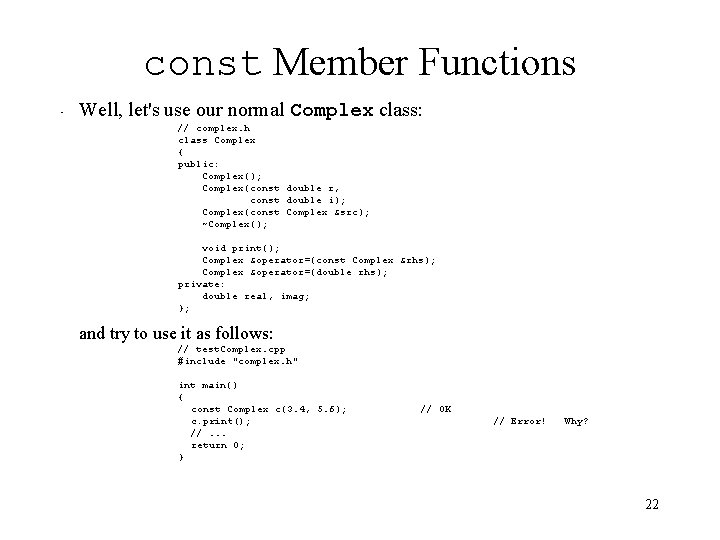
const Member Functions • Well, let's use our normal Complex class: // complex. h class Complex { public: Complex(); Complex(const double r, const double i); Complex(const Complex &src); ~Complex(); void print(); Complex &operator=(const Complex &rhs); Complex &operator=(double rhs); private: double real, imag; }; and try to use it as follows: // test. Complex. cpp #include "complex. h" int main() { const Complex c(3. 4, 5. 6); c. print(); //. . . return 0; } // OK // Error! Why? 22

const Member Functions • • • Since the C++ compiler takes us seriously when we say const, it doesn't know that the Print() member function won't change the instance. By adding const, we are telling the compiler that the member function will not change anything in the instance. Note that the compiler will check the member function implementation to ensure that it does not change anything! 23
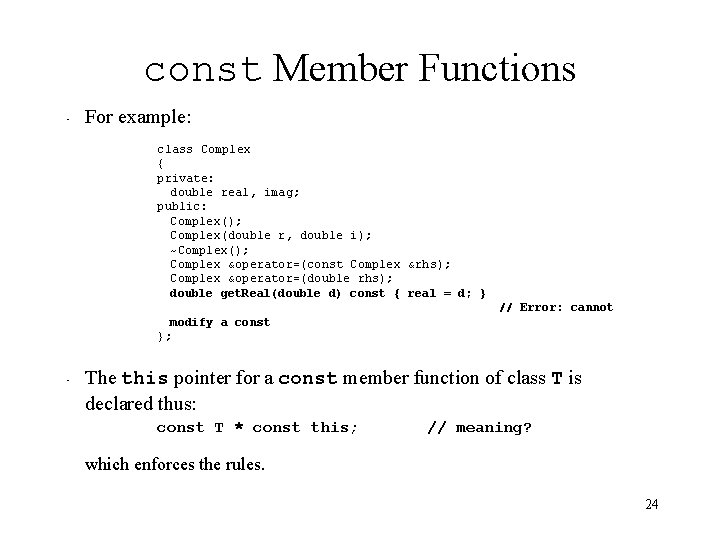
const Member Functions • For example: class Complex { private: double real, imag; public: Complex(); Complex(double r, double i); ~Complex(); Complex &operator=(const Complex &rhs); Complex &operator=(double rhs); double get. Real(double d) const { real = d; } // Error: cannot modify a const }; • The this pointer for a const member function of class T is declared thus: const T * const this; // meaning? which enforces the rules. 24
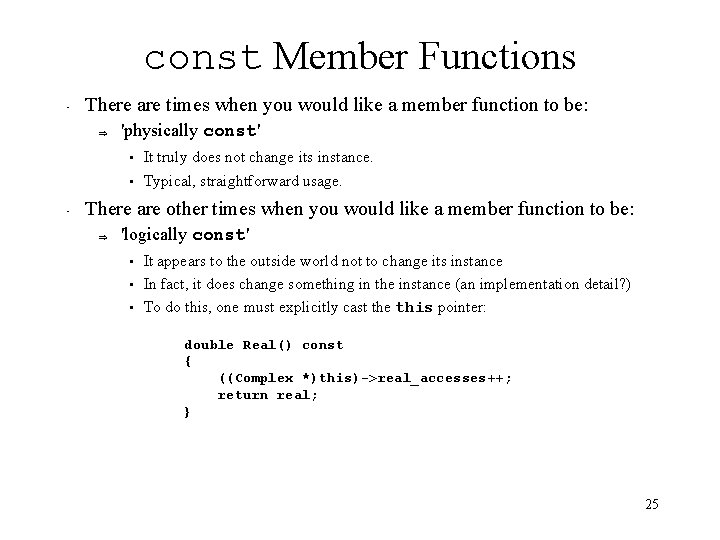
const Member Functions • There are times when you would like a member function to be: Þ 'physically const' • • • It truly does not change its instance. Typical, straightforward usage. There are other times when you would like a member function to be: Þ 'logically const' • • • It appears to the outside world not to change its instance In fact, it does change something in the instance (an implementation detail? ) To do this, one must explicitly cast the this pointer: double Real() const { ((Complex *)this)->real_accesses++; return real; } 25
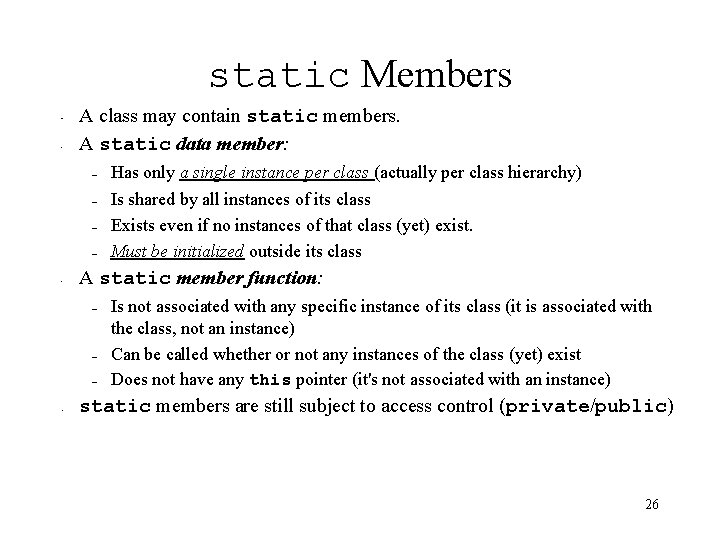
static Members • • A class may contain static members. A static data member: – – • A static member function: – – – • Has only a single instance per class (actually per class hierarchy) Is shared by all instances of its class Exists even if no instances of that class (yet) exist. Must be initialized outside its class Is not associated with any specific instance of its class (it is associated with the class, not an instance) Can be called whether or not any instances of the class (yet) exist Does not have any this pointer (it's not associated with an instance) static members are still subject to access control (private/public) 26
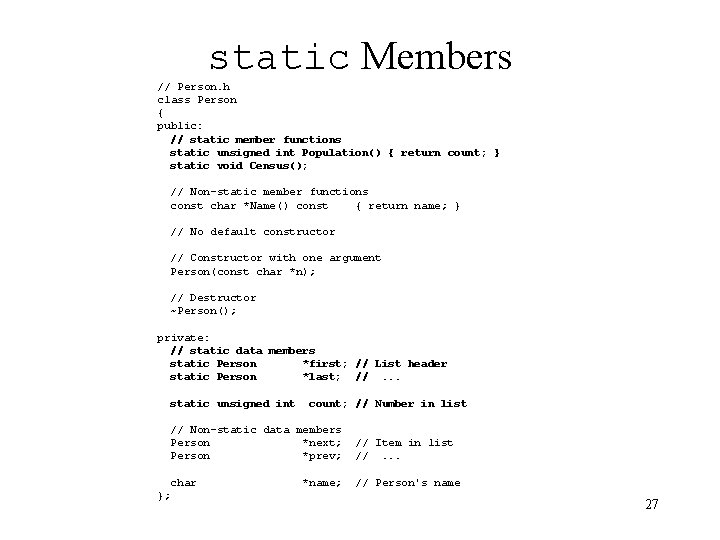
static Members // Person. h class Person { public: // static member functions static unsigned int Population() { return count; } static void Census(); // Non-static member functions const char *Name() const { return name; } // No default constructor // Constructor with one argument Person(const char *n); // Destructor ~Person(); private: // static data members static Person *first; // List header static Person *last; //. . . static unsigned int count; // Number in list // Non-static data members Person *next; Person *prev; char }; *name; // Item in list //. . . // Person's name 27
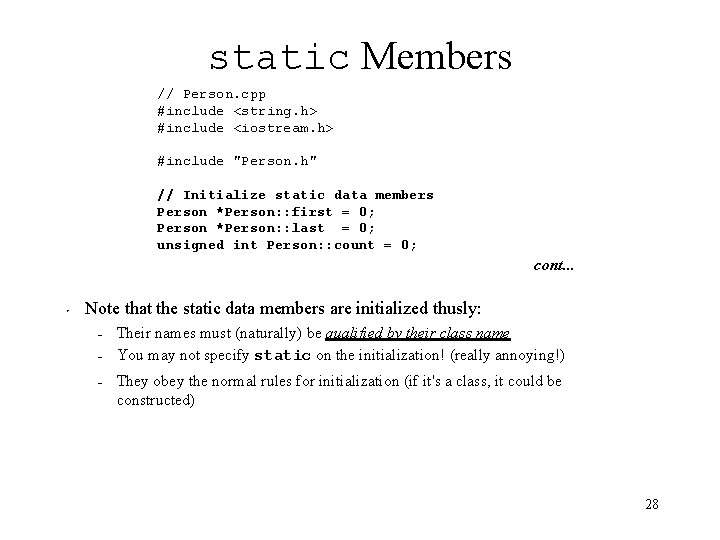
static Members // Person. cpp #include <string. h> #include <iostream. h> #include "Person. h" // Initialize static data members Person *Person: : first = 0; Person *Person: : last = 0; unsigned int Person: : count = 0; cont. . . • Note that the static data members are initialized thusly: – – – Their names must (naturally) be qualified by their class name You may not specify static on the initialization! (really annoying!) They obey the normal rules for initialization (if it's a class, it could be constructed) 28
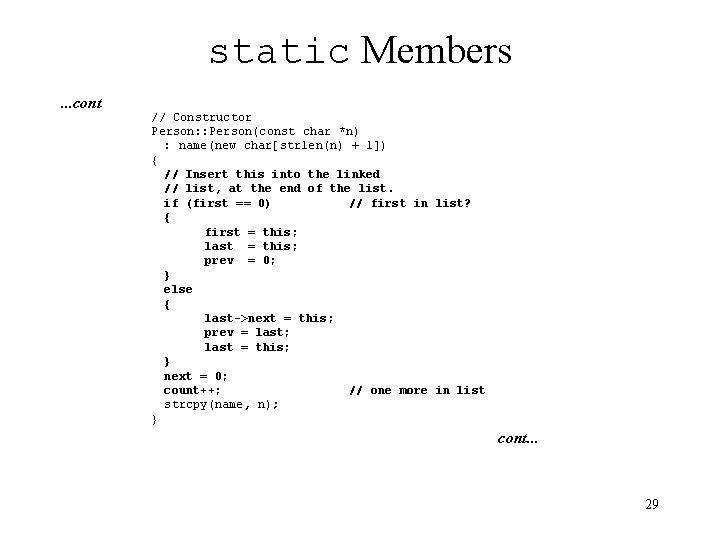
static Members. . . cont // Constructor Person: : Person(const char *n) : name(new char[strlen(n) + 1]) { // Insert this into the linked // list, at the end of the list. if (first == 0) // first in list? { first = this; last = this; prev = 0; } else { last->next = this; prev = last; last = this; } next = 0; count++; // one more in list strcpy(name, n); } cont. . . 29
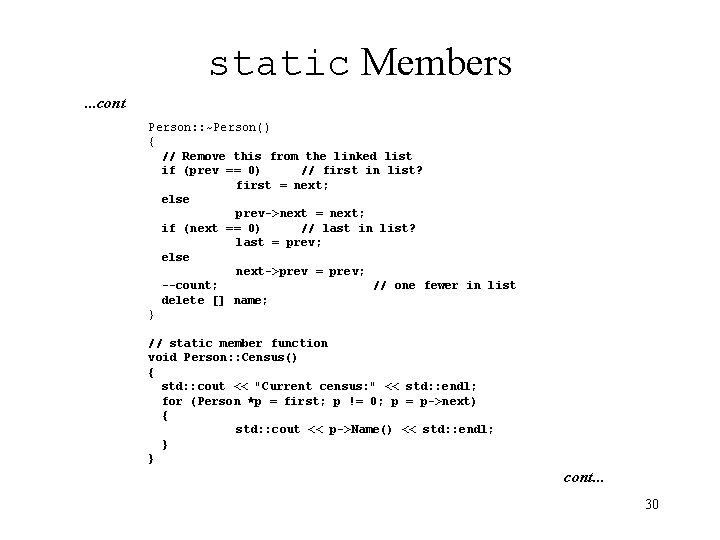
static Members. . . cont Person: : ~Person() { // Remove this from the linked list if (prev == 0) // first in list? first = next; else prev->next = next; if (next == 0) // last in list? last = prev; else next->prev = prev; --count; // one fewer in list delete [] name; } // static member function void Person: : Census() { std: : cout << "Current census: " << std: : endl; for (Person *p = first; p != 0; p = p->next) { std: : cout << p->Name() << std: : endl; } } cont. . . 30
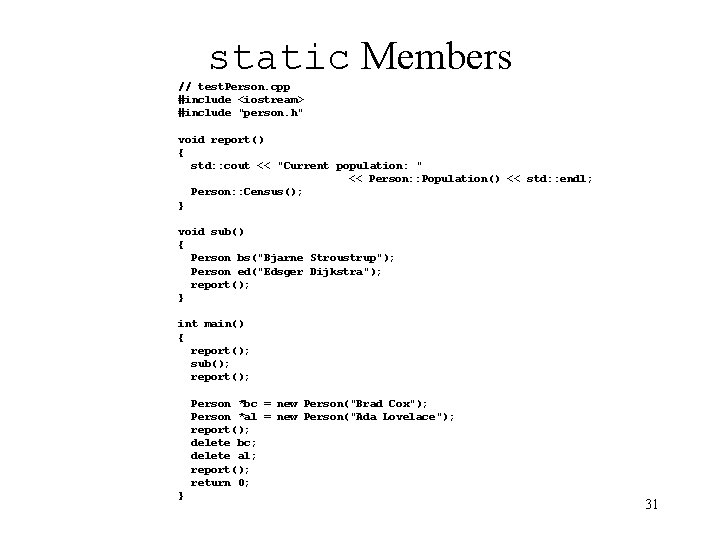
static Members // test. Person. cpp #include <iostream> #include "person. h" void report() { std: : cout << "Current population: " << Person: : Population() << std: : endl; Person: : Census(); } void sub() { Person bs("Bjarne Stroustrup"); Person ed("Edsger Dijkstra"); report(); } int main() { report(); sub(); report(); Person *bc = new Person("Brad Cox"); Person *al = new Person("Ada Lovelace"); report(); delete bc; delete al; report(); return 0; } 31
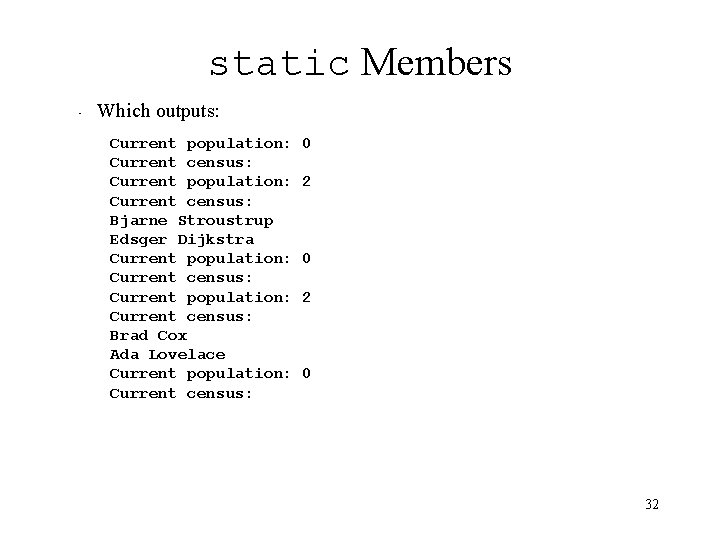
static Members • Which outputs: Current population: Current census: Bjarne Stroustrup Edsger Dijkstra Current population: Current census: Brad Cox Ada Lovelace Current population: Current census: 0 2 0 32

static Members • When used properly: – static data members can replace global data – static member functions can replace global functions • All while retaining encapsulation and data abstraction. Think seriously about how you might be able to use static class members! 33
Summary • Well, we've learned still more about classes: – Member Class Objects – Constructor Initializer Lists – const, Reference, and static Members all of which are important topics. • As you can see, classes are the central feature of C++! • While there are many features relating to classes still to learn, we'll now move on to something a little different. . . J Did I hear a cheer back there? 34
- Slides: 34