
C Chartership competencies Part 4 Breakfast Webinar Series
C Chartership competencies Part 4 | Breakfast Webinar Series Katie Woollard

Introduction
Format Introduce competency Set out Key Questions Give some example responses Set some activities for today Set some activities for this week Cross referencing for other accreditations
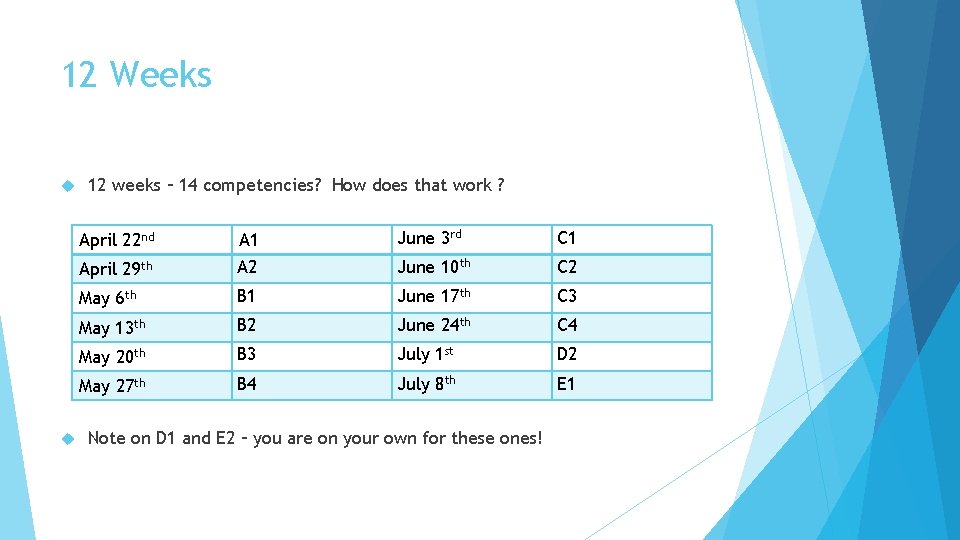
12 Weeks 12 weeks – 14 competencies? How does that work ? June 3 rd C 1 April 29 th A 1 A 2 June 10 th C 2 May 6 th B 1 June 17 th C 3 May 13 th B 2 June 24 th C 4 May 20 th B 3 July 1 st D 2 May 27 th B 4 July 8 th E 1 April 22 nd Note on D 1 and E 2 – you are on your own for these ones!
B 2 Ability to solve problems by identifying, developing and evaluating options.
B 2 – Exam Question Ability to solve problems by identifying, developing and evaluating options You should demonstrate the use of advanced scientific / engineering / management / environmental principles as appropriate when formulating potential solutions to a problem. You will need to demonstrate that you have considered the implications of each method of working or solution; identifying the solution that best fits with the issues and requirements identified (e. g. regulatory / legislative / social / economic / environmental / customer). You will use evidence to support the recommended solution and be able to show the decision was made.
B 2 – Key Questions Ability to solve problems by identifying, developing and evaluating options What was the problem and what was your role at the time? What solutions did you identify and consider? What were your priorities? What was the purpose and result of this prioritisation? What evaluation did you undertake? What were the evaluation criteria? Which solution did you recommend and why? How did you use creative and original thought in identifying potential solutions? How did you compare widely differing options to find the best solution? How do you illustrate your method of presenting your analysis and options to a client?
B 2 – Examples Problem – Evaluation of Options - Solution A key element of Catchment Flood Management Plans (CFMPs) is identifying alternative policies and methods of catchment and flood management. As assistant project manager of the [LOCATION] CFMP I considered various management options, taking into account specific features of the area and the opinions of the local Environment Agency staff, to develop a policy for each area of the catchment. I evaluated each policy according to technical, social, environmental and economic criteria.
B 2 – Examples Problem – Evaluation of Options - Solution I was commissioned by [A CLIENT] to determine the frequency of overtopping of defence embankments on the [RIVER], between [LOCATION]. Rather than being a straight forward hydraulic modelling project, we were faced with the problem of how to take into account the combined effect of the fluvial flows and tidal levels within the study area. This meant that each of the specific defence embankments selected for study could be overtopped by flooding caused by a range of fluvial / tidal event combinations. The brief also required us to provide a dynamic set of results which would allow the client to input any particular level at each of the locations, and be presented with a return period for that level, based on the results of my modelling. I undertook a large sample of fluvial / tidal event combinations and ran a series of 62 different model events. Results were entered into a combined probability analysis spreadsheet. Spreadsheets and graphs were also used to compare options in relation to how design water levels are affected from different modelling scenarios. Results were used in assisting with defence management and cost benefit analysis for new defence schemes
B 2 – Examples Problem – Evaluation of Options - Solution Chilbolton Water Supply Works (WSW) located near Winchester was identified as being at risk of high nitrate concentrations by the DWI. Catchment management options had already been implemented by the Environment Agency. With rising concentrations and forecast water quality failures, the WSW was removed from service and an alternative supply was identified. This led to deterioration in the water pressure. An additional concern was over the condition and remaining service life of Chilbolton Tower reservoir, previously supplied by the WSW. Initial options identified included 6 km of mains reinforcements and removal of the tower which was higher than the scheme budget. I determined that the water tower would need to be retained to maintain pressures and provide resilience in case of loss of supply upstream. The cost to renovate the tower was low when compared to the initial 6 km of mains reinforcements. To improve pressures, I identified 0. 8 km of mains reinforcement. Modelling showed there to be a small daily deficit in the tower level, however, it was determined that the risk was only relevant during peak year demands and could be mitigated by tankering. The option of installing a booster and alternative sources of supply were disregarded based on costly asset requirements/future maintenance and therefore a high carbon and environmental impact. Through this evaluation I therefore identified a long-term solution - retaining the tower and 0. 8 km of mains reinforcement in combination with tankering during peak year demands which addressed the nitrate issues whilst restoring levels of service for pressure to an acceptable level and minimising cost and environmental impact.
B 2 – Examples Problem – Evaluation of Options - Solution As part of the Northern line extension tunnelling work, contingency plans were required should the nearby major trunk mains be affected in any way and be required to be shut in. I developed contingency plans for the shut and how supply could be maintained to customers. This was done by developing and simulating infusions, cross connections, alternative sources or calculating the length and size of rider mains whilst maintaining pressures and water quality for the surrounding customers. This gave confidence that if mains were affected by the tunnelling that a robust contingency was in place.
B 2 – Examples Problem – Evaluation of Options - Solution The need to amend and extend a historic agreement between [WATRER COMPANY] and [NAME] Power Station, which involves the water company buying a portion of the power station’s underutilised abstraction licence, due to changing cooling requirements Supporting senior managers with negotiations enabled me to gain insight on the feasibility of different options from an operational perspective and running various scenarios through water resources modelling software of power station water consumption over a range of timescales enabled me to assess the benefits which fed into subsequent cost benefit analysis. I presented my results and recommended that with monitoring data limited, operating a flat consumptive use profile would be more feasible than a varying profile through the year / across years based on state of drought and that this would also be the lowest cost option as no change in the operation of the power station was required. As a result of my recommendations the revised agreement was signed in 2018, included ‘in the WRMP 19 decision making (options appraisal) modelling and selected as part of the preferred programme of solutions helping to solve the supply demand deficit.
Activity – Today Discuss on the forum or with your peers at work: Types of research/investigation that you have carried out to address problems Methods of identifying, developing and evaluating options you have used What successful outcomes have you had / solutions you have identified Lessons have you learnt from being unsuccessful in finding solutions to problems
Activity – this week Make a list of 5 problems / projects you have worked on in your career. Consider how your ability to solve these problems through the identifying, developing, and evaluating options has changed in this time. Spend 15 mins answering the key questions for this week
Tips • Always write in the first person – CIWEM are only interested in what you have done, not what your team has done. • Be honest about what you have contributed to a project • Understand why you are doing a particular tasks – what is the bigger picture? • Be concise • Remember what you have written • Don’t limit your self to experience at current employer or paid employment
Cross referencing – other accreditations Related professional registrations While looking at B 2 you may want to consider incorporating the following related professional regulations for Chartered Env/Eng/Sci. (CSci, A 2) Use theoretical and practical methods in the analysis and solution of problems. (CSci, B 1) Plan and organise projects effectively. (CSci, B 2) Work effectively in a team. (CEnv, A 3) Analyse and evaluate problems from an environmental perspective, develop practical sustainable solutions and anticipate environmental trends to develop practical solutions. (CEnv, B 1) Influence others to promote behavioural and cultural change to secure environmental improvement beyond legislative compliance. (CEnv, B 2) Promote a strategic environmental approach. Analyse and evaluate problems from an environmental perspective, develop practical sustainable solutions and anticipate environmental trends to develop practical solutions.
e t a d e h t e ll a v c Sa Next 20 – B 3 May Abil itiat n i o ity t th ge n a h ec anag m nd ta en m e pl m i , e C Chartership competencies Part 4 | Breakfast Webinar Series Katie Woollard
- Slides: 17