
C B A A typical line graph for
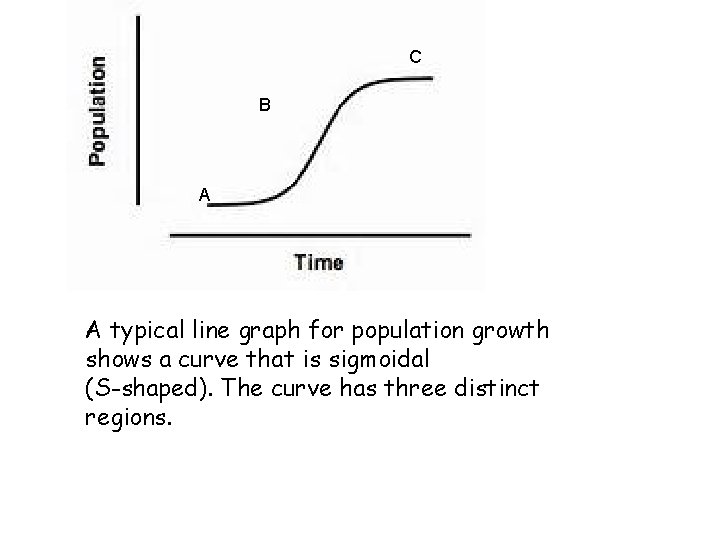
C B A A typical line graph for population growth shows a curve that is sigmoidal (S-shaped). The curve has three distinct regions.
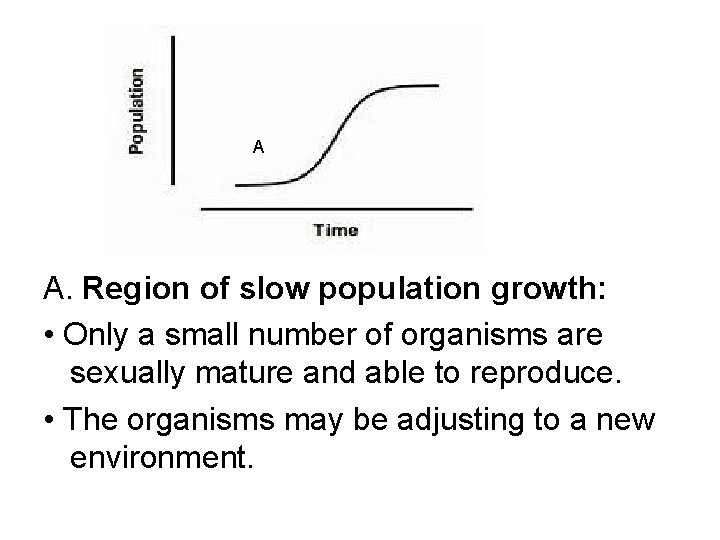
A A. Region of slow population growth: • Only a small number of organisms are sexually mature and able to reproduce. • The organisms may be adjusting to a new environment.
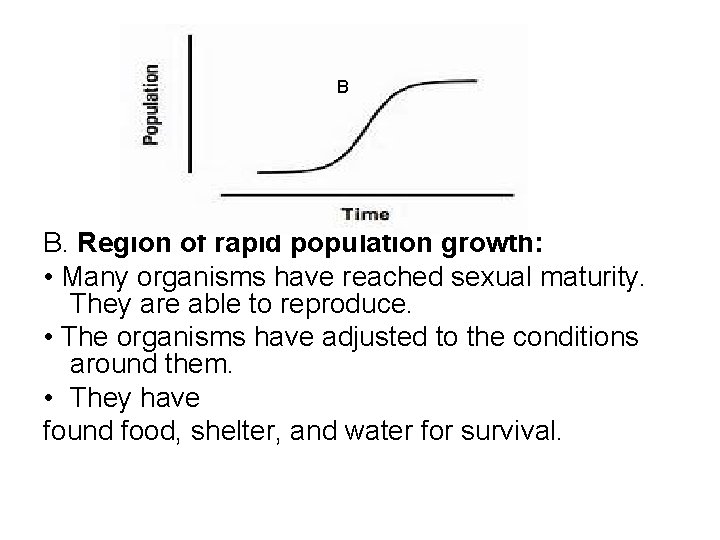
B B. Region of rapid population growth: • Many organisms have reached sexual maturity. They are able to reproduce. • The organisms have adjusted to the conditions around them. • They have found food, shelter, and water for survival.

C C. Region of steady population growth: • The carrying capacity is reached. Population growth becomes constant. • The number of deaths equals the number of births.
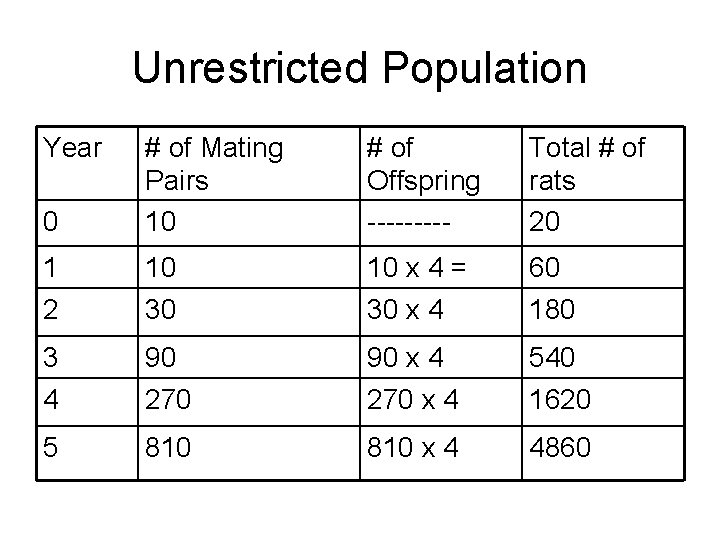
Unrestricted Population Year 0 # of Mating Pairs 10 # of Offspring ----- Total # of rats 20 1 10 10 x 4 = 60 2 30 30 x 4 180 3 4 90 270 90 x 4 270 x 4 540 1620 5 810 x 4 4860
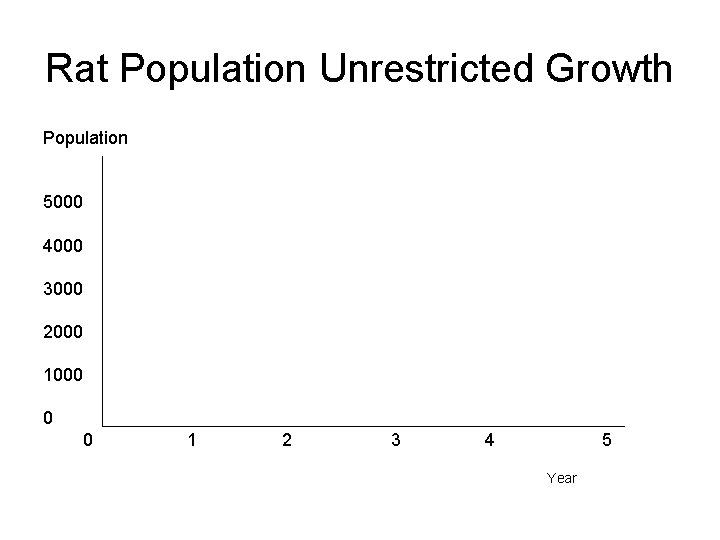
Rat Population Unrestricted Growth Population 5000 4000 3000 2000 1000 0 0 1 2 3 4 5 Year
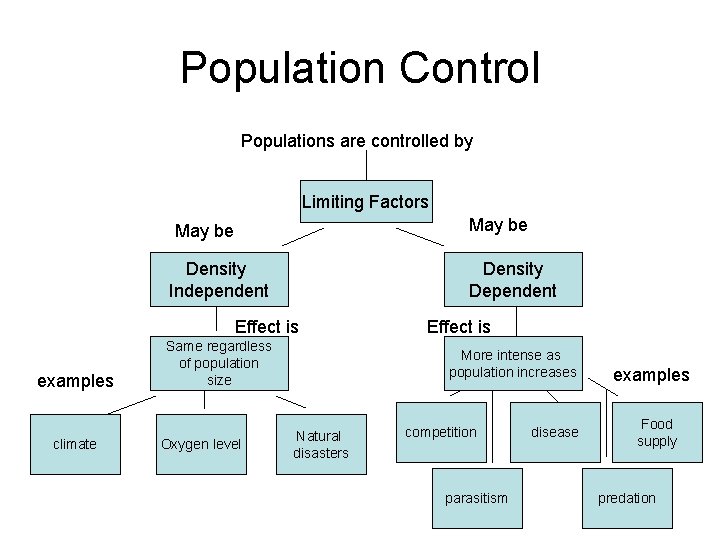
Population Control Populations are controlled by Limiting Factors May be Density Independent Density Dependent Effect is examples climate Same regardless of population size Oxygen level Effect is More intense as population increases Natural disasters competition parasitism disease examples Food supply predation
Population Terms 1. When two organisms from the same species are after the same resources and food they are in intraspecific competition 2. When a population has reached an amount where growth can no longer occur, it has reached its carrying capacity 3. The number of organisms that live in a given area can be referred to as population density 4. The relationship between two different organisms (either from the same species or from different species) after a common goal can be called competition
5) When two organisms from different species are after the same resources and food they are in interspecific competition 6) Factors that increase in significance as a population grows are called density-dependent. 7) Factors such as forest fires, than can limit a population regardless of its size are referred to as density independent. 8) Give a concrete example to show that you understand each term below. a) Interspecific competition wolf and coyote b) Intraspecific competition wolf and wolf
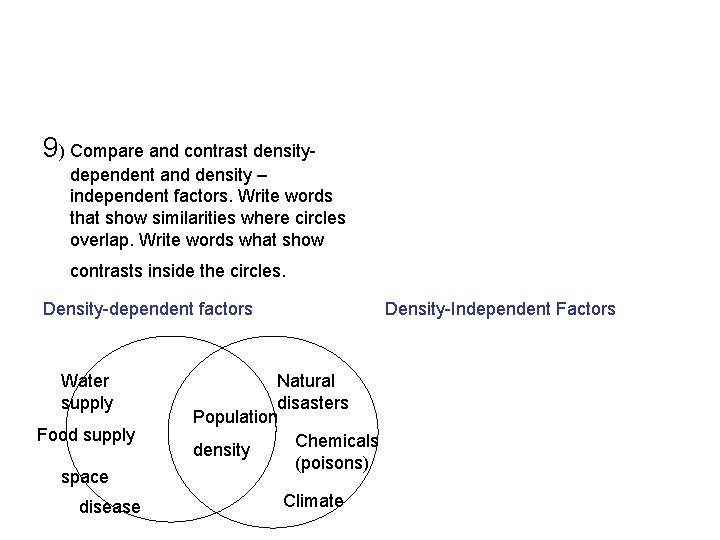
9) Compare and contrast densitydependent and density – independent factors. Write words that show similarities where circles overlap. Write words what show contrasts inside the circles. Density-dependent factors Water supply Food supply space disease Density-Independent Factors Natural disasters Population Chemicals density (poisons) Climate
- Slides: 10