
C 81 BIO Introduction to Cognitive Neuroscience and
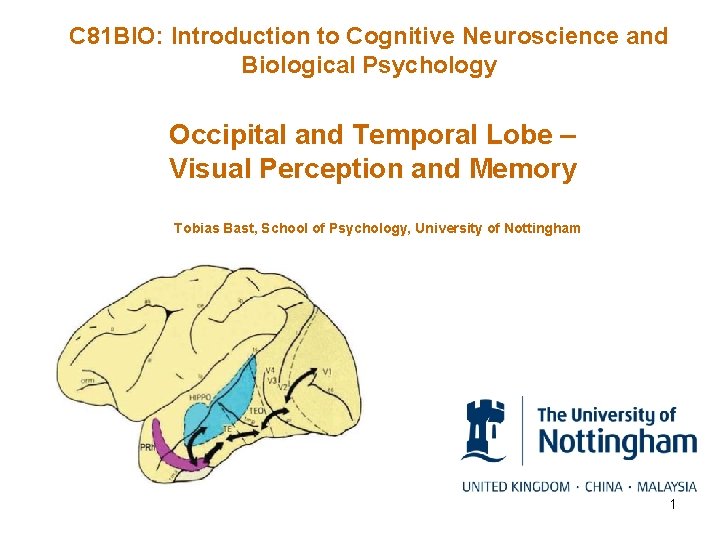
C 81 BIO: Introduction to Cognitive Neuroscience and Biological Psychology Occipital and Temporal Lobe – Visual Perception and Memory Tobias Bast, School of Psychology, University of Nottingham 1
The primary visual pathway includes: a) Retina, lateral geniculate body, primary visual cortex. b) Retina, lateral geniculate body, primary visual cortex, hippocampus. c) Retina, superior colliculus, primary visual cortex. 2
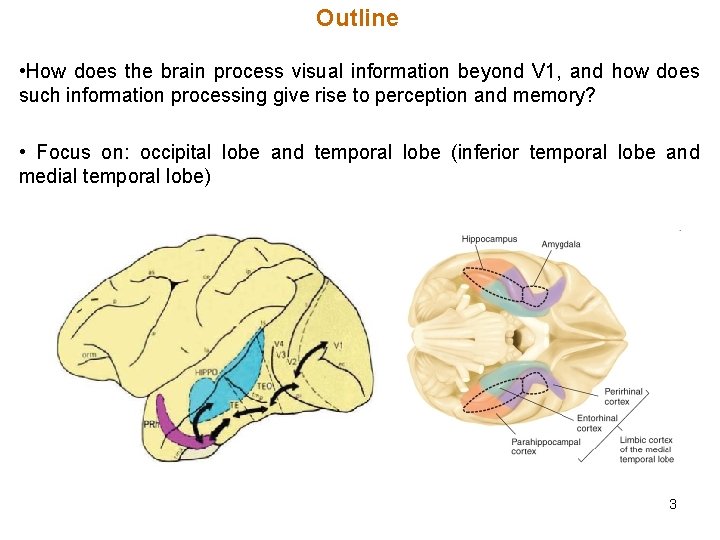
Outline • How does the brain process visual information beyond V 1, and how does such information processing give rise to perception and memory? • Focus on: occipital lobe and temporal lobe (inferior temporal lobe and medial temporal lobe) 3
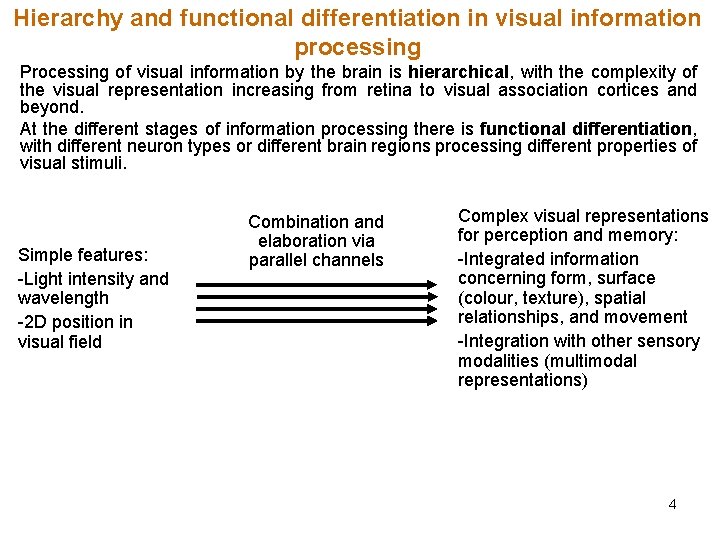
Hierarchy and functional differentiation in visual information processing Processing of visual information by the brain is hierarchical, with the complexity of the visual representation increasing from retina to visual association cortices and beyond. At the different stages of information processing there is functional differentiation, with different neuron types or different brain regions processing different properties of visual stimuli. Simple features: -Light intensity and wavelength -2 D position in visual field Combination and elaboration via parallel channels Complex visual representations for perception and memory: -Integrated information concerning form, surface (colour, texture), spatial relationships, and movement -Integration with other sensory modalities (multimodal representations) 4
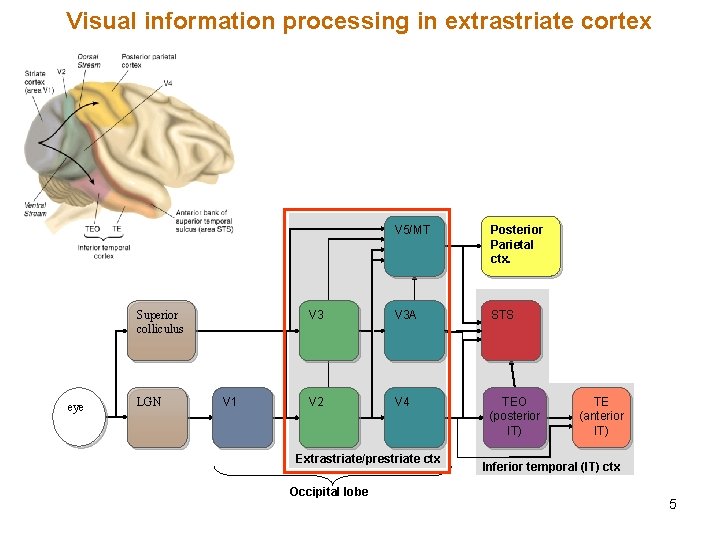
Visual information processing in extrastriate cortex Superior colliculus eye LGN V 1 V 5/MT Posterior Parietal ctx. V 3 A STS V 2 V 4 TEO (posterior IT) Extrastriate/prestriate ctx Occipital lobe TE (anterior IT) Inferior temporal (IT) ctx 5
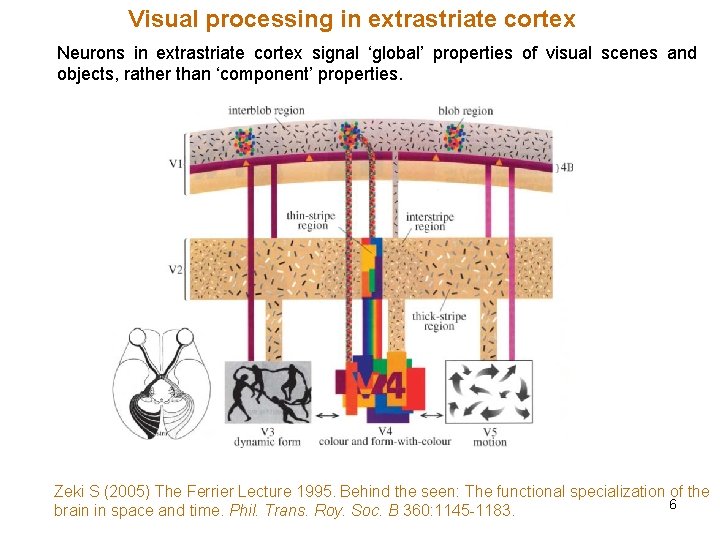
Visual processing in extrastriate cortex Neurons in extrastriate cortex signal ‘global’ properties of visual scenes and objects, rather than ‘component’ properties. Zeki S (2005) The Ferrier Lecture 1995. Behind the seen: The functional specialization of the 6 brain in space and time. Phil. Trans. Roy. Soc. B 360: 1145 -1183.
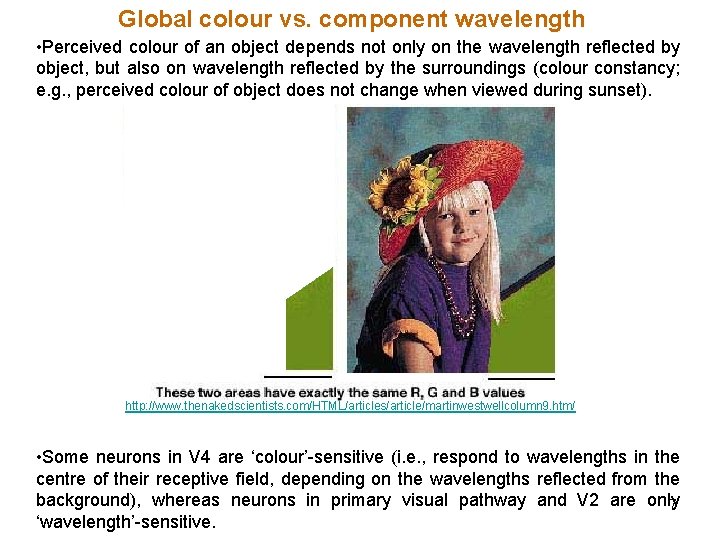
Global colour vs. component wavelength • Perceived colour of an object depends not only on the wavelength reflected by object, but also on wavelength reflected by the surroundings (colour constancy; e. g. , perceived colour of object does not change when viewed during sunset). http: //www. thenakedscientists. com/HTML/articles/article/martinwestwellcolumn 9. htm/ • Some neurons in V 4 are ‘colour’-sensitive (i. e. , respond to wavelengths in the centre of their receptive field, depending on the wavelengths reflected from the background), whereas neurons in primary visual pathway and V 2 are only 7 ‘wavelength’-sensitive.
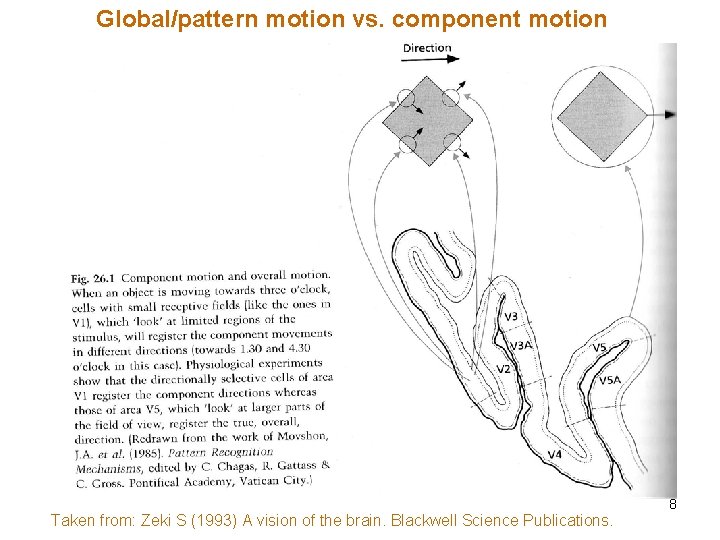
Global/pattern motion vs. component motion Taken from: Zeki S (1993) A vision of the brain. Blackwell Science Publications. 8

Two visual information processing streams Following V 1 (and perhaps earlier) visual information processing seems to be mediated by two streams, that are anatomically and functionally differentiated. Dorsal stream V 5/MT Posterior Parietal ctx. V 3 A STS Ventral stream V 3 Superior colliculus eye LGN Dorsal stream: Visuo-spatial (‘where’)/ visuo-motor (‘how’) processing Ventral stream: Object analysis (‘what’) V 1 V 2 V 4 Extrastriate/prestriate ctx Occipital lobe TEO (posterior IT) TE (anterior IT) Inferior temporal (IT) ctx 9
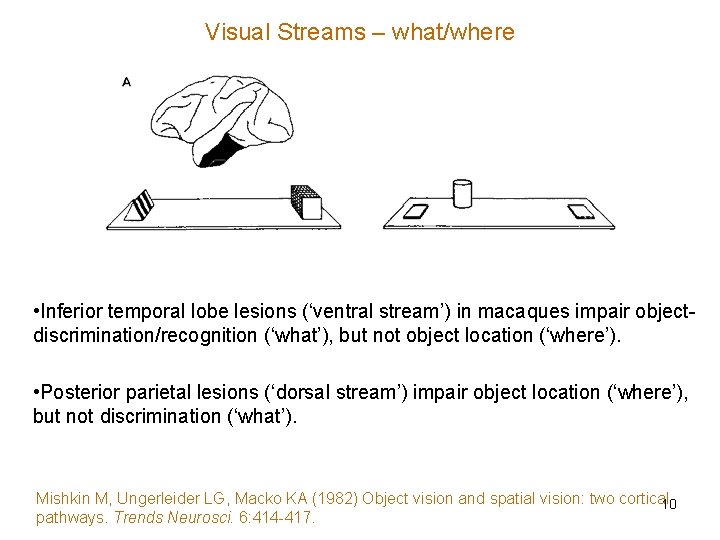
Visual Streams – what/where • Inferior temporal lobe lesions (‘ventral stream’) in macaques impair objectdiscrimination/recognition (‘what’), but not object location (‘where’). • Posterior parietal lesions (‘dorsal stream’) impair object location (‘where’), but not discrimination (‘what’). Mishkin M, Ungerleider LG, Macko KA (1982) Object vision and spatial vision: two cortical 10 pathways. Trends Neurosci. 6: 414 -417.
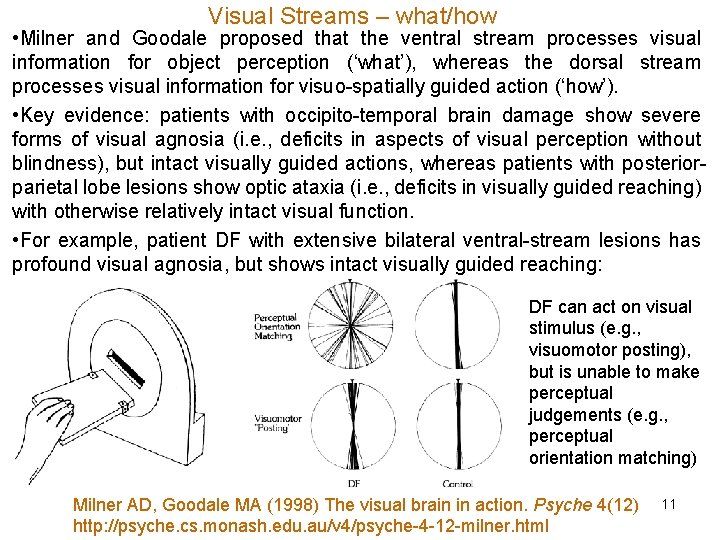
Visual Streams – what/how • Milner and Goodale proposed that the ventral stream processes visual information for object perception (‘what’), whereas the dorsal stream processes visual information for visuo-spatially guided action (‘how’). • Key evidence: patients with occipito-temporal brain damage show severe forms of visual agnosia (i. e. , deficits in aspects of visual perception without blindness), but intact visually guided actions, whereas patients with posteriorparietal lobe lesions show optic ataxia (i. e. , deficits in visually guided reaching) with otherwise relatively intact visual function. • For example, patient DF with extensive bilateral ventral-stream lesions has profound visual agnosia, but shows intact visually guided reaching: DF can act on visual stimulus (e. g. , visuomotor posting), but is unable to make perceptual judgements (e. g. , perceptual orientation matching) Milner AD, Goodale MA (1998) The visual brain in action. Psyche 4(12) http: //psyche. cs. monash. edu. au/v 4/psyche-4 -12 -milner. html 11
What does the observation of optic ataxia in a patient with posterior parietal lobe lesions suggest? a) The posterior parietal lobe is required for object perception. b) The posterior parietal lobe is required for visuo-spatially guided action. c) None of the above. 12
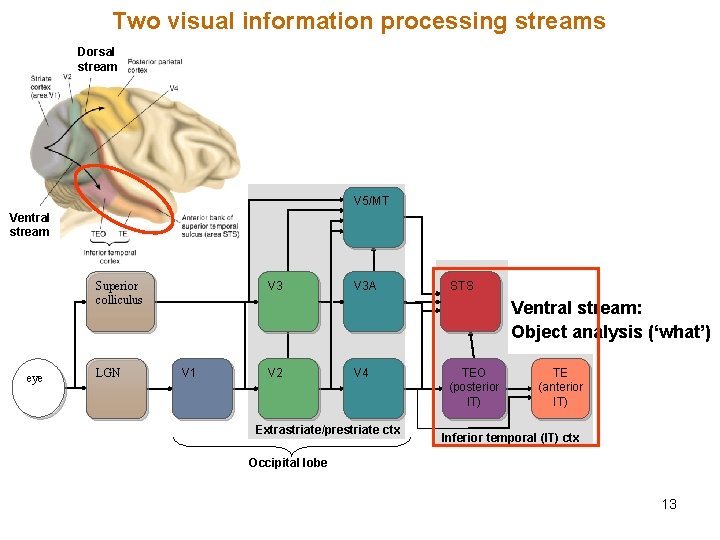
Two visual information processing streams Dorsal stream V 5/MT Posterior Parietal ctx. V 3 A STS Ventral stream V 3 Superior colliculus eye LGN Dorsal stream: Visuo-spatial (‘where’)/ visuo-motor (‘how’) processing Ventral stream: Object analysis (‘what’) V 1 V 2 V 4 Extrastriate/prestriate ctx TEO (posterior IT) TE (anterior IT) Inferior temporal (IT) ctx Occipital lobe 13
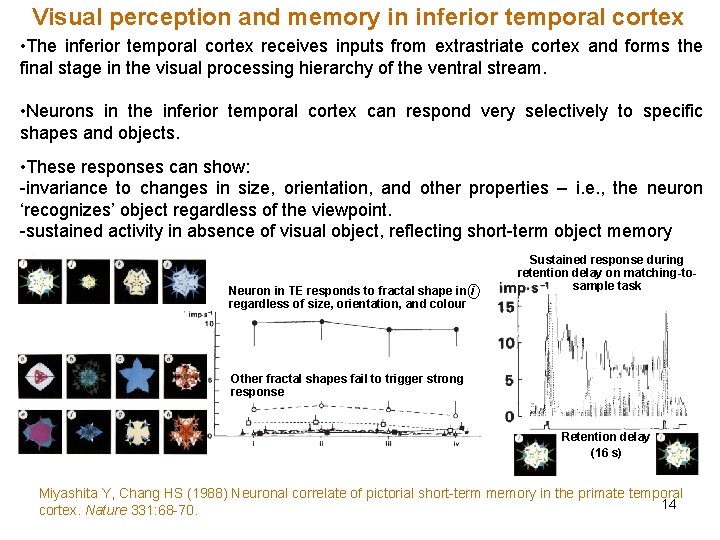
Visual perception and memory in inferior temporal cortex • The inferior temporal cortex receives inputs from extrastriate cortex and forms the final stage in the visual processing hierarchy of the ventral stream. • Neurons in the inferior temporal cortex can respond very selectively to specific shapes and objects. • These responses can show: -invariance to changes in size, orientation, and other properties – i. e. , the neuron ‘recognizes’ object regardless of the viewpoint. -sustained activity in absence of visual object, reflecting short-term object memory Neuron in TE responds to fractal shape in i regardless of size, orientation, and colour Sustained response during retention delay on matching-tosample task Other fractal shapes fail to trigger strong response Retention delay (16 s) Miyashita Y, Chang HS (1988) Neuronal correlate of pictorial short-term memory in the primate temporal 14 cortex. Nature 331: 68 -70.
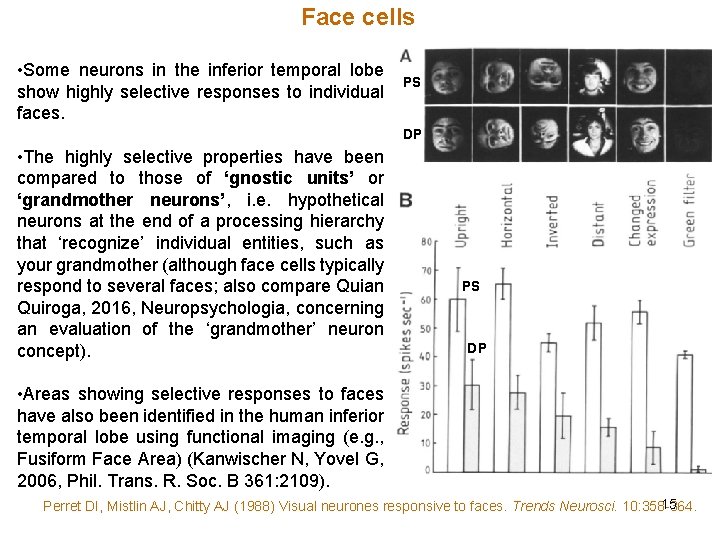
Face cells • Some neurons in the inferior temporal lobe show highly selective responses to individual faces. PS DP • The highly selective properties have been compared to those of ‘gnostic units’ or ‘grandmother neurons’, i. e. hypothetical neurons at the end of a processing hierarchy that ‘recognize’ individual entities, such as your grandmother (although face cells typically respond to several faces; also compare Quian Quiroga, 2016, Neuropsychologia, concerning an evaluation of the ‘grandmother’ neuron concept). PS DP • Areas showing selective responses to faces have also been identified in the human inferior temporal lobe using functional imaging (e. g. , Fusiform Face Area) (Kanwischer N, Yovel G, 2006, Phil. Trans. R. Soc. B 361: 2109). 15 Perret DI, Mistlin AJ, Chitty AJ (1988) Visual neurones responsive to faces. Trends Neurosci. 10: 358 -364.
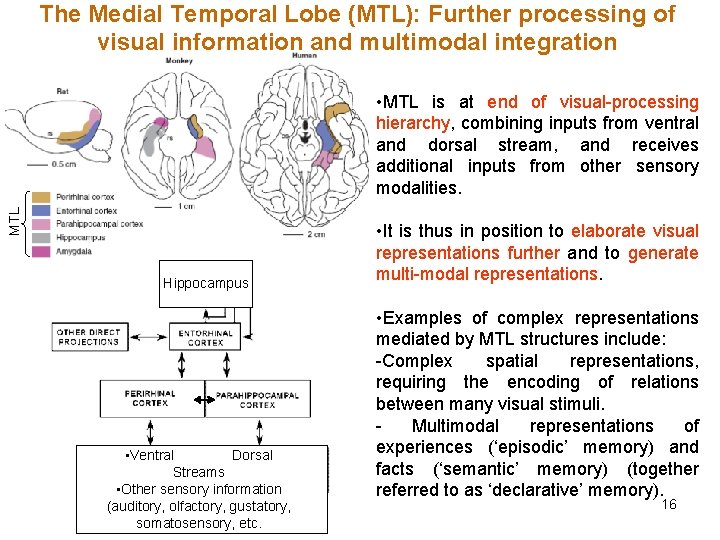
The Medial Temporal Lobe (MTL): Further processing of visual information and multimodal integration MTL • MTL is at end of visual-processing hierarchy, combining inputs from ventral and dorsal stream, and receives additional inputs from other sensory modalities. Hippocampus • Ventral Dorsal Streams • Other sensory information (auditory, olfactory, gustatory, somatosensory, etc. • It is thus in position to elaborate visual representations further and to generate multi-modal representations. • Examples of complex representations mediated by MTL structures include: -Complex spatial representations, requiring the encoding of relations between many visual stimuli. Multimodal representations of experiences (‘episodic’ memory) and facts (‘semantic’ memory) (together referred to as ‘declarative’ memory). 16
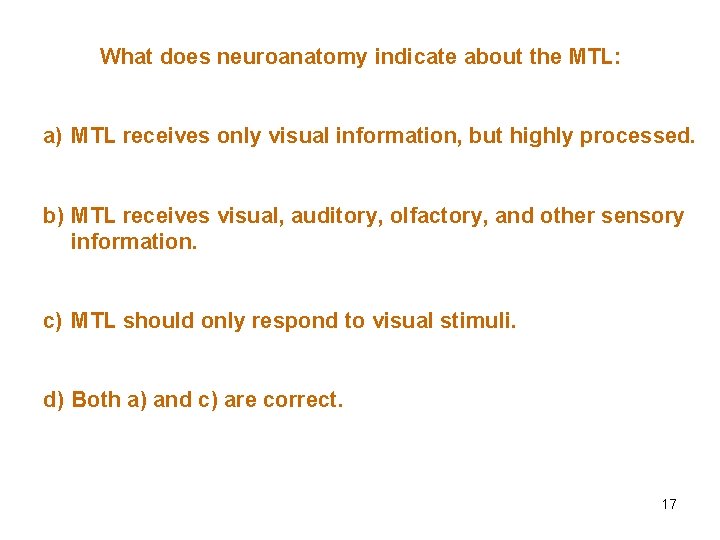
What does neuroanatomy indicate about the MTL: a) MTL receives only visual information, but highly processed. b) MTL receives visual, auditory, olfactory, and other sensory information. c) MTL should only respond to visual stimuli. d) Both a) and c) are correct. 17
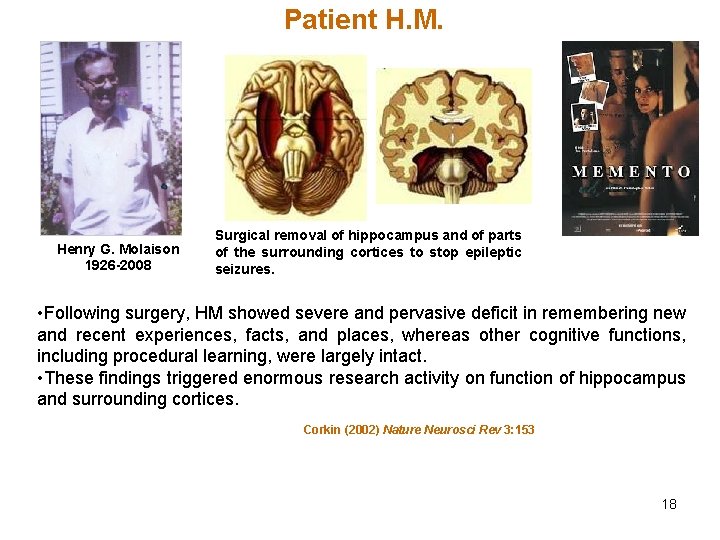
Patient H. M. Henry G. Molaison 1926 -2008 Surgical removal of hippocampus and of parts of the surrounding cortices to stop epileptic seizures. • Following surgery, HM showed severe and pervasive deficit in remembering new and recent experiences, facts, and places, whereas other cognitive functions, including procedural learning, were largely intact. • These findings triggered enormous research activity on function of hippocampus and surrounding cortices. Corkin (2002) Nature Neurosci Rev 3: 153 18
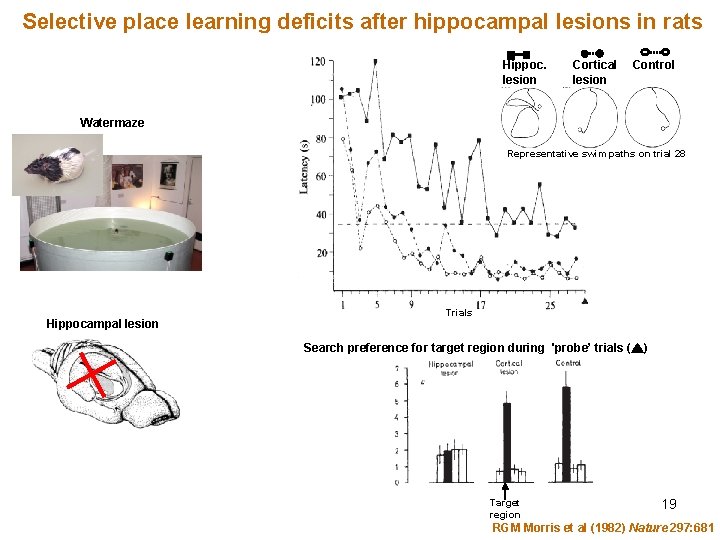
Selective place learning deficits after hippocampal lesions in rats Hippoc. lesion Cortical lesion Control Watermaze Representative swim paths on trial 28 Hippocampal lesion Trials Search preference for target region during 'probe’ trials ( Target region ) 19 RGM Morris et al (1982) Nature 297: 681
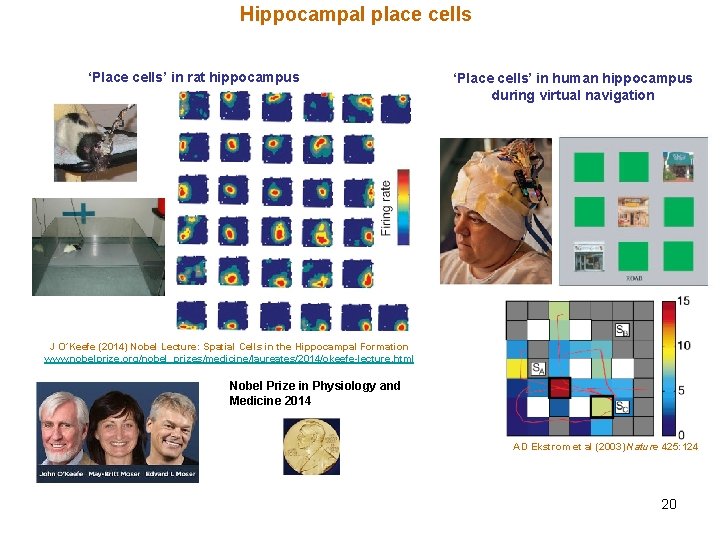
Hippocampal place cells ‘Place cells’ in rat hippocampus ‘Place cells’ in human hippocampus during virtual navigation J O´Keefe (2014) Nobel Lecture: Spatial Cells in the Hippocampal Formation www. nobelprize. org/nobel_prizes/medicine/laureates/2014/okeefe-lecture. html Nobel Prize in Physiology and Medicine 2014 AD Ekstrom et al (2003) Nature 425: 124 20
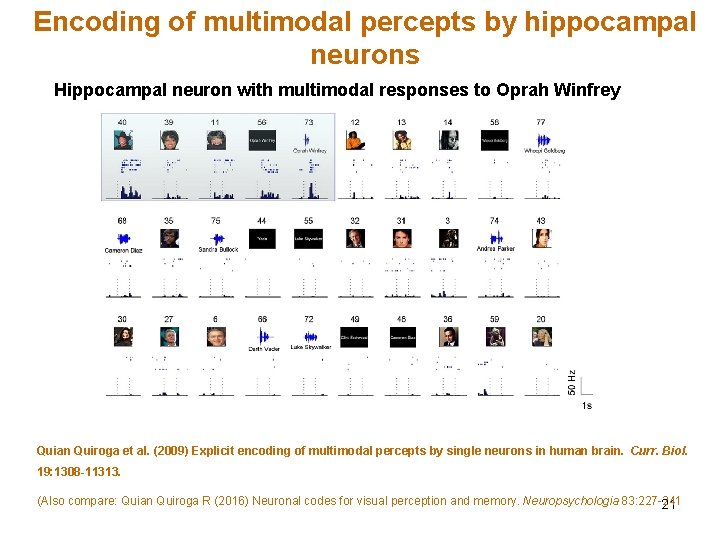
Encoding of multimodal percepts by hippocampal neurons Hippocampal neuron with multimodal responses to Oprah Winfrey Quian Quiroga et al. (2009) Explicit encoding of multimodal percepts by single neurons in human brain. Curr. Biol. 19: 1308 -11313. (Also compare: Quian Quiroga R (2016) Neuronal codes for visual perception and memory. Neuropsychologia 83: 227 -241 21
Conclusion • Perception and memory based on visual (and other sensory) information can be understood as a hierarchically organized sequence of processing steps mediated by interconnected brain networks. • At the earliest stages neurons respond to very basic features. • At progressively higher stages, neurons respond to combinations of basic features and get activated by more and more complex stimuli. • Visual information processing is also characterized by functional differentiation, i. e. different properties of visual stimuli are processed in parallel by different neuron types/brain regions (e. g. , colour and motion; information concerning stimulus identity vs. information relevant to what to do with a stimulus). 22
Occipital and temporal lobe: visual perception and memory – Selected Reading Textbook chapters: Carlson NR (any recent edition) The physiology of behavior. -Vision (Chpt. 6) -Relational learning and amnesia (Chpt. 15) Review articles: Mishkin M, Ungerleider LG, Macko KA (1982) Object vision and spatial vision: two cortical pathways. Trends Neurosci. 6: 414 -417. Quian Quiroga R (2016) Neuronal codes for visual perception and memory. Neuropsychologia 83: 227 -241. 23
Occipital and temporal lobe: visual perception and memory – Revision questions • What could be considered overarching principles of visual information processing? • Can you illustrate these principles based on examples from visual information processing along the primary visual pathway and beyond? • What are the ventral and dorsal visual streams? Which empirical evidence supports the existences of these two visual processing streams? • Describe the firing characteristics of neurons in the inferior temporal lobe that are selective for specific visual shapes and objects, or faces. • What happens with visual information in the medial temporal lobe? • Describe some types of neurons in the hippocampus, with highly selective firing properties. 24
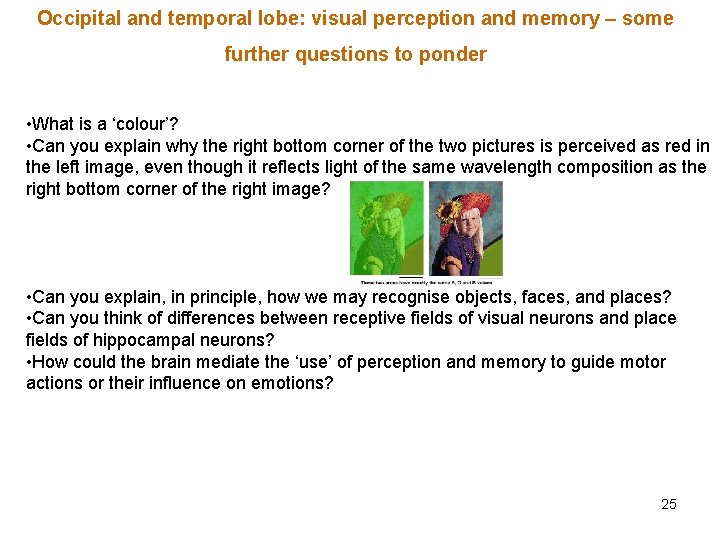
Occipital and temporal lobe: visual perception and memory – some further questions to ponder • What is a ‘colour’? • Can you explain why the right bottom corner of the two pictures is perceived as red in the left image, even though it reflects light of the same wavelength composition as the right bottom corner of the right image? • Can you explain, in principle, how we may recognise objects, faces, and places? • Can you think of differences between receptive fields of visual neurons and place fields of hippocampal neurons? • How could the brain mediate the ‘use’ of perception and memory to guide motor actions or their influence on emotions? 25
- Slides: 25