
C 1 Chemistry A Synthesis Gas Gas mixture
- Slides: 12
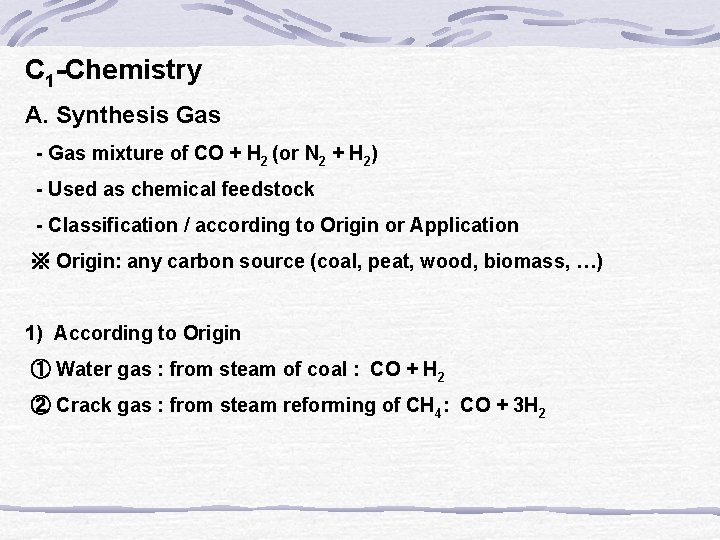
C 1 -Chemistry A. Synthesis Gas - Gas mixture of CO + H 2 (or N 2 + H 2) - Used as chemical feedstock - Classification / according to Origin or Application ※ Origin: any carbon source (coal, peat, wood, biomass, …) 1) According to Origin ① Water gas : from steam of coal : CO + H 2 ② Crack gas : from steam reforming of CH 4: CO + 3 H 2
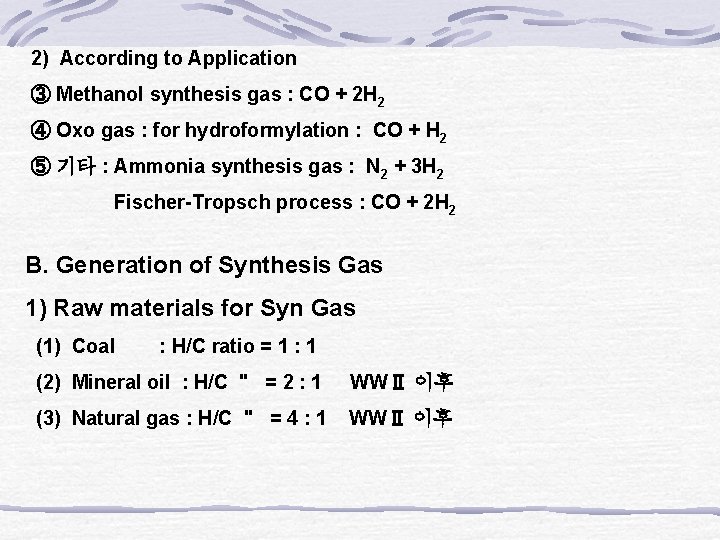
2) According to Application ③ Methanol synthesis gas : CO + 2 H 2 ④ Oxo gas : for hydroformylation : CO + H 2 ⑤ 기타 : Ammonia synthesis gas : N 2 + 3 H 2 Fischer-Tropsch process : CO + 2 H 2 B. Generation of Synthesis Gas 1) Raw materials for Syn Gas (1) Coal : H/C ratio = 1 : 1 (2) Mineral oil : H/C " = 2 : 1 WWⅡ 이후 (3) Natural gas : H/C " = 4 : 1 WWⅡ 이후
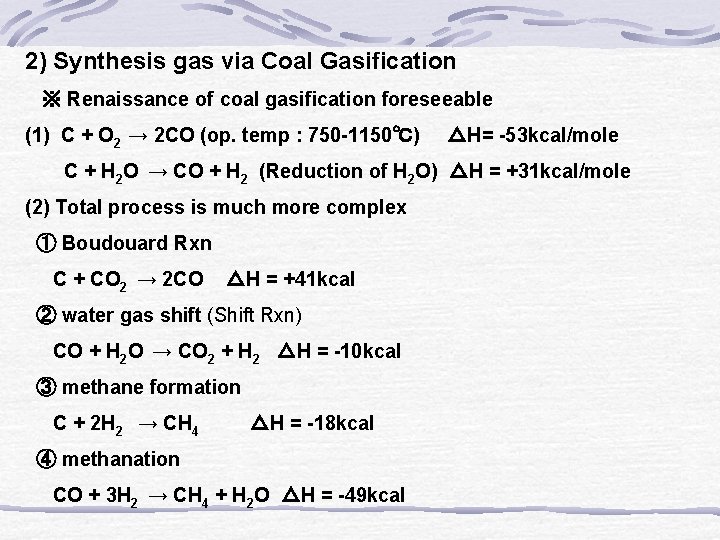
2) Synthesis gas via Coal Gasification ※ Renaissance of coal gasification foreseeable (1) C + O 2 → 2 CO (op. temp : 750 -1150℃) △H= -53 kcal/mole C + H 2 O → CO + H 2 (Reduction of H 2 O) △H = +31 kcal/mole (2) Total process is much more complex ① Boudouard Rxn C + CO 2 → 2 CO △H = +41 kcal ② water gas shift (Shift Rxn) CO + H 2 O → CO 2 + H 2 △H = -10 kcal ③ methane formation C + 2 H 2 → CH 4 △H = -18 kcal ④ methanation CO + 3 H 2 → CH 4 + H 2 O △H = -49 kcal
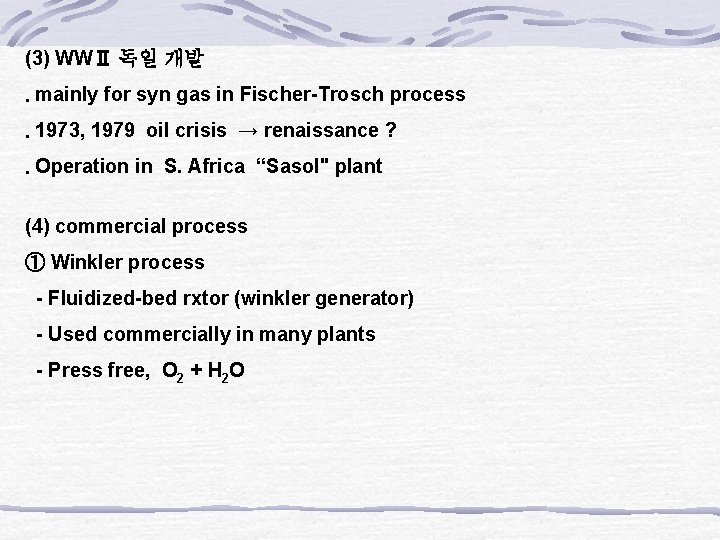
(3) WWⅡ 독일 개발 ․mainly for syn gas in Fischer-Trosch process ․ 1973, 1979 oil crisis → renaissance ? ․Operation in S. Africa “Sasol" plant (4) commercial process ① Winkler process - Fluidized-bed rxtor (winkler generator) - Used commercially in many plants - Press free, O 2 + H 2 O
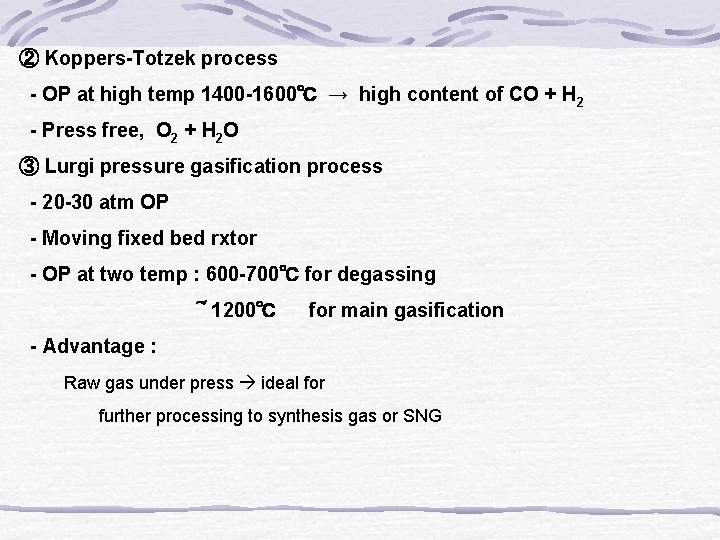
② Koppers-Totzek process - OP at high temp 1400 -1600℃ → high content of CO + H 2 - Press free, O 2 + H 2 O ③ Lurgi pressure gasification process - 20 -30 atm OP - Moving fixed bed rxtor - OP at two temp : 600 -700℃ for degassing ~ 1200℃ for main gasification - Advantage : Raw gas under press ideal for further processing to synthesis gas or SNG
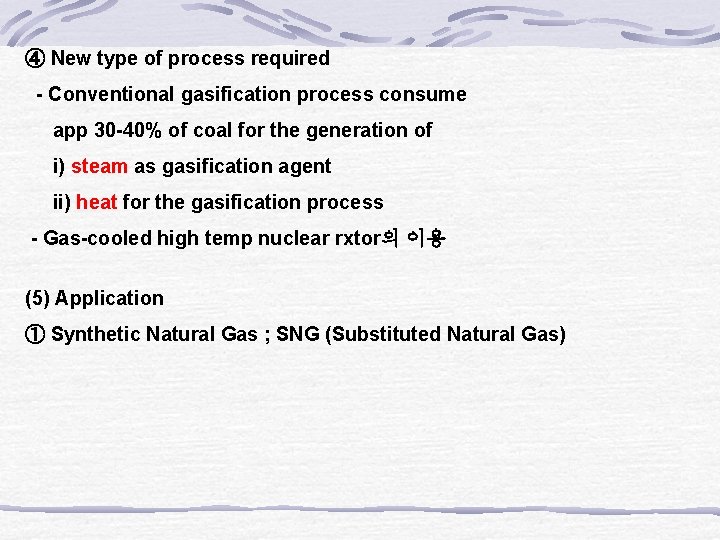
④ New type of process required - Conventional gasification process consume app 30 -40% of coal for the generation of i) steam as gasification agent ii) heat for the gasification process - Gas-cooled high temp nuclear rxtor의 이용 (5) Application ① Synthetic Natural Gas ; SNG (Substituted Natural Gas)
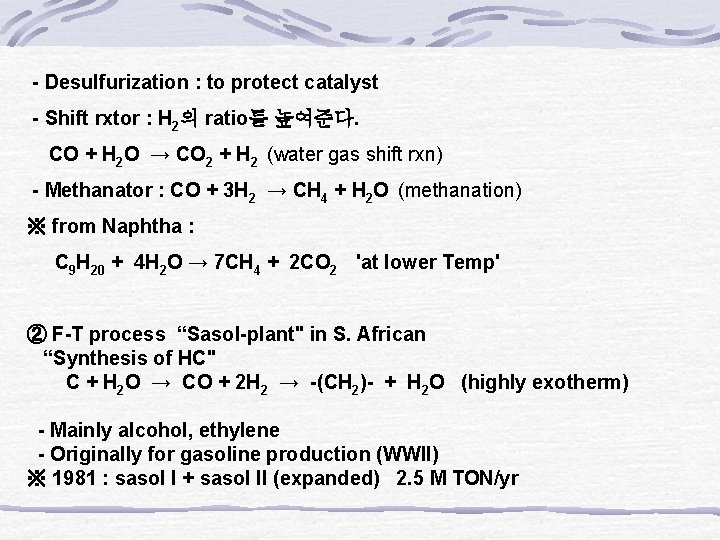
- Desulfurization : to protect catalyst - Shift rxtor : H 2의 ratio를 높여준다. CO + H 2 O → CO 2 + H 2 (water gas shift rxn) - Methanator : CO + 3 H 2 → CH 4 + H 2 O (methanation) ※ from Naphtha : C 9 H 20 + 4 H 2 O → 7 CH 4 + 2 CO 2 'at lower Temp' ② F-T process “Sasol-plant" in S. African “Synthesis of HC" C + H 2 O → CO + 2 H 2 → -(CH 2)- + H 2 O (highly exotherm) - Mainly alcohol, ethylene - Originally for gasoline production (WWII) ※ 1981 : sasol I + sasol II (expanded) 2. 5 M TON/yr
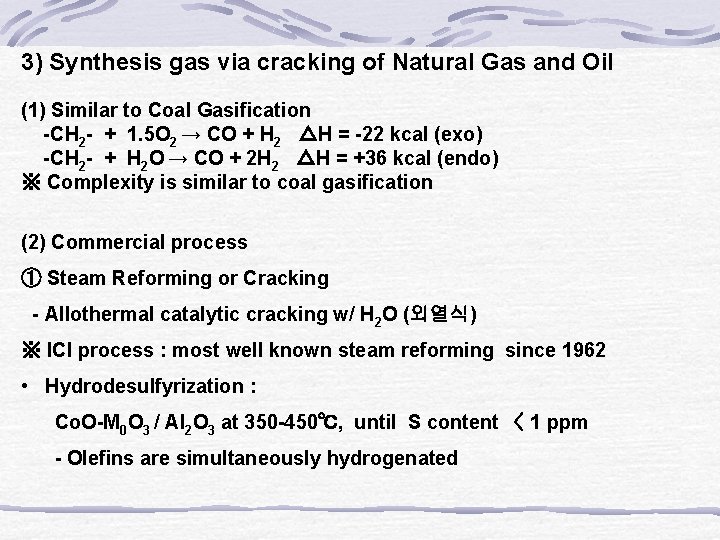
3) Synthesis gas via cracking of Natural Gas and Oil (1) Similar to Coal Gasification -CH 2 - + 1. 5 O 2 → CO + H 2 △H = -22 kcal (exo) -CH 2 - + H 2 O → CO + 2 H 2 △H = +36 kcal (endo) ※ Complexity is similar to coal gasification (2) Commercial process ① Steam Reforming or Cracking - Allothermal catalytic cracking w/ H 2 O (외열식) ※ ICI process : most well known steam reforming since 1962 • Hydrodesulfyrization : Co. O-M 0 O 3 / Al 2 O 3 at 350 -450℃, until S content 〈 1 ppm - Olefins are simultaneously hydrogenated
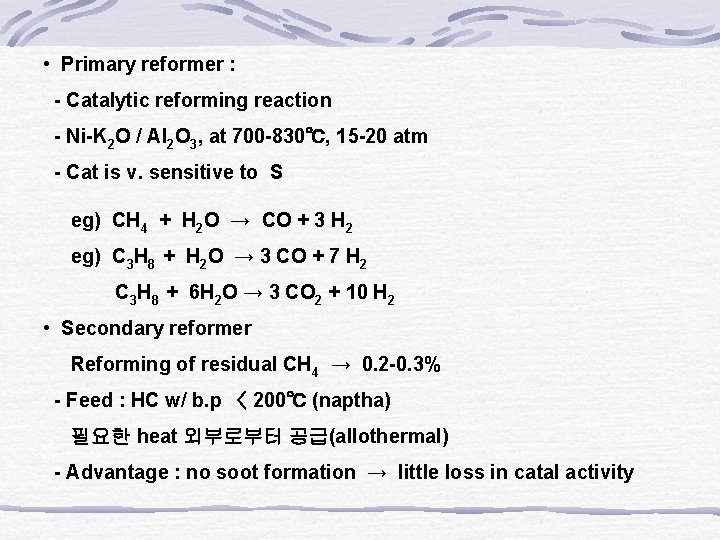
• Primary reformer : - Catalytic reforming reaction - Ni-K 2 O / Al 2 O 3, at 700 -830℃, 15 -20 atm - Cat is v. sensitive to S eg) CH 4 + H 2 O → CO + 3 H 2 eg) C 3 H 8 + H 2 O → 3 CO + 7 H 2 C 3 H 8 + 6 H 2 O → 3 CO 2 + 10 H 2 • Secondary reformer Reforming of residual CH 4 → 0. 2 -0. 3% - Feed : HC w/ b. p 〈 200℃ (naptha) 필요한 heat 외부로부터 공급(allothermal) - Advantage : no soot formation → little loss in catal activity
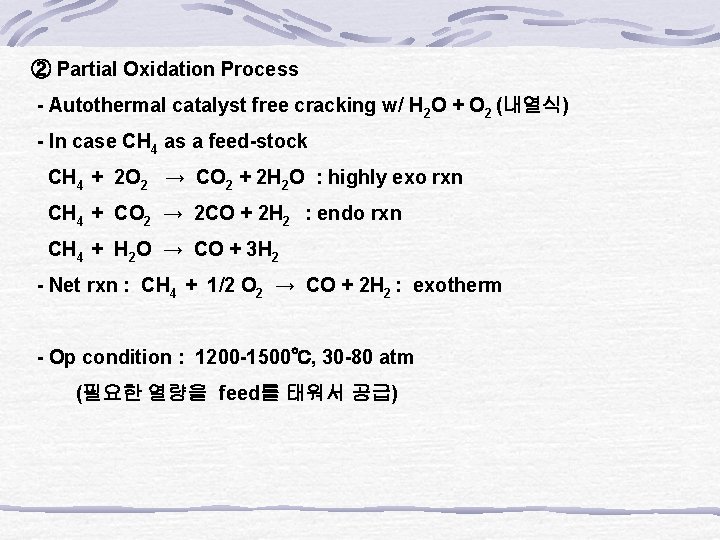
② Partial Oxidation Process - Autothermal catalyst free cracking w/ H 2 O + O 2 (내열식) - In case CH 4 as a feed-stock CH 4 + 2 O 2 → CO 2 + 2 H 2 O : highly exo rxn CH 4 + CO 2 → 2 CO + 2 H 2 : endo rxn CH 4 + H 2 O → CO + 3 H 2 - Net rxn : CH 4 + 1/2 O 2 → CO + 2 H 2 : exotherm - Op condition : 1200 -1500℃, 30 -80 atm (필요한 열량을 feed를 태워서 공급)
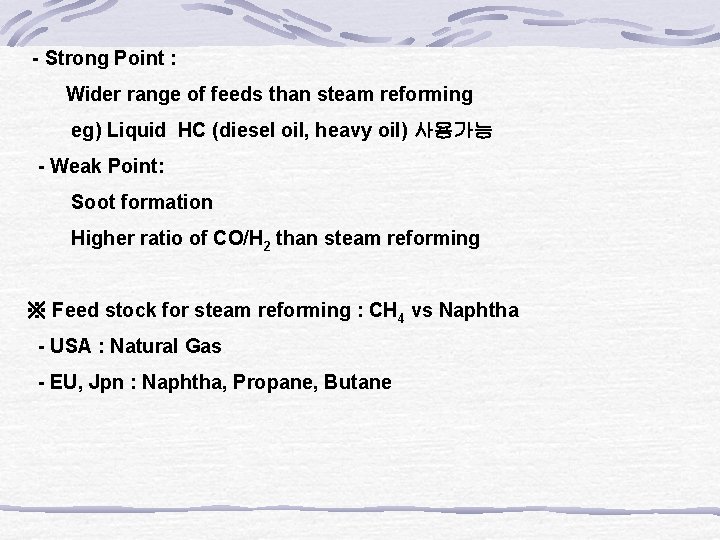
- Strong Point : Wider range of feeds than steam reforming eg) Liquid HC (diesel oil, heavy oil) 사용가능 - Weak Point: Soot formation Higher ratio of CO/H 2 than steam reforming ※ Feed stock for steam reforming : CH 4 vs Naphtha - USA : Natural Gas - EU, Jpn : Naphtha, Propane, Butane
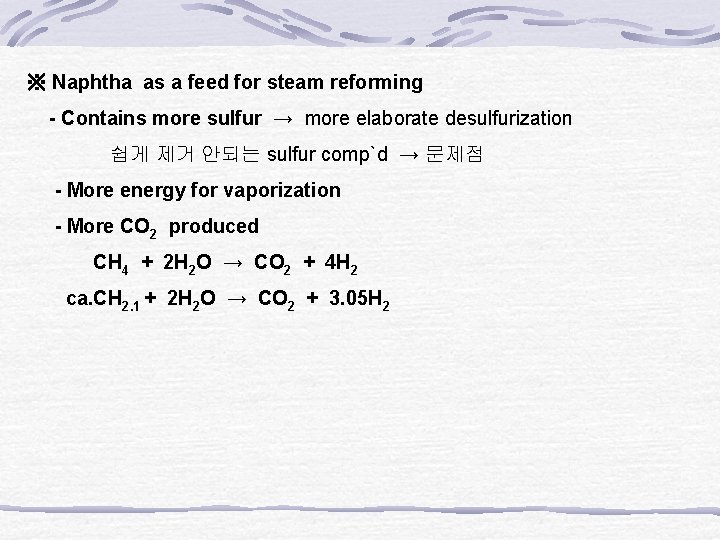
※ Naphtha as a feed for steam reforming - Contains more sulfur → more elaborate desulfurization 쉽게 제거 안되는 sulfur comp`d → 문제점 - More energy for vaporization - More CO 2 produced CH 4 + 2 H 2 O → CO 2 + 4 H 2 ca. CH 2. 1 + 2 H 2 O → CO 2 + 3. 05 H 2