
Bypass Testing of Web Applications Jeff Offutt SWE
Bypass Testing of Web Applications Jeff Offutt SWE 737 Advanced Software Testing
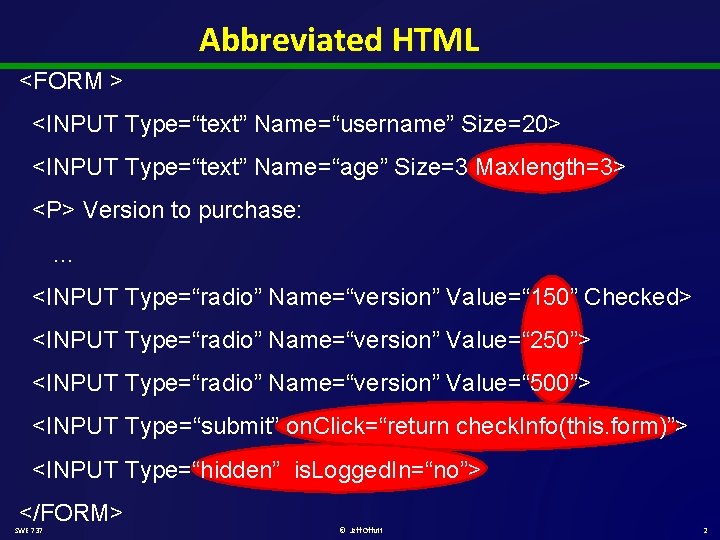
Abbreviated HTML <FORM > <INPUT Type=“text” Name=“username” Size=20> <INPUT Type=“text” Name=“age” Size=3 Maxlength=3> <P> Version to purchase: … <INPUT Type=“radio” Name=“version” Value=“ 150” Checked> <INPUT Type=“radio” Name=“version” Value=“ 250”> <INPUT Type=“radio” Name=“version” Value=“ 500”> <INPUT Type=“submit” on. Click=“return check. Info(this. form)”> <INPUT Type=“hidden” is. Logged. In=“no”> </FORM> SWE 737 © Jeff Offutt 2
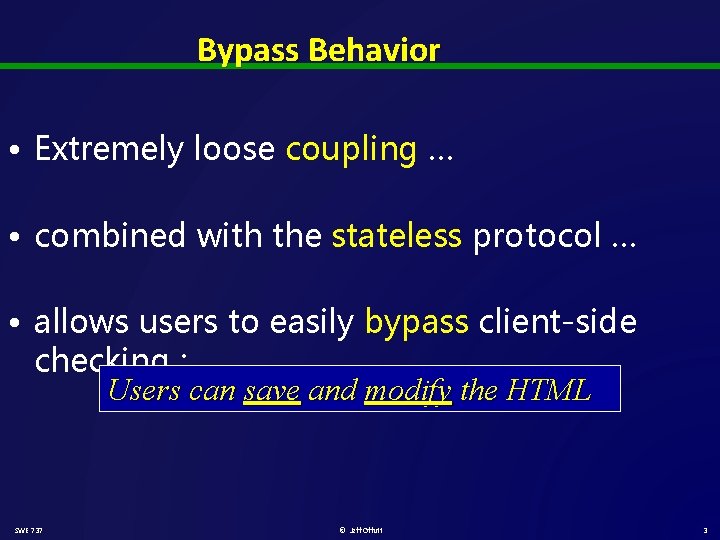
Bypass Behavior • Extremely loose coupling … • combined with the stateless protocol … • allows users to easily bypass client-side checking : Users can save and modify the HTML SWE 737 © Jeff Offutt 3
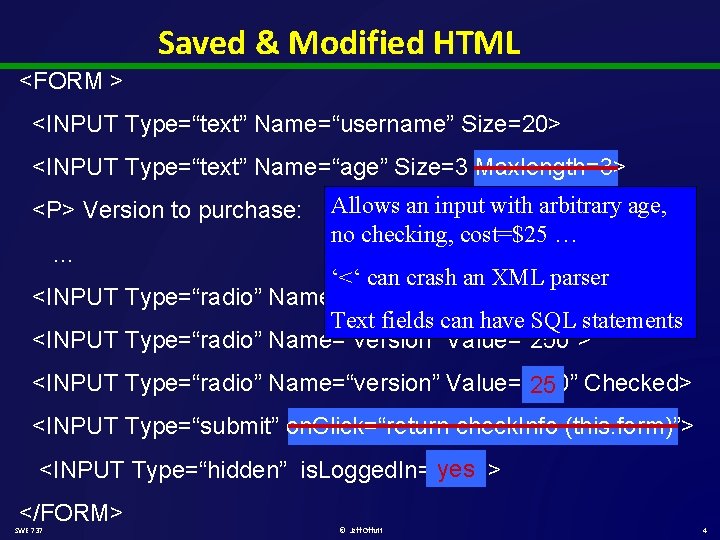
Saved & Modified HTML <FORM > <INPUT Type=“text” Name=“username” Size=20> <INPUT Type=“text” Name=“age” Size=3 Maxlength=3> <P> Version to purchase: … Allows an input with arbitrary age, no checking, cost=$25 … ‘<‘ can crash an XML parser <INPUT Type=“radio” Name=“version” Value=“ 150”> Text fields can have SQL statements <INPUT Type=“radio” Name=“version” Value=“ 250”> <INPUT Type=“radio” Name=“version” Value=“ 500” 25 Checked> <INPUT Type=“submit” on. Click=“return check. Info (this. form)”> <INPUT Type=“hidden” is. Logged. In= yes “no” > </FORM> SWE 737 © Jeff Offutt 4
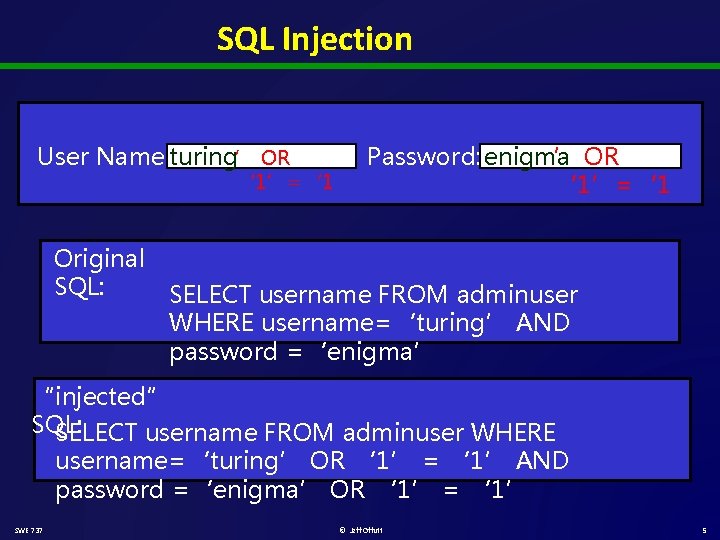
SQL Injection User Name: turing’ OR ‘ 1’=‘ 1 Original SQL: ’ OR Password: enigma ‘ 1’=‘ 1 SELECT username FROM adminuser WHERE username=‘turing’ AND password =‘enigma’ “injected” SQL: SELECT username FROM adminuser WHERE username=‘turing’ OR ‘ 1’ = ‘ 1’ AND password =‘enigma’ OR ‘ 1’ = ‘ 1’ SWE 737 © Jeff Offutt 5
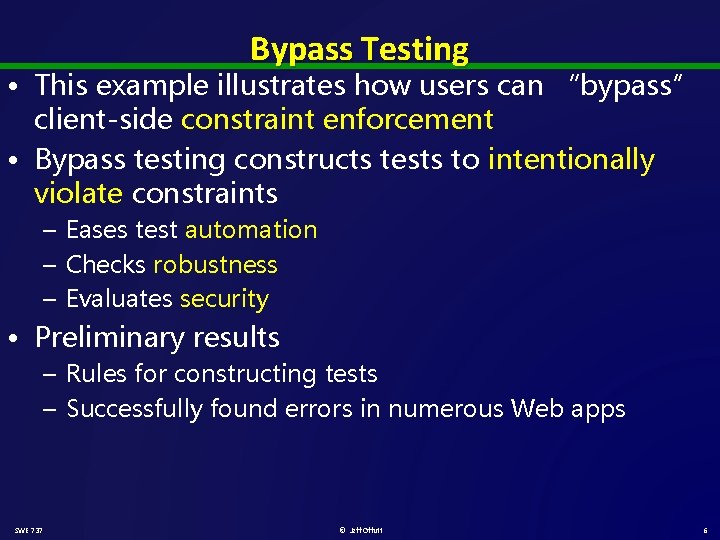
Bypass Testing • This example illustrates how users can “bypass” client-side constraint enforcement • Bypass testing constructs tests to intentionally violate constraints – Eases test automation – Checks robustness – Evaluates security • Preliminary results – Rules for constructing tests – Successfully found errors in numerous Web apps SWE 737 © Jeff Offutt 6
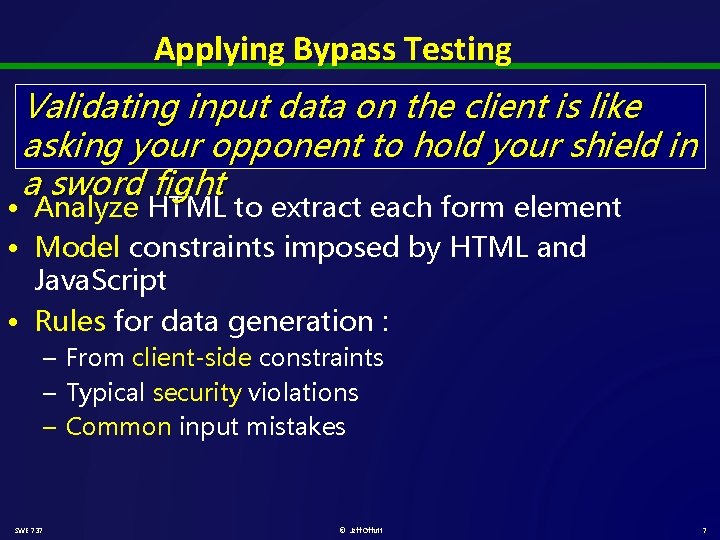
Applying Bypass Testing Validating input data on the client is like asking your opponent to hold your shield in a sword fight • Analyze HTML to extract each form element • Model constraints imposed by HTML and Java. Script • Rules for data generation : – From client-side constraints – Typical security violations – Common input mistakes SWE 737 © Jeff Offutt 7
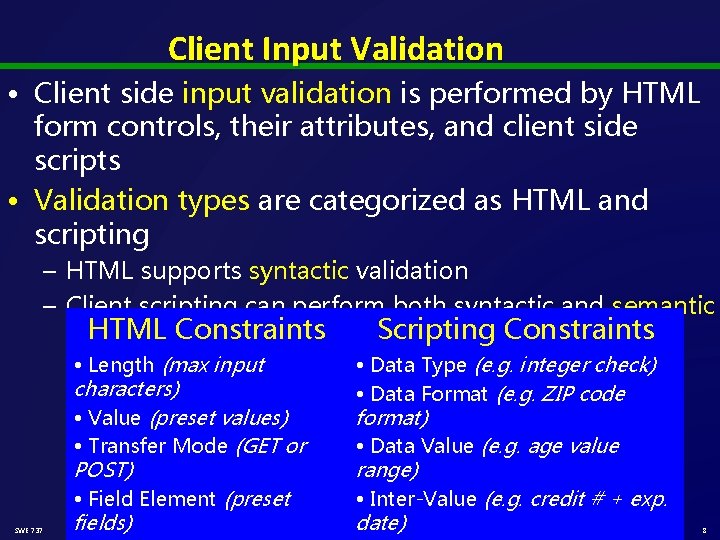
Client Input Validation • Client side input validation is performed by HTML form controls, their attributes, and client side scripts • Validation types are categorized as HTML and scripting – HTML supports syntactic validation – Client scripting can perform both syntactic and semantic HTML Constraints Scripting Constraints validation SWE 737 • Length (max input characters) • Value (preset values) • Transfer Mode (GET or POST) • Field Element (preset fields) • Data Type (e. g. integer check) • Data Format (e. g. ZIP code format) • Data Value (e. g. age value range) • Inter-Value (e. g. credit # + exp. date) © Jeff Offutt 8
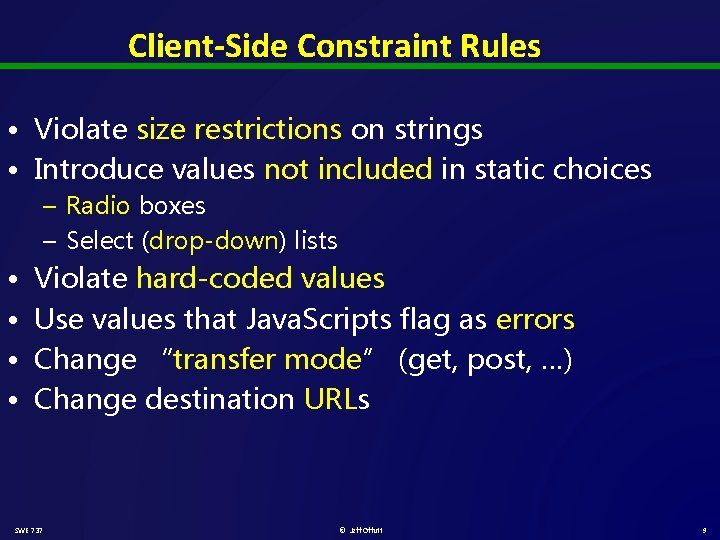
Client-Side Constraint Rules • Violate size restrictions on strings • Introduce values not included in static choices – Radio boxes – Select (drop-down) lists • • Violate hard-coded values Use values that Java. Scripts flag as errors Change “transfer mode” (get, post, …) Change destination URLs SWE 737 © Jeff Offutt 9
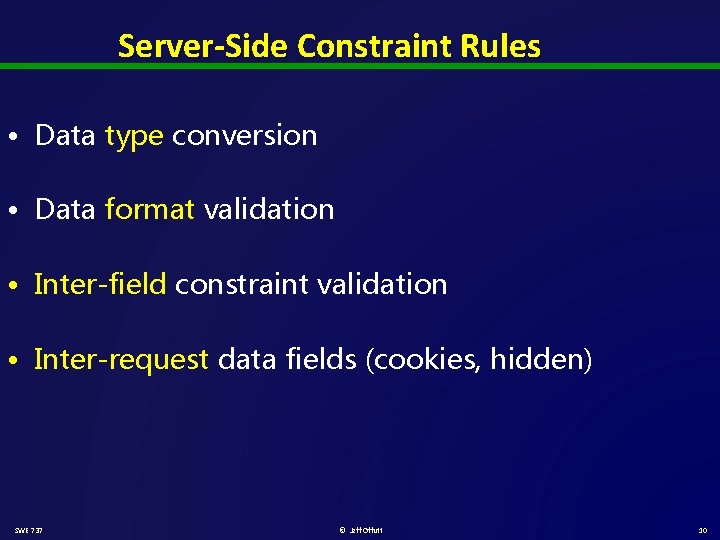
Server-Side Constraint Rules • Data type conversion • Data format validation • Inter-field constraint validation • Inter-request data fields (cookies, hidden) SWE 737 © Jeff Offutt 10
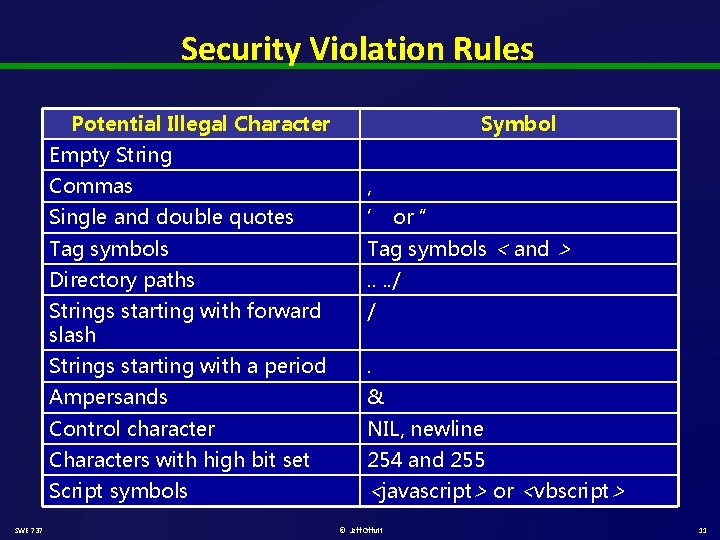
Security Violation Rules Potential Illegal Character Symbol Empty String SWE 737 Commas , Single and double quotes ’ or ” Tag symbols < and > Directory paths . . / Strings starting with forward slash / Strings starting with a period . Ampersands & Control character NIL, newline Characters with high bit set 254 and 255 Script symbols <javascript> or <vbscript> © Jeff Offutt 11
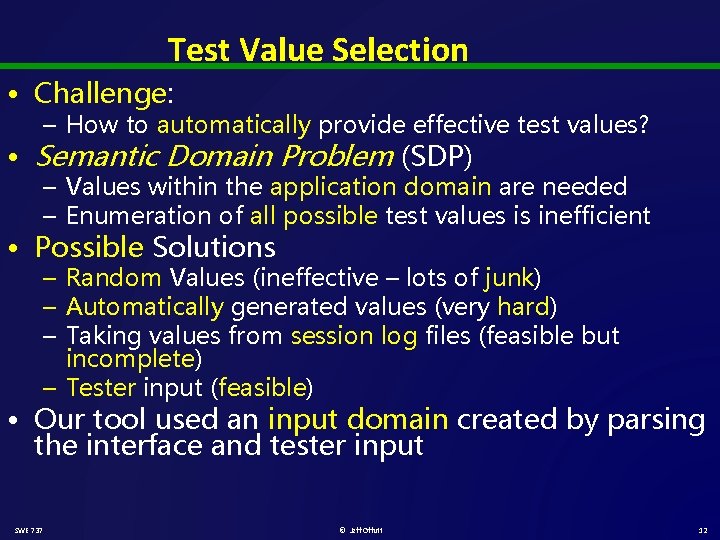
Test Value Selection • Challenge: – How to automatically provide effective test values? • Semantic Domain Problem (SDP) – Values within the application domain are needed – Enumeration of all possible test values is inefficient • Possible Solutions – Random Values (ineffective – lots of junk) – Automatically generated values (very hard) – Taking values from session log files (feasible but incomplete) – Tester input (feasible) • Our tool used an input domain created by parsing the interface and tester input SWE 737 © Jeff Offutt 12
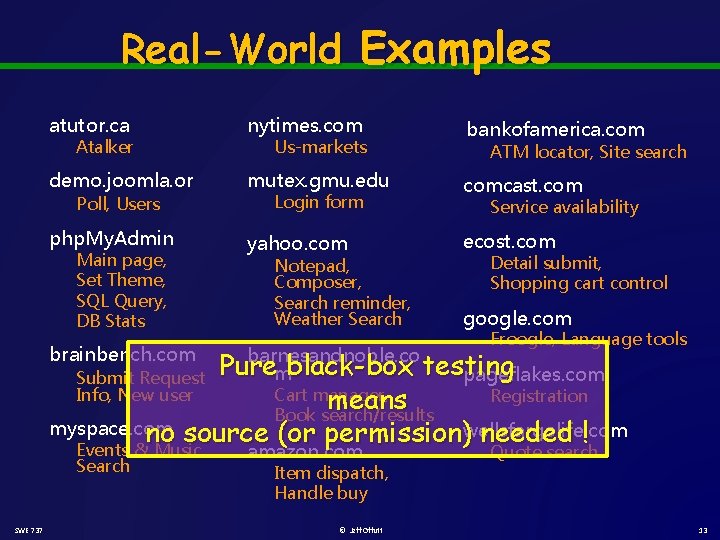
Real-World Examples atutor. ca Atalker demo. joomla. or Poll, Users php. My. Admin Main page, Set Theme, SQL Query, DB Stats nytimes. com Us-markets mutex. gmu. edu Login form yahoo. com Notepad, Composer, Search reminder, Weather Search brainbench. com bankofamerica. com ATM locator, Site search comcast. com Service availability ecost. com Detail submit, Shopping cart control google. com Froogle, Language tools barnesandnoble. co Pure mblack-box testing pageflakes. com Submit Request Cart manager, Info, New user Registration means Book search/results myspace. com wellsfargolife. com no source (or permission) needed ! Events & Music Search SWE 737 amazon. com Item dispatch, Handle buy © Jeff Offutt Quote search 13
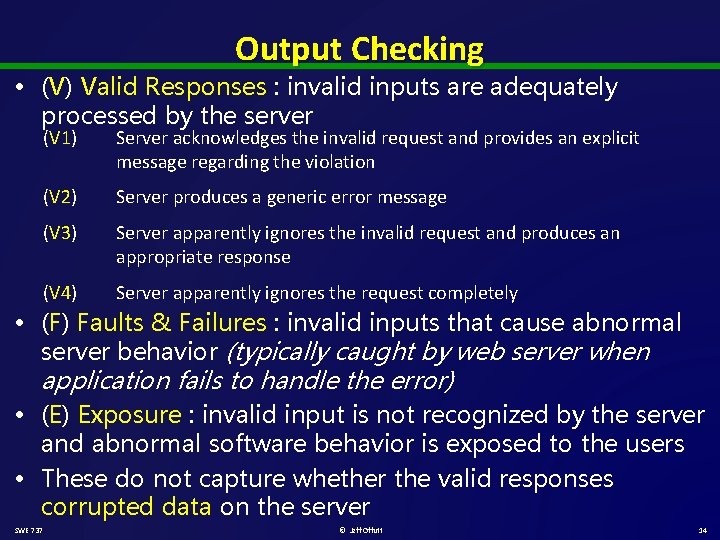
Output Checking • (V) Valid Responses : invalid inputs are adequately processed by the server (V 1) Server acknowledges the invalid request and provides an explicit message regarding the violation (V 2) Server produces a generic error message (V 3) Server apparently ignores the invalid request and produces an appropriate response (V 4) Server apparently ignores the request completely • (F) Faults & Failures : invalid inputs that cause abnormal server behavior (typically caught by web server when application fails to handle the error) • (E) Exposure : invalid input is not recognized by the server and abnormal software behavior is exposed to the users • These do not capture whether the valid responses corrupted data on the server SWE 737 © Jeff Offutt 14
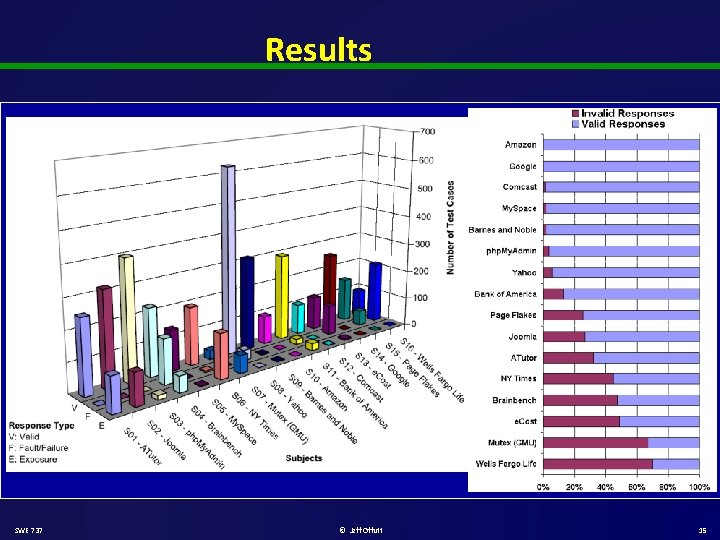
Results v SWE 737 © Jeff Offutt 15
References • Jeff Offutt, Vasileios Papadimitriou, and Upsorn Praphamontripong. A Case Study on Bypass Testing of Web Applications. Springer’s Empirical Software Engineering journal, July 2012 • Mouelhi, Le Traon, Abgrall, Baudry, and Gombault. Tailored Shielding and Bypass Testing of Web Applications. Fourth International Conference on Software Testing, Verification and Validation (ICST), March 2011, pp 210 -219 • Jeff Offutt, Qingxiang Wang and Joann J. Ordille. An Industrial Case Study of Bypass Testing on Web Applications. 1 st IEEE International Conference on Software Testing, Verification and Validation , pages 465474, April 2008, Lillehammer, Norway • Jeff Offutt, Ye Wu, Xiaochen Du and Hong Huang. Bypass Testing of Web Applications. IEEE International SWE 737 © Jeff Offutt 16
- Slides: 16