
Bylaws Effective Rules for Your Board A guide
Bylaws: Effective Rules for Your Board A guide for nonprofit board leaders on bylaw clauses specific to the board of directors
Introduction Most nonprofits begin their existence by filing articles of incorporation with the state in which their headquarters is located. Another critical step is to draft a set of bylaws to establish key governance rules. This guide provides some basic information about bylaws and then focuses on those bylaws that pertain specifically to boards of directors. Generally, bylaws should include sections on the following topics: • General clauses • Members (if applicable) • Board of directors • Officers • Committees • Fiscal matters • Other issues Carefully crafted bylaws and adherence to them can help ensure effective board decision making and provide protection against legal challenges. It’s time to give your bylaws the attention they demand.
Table of Contents The Basics and General Bylaws Key Bylaws for the Board of Directors Other Bylaws Pertaining to the Board Where to Find More Information
THE BASICS Every nonprofit needs to pay careful attention to its bylaws. What happens in a controversy? How are board members and officers elected? How are committees formed?
THE BASICS The 3 Important Functions of Bylaws: To determine structure To determine the rights of participants To determine procedures by which rights can be exercised
GENERAL BYLAWS General Key Bylaws Clauses • Official name of the organization • Location of principal office • Statement of purpose • Any limitations required for tax exemption • Procedure for disposition of assets upon dissolution
BOARD OF DIRECTORS Nonprofit corporations are governed by a board of directors (sometimes called trustees). State law requires that there be a board of directors – the body with ultimate decision -making authority and responsibility for the organization. We’ll address these questions and more in the following section: • How many directors will be on the board? • What are the terms? • Are they compensated? • How many times should the board meet? • Should there be an executive committee?
BOARD OF DIRECTORS Numbers and Selection 1. Numbers of Members 2. Method of Selection Many states require that the bylaws specify the Many board are self perpetuating – boards that exact number of directors. If your laws do not, determine who shall serve and that may re- providing ranges in the number of members elect or reappoint current directors. When helps provide flexibility and less need to amend looking for potential directors, consider… the bylaws if someone quickly departs or if you find new talent that fills a needed skill set. A typical statement looks like this: “No fewer than 10 nor more than 20. ” • what skill sets are needed to align with your organization’s strategies, goals, and needs? • is your board diverse? Something to think about – In calculating the number of directors, consider whether the officers are chosen from among Quick tip – CEOs may automatically serve on the board by the directors, are directors by virtue of being officers, or are virtue of their position in the organization. They are referred to chosen from the general public but are not also part of the board. as ‘ex officio’ – an ex officio director’s voting rights should be Commonly, nonprofits elect officers from among the directors. clearly specified in the bylaws so there is never any confusion. Board. Source recommends that chief executives have no voting rights.
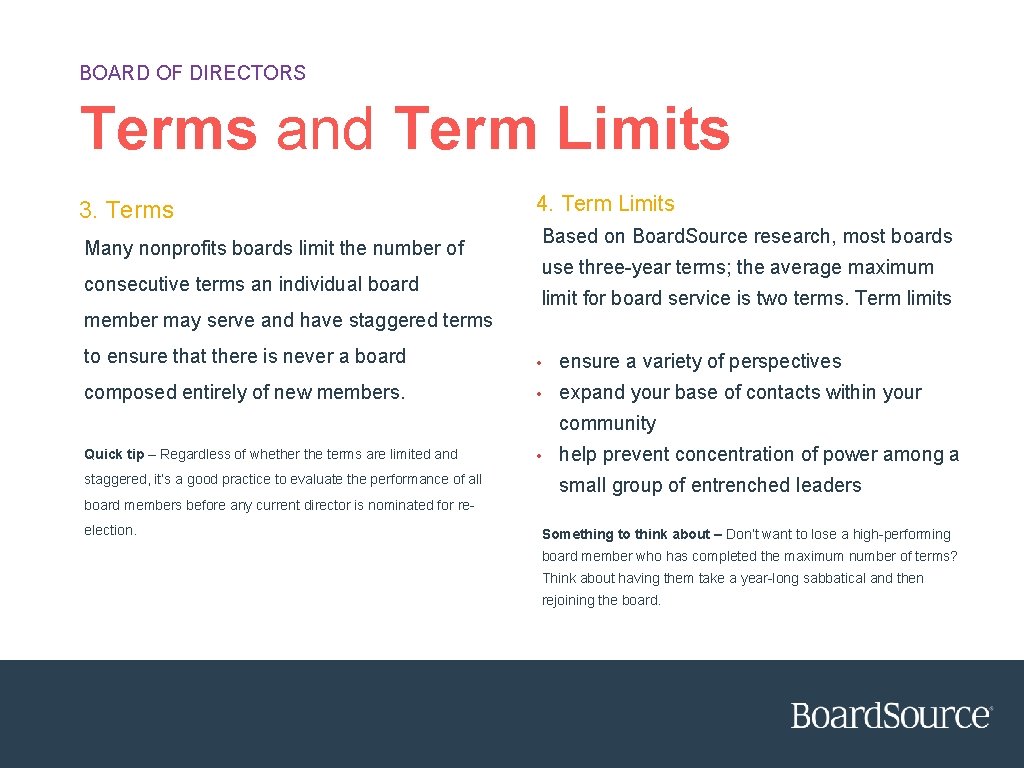
BOARD OF DIRECTORS Terms and Term Limits 3. Terms Many nonprofits boards limit the number of consecutive terms an individual board 4. Term Limits Based on Board. Source research, most boards use three-year terms; the average maximum limit for board service is two terms. Term limits member may serve and have staggered terms to ensure that there is never a board • ensure a variety of perspectives composed entirely of new members. • expand your base of contacts within your community Quick tip – Regardless of whether the terms are limited and staggered, it’s a good practice to evaluate the performance of all • help prevent concentration of power among a small group of entrenched leaders board members before any current director is nominated for reelection. Something to think about – Don’t want to lose a high-performing board member who has completed the maximum number of terms? Think about having them take a year-long sabbatical and then rejoining the board.
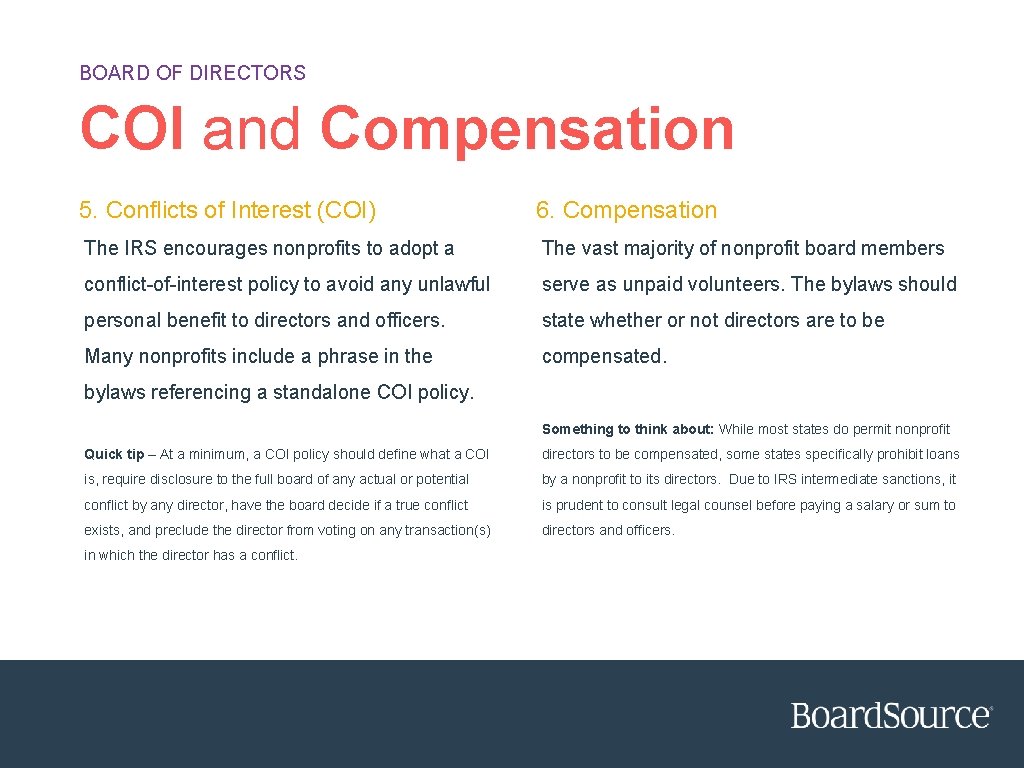
BOARD OF DIRECTORS COI and Compensation 5. Conflicts of Interest (COI) 6. Compensation The IRS encourages nonprofits to adopt a The vast majority of nonprofit board members conflict-of-interest policy to avoid any unlawful serve as unpaid volunteers. The bylaws should personal benefit to directors and officers. state whether or not directors are to be Many nonprofits include a phrase in the compensated. bylaws referencing a standalone COI policy. Something to think about: While most states do permit nonprofit Quick tip – At a minimum, a COI policy should define what a COI directors to be compensated, some states specifically prohibit loans is, require disclosure to the full board of any actual or potential by a nonprofit to its directors. Due to IRS intermediate sanctions, it conflict by any director, have the board decide if a true conflict is prudent to consult legal counsel before paying a salary or sum to exists, and preclude the director from voting on any transaction(s) directors and officers. in which the director has a conflict.
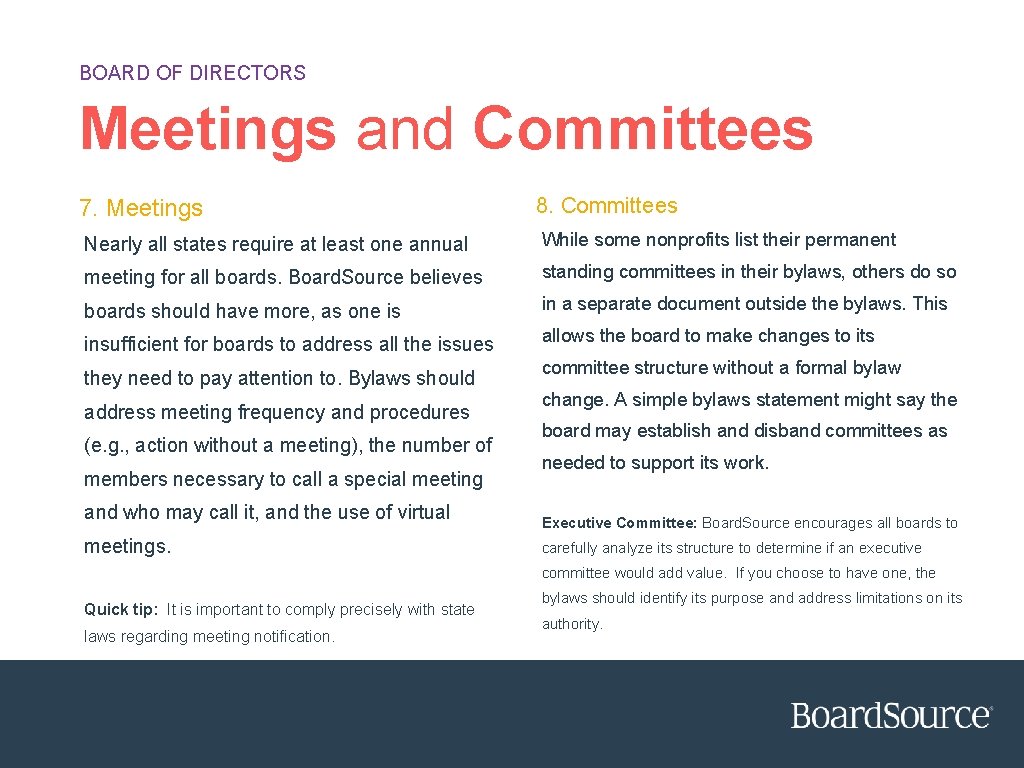
BOARD OF DIRECTORS Meetings and Committees 7. Meetings 8. Committees Nearly all states require at least one annual While some nonprofits list their permanent meeting for all boards. Board. Source believes standing committees in their bylaws, others do so boards should have more, as one is in a separate document outside the bylaws. This insufficient for boards to address all the issues allows the board to make changes to its they need to pay attention to. Bylaws should address meeting frequency and procedures (e. g. , action without a meeting), the number of members necessary to call a special meeting committee structure without a formal bylaw change. A simple bylaws statement might say the board may establish and disband committees as needed to support its work. and who may call it, and the use of virtual Executive Committee: Board. Source encourages all boards to meetings. carefully analyze its structure to determine if an executive committee would add value. If you choose to have one, the Quick tip: It is important to comply precisely with state laws regarding meeting notification. bylaws should identify its purpose and address limitations on its authority.

BOARD OF DIRECTORS Quorum and Voting 9. Quorum 10. Voting by Proxy and Virtually A quorum is the minimum number of people who Can directors vote by proxy? Usually not. Most must be present to hold a valid meeting and take action. Quorum may be set by state law and should be specified in the bylaws. Most laws provide that a quorum is the majority of voting directors in office; one-third is often the lowest state laws stipulate that directors must vote in person or electronically during a virtual meeting. It is important to familiarize yourself with your state laws before allowing electronic voting, however. Your bylaws should address the issue of proxy and electronic voting. allowable number. Something to think about: What happens if some board members Quick Tip – Careful consideration should be given to whether leave during a meeting? Can votes be taken after quorum is lost? The answer is not clear! Consider the following: Handle all voting the board should act without a majority of its member present. matters early in a meeting, consult state law or legal counsel, It can send the wrong message about board meeting prohibit voting once quorum is lost, or allow voting only on routine attendance and result in a small number of directors taking matters. action that binds the entire organization.
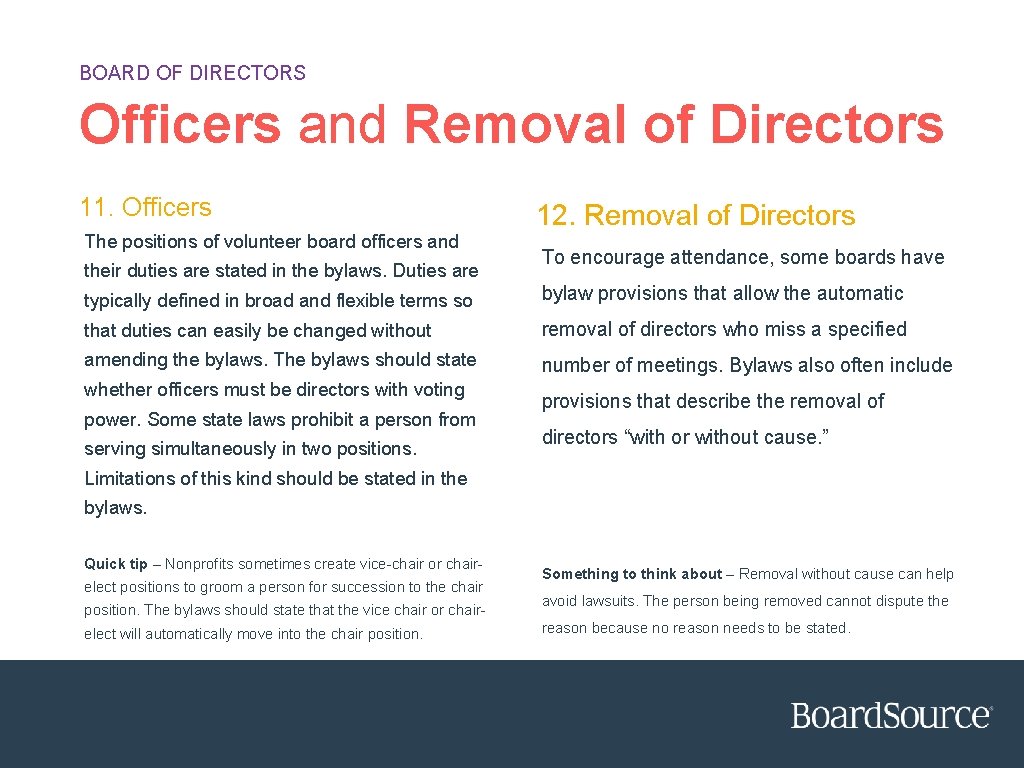
BOARD OF DIRECTORS Officers and Removal of Directors 11. Officers The positions of volunteer board officers and their duties are stated in the bylaws. Duties are 12. Removal of Directors To encourage attendance, some boards have typically defined in broad and flexible terms so bylaw provisions that allow the automatic that duties can easily be changed without removal of directors who miss a specified amending the bylaws. The bylaws should state number of meetings. Bylaws also often include whether officers must be directors with voting power. Some state laws prohibit a person from serving simultaneously in two positions. provisions that describe the removal of directors “with or without cause. ” Limitations of this kind should be stated in the bylaws. Quick tip – Nonprofits sometimes create vice-chair or chairelect positions to groom a person for succession to the chair position. The bylaws should state that the vice chair or chairelect will automatically move into the chair position. Something to think about – Removal without cause can help avoid lawsuits. The person being removed cannot dispute the reason because no reason needs to be stated.
ADDITIONAL SECTIONS OF BYLAWS Other topics addressed in bylaws pertaining to the board: Fiscal matters: audits, insurance, check-signing, bonding, indemnification, standards of conduct/codes of ethics

MORE ON BYLAWS For more on this topic, visit boardsource. org This guide was adapted from Better Bylaws: Creating Effective Rules for Your Nonprofit Board, Second Edition
- Slides: 15